Identity & Access Management (IAM) for Applications with Self-Sovereign Identity (SSI) - Disrupt Meetup Digital Identity Achieving Digital Self ...
←
→
Page content transcription
If your browser does not render page correctly, please read the page content below

Identity & Access Management (IAM)
for Applications with
Self-Sovereign Identity (SSI)

Disrupt Meetup Digital Identity
Achieving Digital Self Sovereignty Through Blockchain
Frankfurt am Main, 26 February 2019
Featured content | Session goals

►    Addressing identity issues with Self-Sovereign Identity (SSI)
►    Insight into international standardization initiatives
►    Introducing relevant terminology
►    Reviewing status quo of technological frameworks
►    Presenting the Identity & Access use case

► Introduce SSI to an IT-related community
► Obtain valuable perspectives for shaping solutions

26.02.2019                      IAM for Applications with SSI        2
Digital identity is one of the hardest problems in our
  networked world

► In a networked world, machines have identities,
  people don’t                                                                    F1
► Every online service we use lures as into creating a
                                                                             G           F2
  new digital identity
► Handling accounts and password is a constant                          A1                    V
  struggle – a hard to win battle
► Services collect data about us – to their own benefit                           YOU.
  & undisclosed purposes
                                                                        F3                    B
► A digital identity of this kind can be revoked or its
  rules can be changed
► YOU ARE NOT IN CONTROL!                                                    A2          T
  YOU SHOULD BE!!!                                                                 n

26.02.2019                              IAM for Applications with SSI                             3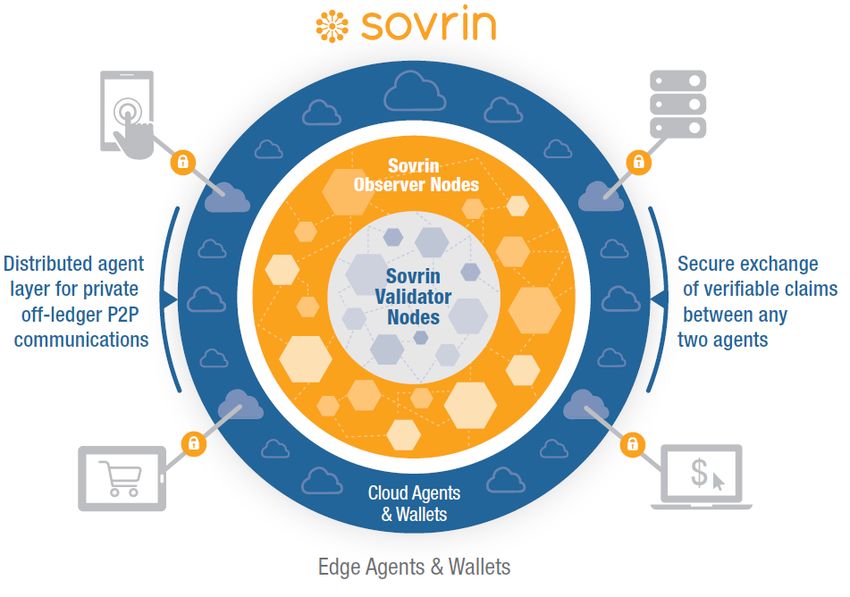
With Self-Sovereign Identity a user regains full
  control over his data

► A Self-Sovereign Identity is 100% owned and
  controlled by an individual                                                      F1
► No one else can read it, use it, turn it off, take it                       G           F2
  away without its owner’s consent
► An SSI is private, highly secure, and moves around                     A1                    V
  with you
► Everything is centered around the user – exactly                                 YOU!
  how it should be
                                                                         F3                    B
► BRING YOUR OWN IDENTITY ultimately becomes
  possible
                                                                              A2          T
                                                                                    n

26.02.2019                               IAM for Applications with SSI                             4
International Blockchain Standardization via
  International Organization for Standardization (ISO)

  ISO/TC 307 Blockchain and distributed                                                 Group              Content
  ledger technologies                                                                   ISO/TC 307/AG 1    SBP Review Advisory Group
  Scope: Standardisation of blockchain                                                  ISO/TC 307/AHG 1   Liaison Review Ad Hoc Group
  technologies and distributed ledger                                                   ISO/TC 307/CAG 1   Convenors coordination group
  technologies.                                                                                            Joint ISO/TC 307 - ISO/IEC JTC 1/SC 27 WG:
                                                                                        ISO/TC 307/JWG 4   Blockchain and distributed ledger
  Started in 2016                                                                                          technologies and IT Security techniques
                                                                                        ISO/TC 307/SG 2    Use cases
  Secretariat Standards Australia
                                                                                                           Interoperability of blockchain and
                                                                                        ISO/TC 307/SG 7
  Two annual onsite meetings                                                                               distributed ledger technology systems
                                                                                        ISO/TC 307/WG 1    Foundations
  41 Participating Members,
                                                                                        ISO/TC 307/WG 2    Security, privacy and identity
  11 Observing Members
                                                                                        ISO/TC 307/WG 3    Smart contracts and their applications
  Diverse liaisons outside of ISO                                                       ISO/TC 307/WG 5    Governance
  EC - European Commission, EEA Inc. - Enterprise Ethereum Alliance Inc.,
  FIG - International Federation of Surveyors, IEEE - Institute of Electrical and
  Electronics Engineers, OECD - Organisation for Economic Co-operation and
  Development, ITU - International Telecommunication Union, SWIFT – Society
                                                                                                                                   https://www.iso.org/committee/6266604.html
  for Worldwide Interbank Financial Telecommunication,
  UNECE - United Nations Economic Commission for Europe

26.02.2019                                                               IAM for Applications with SSI                                                                     5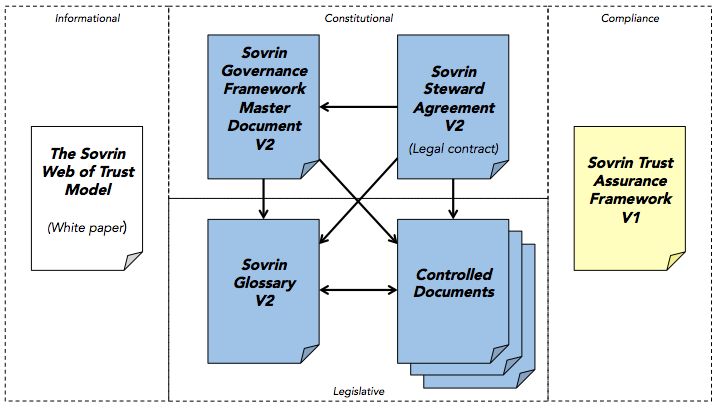
Standard and/or project under the direct
  responsibility of ISO/TC 307 Secretariat

  ISO/CD 22739       Terminology
  ISO/NP TR 23244    Overview of privacy and personally identifiable information (PII) protection
  ISO/DTR 23245      Security risks, threats and vulnerabilities
  ISO/NP TR 23246    Overview of identity management using blockchain and distributed ledger
                     technologies
  ISO/CD 23257       Reference architecture
  ISO/AWI TS 23258   Taxonomy and Ontology
  ISO/AWI TS 23259   Legally binding smart contracts
  ISO/DTR 23455      Overview of and interactions between smart contracts in blockchain and
                     distributed ledger technology systems
  ISO/NP TR 23576    Security management of digital asset custodians
  ISO/NP TR 23578    Discovery issues related to interoperability
  ISO/NP TS 23635    Guidelines for governance
                                                                             https://www.iso.org/committee/6266604/x/catalogue/p/0/u/1/w/0/d/0

26.02.2019                                IAM for Applications with SSI                                                                     6
Decentralized Identity Foundation (DIF)
https://identity.foundation/images/logo-white-small.png
DIF Mission Developing the foundational components of an open, standards-based, decentralized identity ecosystem
for people, organizations, apps, and devices.
DIF Focus DIF is an engineering-driven organization focused on developing the foundational elements necessary to
establish an open ecosystem for decentralized identity and ensure interop between all participants.
Technical Specifications. Groups in DIF develop specifications and emerging standards for protocols,
components, and data formats that implementers can execute against.
Reference Implementations. Beyond specifications, DIF members develop open source reference
implementations of the technical components and protocols they create.
Industry Coordination. As the leading industry organization in the Decentralized Identity space, DIF seeks to
align industry participants to advance their common interests.
DIF Groups Identifiers, Names, and Discovery. Identify and locate people, organizations, and devices without
centralized systems of identifiers.
Storage and Compute. Secure, encrypted, privacy-preserving storage and computation of data.
Claims and Credentials. Ability to verify the claims and assertions of identities is key in establishing trust
among entities on a decentralized system that lacks a centralized hierarchy.
https://identity.foundation
26.02.2019 IAM for Applications with SSI 7DIF Members
https://identity.foundation
26.02.2019 IAM for Applications with SSI 8Coordinated Identity Workshops
Rebooting Web-of-Trust (RWOT) – hosted by Christopher Allen
This facilitated design workshop is focused on the creation of the next generation of decentralized
web-of-trust based identity systems. Objectives are:
Build the next generation of Web-Of-Trust based identity systems.
Showcase the scope of potential applications for decentralized trust models.
Bring together the top contributors in web of trust and similar applications.
Explore developing tools that might be useful to funders and researchers.
https://www.weboftrust.info/images/wot-logo.png
Discuss and suggest requirements to drive adoption in the Web-of-Trust model.
https://www.weboftrust.info
Internet Identity Workshop (IIW) – organized by Phil Windley
The Internet Identity Workshop has been finding, probing and solving identity issues twice every year
since 2005. We meet in the Computer History Museum in Mountain View, CA. Every IIW moves topics,
code and projects downfield. Name an identity topic and it’s likely that more substantial discussion
and work has been done at IIW than any other conference. IIW is at its heart a participatory
https://internetidentityworkshop.com/wp-
content/uploads/2018/10/iiw-dog-logo.png conference, it is an Open Space unConference. It has no keynotes or panels, so it’s about getting
stuff done. IIW brings together the largest concentration on the planet of talent dedicated to
designing and building identity systems that empower individuals.
https://internetidentityworkshop.com
26.02.2019 IAM for Applications with SSI 9World Wide Web Consortium (W3C)
https://www.w3.org/Icons/w3c_home
About W3C The World Wide Web Consortium (W3C) is an international community where Member organizations, a full-
time staff, and the public work together to develop Web standards. Led by Web inventor and Director Tim
Berners-Lee and CEO Jeffrey Jaffe, W3C's mission is to lead the Web to its full potential.
W3C Mission The W3C mission is to lead the World Wide Web to its full potential by developing protocols and guidelines
that ensure the long-term growth of the Web. W3C's standards define key parts of what makes the World
Wide Web work.
W3C Groups A variety of W3C groups enable W3C to pursue its mission through the creation of Web standards,
guidelines, and supporting materials. Community and Business Groups offer more ways for innovators to
bring work to W3C.
Credentials The mission of the W3C Credentials Community Group is to explore the creation, storage, presentation,
Community verification, and user control of credentials. We focus on a verifiable credential (a set of claims) created by
Group an issuer about a subject — a person, group, or thing — and seek solutions inclusive of approaches such as:
self-sovereign identity; presentation of proofs by the bearer; data minimization; and centralized, federated,
and decentralized registry and identity systems. Our tasks include drafting and incubating Internet
specifications for further standardization and prototyping and testing reference implementations.
https://open-stand.org/wp-content/uploads/2014/08/blog-080214-new-header.png https://www.w3.org/Consortium | https://www.w3.org/community/credentials
26.02.2019 IAM for Applications with SSI 10W3C Credentials Community Group –
Identity-relevant Standardization Contributions
► Decentralized Decentralized Identifiers (DIDs) are a new type of identifier for verifiable, "self-sovereign" digital identity. DIDs are
Identifiers (DIDs) fully under the control of the DID subject, independent from any centralized registry, identity provider, or certificate
v0.11 authority. DIDs are URLs that relate a DID subject to means for trustable interactions with that subject. DIDs resolve
to DID Documents — simple documents that describe how to use that specific DID. Each DID Document contains
Draft Community Group at least three things: cryptographic material, authentication suites, and service endpoints. Cryptographic material
Report, 23 August 2018 combined with authentication suites provide a set of mechanisms to authenticate as the DID subject (e.g. public
keys, pseudonymous biometric protocols, etc.). Service endpoints enable trusted interactions with the DID subject.
► Verifiable Claims A verifiable claim is a qualification, achievement, quality, or piece of information about an entity's background
Use Cases 1.0 such as a name, government ID, payment provider, home address, or university degree. Such a claim describes a
quality or qualities, property or properties of an entity which establish its existence and uniqueness. The use cases
Final Community Group outlined here are provided in order to make progress toward possible future standardization and interoperability of
Report, 01 May 2017
both low and high-stakes claims with the goals of storing, transmitting, and receiving digitally verifiable proof of
attributes such as qualifications and achievements. The use cases in this document focus on concrete scenarios
that the technology defined by the group should address.
► Verifiable Claims A self-sovereign architecture for verifiable claims is one where the holder of a verifiable claim is in complete control
Data Model and of their identifier, where their verifiable claims are stored, and how they are used. There is currently no widely used
Representations self-sovereign, privacy-enhancing standard for expressing and transacting verifiable claims (aka: credentials,
1.0 attestations) via the Web. This specification describes a data model for a digital identity profile and a collection of
digital entity credentials that assert verifiable claims about that identity profile. It also describes how to express that
Final Community Group data model in JSON, JSON-LD, and WebIDL.
Report, 01 May 2017
https://w3c-ccg.github.io/did-spec | https://www.w3.org/2017/05/vc-use-cases/CGFR/2017-05-01 | https://www.w3.org/2017/05/vc-data-model/CGFR/2017-05-01
26.02.2019 IAM for Applications with SSI 11Blockchain, DIDs und Claim Signing
Source: Sovrin™: A Protocol and Token for Self-Sovereign Identity and Decentralized Trust - A White Paper from the Sovrin Foundation - Version 1.0 - January 2018
26.02.2019 IAM for Applications with SSI 12Verifiable Claims
Source: Sovrin™: A Protocol and Token for Self-Sovereign Identity and Decentralized Trust - A White Paper from the Sovrin Foundation - Version 1.0 - January 2018
26.02.2019 IAM for Applications with SSI 13Zero Knowledge Proof
Source: Sovrin™: A Protocol and Token for Self-Sovereign Identity and Decentralized Trust - A White Paper from the Sovrin Foundation - Version 1.0 - January 2018
26.02.2019 IAM for Applications with SSI 14Hyperledger
https://www.hyperledger.org/wp-content/uploads/2016/09/logo_hl_new.png
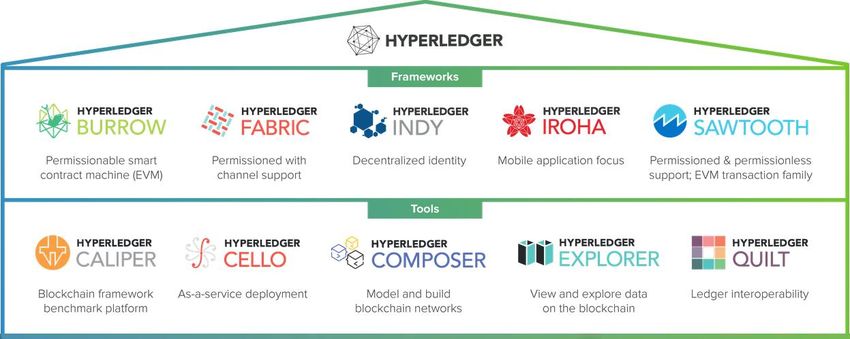
Hyperledger Hyperledger is an open source collaborative effort created to advance cross-industry blockchain
Mission technologies. It is a global collaboration, hosted by The Linux Foundation, including leaders in finance,
banking, Internet of Things, supply chains, manufacturing and Technology.
Indy Hyperledger Indy is a distributed ledger, purpose-built for decentralized identity. It provides tools, libraries,
and reusable components for creating and using independent digital identities rooted on blockchains or
other distributed ledgers for interoperability.
Frameworks &
Tools –
„Greenhouse“
https://www.linuxfoundation.org/wp-
content/uploads/2017/06/LF_logo_NEW_H_W.png https://www.hyperledger.org
26.02.2019 IAM for Applications with SSI 15Example: A model for Self-Sovereign Identity &
decentralized trust
Global DLT-based identity network
Uses Decentralized Identifiers (DIDs)
Fast and low-energy consensus (RBFT: Redundant
Byzantine Fault Tolerance)
Governed by not-for-profit foundation
Diverse “stewards” commit to trust framework &
operate validator nodes
Cross-operational with others
Open-source software basis
Part of Hyperledger Indy
Source: Sovrin™: A Protocol and Token for Self-Sovereign Identity and Decentralized Trust - A White Paper from the Sovrin Foundation - Version 1.0 - January 2018
26.02.2019 IAM for Applications with SSI 16Overview Sovrin Governance Frameworks V2
https://sovrin.org/wp-content/uploads/2018/11/sovrin-governance-framework-diagram-v2.png
26.02.2019 IAM for Applications with SSI 17IAM Players in a SSI Ecosystem
DID DID DID
CEO CIO CHRO Board CISO ISO1 ISOn CISO HRHead PRef1 PRefn Personal
Function Function Function
DID DID DID DID DID DID DID DID DID
DID DID DID
App1
Ops1 Ops2 Opsn B1Head B1AL1 B1ALn Business1 B2Head B2AL1 B2ALn Business2
Operations
AppOwner Function Function
DID DID DID Function DID DID DID DID DID DID
DID
DataOwner A1MA1 A1MA2 A1MA3 A1MAn A1MA1 A1MA2 A1MA3 A2MAn
DID DID DID DID DID DID DID DID DID
26.02.2019 IAM for Applications with SSI 18IAM with SSI: Setup and Architecture 26.02.2019 IAM for Applications with SSI 19
IAM meets Self-Sovereign Identity

26.02.2019                   IAM for Applications with SSI   20
IAM meets Self-Sovereign Identity cont‘d

26.02.2019                   IAM for Applications with SSI   21
Questions and Discussion

26.02.2019             IAM for Applications with SSI   22
Thank you for your
Contribution!

26.02.2019           IAM for Applications with SSI   23
Your esatus Blockchain Contact

                  CIO esatus AG und Leiter Blockchain AG TeleTrusT

                  Dr. André Kudra
                  Telefon: +49 6103 90295-0
                  Mail: a.kudra@esatus.com

26.02.2019              IAM for Applications with SSI                24
Copyright
Copyright © 2019 esatus AG. Alle Rechte vorbehalten
Alle Inhalte, Fotos und Grafiken sind urheberrechtlich geschützt. Sämtliche
Teile dieses Dokuments dürfen nicht ohne vorherige schriftliche Genehmigung
durch die esatus AG weder ganz noch auszugsweise kopiert, vervielfältigt,
verändert oder übertragen werden.
Herausgeber: esatus AG
Copyright Fotos: Tomasz Zajda/Fotolia; bismillah_bd/Fotolia; tostphoto/Fotolia; envfx/Fotolia; Gunnar Asmy/Adobe Stock; Alexander Limbach/Adobe Stock;
SG-design/Adobe Stock; Perfect Vectors/Adobe Stock; Vikivector/Adobe Stock; raven/Adobe Stock; Graphic in Motion/Adobe Stock;
vectorfusionart/Adobe Stock; Елизавета Акимова/Adobe Stock; Tierney/Adobe Stock; DaiPhoto/Adobe Stock; Feng Yu/Adobe Stock;
HQUALITY/Adobe Stock; jonnysek/Adobe Stock; metamorworks/Adobe Stock; area51uk/Adobe Stock
26.02.2019 IAM for Applications with SSI 25You can also read


