Impact in Horizon 2020 Group work - SESSION 5 Name: Martin Felix Gajdusek & George Bonas Function: Service Facility in support of International ...
←
→
Page content transcription
If your browser does not render page correctly, please read the page content below
Impact in Horizon 2020
                                                Group work
                                                SESSION 5

Name: Martin Felix Gajdusek & George Bonas
Function: Service Facility in support of International
Cooperation in Research and Innovation
(communication@ServiceFacility.eu)
2
Session overview: Impact

1. General information on impact

2. Impact in Horizon 2020

3. Group work: Define the impact of your proposal

                                          3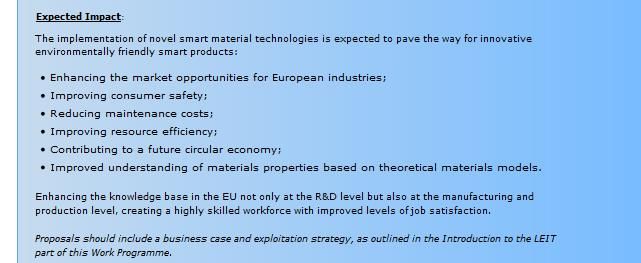
1. Impact: General information

                      4
From Activities to Impacts

                                              which -
                                              through
   Activities     produce      Outputs                     Outcomes
                                                use -
                                               create

OUTCOME =what happens, if our target group uses our outputs!
   • they become more knowledgeable (enlightenment!) or
   • produce better products or
   • reduce the ecological footprint

IMPACT = what happens by use or non-use of others than our primary target
group (i.e. a ‘secondary’ or even ‘not-intended audience’)

                                                     5
                                                     5                      5
                                                                            5
Impacts & Exploitation

Project partners          Internal                            External

                                       Exploitation
                                      Further research
                                          Product                        End users
                                          Process
                                          Service
Competitive                           Standardisation
results
                          IP                                             Short-term   Sustained
  Project results                                        Successful      outcomes      impact
                      protection     Commercialization
                                                         communicatio
                                                         n
                    Dissemination                                          Target     Stakeholder
                                                                         audiences    needs
                                                                           Inform
                                                                                      Stakeholders
                                                                          Educate
                                                                                      Researchers
                                                                          Network
                    Communication                                                     Industry & SMEs
                                                                          Support
                                                                                      Professionals
                                                                                      Policy makers
                                                                                      Public & media

                                                                          6
                                                                          6                       6
                                                                                                  6
Types of effects / impacts

Results-oriented      impacts:       usually            quantitative
measurable     results     (e.g.   creation        of    jobs,   new
publications, patents, reduction etc.)

Behavioural     impacts:      changes         in        the   (social,
economic, …) behaviour (e.g. changes concerning
innovative    behaviour,     change      of         environmental
behaviour, change of images & awareness etc.)

                                              7
                                              7                      7
                                                                     7
Various categories of impacts
Scientific/Academic/Research: This avenue generally focuses on the
possible publications, conferences, or any other opportunities that can
arise as a result of this project to promote the research field.
Socio-economic: Here, researchers often touch on the new
possibilities for job creation, important policy outputs, and overall social
benefits of their project.
Environmental: Such applications mostly refer to policy papers or
guidance documents produced as a result of the research project.
Public engagement: In this selected avenue, researchers describe
varying ways to publicly engage through communication strategies,
education, media or social media outlets, and user groups.
8
8 8
8Eleven dimensions of the impacts
Source: Godin and Doré, 2006
9
9 9
9Impact orientation in all stages
Expected Impact Expected
Impact orientation in Impact oriented Impact plans
impact oriented impact as key
programmes and calls project beyond project
required in project criteria in
implementation end
proposals planning evaluation
Impact monitoring and reporting
• Most programmes have an impact-oriented approach
• Horizon 2020 balances research and innovation and aims to drive
competitiveness/growth and to tackle global societal challenges
• Many programmes encourage collaboration between different stakeholders
(researchers, industry including SMEs, public sector organisations and citizens)
• Expected impacts are crucial for successful proposals and projects
• Aspects of the project (activities, partnership, open access of results, etc.)
intend to maximise potential impacts
10
10 10
102. Impact in Horizon 2020:
a brief overview
11The 5 targets for the EU in 2020
Example of framework conditions for impact
1. Employment
75% of the 20-64 year-olds to be employed
2. R&D
3% of the EU's GDP to be invested in R&D
3. Climate change and energy sustainability
greenhouse gas emissions 20% (or even 30%, if the conditions are right) lower than 1990
20% of energy from renewables
20% increase in energy efficiency
4. Education
Reducing the rates of early school leaving below 10%
at least 40% of 30-34–year-olds completing third level education
5. Fighting poverty and social exclusion
at least 20 million fewer people in or at risk of poverty and social exclusion
12
12 12
12Impact in Horizon 2020: a brief overview
What is meant by impact in terms of research/ innovation
projects?
• Impact: The changes or benefits to the economy, society, culture,
public policy or services, health, the environment or quality of life,
derived from the innovation
• Impact is assessed alongside research outputs to provide an
evaluation of research taking place within a firm or an institution
• As such, research outputs, for example, knowledge generated and
publications, can be translated into outcomes, for example, new
products, services and standards, which generate impacts
Inputs Activities Outputs Outcomes Impacts
Objectives of the project
13Global expected impact in different pillars of
Horizon 2020
Excellent
Science
Delivering solutions
adressing key societal and
technical challenges
Economic impact
Industrial
Societal impact
Leadership
Academic impact Innovations Theory Quality of life
Competitiveness Method
Growth
Health
Knowledge Environment
Jobs Technology-
Budget savings Public services
development Policy
Societal
Reseacher training Creative activity
Challenges Application Public engagement
Understanding
Education
14Horizon 2020 Structure
INDUSTRIAL SOCIETAL CHALLENGES
EXCELLENT SCEINCE
LEADERSHIP
• Health, wellbeing and aging
• European Research Council
• ICT • Food security, bioeconomy,
• Future and Emerging …
• Key EnablingTechnologies
Technologies (FET) (KETs): • Safe, clean, efficient energy
• Marie Skłodowska-Curie - Microelectronics • Intelligent, green, integrated
research grant scheme - Photonics transportation
• Research Infrastructures - Nanotechnologies • Climate, environment, raw
- Advanced materials materials
- Production systems • Inclusive, innovative
- Biotechnologies society, capable of
• Space reflection
• Innovation in Small and Medium • Security
Enterprises (SMEs) E
• Access to Risk Finance U
R
A
T
Spreading of best practices and widening participation
O
M
Science with and for Society
European Institute of Innovation and Technology (EIT)
Joint Research Centre (JRC)
15Impact dimensions for the Horizon 2020
programme
Scientific impact Economic impact Societal impact
• EU world class • Better innovation • Better contribution of
excellence in capability of EU R&I to tackle
science (theory, firms, increased societal challenges
methods, competitiveness (health, quality of
knowledge, • EU technological life, sustainability,
application of leadership and etc.)
science results) reinforced • Stronger global role
• Better cross-border competitiveness of the EU
and cross-sector • Diffusion of • Better societal
coordination and innovation acceptance of
integration generating jobs, innovative solutions,
• Emergence of new growth and public engagement,
fields of science in investments understanding,
the EU creativity
16
16 16
16Key performance indicators for impact in
Horizon 2020 pillars
Scientific Excellence Industrial Leadership Societal Challenges
• Percentage of publications • Patent applications and • Publications in peer-
from ERC funded projects patents awarded in the reviewed high impact
which are among the top different enabling and journals in this area
1% highly cited industrial technologies • Patent applications and
• Publications in peer- • Percentage of participating patents awarded in this
reviewed high impact firms introducing area
Journals innovations • Number of prototypes and
• Patent applications and • Number of joint public testing activities
patents awarded in Future private publications • Number of joint public-
and Emerging Technologies • Total investments mobilised private publications
• Cross-sector and cross- (from different funds) • New products, processes,
country circulation of • Number of organisations and methods launched into
researchers, including PhD funded and amount of the market
Candidates private funds leveraged • Percentage of the
• Number of researchers who • Percentage of participating respective Societal
have access to research SMEs introducing Challenge funds allocated
infrastructures through innovations to related research activities
support from Horizon 2020 • Growth and job creation in
participating SMEs
17
17 17
17An impact-oriented approach at all
stages of Horizon 2020
• Built-in innovation and
impact orientation:
Impact-oriented calls Expected
• challenge-based
for proposals impact to
approach
be spelled
out in the • funding all the way from
proposals lab to market
• enhanced involvement of
business, in particular
Regular Small and Medium-sized
Impact
reporting and Enterprises (SMEs)
examined during
monitoring
proposal
evaluation
21Varying expected impact depending on the
Technology Readiness Level (TRL) in Horizon 2020
TRL 1: basic principles observed Future & Emerging
Technologies
TRL 2: technology concept formulated
TRL 3: experimental proof of concept
TRL 4: technology validated in lab Societal Challenges
TRL 5: technology validated in relevant environment
Leadership in enabling
TRL 6: technology demonstrated in relevant environment and industrial
technologies
TRL 7: system prototype demonstration in operational environment
TRL 8: system complete and qualified
TRL 9: actual system proven in operational environment
TRL in Horizon 2020 is used to assess the
maturity level of a particular technology
22What evaluators of Horizon 2020 proposals
are looking for
The evaluators pay particular attention to:
• Expected impacts described for the topic of the project
• Key performance indicators (KPIs) including target values
• Enhancing innovation capacity and integration of new knowledge
• Strengthening competitiveness and growth of industrial partners
by developing and delivering innovations meeting market needs
• Other environmental or social impacts…
They evaluate effectiveness of the proposed measures to
exploit and disseminate the project results (including
management of IPR), to communicate the project...
23How to maximise impact in the Horizon 2020
proposals and projects (I)
Some guidelines for impact maximisation
Link the proposal to the policy context of the call for proposals
Involve potential end-users and stakeholders in the proposal
Identify how the consortium expects the results of the project to
be applied
Understand the barriers to any application of the project results
• Intellectual Property rights issues
• Skills shortage
• Mismatch between market needs and the solution
24How to maximise impact in the Horizon 2020
proposals and projects (II)
Some guidelines for impact maximisation
Anticipate the potential need to take further steps to apply the
project results in practice
• Standards to be agreed
• Financing the testing
• Promoting acceptance by consumers
Implement open access and consider how to manage the data
Prepare the exploitation and dissemination plan carefully
253. Group work: Impact part
26Part B:
3 Proposal Key Aspects = 3 Evaluation Criteria
Why do I want to conduct this
Excellence project? What are my objectives?
What is the basis?
Impact What will be the benefits during
this project and beyond?
Implementation How will I conduct this project?
27Identify the parts of the proposal –
show excellence in all areas
1. Excellence => Objectives that contribute to
1.1 Objectives broader impact dimension
1.2 Relation to the work programme
1.3 Concept and methodology
1.4 Ambition
=> Draft plans to reach expected
2. Impact impacts, knowledge management plan,
2.1 Expected impacts business plan, management of
2.2 Measures to maximise impact
research data, etc.
a) Dissemination and exploitation of results
b) Communication activities => WP Dissemination &
3. Implementation Exploitation & Communication
=> Role of impact/innovation
3.1. Workplan – Workpackages, Deliverables
manager with adequate resources
3.2 Management structure, milestones and procedures => Exploitation partner,
3.3 Consortium as a whole Communication partner
3.4 Resources to be committed 28
28 28
28B2: Impact
2.1 Expected impacts => impact indication can be found in Work programme and specific
Call;
=> Enhancing innovation capacity and integration of new knowledge
=> Strengthening the competitiveness and growth of companies by developing innovations
meeting the needs of European and global markets
29
29 29
29Part B: Impact
The extent of benefits for…
• Science
• Environment
• Society
• Technological progress
• Economy/competitiveness
• …
Focus on Europe
Focus depends on type of action/Call
30Part B: Impact
2.1 Expected impacts - I
• Be specific! If possible, use quantitative statements
• In relation to the expected impact from the topic description– how
can you contribute?
• You can use a table
• Explain the impact of the results of the objectives of the project,
which goes beyond the topic description
• Go for scientific advances, innovation potential,
competitiveness of Europe
• Discussion of potential barriers/obstacles, which might influence
reaching the objectives. How would you deal with that?
• Be convincing for evaluators
32Part B: Impact
2.1 Expected impacts - II
• Who benefits from the results? Impact on the several
stakeholders
• Think one step ahead: which further opportunities go beyond the
direct impact?
• For future research?
• For market/competitiveness?
• Concerning EU context: Which EU policies, strategies and
objectives do you support?
• Laws, market habits etc.
• Output should be concrete and realistic
33Steps for the group work
• List objectives of the call
• Fill in specific expected impact from call text
• Add additional impacts of your proposal
• Identify type of impact
• Identify relevant indicators
• Stakeholders that are directly addressed
• Stakeholders that influence the impact
• Check contribution to Objectives of the call and add number
of List of the objectives
34Objectives of call
1.
2.
3.
35Specific expected Type of Impact Indicator Stakeholders Objectives
impact (from call (Numbers)
text)
36Follow up: Description
Describe how your project will contribute to…
• Each of the expected impacts mentioned in the work
programme, under the relevant topic;
• any substantial impacts not mentioned in the work
programme, that would enhance innovation capacity; create
new market opportunities, strengthen competitiveness and
growth of companies, address issues related to climate
change or the environment, or bring other important
benefits for society
• Describe any barriers/obstacles, and any framework
conditions (such as regulation, standards, public acceptance,
workforce considerations, financing of follow-up steps,
cooperation of other links in the value chain), that may
determine whether and to what extent the expected impacts
will be achieved.
37Join Now!
#InvestEUresearch
www.ec.europa.eu/research
Participant Portal
http://ec.europa.eu/research/participants/portal/
© European Union, 2019
The information and views set out in this presentation are those of the author(s) and do
not necessarily reflect the official opinion of the European Union. Neither the European
Union institutions and bodies nor any person acting on their behalf may be held
responsible for the use which may be made of the information contained therein.
Reproduction is authorised provided the source is acknowledged. 38You can also read


