IMPAIRED DRIVING SUMMIT SUMMARY - HELD FEBRUARY 13, 2013 HOSTED BY TRANSPORTATION AND INFRASTRUCTURE RENEWAL (TIR) RODD CHARLOTTETOWN KENT STREET ...
←
→
Page content transcription
If your browser does not render page correctly, please read the page content below
Impaired Driving Summit
        Summary

              Held February 13, 2013

                    Hosted by
  Transportation and Infrastructure Renewal (TIR)
               Rodd Charlottetown
          Kent Street, Charlottetown PEI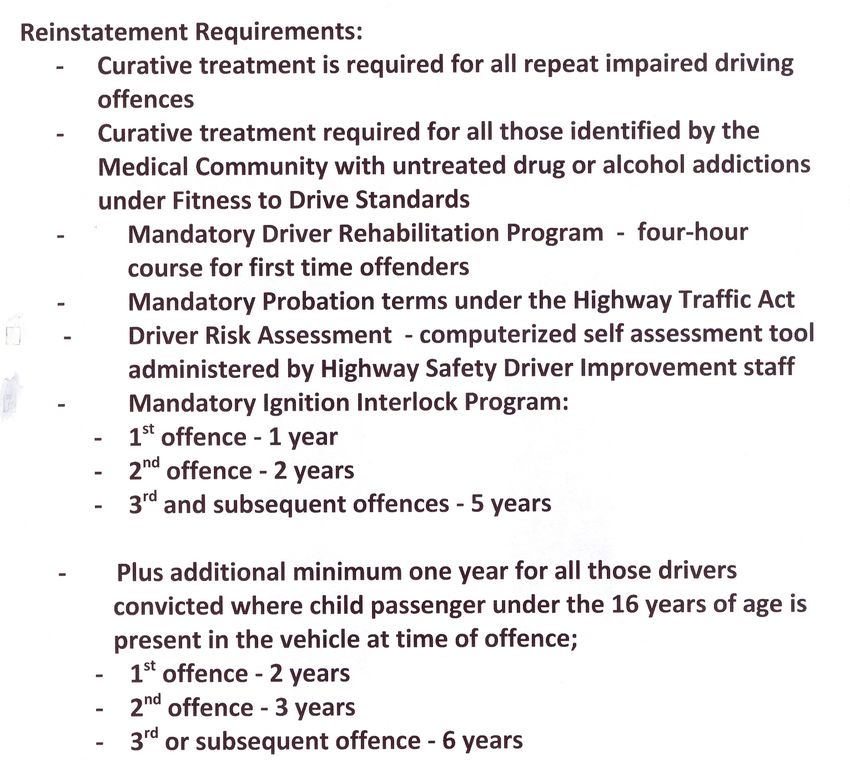
Message from the Minister

Over the years, a growing focus has been given to the serious issue of impaired
driving. Thanks to the work of governments, the justice system, community
groups, families and individuals, the instances of impaired driving have
decreased and the message is being spread that impaired driving isn’t
acceptable.

However, despite these efforts, the message still hasn’t fully sunk in. The fact remains: Prince Edward
Island’s rates of impaired driving are some of the highest in the country.

This is a needless distinction. Prince Edward Island is a rural province and that can provide unique
challenges when it comes to transportation. But there are absolutely no excuses for driving after
drinking or taking other drugs.

It is a senseless crime, sometimes with tragic results.

However working with our partners, such as MADD, the justice system, addictions services, and law
enforcement, I am optimistic we can shed this unfavourable distinction.

This sense of confidence was buoyed during the one-day summit I hosted in February as Minister of
Transportation and Infrastructure Renewal.

The day included representatives of the RCMP, municipal police forces, MADD Canada and local MADD
chapters, Addiction Services, the Department of Environment, Labour and Justice, and the Department
of Transportation and Infrastructure Renewal.

As this report shows, all participants worked together to suggest a wide range of tangible, effective
solutions that can be implemented by the Department of Transportation and Infrastructure Renewal.

I want to thank everyone who participated in the summit for their commitment to tackling this senseless
crime. And I want to assure all Islanders that as a government we’re serious about highway safety and
reducing the number of impaired driers on our roads by introducing tougher penalties.

I look forward to seeing these recommendations and other initiatives undertaken by the department
result in safer roads for Islanders.

Robert Vessey

Minister, Transportation and Infrastructure Renewal
Impaired Driving Summit – February 13, 2013
 Hosted by the Department of Transportation and Infrastructure Renewal (TIR)
                            Rodd Charlottetown
                       Kent Street, Charlottetown PEI

                                   Summit Summary

The Department of Transportation and Infrastructure Renewal (TIR) hosted an Impaired Driving
Summit on February 13th, 2013 which brought together local leaders and decision-makers for
dialogue and discussion on how to help combat impaired driving on Prince Edward Island roads.
The overall purpose of the Summit was to focus on tangible, effective solutions that can be
implemented by the Department of Transportation and Infrastructure Renewal to reduce the
instances of impaired driving. The Summit followed recent changes made to the Highway
Traffic Act including mandatory participation in the ignition inter-lock program for all convicted
impaired drivers and strengthened vehicle impoundment penalties.

Summit Objectives:
   •   To engage leaders and experts on the issue of impaired driving in a facilitated dialogue
       to exchange ideas about legislative and non-legislative strategies that can be
       implemented to enhance existing reduction strategies presently in place;
   •   To identify effective mechanisms that modify behaviours contributing to impaired
       driving;
   •   To achieve consensus on areas that can be developed into action items for further
       follow-up.

Introductions and Welcome
Facilitator Patsy MacLean of HRA greeted Summit participants as they arrived and encouraged
participants to sit at designated tables to ensure that there was a strong cross-representation
of people at each round table. Participants represented members of the following provincial
government departments and agencies, law enforcement agencies, and national/local
organizations:

   •   Minister of Transportation and Infrastructure Renewal
   •   Deputy Minister of Transportation and Infrastructure Renewal
   •   Minister of Environment, Labour and Justice and Attorney General

_____________________________________________________________________________________
                                                 Impaired Driving Summit Summary Page | 1
Impaired Driving Summit – February 13, 2013

   •   Deputy Minister of Environment, Labour and Justice and Attorney General
   •   CEO of MADD Canada
   •   Representatives from the Department of Transportation and Infrastructure Renewal
   •   Representatives from the Department of Environment, Labour and Justice
   •   Representative from Health PEI, Mental Health and Addiction Services
   •   Representatives of Law Enforcement (RCMP, Municipal Police)
   •   Director of Prosecutions, Crown Attorney’s Office
   •   Representatives from Ad Hoc Committee on Impaired Driving
   •   Representatives from MADD (Atlantic Region and Provincial representatives)
   •   Chief Coroner of PEI

The Impaired Driving Summit began with welcome and opening remarks delivered by Minister
of Transportation and Infrastructure Renewal, the Honourable Robert Vessey. Remarks were
also given by Minister of Environment, Labour and Justice and Attorney General, the
Honourable Janice Sherry.

Information Sharing
The Summit began with an information sharing session which provided an overview of the
status of national and provincial impaired driving initiatives. A presentation was given by Mr.
Andrew Murie, CEO of MADD Canada, entitled “Addressing the Impaired Driving Problem on
Prince Edward Island”. The powerpoint presentation is attached as Appendix “A”. Mr. Murie
presented on the national and provincial perspectives of impaired driving. He also outlined the
best practices in provincial impaired driving legislation. Mr. Murie noted that PEI has made
significant legislative progress since 2006; including

   •   Improvements to graduated licensing program;
   •   7-day short-term administrative license suspension program;
   •   Mandatory interlocks for first-time offenders; and
   •   Stronger sanctions against offenders with child passengers.

Director of Highway Safety, John MacDonald, provided an overview of Department of TIR
strategies and initiatives to address impaired driving in PEI. Highlights of his presentation are
attached as Appendix “B”. Mr. MacDonald identified the following impaired driving initiatives in
place in PEI:

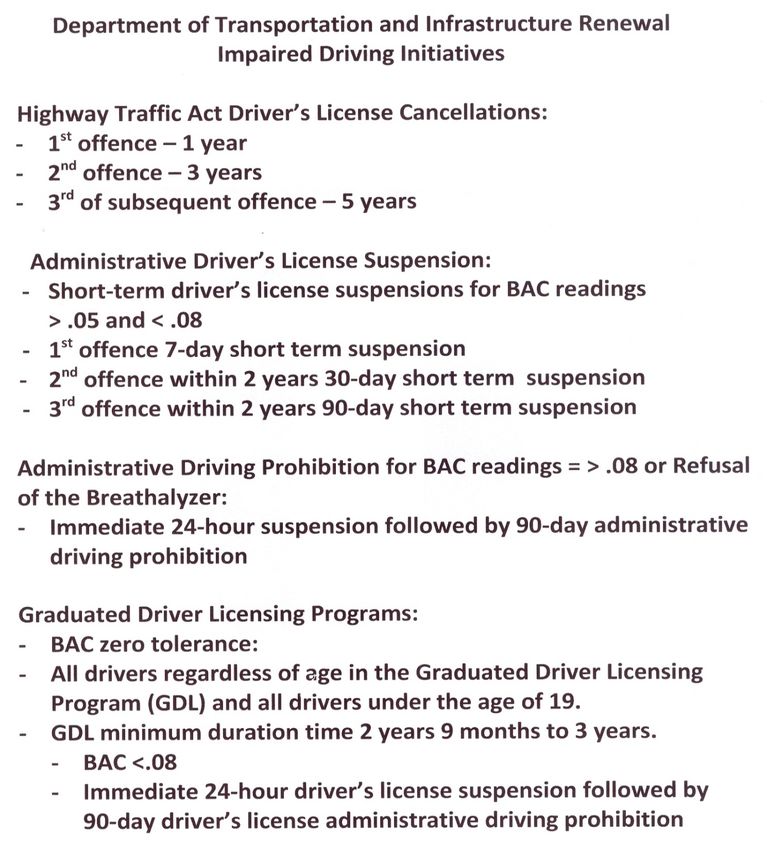
   •   Highway Traffic Act Driver’s License cancellations
   •   Administrative Driver’s License suspension
          o Short-term driver’s license suspension for BAC greater than .05 and less than .08
          o Administrative Driving Prohibition for BAC reading equal to or greater than .08 or
             refusal of breathalyser
          o Graduated Driver Licensing Programs

_____________________________________________________________________________________
Page | 2 Impaired Driving Summit Summary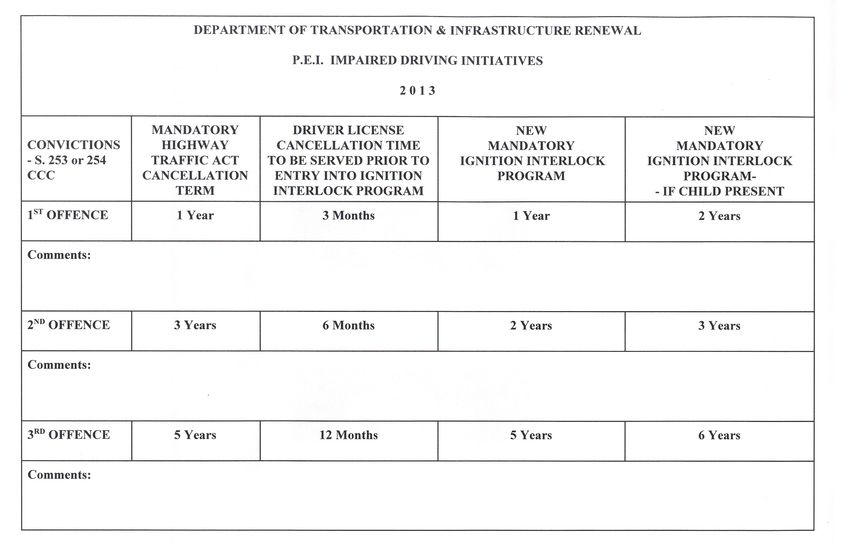
Impaired Driving Summit – February 13, 2013

   •   Re-instatement Requirements
           o Curative Treatment
           o Fitness to Drive Standards
           o Mandatory Ignition Interlock
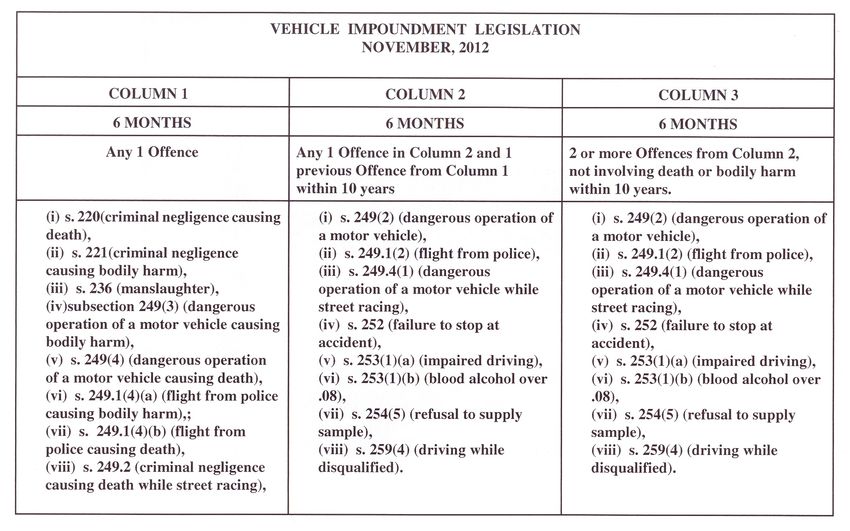
   •   Motor Vehicle Impoundment
           o Driving while suspended or prohibited
           o Six month impoundment
   •   Public Awareness

Mr. MacDonald also shared statistics from 1989 to 2012 which indicated that the total impaired
driving convictions in PEI have reduced from 628 instances in 1989 to 327 instances in 2012.

Morning Session - Alcohol Impaired Driving
Small group facilitated discussion
The morning session focused on the topic of Alcohol Impaired Driving. Participants engaged in a
facilitated discussion in small groups using guiding questions. The following provides an
overview of the discussion.

Currently, there are effective measures in place addressing alcohol related impaired driving in
PEI. Could these measures be further enhanced?

Participants reflected on the perspective that drinking and driving is seen by many in PEI as a
social norm or as part of the culture and this attitude needs to change. Participants agreed that
existing measures addressing alcohol related impaired driving could be enhanced.

   •   Suspension of License
          o Access to data is important as impoundment of vehicle is related to the
             knowledge of the suspension of person’s license
   •   Enhanced use of 911 call by the general public
          o More public education is needed regarding this use of 911
          o 911 signage could be improved to ensure it stands out for the travelling public
             (special or distinctive design/flashing electronic warning signs)
          o Caller identification can inhibit people from calling ( not an anonymous call)
          o Use Crime Stoppers as a mechanism for anonymous reporting
   •   Enhanced use of data
          o Mine existing data to target potential impaired drivers; eg. mapping of offences

_____________________________________________________________________________________
                                                 Impaired Driving Summit Summary Page | 3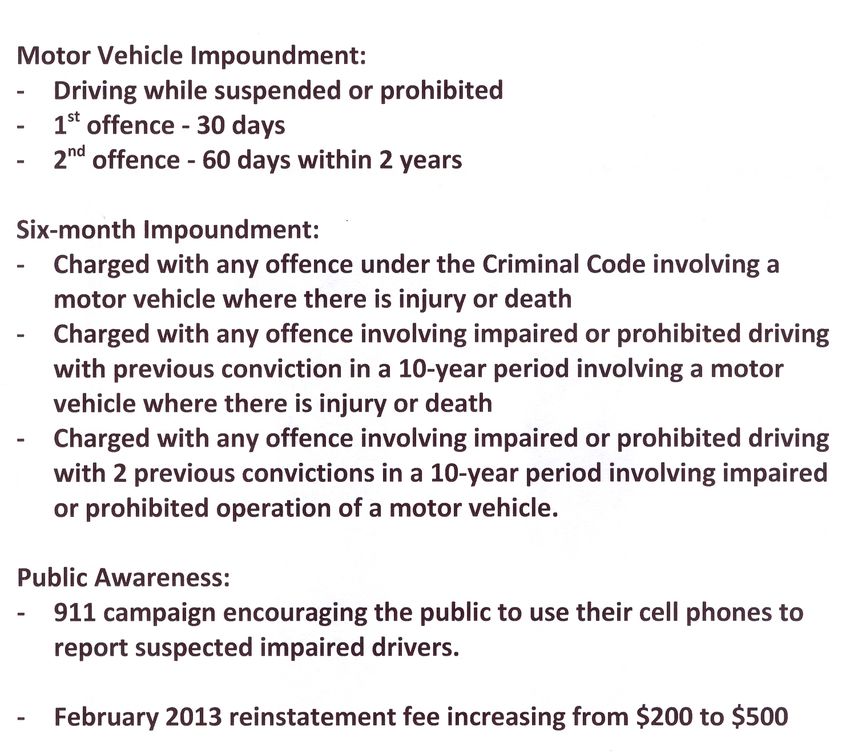
Impaired Driving Summit – February 13, 2013

           o Analyze and utilize 911 data more fully
           o Important for law enforcement to be able to access data to identify repeat
               offenders
   •   Ignition Interlock
           o Increase suspension of license to 6 months
   •   Re-examine vehicle impoundment laws
           o Apply vehicle impoundment sanctions to graduated licensing program
           o Apply vehicle impoundment sanctions to administrative license suspension
               programs
   •   Increase public awareness and education campaigns regarding recent changes to
       Highway Traffic Act relating to impaired driving

What other measures could be introduced in PEI?

   •   Coloured/designated plate to identify second time offenders could be seen as shaming
       of the individual and the individual’s family
           o Law enforcement officers still require grounds to pull someone over to roadside
   •   Coloured/designated plate to identify second time offenders has been used in some
       states (what does the evidence say with respect to effectiveness?)
           o Rather than a designated plate, consider applying an identifier on the driver’s
               license
   •   Separation of graduated driver license age from legal drinking age
   •   Enhanced public education and aggressive social marketing for target populations; eg.
       youth
   •   Use evidence-based data to evaluate implementation of new measures ( expansion of
       ignition inter-lock program, vehicle impoundment, designated license plate if
       implemented)
   •   Dual license plates ( on front and back of vehicle) would enable identification
   •   Use technology and its applications to assist people in accessing alternate
       transportation
   •   Encourage establishments that serve alcohol to visibly promote and provide incentives
       for designated driving programs
   •   Tobacco use has been effectively addressed by attributing a social stigma to the
       behaviour; can similar approaches be used for drinking and driving?
   •   Increase communication amongst partners involved in addressing and limiting impaired
       driving in PEI; hold Impaired Driving Summit annually.
   •   Police traditionally charge a person with a BAC of 1.00. Consider lowering this to BAC of
       .90
   •   Consider increased sanctions based on increasing BAC

_____________________________________________________________________________________
Page | 4 Impaired Driving Summit Summary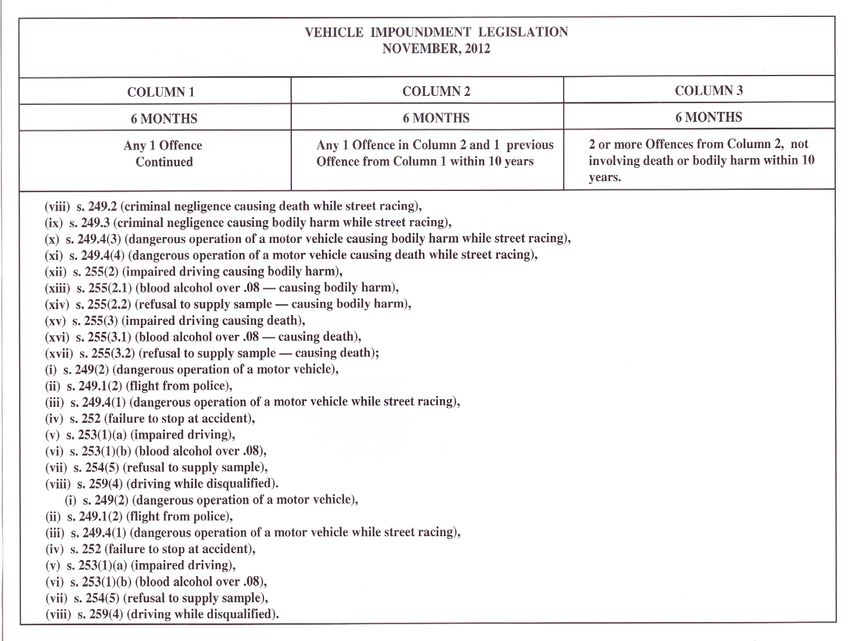
Impaired Driving Summit – February 13, 2013

   •   Further explore administrative license suspension, rehabilitation programs targeting
       those at BAC .08 for first time offenders ( similar to B.C.)
   •   There needs to be an identified resource to coordinate the provincial activities and
       initiatives with respect to impaired driving; eg. establish a position for an” Impaired
       Driving Coordinator”.

Afternoon Session - Drug Impaired Driving
The afternoon session began with a presentation by Mr. Andrew Murie, CEO of MADD Canada,
entitled “Recognizing and Addressing the Drug –Impaired Diving Problem”. The powerpoint
presentation is attached as Appendix “C”. Mr. Murie provided an overview of drug impaired
driving legislation. Until 2008 drug impaired driving provisions were primarily enforced or
prosecuted by observational evidence. In 2008 the Criminal Code was amended to give police
authority to demand “physical coordination tests” such as the Standard Field Sobriety Test
(SFST) or Drug Recognition Evaluations (DRE).

Small group facilitated discussion
The afternoon session focused on the topic of Drug Impaired Driving. Participants engaged in a
facilitated discussion in small groups using guiding questions. The following provides an
overview of the discussion.

What are the issues regarding drug related impaired driving in PEI?

   •   Lack of/limited tools for police and prosecutors for detection/recognition/evidenceof
       drug impairment
          o Technology has not advanced sufficiently to ensure reliability for proving drug
              impaired driving in court
          o Lack of provincial legislation in PEI
          o Legislation generally follows public pressure and legislation on drug impaired
              driving lags behind that of alcohol impaired driving
          o Limited case law on drug impaired driving
   •   There are a limited number of people trained to perform Drug Recognition Evaluations
       (DRE) in PEI. The RCMP has one active DRE person who has maintained certification.
       There are two other people who have training in DRE within the RCMP; however, their
       credentials have expired. A person with training in DRE within the Charlottetown City

_____________________________________________________________________________________
                                                 Impaired Driving Summit Summary Page | 5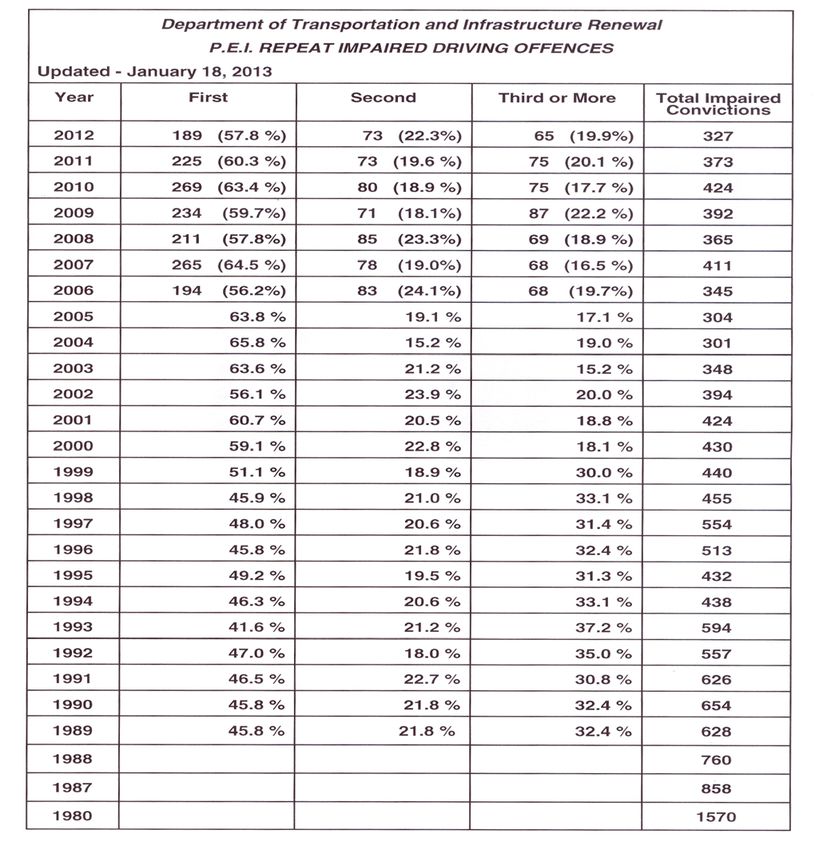
Impaired Driving Summit – February 13, 2013

       Police has retired. Two people are presently training in DREs and this will increase the
       total complement to three by March 2013.
   •   Training and maintaining DRE expertise within the jurisdiction is costly. Maintaining
       competency and accreditation is challenging.
   •   The standard field sobriety test (SFST) is not an effective tool for identifying drug
       impaired driving from an evidentiary perspective, which is why maintaining people with
       DRE competencies within the jurisdiction is important.
   •   Training and certification of “evaluating officers” is costly.
   •   Availability of breathalyzer vs. blood test or saliva testing is a factor.
   •   There is effective integration amongst law enforcement agencies within PEI which
       enables an effective use of scarce expertise and resources.

How are the issues being addressed in PEI, and in other jurisdictions? Are the measures
legislative, non-legislative?

Current Process in PEI for Drug Impaired Driving in PEI

                                        Sobriety Field Test

                                     Drug Recognition Expert

                                           Blood Warrant

                                               Analysis

                                 Extrapolation Process For Court

                                     Evidence For Conviction

Participants indicated that the current approach is a reactive approach to addressing drug
related impaired driving. It is difficult to obtain a good understanding of drug related impaired
driving in PEI and this is attributed to a lack of tools, resources and education.

Participants noted that:

   •   Drug testing on PEI is screening only

_____________________________________________________________________________________
Page | 6 Impaired Driving Summit Summary
Impaired Driving Summit – February 13, 2013

   •   The health sector (pharmacists) could put protocols in place to flag high risk people who
       could be at risk for drug related impaired driving.
   •   The health sector identified as a key player in working with Highway Safety Division and
       law enforcement.
   •   There is more of an emphasis on alcohol related impaired driving than drug related
       impaired driving.
   •   There is no drug-related administrative program in PEI
   •   There is no provincial solution and limited mechanisms to address drug related impaired
       driving

Based on your discussions and understanding of the issues with respect to drug related impaired
driving in PEI, identify measures that could be enhanced or implemented to effectively address
drug related driving in PEI.

   •   There is a potential opportunity to train a Highway Safety Officer in DRE. Benefits
       associated with this opportunity include the retention and maintenance of the expertise
       in PEI. If the expertise is within the RCMP; a transfer of the person out of the jurisdiction
       means the expertise leaves the jurisdiction as well.
   •   Explore a cost-effective “train-the-trainer” model to enhance DRE capabilities in PEI.
   •   Enhance awareness on the issue of non-intentional drug related impairment related to
       the increasing use of prescription drugs for:
           o Health professionals (physicians, pharmacists, Nurse Practioners, dentists)
           o Law enforcement agencies
           o Judiciary
           o Public
   •   Enhance public awareness and knowledge regarding:
           o What drug related impairment means
           o Impact of drug related impairment ( legal or illicit)
           o Include enhanced awareness in school system and health curriculum
   •   Use “green” “yellow” “red” system to flag prescription drugs that impair cognition
   •   Enhance availability and use of documentation that shows a person has been advised by
       a pharmacist/physician/health provider that a prescription drug could impair ability to
       operate a motor vehicle.
   •   Strike a task force to address use of prescription drugs and impaired driving (engage the
       medical community and health care professionals).
   •   Continue to develop primary care capacity to use alternative treatments (move away
       from pharmaceutical treatment of health condition; eg. depression).

_____________________________________________________________________________________
                                                 Impaired Driving Summit Summary Page | 7
Impaired Driving Summit – February 13, 2013

     •   Strengthen understanding and use of Medical Standards for Drivers.
     •   Criminal Code is not working well to address drug related driving issue and currently no
         sanctions under the Highway Traffic Act
             o Introduce administrative sanctions in PEI, similar to those instituted in
                Newfoundland and Labrador
             o Roadside suspension for drivers who fail SFST or roadside drug screening test
     •   Following a death or serious injury mandatory ASD test ( implement authority to do so
         in Highway Traffic Act)
     •   Place pressure on the federal government to “do the science and set per se limits”
             o Consider what is needed to implement saliva testing
     •   Does the judiciary have training in the area of drug related impaired driving? Is there a
         need to enhance training for judiciary?

Next Steps
Participants appreciated the opportunity to attend a forum that offered meaningful dialogue
and discussion with respect to impaired driving. Information was shared through a facilitated
process using small and large group discussions. This process enabled the identification of
current issues and opportunities to enhance existing measures or implement new measures. In
reflecting on the discussions of the day, participants identified the following next steps as
potential actions to be taken:

1.       The summary of discussions arising from the Impaired Driving Summit be circulated to
         all participants.

2.       The use of 911 system be enhanced for public to alert police regarding a potentially
         impaired driver.

3.       Consideration be given to including Crime Stoppers as an avenue by which the public
         could anonymously report an impaired driver.

4.       Enhanced public awareness and social media campaigns be used to increase citizen
         engagement and highlight personal responsibility with respect to alcohol related and
         drug related impaired driving.

6.       Consideration be given to enhancing the use of licence plates in addressing impaired
         driving:

         •      Two licence plates (front and rear of vehicle)

_____________________________________________________________________________________
Page | 8 Impaired Driving Summit Summary
Impaired Driving Summit – February 13, 2013
• Designated license plate for a second offence of impaired driving (consider
evidence regarding effectiveness).
7. Establish mechanisms and opportunities to share information about effective national
and international initiatives through enhanced communication amongst partners;
including Government Department Representatives (TIR, Justice, and Health and
Wellness), Law Enforcement (RCMP and Municipal police), Crown Attorney’s Office,
Health Professionals, National/Atlantic/Provincial Organizations (MADD), Coroner’s
Office and Island communities.
• Discuss and identify cross-sector initiatives and solutions that enable
government departments to address their respective mandates in addition to
enhancing shared mandates.
8. Enhance and implement initiatives to address drug impaired driving; improve Drug
Recognition Evaluation capabilities and implement administrative sanctions in PEI
similar to those instituted in Newfoundland and Labrador.
9. Strike a permanent committee to advance ideas and proposed actions arising from the
February 2013 Impaired Driving Summit and recommendations developed through the
work of the Ad Hoc Committee for Impaired Driving.
10. Maintain momentum on the issue of impaired driving by reconvening participants of the
February 2013 Summit for further discussion and problem-solving in six months
(September 2013).
_____________________________________________________________________________________
Impaired Driving Summit Summary Page | 9Andrew Murie
Chief Executive Officer
MADD Canada• Every day, on average, 4 Canadians are killed and 174 are
injured in impairment-related crashes
• Costs the Canadian economy $20 billion annually
Impairment-Related Crash
Deaths in Canada: 2005 - 2009
2005 2006 2007 2008 2009Total Crash Impairment-Related Crash Deaths
Year
Deaths Number Percentage
2000 3,162 1,247 37.2%
2001 3,021 1,176 40.2%
2002 3,197 1,161 36.3%
2003 3,124 1,257 40.3%
2004 3,013 1,157 39.4%
2005 3,226 1,210 37.5%
2006 3,122 1,278 40.9%
2007 3,045 1,239 40.7%
2008 2,694 1,162 43.1%
2009 2,575 1,074 41.7%Impaired Driving Criminal Code Charges and Convictions: 2011
Prov 2011
Charges Convictions Conviction % Change
Rate over 2010
NL 926 608 66% -3%
PE 436 321 74% +3%
NS 2,160 1,586 73% -2%
NB 1,741 1,209 69% -14%
QC 14,775 6,843 46% -9%
ON 16,165 13,414 83% +19%
MB 2,745 1,771 65% +9%
SK 4,705 2,672 57% 1%
AB 11,009 5,738 52% -2%
BC 9,865 5,591 57% -6%
Total 64,527 39,753 62% 3%Impaired Driving Deaths Per 100,000
1. Ontario 2.03
2. Québec* 2.15
3. Newfoundland 2.82
4. British Columbia 3.60
5. Nova Scotia 4.57
6. Manitoba 4.86
7. Prince Edward Island 5.46
8. New Brunswick 5.58
9. Alberta 5.70
10. Saskatchewan 8.44
Canada 3.18
* The Québec data must be viewed with caution
because of problems with underreporting.Impairment-Related Crash Deaths - Prince Edward Island
Year Number As % of total crash deaths Per 100,000 population
P.E.I. Canada P.E.I. Canada
2000 8 39% 37% 5.64 3.83
2001 15 81% 40% 11.27 3.91
2002 12 61% 36% 8.84 3.70
2003 12 71% 40% 8.82 3.97
2004 12 40% 38% 8.79 3.62
2005 3 19% 38% 2.39 3.75
2006 17 59% 41% 11.96 3.92
2007 7 73% 41% 4.78 3.76
2008 10 52% 43% 7.10 3.49
2009 8 64% 42% 5.46 3.182000-2009: 2005-2009: 2008-2009:
10-year Change 5-year Change 1-year Change
Prince Edward Island -3.20% +128.48% -23.07%
Canada -16.96% -15.20% -8.71%• .00% BAC limit for drivers 21 years and under / with less than 5 years driving experience ‒ Vehicle impoundment for violations (Alberta) • 7-day / multi-faceted administrative licence suspension • Vehicle impoundment program at .05% BAC level (BC and Alberta) • Mandatory alcohol interlocks for federal impaired driving offenders • Administrative licence suspensions, rehabilitation programs targeting those at .08% BAC and above (BC)
• Road crashes are #1 cause of death for 15-24 year olds;
  approximately 50 % are alcohol-related

• Zero and low BAC restrictions have positive results:

    ⁻ U.S. review found “zero tolerance laws” reduced the odds of an
      alcohol-positive crash by over 24% for drivers under 21

   -   Early study of Ontario’s GLP .00% BAC restriction found a 25%
       reduction in the number of grade 11 and 12 males who reported
       driving after drinking
Legal
.00% BAC Limit Age at which .00%
Province Drinking
Beyond GLP BAC Limit Ends
Age
AB None 18 18
BC None 18½ 19
MB 3 years 20½ 18
NB 3 years 21 19
NL None 17⅔ 19
None (pending – 2 18¼ (pending – 21 or
NS 19
years) 20¾ with driver ed.)
ON 3⅓ years 22 19
PE ¼ year 19 (proposed 21) 19
QC 3 years 22 18
SK None 17½ 19Province 1st Occurrence 2nd Occurrence 3rd Occurrence 4th and Subsequent
Occurrences
AB1 3 days 15 days 30 days 30 days
BC2 3 days 7 days 30 days 30 days
MB 24 hours 15 days 30 days 60 days
NB 7 days 7 days 7 days 7 days
NL 7 days 14 days 2 months 4 months
NS 7 days 15 days 30 days 30 days
ON 3 days 7 days 30 days 30 days
PE3 7 days 30 days 90 days 90 days
QC No Short-Term ALS.
SK 24 hours 15 days 90 days 90 days
CCMTA 7-14 days 30 days 45 days 60 days
1. 3-day vehicle impoundment for first infractions, 7-day impoundment on subsequent infractions
2. Corresponding vehicle impoundments
3. Look-back period is only 2 years; 6-month licence suspension imposed for fifth or subsequent
infractions within 2 yearsVehicle Mandatory
Province Mandatory Legislated Remedial Programs
Impound. Interlock
- Drivers with a second .05% BAC infraction within 10 years must take a remedial course
and may be subject to a licence review.
AB Yes No
- Drivers with a third infraction must take a remedial course and are subject to a licence
review.
- No, but Super. requires drivers to take a remedial program if they have a 30 or 90-day IRP,
BC Yes No a 90-day ALS, or any combination of three 24-hour, 3-day or 7-day IRPs within 5 years.
- Super. also imposes a 1-year interlock order on these drivers.
Drivers with 2 or more suspensions within 3 years must undergo an impaired driver’s
MB No No assessment & may be required to complete an education or treatment program.
NB No No No
- Drivers with 2 suspensions within 2 years must complete an education program.
NL No No - Drivers with 3 or more suspensions within 2 years must complete an alcohol dependency
assessment & rehabilitation program.
NS No No No
- No, but Registrar requires drivers with 2 suspensions within 5 years to participate in an
alcohol education program.
ON No No - Drivers with 3 or more suspensions within 5 years must participate in an alcohol
treatment program & are subject to a 6-month interlock order.
- Drivers with 4 or more suspensions within 5 years must undergo a medical examination.
QC No Short-Term ALS.
PE No No No
Drivers with 2 suspensions within 5 years must complete the “Driving Without
SK No No
Impairment” course.
Yes on 3rd Drivers with 2 suspensions within 3 years should be required to complete an impaired
CCMTA NoBritish Columbia saw a significant drop in impairment-related crash deaths after enhancing road-side prohibitions
Warn Range Administrative Licence Suspensions in 2011
Province     24 Hrs. 3 Days    7 Days  14/15   30     60     90     120    180    Totals    % Change
                                       Days    Days   Days   Days   Days   Days             from 2010
NL           N/A      N/A      287     16      N/A    30     N/A    5      1      339       -11%
PE           325      N/A      78      N/A     6      N/A    0      N/A    N/A    409       +3%
NS           23       N/A      621     24      3      N/A    N/A    N/A    N/A    671       -8%
NB           N/A      N/A      Unknown N/A     N/A    N/A    N/A    N/A    N/A    Unknown
ON           N/A      14,344   1,022   N/A     81     N/A    N/A    N/A    N/A    15,447    -10%
MB           698      N/A      N/A     29      6      1      N/A    N/A    N/A    734       0%
SK           2,499    N/A      N/A     325     N/A    N/A    61     N/A    N/A    2,885     -11%
AB           7,114    N/A      N/A     N/A     N/A    N/A    N/A    N/A    N/A    7,114     -11%
BC           4,069    7,873    147     N/A     4      N/A    N/A    N/A    N/A    12,093    -54%
Totals       14,728   22,217   2,155    394    100    31     61     5      1      39,692    -31%
% of Total   37%      56%      5%       1%
Susp.
• Reduces recidivism rates up to 90% while on vehicle, and continue to
have positive results once removed:
- Washington State: 12% reduction in recidivism rates post-interlock (at
participation rate of 30%)
- Mandatory interlocks in New Mexico resulted in 35% fatality reduction;
reduction in recidivism once device was removed
• Not a punishment - effective rehabilitative tool to help impaired
drivers get control of alcohol consumption levels
• Keeps impaired driving offenders in the licensing systemProvince Mandatory Interlocks AB Criminal BC Criminal and administrative MB Criminal NB Voluntary NS Based on assessment ON Criminal PE Criminal QC Based on assessment SK Voluntary
Province   2007     2008     2009     2010     2011
AB         1,168    1,289    1,449    1,762    2,180
BC         206      336      633      1,248    8,029*

MB         100      108      127      133      155

NL         34       43       78       80       89
NB                           116      120      137
NS                  27       330      491      599
ON         2,345    2,823    2,732    4,017    6,209
PE         32       41       57       73       85
QC         7,083    7,555    8,224    9,114    9,539
SK         320      323      369      376      400

Canada     11,305   12,560   14,132   17,435   27,440 (+36%)
PEI has made significant legislative progress since 2006

• Improvements to Graduated Licencing Program

• 7-day Short-Term Administrative Licence Suspension Program

• Mandatory interlocks for first-time offenders

• Stronger sanctions against offenders with child passengers
Room for further improvement:

• Enact .00% BAC requirement for drivers until age 21
   ‒ Vehicle impoundments for violations

• Vehicle impoundments for Short-Term Administrative Licence
  Suspension Program

• Expand the Call 911 Program
   ‒ Use data to develop strategies to focus on repeat drinking
      drivers
• Random breath testing • Improved BAC evidence collection in hospitals
• Roadside breath screening test to detect impaired drivers

• Used primarily at stationary sobriety checkpoints; every
  passing driver is required to stop and give a breath sample

• Increases detection rates

• Increases perception that impaired drivers will be caught

• Proven effective in numerous other countries where it has
  been introduced
• Impairment-related crashes continue to be leading criminal cause
  of death in Canada, claiming an estimated 1,074 lives in 2009

• Existing breath screening laws in Canada do not effectively deter
  impaired driving:

    − Police can only demand a roadside breath sample if they have
      reasonable grounds to suspect the driver has been drinking

    − Majority of drinking drivers go undetected at sobriety checkpoints

    − A person would have to drive impaired, on average, once a week,
      every week, for more than 3 years before being charged, and for
      over 6 years before ever being convicted
Introduction of random breath testing would reduce impaired driving in Canada by an estimated 20% annually: • Prevent more than 200 deaths • Prevent more than 12,000 injuries
MADD Canada thoroughly analyzed the constitutional issues, traffic
safety and cost factors, and public support for random breath testing:

• Overwhelming majority of Canadians would support random breath
  testing (Ipsos Reid poll, 2010)

• Comprehensive review of random breath testing in Canada outlined
  effectiveness of the measure and likelihood it will withstand challenge
  under the Charter of Rights

• Impact and cost analysis found random breath testing will prevent crashes
  and fatalities and reduce the social costs of impaired driving by billions of
  dollars annually, without significantly increasing demands on police
  resources or unduly burdening the court system or the driving public
• The following organizations are on record, in writing or in media, as
  supporting random breath testing:

   Canadian Medical Association
   Canadian Police Association
   Canadian Chiefs of Police
   BC Medical Association
   Centre for Addiction and Mental Health
   Canadian Centre on Substance Abuse
   Alcohol Test Committee
   Insurance Bureau of Canada
   Canadian Council of Motor Transport Administrators
• June 2009: Standing Committee on Justice and Human Rights
  recommended the introduction of random breath testing legislation
  in its report, Ending Alcohol-Impaired Driving: A Common Approach

• No movement since then
• 89% of legally impaired drivers admitted to a hospital
  emergency room are never charged with impaired driving

• Current laws make it very difficult for police and health
  professionals to gather BAC evidence in a hospital setting
2010
         BAC

200      176
               150
150

100

50

 0
        BAC

      160
2011
BAC
200 171 168
150
100
50
0
BAC
1602012
BAC
148
160
130
140
120
100
80
60
40
20
0
BAC
>160Andrew Murie
Chief Executive Officer
MADD Canada• Criminal Code first prohibited drug-impaired driving in 1925 • Enforcement issues quite distinct from alcohol-impaired driving ‒ Wide variety of drugs that can impair driving ability • Until 2008, drug-impaired driving provisions primarily enforced and prosecuted by observational evidence; driver had to be obviously high in order to be detected /charged • In 2008, Criminal Code amended to give police authority to demand “physical coordination tests” (ie standardized field sobriety tests or SFSTs) and Drug Recognition Evaluations (DREs)
• Driving after drug use has become more common in Canada
  during the last decade
    ‒ Roadside surveys show drug-impaired driving at same, or
      higher, rates than impaired driving

• National survey of drivers: % of respondents who admitted
  to driving within two hours of using marijuana or hashish
  increased from 1.5% in 2002 to 2.4% in 2006; represents
  over half a million Canadians driving after using those drugs
  in the past twelve months

• Survey of adult drivers in Ontario, 2.9% of respondents
  admitted to driving within one hour of using marijuana or
  hashish in the past twelve months
SFST and DRE provided more detailed, objective evidence of a driver’s impairment, but cumbersome, expensive, and readily susceptible to legal challenge • Training and certifying “evaluating officers” takes at least 112 hours at a cost of $17,000 per officer • Judges may not accept that “failing” the DRE provides proof of impairment of driving ability
Current system for detecting and investigating drug-impaired
drivers not working:

• SFST and DRE: effective as screening measure but weak in
  establishing impairment by drugs beyond reasonable doubt

• Drug impaired driving dramatically under-enforced in Canada

• Total drug-impaired driving charges is just 1.4% of overall
  impaired driving charges

• 915 charges out of 65, 183

• No immediate solutions in sight
Total Number of Persons Charged
   Province         2008              2009               2010

        NL            19               36                51
        PE             1                5                 5
        NS            18               39                69
        NB            13               67                37
        QC             3               51                98
       ON             66              317               322
       MB              7               21                27
        SK             8               45                57
        AB            29               86               132
        BC            23              128               112
    Canada           188              796               915
(total impaired)   (65,822)         (68,399)          (65,183)
• No information on the outcome of these drug-impaired driving cases • Statistics Canada includes these cases in the statistics on total impaired driving cases “by type of decision” and “by type of sentence” • No way of knowing the number of charges dropped prior to trial, the conviction rate of cases that go to trial, or the sentences that are imposed in cases in which there is a guilty disposition
R v Perillant:

• Accused acquitted despite: admitting to having smoked
  cannabis before driving, failing several elements of the
  DRE, testing positive for cannabis

• Judge indicated that evidence proved accused used
  marijuana prior to being stopped at police check stop
  and still had some of it in her system at the time of the
  DRE, but that evidence of the drug’s presence did not
  prove accused’s ability to drive was impaired
• Saliva testing at road-side to replace SFST

• ‘Per se’ levels established for the major groups of drugs
    ‒ For example: 5 nanograms of cannabis is used in some
       Americans states for driving limit
Drug-Related Administrative Licence Suspensions
Duration
(1st
Province Grounds occurrence) Number
Reasonable grounds to believe driver’s ability is impaired by a drug or Not
NL 7 days
combination of drugs and alcohol known
PE No drug-related administrative program
NS No drug-related administrative program
NB No drug-related administrative program
QC No alcohol or drug-related administrative program
ON No drug-related administrative program
Based on SFST, believe driver is unable to drive safely; refuses SFST; or is so
MB impaired by alcohol or drugs as to be unable to provide a sample or take 24 hours 48
SFST
SK Refusal to undergo, or a failure of, a SFST 24 hours 61
Not
AB Reasonably suspect driver`s physical or mental ability is affected by a drug 24 hours
known
BC Reasonable grounds to believe driver`s ability is affected by a drug 24 hours 4,457Prince Edward Island should consider the following measures: • Administrative licence suspensions for drivers who fail SFST or roadside drug screening test • Enact a zero tolerance law for psychoactive drugs as part of their graduated licensing programs, paralleling the .00% BAC restriction
Federal Government should consider:

• Use of saliva testing for drug detection

• Crucial to authorize enforcement procedures that are relatively
  straightforward and cost-effective, while still constitutionally
  valid

• Several European countries and Australian states have
  introduced random roadside screening for certain drugs
   ‒ Police have authority to demand any driver take a saliva
      screening test at roadside; if the driver tests positive, he or
      she will be required to undergo additional, evidentiary
      testing
• Many comparable countries have enacted or are in process of enacting drug ‘per se’ laws • Like the .08% BAC, ‘per se’ limit for driving would require defining a level at which a typical driver’s skills would be impaired by a given drug
You can also read


