Indian Institute of Technology Kharagpur - for B.Tech. (Hons.), Dual Degree, Interdisciplinary Dual Degree, IIT Kharagpur
←
→
Page content transcription
If your browser does not render page correctly, please read the page content below
for

                B.Tech. (Hons.),
                  Dual Degree,
         Interdisciplinary Dual Degree,
                B. Arch. (Hons.),
           Integrated M. Sc. Degrees,
      2 Year M.Sc. of Joint - M.Sc. - Ph.D.
      6 Year Dual Degree M.Sc. - M.Tech.

Indian Institute of Technology Kharagpur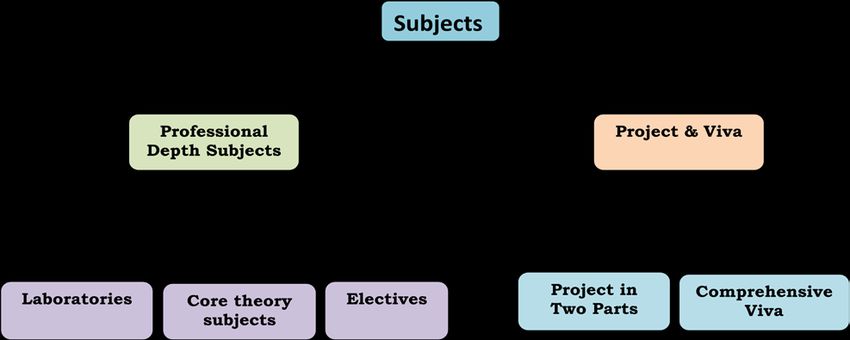
CONTENTS
                                                                  Page No.
          Preface                                                     2
   1.     Academic Administration                                     3
   2.     Academic Programs                                           3
   3.     Scope of the Regulations                                    6
   4.     Academic Calendar                                           7
   5.     Admission                                                   7
   6.     Residence                                                   8
   7.     Attendance                                                  8
   8.     Conduct and Discipline                                      9
   9.     Change of Branch                                           11
   10.    Switch Over to Interdisciplinary Dual Degree Programs      13
   11.    Allocation of Verticals for QEDM                           13
   12.    B.Tech.(Hons.) to Dual Degree Switch Over                  13
   13.    Options for Dual Degree Specialization                     14
   14.    Course Curricula                                           14
   15.    Co-ordinated Courses                                       18
   16.    Industrial Training and Field Work                         18
   17.    Additional Credits                                         19
   18.    Micro-Credits                                              20
   19.    Minor in a Discipline                                      20
   20.    Micro – Specialization                                     21
   21.    Admission to Ph.D. for Joint M.Sc.-Ph.D. Program           21
   22.    Semester Registration                                      22
   23.    De-Registration                                            25
   24     Grading System                                             25
   25.    Assessment of Performance                                  26
   26.    Assessment of Project Work                                 29
   27.    Examinations                                               30
   28.    Supplementary Examination                                  32
   29.    Summer Quarter                                             34
   30     Grade Submission & Grade Revision                          35
   31.    Graduation Requirement                                     36
   32.    Promotion and Discontinuation of Study                     37
   33     Withdrawal from the Institute                              38
   34.    Striking off the name from Institute Roll List             38
   35.    Relaxation                                                 38
   36     Medals, Awards and Prizes                                  39
   37.    Scholarships                                               51
   38.    Appendix 1 ---Subjects in Lieu of BTP Projects             67

Rules and Regulations            Updated –February 2020                      Page 1
PREFACE
The Indian Institute of Technology at Kharagpur is the first of the sixteen Institutes
established in the IIT system. Established in 1951, IIT Kharagpur stands tall for its
excellence in Academics and Research with top class faculty. With 19 Academic
Departments, 7 Centers & 8 Schools of Excellence, the Institute offers 15
B.Tech.(Hons.) Programs, 38 Dual Degree Programs, 2 Interdisciplinary Dual
Degree Programs, 6 Integrated M.Sc. Programs and 5 Two Year M.Sc. degree
programs of Joint M.Sc.-Ph.D.
The Undergraduate courses at IIT Kharagpur are known for their academic depth
and professional learning flexibility, imbibed with options to earn minor or extra
credits. Having an apt mix of basic sciences, engineering sciences, professional core
of the major discipline, humanities courses, management subjects, project work,
open electives and industrial training, the courses give a professional edge to the
students. The system stimulates broad spectrum learning. Extra Academic activity
is a non credit component of the curriculum that not only helps the students in
character and personality building but also in understanding the needs of the
society and contributing in an effective way to meet these social challenges.
IIT Kharagpur follows a credit based semester system. There are two Semesters in
an academic year (Autumn: July - November; and Spring: January - April) during
which all courses specified for various degree programs are offered. There is one
additional term of seven week duration during summer, for the theory subjects of
the first year to offer additional training to students who do not clear these
subjects. The Institute has recently launched an International Summer /Winter
Term Program which is open to all students. The students get an opportunity to
seek knowledge and experience from International faculty in various multi-
disciplinary subjects.
IIT Kharagpur is a very student friendly place and all efforts are made to ensure
that the students are provided the best opportunities that are needed to create
outstanding pool of human resources to meet the global challenges in all spheres.
The students are required to follow certain procedures and meet specified academic
requirements each semester. This booklet gives comprehensive information on the
existing Rules and Regulations for B.Tech.(Hons.), Dual Degree and M.Sc.
Programs.
We urge the students to make best use of the world class infrastructure and
facilities available at IIT Kharagpur and wish all of them all the very best for a
successful career.
Dean (UGS)
1. Academic Administration
Rules and Regulations Updated –February 2020 Page 2The Senate is a statutory and supreme body that governs all
academic matters of the Institute, and the rulings of Senate Chairman (Director
of The Institute) are final in regard to all academic issues. A definite time
schedule is set by the Senate for various academic activities, through an
Academic Calendar issued in the beginning of each academic year. The Senate
continuously assesses the Academic Programs and makes appropriate revisions/
modifications/improvements as and when required through three Institute level
Senate subcommittees: The Under-Graduate Program Evaluation Committee
(UGPEC) for undergraduate programs, the Post-Graduate Program Evaluation
Committee (PGPEC) for post-graduate programs, and the Research Program
Evaluation Committee (RPEC) for research programs. Administrative back-up
and support for all academic activities is provided by the Academic Section and
the ERP system of the Institute. On joining the Institute, students of each
discipline are assigned to a Faculty Advisor from their Department. Faculty
Advisors assist the students on matters relating to their academic performance
and the courses they may take in various semesters.
Dean (Undergraduate Studies) and Dean (Students’ Affairs) are the two Chief
Academic Authorities for the Undergraduate (UG) Programs. All the UG Academic
matters come under the purview of Dean (Undergraduate Studies). Matters
pertaining to conduct, discipline and welfare of the students are overseen by the
Dean (Students’ Affairs).
2. Academic Programs
The following Undergraduate Programs are Offered by the Institute:
(i) 4-year courses in Engineering / Technology leading to the award of B.Tech.
(Hons.) Degree. (Table 2.1)
(ii) 5-year Integrated courses in Engineering / Technology leading to Dual B.Tech.
(Hons.) and M.Tech. Degrees. (Table 2.2)
(iii) 5-year Integrated courses in Engineering / Technology leading to
Interdisciplinary Dual B.Tech. (Hons.) and M.Tech. Degrees. (Table 2.3)
(iv) 5-year course in Architecture leading to the award of B.Arch. (Hons.) degree.
(v) 5-year Integrated courses in Science subjects leading to the award of both B.Sc.
and M.Sc. Degrees. (Table 2.4)
(vi) 6-year Integrated courses in Science/Technology leading to Dual M.Sc. and
M.Tech. Degrees (Table 2.6)
(vii) 2 Year M.Sc. courses of Joint M.Sc.-Ph.D. Degrees in Science subjects leading to
the award of M.Sc. Degrees. (Table 2.5)
(viii) 3 Year M.Sc. of Joint M.Sc.-Ph.D. Degrees in Science subjects leading to the
award of M.Sc. Degrees. (Table 2.5.I)
TABLE – 2.1 4-year courses in Engineering/Technology leading to the award of
Rules and Regulations Updated –February 2020 Page 3B.Tech. (Hons.) Degree
Sl. Courses
1. Aerospace Engineering
2. Agricultural and Food Engineering
3. Biotechnology and Biochemical Engineering
4. Chemical Engineering
5. Civil Engineering
6. Computer Science and Engineering
7. Electrical Engineering
8. Electronics and Electrical Communication Engineering
9. Instrumentation Engineering
10. Industrial Engineering
11. Manufacturing Science and Engineering
12. Mechanical Engineering
13. Mining Engineering
14. Metallurgical and Materials Engineering
15. Ocean Engineering and Naval Architecture
TABLE – 2.2 5-year Integrated courses in Engineering/Technology leading to Dual
B.Tech. (Hons.) and M.Tech. Degrees
Sl. Courses
1. B.Tech.(Hons.) & M.Tech. in Aerospace Engineering
2. B. Tech.(Hons.) in Agricultural and Food Engineering & M. Tech. in Food
Process Engineering
3. B. Tech.(Hons.) in Agricultural and Food Engineering & M. Tech. in Land and
Water Resources Engineering
4. B. Tech.(Hons.) in Agricultural and Food Engineering & M.Tech. in Farm
Machinery and Power
5. B. Tech.(Hons.) in Agricultural and Food Engineering & M.Tech. in
Aquacultural Engineering
6. B. Tech.(Hons.) in Agricultural and Food Engineering & M.Tech. in Agricultural
Systems and Management
7. B. Tech.(Hons.) in Agricultural and Food Engineering & M.Tech. in Agricultural
Biotechnology
8. B.Tech. (Hons.) & M.Tech. in Biotechnology and Biochemical Engineering
9. B.Tech. (Hons.) & M.Tech. in Chemical Engineering
10. B.Tech. (Hons.) in Civil Engineering & M.Tech. in Structural Engineering
11. B.Tech. (Hons.) in Civil Engineering & M.Tech. in Transportation Engineering
12. B.Tech. (Hons.) in Civil Engineering & M.Tech. in Geotechnical Engineering
13. B.Tech. (Hons.) in Civil Engineering & M.Tech. in Hydraulic and Water
Resources Engineering
14. B.Tech. (Hons.) in Civil Engineering & M.Tech. in Environmental Engineering
and Management
15. B.Tech. (Hons.) & M.Tech. in Computer Science and Engineering
16. B.Tech. (Hons.) in Electrical Engineering & M.Tech. in Control System
Engineering
Rules and Regulations Updated –February 2020 Page 417. B.Tech. (Hons.) in Electrical Engineering & M.Tech. in Machine Drives and
Power Electronics
18. B.Tech. (Hons.) in Electrical Engineering & M.Tech. in Power and Energy
Systems
19. B.Tech. (Hons.) in Electrical Engineering & M.Tech. in Instrumentation and
Signal Processing
20. B.Tech. (Hons.) in Electronics & Electrical Communication Engineering &
M.Tech. in Microelectronics and VLSI Design
21. B.Tech. (Hons.) in Electronics & Electrical Communication Engineering &
M.Tech. in RF and Microwave Engineering
22. B.Tech. (Hons.) in Electronics & Electrical Communication Engineering &
M.Tech. in Telecommunication System Engineering
23. B.Tech. (Hons.) in Electronics & Electrical Communication Engineering &
M.Tech. in Visual Information and Embedded Systems
24. B.Tech. (Hons.) in Electronics & Electrical Communication Engineering &
M.Tech. in Fibre Optics and Light Wave Engineering
25. B.Tech. (Hons.) in Instrumentation Engineering & M.Tech. in Instrumentation
and Signal Processing
26. B.Tech. (Hons.) in Instrumentation Engineering & M.Tech. in Control System
Engineering
27. B.Tech. (Hons.) in Industrial Engineering & M.Tech. in Industrial Engineering
and Management
28. B.Tech. (Hons.) in Manufacturing Science and Engineering & M.Tech. in
Industrial Engineering and Management
29. B.Tech. (Hons.) in Mechanical Engineering & M.Tech. in Manufacturing Science
and Engineering
30. B.Tech. (Hons.) in Mechanical Engineering & M.Tech. in Thermal Science and
Engineering
31. B.Tech. (Hons.) in Mechanical Engineering & M.Tech. in Mechanical Systems
Design
32. B.Tech. (Hons.) & M.Tech. in Mining Engineering
33. B.Tech. (Hons.) in Mining Engineering & M.Tech. in Safety Engineering
34. B.Tech. (Hons.) in Metallurgical and Materials Engineering & M.Tech. in
Metallurgical Engineering
35. B.Tech. (Hons.) & M.Tech. in Ocean Engineering and Naval Architecture.
36. B.Tech. (Hons.) in Engineering Product Design and Manufacturing & M.Tech. in
Design and Quality Engineering with Mechanical Engineering Vertical
37. B.Tech. (Hons.) in Engineering Product Design and Manufacturing & M.Tech. in
Design and Quality Engineering with Industrial Electronics Vertical
38. B.Tech. (Hons.) in Chemical Engineering and M.Tech. in Petroleum Engineering
39. B.Tech. (Hons.) in Mechanical Engineering and M.Tech. in Petroleum
Engineering
40. B.Tech. (Hons.) in Mining Engineering and M.Tech. in Petroleum Engineering
TABLE–2.3 Integrated courses in Engineering/Technology leading to Inter/Trans
disciplinary Dual B.Tech. (Hons.) and M.Tech. Degrees
Rules and Regulations Updated –February 2020 Page 5Sl. Courses
1. B.Tech.(Hons.) in any Engineering Discipline and M.Tech. in Financial
Engineering (5-year)-- Inter-disciplinary
2. B.Tech.(Hons.) in any Engineering Discipline and M.Tech. in Engineering
Entrepreneurship (5-year)-- Inter-disciplinary
3. B.Tech.(Hons.) in Mechanical/Chemical/Mining Engineering Discipline and
M.Tech. in Petroleum Engineering (5-year)—Trans-disciplinary
TABLE – 2.4 5-year Integrated courses in Science subjects leading to the award of
both B.Sc.(Hons.) and M.Sc. Degrees
Sl. Courses
1. Chemistry
2. Exploration Geophysics
3. Applied Geology
4. Economics
5. Mathematics and Computing
6. Physics
TABLE – 2.5 2 Year M.Sc. of Joint M.Sc.-Ph.D. Degrees
Sl. Courses
1. Chemistry
2. Geophysics
3. Geology
4. Mathematics
5. Physics
6. Chemical and Molecular Biology (in collaboration with INDIAN ASSOCIATION
FOR THE CULTIVATION OF SCIENCE)
7. Nuclear Medicine (in collaboration with TATA MEDICAL CENTRE, KOLKATA)
8. Molecular Medical Microbiology (in collaboration with TATA MEDICAL
CENTRE, KOLKATA)
TABLE – 2.5.I 3 Year M.Sc. of Joint M.Sc.-Ph.D. Degrees (Senate : 316.F.I.C.11)
1. Medical Physics (in collaboration with TATA MEDICAL CENTRE, KOLKATA) ,
AREB Accreditation (senate : 331.H.I.R.4)
TABLE – 2.6 6-year Integrated courses in Science/Technology leading to Dual M.Sc.
and M.Tech. Degrees (Senate: 314.H.I.C.6)
Sl. Courses
1. M.Sc. in Applied Geology and M.Tech. in Petroleum Engineering
2. M.Sc. in Exploration Geophysics and M.Tech. in Petroleum Engineering
3. Scope of the Regulations
3.1 The provisions of this Regulation is applicable to all Programs and disciplines
listed above and will also be applicable to new Under-Graduate(UG) disciplines
that are introduced from time to time .
3.2 The Board of Governors (BOG) may, on the recommendation of the Senate
change any or all parts of this Regulation at any time considered appropriate by
the Senate.
Rules and Regulations Updated –February 2020 Page 64. Academic Calendar
4.1 The academic session is divided into two semesters each of approximately 20
weeks duration: an Autumn Semester (July-November) and a Spring Semester
(January-April).
4.2 The Senate-approved schedule of academic activities for a session, inclusive of
dates for registration, mid-semester and end-semester examinations, inter-
semester breaks etc., shall be laid down in the Academic Calendar for the
session and published on Institute Web Site. The Academic Calendar shall strive
to provide for a total of about 90 working days in each semester.
5. Admission
5.1 Admission to all courses (except the 2 Year M.Sc. of the Joint M.Sc.-Ph.D.
programs) will be made in the Autumn Semester of each session, at the First
Year level, through a Joint Entrance Examination (JEE Advanced) conducted by
one of the IITs every year by rotation under the supervision of a Joint Admission
Board, which comprises of representatives from all the IITs.
5.3 Admission to 2 Year M.Sc. courses of the Joint M.Sc.-Ph.D. Program will be
made in the Autumn Semester of each session, at the First Year level, through a
Joint Admission Test (JAM) conducted by one of the IITs every year by rotation
under the supervision of a Joint Admission Committee, which comprises of
representatives from all the IITs.
5.4 In special cases the Institute may admit students to a course on transfer from
other IITs. Such admission may be made at any level considered appropriate
except at first year level.
5.5 Provisions of this Regulation do not prevent the Institute from allowing students
enrolled in a university in India or abroad to attend specified subjects in one or
more semesters without leading to any degree on certain terms and conditions.
5.6 All students admitted to any of the courses including those accepted under
Section 5.4 above shall be required to pay at the time of joining and also in
subsequent semesters prevalent tuition and other fees as prescribed by the
Institute till they are on roll.
5.7 The Institute reserves the right to cancel the admission of any student, and ask
him/her to discontinue his/her studies at any stage of his/her career on
grounds of unsatisfactory academic performance, irregular attendance in classes
or indiscipline.
5.8 Candidate admitted through JEE Advanced to B.Tech.(Hons.)/Dual
Degree/Integrated M.Sc. programs (other than B.Arch.(Hons.) students) will be
eligible for Branch Change and Switch Over to Interdisciplinary Dual Degree
Programs, the rules for which are mentioned in the subsequent sections.
5.9 Cut-off score of TOEFL and IELTS for admission of students from other
countries. (SENATE: 329.H.I.C.6)
1) TOEFL score of at least 80 out of 120
2) IELTS score of at least 6.5 out of 9.0
Rules and Regulations Updated –February 2020 Page 76. Residence
The Institute is essentially a residential one and unless otherwise
exempted/permitted, every student shall be required to reside in, and be a
boarder of a Hall of Residence, to which they are assigned. Following are the
detailed rules governing residence requirements of students:
6.1 The mess of each Hall of Residence shall function as a single integrated unit and
shall not, under any circumstances be sub-divided into any kind of groups or
sub-groups.
6.2 Under special circumstances, the Director/Dean of Students’ Affairs may permit
a student to reside with his Parent/Guardian in the Institute Campus or within
a reasonable distance from the Institute. Such a student shall, however, be
attached to a Hall of Residence and will be required to pay seat rent according to
rules, and Hall establishment charges fixed by the Hall Management Committee
(HMC) and the Warden of the Hall. However, this permission may be withdrawn
at the discretion of the Institute, at any time considered appropriate without
assigning any reason.
6.3 No married accommodation shall be provided to any student of the
undergraduate courses.
6.4 No student shall come into or give up the assigned accommodation in any Hall of
residence without the prior permission of the Chairman, HMC.
6.5 A student shall reside in a room allotted to him/her and may shift to any other
room only under the direction/permission of the Warden.
6.6 Students shall be required to make their rooms available whenever required for
inspection, repairs, maintenance or disinfecting and shall vacate the rooms when
leaving for the vacations/holidays.
6.7 Students shall be responsible for the proper care of the furniture; fan and other
fittings in the rooms allotted to them and shall generally assist the Warden in
ensuring proper use, care and security of those provided in the Halls for common
use of all students.
6.8 Students will be responsible for the safe keeping of their own property. In the
event of loss of any personal property of a student due to theft, fire or any other
cause, the Institute shall accept no responsibility and shall not be liable for
payment of any compensation.
6.9 Engaging personal attendants, keeping pets and use of appliances like electric
heater, refrigerators etc. by a student in the Hall of Residence are prohibited.
6.10 All students must abide by the rules and regulations of the Hall of Residence as
may be framed from time to time.
7. Attendance
7.1 Attendance in all classes (lectures, tutorials, laboratories, workshops, Extra
Academic Activity including its related camps and other publicized activities etc.)
is compulsory. A student may be debarred from appearing at an examination on
the ground of unsatisfactory attendance.
7.2 The teacher concerned may condone absence from classes for a very short period
due to unavoidable reasons provided he/she is satisfied with the explanation.
7.2.1 If the period of absence is for a short duration (of not more than two
weeks) application for leave shall have to be submitted to the Head of the
Department concerned stating fully the reasons for the leave requested for
Rules and Regulations Updated –February 2020 Page 8along with supporting document(s). The Head of the Department will grant
such leave.
7.2.2 Absence for a period not exceeding two weeks in a semester due to
sickness or any other unavoidable reason for which prior application could
not be made may be condoned by the Head of the Department provided he
is satisfied with the explanation.
7.3 If the period of absence is likely to exceed two weeks, a prior application for
grant of leave will have to be submitted through the Head of the Department to
the Dean (Undergraduate Studies), with the supporting documents. The decision
to grant or condone such leave shall be taken by the Dean (Undergraduate
Studies) after considering the recommendation of the Head of the Department.
7.4 It will be the responsibility of the student to get his absence from classes
condoned by the appropriate authority.
7.5 Absence from classes without prior permission will be considered as an act of
indiscipline. Such cases will be dealt with in accordance with Section 5.7.
7.6 A student must intimate his/her absence to the Warden of the Hall in which
he/she is residing, before availing of any leave. Failing to do so will be construed
as breach of discipline and will be dealt with as per provisions in Section 8.5
7.7 Before proceeding on medical leave the B.C.Roy Technology hospital should be
informed and before rejoining the institute, the student should obtain a fitness
certificate from the B.C.Roy Technology hospital (Senate approval, Item
316.C.I.C.1).
7.8 Medical leave of a maximum period of one month during the semester is allowed.
Beyond one month the rejoining will be considered on a case to case basis
(Senate approval, Item 316.C.I.C.1).
8. Conduct and Discipline
8.1 Students shall conduct themselves within and outside the precincts of the
Institute in a manner befitting the students of an institution of national
importance.
8.2 Students shall show due respect to the teachers of the Institute, the Wardens of
the Halls of Residence, the Sports Officers of the Gymkhana and the Officers of
the National Cadet Corps; proper courtesy and consideration should be extended
to the employees of the Institute and of the Halls of Residence. They shall also
pay due attention and courtesy to visitors.
8.3 Students are required to develop a friendly relationship with fellow students. In
particular, they are expected to show kindness and consideration to the new
students admitted to the Institute every year. Law bans ragging in any form to
anybody - acts of ragging will be considered as gross indiscipline and will be
severely dealt with.
8.4 The following acts of omission and/or commission shall constitute gross
violation of the code of conduct and are liable to invoke disciplinary measures:
Ragging.
Furnishing false statement of any kind in the form of application for
admission or for award of scholarship etc.
Displaying lack of courtesy and decorum; resorting to indecent behavior
anywhere within or outside the campus.
Willfully damaging or stealthily removing any property/belongings of the
Rules and Regulations Updated –February 2020 Page 9Institute, Hall or fellow students.
Possession, consumption or distribution of alcoholic drinks or any kind of
hallucinogenic drugs.
Adoption of unfair means in the examinations.
Organizing or participating in any group activity in company with others
in or outside the campus without prior permission of the Dean of
Students’ Affairs.
Mutilation or unauthorized possession of library books.
Resorting to noisy and unseemly behavior, disturbing studies of fellow
students.
Misuse of Internet/e-mail facilities or tempering/hacking with servers
anywhere in the Halls of Residence/Departments etc.
Not intimating his/her absence to the Warden of the Hall before availing
any leave.
Commensurate with the gravity of the offence, the punishment may be
reprimand, fine, and expulsion from the Hall, debarment from an examination,
rustication for a specified period or even outright expulsion from the Institute.
8.5 For an offence committed (a) in a Hall of Residence, (b) in the Department or a
classroom and (c) elsewhere, the Warden, the Head of the Department and the
Dean of Students’ Affairs, respectively, shall have the authority to reprimand or
impose fine or take any other suitable measure.
All cases involving punishment other than reprimand shall be reported to the
Chairman of the Standing Institute Disciplinary Committee.
8.6 (a) All major acts of indiscipline, which may have serious repercussion on the
general body of students, and/or which may warrant a uniform and more
formalized nature of investigation, shall be handled by the Standing Institute
Disciplinary Committee appointed by Senate. The Standing Disciplinary
Committee consists of the following ex-officio and other members:
(i) Dean of Students’ Affairs - Chairman
(ii) Chairman, Hall Management Committee - Member
(iii) Warden of the Hall of Residence of which the student concerned is a boarder -
Member
(iv) One Faculty nominated by the Senate, by rotation for two years - Member
(v) Student Vice-President, Technology Students’ Gymkhana - Member
(vi) One of the student representatives in the Senate, to be nominated by the Dean
Students’ Affairs, for one year – Member
(vii) The Deputy Registrar (Academic) - Member Secretary
In addition, the Chairman may invite any other person(s) to be associated with the
proceedings of a particular case, if his/her/their participation is considered
necessary in disposing of the matter.
(b) Recommendation of the committee, which will include the suggested
punishment in cases of guilt proven, will be forwarded to the Chairman Senate
for necessary action.
8.7 Cases of adoption of unfair means in an examination shall be dealt with by the
Rules and Regulations Updated –February 2020 Page 10Committee on Prevention of Examination Malpractices consisting of the
following members:
(i) Professor-in-Charge of Examination - Chairman
(ii) Head of the Department to which the reported student belongs - Member
(iii) The Invigilator reporting the case- Member
(iv) The Invigilator-in-Charge of the Examination Hall concerned- Member
(v) The Paper-setter concerned - Member
(vi) Two members of faculty nominated by the Undergraduate Program &
Evaluation Committee for a term of two years - Members
(vii) The Assistant Registrar (UGS) - Secretary
The Committee shall recommend appropriate measures in each case to the
Chairman of the Senate for awarding the punishment
9. Change of Branch (At the end of First Year)
9.1 Change of the branch is a privilege and not a right. Only those students admitted
to B.Tech.(Hons.) / Dual Degree / Integrated M.Sc. Programs through
JEE(Advanced) are eligible to be considered for a change of branch after the
Second (Spring) Semester as per the following rules:
To be eligible for consideration for a change of branch the following conditions
must be satisfied:
9.1.1 He/she must have completed all the credits prescribed in the first two
semesters of the course, in his/her first attempt, without having had to
pass any course requirement in the re-examination, supplementary
examination and/or summer quarter.
9.1.2 He/she must have obtained a Cumulative Grade Point Average (CGPA)
not lower than 8.5 at the end of the Second (Spring) Semester.
9.1.3 Students will NOT be eligible for Branch Change, if EAA has not
successfully completed.
9.1.4 Only for serious medical cases, for all EAA activities (NCC, NSS and NSO),
a certificate is to be obtained from B.C. Roy Technology Hospital for waiver
of EAA completion for branch change.( Senate, Item 321.H.I.C.2)
9.1.5 He/she must not have been punished for any offence by the Standing
Institute Disciplinary Committee or the Committee on Prevention of
Examination Malpractices at any time prior to the notification for the
change of branch.
9.2 Application for a change of branch must be made by intending eligible students
when the notification is made during the Spring Semester of the academic year.
The students have to accordingly (i) apply online and (ii) submit signed
hardcopy to Academic Section by the specified deadline.
9.2.1 Students admitted to 4-Year B.Tech.(Hons.) and 5-Year Integrated M.Sc.
programs are eligible for consideration for a change of branch to any
Engineering or a Science discipline.
9.2.2 Students admitted to a 5-Year Dual Degree Program are eligible for a
change to another 5-Year Dual Degree Program only.
9.3 Students may enlist up to TEN (10) choices of branch, in order of preference, to
which they wish to change over. It will not be permissible to alter the choices
after the application has been submitted.
Rules and Regulations Updated –February 2020 Page 119.4 Change of branch shall be made strictly on the basis of inter se merit of the
applicants. For this purpose the CGPA obtained at the end of the Second (Spring)
Semester shall be considered. Ties will be broken by the JEE Advanced rank of
the applicants.
9.5
(a) In making the change of branch, those applicants shall be first considered
who have secured a rank within top 1% (one percent), rounded to the nearest
integer, amongst all the first year students in terms of the CGPA scored at the
end of the Second (Spring) Semester. Change of branch requested for by such
applicants shall be made without any constraint on the number of seats.
(b) The remaining applicants may be allowed a change of branch, strictly in order
of inter se merit, subject to the limitation that the actual number of students
in the Third (Autumn) Semester, in the branch to which the transfer is to be
made, does not exceed 110% of the sanctioned yearly intake for that
branch.
The sanctioned yearly intake of a particular branch shall be the number
sanctioned by the Senate as the intake for that branch for the particular year
of entry of the applicants. To compute the total number of students in the
first year, sum of the sanctioned yearly intake of all the branches will be
taken. For the purpose of calculating the actual number of students in a
particular branch, the number of students joining the branch is to be
considered.
9.6 The academic section will notify the students and display on the notice boards
about the changes of the branch at least 7 (seven) days before the assigned
date(s) of the registration of the third (Autumn) semester. However, all changes of
branch made in accordance with the above rules will be effective from the Third
(Autumn) Semester of the applicants concerned. No changes of branch shall be
permitted thereafter.
9.7 All changes of branch will be final and binding on the applicants. No student will
be permitted, under any circumstances, to refuse the change of branch offered.
9.8 Notwithstanding the provisions of foregoing paragraphs, the Senate may under
very special circumstances, permit the transfer of a student from one branch to
another in deviation of the above mentioned rules. In each such case the special
reasons for which the transfer is permitted must be recorded in the Senate
resolution. Such transfers, if any, will be over and above the regular transfers,
and their number will not be counted in the computation of ‘Actual Number of
Students’ in a given branch.
10. Switch Over to Interdisciplinary Dual Degree
Students admitted to the 4-year B. Tech.(Hons.) / 5-year Dual Degree Program
through JEE(Advanced) are eligible for Switch Over to the Dual Degree Programs of
Engineering Entrepreneurship/Financial Engineering.
10.1 Such students must have completed all the prescribed course work for the first
two Semesters in first attempt with a minimum CGPA of 6.00.
10.2 Application for a Switch Over must be made by intending eligible students when
the notification is made during the Spring Semester of the academic year. The
students have to accordingly (i) apply online and (ii) submit signed hardcopy to
Rules and Regulations Updated –February 2020 Page 12Academic Section by the specified deadline.
An option for Interdisciplinary Dual Degree Programs does not prevent a student to opt for
Change of Branch. In such case Change of Branch allotted to a student would prevail over the
option of Interdisciplinary Dual Degree Program.
For Switching over to Dual Degree Petroleum Engineering (PE) M.Tech. Program the student
has the option to switch over after 1st year and also after 2nd year in case there is a vacant seat.
SENATE: 330.H.I.C.10
11. Allocation of Verticals for QEDM
11.1 Students admitted to the Dual Degree Program in Engineering Product Design
and Manufacturing must exercise their options for Industrial electronics or
Mechanical Engineering verticals at the end of first year. This will be notified
in the Spring Semester of each academic year. The students have to accordingly
(i) apply online and (ii) submit signed hardcopy to Academic Section by the
specified deadline
11.2 Vertical assignment will be strictly in accordance with choice and CGPA for GE,
OBC, SC and ST categories.
12. B.Tech.(Hons.) to Dual Degree Switch Over
12.1 Third year B.Tech.(Hons.) students will have the option to switch over from 4-
year B.Tech.(Hons.) to an existing 5-year Dual Degree course (one-way and not
the reverse) in the same department, including a choice of specialization, offered
at 2-year M.Tech. level in the Department maintaining proportionate distribution
of seats.
12.2 The student must have completed all the curricular requirements upto sixth
semester and must not have any backlog subjects with a minimum CGPA of 6.00.
12.3 The notification for Switch Over will be issued during the Spring Semester of
each academic year. The students have to accordingly (i) apply online and (ii)
submit signed hardcopy to Academic Section by the specified deadline.
13. Options for Dual Degree Specialization
13.1 Third year Dual Degree students of Agricultural and Food Engineering, Civil
Engineering, Electrical Engineering, Electronics & Electrical Communication
Engineering and Mechanical Engineering must exercise their choice of particular
M.Tech. specialization.
13.2 Such dual degree students will be allowed to choose any post-graduate
specialization approved by the department without any constraint. Alternately if
a department fixes the number of seats in each post-graduate specialization with
the approval of the senate the allotment of the seats will be made on the basis of
choice and CGPA at the end of the 3rd year including the Supplementary/
Summer Quarter results as the case may be.
13.3 Specialization allotment will be made only for those students who are promoted
to the next level.
13.4 The notification for choice of specialization will be issued during the Spring
Semester of each academic year. The students have to accordingly (i) apply
online and (ii) submit signed hardcopy to Academic Section by the specified
deadline.
Rules and Regulations Updated –February 2020 Page 1314. Course Curricula
14.1 Course Structure
The general course structure for all Programs (B.Tech.(Hons.) / B.Arch.(Hons.)
/ 5 year M.Sc./Dual Degree) comprises of the following components:
Common Curricula for First Year (Except B.Arch. (Hons.)).
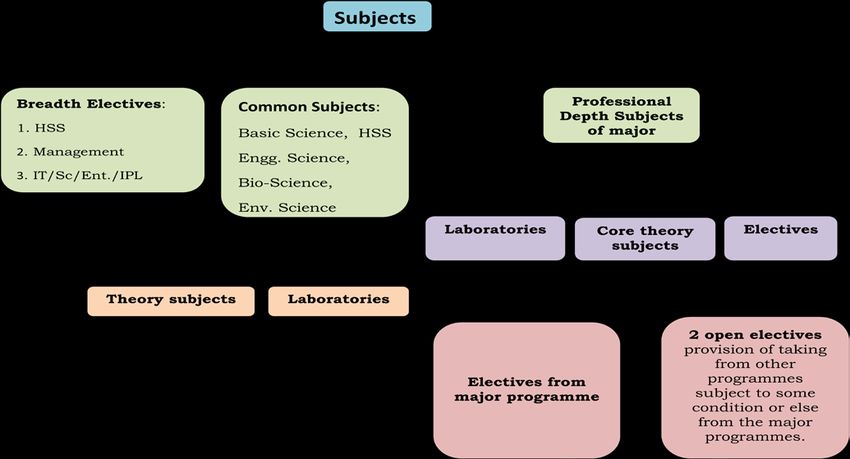
Theory and Laboratory /Design/Sessional subjects with regular class room
contact. The various categories as shown in Figure 1.
Four Non Credit components of Extra Academic Activity (Two in case of
B.Arch.(Hons.)) from 1st to 4th semester.
Industrial Training.
Comprehensive Viva Voce.
Project in Two parts for B.Tech.(Hons.)/B.Arch.(Hons.)/5 Year M.Sc. Programs.
Project in Four Parts, 2 each corresponding to the B.Tech.(Hons.) and M.Tech.
Field Trips for Mining Engineering, Geology and Exploration Geophysics
programs.
Figure-1 Category of Subjects
Students of Interdisciplinary Dual Degree will forgo the three Breadth courses
and two open electives in place of the corresponding subjects of Financial
Engineering or Engineering Entrepreneurship.
For Dual Degree Students, 2 M.Tech. level core/elective subjects will replace the
open electives.
The curricular components of the 2 Year M.Sc. of Joint M.Sc. -Ph.D. Program
structure is shown in the Figure 2.
Rules and Regulations Updated –February 2020 Page 14Figure 2.: Components of the 2 Year M.Sc. of Joint M.Sc.-Ph.D. Program
The students of Geology and Geophysics have field-trips as a part of their
curriculum.
14.2 Except Extra Academic Activity each component of the curriculum has credits
attached to it.
14.3 The detailed Senate approved curricula for various Disciplines along with the
syllabus for each subject for all the programs are available on the Institute
Website.
14.4 The curricula to be followed in the first two semesters by students of
B.Tech.(Hons.) /5 year M.Sc./Dual Degree programs shall be common.
14.5 Subjects: All subjects prescribed in the curriculum except Extra Academic
Activity have credits assigned to them. Subjects are broadly classified into two
categories:
14.5.1 Theory, Laboratory, Sessional and Design based courses having a regular
class room/laboratory contact. These Subjects have a lecture-tutorial-
experiment/design component (L-T-P) to indicate the contact hours per
week. Their L-T-P pattern may be (L-T-0,L-0-0,0-0-P and in some cases
L-T-P)
14.5.2 Comprehensive Viva Voce, Project, Field Trips and Industrial
Training/Office Training which do not have regular class room contact.
14.6 Teaching of subjects would be reckoned in terms of credits.
14.7 Subject pre-requisite: A subject may have one or more subjects listed as its
pre-requisite. A student who has qualified in all the subjects in the pre-requisite
would be allowed to register in the subject. The teacher concerned would have
the prerogative to waive the prerequisite for a student if he/she is satisfied
through a test that the student otherwise have gained sufficient proficiency to
take up the subject.
14.8 Extra Academic Activity: Every student must register and complete the Extra
Academic Activity (EAA) requirements as laid down in the curriculum.
EAA is classified into 4 main groups such as National Cadet Corps (NCC)
National Service Scheme (NSS), National Sports Organization (NSO) and
Health and Fitness (HF).
Further NCC is classified into Electrical & Mechanical Engineering (EME)
Wing and Air Wing (ARW).
Rules and Regulations Updated –February 2020 Page 15 NSS classified into 15 units.
NSO classified into different sports such as athletics, badminton, basketball,
cricket, football, hockey, swimming, tennis, table tennis, volleyball.
Health & Fitness classified into 10 units.
All the above EAA is being coordinated by Program Coordinator and the
individual modules by Program officers.
Student exercise their choice of EAA components at the time of admission.
Allocation of the EAA component is made centrally based on their choices and
availability.
EAA is a non credit course, however the grade will awarded. (SENATE:
323.H.I.C.9)
Clearing EAA is mandatory for the award of the degree.
14.9 Modalities for administering the open elective slots
Open elective I
In the slot of open elective I, only the following category of students can opt for a
subjects from other departments:
The students must have registered for a minor/ Micro-Specialization and the subject
opted from other departments must be one of the subjects of his / her requirement for
the minor/ Micro-Specialization.
The students who do not fall in the above category (who have not registered for a
minor/ Micro-Specialization) have to opt for subjects only from the list of his / her
parent department in this slot.
Open elective II
In the slot of open elective II, the following category of students can opt for a subject
from other departments:
The students must have a CGPA ≥ 8.0.
The students registered for a minor/Micro-Specialization may utilize this slot in opting
for a subject of his / her requirement for the minor, or for a subject from other
departments (available in the slot) as he / she desires.
The students having a CGPAyears for 5-year Integrated M.Sc., 5-year B.Arch. (Hons.), and 5-year Dual
Degree students, 4-years for the 2 Year M.Sc. of the Joint M.Sc.- Ph.D.
Program .
14.12 Conferment of Degrees for Dual Degree/5 Year M.Sc. Program/6 Year Dual
Degree M.Sc.- M.Tech: On successful completion, a student would be conferred
the B.Tech.(Hons.) and the M.Tech. degrees in the case of the Dual Degree;
B.Tech. (Hons.) in the parent engineering discipline and M.Tech. in Financial
Engineering or Engineering Entrepreneurship for Interdisciplinary Dual Degree
Programs or Petroleum Engineering for the Trans-disciplinary Program. Both
B.Sc.(Hons.) and the M.Sc. degrees will be awarded in the case of the Integrated
M.Sc. degree together on successful completion of all ten semesters of study.
For the 6 Year Dual Degree M.Sc.- M.Tech program- B.Sc.(Hons.), M.Sc. degree
in the respective discipline along with an M.Tech. in Petroleum Engineering
would be awarded on successful completion of all twelve semesters of study
15. Co-ordinated Courses
A Co-ordination Committee would be constituted for each subject taught by more
than one teacher of one or more Departments/Centers. Each committee would
consist of all the teachers who are involved with the teaching of the subject
during the semester. One of its members would be nominated by the Head of
that Department, under whose name the subject is being offered, to act as its
Chairman.
15.1 Tenure: The semester in which the subject is being offered.
15.2 Functions:
15.2.1 To lay down the course plan for the subject.
15.2.2 To coordinate instructions and progress of teaching in the subject and
to ensure that the full syllabus is covered.
15.2.3 To review periodically the performance of students who have registered
in the subject.
15.2.4 To forward the results of the examinations and the final grades
obtained by each student taking the subject to the concerned Head of
the Department.
15.2.5 To moderate the question papers on the subject and ensure that the
syllabus is well covered by the question papers.
15.3 Frequency of Meetings: Each Co-ordination Committee shall meet at least four
times during the semester.
16. Industrial Training and Field work
16.1 The curricula for all B.Tech.(Hons.) programs would include compulsory
industrial training for 8 weeks carrying 2 credits, to be carried out in the
summer vacation at end of the sixth semester,
16.2 The curricula for all Dual Degree and 5-year M.Sc. programs would include
compulsory industrial training for 8 weeks carrying 2 credits, to be carried out
in the summer vacation at end of the eighth semester.
16.3 The allotment of training programs of all the students by Career Development
Centre will be frozen by a suitable and fixed deadline each year. No further
change will be entertained under any circumstances.
16.4 A student after being selected in an organization by Career Development Centre
cannot opt out of his training from that organization under any circumstances.
16.5 Any arrangement of training in industry or academia (within or outside the
Rules and Regulations Updated –February 2020 Page 17country) has to be routed through Career Development Centre via the Professor-
in-Charge of training of the respective department.
16.6 Evaluation of Summer Training. The performance of the student in the
Summer Training will be evaluated based on his submission of a certificate from
the organization of his training followed by a combined viva-voce/presentation
and report examination.
16.7 The curricula of Mining Engineering would suitably include the additional
requirements of industrial training and field work equitably distributed at the
third and the fourth year levels.
16.8 The curriculum of B.Arch.(Hons.) course shall include a six month field training
to be carried out in the eighth semester.
16.9 Summer Internship of ongoing 4th year Dual Degree students.
A 4th year Dual Degree student ( students admitted prior to Academic year 2013-
2014) will be allowed to pursue a Summer Internship Program provided the
Supervisor of his M.Tech. thesis work certifies that the program is strongly
connected to his thesis work. The students undergoing such program will not get
the M.Tech. scholarship during their period of internship outside.
From the session 2016-2017 onwards, the curricula for Dual Degree
courses and all 5-year M.Sc. programs would include compulsory industrial
training for 8 weeks carrying 2 credits, to be carried out in the summer
vacation at end of the eighth semester (in place of sixth semester)
including QEDM programme (SENATE: 326.H.I.C.4)
For students of petroleum engineering students (Bsc-Msc-M Tech), the
compulsory industrial training for 8 weeks carrying 2 credits, to be carried
out in the summer vacation at end of the tenth semester. (SENATE:
330.H.I.C.9)
17. Additional credits
From the THIRD semester onwards (including 2yr MSc Students, SENATE:
329.H.I.C.5) the curriculum offers scope for a student to opt for Additional
subjects apart from the regular curriculum requirement under the following
conditions:
17.1 If a student has a Cumulative Grade Point Average (CGPA) equal to or greater
than 7.50 without any backlog, he/she would be allowed to take additional
subjects within and/or outside his/her own discipline to earn additional credits
of up to 33% of his/her requirement for major. A student would be allowed to
register in an additional subject only if he/she satisfies the pre-requisite, there is
no clash in the timetable and the class size permits.
17.2 Once a student has registered in an additional subject, the grade obtained
(including F-grade) in that subject would invariably be recorded in his/her grade
card. The credit contribution of these additional subjects to the computation of
CGPA, however, would be considered as nil.
17.3 The GPA of the additional subjects is separately calculated and indicated in the
grade card.
17.4 A student can drop an additional subject following the proper procedure before
mid-semester examination (Senate Item 320.H.I.C.11); otherwise the subject will
remain registered and the subject will be mandatorily reflected on the Grade
Card even with F grade.
17.5 There is no scope for supplementary examination in an additional subject.
17.6 However in the case of failure in the additional subject, the student should
Rules and Regulations Updated –February 2020 Page 18repeat the additional subject in the next offered semester. The student is
permitted to take alternate additional subject if the subject is not offered in the
next semester. These additional subjects will not be counted for minor
specialization (Senate Item 320.H.I.C.11).
17.7 The students can register for Additional subjects with EAA as backlog
(Senate Item 322.H.I.C.6). .
18. Micro-Credits
18.1 Micro-Credit courses are one credit courses having duration of 3‐14 days
offered during the semester or during evening or free slots available during
weekdays or even weekends that are not declared holidays in some special
cases when students are available.
18.2 The subject will be counted for total credit requirement for completion of
degree in special cases subject to recommendation of the Head and
approval of Dean (UGS) with due reasons recorded.
17.8 The subject and grade will be mentioned in transcript / grade card and will be
used to compute CGPA for additional subjects and will be shown as ACGPA.
Failures will be marked by F grade. There will be no supplementary examination
for such subjects. In the case of failure in the micro-credit subject, the student
should repeat the micro-credit subject if offered in the next offered semester. The
student is permitted to take alternate micro-credit subject if the subject is not
offered in the next semester. (Senate Item 321.A.I.C.1).
18.3 However, in case the micro-credit is accepted as a subject contributing
to the curricular requirement, it will be accounted for in the CGPA
calculations.
18.4 A student is normally not expected to take more than 2 such courses in a
semester. The subject may also be a part of minor and micro‐specialization.
18.5 The students can register for Micro-credit subjects with EAA as backlog
(Senate Item 322.H.I.C.6). .
19. Minor in a Discipline
19.1 A department would offer a MINOR in a discipline in which it offers a major.
19.2 The department would enlist a set of subjects from its curriculum and prescribe
a requirement for minor taking six subjects or more (18-24 contact-hours plus
3-9 hours of laboratory) from this set. The subjects would be a combination of
mostly core and some electives.
19.3 Students aspiring for a Minor in a discipline must register for the same in the
beginning of the 5th semester. Only those students, who have a CGPA of 7.5 or
above, without any Backlog, will be permitted to register for a Minor. An SGPA or
CGPA in excess of 8.0 has to be maintained in the subsequent semesters
without any Backlog in order to keep the Minor registration active. Should both
the SGPA and CGPA fall below 8.0 at any point after registering for the minor;
the Minor registration will cease to be active.
19.4 A student registered for Minor in a discipline must register and pass in all
subjects that constitute the requirement for a minor and score a minimum
grade point average of 6.00 to be awarded a Minor in that discipline.
19.5 A student may cover these six subjects as either a depth subject, elective subject
or a breadth subject or as additional credits. However, he/she has to take at
least three subjects as additional credits to earn a minor.
19.6 Students enrolled in Dual Degree, Integrated M.Sc. and B.Arch. (Hons.) are
Rules and Regulations Updated –February 2020 Page 19permitted to pursue minor in other discipline up to their 10th Semester, while
the students of B.Tech.(Hons.) should complete the minor requirements by 8th
semester.
19.7 The students can register for Minor with EAA as backlog (Senate Item
322.H.I.C.6). .
20. Micro – Specialization
The Institute offers Micro-Specializations to UG students from the Spring
Semester of the current Academic Session (2014-2015). The salient features are
as follows:
20.1 Each Micro-Specialization has a defined structure in terms of three sequential
components:
20.1.1 Component-I – One Foundation Course (2-4 credits) that constitutes a
Mandatory Requirement and also a Pre-Requisite for subsequent
Components.
20.1.2 Component-II- One/Two subjects (3-4 credits each) from a Specified list
of subjects.
20.1.3 Component-III- Project/Design/Term Paper (4 credits) OR one subject
(4 credits) from a Specified list.
20.2 A Student would be required to complete 3-4 subjects (10-14 credits) from the
specified list in order to earn a Micro-Specialization.
20.3 The subjects can be taken through the Breadth/Open Elective component of the
curriculum or as Additional Subjects. If specified in the Micro-Specialization
curriculum, the subject can also be taken as Micro-Credit/s.
20.4 A student has to register for a Micro-Specialization. The Registration can be done
in the beginning of any Semester beyond first year.
20.5 In order to register for a Micro-Specialization the student must have completed
all curricular requirements upto the previous semester and have a CGPA ≥ 7.0.
Thereafter the student must maintain a CGPA or SGPA ≥ 7.5 without any
Backlog in the subsequent semesters to keep the Micro-Specialization
registration active.
20.6 GPA for the subjects contributing to the Micro-Specialization will be separately
calculated. A minimum GPA of 6.00 is essential to earn the Micro-Specialization.
20.7 The students can register for Micro-Specialization subjects with EAA as
backlog (Senate Item 322.H.I.C.6).
21. Admission to Ph.D. for Joint M.Sc. - Ph.D.
Program
Students admitted to the 2 year M.Sc. of the Joint M.Sc.-Ph.D. program can
either leave with the M.Sc. degree after the fourth semester or join the Ph.D.
program (SENATE: 304.F.I.C.4) if he/she satisfies the following rules:
21.1 The student must have secured a minimum CGPA of 8 at the end of the fourth
semester. The students must express, in writing, his (or her) willingness to
continue with Ph.D.
21.2 Successful Joint M.SC.-Ph.D. student will be awarded two degrees (M.Sc. and
Ph.D.) simultaneously. Hence a student shifting to the Ph.D. program will not be
listed as a recipient M.Sc. degree in the following convocation. However, each
such student will be the given final grade card of the 4-semester M.Sc. degree. If,
after joining, a student exits the Ph.D. program, then the degree of M.Sc. will be
Rules and Regulations Updated –February 2020 Page 20awarded in the next convocation. In that case the student will be given
provisional certificate at the time of discontinuing the program and the student
will be admitted to the Degree in the next convocation.
21.3 All regulations for the Ph.D. program with regard to admission, enrollment,
comprehensive examination, registration, and award of degree, etc. are
applicable to these students.
21.4 Joint M.Sc.-Ph.D. student admitted to the Ph.D. program will be treated as
Institute Research student and will receive assistantship as per the MHRD
norms prevailing at the time admission to the Ph.D. program.
21.5 A scholarship of Rs.5,000/- (Rs.Five thousand only) per month for the first two
years of M.Sc. program will be paid to the students who join the Ph.D. program.
The final amount will be released after the Ph.D. registration.
22. Semester Registration
22.1 From the second semester onwards only those students will be permitted to
register who have:
22.1.1 Cleared all Institute and Hall dues of the previous semesters,
22.1.2 Paid all required prescribed fees for the current semester, and
22.1.3 Not been debarred from registering for a specified period on disciplinary
or any other ground.
22.2 Eligible Students will be presented with a broad time window, as specified
in the Academic Calendar to Pay the Semester Registration Fee and finalize
his/her subject Registration by suitable choice of Electives/Additional or
Backlog subjects for each Semester.
22.3 It is mandatory for the student to be present in the Institute and report to
their faculty advisors on or before the day from which the classes
commence (as notified in the Academic Calendar).
22.4 Registration by the student and digital approval of registration by Faculty
Adviser should be completed within the specified date as per Academic
Calendar. (Senate Item 320.H.I.C.15)
22.5 No late registration is allowed. However, late registration is permitted only if a
student has taken permission a priori or has medical reason/calamity in the
family or any exceptional/ emergency circumstances. (Senate Item 320.H.I.C.15)
22.6 Guidelines for registration of UG students (except fresh 1st year)
22.6.1 A Student who has cleared all curricular requirements up-to the
previous semester will register for all subjects of the current semester in
accordance with the curriculum.
22.6.2 All backlog subjects of the corresponding semester have to be registered
first.
22.6.3 Students having only one backlog subject in a semester may register for
the prescribed credit of the semester in addition to the backlog subject.
22.6.4 For students having more than one backlog subject in a semester the
registered credit in the semester inclusive of backlog subjects must not
exceed 28.
22.6.5 For students repeating a year, the registered credit in a semester must
not exceed 20 (Senate item 320.H.I.C.10) in consultation with Faculty
Adviser and Head of the Department. However, on the recommendation
of the Department and approval of the Dean (UGS), a student may be
allowed to take maximum 23 credits. He/She may register for subjects
of P grade along with backlog subjects, with total registered credit not
Rules and Regulations Updated –February 2020 Page 21exceeding the limit of 20/23 as the case may be.
22.6.6 The credits of Industrial Training, field Trips (GG and MI students),
comprehensive viva voce and EAA should be excluded while calculating
the 28 or 16 credit limits per semester for backlog/year repeating
students.
22.6.7 In registration for a subject, prerequisite must be taken care of.
Students may be allowed to take Departmental elective subjects instead
of professional breadth electives.
22.6.8 Registration in the subjects of same slots will not be allowed.
22.6.9 Subject to availability, a student, irrespective of his/her level or
discipline of study may be allowed to take a subject including an
M.Tech. subject as an Elective, Breadth or Additional Subject Students
who have a Backlog in a Breadth or an Elective may register in
another Breadth or Elective. The Elective must be in the same
group of Electives offered in the Semester concerned.
22.6.10 Final year students may be allowed to take prescribed credit and, in
addition, maximum two backlog subjects in a semester provided he has
a CGPA of 6.00 and above so that he/she can clear all requirements of
the degree if otherwise there is no time clash.
22.6.11 Academically Weak Students:
Such students will be divided into two categories based on their
Notional CGPA (calculated on the basis on Total Credit Taken)
A. A student having CGPA < 6.0
B. A student who has more than two backlogs/unregistered subjects
(regardless of CGPA).
The faculty advisors will set up a meeting date every month and it will be
mandatory on the part of the students to attend these meetings. During
the meeting the problems of student will be discussed and measures to
improve their Academic Performance suggested. A report of these
meetings must be recorded on ERP for each student.
The Academic Registration on ERP for all weak students shall be done
through faculty advisor only.
22.6.12 Restriction limits on Registration for Academically Weak
Students
Students will be divided into two categories based on their
Notional CGPA (calculated on the basis on Total Credit Taken)
Category 1: Students with CGPA >=6.0
Category 2: Students with CGPA < 6.0
Registration limits will depend on the students’ category and the following limits
will be imposed based on the number of subjects:
Category 1: No restriction on the number of subjects. The student,
however, must register for the Backlog/Unregistered subjects first. A
student may register for a maximum of 24 credits. In case of final year,
where the normal credit loading itself is around 24 credits due to the
Project component, a student may be allowed two backlogs over and
above the prescribed credit limit of the semester.
Rules and Regulations Updated –February 2020 Page 22You can also read


