Information on applying a wellbeing approach to agency external planning and performance reporting - Audit New Zealand
←
→
Page content transcription
If your browser does not render page correctly, please read the page content below
Information on applying a wellbeing
approach to agency external planning
and performance reporting
Purpose
This document is a guide for agencies to consider how they could incorporate a wellbeing
approach into their external planning and performance reporting.

Background
What is wellbeing?
While there are many possible definitions of wellbeing, a wellbeing approach has recently
been described as enabling people to have the capabilities they need to live lives of purpose,
balance, and meaning for them. 1

The overall goal is a public sector focussed on current and future wellbeing

To achieve the Government’s wellbeing vision, New Zealand needs a public service that is
more strongly focussed on improving current and future wellbeing. To support this focus, the
Minister of Finance expects wellbeing to be incorporated into agency planning and
performance reporting and the Treasury has been working with agencies to test and learn
what a wellbeing approach in this area looks like.

How we expect this working document to be used
This document describes what we have learnt and is a working document, not a how-to-guide
or checklist. Agencies should consider how the approach described might be useful for their
agency and use their judgement as to how they will use it. We will work with agencies to
improve and update the information by the end of 2019, including having further examples of
work being undertaken (refer Appendix One).

This document is focussed on the agency reporting requirements set out in the Public Finance
Act (PFA) and would be relevant to the requirements that apply for Crown entities under the
Crown Entities Act.

Links to other work
This work is part of broader changes to the public finance system to apply a wellbeing
approach and to improve strategic financial management. Budget 2019 is one part of those
changes. Budget 2019 includes priorities that have been based on wellbeing analysis, and a
greater focus on outcomes and collective action. Another directly-relevant workstream is the

1
    Budget Policy Statement 2019 www.treasury.govt.nz/publications/budget-policy-statement/budget-policy-statement-
     2019-html
                                                                                                                          March 2019

Treasury:4085888v1                                 UNCLASSIFIED                                                       1
review of strategic planning and performance reporting (covering legislative and non-
legislative requirements). The objective of the review is to integrate strategic planning,
decision-making, and delivery. Recommendations from the review are due in 2019.
Intentions
We are seeking to achieve three impacts
The reporting requirements in the PFA set out accountability for agencies to Parliament and
the Public for the expenditure of public funds. In meeting these requirements, we are looking
for agencies to apply an effective wellbeing approach to help achieve the following three
impacts:
1. Parliament and the public being better-informed through performance information
with a wellbeing dimension
2. Ministers’ decision-making being informed by meaningful agency wellbeing
performance information, and
3. Agencies orientating behaviours, actions and delivery to improve wellbeing through
their strategy, planning and reporting processes.
These impacts have been agreed with the Minister of Finance.
By applying four principles of a wellbeing approach to performance reporting
The Minister of Finance also agreed the following four principles of a wellbeing approach for
agency performance reporting:
1. Long term/intergenerational – taking a longer term view
2. Collectively working towards shared outcomes - identifying the outcomes your agency
and others should be working towards and working together to achieve them
3. Multi-dimensional – thinking broadly about impacts both positive and negative
4. Recognising and building on existing tools – applying or aligning to existing wellbeing
frameworks (e.g. LSF), strategies (e.g. Child Wellbeing) and indicators (e.g. Living
Standards Dashboard, Indicators Aotearoa New Zealand).
To make these principles practical and useful, the table overleaf describes how they could be
applied by agencies in developing planning and performance reporting products. The overall
intent is that agencies should describe how they contribute (and have contributed) to
improving intergenerational wellbeing and supporting the Government’s wellbeing approach,
in ways that are meaningful and relevant to their agency and that meet the relevant legislative
and non-legislative reporting requirements.
Treasury:4085888v1 UNCLASSIFIED 2Applying the principles of the wellbeing approach to performance reporting requirements
The table below shows how the principles of the wellbeing approach could be considered in the process of developing various reporting products required in the PFA.
Aspect/process Principles Prompts to consider Examples of agency application
In meeting the requirements of the PFA or Crown Entities Act, and external stakeholders’ Depending on the nature of the work of the
Overall requirements, how can your SI/SOI show how you will support improving intergenerational agency, examples might not be relevant to others
wellbeing in a way that is meaningful and relevant to your agency? with different work and role
If you are undertaking horizontal and environmental scanning processes does it:
• look long term:
Some agencies take a longer term view due to the
• consider an appropriate timeframe?
nature of their work e.g. transport infrastructure,
• consider the balance of looking at both long term and immediate changes in your environmental work and impacts
Context and environment?
Worksafe used the LSF in their latest Strategic
environmental scanning
• consider any intergenerational issues or trade-offs in making strategic choices e.g. Intentions/Statement of Intent to describe their
environmental, societal etc? broader impacts
• look across a range of possible impact areas, not just in your area of focus? (Seeking examples of other agencies’ work)
• Long term/intergenerational
Strategic • consider wellbeing tools and strategies e.g. LSF four capitals, LSF Dashboard, Sector wellbeing
Intentions (SI) • Multidimensional strategies (e.g. Child Wellbeing Strategy)?
• Collectively working towards Does your framework demonstrating performance (e.g. outcomes, objectives, outcome framework
shared outcomes and indicators), where relevant, reflect:
• Using what already exists • long term timeframes and bridging the gap between current state and the long-term future
state?
• any relevant intergenerational effects (positive and negative) (e.g. issues in intergenerational
Frameworks and methods poverty, long-term environmental impacts)?
to demonstrate Worksafe references the LSF in their wider strategic
performance e.g. • your impacts (positive and negative) in a wide range of areas (for example any positive or context and the Ministry of Transport references it
outcomes, objectives, negative impacts across the LSF’s four capitals)? in their outcomes framework.
outcomes frameworks, • consider how you work with other agencies towards achieving shared outcomes (Seeking examples of other agencies’ work)
priorities and indicators
• What objectives/outcomes do you share with others?
• Are there other shared perspectives that could provide opportunities for improving
delivery e.g. shared customers, working in same region, same workforce etc?
• Existing wellbeing frameworks and indicators, e.g. LSF indicators, Child Wellbeing Strategy
indicators?
Treasury:4085888v1 UNCLASSIFIED 3Aspect/process Principles Prompts to consider Examples of agency application
• Are there opportunities for working collectively with other agencies to improve the
functioning of the organisation e.g. where there is a common workforce that makes sense to
Managing organisational develop in a collective way?
• Collectively working (Seeking examples of agencies’ work)
functions
• What barriers to working collectively with other agencies exist and how might they be
overcome?
Strategic
Intentions (SI) Are your current performance indicators able to better reflect the wellbeing principles (and be
robust and meaningful), for example:
Performance indicators • Using what already exists • Do they reflect long-term or intergenerational timescale (if this is appropriate)?
• Is it appropriate and meaningful to link to other wellbeing indicators e.g. the LSF
Dashboard or Indicators Aotearoa New Zealand?
• Do your intention statements reflect or reference collective work e.g. using similar intention
• Using what already exists
statement stems across Votes that are working towards a shared outcome? Some agencies are looking at this for Estimates
Intention Statement • Collectively working towards
• Does your intention statement, where appropriate, focus on the long-term contribution to 2019/20 but the work is not yet finalised
shared outcomes
Estimates wellbeing?
Is it appropriate for your performance measures to look over a longer timeframe e.g. a five year
Some agencies are looking at this for Estimates
Performance indicators • Long term/intergenerational timeframe if this is appropriate to the nature of the investment? [Note that your performance
2019/20 but the work is not yet finalised
indicators will need to be robust, meaningful and meet external stakeholders’ requirements]
In meeting the requirements of the Public Finance Act (or Crown Entities Act) and the This depends on the nature of the work of the
Overall All requirements of external stakeholders, how can your Annual Report show how you have agency, examples might not be relevant to others
contributed to improving intergenerational wellbeing in a way that is meaningful and relevant? with different work and role
Reporting Frameworks – The Treasury is interested in talking to agencies who might consider the Integrated Reporting NZ Post and KiwiRail use the Integrated Reporting
Integrated reporting approach to their Annual Report (as a pilot to trial and test the approach). approach in their Annual Reports
The Student Loan Scheme is a long-standing
Annual Report Are you working as part of a collective body towards a shared outcome that could consider
New ways of reporting – approach to collective reporting. The Family
reporting progress on that shared outcome to give Parliament and the Public information on
collective reporting Violence/Sexual Violence Joint Venture may
• Long term/ intergenerational outcomes that matter?
develop a 2018/19 collective report
• Multidimensional • While the annual Report needs to report against your Strategic Intentions and Estimates (or
• Using what already exists Statement of Intent and Statement of Performance Expectations for Crown entities) can this
Content, including be done in a way that highlights the agency’s contribution to improving intergenerational
additional reporting wellbeing and/or how you support the Government’s wellbeing approach?
information • The Annual Report can also report on other activities undertaken during the year – is there a
contribution to improving wellbeing that could be added to your Annual Report (as long as it is
meaningful and relevant to the performance story you are telling)?
Treasury:4085888v1 UNCLASSIFIED 4UNCLASSIFIED
Appendix One - What some agencies have done so far
Housing New Zealand
Note: the material below from Housing New Zealand was written before the Government
announced the establishment of a new Crown agency, the Housing and Urban Development
Authority. The material is included to illustrate Housing New Zealand’s proactive approach to
considering wellbeing in their strategic planning and performance reporting, however the
detail in the next steps section in the second paragraph does not reflect the impact of
subsequent structural changes.
For Housing New Zealand (HNZ), interest in wellbeing reflects their change in focus from asset
management to including a more customer-focused approach. Some of the work HNZ has
done relating to wellbeing in 2018 includes:
• Mapping their outcomes and impacts to wellbeing, guided by the LSF and proposed LS
Dashboard, OECD’s Better Life and How’s Life In Your Region, and other
outcomes/wellbeing work including the Australian Social Housing model
• the Executive Team gaining an understanding on the linkages between HNZ’s
interventions and the 12/13 LSF domains including current Wellbeing domains and 4
capitals
• briefing all people leaders on the wellbeing domains and workshopping material for
their strategy refresh.
Planned next steps for HNZ include engaging with the Board on their outcomes and the linkage
to the wellbeing domains, which will then help inform the refreshing of their Statement of
Intent, and engaging the organisation in the new outcomes framework, including the ‘critical
few’ outcomes to help prioritise their activities. Finding a way to cast an outcome/wellbeing
lens throughout their existing planning processes will be critical to implementation of their
strategy.
Treasury:4085888v1 UNCLASSIFIED 5UNCLASSIFIED
Worksafe
WorkSafe have used the Living Standards Framework to look at how they contribute to
wellbeing across different dimensions in their 2018/19 – 2021/22 Statement of Intent
https://worksafe.govt.nz/about-us/corporate-publications/statement-of-intent/1819-
2122/
The material from page 14 is copied below.
Treasury:4085888v1 UNCLASSIFIED 6UNCLASSIFIED Appendix Two –Frequently Asked Questions (expected from agencies) Do I need to develop a new Strategic Intentions document? The PFA describes when a new Strategic Intentions document is required (see Section 38). This note does not change those statutory requirements, and should be considered when a new Strategic Intentions or Statement of Intent is required. How does this material alter our current requirements? The PFA sets out the requirements for Strategic Intentions, Estimates and Annual Reports. Tthis note is about how wellbeing might be considered within those requirements. Do I have to use the LSF? No, but it provides a useful tool for helping you to take a wellbeing approach. If there are other existing tools you are welcome to use those. Do I need to develop a wellbeing framework for our agency? Some agencies already have a wellbeing framework that applies to their work and their agency, but there is no expectation that all agencies would have one. Is this note only for reporting requirements in the PFA, or is it also for Crown Entities? Many of the agencies we have worked with in developing the guidance are Crown entities, who have seen value in looking at how to include wellbeing in their performance reporting. This note also could be applied to the ’equivalent’ requirements across the two acts (i.e. Strategic Intentions/Statement of Intent and Annual Report). Why the focus on the documents (Strategic Intentions, Annual Reports, Estimates)? The documents are products. The value of planning and reporting is often in the process and the development of insights. However, focussing on the products is a way to open the conversation about bringing wellbeing into agency performance reporting. The ideal is that the documents flow naturally from a process, rather than the documents are a separate product from thinking on strategic planning. What does this mean for other internal strategies, plans and performance reports? This note is about reporting required under the PFA (or equivalent under the Crown Entities Act). However most agencies also have other strategies, plans and reporting (for example sector strategies, organisational strategies and functional reporting). Although these are not covered by this note, agencies may wish to consider if it is useful to apply the principles into those other documents. Treasury:4085888v1 UNCLASSIFIED 7
UNCLASSIFIED

Appendix Three – wellbeing frameworks, information and
resources
Speech - Applying a Wellbeing Approach to the Public Financing System
Speech to the Institute of Public Administration New Zealand (IPANZ) by the Minister of
Finance, Hon Grant Robertson, on 21 February 2019.

        https://ipanz.org.nz/Article?Action=View&Article_id=150163

The Treasury’s Living Standards Framework (LSF)
        https://treasury.govt.nz/information-and-services/nz-economy/living-standards/our-
        living-standards-framework

The LSF is the Treasury’s high-level framework on intergenerational wellbeing designed to
support the Treasury’s advice. The LSF draws on OECD analysis of wider indicators of wellbeing
and amends it for New Zealand. The LSF complements rather than replaces other Treasury
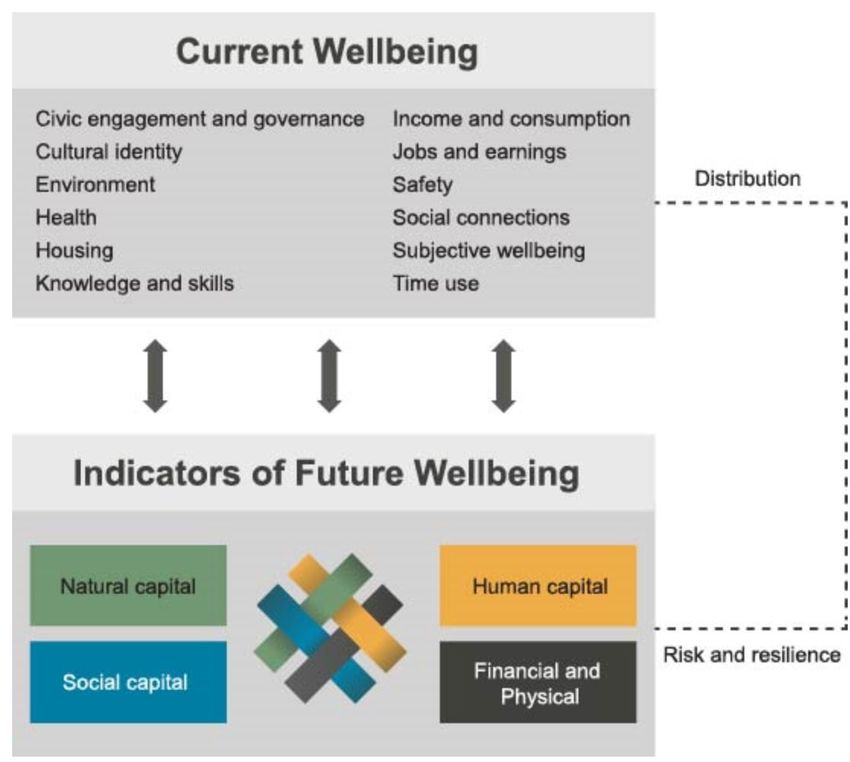
frameworks. The elements of the LSF are: the domains of current wellbeing; the capitals that
interdependently generate wellbeing; and risk and resilience. Intergenerational wellbeing
relies on the sustainable growth and distribution of the four capitals.

Living Standards Framework Dashboard

The LSF Dashboard is a measurement tool developed to support the LSF.within the Treasury to
view and compare indicators of wellbeing. It has been published on the Treasury website for
public transparency and interest. The LSF Dashboard is supported by a number of explanatory
reports.

To access the Dashboard and supporting material see the link below.

        https://treasury.govt.nz/information-and-services/nz-economy/living-standards/our-
        living-standards-framework/measuring-wellbeing-lsf-dashboard

Treasury:4085888v1                      UNCLASSIFIED                                         8
UNCLASSIFIED
Information about Treasury’s work to embed wellbeing in the public sector
The Treasury has developed a webpage on work to embed wellbeing in the public sector,
including embedding wellbeing into the Public Finance Act.
https://treasury.govt.nz/information-and-services/nz-economy/living-
standards/embedding-wellbeing-public-sector
The Wellbeing Budget 2019 and how the Wellbeing approach is being applied
https://treasury.govt.nz/publications/budget-policy-statement/budget-policy-
statement-2019
The 2019 Budget Policy Statement (link above) describes the Government’s wellbeing
approach and how it is being used in the Budget process in 2019. The 2019 Budget Policy
Statement includes a Wellbeing Outlook, and describes the five Budget priorities for Budget
2019.
Indicators Aotearoa New Zealand – Ngā Tūtohu Aotearoa
Indicators Aotearoa New Zealand is being developed by Statistics NZ as a source of measures
for New Zealand’s wellbeing. The set of indicators will go beyond economic measures, such as
gross domestic product (GDP), to include wellbeing and sustainable development.
Statistics New Zealand is aiming to launch the Indicators Aotearoa New Zealand – Ngā Tūtohu
Aotearoa website in mid-2019.
For more information see the Statistics New Zealand website.
https://www.stats.govt.nz/indicators-and-snapshots/indicators-aotearoa-new-
zealand-nga-tutohu-aotearoa
Treasury:4085888v1 UNCLASSIFIED 9UNCLASSIFIED
Some other wellbeing resources, frameworks and activity
Note: the Living Standards Framework and Indicators Aotearoa New Zealand are described in
Appendix Three.
International wellbeing frameworks
How’s Life? - OECD
https://read.oecd-ilibrary.org/economics/how-s-life-2017_how_life-2017-en#page11
Sustainable Development Goals (United Nations) – in New Zealand led by the Ministry of
Foreign Affairs and Trade (MFAT)
United Nations:
www.un.org/sustainabledevelopment/sustainable-development-goals/
MFAT:
www.mfat.govt.nz/en/peace-rights-and-security/work-with-the-un-and-other-
partners/new-zealand-and-the-sustainable-development-goals-sdgs/
Activity by other government agencies
Child and Youth Wellbeing Outcomes Framework - Department of the Prime Minister
and Cabinet
https://dpmc.govt.nz/our-programmes/child-and-youth-wellbeing-strategy
Child Poverty Measures – Department of the Prime Minister and Cabinet
https://dpmc.govt.nz/our-programmes/reducing-child-poverty/child-poverty-
reduction-bill
Environmental Reporting – Ministry for the Environment and Statistics New Zealand
http://www.mfe.govt.nz/more/environmental-reporting/about-reporting-series
Lifetime Wellbeing Model – Oranga Tamariki
Treasury:4085888v1 UNCLASSIFIED 10You can also read


