BULLET JOURNALING For More KAPOW!
←
→
Page content transcription
If your browser does not render page correctly, please read the page content below
©
BULLET JOURNALING
  For More KAPOW!
Needing an Improved System
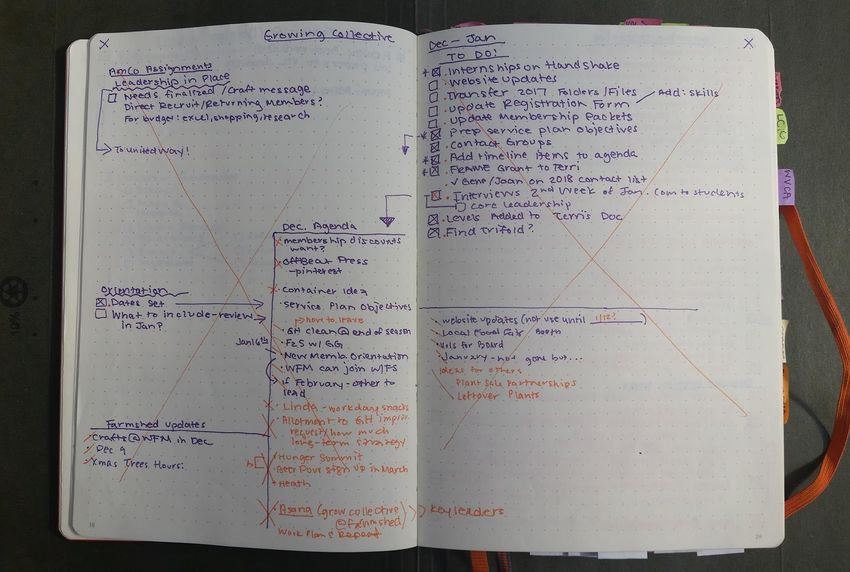
Finding Balance for More Kapow
Time Management with Bullet Journaling

●   Goal Setting
●   Prioritizing
●   Limit Procrastination
●   Scheduling
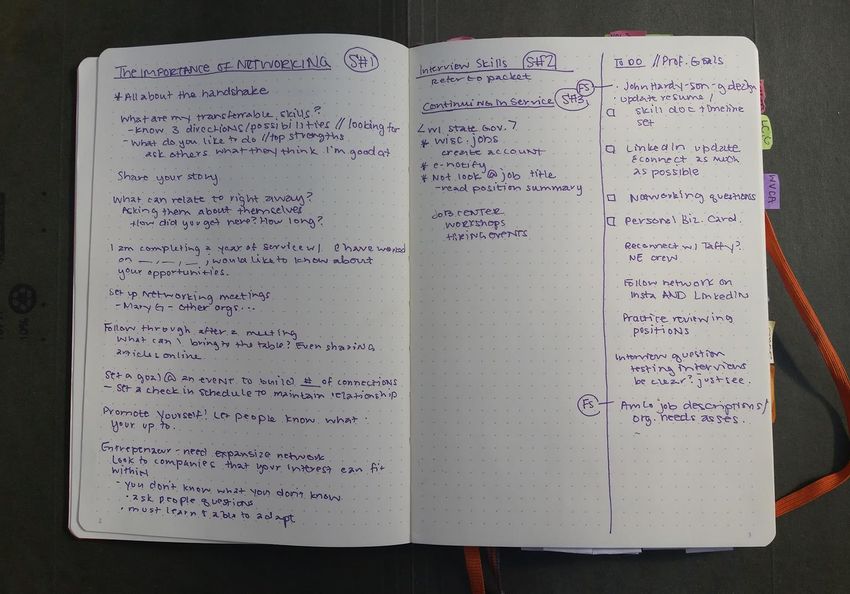
Getting Started – Tools
Getting Started - Organization

●   Just Begin!
●   Index
●   Color Tabs
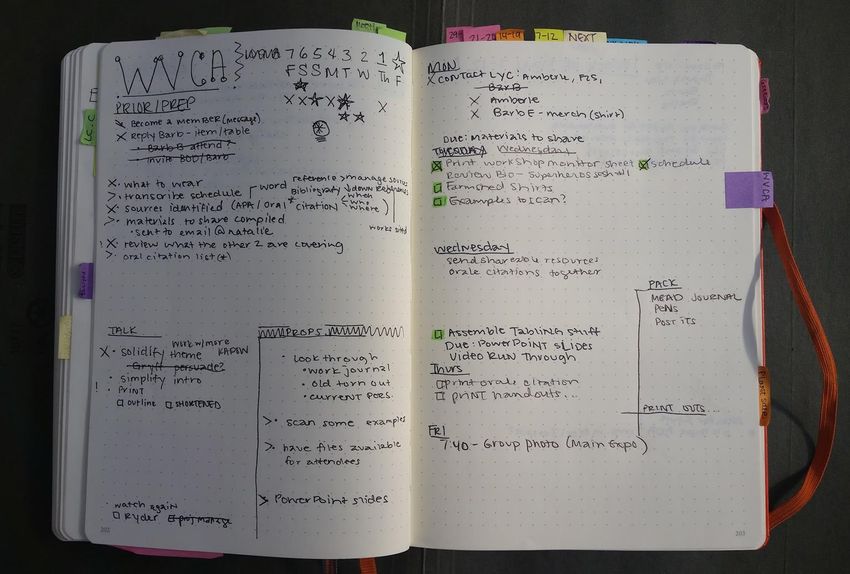
Getting Started - Indicators
●  Bullet - indicates a task
 ● Box (or color) indicates priority

   Partially complete
   Done
> Migration forward
< Migration backward
   Strikethrough
Organization - Additional Tips

●   Complete pages

●   Threading
Contemplate:

● Goals you have
● Habits you wish you did more often
● Tasks that you should accomplish
Goal Setting
Consciously creating infrastructure

Micro & Macro Goals

Commitment, Accountability & Positive
 Reinforcement
Prioritizing - Why Lists
Prioritizing - Non-priority Tasks & Goals
Limiting Procrastination
Limiting Procrastination - Simplifying
                Tasks
Scheduling ● Annual / Quarterly ● Monthly ● Collections ● Weekly & Daily
Scheduling - Quarterly
Scheduling - Monthly
Scheduling - Weekly & Day to Day
● Weekly Include
    ○ Week Of _____________
    ○ Big project goals/deadlines
● Daily Include
    ○ Appointments
    ○ 5 Top Tasks to complete
    ○ Breaks
● Create space for Next Week
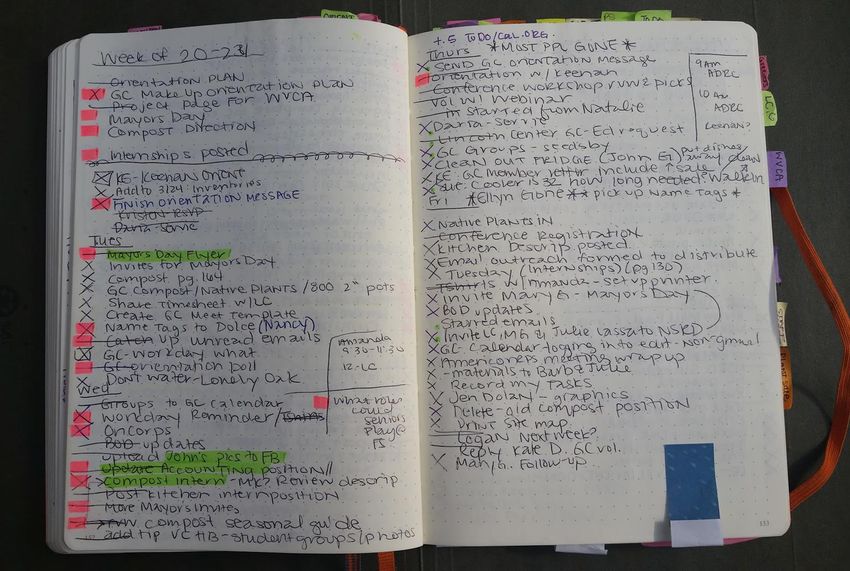
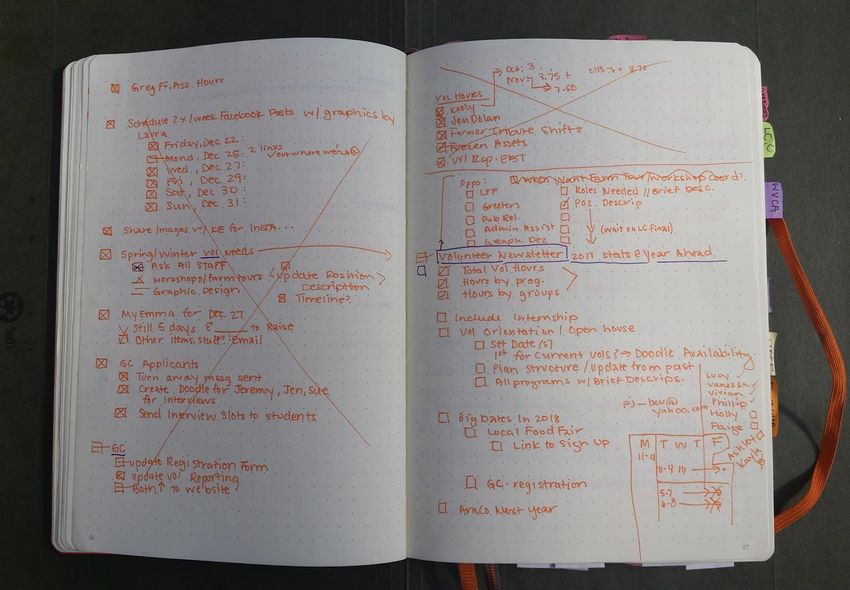
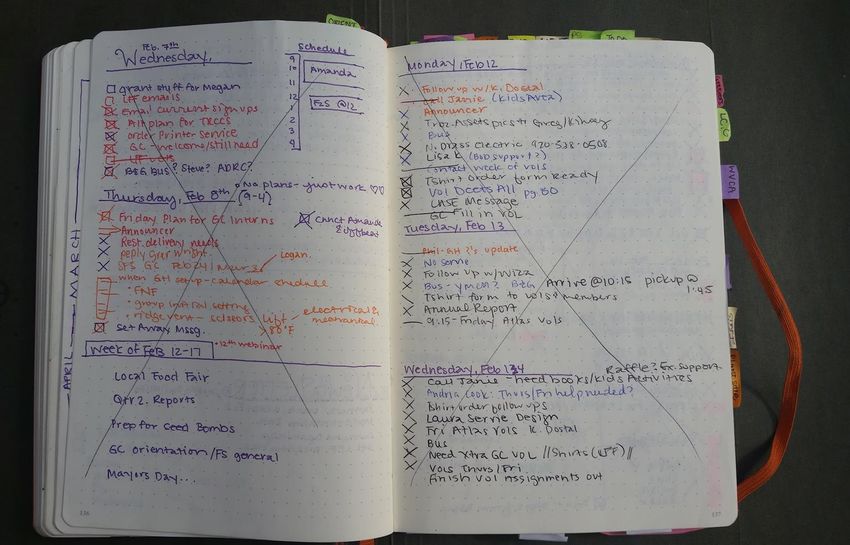
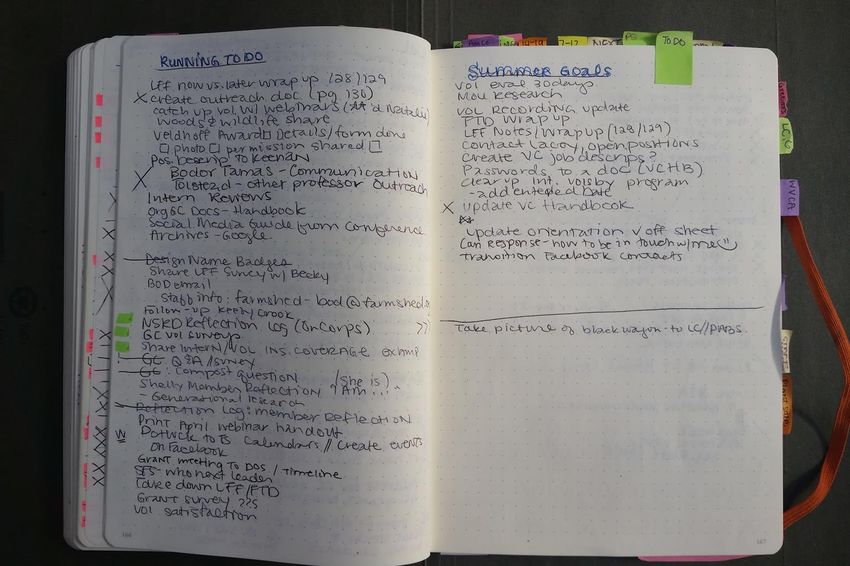
Weekly & Day to Day Plans
Weekly & Day to Day Plans
Weekly & Day to Day Plans
Collection Lists
● Meetings
    ○ One on one, staff
    ○ Notes
● Shopping & Wish Lists
    ○ tasks, items
● Thank You’s
● Personal Goals & Tracking
    ○ Books, Podcasts, Ideas, Crafts,
    ○ Quotes, Memories, Birthdays, Gift Ideas
    ○ House projects
Collections -1st Step
Collections - Big Projects
Collections – Big Projects
Collections - Big Projects
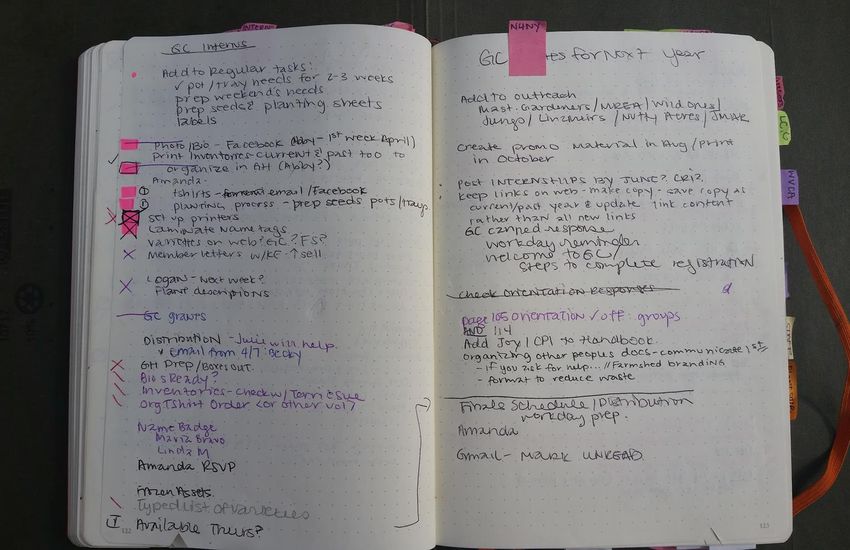
Collections - Notes
Collections - Notes for Next Year
Reflection, Maintenance & Evolution
In Conclusion
Recommended Resources

● Original Bullet Journal site
● How to lead an intentional life TEDxYale Ryder Carroll
● Project management bullet journal youtube video
● Minimal project management website
Works Cited
Adams, G. (2016, Feb 17). A Medium Corporation (US). Retrieved from 6 Top Tips for Time Management as a Busy Millennial:
https://medium.com/leaders-create-leaders/6-top-tips-for-time-management-as-a-busy-millennial-f68de3aed5bd

Bullet Journal. (2013). Getting Started. Retrieved April 22, 2018, from Bullet Journal: http://bulletjournal.com/get-started/
Carroll, R. (2017, Jan 20). How to Lead an Intentional Life | Ryder Carroll | TEDxYale. Retrieved April 22, 2018, from YouTube:
https://www.youtube.com/watch?v=ym6OYelD5fA&t=1s
How to Bullet Journal for Work: An Update. (2016, Aug 17). Retrieved April 22, 2018, from YouTube Pretty Prints & Paper:
https://www.youtube.com/watch?v=6HwPwiN-QVQ
Millenials. (2018, April 14). Retrieved April 14, 2018, from Wikipedia: https://en.wikipedia.org/wiki/Millennials
Pew Research Center. (2014, March 7). Pew Research Center. Retrieved from Millennials in Adulthood:
http://www.pewsocialtrends.org/2014/03/07/millennials-in-adulthood/
Pew Research Center. (2014, February 11). The Rising Cost of Not Going to College. Retrieved April 14, 2018, from Pew
Research Center: http://www.pewsocialtrends.org/2014/02/11/the-rising-cost-of-not-going-to-college/
Pew Research Center. (2015, September 3). Most Millennials Resist the ‘Millennial’ Label. Retrieved April 14, 2018, from Pew
Research Center: http://www.people-press.org/2015/09/03/most-millennials-resist-the-millennial-label/
Soto, K. (2016, July 16). Time Management: A 6-Step Guide For Millennials . Retrieved April 14, 2018, from Kenny Soto Student
of the Internet A Nerd With a Blog: http://kennysoto.com/time-management/
Williams, J. (2005, December 28). Nacada Academic Advising Today. Retrieved from Nacada KSU:
http://www.nacada.ksu.edu/Resources/Academic-Advising-Today/View-Articles/Millennial-Students-Rethinking-Time-
Management.aspx
Happy Planning- Thank You!

       Jackie Mather
  volunteer@farmshed.org
Work With More Kapow!
Deep Work
(Concepts by Cal Newport,
Presented by Ann Elise Trafford,
annelise@goodmancenter.org)Introduction Overview of presentation ●Hypothesis outlined in Cal Newport’s book ●Why Deep Volunteer Management Work? ●The Four Approaches to Deep Work ●Setting Up Routines and Rituals ●Productive Meditation ●Quitting Social Media ●Draining the Shallows ●Taking it Home
The Deep Work Hypothesis
The ability to perform deep work is becoming
increasingly rare at exactly the same time it is
     becoming increasingly valuable in our
  economy. As a consequence, the few who
cultivate this skill, and then make it the core of
          their working life, will thrive.
What is “Deep Work”?
• Description: Deep work vs. shallow work
• Why Deep Work is so important now
• The new law of productivity:
• (Time Spent) x (Intensity of Focus) = High-Quality Work
Produced
• Getting into the “flow state”Why is Deep Work important to
Volunteer Management?
• We are a field that makes connections and
therefore thrives on communication – which
can be antithetical to deep work
• It is crucial that we are adaptive and “big
picture oriented”
• My experiments and accomplishmentsThe Four Approaches to Deep Work
• Monastic approach – Retreat to quiet environment for a long
stretch of time to eliminate or radically reduce shallow obligations
(Secluding yourself is best option when you’re in a
distracting/hostile environment)
• Rhythmic approach -- Increase the frequency of deep efforts by
scheduling them regularly in the calendar
• Journalist approach -- Whenever you find leisure time during the
week, switch to deep work mode (“when the inspiration strikes”)
• Grand gesture approach -- Radically change your environment
(and make an investment of money or effort) to increase the
perceived importance of the task (ie locking yourself in a cabin
until the project is finished)Setting up Routines and Rituals • May be helpful to think of it as a mental workout: Daily straining of your mental muscle/focusing hours. • Focusing ability must be trained regularly and consistently. Feeling bored + craving distraction is an opportunity. • Important to define clearly: Where you’ll work deeply, what you’ll be working on & the rules (for example: closed windows, no phone, darkened, no blogs/Facebook/Twitter) • Where and when will you do Deep Work? What do you need for it? ●write down designated spaces and triggers
Setting Up Routines and Rituals
● A forced daily shutdown is important because of:
 ○Parkinsons law: when you have a limited amount of time, it
  forces you to work faster & implement tactics/habits to
  increase per hour output
   ■It may even be useful sometimes to create artificial time
    limits, for example, writing something in half the time it
    would normally take you
 ○Zeigarich effect: Letting unfinished tasks take up mental
  resources after the work day has been completed. Solution:
  Make a schedule for any uncompleted tasks in the coming
  days
● Write down forced end time with a shutdown routine
Productive Meditation
• What it is: Occupy yourself physically & focus your attention on
one single well-defined professional problem
• Avoid:
• Distraction from the problem at hand
• Looping over what you already know about the problem
(brains will naturally do this to save energy)Productive Meditation • Could also be structured thinking. Do this by asking relevant questions. • For an example volunteer management project: • i. Find the relevant outline: What is needed for this project? • ii. Next step questions: How can I complete those next steps & what do they need to look like? • iii. Consolidate & affirm your answer: I will reach key objective x by strategies x, y & z which have tactics x, y & z. which will be tracked by indicators x, y & z.
Quitting Social Media
•   I know it’s challenging!!
•   Practice boredom = concentration training. When the brain
    becomes accustomed to on-demand distractions (phone,
    social media, …) it reduces its ability to manage working
    memory, ability to filter out relevant information, ability to
    focus on a specific task without distraction and otherwise the
    engagement of larger parts of the brain (mental resource
    depletion) than is necessary. Constant switching between
    tasks teaches brain to never tolerate absence of novelty.
Quitting Social Media
• Make a plan for practicing disconnectedness. Plan periods
on a daily/weekly basis where you have no access to the
internet/phone. Schedule in daily when you’ll use it. If you
find early in your offline-time that you need “crucial” internet
access:
●i. Switch to a different scheduled offline task
●ii. Schedule your online tasks sooner BUT wait an extra 5
minutes (conditioning)Draining the Shallows ● Write out draft schedules
The Potential in Being Less Busy

       ”The deep life, of course, is not for everybody.
It requires hard work and drastic changes to your habits.
   For many, there’s a comfort in the artificial busyness
  of rapid e-mail messaging and social media posturing.
         While the deep life demands that you leave
     much of that behind. There’s also an uneasiness
        that surrounds any effort to produce the best
         things you’re capable of producing, as this
          forces you to confront the possibility that
               your best is not (yet) that good.”
Work With More Kapow!
Presented by Natalie Holbrook,
Holbrook.natalie@marshfieldclinic.orgExamples
Examples
How Do I Canva?
Questions?
      Contact Presenters Through 8/31/18
Bullet Journaling
Jackie Mather, Marshfield Clinic Health System AmeriCorps Volunteer Wisconsin member serving at
The Central Rivers Farmshed, Inc., Stevens Point, Volunteer@farmshed.org

Deep Work
Ann Elise Trafford, Marshfield Clinic Health System AmeriCorps Volunteer Wisconsin member
serving at Goodman Community Center, Madison, annelise@goodmancenter.org

Canva
Natalie Holbrook, Marshfield Clinic Health System AmeriCorps Volunteer Wisconsin member serving
with Volunteer Wisconsin and MCHS Youth Net, Marshfield, holbrook.natalie@marshfieldclinic.org

                                     Thank you!
You can also read


