INTERNATIONAL BACCALAUREATE DIPLOMA PROGRAMME SUBJECT DESCRIPTIONS 2021-2023
←
→
Page content transcription
If your browser does not render page correctly, please read the page content below
ISL DOCUMENT
INTERNATIONAL BACCALAUREATE
DIPLOMA PROGRAMME SUBJECT
DESCRIPTIONS 2021-2023
Effective: 1 February 2021
Owner: Assistant Principal - IB Diploma Programme Coordinator

Chemin de la Grangette 2 I 1052 Le Mont-sur-Lausanne, Switzerland I T +41 21 560 02 02 I info@isl.ch I www.isl.ch
Table of content

The ISL International Baccalaureate experience                                              3

The ISL High School Diploma                                                                 3

The IB Diploma Curriculum                                                                   4

Group 1 – Studies in language and literature                                                4

  English A literature                                                                      4
  English A language & literature                                                           4
  French A literature (this course is currently tentative, and dependent on student numbers) 5
  French A language & literature                                                            5
  Language A literature school supported self-taught SL                                     5

Group 2 – Language acquisition                                                              5

  Language B (at ISL, we offer French, English, German, and Spanish as B languages)         5

Group 3 – Individuals and societies                                                         5

Group 4 – Experimental sciences                                                             6

  Biology                                                                                   6
  Chemistry                                                                                 6
  Physics                                                                                   7
  Computer science                                                                          7
  Design technology                                                                         7

Group 5 – Mathematics                                                                       7

  Mathematics: Analysis and approaches                                                      7
  Mathematics: Applications and interpretation SL                                           7

Group 6 – Arts                                                                              8

  Visual arts                                                                               8
  Music                                                                                     8
  Theatre                                                                                   8

IB Diploma Core                                                                             9

IB Diploma Assessment                                                                       9

01/02/2021                                                                       Page 2 of 12
The International Baccalaureate Diploma Programme (IBDP) is a rigorous two-year course of
study that was introduced at ISL in September 2000.

The International Baccalaureate Diploma gives students access to college and university study
throughout the world, and universities rightly perceive that a student who has completed the
requirements of the IB Diploma is well prepared for the demands of higher education.

The IB Diploma offers both breadth, in terms of the range of courses offered, and depth, in that
students must take each course for two years. It is a deliberate compromise between the
specialisation required by some national systems and the breadth preferred in others.

The ISL International Baccalaureate experience
The International School of Lausanne has provided an exceptional academic and
extra-curricular programme for the local and international community since 1962. The school
offers all three IB programmes, including the Primary Years Programme (IBPYP) and Middle
Years Programme (IBMYP). The IBDP or IB certificates are offered to all students in Years 12
and 13 with each year group consisting of around 90 students.

The dedicated, experienced and well-qualified teachers provide a secure and happy environment
where students are stimulated to learn and have the satisfaction of realising their full potential.
The relatively small classes and a good student – teacher ratio ensure that each child receives
the close supervision and individual attention that he or she deserves.

The IB Diploma Results of students at the International School of Lausanne are excellent, with a
mean points score each year of between 34.1 and 36.5 points, well above the world mean and
amongst the best non-selective IB Diploma schools globally.

The ISL High School Diploma
ISL offers a fully recognised US High School Diploma in addition to the International
Baccalaureate Diploma, as ISL is accredited by the New England Association of Schools and
Colleges (NEASC).

The IB Diploma and the ISL High School Diploma are two separate qualifications. The IB
Diploma is a more demanding programme, and students who successfully complete it are also
awarded the ISL High School Diploma. However, several students each year choose to focus
their efforts on achieving the ISL High School Diploma only, rather than both qualifications
simultaneously. Achieving greater success with a reduced range of courses that meets the
requirements of the ISL High School Diploma is the correct choice for a number of our students.
It involves taking individual courses that lead to the same final IB examinations, and results in a
portfolio of official IB course results that are recognized by universities in combination with the
ISL High School Diploma.

To receive the ISL High School Diploma, students must meet the following graduation
requirements:

    ●   4 years of a first language
    ●   4 years of mathematics
    ●   4 years of science
    ●   4 years of social science
    ●   2 years of a second language

Students must achieve an average ISL semester achievement grade of 3.0 each year, in each of
the above subjects.

More information can be found in the document “The ISL HS Diploma”. Please consult our
website or contact Mr Humphrey for more information.

01/02/2021                                                                            Page 3 of 12
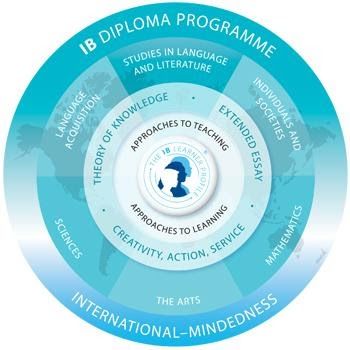
The IB Diploma Curriculum Students take six subjects for the full IB Diploma; three at higher level (HL) and three at standard level (SL). Each student must take one course from each of six groups. Generally, subjects studied at higher level will reflect the student’s area of interest and specialisation, and will be covered in greater depth and breadth than subjects studied at standard level. Higher level courses involve about 50% more work and are also more demanding. When choosing courses, it is essential to choose one subject from each of the six option blocks, A to F, using the form “IB Diploma courses offered at ISL 2021-2023”. The option blocks are designed to allow the maximum different subject combinations, given some necessary scheduling constraints. At ISL we anticipate the following choices will be available in August 2021. Information videos We are excited to launch the new section of our website, “Diploma programme options”. Please do visit this page to benefit from subject introductions for all of our diploma subjects, recorded by the teachers who actually deliver the courses. 01/02/2021 Page 4 of 12
Group 1 – Studies in language and literature
English A literature
       This is a literature course for native speakers of English as well as students with
       advanced proficiency in the language. It is offered at both HL and SL. Thirteen (HL) or
       nine (SL) works of literature are studied, some of which are world literature in
       translation. The course covers works of prose, poetry, drama and creative non-fiction
       from a variety of time periods.

English A language & literature
       This course is for native speakers of English as well as students with advanced
       proficiency in the language. It is offered at both HL and SL. The course focuses on both
       literary and non-literary texts. Together, the four parts of the course allow the student to
       explore English through its cultural development and use, its use in mass
       communication, and its literature. For further guidance on the differences between the
       two English A courses, please refer to the separate document “Literature vs language
       and literature – advice sheet”.

French A literature
       This is a literature course for native speakers of French as well as students with
       advanced proficiency in the language. It is offered at both HL and SL. Thirteen (HL) or
       nine (SL) works of literature are studied, some of which are world literature in
       translation. The course covers works of prose, poetry, drama and creative non-fiction
       from a variety of time periods.

French A language & literature
       This course is for native speakers of French as well as students with advanced
       proficiency in the language. It is offered at both HL and SL. The course focuses on both
       literary and non-literary texts. Together, the four parts of the course allow the student to
       explore French through its cultural development and use, its use in mass
       communication, and its literature.

More details on the differences between the two language A courses can be found in the
document ‘Language A - advice sheet’.

Language A literature school supported self-taught SL
       The IB offers students the opportunity to study literature in their home language,
       supported by an external tutor. The SSST literature course is paid for by the family, and it
       is designed for native or near-native speakers. It is only offered at SL. Ten works of
       literature are studied, three of which are world literature in translation. Please contact
       Mr Humphrey for more information.

01/02/2021                                                                            Page 5 of 12
Group 2 – Language acquisition
Language B (at ISL, we offer French, English, German, and Spanish as B
languages)
Language B is a foreign language course for students with previous experience of
learning the language. It is primarily a language acquisition programme, although some
literature is studied in the HL course as a means of understanding the diverse use of the
language. The emphasis of the language B programme is on communicative skills in
speech and writing, and on learning about the culture of the countries where the
language is spoken.
Aside from the literature component at HL, the main difference between the HL and the
SL courses is that HL students are expected to show a much wider range of vocabulary,
a firm command of grammar and an effective use of complex sentence structures. As a
rule of thumb, we expect 3-5 years of previous learning for the SL course, and 4+ years
of previous learning for the HL course. However, what is appropriate will vary
individually and the school is happy to advise students about the choice of level.
French ab initio (beginners)
Offered at SL only, this is a foreign language learning programme for absolute
beginners.
01/02/2021 Page 6 of 12Group 3 – Individuals and societies
Economics
Individuals, firms and governments must constantly make choices which will affect
their own economic wellbeing and that of society as a whole. How these choices are
made and the analysis of their consequences is central to the field of economics. Both
SL and HL students cover the same units, but in the HL course the topics are studied in
more depth and with quantitative tools.
Environmental systems and societies (ESS)
ESS is an interdisciplinary group 3 and 4 course that is offered only at standard level
(SL). As an interdisciplinary course, ESS is designed to combine the methodology,
techniques and knowledge associated with group 4 (sciences) with those associated
with group 3 (individuals and societies). Because it is an interdisciplinary course,
students can study ESS and have it count as either a group 3 or a group 4 course, or as
both. If students choose the latter option, this leaves the opportunity to study an
additional subject from any other group, including an additional group 3 or 4 subject.
ESS is firmly grounded in both a scientific exploration of environmental systems in their
structure and function and in the exploration of cultural, economic, ethical, political, and
social interactions of societies with the environment. As a result of studying this course,
students will become equipped with the ability to recognize and evaluate the impact of
our complex system of societies on the natural world.
Geography
Geography is a dynamic subject that is firmly grounded in the real world and focuses on
the interactions between individuals, societies and physical processes in both time and
space. The core themes include changing populations; global climate change; and
resource consumption and security. Accompanying the core is a series of two (SL) or
three (HL) options from key geographic themes. These include urban environments;
leisure, sport and tourism; and food and health (HL). In addition, HL students also study
an extension which focuses on global interactions. Fieldwork, leading to one written
report, is based on Lausanne’s urban environment and makes up the internal
assessment component of the geography course.
Global politics
Global politics allows students to analyze the significant political issues of our time in
an in-depth way. All SL and HL students complete a common core entitled “people,
power and politics”. This consists of four core units: power, sovereignty and
international relations; human rights; development; and peace and conflict. All students
undertake an engagement activity through which they study a political issue of interest
experientially. HL students also examine two contemporary global political challenges
through a case studies approach.
History
This is a world history course based on a comparative and multi-perspective approach
to history. It emphasizes the importance of encouraging students to think historically
and to develop historical skills as well as gaining factual knowledge. The prescribed
topic focuses on the move to global war in the twentieth century, with case studies
including authoritarian states in Germany, Cuba and Mexico. HL students also study one
regional option in depth, which is the history of the Americas region. All students will
also undertake an historical investigation of their choice which can be from any time
period or location.
01/02/2021 Page 7 of 12Group 4 – Experimental sciences
Biology
Biology is the study of the science of living things and how they function. It is an
experimental science that combines academic study with practical and investigational
skills. The core themes are: cell biology, molecular biology, genetics, ecology, evolution
and biodiversity, and human physiology. HL students study some topics in greater
depth, alongside some additional topics, such as plant biology and animal physiology.
Chemistry
Chemical principles underpin both the physical environment in which we live and all
biological systems, and chemistry is a prerequisite for many science higher education
courses. It is an experimental science that combines academic study with practical and
investigational skills. The core themes are: stoichiometric relationships, atomic
structure, periodicity, chemical bonding and structure, energetics, chemical kinetics,
equilibrium, acids and bases, redox processes, organic chemistry, and measurement
and data processing. The HL course covers the topics in greater depth.
Computer science
Computational thinking lies at the heart of the course and is integrated with other
topics. This will be supported by practical activities including programming, a case
study and a project to develop a product and associated documentation. Themes
covered include computer systems, computer organization and networks. HL students
additionally study abstract data structures, resource management and control.
Design technology
Design technology is a way of thinking and a set of processes and practices that aims
to use technology to develop improved solutions to human needs. The course consists
of six core topics: human factors and ergonomics, resource management and
sustainable production, modelling, final production, innovation and design, and classic
design. HL students additionally study user-centered design, sustainability, innovation
and markets and commercial production. Students develop their understanding of these
topics through a balanced series of teacher directed practical tasks and conceptual
case studies.
Environmental systems and societies (ESS)
ESS is an interdisciplinary group 3 and 4 course that is offered only at standard level
(SL). As an interdisciplinary course, ESS is designed to combine the methodology,
techniques and knowledge associated with group 4 (sciences) with those associated
with group 3 (individuals and societies). Because it is an interdisciplinary course,
students can study ESS and have it count as either a group 3 or a group 4 course, or as
both. If students choose the latter option, this leaves the opportunity to study an
additional subject from any other group, including an additional group 3 or group 4
subject.
ESS is firmly grounded in both a scientific exploration of environmental systems in their
structure and function and in the exploration of cultural, economic, ethical, political, and
social interactions of societies with the environment. As a result of studying this course,
students will become equipped with the ability to recognize and evaluate the impact of
our complex system of societies on the natural world.
01/02/2021 Page 8 of 12Physics
Physics is the study of the properties and interactions of matter and energy. It is an
experimental science that combines academic study with practical and investigational
skills. The core themes are: measurement and uncertainties, mechanics, thermal
physics, waves, electricity and magnetism, circular motion and gravitation, atomic,
nuclear and particle physics, and energy production. The HL course covers the topics in
greater depth. No specific level of achievement in mathematics is required for any IB
science course, but HL physics students are advised to combine it with mathematics:
analysis and approaches HL, and SL physics students are advised to take mathematics:
analysis and approaches at SL (or HL).
Sports, exercise and health science (please note that SEHS is tentatively included here as
the ability to run the course will depend on sufficient student interest)
Offered at SL only, sports, exercise and health science studies physical performance in
sport and health. It includes a consideration of the physiological, biomechanical and
psychological demands relating to high level performance in an activity. The course is
largely classroom-based and follows normal scientific inquiry. The traditional disciplines
of anatomy and physiology, biomechanics, psychology and nutrition are studied.
01/02/2021 Page 9 of 12Group 5 – Mathematics
Mathematics: Analysis and approaches
Mathematics: Analysis and approaches, offered at both SL and HL, is appropriate for
students who enjoy developing their mathematics to become fluent in the construction
of mathematical arguments and develop strong skills in mathematical thinking. They
will also be fascinated by exploring real and abstract applications of these ideas, with
and without the use of technology. Students who take this course will be those who
enjoy the thrill of mathematical problem solving and generalization. This subject is
aimed at students who will go on to study subjects with substantial mathematics
content such as mathematics itself, engineering, physical sciences, or economics for
example. The course has an emphasis on calculus and on algebraic, graphical and
numerical approaches.
Mathematics: Applications and interpretation SL
Mathematics: Applications and interpretation (offered at SL only) is appropriate for
students who are interested in developing their mathematics for describing our world
and solving practical problems. They will also be interested in harnessing the power of
technology alongside exploring mathematical models. Students who take this course
will be those who enjoy mathematics best when seen in a practical context. This subject
is aimed at students who will go on to study subjects such as social sciences, natural
sciences, statistics, business, some economics, psychology, and design, for example.
The course emphasises the applied nature of the subject, and also that interpretation of
results in context is an important element of the subject.
01/02/2021 Page 10 of 12Group 6 – Arts
Music
The music course offers students the opportunity to explore and enjoy the diversity of
musical forms throughout the world. They will develop perceptual and conceptual skills
through a breadth of musical experiences, learning to recognise, speculate, analyse,
identify, discriminate, create and hypothesise. The course aims to develop musicianship
and performance skills both individually and collaboratively and focuses on creation
skills through the exploration and investigation of composition and musical elements
using appropriate musical language. Underpinning the course is an emphasis on
increasing knowledge and understanding and developing critical awareness of music in
relation to time and place.
Theatre
The theatre course offers a broad range of study requiring students to learn about the
roles of performers, directors, designers and theatre-makers. Students learn to research,
contextualize, explore, analyse and evaluate their own work and that of other
theatre-makers. They have the opportunity to work as part of collaborative ensembles
as well as individually, distinguishing their own strengths and weaknesses and
discovering the benefit of close collaboration with others. In learning about world
theatre practices, influential practitioners, creative and original theatre companies and
established playwrights, students gain a richer understanding of themselves, their
community and the world they live in. A requirement of the course is viewing live theatre
and evaluating decisions taken by professional directors: we aim to see a variety of
productions during the course. Students are able to design the course to follow their
own passions and interests as their knowledge of theatre deepens, allowing
independence and creativity of thought and process.
Visual arts
Students of visual arts study three interrelated areas: visual arts in context, visual arts
methods and communicating visual arts. Visual arts in context provides a lens through
which students are encouraged to explore perspectives, theories and cultures that
inform and influence visual arts practice. Visual arts methods address ways of making
artwork through the exploration and acquisition of skills, techniques and processes, and
through engagement with a variety of media and methods. Communicating visual arts
involves students investigating, understanding and applying the processes involved in
selecting work for exhibition and public display. The HL students go into greater depth
and breadth with their exploration of these three areas.
In place of an arts subject, the sixth subject chosen may alternatively be another subject from
Groups 1, 2, 3 or 4.
Students can also study two languages in group 1 (rather than studying a B language in group 2)
– doing so will result in a ‘bilingual IB Diploma’.
We have had students take courses online in partnership with an official IB provider, Pamoja.
Online learning is not suitable for all students, but it provides students with other options for
study. Pamoja’s website can be found on this link. Please contact Mr Humphrey for more
details.
01/02/2021 Page 11 of 12IB Diploma Core At the centre of the IB Diploma model are three elements that ensure the IB Diploma is a unique educational programme, and completion of these is mandatory for achieving the IB Diploma. Theory of knowledge and the extended essay are not compulsory requirements of the ISL High School Diploma. Theory of knowledge (TOK) The extended essay CAS (creativity, activity, service) IB Diploma Assessment The IB Diploma (along with certificates for individual subjects, for those who are undertaking only the ISL High School Diploma) is not granted after an accumulation of credits. Instead, student assessment is based primarily on external examinations taken in all subjects in May of Year 13. However, all courses include at least 20% internal assessment. Each subject is graded on a scale of 1 (minimum) to 7 (maximum). In order to earn the IB Diploma a student must meet defined standards and conditions including a minimum of 24 points in total, including a minimum of 12 points from three HL subjects, and the satisfactory completion of the three IB Diploma requirements outlined above: theory of knowledge (TOK), the extended essay, and CAS (creativity, activity and service). The minimum score of 24 is based on the notion that a grade 4 represents a passing level in each of the six subjects. Excellent performance in the six subject areas results in a grade 7 for each, or a total of 42 points. Theory of knowledge and the extended essay combine to contribute a possible 3 additional points to the overall score, giving a maximum IB Diploma score of 45 points. If you have any questions about the High School Diploma or the IB Diploma Programme at ISL, please contact Michael Humphrey, Assistant Principal - IB Diploma Programme Coordinator (phone: +41 21 560 02 39; email: dpcoordinator@isl.ch). 01/02/2021 Page 12 of 12
You can also read


