School Charter, Strategic and Annual Plan for Farm Cove Intermediate School 2021 2023
←
→
Page content transcription
If your browser does not render page correctly, please read the page content below
School Charter, Strategic and Annual Plan
                                                                       for
                                       Farm Cove Intermediate School
                                                             2021 - 2023
                          Principal’s endorsement:                          Tamara Jones
                          Board of Trustees’ endorsement:                   Troy Scragg (BoT Approval Minuted)
                          Submission date to Ministry of Education:         March 2021

For further support and updated resources see our website www.uacel.ac.nz                                    ©AucklandUniServices Ltd, 2018
School Charter Mission Statement The Farm Cove Intermediate School community strives to ‘Reach Out’ and work collaboratively across the school, within the wider community and globally. 2
Vision
Wellbeing is at the heart of what we do. Our students are empowered as learners.
They are provided with opportunities to develop academically, socially, physically,
emotionally and spiritually. Their learning comes to life as they are engaged in
authentic inquiry based experiences that promote the attitudes that we value. Our
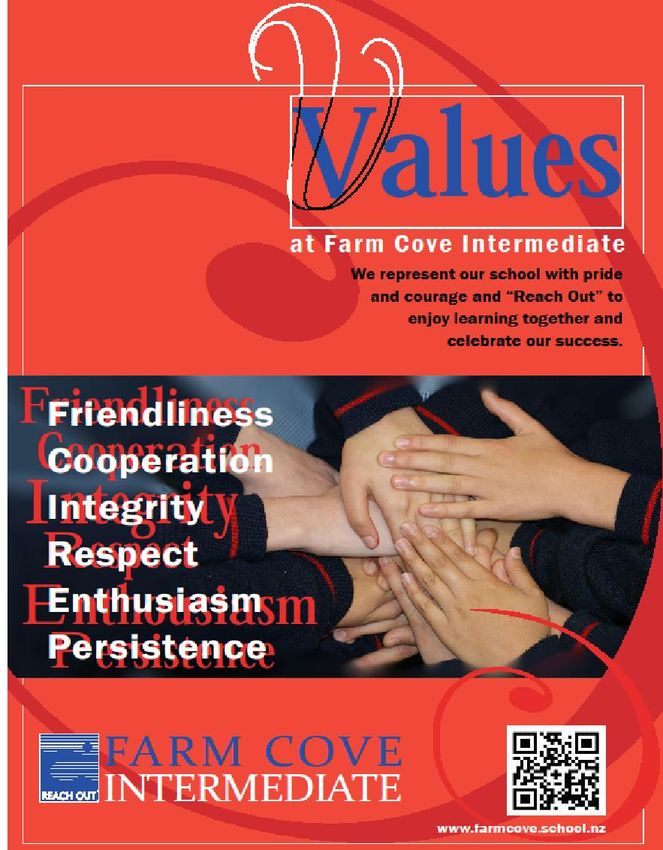
values include friendliness, cooperation, integrity, respect, enthusiasm and
persistence.

Equitable, caring and interactive learning environments support students.

Teachers are involved in on-going effective professional learning to enable students
to be confident, happy, connected and reflective learners. There is a shared
understanding of the Treaty of Waitangi and cultural diversity is celebrated.

Our vision extends to the wider community including parents and whanau. We
‘Reach Out’ to enjoy learning together and celebrate our success.

3
Principles   For our students to be at the centre of teaching and learning in our school we believe strongly that our curriculum reflects
             the following principles:

             High Expectations: Teachers interpret and scaffold learning to support students to achieve their personal best.

             Treaty of Waitangi: Acknowledging the Treaty of Waitangi as the foundation of New Zealand/Aotearoa all students will
             have an equal opportunity to learn. Opportunities are provided for all students to achieve knowledge of te reo Māori me
             ona tikanga.

             Cultural Diversity: Teachers and children celebrate diversity and respect each other’s cultural and personal
             backgrounds.

             Inclusion: The curriculum is inclusive so students are treated fairly without discrimination. Diverse learning needs are
             catered for and students are appreciated and affirmed as unique individuals. Abilities and talents are recognised and
             appreciated. Students feel valued.

             Learning to Learn: Learning to learn refers to students’ developing their learning abilities, and growing an awareness
             of different learning strategies so they can apply these confidently to situations which relate to personal goals. Teachers
             help students to learn through explicit feedback that guides success and how best to move forward. Students know what
             they are learning and what successful learning looks like. Personal, measured risk taking is encouraged.

             Community Engagement: The learning experiences connect the curriculum to the students’ world and encourage the
             support of their family and the community. Through collaboration, students’ learning experiences connect to their world.
             Sharing learning experiences with peers, family, community and the wider world is an important part of learning.

             Coherence: Learning is experienced in ways that interconnect values, key competencies and learning areas.

             Future Focus: Learning experiences are relevant to the changing worlds in which we now live.

4
Māori Statements from FCI documentation
Dimensions Meeting Student Needs The school has a responsibility to provide learning opportunities that maximise students’
and Cultural potential.
Diversity Community Partnership Students’ learning will be enhanced when the school’s Board and staff are responsive to
the educational needs and wishes of the school community.
School Self Review FCI will maintain a systematic process of self-review which will provide a sound basis for
improving educational outcomes for all students.
Performance Teachers are continually developing in terms of knowledge, skills and attitudes which
Management enhance their role and performance.
Professional Growth Collaborative inquiry into practice, and knowledge of The Code and The Standards for
Cycles the Teaching Profession will increase staff awareness of what is expected and lead to
greater effectiveness.
Evidence of the Board’s policies and practices that reflect the unique position of the Māori culture.
Teachers’ planning will reflect the unique tangata whenua status of Maori and reflect the principles of the Treaty of
Waitangi by:
● Consulting regularly with the FCI Māori community.
● Developing a strong kapa haka group to further understand tikanga Māori .
● Conducting regular reviews bi-annually on the professional development required to allow teaching staff to
embrace and incorporate te ao Māori (the world), te reo (the language) and tikanga Māori (the values) into
everyday learning within the school. (NELP 3)
● Monitoring and reporting on trends of Māori aori student achievement and gathering anecdotal data on the views
of Māori students to best support Māori learning as Māori eg. focus group discussions with Māori students.
● Monitoring trends of student attendance and highlighting “at risk” students for further detailed monitoring.
● Provide a Māori immersion GATE programme.
● Provide Māori enrichment activities within the Areas eg. Māori language week activities and Māori celebration.
● Provide Te Whare Ako, a specialist programme with a fully registered and confident te reo Māori teacher.
5Evidence that FCI procedures and policies reflect New Zealand’s cultural diversity.
● Providing ESOL programmes to meet student’s needs.
● Providing language learning in every Area.
● Including the celebration of cultural diversity within i-learning studies.
● Maintaining cultural performance groups, where possible, using staff and community interest and strengths.
● Maintaining and further developing procedures and practices for both students and teachers to become further
‘Asia equipped’.
● Maintaining the Ambassador programme to develop students’ understanding of cultural diversity and support of
students from various cultures.
Special To meet parent requests for a child to be instructed in Tikanga Māori and Te Reo Māori
The FCI Board’s policies ensure all reasonable steps are taken to provide instructions in tikanga Māori and te reo Māori for
Character/ full time students whose parents make this request.
Māori
Medium Step 1 Parents to contact the Principal and meet to discuss the needs and requirements of the child.
Step 2 Principal, Deputy Principal or Special Education Needs Co-ordinator (SENCo) contacts the Principal of the
status local college (Pakuranga College – Principal, Mr Michael Williams).
Step 3 Discussions take place between school, parents and college Head of Department for Maori, regarding the
student’s needs.
Step 4 If the needs can be met by the college an appropriate timetable will be set where the student joins the
appropriate class and an Individual Education Plan (IEP)/collaborative programme will be set in
consultation with the school, college and parents.
Step 5 If the needs of the student cannot be met by the college i.e. the student is not up to the standards set in
any class at Pakuranga College, the school will contact the local kaumatua for guidance eg. providing a
suitable tutor and linking into the Te Aho o te Kura Pounamu (The Correspondence School).
Full parent consultation will be maintained throughout the process.
6School Context
Baseline Data
Students’ Reading: School Wide data from End of Year 2017 to End of Year 2020
Learning NOTE: Although the cohorts from Year 7 to Year 8 are not identical from one year to the next they are very similar.
Working Towards At Above
Student Proportion Student Proportion Student Proportion
Number Number
Number
2017 Y7 54 17.2% 149 49.5% 101 33.3%
2018 Y8 51 16.3% 152 48.4% 111 35.3%
2018 Y7 81 26.4% 136 44.3% 90 29.3%
2019 Y8 60 19.7% 144 47.4% 100 32.9%
2019 Y7 77 24.5% 129 41.1% 108 34.4%
2020 Y8 56 18.1% 117 37.7% 137 44.2%
2020 Y7 84 28.1% 127 42.5% 88 29.4%
2017 Y7 & 8 Māori 15 24.6% 30 49.2% 16 26.2%
2018 Y7 & 8 Māori 14 18.4% 49 64.5% 13 17.1%
2019 Y7 & 8 Māori 17 24.6% 38 55.1% 14 20.3%
2020 Y7 & 8 Māori 14 28.6% 25 51% 10 20.4%
2017 Y7 & 8 Pasifika 7 22.6% 18 58.1% 6 19.4%
2018 Y7 & 8 Pasifika 10 28.6% 18 51.4% 7 20%
2019 Y7 & 8 Pasifika 15 40.5% 15 40.5% 7 19%
2020 Y7 & 8 Pasifika 18 50% 11 30.6% 7 19.4%
7Students’ Learning Writing: School Wide data from End of Year 2017 to End of Year 2020
NOTE: Although the cohorts from Year 7 to Year 8 are not identical from one year to the next they are very similar.
Working Towards At Above
Student Proportion Student Proportion Student Proportion
Number Number Number
2017 Y7 90 29.5% 161 52.8% 53 17.4
2018 Y8 78 24.5% 166 58% 70 22%
2018 Y7 125 40.7% 143 46.6% 39 12.7%
2019 Y8 92 30.3% 141 46.4% 71 23.3%
2019 Y7 112 35.7% 151 48.1% 51 16.2%
2020 Y8 77 24.8% 151 48.7% 82 26.5%
2020 Y7 113 37.8% 143 47.8% 43 14.4%
2017 Y7 & 8 Māori 22 36.1% 28 45.9% 11 18%
2018 Y7 & 8 Māori 27 35.5% 43 56.6% 6 7.9%
2019 Y7 & 8 Māori 32 46.4% 27 39.1% 10 14.5%
2020 Y7 & 8 Māori 23 46.9% 21 42.9% 5 10.2%
2017 Y7 & 8 Pasifika 6 19.4% 21 67.7% 4 12.9%
2018 Y7 & 8 Pasifika 8 22.9% 23 65.7% 4 11.4%
2019 Y7 & 8 Pasifika 17 47.2% 15 41.7% 4 11.1%
2020 Y7 & 8 Pasifika 18 50% 16 44.4% 2 5.6%
8Students’ Learning Mathematics: School Wide data from End of Year 2017 to End of Year 2020
NOTE: Although the cohorts from Year 7 to Year 8 are not identical from one year to the next they are very similar.
Working Towards At Above
Student Proportion Student Proportion Student Proportion
Number Number
Number
2017 Y7 74 24% 143 47% 87 29%
2018 Y8 65 21% 106 34% 143 46%
2018 Y7 109 35.5% 121 39.4% 77 25.1%
2019 Y8 74 24.3% 105 34.5% 125 41.1%
2019 Y7 116 36.9% 103 32.8% 95 30.3%
2020 Y8 85 27.3% 97 31.2% 129 41.5%
2020 Y7 95 31.6% 112 37.4% 93 31%
2017 Y7 & 8 Māori 20 32.8% 29 47.5% 12 19.7%
2018 Y7 & 8 Māori 23 30.3% 40 52.6% 13 17.1%
2019 Y7 & 8 Māori 25 36.2% 35 50.7% 9 13.1%
2020 Y7 & 8 Māori 21 42.8% 25 51% 3 6.2%
2017 Y7 & 8 Pasifika 13 41.9% 14 45.2% 4 12.9%
2018 Y7 & 8 Pasifika 13 37.1% 17 48.6% 5 14.3%
2019 Y7 & 8 Pasifika 21 56.8% 9 24.5% 7 18.9%
2020 Y7 & 8 Pasifika 20 55.6% 12 33.3% 4 11.1%
9Student Most students have excellent attendance and arrive at school in time to prepare for lessons. However, each year there
is a small number of students whose attendance requires close monitoring. Below 80% attendance is used as a guide
Engagement for attendance; students whose attendance drops below this percentage are supported to improve their attendance.
Providing students with choice, hearing student voice, growing student agency and further developing wellbeing is our
school wide focus. Student leadership opportunities enable students' voices to be heard. The Board regularly consults
with students through curriculum reports, walkabouts, students’ sharing research, and focus group interviews.
BYOD and the use of school owned devices have transformed the students’ access to information. Over 98% of students
currently bring their own devices. This has further empowered students in their learning and underpins staff collaborative
practices.
10School Farm Cove Intermediate (FCI) is a state co-educational school. The school was officially opened in 1980 and it caters
Organisation and for students in Years 7 and 8. The district, which was originally settled by the Nga Tai people, is now the well-established
coastal suburb of Pakuranga in the eastern suburbs of Auckland City.
Structures
The school is sited on 4.6 hectares of land which has both sealed and grassed areas. The grounds are attractive, well
planted and planned to meet the school’s needs. Well planned and well maintained innovative learning environments
are highly supportive of collaborative learning which is a major focus within our school. There are five main teaching
blocks and seven specialist rooms which include Food Technology, MultiMedia and Design Technology, Hard Materials
Technology, Visual Art, Science, Te Whare Ako and Performing Arts. The resource room and library adjoin the staffroom
and the administration block is a separate building. The hall is central to all teaching spaces and a gymnasium occupies
part of the field space between Farm Cove Intermediate and the adjoining school (Wakaaranga Primary).
The school operates an enrolment scheme and each year out of zone students are enrolled.
The main ethnic groups are:
NZ European 35.5%
Other European 6.3%
Māori 9%
Pasifika 4.2%
Chinese 21%
Indian 8.8%
Other 15.2%
11The decile rating is 8. Many parents play an active role in supporting their child’s education. Enrolment numbers are
reasonably stable with the school maintaining a roll of around 600 regular students along with a goal to also enrol an
additional 5% of international students.
The staff include a senior leadership team of three, eighteen classroom teachers, eight specialist teachers, an ESOL
learning assistant, five learning assistants supporting the regular classroom programme, five office administration staff
and a property manager. There is a balance of experienced teachers and less experienced teachers.
Robust health and safety policies, procedures and routines underpin day to day activities and all school practices. The
significant school wide use of student owned devices is managed within sensible procedures and guidelines. Up-to-date
personnel policies and practices ensure the Board continues to comply with all legislative requirements of being a good
employer.
A shared vision, school values, effective strategic documentation and a system of regular self-review underpins FCI’s
direction. There is a sense of commitment by students and staff to realise our shared vision of Reaching Out to our
school, local and global community. Students work in Areas to support each others’ learning and wellbeing. There is
a strong focus on collaboration, and students and staff utilise their strengths to maximise learning opportunities.
12Review of Our vision, Reach Out motto, values and principles underpin consultation. Consultation for 2021 included students
surveying students and on-line parent surveys, which have been analysed, evaluated and where appropriate, actioned.
Charter and The findings have been shared at Board meetings, with the survey participants and with our community.
Consultation
2021 planned review/surveys/consultation includes:
● Sexuality Education (staff with BoT)
● Māori and Pasifika Consultation (community)
● School Based Curriculum Consultation (community)
● Principal Interviews with each staff member (10 min interviews)
● Digital Technology (emergent)
A Maori consultation process will be developed in consultation with FCI experts and staff.
Self-review in relation to our Charter and Strategic Plan and review of our Annual Goals has included Board discussion,
teacher consultation and a mid and end of year senior teacher review.
This Charter and Strategic Plan will be reviewed in October 2021. An Annual Plan will then be developed and all strategic
documentation will be presented to the Ministry of Education by 1 March 2022.
13Strategic and Annual Plan Section
Strategic Goals Core Strategies for Achieving Goals 2021 Annual Plans
2021 - 2023 (hard copies attached to document)
Students’ Goal A
● Use achievement information effectively to Science and Sustainability Plan
Learning
1. To deliver a support improvement in student outcomes.
Implement the Board policies and long term Literacy Plan
curriculum in Reading,
Writing and plans to identify and improve student Mathematics Plan
Mathematics that progress and achievement for Māori and
reflects national Pasifika students. Wellbeing Plan
requirements and
focuses on raising STEAM Plan
● Identify barriers to learning and implement
student achievement.
strategies established to address these Culturally Responsive
(NELP 1)
issues in consultation with key stakeholders. Pedagogy Plan
2. To ensure there is (NELP 2)
Digital Technology Plan
appropriate resourcing,
a high level of teacher ● To sustain learning assistants’ roles and
capability and effective specialist teachers in supporting Reading,
planning to cater for Writing and Mathematics.
diverse needs.
● To track individual student achievement,
3. To raise learners’ involvement and work towards improving
well-being to impact student outcomes. This is to include specific
positively on them tracking and analysis of Māori, Pasifika and
academically, socially,
additional needs students.
emotionally, physically
and spiritually.
14● Work collaboratively within the school and
4. To develop across our Kahui Ako to improve student
sustainable learning outcomes and student wellbeing.
collaborative working ● Implement wellbeing lessons that are
groups connecting the
evidence based, focussed on developing
teachers so they can
student wellbeing.
be highly effective in
supporting the
students’ learning
(Kahui Ako Strategic
Mission).
Student Goal B ● For all classroom teachers to continue to monitor
Engagement To continue to monitor students who have attendance below 80% and
student attendance. implement strategies to lift attendance levels.
● For lateness to be monitored regularly and for
regular lateness to be addressed.
Goal C ● To listen to Māori and Pasifika student voices
through focus group discussions and pastoral
To increase student
care support.
consultation levels, to
listen to student voice
● To extend collaborative practice so students are
and further develop
further empowered through greater choice, voice
wellbeing.
and agency within their learning programme
(Kahui Ako project).
15School Goal D ● To continue to support all students by effectively
Organisation transitioning them from their contributing school
1. To continue to and then on to college.
and
successfully transition
Structures students from their ● For all staff to work successfully to transition
contributing schools students at the start of the year.
and on to college.
(Kahui Ako Goal) ● To work with the Kahui Ako to strengthen
2. To ensure that the transition strategies for our students.
school provides a safe
space for learning, free
from racism
discrimination and
bullying (NELP 1).
Personnel Goal E ● Review identified personnel policies.
To be a good employer
● To ensure that resources are provided to support
and for the Board to
PLD for all staff.
treat its staff in a fair
and equitable manner,
● For the Board to be visible and approachable.
complying with all
relevant employment
● For Board members to develop an understanding
legislation and
of their governance role and employment
contractual obligations.
responsibilities.
● To build coaching skills to promote
To provide resources understanding, trust and positive relationships.
and a work
16environment which
promotes a positive
and supportive culture
and where welling is
prioritised.
Property
Goal F ● Continue the cyclical maintenance programme
guided by the 10YPP.
To develop the
buildings, facilities and ● Complete outdoor projects.
grounds to support the
shared vision of the
school.
Finance Goal G ● To manage the finances in line with policies and
procedures.
To ensure that
appropriate financial ● To work with international student agencies to
management systems maintain effective relationships with them to
are in place. ensure international students’ stays are highly
successful.
To endeavour to
maintain the levels of ● To endeavour to maintain the international
locally raised funds. student income levels by enrolling short-term and
long-term students.
17Other 2021 Key Improvement Strategies to Achieve Strategic Vision
Property Short Report Finance Short Report
(summarised from 10YPP &
5YPP property plans)
To develop the buildings, Complete identified outdoor spaces which To ensure that appropriate To endeavour to maintain the number of
facilities, and grounds to include shade sail and turf in lower courts, financial management long-term international fee paying students.
support the shared vision replenishing lower gardens, completing systems are in place.
of the school. Kowhai quad, and Totara and Pohutukawa Seek external funding from specific funding
seating. To endeavour to maintain pools.
the levels of locally raised
Additional artworks will be displayed to funds. To continue to implement the 10YPP
enhance outside spaces. cyclical maintenance programme.
To create a property development plan which (links to: 2020 Budget, FCI policies and
will guide future direction. procedures, Health and Safety Register)
(links to: 2020 Budget, FCI policies and
procedures, 10YPP and 5YP, Health and
Safety Register)
Personnel Short Report Community Engagement Short Report
To be a good employer To continue to use PLGs, staff meetings and To consider a range of To continue with online surveys, and
and for the Board to treat specific courses to provide needs based PLD options to strengthen provide opportunities for community voice.
its staff in a fair and for teachers. community engagement and
18equitable manner, Ensure appropriate release supports PLD. select those which are the
complying with all relevant most viable. To continue to provide opportunities for
employment legislation feedback on policies and procedures.
To further develop collaborative inquiry to
and contractual support professional growth.
obligations. To continue to consult with local iwi, and
support local schools hosting the Koanga
To further support staff to maximise
Festival on matters relating to tikanga
To provide resources and collaboration to improve student learning
Maori.
a work environment which outcomes.
promotes a positive and
To continue Travelwise initiatives to support
supportive culture and (links to: 2020 Budget, FCI Personnel Policies,
independent and safe travel to and from
where welling is Staff Meeting/PLG Schedules, FCI Appraisal
school.
prioritised. Process, FCI SBC)
To continue to work successfully with Kahui
Ako schools and implement Strategic
Initiatives.
(links to: 2020 Budget, Travelwise Initiative,
Self-review Schedule, Maori Consultation
Processes, CoL documentation).
1920
You can also read


