IRELAND FOR FINANCE - Action Plan 2021 Building on Resilience - The strategy for the development of Ireland's international financial services sector
←
→
Page content transcription
If your browser does not render page correctly, please read the page content below
IRELAND FOR
FINANCE
The strategy for the development
of Ireland’s international financial
services sector

Action Plan 2021
Building on Resilience
Prepared by the Department of Finance   January 2021

Contents

Minister of State’s Foreword                      1

The Minister of State’s priorities                3

		Sustainable finance                             3
		Diversity                                       4
		Regionalisation                                 4

What has shaped our policy?                       6
Resilience and COVID-19, and digital finance      7
Capital Markets Union                             9

Action Meaures for 2021                          12

		Pillar 1 Operating Environment                 12
		Pillar 2 Technology and Innovation             16
		Pillar 3 Talent                                20
		Pillar 4 Communication and Promotion           24

Appendix 1: 2021 actions by quarter              30
Appendix 2: Review of 2020 action measures       33
Appendix 3: List of abbreviations and acronyms   37
D
Minister of State’s Foreword

I am pleased to introduce the new Action Plan 2021 under the Ireland for Finance strategy. It is a whole-
of-government strategy prepared in collaboration with industry stakeholders to develop the international
financial services sector in Ireland. 2021 marks the third year of delivering important results under it, since it
was launched in April 2019.

The vital contribution the international financial services sector makes to our economy is both recognised
and valued in the Programme for Government, ‘Our Shared Future’.

I would like to express my very great appreciation to the executives and officials in the private and public
sectors for their commitment to the implementation and oversight of the strategy and the delivery of Action
Plan 2021. Their contribution is key to preparing a balanced and effective suite of action measures, which
includes 16 new measures for 2021 in addition to the 30 ongoing actions. These focus on the key priority areas,
supported by commitments identified by industry, central Government departments and State agencies.

Over the course of 2021, I will formally meet senior executives from industry and senior officials from core
public sector bodies at the quarterly meetings of the Ireland for Finance Joint Committee to monitor progress.
At these meetings we will have the opportunity to discuss developments in the wider environment, including
opportunities and challenges, and I value the expertise and advice that both the firms and public bodies on that
Committee have already shared with me.

2020 was a challenging year, but the international financial services sector in Ireland has demonstrated a high
level of resilience to date. Overall, firms in the sector maintained employment and operations through the
COVID-19 pandemic, and the numbers of people employed in the financial services sector who needed the
Pandemic Unemployment Payment have been low. However, we will need to continue to monitor the effect
of the pandemic on the international financial services sector.

The other major development in 2020 was Brexit. It will bring changes in the relationships between all actors
in the international financial services sector in Ireland – firms, Government, investors and consumers, and
regulators and supervisors – and the actors in the UK. The Department of Finance has strengthened its team
in the Irish Embassy in London, and the Department will continue to engage with the EU and UK authorities on
a range of financial services issues throughout 2021.

The focus on the pandemic and Brexit must not distract us from dealing with other potential risks such as anti-
money laundering and terrorism financing, cybersecurity and IT risk, and environmental, social and governance
risks. The international financial services sector – and, equally, the domestic financial services sector – will need
to be aware of these and other risks, to continually monitor their policies and practices, and to ensure that they
keep abreast of legal and regulatory requirements.

I look forward to the sector’s contribution to the national recovery from the economic effects of the pandemic
and I believe it is one we can look to for growth in high-value employment in the coming years. To achieve that,
all of us – in the private and public sectors – must deliver on all of the actions we have all committed to in this
Action Plan.

                                                            Seán Fleming TD
                                                            Minister of State for Financial Services,
                                                            Credit Unions and Insurance
                                                            Department of Finance

        Ireland for Finance                                                                                        1
2
The Minister of                                          support the effectiveness of these green initiatives.
                                                         This will enable the commencement of the significant
                                                         investment needed to finance the fight against climate
State’s priorities                                       change and environmental degradation, especially in
                                                         light of renewed commitments on these areas
Sustainable finance                                      at COP26.

One of the priorities for 2021 is sustainable finance.   For Ireland, the European Green Deal and the
                                                         Renewed Sustainable Finance Strategy will help the
A key global event this year will be the 26th UN         country’s post-COVID-19 recovery, enabling us to
Climate Change Conference (known as COP26) in            build back better based on a transition to a green,
Glasgow in November, and Ireland is well placed to       low-carbon, sustainable economy in line with the
work with the UK authorities and the City of London      commitments in the Programme for Government.
in progressing shared interests on international
climate finance where Ireland can enhance its growing         Ireland leads on sustainability
engagement in this area with emerging economies and
the international financial institutions.
                                                                                   “Ireland’s initiative for improving
The World Bank Group has used Dublin as a centre                                   skills and expertise for greening
                                                                                   the financial system is setting an
for the issuance of sustainable and development                                    example for others to follow.”
bonds. The designation of the Irish Stock Exchange
                                                                                   – European Commissioner
as Euronext’s hub for green bonds and bonds related                                Mairead McGuinness,
to environmental, social and governance objectives,                                3 November 2020
including social and sustainability-linked bonds, has
been a key factor in the growth of this area.
                                                                                   In 2020 1,400 Irish located

           Centre of excellence                                 1,400              professionals participated in
                                                                                   sustainable finance talent
                                                                                   development programmes

                                                                                   A world first: in 2020 Ireland
                                                                                   supported the development of
                 Ireland is a centre
                                                                                   Europe’s first Taxonomy training
                 of excellence for                                                 course for asset managers
                 ESG Bonds*

                                                         On 10 March, the European Union’s Sustainable
                                                         Finance Disclosures Regulation will come into
                                                         force, and at the very end of the year the Taxonomy
                                                         Regulation will apply to the two objectives of climate
                                                         change mitigation and climate change adaptation.
*ESG bonds are bonds to fund projects with positive      These changes in the legal regime will require
environmental, social or governance outcomes.
                                                         continued work to raise awareness and develop
                                                         expertise in the financial services sector, and Action
This year will also be a significant one in Europe for
                                                         Plan 2021 reflects these through measures on
sustainable finance. The completion and launch of
                                                         the provision of training, the development of new
the European Commission’s Renewed Sustainable
                                                         products and services, and advancing best practice.
Finance Strategy will provide a valuable roadmap
for the continued development and growth Ireland’s
sustainable finance sector. Dublin was selected as
one of a small number of venues for the Commission’s
outreach on the Strategy because of its existing
success through actions in Ireland for Finance and
IFS2020, the previous Government strategy on the
international financial services sector. The Strategy
will underpin the European Green Deal Investment
Plan by increasing private investment in sustainable
projects and activities, coupled with the development
of the EU’s Capital Markets Union (CMU) to assist and

        Ireland for Finance                                                                                              3
A range of digital data sources have the potential Regional distribution of jobs
to offer more and better data for financial decision (outside of Dublin)
making. Under one of the measures in this action
plan, Sustainable and Responsible Investment
Forum Ireland (SIF Ireland) will undertake a review
of the types of digital data that are available on
environmental, social and governance risks, and how
these can be linked to standards and frameworks 30% 35%
such as the UN Sustainable Development Goals and in regions in regions
the recommendations of the Task Force on Climate-
related Financial Disclosures (TCFD).
Diversity
The business case for diversity is well known at this
2015 2020
stage. 2019 saw some improvements in the gender Regionalisation 2015-2020: larger share of jobs in the regions
balance of key roles in financial services firms, notably
in insurance and credit unions.1 However, the pace of
change remains very slow. COVID-19’s mass working from home ‘experiment’
has shown how services can be delivered from any
More work is needed to enhance diversity in its location in the country. The financial services industry
widest sense at senior levels across the entire rapidly adapted to enable staff to work from home, in
financial services industry. The issue is even more Ireland and, in some cases, abroad. A return to work in
acute in roles that are responsible for driving revenue, the office when it is safe to do so will be welcomed.
such as chief executive officers and heads of business
lines, where 85 per cent of posts are held by men. The regions have greatly enhanced their capacity
and capabilities through engaging with third-level
Different personality types, educational backgrounds, institutions that work successfully with international
and ethnicities, along with diversity of thought, can financial services firms. An important driver has
mitigate the risk of groupthink, improve decision- been the network of Regional Skills Fora, which
making, increase the effectiveness of internal were established under the Government’s skills
challenge, and enhance the culture within firms. architecture set out in Ireland’s National Skills
Given the importance of diversity and inclusion to Strategy 2025, and which provide a framework for
the culture and resilience of financial services firms, employers and the education and training system to
the Government continues to support the industry- work together to meet their regions’ skills needs. In
led initiative ‘Women in Finance Charter’ to place addition, apprenticeships in international financial
the spotlight on the need to improve diversity in the services continue to be provided around the country.
financial services sector.
A number of international financial services
Regionalisation companies have chosen to build centres of excellence
in regional locations in Ireland, taking advantage
Regional locations in Ireland offer a viable alternative of the opportunity afforded by the higher rates of
to Dublin for providing international financial services, staff retention in operations outside Dublin. There
whether as a primary site or as a second site that is are many benefits to this focus, such as reduced
complementary to operations in Dublin. Over a third costs for companies, enabling businesses to draw on
of international financial services jobs are located regional labour pools and well-renowned third-level
in areas outside Dublin. The sector has a significant institutions that work successfully with international
presence in a number of regional locations including financial services companies, supporting the regions
Carlow, Cavan, Clare, Cork, Donegal, Galway, Kerry, to realise their full economic potential. Two notable
Kildare, Kilkenny, Louth, Leitrim, Limerick, Meath, examples of firms with links to higher education
Sligo, Tipperary, Waterford, Wexford, and Wicklow. are Fexco in Killorglin, Co Kerry and TCS (formerly
Pramerica) in Letterkenny, Co Donegal. Employees
also benefit from lower living costs and commuting
times than in the capital.
1 Central Bank (2020) Demographic Analysis 2019:
Applications for Pre-Approval Controlled Function
(PCF) roles within Regulated Firms, https://www.
centralbank.ie/docs/default-source/regulation/how-we-
regulate/diversity-and-inclusion/2019-demographics-
of-the-financial-sector-report.pdf
4Case Study
The creation of the new technological universities (TUs) will deliver significant advantages in national priorities on skills,
on employment creation and retention, and on supporting enterprise and regional development. Each technological
university has a particular emphasis on regional development, research, and technological skills. They will deliver a
range of disciplines and levels of qualifications from apprenticeship to PhDs in order meet regional and national skills
needs. The potential benefits of the TUs include international recognition, building research capacity, attracting foreign
direct investment (FDI), creating and retaining skills, regional development, enhanced staff and student experience
and opportunities, and socio-economic progression. Budget 2020 provided for a new Technological University
Transformation Fund of €90 million (over 3 years 2020–2023) to assist the development and progression of TUs.
Munster Technological University, combining Cork Institute of Technology and Institute of Technology Tralee, was
established on 1 January 2021. The Athlone and Limerick Institutes of Technology consortium submitted its application
in November 2020 in anticipation of being established as a TU for the 2021–22 academic year. The Technological
University for the South East of Ireland consortium, comprising Institute of Technology Carlow and Waterford Institute
of Technology, is expected to submit its application by the end of April 2021.
Ireland for Finance 5What has shaped Post-Brexit Transformation
Investment Firms
our policy?
For more than 35 years, Government strategies
for the development of the international financial
services (IFS) sector have been an important
component of Ireland’s programme for economic
development and employment growth. They have 50%
delivered a vibrant portfolio of high value-added jobs
across investment funds, capital markets, banking, MiFID
payments, and insurance. Ireland for Finance is the firms
current strategy in this long-term programme.
The jobs figures for international financial services
relate solely to direct jobs supported by the enterprise
agencies and do not include the posts related
to international financial services in the Central
Bank of Ireland, in the domestic pillar banks, in the
Department of Finance, in the professional service
providers who support the legal and audit needs
2017 2018 2019 2020
of the sector, or in the third level and professional
education providers that work directly with the
industry.
Collectively, this dynamic ecosystem presents a
compelling value proposition for international IFS
investors, whether they want to locate operations in
Ireland or to source financial services from Ireland.
55%
The IFS sector has developed to a point where it is
recognised as an important component of the Irish UCITS
economy, and the nature, scale and complexity of ManCos
activities carried out here is broader, more diverse,
and more geographically spread across the country
than ever before. In addition to having the highest
levels of employment, the sector is remarkable for the
diverse backgrounds of the people working in it and
the high levels of collaboration, both domestically and
internationally. This success is the result of deliberate
policy actions taken at a national level in response to
major changes in the global financial ecosystem, 2017 2018 2019 2020
through annual plans developed in partnership with
industry that are focused on the policy areas that the
leaders of firms care about most.
Ireland will need to continue to attract talent to
the international financial services sector, both
‘internally’ from among school leavers, graduates,
and those changing careers, and from overseas. The 70%
commitment in this action plan to a study by the
Expert Group on Future Skills Needs will provide a
AIFMs
valuable basis for making policy to develop talent
in the medium to longer terms. The Ireland for
Finance Joint Committee, and in particular the
industry members of that Committee, will provide
an important sounding board for possible measures
that can be considered in the shorter term to further
attract talent and expert professionals to locate
in Ireland. 2017 2018 2019 2020
6The IFS industry in Ireland has shown a continued architecture put in place post the 2008 financial
capacity to respond and not just react to changes crisis has worked well. Banking and financial services,
in the international financial system. The first together with the necessary shift in resources of the
Basel accord, the introduction of the Euro, and the State to emergency relief, can play a critical role in
regulatory response to the 2008 crisis have each supporting economic recovery.
been catalysts for step changes in the growth in
employment in the sector. Brexit and the departure There has been a shift in the way people use banks
of the largest capital market in the European Union and pay for goods and services. COVID-19 underlined
is proving to be another stimulus to the IFS industry the importance of the technological transformation
as many firms expand their operations here in order in financial services. Digital wallets have become
to continue to provide services in Europe and others increasingly popular with consumers over recent
move to enter the Irish and EU market for the years as the appetite for convenience and speed
first time. grows. As the European Commission notes, ‘the future
of finance is digital’.2 This is supported by the Central
Ireland is well positioned for future growth as a result Bank of Ireland’s credit and banking statistics, which
of the investments won in recent years, which include show a 35 per cent increase in online spending and a
ratings agencies, trading platforms, and banking and 45 percent reduction in cash withdrawals from ATMs
trading operations of scale, coupled with a marked in November 2020, compared with November 2019.3
increase in the number of e-money institutions
operating here. COVID-19 has shown the need to ensure that our
legislation and regulation are fit for the digital finance
The Central Bank of Ireland’s vision for the financial age. In September 2020, the European Commission
system is that it is well-managed, well-regulated, published its Digital Finance Package, consisting of a
and sustainably serves the needs of the Irish Digital Finance Strategy, a Retail Payments Strategy,
and European economy and consumers over the and two legislative proposals, on crypto-assets
long term. The Central Bank seeks to achieve a and on digital operational resilience. The goal is to
trustworthy and resilient financial services system develop a competitive EU financial sector that gives
in Ireland and in the EU more generally, thereby consumers access to innovative financial products,
ensuring the best interests of consumers and while ensuring consumer protection and financial
investors are protected. To this end, it operates a stability. The Digital Finance Package follows wide
robust and effective approach to authorisations public consultations and the ‘Digital Finance Outreach
and supervision. The Central Bank plays an active 2020’ programme of events that were organised
role in the European framework of regulation and by the European Commission in cooperation with
supervision with the objective of ensuring the Member States, including Ireland and the Department
stability of the financial system and the protection of of Finance.
consumers of financial services, which ensures that
Ireland’s regulatory reputation is highly regarded The European Commission believes that a more
internationally. digitalised financial sector would support Europe’s
strategy for a post-COVID-19 social and economic
Overall, history suggests that regulation together recovery, as well as helping to open up channels to
with openness – to trade, capital, and people – and a mobilise funding for the European Green Deal and
business-friendly regulatory environment have been the New Industrial Strategy for Europe.4
key determinants for the success of financial centres,
whose fate has tended to evolve slowly, unless hurried The Digital Finance strategy is linked to a number of
by economic and political disorder. EU initiatives, such as the Banking Union, the Capital
Markets Union, the European Green Deal, and the
EU’s 2020 Data Strategy.
Resilience and
COVID-19, and 2 European Commission (2020) Digital Finance Strategy
for the EU, COM(2020) 591 final (at page 1), https://
ec.europa.eu/transparency/regdoc/rep/1/2020/EN/
digital finance 3
COM-2020-591-F1-EN-MAIN-PART-1.PDF
Central Bank of Ireland (2020) Statistical Release:
Credit and Debit Card Statistics – November 2020, https://
The European financial system has so far www.centralbank.ie/docs/default-source/statistics/
demonstrated resilience in the face of extraordinary data-and-analysis/credit-and-banking-statistics/credit-
and-debit-card-statistics/credit-and-debit-card-
challenges posed by the COVID-19 pandemic, and statistics-november-2020.pdf
total employment in the IFS sector in Ireland has been 4 European Commission (2020) Communication from
maintained in 2020, though it is too early to draw any the Commission: A New Industrial Strategy for Europe
COM(2020) 102 final, https://ec.europa.eu/info/
definite conclusions about the longer term impact. sites/info/files/communication-eu-industrial-strategy-
In general, the regulatory and supervisory march-2020_en.pdf
Ireland for Finance 7Fintech and payments ecosystem in Ireland
Coimisiún
Cosanta Sonraí
Data Protection
Commission
& REGULATORS
GOVERNMENT
IN
NO
TO S
RS
BA OR
VA
CU ST
TIO
IN E
& C INV
NL
AB
V
S
COM H
PAN ARC
IES RESETRES
C E N
IND
PAN
IE S BODUSTRY
COM IES
FIN RMS
A
FI
MI
AN
FIRMS
TECHNOLOGY
DE
CI
A
A
AC
L
Source: IDA
8These developments chime with the innovation and
technology pillar of the Ireland for Finance strategy. Capital Markets
Union
The action measures proposed in this action plan
are wide and deep, encompassing the direction of
digital finance, thus creating opportunities for digital
finance (or ‘fintech’) and in particular for suptech In September 2020 the European Commission
(the use of financial technology by supervisory launched its new Capital Markets Union (CMU)
authorities) and the thriving regtech (the application action plan, ‘A Capital Markets Union for people and
of financial technology for regulatory and compliance businesses’.7 That Action Plan takes note of progress
requirements and reporting by regulated financial made in the first phase of CMU and seeks to build on
institutions) sub-sectors in Ireland.5 The Department it and to further deepen Europe’s capital markets.
continues to monitor developments regarding The conclusions of the Council of the EU (the finance
insurtech (the application of fintech for insurance ministers of the Member States) on the CMU action
markets6) at European and international levels and plan provide a clear mandate to take a sequenced
plans to consult with relevant stakeholders on a approach which will work towards making tangible
number of areas, including consumer protection, progress over 18 months to support economic
data privacy and ownership, and ways to recovery, while also looking at structural issues over
encourage the development of the insurtech a longer-term.8 With a focus on more immediately
sector in Ireland. impactful developments balanced with longer term
structural issues, the new action plan brings one
of the EU’s most important and ambitious financial
policies up to date. The Council of the EU emphasises
that a deepened CMU is needed to unlock the
opportunities of transition in the European Union to
a sustainable and digital economy and stresses that
actions for further development of the CMU should
take into account as much as possible the parallel
work on the Commission’s Strategy for Digital Finance
and the Commission’s Action Plan on Sustainable
Finance.
5 The definitions of ‘regtech’ and ‘suptech’ are taken
from: Financial Stability Board (2017) Artificial
intelligence and machine learning in financial services: 7 European Commission (2020) A Capital Markets
Market developments and financial stability implications Union for people and businesses – new action plan
(at pages 35 and 36), https://www.fsb.org/wp-content/ COM(2020) 590 final, https://eur-lex.europa.eu/
uploads/P011117.pdf resource.html?uri=cellar:61042990-fe46-11ea-b44f-
6 Financial Stability Board (2017) Artificial intelligence 01aa75ed71a1.0001.02/DOC_1&format=PDF
and machine learning in financial services: Market 8 Council of the EU (2020) ‘Council Conclusions on the
developments and financial stability implications (at Commission’s CMU Action Plan’, Doc 12898/1/20,
page 35), https://www.fsb.org/wp-content/uploads/ https://data.consilium.europa.eu/doc/document/ST-
P011117.pdf 12898-2020-REV-1/en/pdf
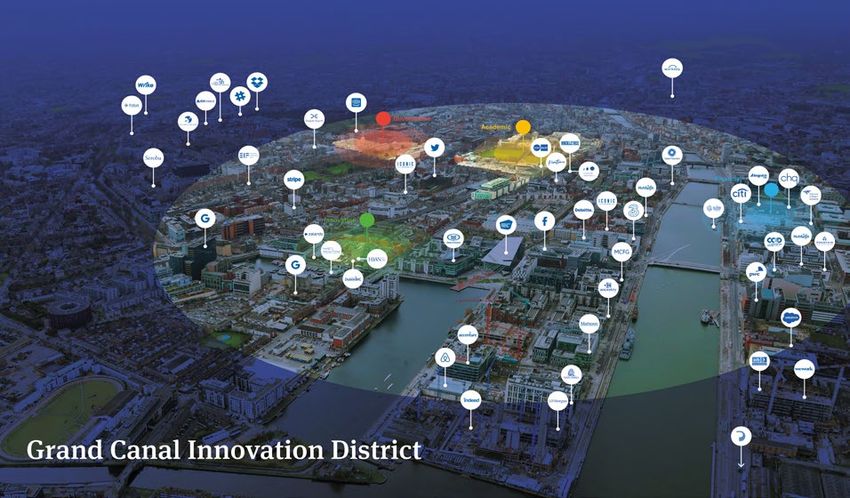
Ireland for Finance 9Case Study The Grand Canal Innovation District (GCID) is a Government-supported initiative that will see the clustering of research institutes, entrepreneurs and educational institutions, high growth companies, and technology and creative start-ups in a concentrated urban environment. The project, which received Cabinet approval in January 2020, will act as a magnet for research and will drive innovation, contributing to Ireland’s economic recovery in the years ahead. The GCID will play critical role in innovation supporting the future of the Irish economy and positioning Dublin as a European technology hub. The District will provide important collaboration space and opportunities for entrepreneurs, researchers, start-ups and corporate innovation teams to develop new research and innovative approaches to overcoming global challenges, including digitalisation and climate change, and identifying new opportunities, for the benefit of society and the economy. 10
Ireland for Finance 11
Action Measures for 2021
Pillar 1 Operating Environment
Pillar 1 deals with the key enablers necessary to ensure that Ireland has an effective and efficient operating environment. The operating
environment is key to maintaining and growing existing products and markets, along with identifying and developing new areas. The
main focus in this pillar is policy and legislation.

 new measures

       Description of Action Measure                                           Lead               Stakeholders            Deadline

 1     Develop a National Sustainable Finance Roadmap                          Finance            D/Fin, industry         Q3
                                                                               Green Ireland      bodies, SIF
       Develop a proposal for a Sustainable Finance Roadmap to
                                                                               Committee          Ireland, FC4S, EIT
       guide Irish green and sustainable finance activities in the
                                                                               (SFI)              Climate-KIC
       context of the European Green Deal and forthcoming Renewed
       Sustainable Finance Strategy.
       Analysing current trends and future needs, when approved,
       the Roadmap can guide Irish green and sustainable finance
       activities across the themes of Operating Environment,
       Technology and Innovation, Talent, and Communications
       and Promotion.
       In partnership with industry bodies and the Department
       of Finance, an output of the Roadmap will see Sustainable
       Finance Ireland and partners engage with senior decision
       makers in Europe, Asia, and North America to showcase and
       promote the scale and sophistication of Ireland’s emerging
       green and sustainable finance activities, underpinning Ireland’s
       emergence as a green and sustainable finance product and
       services ‘Living Lab’. This is to be launched during Climate
       Finance Week Ireland 2021.

 2     Develop proposals for increased collaboration in the Grand              Fintech            IDA, EI, D/Fin          Q2
       Canal Innovation District                                               Foresight
                                                                               Group
       The Fintech Foresight Group will develop proposals to establish
       better collaboration between 'big tech' in the Grand Canal
       Innovation District area, tertiary education, new start-ups and
       venture capital firms.

See Appendix 3 for a list of the abbreviations used in the tables of action measures.

12
ongoing measures
3 Develop the collection and analysis of data with CSO D/Fin CSO, IDA, EI, Q3
D/ETE
The Department of Finance will continue to work with the
Central Statistics Office (CSO), State agencies, the Central
Bank and other organisations to seek to gather, record and
publish more granular data on the economic contribution of
the international financial services sector as a subset of the
financial services sector as a whole.
4 Continue work on further stakeholder engagement with D/Fin Central Bank of Q2
Central Bank of Ireland Ireland, IAC
In order to effectively deliver on its mandate, the Central Bank
of Ireland works closely with stakeholders in the financial
services industry. In particular, the Central Bank undertakes
stakeholder engagement across a broad range of sectors.
Industry representative groups meet with senior Central Bank
representatives regularly; for other sectors there are less
formal arrangements.
A key focus in the Central Bank of Ireland Strategic Plan
2019–2021 is to enhance its strategic engagement with the
public and relevant stakeholders at home and abroad.
In 2020, building on initial work carried out in 2019, the
Central Bank reviewed its stakeholder engagement in order to
consider how it engages with the broadest range of relevant
parties, including industry representatives and non-industry
participants such as consumer groups, public interest groups
and academics. As part of that work, the Central Bank
reviewed the stakeholder engagement models used by its
international peers and the European Supervisory Authorities.
The Central Bank also reviewed relevant research and
commentary on the topic.
The Central Bank will publish a consultation paper setting out
proposals on how the Central Bank can enhance its strategic
stakeholder engagement in early 2021, and the Central Bank
will then assess the feedback received before finalising its new
stakeholder engagement structure.
5 Engage at EU level on the latest Capital Markets D/Fin Industry Q4
Union proposals
The European Commission published a new Capital Markets
Union Action Plan in the third quarter of 2020, with a focus
on three objective areas; small and medium enterprises, retail
investors, and the single market.
The Department of Finance welcomes the Commission’s
Capital Markets Union Action Plan and will continue
to monitor, engage and contribute in all aspects of the
development of the Capital Markets Union.
See Appendix 3 for a list of the abbreviations used in the tables of action measures.
Ireland for Finance 136 Engage at EU level on sustainable finance developments D/Fin Industry, SFI Quarterly
The Department of Finance will monitor and seek to influence
EU developments on sustainable finance, including initiatives
emerging from the European Commission’s forthcoming
Renewed Sustainable Finance Strategy.
7 Engage on EU legislative and regulatory proposals D/Fin Industry Q2, Q4
The Department of Finance will meet industry representative
bodies collectively three times in 2021 to exchange views
and to discuss progress on EU dossiers in financial services (in
addition to regular bilateral contact).
The Department of Finance will continue every six months
to meet the incoming Presidency of the Council of the EU to
examine potential issues and expand on Ireland’s EU priorities,
including in financial services.
The Department of Finance’s work will include engagement
with European Commission’s DG FISMA (Directorate-General
for Financial Stability, Financial Services, and Capital Markets
Union) and other Directorates-General to discuss financial
services with the Commissioner and Commission officials on a
regular basis.
8 Enhance Ireland’s network of double taxation agreements D/Fin Industry Q3
The Department of Finance will continue to explore
opportunities to enhance Ireland’s treaty network and will
ensure our existing treaties follow international best practice.
The Department and the Revenue Commissioners will, as
appropriate, maintain an open dialogue with the international
financial services industry regarding relevant developments.
9 Engage on and analyse post-Brexit financial services issues D/Fin Industry, PSCG, Q2
IAC, industry
The Department of Finance will consider financial services
representative
issues arising between, on the one hand, Ireland and the
bodies, IDA, EI
EU and, on the other hand, the UK, building on the work of
Ireland’s financial services attachés in the EU and the UK. This
work will include:
· engaging bilaterally with relevant stakeholders in both
Ireland and the EU, and
· engaging bilaterally with industry representative bodies.
10 Submit proposals for necessary changes to legislation IAC Industry Q4
stakeholders,
The Industry Advisory Committee (IAC), in consultation with
D/Fin, D/Justice
the industry representative bodies, will identify and make
submissions on proposed legislative provisions it considers
important to further develop the operating environment.
See Appendix 3 for a list of the abbreviations used in the tables of action measures.
1411 Continue to raise awareness of the responsible SIF SFI, industry Q4
investment agenda Ireland bodies, UN PRI,
Eurosif
As a key platform for advancing the environmental, social,
and corporate governance (ESG) agenda, the Sustainable
and Responsible Investment Forum Ireland (SIF Ireland) will
continue efforts to raise awareness of the ESG agenda across
all Irish-located asset classes by means of its dedicated ESG
best practice and digital library web portal, while supporting
the Sustainable Finance Skillnet roll out of an ESG-focused
skills development programme.
Continuing to measure progress on advancing the agenda and
identifying barriers to continued growth, SIF Ireland will take a
deep dive into the ESG data agenda.
SIF Ireland will also promote the merits of the
Taskforce on Climate-related Financial Disclosures
(TCFD) recommendations. The implementation of the
recommendations represent best practice for companies
and opens up access to more sustainable pools of growth
capital while addressing the needs of investors for greater
transparency.
In addition, in support of biodiversity action, SIF Ireland will
explore outstanding issues with assessing and managing
biodiversity impacts, dependencies and risks for the financial
sector.
See Appendix 3 for a list of the abbreviations used in the tables of action measures.
Ireland for Finance 15Pillar 2 Technology and Innovation
Pillar 2 acknowledges that the digital revolution has the potential to be one of the greatest disruptors in financial services over the next
decade. Perhaps more than the other pillars, technology and innovation underpin much of the possible advances in existing markets
and into new markets while ensuring that we maintain what we have already achieved.
new measures
Description of Action Measure Lead Stakeholders Deadline
12 Establish Department of Finance Fintech Group D/Fin D/ETE, EI, Q1
IDA, industry
Ireland is uniquely positioned to benefit from the massive
global investment in fintech. This is due in part to our excellent
track record in attracting foreign direct investment (FDI), our
entrepreneurial culture, and our unique cluster of international
financial services and technology firms.
The European Commission adopted the Digital Finance
Package in September 2020, including a Digital Finance
Strategy and legislative proposals on crypto-assets and digital
resilience, for a competitive EU financial sector that gives
consumers access to innovative financial products, while
ensuring consumer protection and financial stability.
In order to capitalise on the opportunities presented by the
Digital Finance Package, to develop Ireland’s policy positions in
light of the legislative elements of the package, and to develop
a shared understanding of the various policy and market
developments in fintech, the Department of Finance will
establish a new Fintech Working Group. This Working Group
of senior officials will coordinate the approach to fintech across
the Department and it is envisaged that it will engage with
external stakeholders from time to time to drive collaboration
and integration across policy-makers, the fintech community
and technological innovations.
13 Deliver the new MSc in fintech innovation Technology Skillnet Q3
Ireland ICT Ireland, IDA,
The new MSc programmes in fintech innovation will be
Skillnet Letterkenny
delivered from Letterkenny IT and from Munster Technological
IT, MTU
University’s Tralee campus. These MSc programmes are in
Tralee, North
response to an industry-led initiative which includes key
West Fintech
stakeholders in the North West Fintech Cluster, the South East
Cluster, South
Fintech Cluster, and the South West Fintech Cluster. These
East Fintech
online programmes will continue to enhance the growing
Cluster, South
footprint of financial service organisations, creating new talent
West Fintech
pipelines and competencies to strengthen Ireland’s position as
Cluster
a location of choice for the global financial services industry. As
both programmes are online, access is open to all individuals
working in or considering a career in financial services.
See Appendix 3 for a list of the abbreviations used in the tables of action measures.
1614 Develop and deliver a programme on data analytics for Aviation Skillnet Q3
aviation finance leaders Skillnet Ireland,
D/FHERIS,
Aviation Skillnet will design, develop, launch and deliver the
IDA, Aircraft
Data Analytics for Aviation Finance Leaders Programme.
Leasing Ireland
Ireland needs to build its aviation finance (data) analytical
capability to maintain our position as a leading location for
aviation leasing, to retain existing companies, and to attract
emerging industry players. Leveraging the potential of big data
and data analytics will strengthen productivity and enable
growth in air finance companies located in Ireland.
See Appendix 3 for a list of the abbreviations used in the tables of action measures.
Ireland for Finance 17ongoing measures
Description of Action Measure Lead Stakeholders Deadline
15 Continue to scope the development of an aviation digitised Ibec, Aviareto, Q4
maintenance registry ALI D/Fin, State
agencies and
Aircraft Leasing Ireland will continue to prioritise scoping
other relevant
the development of an Aviation Digitised Maintenance
Departments,
Registry in 2021. The objective is to generate a digital and
industry
centralised registry of aircraft maintenance work based on
a new pan-industry (regulators, airlines, maintenance, repair
and overhaul firms, lessors, airports) agreed protocol to be
developed by Irish firms to support Irish aviation businesses.
16 Continue work of the Fintech Foresight Group BPFI, Fintech Q2, Q4
FPAI Foresight
The Fintech Foresight Group will continue to promote greater
Group, HLIC,
collaboration across private and public stakeholders from
IAC, Industry
all elements of the fintech ecosystem to develop a growth
associations,
mindset in the industry.
Third-level
The Fintech Foresight Group will develop insights and institutions,
recommendations to help inform policymaking on key EI, IDA
technology and innovations in financial services such as open
data, digital currency, and regtech.
17 Develop an InsurTech Hub Insurance Industry Q2
Ireland members,
Insurance Ireland plans to develop an InsurTech Hub to have
technology
the insurance industry and technology firms work more
companies,
closely together.
IDA, EI
The Hub aims to help develop insurtech startups through
mentoring, coaching, events, and engagement with insurers.
18 Continue the rollout of Ireland’s sustainable finance SFI Skillnet Ireland, Q4
innovation programme supporting the development of EIT Climate-
new IFS environmental, social, and governance products KIC, BPFI,
and services SIF Ireland
In light of the European Green Deal and the forthcoming EU
Renewed Sustainable Finance Strategy, an increasing number
of firms in Ireland are exploring the development of new
products and services in support of the sustainable finance
and the broader ESG agendas. Sustainable Finance Ireland
will accelerate the rollout of this development via a dedicated
intrapreneurship programme, in support of Irish firms’ efforts,
thus contributing to Ireland’s emergence as a ‘Living Lab’.
See Appendix 3 for a list of the abbreviations used in the tables of action measures.
1819 Organise international fintech events to promote EI Q4
Irish exporters
Through its overseas office network, EI will run events specific
to financial services and fintech in the UK, the United States,
Europe, and AsiaPac and Australia in 2021.
EI will ensure that the message of what Irish companies have
to offer to potential buyers will be communicated through
these events. The events will largely coincide with large
financial services and fintech events in the local market
such as Hong Kong Fintech Week, and some will include the
participation of companies at different stages of development.
These international events will highlight the nature of the
services and technologies that can be sourced in Ireland from
Irish financial services and fintech companies and the events
will be coordinated by EI’s overseas offices. Each will provide
an opportunity for EI clients to meet key decision-makers in-
market and to generate client–buyer introductions with those
decision makers, leading to tangible business opportunities.
20 Organise the Annual Fintech Forum EI EI client Q4
companies
The Fintech Forum provides an opportunity for fintech
companies to network and meet with peer companies and
Market Advisers from Enterprise Ireland’s overseas office
network. The forum will consist of an evening seminar in the
RDS which will be aimed at clients in the sector at all stages
of development. The theme will be one of direct relevance to
their businesses, especially given many fundamental shifts in
the financial services space that are apparent – for example,
changing customer requirements and digitalisation. The
seminar will be followed by Q&A and a networking reception.
See Appendix 3 for a list of the abbreviations used in the tables of action measures.
Ireland for Finance 19Pillar 3 Talent
Pillar 3 recognises that Ireland’s international financial services sector draws a significant competitive advantage from its
well-educated, highly-skilled and adaptable workforce. This pillar will ensure that a consistent focus is maintained on workforce
development and upskilling, particularly as advances in technology constantly creates requirements for new skills. This pillar will
also look to build linkages between firms and educational institutions based in the regions.
new measures
Description of Action Measure Lead Stakeholders Deadline
21 Commission a study from the Expert Group on Future EGFSN D/ETE, IDA, EI, Q2
Skills Needs D/FHERIS,
D/Fin
The Expert Group on Future Skills Needs (EGFSN) will
commence a study to assess the potential additional skills
demands to fully exploit opportunities in subsectors such as
fintech, applied alternative assets, sustainable finance, artificial
intelligence, and blockchain. The scope will be agreed in 2021
and the study finalised in 2022.
22 Hold a Legislative Alignment Summit on Technology, Law Society Skillnet Ireland, Q1
Innovation & Law – The Case for Agile Alignment Finuas D/FHERIS, Law
Skillnet Society of Ireland
Law Society Finuas Skillnet will hold an IFS Legislative
Alignment Summit in Q1 2021 to identify and address apparent
ambiguities between EU and national law and between
different Irish laws in various areas that affect IFS service
delivery. These skills gaps could affect our competitiveness
and sustainability if left unaddressed as talent resources
are wasted in dealing with challenges as opposed to finding
properly informed co-ordinated solutions.
23 Promote Financial Services as a ‘Career less Ordinary’ 30% Club 30% Club, Q2
IOB, Industry
The 30% Club Ireland Financial Services Group will develop
(Irish Funds
a communications tool for transition year students and their
and others),
teachers, highlighting the variety of careers available across
National Centre
financial services, and encouraging consideration of it as a
for Guidance in
viable career option post leaving certificate or post college.
Education
The programme will include case studies of a diverse range of
financial services employees in roles not typically associated
with the industry, showcasing the breadth of potential
careers. The selection of case studies will also demonstrate
the diversity of talent within the industry, including a focus
on gender, race, and educational background. Environmental,
social, and governance factors will be included as a theme
within the case studies.
See Appendix 3 for a list of the abbreviations used in the tables of action measures.
2024 Develop an Institute of Banking lifelong learning portfolio IOB Q2
for the sector
The Institute of Banking (IOB) will develop a portfolio of
lifelong learning supports for those employed, or hoping to
be employed, in the sector with a wide range of high quality,
relevant, practical micro learnings and short sprints across a
suite of themes including: digital and innovation, sustainable
finance, investment funds, risk management, and culture
and compliance.
25 Develop a portfolio of sustainable finance programmes IOB SFI, industry Q2
bodies
In 2021, the Institute of Banking will launch a sustainable
finance skills matrix, and associated learnings and programmes,
that addresses the current and future skills need of the
financial services sector.
26 Provide the IMI programme on Leadership in a IFS Skillnet IMI, FSI, BPFI, Q3
Regulated World FIBI, Irish Funds
The Irish Management Institute (IMI) will support skills
development across the financial services sector through the
provision of a customised Leadership in a Regulated World
programme. The programme, which is being designed in
consultation with industry, will provide those in PCF
(Pre-Approval Controlled Functions) and SEF (Senior
Executive Functions) roles with an immersive learning
experience through which they can explore the challenges
involved in leadership and accountability in an increasingly
complex regulated environment.
This is a consortium programme, designed to bring cohorts of
participants from across the financial services sector together,
to promote peer learning and skills development in the
industry, and to provide a safe environment for participants to
reflect on their experience, explore different approaches, and
transfer learning to their workplace.
27 Promote a Certificate in ESG Investing CFA Society SFI Q3
Ireland
CFA Society Ireland is always looking at innovation in financial
and investment education and has recently launched a
Certificate in ESG Investing.
This certificate is designed for people who want to be
recognised as leaders and experts in this area and who want
to integrate environmental, social, and corporate governance
(ESG) factors into the investment process.
CFA Society Ireland will continue to promote uptake of this
certificate in Ireland.
See Appendix 3 for a list of the abbreviations used in the tables of action measures.
Ireland for Finance 21ongoing measures
Description of Action Measure Lead Stakeholders Deadline
28 Launch the Women in Finance Charter FSI, BPFI IAC, D/Fin, Q1,
other industry Q2
Industry stakeholders have been working to develop ‘Ireland’s
representative
Women in Finance Charter’ which will allow firms to devise
bodies and
commitments to progress gender diversity in their firms.
industry
Industry will update on progress on the Charter at the end
stakeholders
of Q1 2021.
The Charter will be launched in Q2 2021 with industry
stakeholders invited to sign the Charter. An update on
signatories (that is, firms and organisations) will be provided
at the end of Q2 2021.
29 Host education and peer events for the 100 Women in 100 Women in 100 Women Quarterly
Finance NextGen Dublin Committee Finance Dublin in Finance
Committee NextGen Dublin
The 100 Women in Finance NextGen Dublin Committee was
Committee
successfully launched in 2018.
The NextGen Committee’s program focuses on those who
have up to 10 years’ experience in the industry and who
are looking to build lasting, synergistic relationships. The
NextGen Committee creates an educational and peer-to-peer
forum through open dialogue about the current interests
and challenges facing working women and financial industry
professionals. The events are unique in the financial services
industry and hear from leaders in the sector about the lessons
they learned, get insights into the outlook for the financial
markets, strengthen professional networks, and hone skills
for advancement. In particular, the Leading Ladies series was
launched in 2020. The series provided the unique opportunity
to meet virtually with some of the industry’s leading figures to
discuss career paths, balance, and trends.
NextGen Dublin will host at least four educational or peer
engagements every year.
See Appendix 3 for a list of the abbreviations used in the tables of action measures.
2230 Review the Chartered Accountants Ireland continuing Chartered IOB Q4
professional development programme to support the Accountants
financial services sector Ireland
Chartered Accountants Ireland, the leading professional
accountancy body on the island of Ireland, with 29,000
members and 7,000 students, is committed to educating
and training appropriately qualified financial professionals.
Chartered Accountants Ireland will seek to provide a post-
qualification accreditation, will review its initial qualification
syllabus and will revisit its continuing professional
development (CPD) programme to ensure it best meets the
needs of the financial services sector. Additionally, Chartered
Accountants Ireland will assist in attracting, retaining,
and upskilling people in by promoting the flexible route to
Chartered Accountancy within the financial services sector.
Chartered Accountants Ireland will also host a financial
services conference in conjunction with the Institute of
Banking in Q2 2021.
31 Build on the launch of the Accredited Funds Professional, the IOB Irish Funds, Q4
new designation for funds industry professionals industry
In 2021, the Institute of Banking will host an event to
showcase the designation and to illustrate to the international
community the commitment from all Irish funds industry
stakeholders to lifelong learning among industry professionals.
The Institute of Banking will provide a suite of micro learning
opportunities to ensure that industry professionals are well
equipped to understand and meet the challenges from the
continual changes within their industry.
32 Deliver training programmes in sustainable finance and Sustainable SFI, Skillnet Q4
responsible investment supported by the Sustainable Finance Ireland,
Finance Skillnet Skillnet industry bodies
In partnership with industry bodies, Sustainable Finance
Ireland, via Sustainable Finance Skillnet, will continue to assess
the demand and support the development of capacity-building
programmes and qualifications where required in order to
expand the market for sustainable finance and responsible
investment in Ireland across key capital market segments,
including banking, insurance, asset management, asset
ownership, and funds.
See Appendix 3 for a list of the abbreviations used in the tables of action measures.
Ireland for Finance 23Pillar 4 Communications and Promotion
Pillar 4 aims to ensure that Ireland’s offering as a leading global centre of choice for international financial services is communicated
and promoted effectively to stakeholders either looking to locate in Ireland or seeking to source solutions from Ireland.
new measures
Description of Action Measure Lead Stakeholders Deadline
33 Develop strategic communications plan for Ireland for Finance D/Fin PSCG, IAC Quarterly
The Department of Finance will develop a strategic
communications plan to progress the policy priorities of
Ireland for Finance as a whole-of-Government strategy, both
domestically and internationally and as part of private sector
events and public sector programmes.
34 Run a virtual event with a regional innovation hub EI EI client Q3
companies,
Enterprise Ireland will run a virtual event in Q3 with a regional
Local Enterprise
innovation hub or centre that has strong fintech activity.
Offices,
The event will highlight the nature of supports available for
innovation hubs
financial services and fintech companies and related companies
seeking to develop the underlying capabilities needed to
successfully execute successful internationalisation strategies.
The themes under consideration include operational
excellence and innovation strategies. The form of the events
might include company case studies, guest speakers, and
panel discussions.
See Appendix 3 for a list of the abbreviations used in the tables of action measures.
2435 Work with the Office to Promote Competition in the D/Fin, Q4
Insurance Market in the Department of Finance D/ETE
An Office to Promote Competition in the Insurance Market has
been established under the responsibility of the Minister of
State at the Department of Finance.
The Office will:
· advance the Government’s work on insurance reform so as
to encourage greater competition;
· develop a strategic approach to the promotion of insurance
competition – in this context a work plan for 2021 is being
developed to ensure coherency and consistency in approach
between relevant State bodies;
· promote transparency and championing the provision of
information in relation to the insurance market and various
insurance products;
· tailor its approach reflecting the particular circumstances
pertaining in the business sector and that of the wider
consumer market which may have different priorities;
· provide for more joined-up policy thinking and
communications; and
· report to the Cabinet Sub-Group on Insurance Reform on
the work of the Office.
Part of the insurance reform agenda is focused on seeking to
encourage greater supply in the market, either from existing
participants or from new domestic or international insurance
firms providing service into the domestic market. An update
on the work of the Office to Promote Competition in the
Insurance Market will be provided in Q4.
36 Promotion of the Investment Limited Partnership vehicle Irish Funds IAC, Rep Bodies, Q4
D/Fin
The Industry Advisory Committee (IAC) and the
representative bodies will promote the benefits of the
investment limited partnership (ILP) vehicle available in Ireland
to meet the demands of a modern private equity sector.
See Appendix 3 for a list of the abbreviations used in the tables of action measures.
Ireland for Finance 25ongoing measures
Description of Action Measure Lead Stakeholders Deadline
37 Maintain a regional focus in developing the IFS sector IDA, EI D/ETE, Q2, Q4
Chambers of
Part of the development of international financial services has
Commerce,
been the emergence of a number of regional centres which are
D/FHERIS, IAC
becoming increasingly important in expertise, employment,
economic activity, and linkages to the education sector.
To ensure that these locations continue to grow as
complementary locations to Dublin while developing their
ability to attract and retain business into the future, they will
be promoted under this Strategy in line with Project Ireland
2040 – the National Planning Framework and with the relevant
Regional Spatial and Economic Strategy. This promotion by the
IDA and EI will also involve close collaboration with industry,
chambers of commerce, and other stakeholders, including the
Regional Assemblies and local authorities, as appropriate.
A regional focus will be included in each progress report.
38 Host the European Financial Forum 2021 IDA PSCG, industry Q1, Q2
IDA Ireland, in consultation with industry stakeholders and
the public sector, will host the sixth European Financial Forum
virtually in Q1 2021.
Following the hosting of this event, the IDA will present a
review of the European Financial Forum to the Ireland for
Finance Joint Committee. Subject to the outcome of this
review in Q2, IDA will determine the merits of hosting a
forum in 2022.
39 Promote Ireland internationally IDA EI, industry Q2, Q4
The IDA will engage with international stakeholders to
promote Ireland as a centre for international financial services
in support of other actions in the Ireland for Finance strategy.
This will involve extensive virtual outreach to its existing client
base and to new-name target companies, as well as, when it
becomes possible, in-person overseas marketing programmes
and meetings.
40 Renew industry promotion of Ireland for Finance IAC Comms Group Quarterly
Industry will look to further enhance its work in promoting
Ireland as a location for international financial services,
working closely in collaboration with stakeholders such as the
IDA, EI, the Departments of Finance and of Foreign Affairs.
This will involve representative organisations and individual
companies and their advisers.
The Industry Advisory Committee will report to the Joint
Committee quarterly.
See Appendix 3 for a list of the abbreviations used in the tables of action measures.
26You can also read


