JANUARY 6TH: AN INSURRECTION FUELED BY FACEBOOK - Accountable Tech
←
→
Page content transcription
If your browser does not render page correctly, please read the page content below

JANUARY 6TH:
AN INSURRECTION
F U E L E D BY FAC E B O O K

EXEC UT IVE SUM M ARY

       The deadly attack on Congress on January 6th was the worst assault on our
       democracy since the Civil War and represented one of the lowest points in
       our country’s history. As the United States House Select Committee convenes
       investigatory hearings on the deadly siege on the Capitol, we already
       know Facebook was used to organize the attack. As Mark Zuckerberg said
       himself, Facebook was weaponized by then President Trump to “incite violent
       insurrection against a democratically elected government,” and internal
       reports and Department of Justice documents confirm the platform’s role.

       While the Committee undertakes a thorough investigation of what happened
       on January 6th, months of research have already uncovered Facebook’s
       role in organizing the insurrection. The platform was used by extremists to
       organize, recruit, and promote their plans to storm the Capitol in an attempt
       to block the certification of the 2020 election results and the evidence is
       overwhelming.

       This report outlines what we already know before a single subpoena
       has been issued or a single witness has been called to testify. It is based
       on publicly available information and extensive analysis that has been
       conducted by expert researchers. It outlines tactics that laid the groundwork
       for the insurrection, including bad actors who fueled conspiracies throughout
       the 2020 campaign, how they leveraged Facebook’s platform to do their
       work, and how Facebook profited off of this activity that led to five deaths.
       Furthermore, this report also outlines how despite pledging to take action in
       the aftermath of January 6th, bad actors remained operating on Facebook,
       demonstrating how the platform continued to provide extremists with a
       platform to organize, recruit and promote their activities.

       These facts lead to an obvious conclusion: Facebook bears significant
       responsibility for the events that transpired on January 6th. The Select
       Committee should use their investigatory powers to dig deeper on what
       happened on the platform leading up to the insurrection, including behind
       the scenes to determine who knew what and when, in order to make sure the
       entity is held accountable for their role in the insurrection.
TA B LE O F CO N TEN TS

       INSTITUTE FOR STRATEGIC DIALOGUE
       04   The Long Road to the Capitol: Laying the Groundwork

       07   The Long Road to the Capitol: A Constellation of Actors

       10   The Long Road to the Capitol: A Hybrid Threat Landscape

       MEDIA MATTERS

       13   Facebook’s narrow ban allows much of the
            “Stop the Steal” content to remain on the platform

       23   Several GOP organizations posted a flyer on Facebook
            calling for “Operation Occupy the Capitol” with the
            hashtag “1776Rebel”

       27   Dozens of Republican Party groups used Facebook to help
            organize bus trips to DC for pro-Trump insurrection

       30   “Stop the Steal” organizers used Facebook and Instagram
            to promote events, including the rally that led to a mob
            breaching the Capitol

       37   MyPillow CEO Mike Lindell’s Facebook posts are full of
            insider information from January 6

       TECH TRANSPARENCY PROJECT
       41   Capitol Attack Was Months in the Making on Facebook

       64   Facebook Home to Militant ‘Patriot Party’ Movement
The Long Road to the Capitol:
    Laying the Groundwork
    19th January 2021

    The January 6 occupation of the US Capitol by far-right extremists shocked the world, representing
    a high water mark of the existential challenge that these threats pose to the safety, security and
    cohesion of our society, as well as the very fabric of liberal democratic civic culture.

    But these events came as no surprise to those of us who have been studying this emerging extremist
    ecosystem. The events of January 6 represent the inevitable consequence of a long-range campaign
    by a constellation of actors – from white supremacists to identitarians, anti-Muslim groups to
    conspiracy theorists – to exploit the rising cultural, economic and identity anxieties of our time. These
    efforts have been hyper-charged and amplified by sophisticated digital propaganda machineries,
    enabled by patchy and reactive responses from the online platforms on which they run riot.

    The themes of disinformation and extremism through 2020
    VOTER FRAUD DISINFORMATION

    Throughout the last year, ISD analysts have tracked a long-seeded campaign of disinformation
    which laid the groundwork for the events at the Capitol building. Our research published in October
    2020, which analysed online activity in the months preceding the election, revealed a now widely
    recognised trend: a small but influential cluster of social media accounts belonging to right-wing
    activists and media figures were responsible for promoting narratives claiming voter fraud was
    widespread in the US. What is interesting, however, is the way in which this narrative dovetailed with
    a campaign laying the ground-work for violence.

    The favoured tactic in promoting this disinformation narrative involved highlighting local reports of
    alleged voter fraud and framing them as indicative of large-scale corruption in the national voting
    process. Reports highlighting President Trump’s comments encouraging voters to submit a mail-in
    ballot in addition to voting in person were numerous in the discussion around voter fraud. In the
    wake of the election, the ‘Stop the Steal’ narrative proved resilient to the sporadic efforts of tech
    companies to stifle its growth, as demonstrated by ISD’s continual identification of groups, pages
    and communication hubs for the disinformation campaign to undermine the democratic process.

4
VIOLENT WHITE SUPREMACIST COMMUNICATIONS

    In parallel to watching these narratives evolve online, ISD researchers tracked an existing, active
    alternative digital ecosystem of violent white supremacist communications, hosted in permissive
    online environments like Telegram, Parler and 4Chan/8Kun. In June 2020, ISD researchers analysed
    over a million posts across more than two hundred white supremacist channels on Telegram, and
    found overt support for terrorists and terrorist organisations in nearly two thirds (60%) of them.

    It is in these channels that online disinformation narratives hold the potential to lead to deadly
    offline consequences. Beyond sharing propaganda of terrorist groups and the celebration of
    terrorists, some groups also actively called for violence. Content included the glorification of terrorist
    attacks and explicit calls for violence against minority communities and other groups deemed
    to be enemies, such as police officers, journalists, drug dealers and paedophiles. References to
    “boogaloo” – an extreme right-wing meme referring to an impending civil war – were made in 117
    (56.3%) of the channels identified. Our research shows that the mobilisation to violence began well
    before the election itself, having been nurtured in these types of online environment for many months
    and even years.

    ONLINE HOSTILITY TOWARD POLITICIANS

    Laying the mood music for the assault on the Capitol, our research found an increasingly hostile
    environment against politicians across a range of mainstream online platforms. An October report
    measured the scale of online abuse targeting a variety of Congressional candidates in the 2020 US
    election on Facebook and Twitter. Female political candidates across the ideological spectrum were
    notably more at risk of being targeted by online abuse than their male counterparts. Our research
    showed language related to ‘treason’ was being used to refer to candidates across political parties,
    and that this became a common feature of US political debate on Twitter throughout 2020.

    MAINSTREAMING OF DISINFORMATION & CONSPIRACY THEORIES

    Conservative and far-right media outlets have attempted to label the events of 6th January as
    the work of ‘Antifa’, turning once again to disinformation as a weapon with which to defend the
    real perpetrators of these violent acts. In the lead up to the election last year, these same actors
    sowed ongoing and plentiful disinformation about the so-called violence of Black Lives Matter and
    Antifa protestors. ISD researchers tracked claims about these groups being involved in ‘false flag’
    attacks and disinformation about their role as ‘domestic terrorists’, tracing back these disinformation
    narratives to the murder of George Floyd and the protests that it catalysed in the US and across

5
the globe. This disinformation flourished on online platforms like Facebook, Twitter and YouTube
    throughout the year. Research showed that Facebook ads were used to target and amplify these
    types of disinformation.

    The online communities in which the 6th January events were organised, promoted and lauded
    emerged out of months of disinformation, conspiracy and extremist mobilisation on these platforms.
    ISD’s analysis saw how platforms allowed COVID-19 disinformation and political disinformation to
    emerge in tandem, as far-right groups and individuals opportunistically used the ongoing pandemic
    to advance their movements and ideologies. COVID-19 was used as a ‘wedge issue’ to promote
    conspiracy theories, target minority communities, and call for extreme violence, as well as being used
    to advance calls for the ‘boogaloo’. Antisemitic hate speech and tropes were adapted to incorporate
    COVID-19 narratives, and proponents of the far-right QAnon conspiracy theory began advancing a
    wide range of different narratives off the back of the COVID-19 pandemic, including the idea that the
    pandemic was being orchestrated to manipulate US politics. ISD analysis of accelerationist discourse
    online shows it was increasingly dominated by discussion of the virus.

    GROWTH OF ANTI-GOVERNMENT MOVEMENTS

    At the same time, we also saw how opposition to contact tracers and a proto-anti lockdown
    movement early in 2020 transitioned into broader anti-government sentiment which transcended
    COVID-19. Contact-tracing efforts became the focus of significant suspicion, hostility and opposition
    within some social media communities, particularly among pro-gun and conspiracy-theory groups.
    Videos containing disinformation and conspiracy theories relevant to contact-tracing were receiving
    more than 300,000 views each on YouTube and being shared tens of thousands of times across
    public Facebook pages and groups. The key conspiratorial narratives referenced, including that
    contact tracers would force people (especially children) into quarantine and/or FEMA camps, framed
    contact-tracing as a deep state, Satanic or elite conspiracy. A multitude of conspiratorial strands
    linked contact-tracing to figures such as George Soros, Bill Gates, the Clintons, the Obamas and
    others, or framed COVID-19 mitigation efforts as a Democratic effort to interfere with the US 2020
    elections. These narratives show the dynamic evolution of the conspiracy landscape which helped to
    precipitate the narratives underpinning the events at the Capitol in January.

6
The Long Road to the Capitol:
    A Constellation of Actors
    21st January 2021

    The thousands of protesters who turned out in DC on January 6 firmly believed President Trump’s
    claims that the election was rigged and this was their last chance to take action and, in their eyes,
    protect the legitimate result and prevent Joe Biden from becoming president.

    However, voter fraud disinformation was not only pushed by the Conspirator-in-Chief before
    and after the November 3 vote, but by various online influencers active in fostering pro-Trump
    conspiracies in QAnon communities, far-right communities and conservative circles also. The results
    of their sustained efforts over the past few months led to the furious, frenzied anger of thousands
    who descended upon DC on January 6.

    Key players and their emergence throughout 2020
    CONSERVATIVE CIRCLES

    ISD research, conducted for Politico in October 2020, analysed millions of posts around voter
    fraud conversations online and found that a small but influential cluster of accounts belonging
    to conservative activists and media figures were responsible for promoting the bulk of narratives
    claiming voter fraud was widespread in the US. This research found that figures like Charlie Kirk,
    James O’Keeffe, Tomi Lahren and Dan Bongino played an early role in supporting Trump’s claims of
    voter fraud. When November 3 did not result in a victory for Trump, other right-wing influencers took
    on the mantle of organising and mobilising pro-Trump communities.

    The Stop the Steal movement quickly emerged as the vehicle for these frustrations, led by activists
    Ali Alexander, Scott Presler and Amy Kremer (of Women for America First and the Tea Party), among
    others, who organised online support, caravans and protests in DC. Yet, the movement also allowed
    more extreme actors and conspiracy theorists to capitalise on the frustrations of angry Trump
    supporters.

7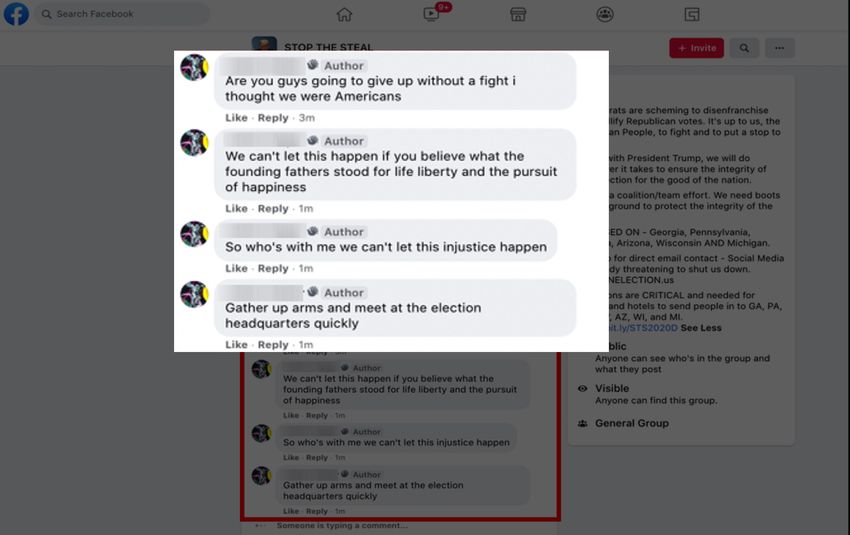
FAR-RIGHT COMMUNITIES

    ISD’s weekly Lens on Hate newsletter noted in November how Nick Fuentes, leader of the white
    nationalist Groyper movement, and Alex Jones, host of Infowars, appeared at Stop the Steal events
    in Georgia to boost Trump’s voter fraud claims. Fuentes and Jones spoke of their anger at those
    within the GOP “working to sabotage President Trump.” Both continued to ferment right-wing distrust
    of the Republican Party and participated in protests in DC on January 6 where large swathes of the
    crowd raged against “traitors” in the GOP as well as the Democrat Party.

    Claims of a rigged election motivated groups more traditionally disposed towards offline
    mobilisation too. The far-right Proud Boys group were always supportive of Trump, yet the
    group seized upon numerous pro-Trump protests in DC to participate in their preferred activity –
    threatening groups and engaging in violence against counter protesters. The Proud Boys benefited
    from the rise of the social media platform Parler, using it to issue threats of violence against possible
    counter protesters on January 6 and celebrate deliberate acts of destruction without repercussion
    from the platform. The group’s leader, Enrique Tarrio, was arrested as he traveled to DC on January
    4, but other leading Proud Boys figures took part in the violent events in the capital and have since
    been arrested.

    THE QANON COMMUNITY

    The role of the QAnon community in the events of January 6 cannot be overstated. How did
    belief in the QAnon conspiracy spread so rapidly in the months prior to this? ISD research found
    that membership of QAnon Facebook groups skyrocketed in 2020 while polling carried out by
    ISD partners in the second half of 2020 showed that about one-in-five Americans recognised
    and believed in at least one of four conspiracy theories that originated from QAnon. ISD and
    Newsguard tracked the spread of QAnon on Facebook in 2020 and found that, despite the
    platform’s October 6 ban on QAnon groups and pages, the conspiracy continued to spread through
    individual “superspreader” profiles who serve as important vectors for the spread of QAnon content,
    particularly pro-Trump political disinformation.

    Since November 3 “Q” has largely been silent, yet a number of key QAnon influencers have stepped
    into the void. Ron Watkins, the former administrator of 8kun, became a leading voice for QAnon
    followers after November and used Twitter to float illusory, outlandish theories related to Dominion
    Voting Systems. Watkins also organised 24/7 surveillance of Dominion buildings in Georgia which led
    to the targeted harassment of polling workers and encouraged people to attend protests in DC.

8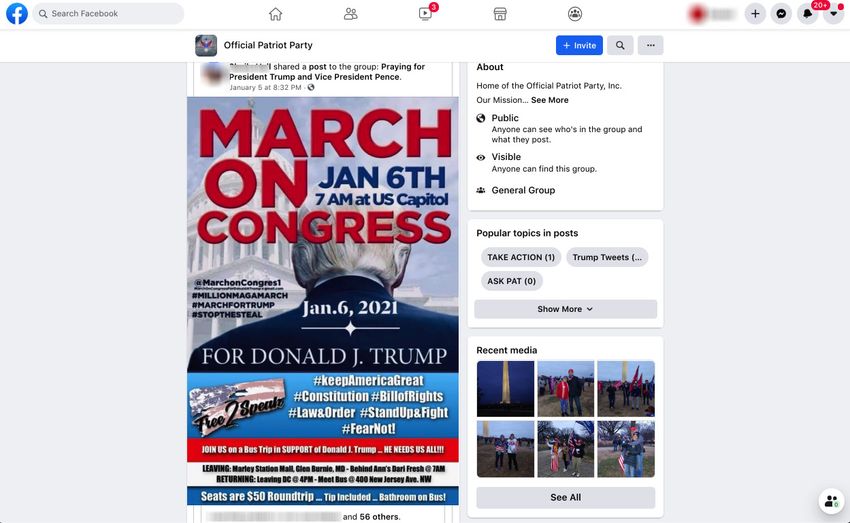
Pro-Trump attorneys Sidney Powell and L. Lin Wood were also embraced by QAnon communities
    as the two attempted to build legal cases for Trump’s voter fraud claims. Powell’s “Kraken” lawsuit
    acted as fodder for the QAnon movement, while Wood’s descent into the depths of the conspiracy
    world came to a head on January 1. Days before crowds in DC would call for Mike Pence to be
    hanged, Wood’s suggestion that Pence should face trial for treason and death by firing squad was
    openly supported among QAnon communities, where threats of violence were always a core feature
    of their online discourse. ing the idea that the pandemic was being orchestrated to manipulate US
    politics. ISD analysis of accelerationist discourse online shows it was increasingly dominated by
    discussion of the virus.

9
The Long Road to the Capitol:
     A Hybrid Threat Landscape
     26th January 2021

     The Capitol attacks represented a perfect storm of disinformation, conspiracy theory, weaponised
     hate and extremism, the emergence of which ISD analysts had tracked closely over the months
     running up to the election.

     In the summer of 2020, the US grappled with the emergence of significant social justice mobilisation
     in the wake of the killing of George Floyd. These events, in conjunction with the difficulties caused by
     the COVID pandemic, meant disinformation proved a constant hazard. Commercial disinformation
     networks, including established for-profit purveyors of disinformation and extremist content, seized
     on the turmoil as an opportunity to publish a deluge of written, audio and video content.

     LARGE SCALE PLATFORM MANIPULATION

     The intersection of disinformation and extremist narratives on standalone websites with social
     media platforms like Facebook, Twitter and YouTube – all of which play central roles in hosting
     and amplifying such narratives – has marked the emergence of an increasingly hybridised threat
     landscape. One prominent node in this landscape studied by ISD was NaturalNews. This commercial
     enterprise and disinformation empire is presided over by Mike Adams, a businessman connected to
     Infowars’ Alex Jones and anti-government militia group, the Oath Keepers.

     In June 2020, ISD research examined the scale and nature of NaturalNews’ largely unchecked
     activity on Facebook, and identified over 18,000 links to NaturalNews affiliated websites that
     were shared in public Facebook groups and pages over a nearly three-month period at the start of
     2020. These affiliated websites engaged with an array of conspiracy theories ranging from health
     disinformation and climate change denial to anti-immigration narratives. Articles written by Adams
     and his associates demonised liberal politicians, voters and institutions, and in some cases urged
     action against these “malign” actors.

10
The broad range of topics promoted by NaturalNews combined with their expert use of social
media to amplify content meant that they were able to reach a vast audience. When this content
was shared on Facebook, it may have acted as a gateway into NaturalNews’ network of extremist
websites and narratives. These narratives, in turn, often used violent and dehumanising language
to discuss the ‘evils’ of liberals, government and big tech companies, and appeared to be aimed
at individuals already engaging with anti-government, militia, and “prepper” ideologies. The wide
dissemination of these narratives meant NaturalNews’ sentiments were then fed into the online
ecosystem of right-wing extremists, which includes individuals who entered the Capitol building on
January 6.
The residual threat of such large-scale platform manipulation was illustrated in a separate
investigation conducted by ISD in June 2020, which revealed how spam-like networks on Facebook
were – and still are – being used to distribute potentially harmful and divisive content across the
platform at scale. In this investigation, content was amplified to Facebook users in groups and
pages focused on topics such as US right-wing politics, right-wing politics in other countries such as
the Philippines and Canada, and political wedge issues.
THE MONETISATION DYNAMIC
Aside from stoking division and sowing discord, commercial actors such as NaturalNews also have
monetary incentives to make the content on their sites as sensational and engaging as possible
while remaining vague enough to attract the broadest audience possible. Unsurprisingly, ISD saw
allegations of election fraud and interference ramp up after November 3 2020 (election day), when
increased coverage of hot-button topics began to correlate directly to an increase in ad revenue.
But it is not only commercial actors who profit from these large-scale disinformation networks. This
monetisation dynamic was highlighted in our assessment of “coordinated inauthentic behaviour” on
Facebook, which noted that between July 2018 and July 2020, Facebook made over $23 million in
advertising revenue from inauthentic networks that violated the platform’s policies.
Major inequalities in the platform policy landscape have been exploited by hate actors. Research
published by ISD in October 2020 found that tech platforms such as PayPal, Stripe, Facebook and
Amazon accepted payments to a number of US-based hate groups, including certain groups and
individuals known to be present in Washington on January 6. ISD’s research found that, of the 54
platforms and mechanisms examined, 38% did not contain policies that explicitly prohibited hate
groups from using their services. It also found that hate groups were able to use the services of 83%
of platforms that did contain policies around hate, showing an overwhelming failure by platforms to
implement and enforce their policies.
11It remains clear that a sizable minority of social media platforms have failed to put in place policies
that explicitly prohibit hate actors from using – and profiting from – their services. They are failings
that must be addressed as a matter of urgency. So long as they remain unaddressed, the possibility
of radicalisation on these platforms leading to future violence similar to that we saw on January 6
remains likely.
12Facebook’s narrow ban allows much of
the “Stop the Steal” content to remain
on the platform
28th January 2021
Facebook’s action was also too late --
Republican members of Congress used the platform to promote “Stop the Steal”
In response to the January 6 insurrection, Facebook has moved to remove “Stop the Steal” election
misinformation from the platform, but the new policy appears to be extremely limited, banning
only posts or groups using that exact phrase. As a result, the social media giant is allowing activity
dedicated to stopping nonexistent election fraud to continue to thrive.
On January 6, a pro-Trump mob stormed the Capitol, seeking to overturn the presidential election
after then-President Donald Trump -- and his supporters in right-wing media and on social media
-- spent months pushing misinformation to subvert the election. Facebook has attempted to both
downplay the role the platform played in organizing these events and claim it has sufficiently
addressed the issue. In reality, these measures were insufficient to address the misinformation and
organizing that enabled the insurrection.
Media Matters has identified posts from Republican members of Congress prior to January 6 that
pushed the false notion that Democrats stole the election and promoted “Stop the Steal” rallies.
These posts are still on Facebook. Additionally:
• Media Matters identified at least 230 Facebook groups related to election fraud. As of
January 28, over 150 of these groups still remain active.
• Of these groups, 91 specifically mentioned “Stop the Steal” or used similar language about
a “stolen election” in their name or within posts. As of January 28, Facebook removed 66 of
these groups, 2 have been archived, and 23 remain active.
13• The additional 139 groups didn’t mention “Stop the Steal” specifically, but are related to
so-called election fraud. As of January 28, 129 of these groups are still active, despite having
similar content to the “Stop the Steal” groups. Facebook removed 6 groups and 4 others have
been archived.
Doing the absolute minimum: Facebook’s response to election misinformation
and “Stop the Steal”
Following the presidential election, right-wing influencers recycled “stop the steal,” a phrase initially
used in 2018 to baselessly accuse Democrats of election fraud. This phrase quickly proliferated on
social media; in fact, only two days after the election, Media Matters identified at least 34 groups
and 39 events on Facebook that were dedicated to “Stop the Steal.”
In the months after the election, Facebook took minimal action against election misinformation
from Trump and his allies and even less action against efforts to organize and promote “Stop the
Steal” events, despite a clear problem. The platform finally made changes after the tragic event at
the Capitol, announcing it would remove content with the phrase “stop the steal” in the lead-up to
President-elect Joe Biden’s inauguration and banning “Stop the Steal” organizer Ali Alexander.
Facebook also temporarily banned Trump from both Facebook and Instagram for at least two
weeks until Inauguration Day, claiming that “the risks of allowing the President to continue to use
our service during this period are simply too great.” Whether or not the former president regains his
account is now in the hands of Facebook’s Oversight Board.
Even though the platform said it retroactively removed “Stop the Steal” groups and content, many
still remain active. It appears Facebook is removing only content that uses the exact phrase “stop
the steal,” and even then, it hasn’t gotten it all.
For example, we found several similar “stop the steal” related posts, some remaining and some
removed. One post with “stop the steal” language was removed, and two others that don’t have that
specific wording -- but are otherwise the same -- remain available.
14Media Matters has also identified over 190 active posts from Republican members of Congress
pushing “Stop the Steal,” related events, and other related keywords prior to the January 6 riot.
And we identified at least 230 Facebook groups dedicated to the topic of so-called election fraud,
roughly 150 of which are still active on Facebook. (This activity also counters Facebook’s claims that
the insurrection was not organized on its platform.)
Several Republican members of Congress promoted “Stop the Steal” on their
Facebook pages. Facebook has not taken down these posts.
Some members of the “sedition caucus” — the 147 Republican members of Congress who voted
against certifying the election results after pro-Trump rioters stormed the Capitol — used either their
official or unofficial Facebook pages (or both) to promote election misinformation about voter fraud
and “Stop the Steal” events.
Between Election Day and January 13, “sedition caucus” members mentioned keywords related to
“Stop the Steal” a total of 193 times on Facebook. Members pushing “Stop the Steal” include Rep.
Marjorie Taylor Greene (R-GA), Rep. Ronny Jackson (R-TX), Rep. Louie Gohmert (R-TX), Rep. Madison
Cawthorn (R-NC), Rep. Mo Brooks (R-AL), and Rep. Paul Gosar (R-AZ).
15MARJORIE TAYLOR GREENE
Rep. Marjorie Taylor Greene is a QAnon and 9/11 conspiracy theorist who was a right-wing
commentator prior to being elected to represent Georgia’s 14th Congressional District. Greene has a
history of using social media to spread misinformation and toxic rhetoric -- something that recently
got her suspended from Twitter for 12 hours.
Greene’s posts about “Stop the Steal” were no exception to this trend. Since Election Day, Greene
has used the phrase in posts on her unofficial, or personal, Facebook page at least 32 times, with
29 of these posts still active on the platform. At least 12 of these posts encourage users to sign her
official “Stop the Steal” petition. She has also made at least 56 other posts using similar keywords.
(We searched for the keywords stop the steal, stopthesteal, sts, fightfortrump, fight for trump,
saveamerica, save america, fightforamerica, and fight for america.)
Greene’s official Facebook page has 4 posts with nearly 7,000 total interactions using these same
keywords to refer to “Stop the Steal” without using the specific phrase.
16RONNY JACKSON
Rep. Ronny Jackson, a former White House doctor, has made at least 30 posts since Election Day
using his unofficial page that mention a number of keywords related to “Stop the Steal.” Notably,
several of these posts appear to have been attempts at fundraising based on the January 6 event,
and he even encouraged people to “FIGHT FOR TRUMP” on the morning of the insurrection.
LOUIE GOHMERT
Since Election Day, Rep. Louie Gohmert has made 5 posts using his official page that mention “Stop
The Steal.” Many of these posts also included inaccurate content from right-wing media outlets such
as Newsmax and The Epoch Times promoting conspiracy theories and misinformation about the
election results.
17MADISON CAWTHORN
Newly elected Rep. Madison Cawthorn has used his campaign page to promote “Stop the Steal” at
least 4 times since Election Day. These posts are self-promotional, encouraging people to donate
to “defend our election” or even touting his participation as a speaker at the rally prior to the
insurrection at the Capitol.
MO BROOKS
Rep. Mo Brooks has mentioned “Stop the Steal” on his official page only once since Election Day, in
which he asked people to “tune in” to the January 6 rally and said he was going to “tell the American
people about the election system weaknesses that the Socialist Democrats exploited to steal this
election.” Another official post related to “stop the steal” features a statement in which Brooks
defends his involvement with the “Stop the Steal” rally against “Vicious & Scurrilous Fake News
Media And Socialist Democrat Attacks.” These two posts earned over 18,000 total interactions.
18PAUL GOSAR
Rep. Paul Gosar spoke at one of the “Stop the Steal” events held in Arizona, pushing baseless
claims of election fraud and falsely claiming that the results of the presidential election could be
overturned. He reportedly promoted “Stop the Steal” events dozens of times and even promoted the
January 6 event in D.C. with a post from his official government Facebook page. This post earned
over 5,000 interactions.
Facebook’s narrow policy against “Stop the Steal” content still allows groups
dedicated to “stopping” election fraud to thrive on the platform
Media Matters has identified at least 230 Facebook groups related to election fraud that were
actively attracting members after the election by referencing “Stop the Steal” or election fraud in
their name and/or sharing content related to voting. These groups -- which range from having just
one member to thousands -- were also active after the January 6 insurrection.
Notably, 91 of these groups specifically mentioned “Stop the Steal” or similar language about a
“stolen election” in their name or within posts. Following Facebook’s policy change, the platform
removed 66 of those groups and as of January 28, 23 remain active on Facebook, with some of them
seeming to have evaded the ban by changing their names. Two groups are archived because they no
longer have an administrator to run them. The active groups are:
• Protect the Vote : Wisconsin
• stop the democrats from stealing the election
• Steal The Election Start A Civil War
• Stop the Trump Steal election fraud again Kamala Harris and Joe Biden
• StopTheVoteSteal
• Stolen 2020 Election
• stolen election
• Patriots for a Fair Election (formerly StolenElection2020)
• BIDEN STOLE the Election
• Stolen Election: Biden will never be my President
• MAGA movement 2021 #Trump2024 (formerly Free and Fair Elections, 2020 was stolen.)
• Stop the Count
• Biden stole the election
• Conservatives United (formerly Stop The Theft)
• Theft by the Left
• Stop the vote stealing
• The Election is Being Stolen.
19• Joe Biden stole the 2020 presidential election
• Joe Biden Stole the 2020 Election.
• Joe Biden stole the election
• Biden should not be President they stole the Election
• Joe Biden is a kiddy toucher that stole the election
• Biden Stole The VOTE!
Of the 230 total groups, 139 didn’t mention “stop the steal” specifically but are related to so-called
election fraud. Facebook removed only 6 of these groups, while 4 groups have been archived.
As of January 28, 129 of these groups are still active, despite also being dedicated to stopping
(nonexistent) voter fraud and having similar content to the “Stop the Steal” groups. Some of these
election fraud groups with thousands of members include:
• We the People... Demand the TRUTH! — over 40,700 members
20• Demand Regular in Person Voting Option New Jersey — over 18,600 members
• VOTE ‘22 — roughly 16,000 members
21• UNITE LONG ISLAND-Separate Our Votes! — roughly 12,000 members
• We the People (formerly Audit the Vote) — over 9,700 members
22Several GOP organizations posted a flyer on
Facebook calling for “Operation Occupy the Capitol”
with the hashtag “1776Rebel”
13th January 2021
Before the deadly pro-Trump riots in Washington, D.C., several Republican Party organizations used
Facebook to post a flyer that called for “Operation Occupy the Capitol” and promoted the hashtag
“1776Rebel.” Facebook has been a cesspool of pro-Trump insurrectionist activity.
NBC’s Ben Collins and Brandy Zadrozny previously reported on an “Operation Occupy the Capitol”
flyer appearing “on Instagram and Facebook in December” and wrote that “that call to arms is
just one of the many warning signs on extremist sites and mainstream social media platforms that
extremism experts say were easy to spot but ultimately disregarded by law enforcement in the runup
to Wednesday’s riot at the Capitol.”
23The flyer is connected to a group called MAGA Drag The Interstate, which has organized pro-Trump events across the country. Media Matters previously reported that several Republican Party organizations -- including the Texas state GOP and county parties in California, Oklahoma, and Texas -- promoted a QAnon- themed flyer connected to that group in September. QAnon supporter Rep. Marjorie Taylor Greene (R-GA) promoted the MAGA Drag The Interstate website on October 23. Media Matters found that several Republican Party organizations promoted the pro-insurrectionist flyer -- which encouraged people to head to Washington, D.C., or their local state capitol -- on Facebook. THE BENTON COUNTY CENTRAL COMMITTEE IN OREGON: 24
THE DEWITT REPUBLICAN PARTY IN TEXAS:

     THE HAYWOOD COUNTY REPUBLICAN PARTY IN NORTH CAROLINA:

25
THE PICKENS COUNTY REPUBLICAN PARTY IN GEORGIA: 26
Dozens of Republican Party groups used Facebook
     to help organize bus trips to DC for
     pro-Trump insurrection
     12th January 2021

     Dozens of Republican Party groups used Facebook to help organize bus trips to Washington, D.C., for
     events that ended up becoming the deadly January 6 pro-Trump riot at the U.S. Capitol.

     “This is a call to ALL patriots from Donald J Trump for a BIG protest in Washington DC! TAKE AMERICA
     BACK! BE THERE, WILL BE WILD!” wrote the New Hanover County GOP of North Carolina in a
     Facebook post advertising bus seats. (The phrase “be there, will be wild!” was a rallying cry by Trump
     to his followers for that day.)

     “BUS TRIP to DC .... #StoptheSteal. If your passions are running hot and you’re intending to respond
     to the President’s call for his supporters to descend on DC on Jan 6, LISTEN UP!” wrote the Polk
     County Republican Party of North Carolina in a Facebook post.

27
“Fight back! Stop the Steal MAGA Bus Trip … Tell Congress - DO NOT CERTIFY THIS VOTE,” stated a
flier posted by the Bergen County Republican Organization in New Jersey.
Days after the Trump riot, Facebook belatedly said it would remove “Stop the Steal” content.
Numerous associated groups are still active on the platform, which served as a key staging ground
for organizing the pro-Trump events that culminated in the attack on the Capitol last week.
Right-wing media figures, Republican Party officials, and President Donald Trump also helped incite
the deadly pro-Trump riots on January 6.
The following are over two dozen links to Republican Party organizations that used Facebook to help
bring people to D.C. on January 6:
• Accomack County Republicans (VA)
• Ashtabula County Republican Party (OH)
• Augusta County Republican Committee (VA)
• Bedford County Republican Party (TN)
• Bergen County Republican Organization (NJ)
• Berks County Republican Committee (PA)
• Carroll County Republican Committee (VA)
• Cheboygan County Republicans (MI)
• Crawford County Republican Party (PA)
• Cumberland County GOP (PA)
• Delaware Republican Party (DE)
• Emmet County Republican Party (MI)
• Hoke County GOP (NC)
• Huntingdon County Republican Committee (PA)
• Huron County Republican Party (MI)
• Martin County Republican Party (FL)
• McLean County Republican Party (IL) [Update 1/13: The link is no longer available.]
• Monongalia County GOP (PA)
• Moon GOP (PA)
28• Oceana County GOP (MI)
• New Hanover County GOP (NC)
• Pasco County Republican Executive Committee (FL)
• Polk County North Carolina Republican Party (NC)
• Portage County Ohio Republican Party (OH) [Update 1/13: The link is no longer available.]
• Republican Committee of Chester County (PA)
• Republican Party of Shawano (WI)
• Republican Party of Virginia Beach (VA)
• Robertson County Republican Party (TN)
• Rutherford County GOP (TN)
• St. Johns County Republican Party (FL)
• Sussex County Republicans (DE)
• Trumbull County GOP (OH)
• Washington County Republican Party (WI)
• Waupaca County Republican Party (WI)
• Westmoreland County Republican Committee (PA)
• Williamsburg James City County Republicans (VA)
29“Stop the Steal” organizers used Facebook and
Instagram to promote events, including the rally that
led to a mob breaching the Capitol
12th January 2021
In an interview on Monday, Facebook’s COO Sheryl Sandberg falsely claimed that these events were
largely organized on other platforms
After a pro-Trump mob stormed the Capitol last week seeking to overturn the presidential election,
Facebook finally took action against efforts to organize and promote “Stop the Steal” events on its
platform, including by removing “Stop the Steal” content and organizer Ali Alexander from the site.
But the pro-Trump group Women for America First and its leaders Kylie Jane Kremer and Amy Kremer,
who organized the “Save America March” along with Alexander, are still on Facebook and Instagram
even though they post almost exclusively to promote “Stop the Steal” events.
During an interview on January 11, Sheryl Sandberg, Facebook’s chief operating officer, dismissed
the company’s role in enabling the insurrection, claiming that “these events were largely organized
on platforms that don’t have our abilities to stop hate, don’t have our standards and don’t have our
transparency.”
30But in reality, Facebook struggled to stop the spread of election misinformation during the campaign
and after the election, and the platform’s response to “Stop the Steal” and similar efforts has been
reactive, despite many clear warning signs. For example, although the platform removed one of
the original “Stop the Steal” groups on Facebook in the days following the election, the company
ultimately failed to take action against hundreds more similar groups that were trying to delegitimize
the election. Earlier, Media Matters had identified at least 70 “Stop the Steal” groups on Facebook,
46 of which were private. Facebook has struggled to enforce its policies within private groups.
The tragic events at the Capitol were a culmination of months of President Donald Trump and his
supporters in right-wing media and on social media repeatedly pushing misinformation to subvert
the election and promoting events to “stop the steal,” a phrase used to baselessly accuse Democrats
of election fraud. Prior to the mob’s violent attack on January 6, Trump spoke at the “March to Save
America,” which was organized and promoted by Women for America First and Alexander, and the
president urged his supporters “to show strength” and to go to the Capitol.
“You don’t concede when there’s theft involved,” Trump said. “And to use a favorite term that all of
you people really came up with, we will stop the steal.”
Following the violence at the Capitol, Facebook announced it would remove content with the
phrase “stop the steal” in the lead-up to President-elect Joe Biden’s inauguration, and the company
temporarily banned Trump from its platform.
Facebook also belatedly took down Alexander’s Facebook page, profile, and Instagram account on
January 11, one day after Twitter and several other tech companies announced permanent bans of
the organizer following the pro-Trump riot. Despite Twitter’s ban, Alexander still maintains and uses
his account on the Twitter-owned live streaming app Periscope.
31But as with many Facebook enforcement actions, the slow removal of “Stop the Steal” events and
organizers is too little, too late. Before Facebook took action against Alexander, he spent months
pushing election misinformation on Instagram, amplifying Trump and his allies’ endorsement of
Alexander’s events, and promoting “Stop the Steal” events across the country, including the January
6 rally in Washington, D.C. In one post, Alexander even called for a “hostile takeover” and promised
to “remove anyone with a title or paycheck in our way.”
Facebook has not taken any similar action against Women for America First and its leaders Kylie
Jane and Amy Kremer, who organized the “March to Save America” along with Alexander. They still
have Facebook and Instagram accounts, even though they use Facebook and Instagram almost
exclusively to promote “Stop the Steal” events across the country.
Notable posts from these organizers promoting the “March to Save America” and other “Stop the
Steal” events include one telling Trump that “the calvary is coming” on January 6, among these
others:
3233
34
35
36
MyPillow CEO Mike Lindell’s Facebook posts are
     full of insider information from January 6
     5th February 2021

     Lindell has posted multiple images and videos from January 6 that depict his
     actions in the lead-up to the Capitol insurrection and potentially implicate
     others

     MyPillow CEO and pro-Trump media darling Mike Lindell has been a leading voice in pushing
     dangerous conspiracy theories about the 2020 presidential election (and bankrolling the
     proliferation of this lie) across right-wing media and social media, most recently through a two-hour
     film filled with disinformation. He pushed this conspiracy theory in appearances at two rallies the
     day before the January 6 insurrection at the U.S. Capitol. He also visited the White House nine days
     after the insurrection to reportedly encourage then-President Donald Trump to consider enacting
     martial law.

     Now, several of Lindell’s public social media posts appear to reveal additional information about his
     activities in the lead-up to the events that day -- and could implicate other prominent figures.

     “SAVE AMERICA MARCH” VIP SECTION PHOTO

     A photo posted on both Lindell’s prolific personal Facebook account and his public Facebook
     page appears to show Lindell, QAnon supporter and former Trump adviser Michael Flynn, and an
     individual that appears to be Rep. Lauren Boebert (R-CO) in a VIP section of the January 6 “Save
     America” rally outside of the White House, held just before the Capitol insurrection.

37
The photo shows Lindell posing with Flynn, and the caption reads: “It has been a long day so far!
Becoming great friends...it’s an honor to help General Flynn! Donald J. Trump is going to be our
president for 4 more years!” ABC News previously reported that Flynn was invited to attend the rally
and that a source indicated he had left partway through the event out of disgust for the “pointless
gathering.”
Another person in the background of the photo appears to be Lauren Boebert, a far-right militia-
connected member of Congress from Colorado. (Here are some photos of what Boebert was wearing
that day.)
38The extent of Boebert’s involvement and participation in the January 6 events remains unclear.
Boebert does not appear to have publicly acknowledged that she attended the rally, but did tweet
on January 6, “Today is 1776.” The year is a reference to the American Revolution and is commonly
used by followers of the QAnon conspiracy theory.
Boebert was originally included on the Wild Protest website’s “invited speakers & featured guests”
list for what appears to have been a separate planned event that day -- but Media Matters was
unable to find evidence of any remarks she may have delivered. In mid-January, the editorial
board of the largest newspaper in Colorado demanded an investigation into Boebert’s role in
the insurrection. The Washington Post has reported that two Democratic lawmakers saw Boebert
leading a “large” tour through the Capitol tunnels days before January 6. (Boebert has denied this.)
LINDELL’S LIVESTREAM VIDEOS FROM JANUARY 6
Lindell has frequently interacted with Trump in recent years, including in the final days of his
administration. Videos from his Facebook account on January 6 indicate that his contact with
influential figures in the Trump inner circle may have been even more extensive in the lead-up to that
day.
Lindell posted four videos to his personal Facebook account on January 6, spanning the hours
before and after the putsch at the Capitol.
In a livestreamed video posted at 7:22 a.m. EST, Lindell claimed to have met with Brazilian President
Jair Bolsonaro’s son the night before the insurrection.
“The whole world is watching,” he claimed. “I met with Brazil last night, the president of Brazil’s son.”
(At the start of the video, he told viewers he will be speaking in an hour and a half. However, Media
Matters did not find any evidence that Lindell delivered remarks on January 6.)
In a second video from 7:26 a.m. EST, Lindell said he spent the previous two days with Flynn,
conspiracy theorist and former Trump lawyer Sidney Powell, and unnamed senators; he also claimed
to have had contact with then-Vice President Mike Pence.
“I’ve spent the last two days -- well, actually the last two months, but the last two days with Sidney
Powell, Gen. Flynn, senators,” Lindell said. “I got to the vice president with a note to him.”
39It is unclear what the alleged note said, but many pro-Trump conspiracy theories circulating at the time suggested that the vice president had the power to block Congress’ certification of the election result on January 6 -- or even to reverse it in Trump’s favor. In a different livestreamed video from 5:07 p.m. EST, which he also posted to his public Facebook page, Twitter, and Instagram accounts, Lindell stated that he was with Flynn the night before the insurrection as well, which aligns with previous reports of a January 5 meeting at the Trump International Hotel that included Lindell, Flynn, several members of the Trump family and inner circle, and several senators. In the video, Lindell says, “I was with Gen. Flynn and all this -- they were getting watched closely last night. And sure enough they did it again.” In his Facebook video, Lindell made Civil War comparisons, repeated false conspiracy theories about Dominion Voting Systems, and called the 2020 presidential election the “biggest crime in history for an election.” Lindell also denied the reality of the Capitol insurrection after the event, calling it a “joke” in a video he posted on Facebook, Twitter, Parler, and Instagram: “First of all, the riots you’re seeing on TV, that’s a joke. My nieces were down there, and they said 99.99% was -- it was just a peaceful protest.” And Lindell doubled down on his proliferation of the lie that President Joe Biden did not win the election, saying, “There’s so much fraud that every state is going to be turned over. It was the biggest election corruption in the history. And Donald Trump is going to be our president for four more years.” 40
Capitol Attack Was Months in the Making
     on Facebook
     19th January 2021

     Facebook suspended President Trump following the mob attack on Congress. But the platform
     allowed organizing for the pro-Trump rally, as well as the spread of conspiracy theories and
     militant extremism that drove the rioters.

     Facebook Chief Operating Officer Sheryl Sandberg made headlines for saying the mob attack on the
     U.S. Capitol was “largely organized” on other platforms, suggesting Facebook had done better than
     others at taking down dangerous content.

     Not only is that assertion false, according to research by the Tech Transparency Project (TTP), but
     it ignores the fact that Facebook spent the past year allowing election conspiracies and far-right
     militia activity to proliferate on its platform, laying the groundwork for the broader radicalization
     that fueled the Capitol insurrection in the first place.

41
For months, TTP has watched extremist groups use Facebook to organize and incite members, fueled
by President Trump’s baseless allegations of voter fraud and a “rigged” election. Despite Facebook’s
new move to suspend Trump’s account and other recent actions, the militant movement it allowed to
flourish for so long threatens to continue its campaign of violence heading into President-elect Joe
Biden’s inauguration, and beyond.
For TTP, one of the first signs of mounting danger came from “boogaloo” groups, which we reported
in April were using Facebook to prepare for a second civil war, often citing conspiratorial fears about
coronavirus lockdowns. Members of private boogaloo groups flagged by TTP later engaged in real
or attempted violence—an ominous warning of how online radicalization can spin out of control.
But that was just the beginning. Since last fall, TTP has documented numerous instances of domestic
extremists discussing weapons and tactics, coordinating their activities, and spreading calls to
overthrow the government on Facebook, up to and including the mob attack on the Capitol, which
left at least five people dead. Much of the activity took place in private Facebook groups—insulated
communities that allow people to organize out of the public eye while still having access to a large
online following.
Here are some of the key takeaways from that research:
• Militant groups had planned a nationwide effort to “back up” police on Election Day against
supposed antifa and Black Lives Matter protests. The event carried the logos of the Proud
Boys and anti-government militias and was circulated in private far-right Facebook groups
with thousands of members.
• Self-declared “patriot” groups on Facebook have ramped up their recruiting efforts tied to the
election. Some of these groups promoted the Jan. 6 event at the Capitol.
• Talk of overthrowing the U.S. government increased dramatically in Facebook groups
monitored by TTP following the declaration of Biden as the winner of the 2020 vote.
• A pro-Trump Facebook group required prospective members to declare if they would be
willing to die for their country in order to join, in what may be a sign of growing extremism.
• Calls to “occupy Congress” were rampant on Facebook in the weeks leading up to the deadly
Capitol riot, making no secret of the event’s aims. Two different “occupy” event listings were
written in a Nazi-style font and began circulating on Facebook in December.
• Since the insurrection, new posts promoting violence, including on Inauguration Day, have
popped up on Facebook.
42Below is a more detailed rundown of Facebook activity spotted by TTP before and after the Nov. 3
vote.
THE PRE-ELECTION PERIOD
In the weeks preceding the November election, members of various “patriot” Facebook groups
organized efforts to intimidate voters at the polls—an early sign of trying to shape the outcome of
the election by force.
On Oct. 27, an individual posted to the private Facebook group Ohio Patriot Action Network, as well
as to other militia and pro-Trump groups and his personal profile, that veterans should bring their
“iron” to the polls—a winking reference to weapons. The same user would go on to post threats to
assassinate Joe Biden and other elected officials on his personal Facebook profile, saying “fair warn
to ALL Military Snipers! Biden wins… they all GO DOWN!! Say farewell now before you can’t!!” (TTP
reported these threats to appropriate authorities at the time).
[Images] Bring weapons to polls and assassination threats
43That same week, the administrator of a private Facebook group called “Patriot Riders” posted a Facebook event for an “Election Day Evening Block Biden Ride” in Johnson City, Tennessee, aimed at disrupting a local Democratic party event at voting precincts. The cover photo for the event featured the logo of the Three Percenters, an anti-government militia movement with a “track record of criminal activity ranging from weapons violations to terrorist plots and attacks,” according to the Anti-Defamation League. 44
Reports from the Capitol attack have highlighted the military- and police-style preparation of
     many of the rioters, who were kitted out in bulletproof vests, helmets and batons. Videos show
     the organized nature of some in the crowd, with one group moving in a disciplined line toward the
     Capitol building. According to a report from The Guardian, some rioters communicated on a walkie-
     talkie app, with one saying, “This is what we fucking lived up for. Everything we fucking trained for.”
     This kind of activity was not a surprise to TTP, which has been monitoring how patriot and militia
     groups on Facebook have put a growing emphasis on tactical training and weaponry.

     The activity in a Facebook group called “FLORIDA PATRIOTS” provides a good illustration of this
     trend. In October, one member called for “well armed” citizens to “join our emergency response unit
     in all zones,” while another requested information on how to “train and meet up and prep.” Similar
     requests popped up in the “Oregon Patriots (save Oregon)” Facebook group, with one member
     warning not to openly share logistical details about training sessions, saying “that’s not really a
     Facebook conversation.”

     [Images] Pre-election militia training and recruiting

45
46
47
These same groups appeared to ramp up their activity around Election Day.

 The “FLORIDA PATRIOTS” posted a nationwide message outlining plans to provide backup to police
 confronting antifa and Black Lives Matter on Nov. 3. (False, right-wing rumors that antifa and BLM
 planned riots around the election were debunked by fact checkers.) The message featured the logos
 of the far-right Proud Boys, the Three Percenters and Oath Keepers, suggesting they were part of
 the effort. The Oath Keepers are a radical antigovernment group that “claims tens of thousands of
 present and former law enforcement officials and military veterans as members,” according to the
 Southern Poverty Law Center. TTP reported this call to arms to appropriate authorities at the time.

 During this period, TTP also observed an escalation of threats to Biden and other Democratic
 politicians on Facebook. For example, a member of the “Pro-Police, Pro-Military, Pro-Trump” group
 in early October said Minnesota Rep. Ilhan Omar should be “sent to Guantanamo Bay,” a comment
 that sparked replies like “Just shoot the bitch” and “she needs a drone strike.” The threats to Omar
 remained active on Facebook as of this writing despite TTP and BuzzFeed highlighting the threat
 back in October.

 At the same time, the rhetoric among these far-right groups began to bend toward insurrection
 talk. In the giant “Stop the Steal” group—which Facebook only removed after the election—members
 posted openly about overthrowing the government if Biden was declared the winner. “So IF they give
 this to Joe, how do we go about over throwing the government,” one individual wrote to the group’s
 338,000-plus members on Nov. 4, prompting replies like, “They come for our guns, but we give them
 the ammo first.”

48
You can also read


