Joint Light Tactical Vehicle (JLTV) - UNCLASSIFIED RCS: DD-A&T(Q&A)823-279 - (DAMIR) - Executive Services ...
←
→
Page content transcription
If your browser does not render page correctly, please read the page content below
UNCLASSIFIED

        RCS: DD-A&T(Q&A)823-279

Joint Light Tactical Vehicle (JLTV)
       As of FY 2021 President's Budget

       Defense Acquisition Management
             Information Retrieval
                   (DAMIR)

               UNCLASSIFIED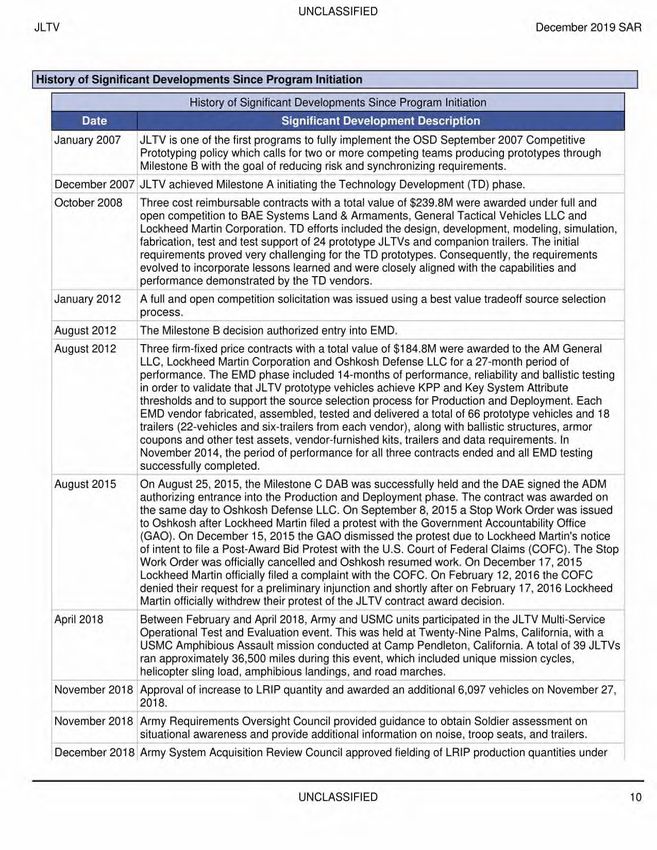
UNCLASSIFIED
JLTV                                                            December 2019 SAR

                                            Table of Contents

       Common Acronyms and Abbreviations for MDAP Programs                3
       Program Information                                                5
       Responsible Office                                                 5
       References                                                         6
       Mission and Description                                            7
       Executive Summary                                                  8
       Threshold Breaches                                                12
       Schedule                                                          13
       Performance                                                       15
       Track to Budget                                                   20
       Cost and Funding                                                  21
       Charts                                                            35
       Risks                                                             37
       Low Rate Initial Production                                       40
       Foreign Military Sales                                            41
       Nuclear Costs                                                     41
       Unit Cost                                                         42
       Cost Variance                                                     45
       Contracts                                                         49
       Deliveries and Expenditures                                       51
       Operating and Support Cost                                        52

                                              UNCLASSIFIED                     2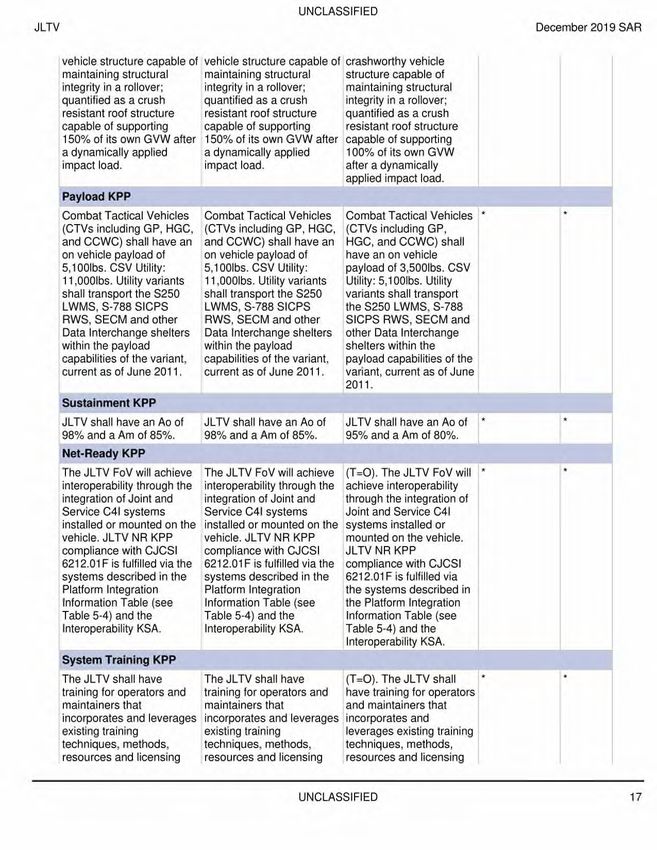
UNCLASSIFIED
JLTV                                                             December 2019 SAR

Common Acronyms and Abbreviations for MDAP Programs

Acq O&M - Acquisition-Related Operations and Maintenance
ACAT - Acquisition Category
ADM - Acquisition Decision Memorandum
APB - Acquisition Program Baseline
APPN - Appropriation
APUC - Average Procurement Unit Cost
$B - Billions of Dollars
BA - Budget Authority/Budget Activity
Blk - Block
BY - Base Year
CAPE - Cost Assessment and Program Evaluation
CARD - Cost Analysis Requirements Description
CDD - Capability Development Document
CLIN - Contract Line Item Number
CPD - Capability Production Document
CY - Calendar Year
DAB - Defense Acquisition Board
DAE - Defense Acquisition Executive
DAMIR - Defense Acquisition Management Information Retrieval
DoD - Department of Defense
DSN - Defense Switched Network
EMD - Engineering and Manufacturing Development
EVM - Earned Value Management
FOC - Full Operational Capability
FMS - Foreign Military Sales
FRP - Full Rate Production
FY - Fiscal Year
FYDP - Future Years Defense Program
ICE - Independent Cost Estimate
IOC - Initial Operational Capability
Inc - Increment
JROC - Joint Requirements Oversight Council
$K - Thousands of Dollars
KPP - Key Performance Parameter
LRIP - Low Rate Initial Production
$M - Millions of Dollars
MDA - Milestone Decision Authority
MDAP - Major Defense Acquisition Program
MILCON - Military Construction
N/A - Not Applicable
O&M - Operations and Maintenance
ORD - Operational Requirements Document
OSD - Office of the Secretary of Defense
O&S - Operating and Support
PAUC - Program Acquisition Unit Cost

                                                  UNCLASSIFIED                   3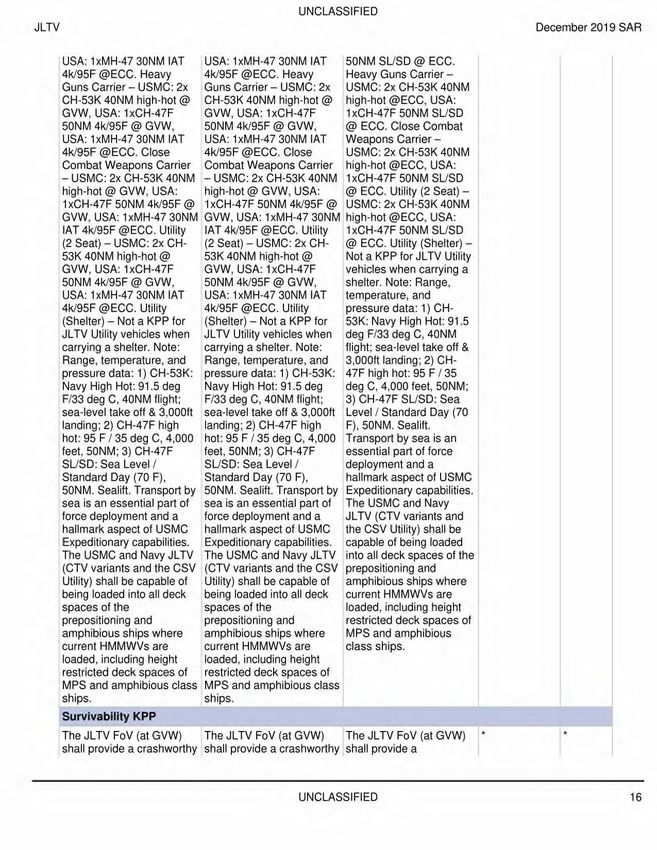
UNCLASSIFIED
JLTV                                                                             December 2019 SAR

PB - President's Budget
PE - Program Element
PEO - Program Executive Officer
PM - Program Manager
POE - Program Office Estimate
RDT&E - Research, Development, Test, and Evaluation
SAR - Selected Acquisition Report
SCP - Service Cost Position
TBD - To Be Determined
TY - Then Year
UCR - Unit Cost Reporting
U.S. - United States
USD(AT&L) - Under Secretary of Defense (Acquisition, Technology and Logistics)
USD(A&S) - Under Secretary of Defense (Acquisition and Sustainment)

                                                   UNCLASSIFIED                                  4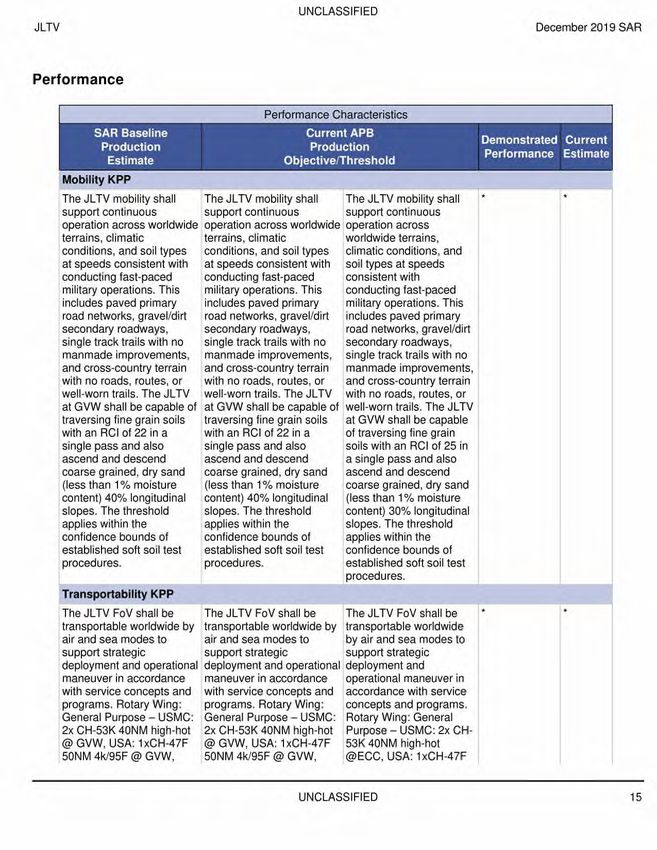
UNCLASSIFIED
JLTV                                                                        December 2019 SAR

Program Information

Program Name
Joint Light Tactical Vehicle (JLTV)

DoD Component
Army

Joint Participants
United States Marine Corps

Responsible Office

Mr. Michael Sprang                         Phone:           586-239-2984
43087 Lake Street                          Fax:
Building 301 NE
                                           DSN Phone:       273-2984
Harrison Township, MI 48045-4941
                                           DSN Fax:
                                           Date Assigned:   June 12, 2019
michael.d.sprang.ciy@mail.mil

                                      UNCLASSIFIED                                          5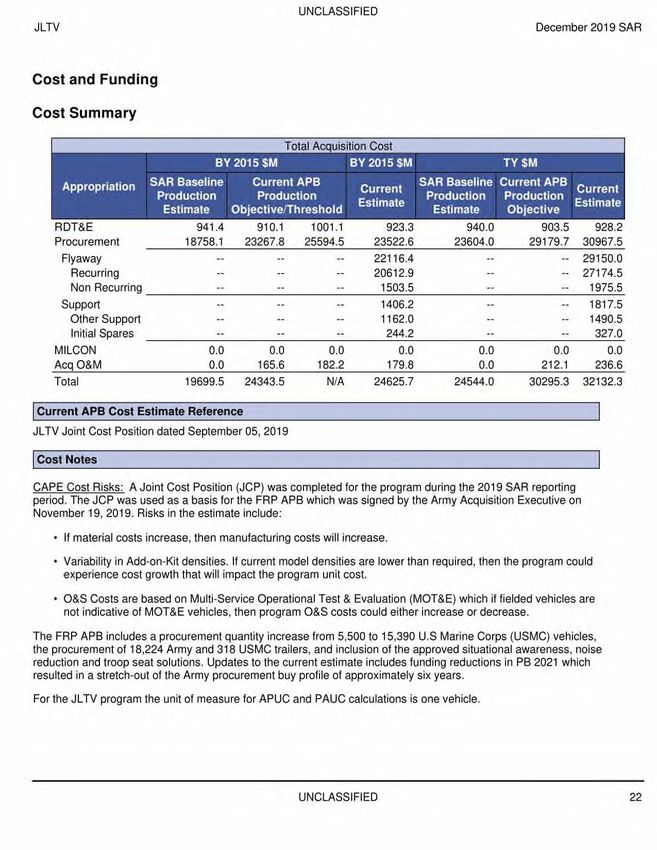
UNCLASSIFIED
JLTV                                                                                             December 2019 SAR

References

SAR Baseline (Production Estimate)

Defense Acquisition Executive (DAE) Approved Acquisition Program Baseline (APB) dated April 27. 2016

Approved APB
Army Acquisition Executive (AAE) Approved Acquisition Program Baseline (APB) dated November 19 2019

                                                   UNCLASSIFIED                                                  6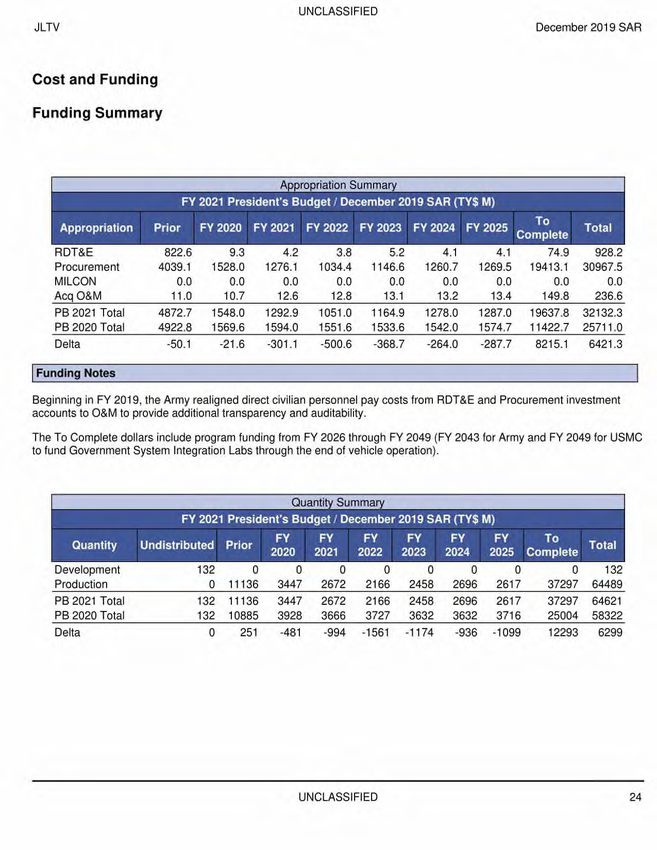
UNCLASSIFIED
JLTV                                                                                                          December 2019 SAR

Mission and Description
The primary mission of the Joint Light Tactical Vehicle (JLTV) is to provide protected, sustained and networked light tactical
mobility to the Joint forces capable of worldwide deployment across the full spectrum of military operations and mission
profiles under all weather and terrain conditions.

The JLTV will be transportable over long distances within any theater of operations through numerous lift assets and
options, from sealift and amphibious shipping to airlift (both fixed and rotary wing) and low velocity aerial delivery. It will
provide mobility to reconnaissance units and direct fire in support of combat maneuver with substantial payload for
personnel, equipment and supplies.

The JLTV will support command, control and communication in both stationary and on-the-move modes, enabling
interoperability with Joint and coalition forces in decentralized operations over extended ranges in complex and dynamic
operational environments.

System Description: the JLTV Family of Vehicles is comprised of two variants based upon a common automotive platform,
a two-seat Combat Support Vehicle (CSV) and a four-seat Combat Tactical Vehicle (CTV) as well as a companion trailer.
The two-seat CSV variant consists of one base vehicle platform: the Utility (UTL); which has a payload capacity of 5,100-
pounds. The four-seat CTV variant consists of two base vehicle platforms: the General Purpose (GP) and the Close
Combat Weapons Carrier (CCWC); which has a payload capacity of 3,500-pounds. Each base vehicle platform will be
configured as mission package configurations such as the GP, Heavy Guns Carrier (HGC), CCWC, and UTL.

                                                          UNCLASSIFIED                                                            7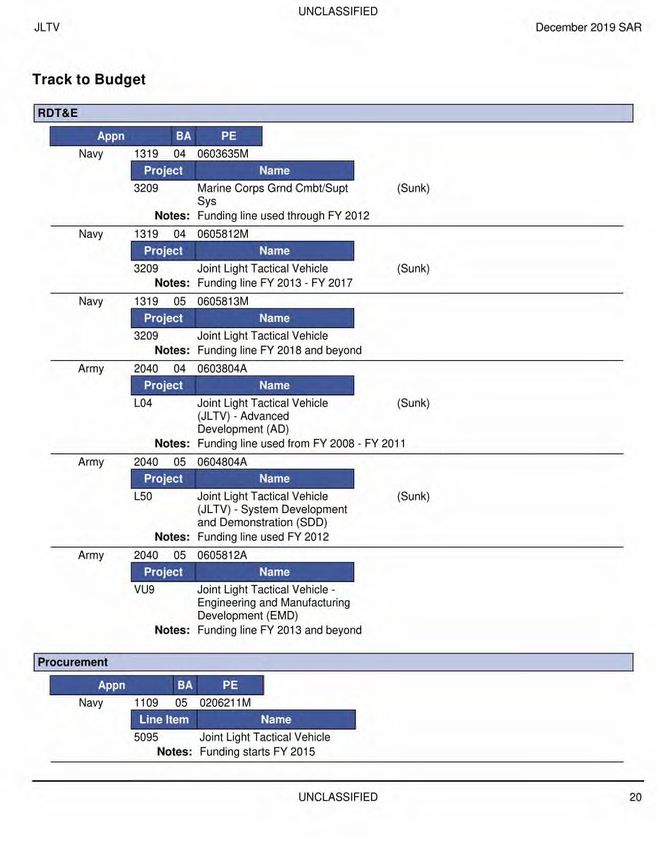
UNCLASSIFIED
JLTV                                                                                                   December 2019 SAR

Executive Summary

Program Highlights Since Last Report

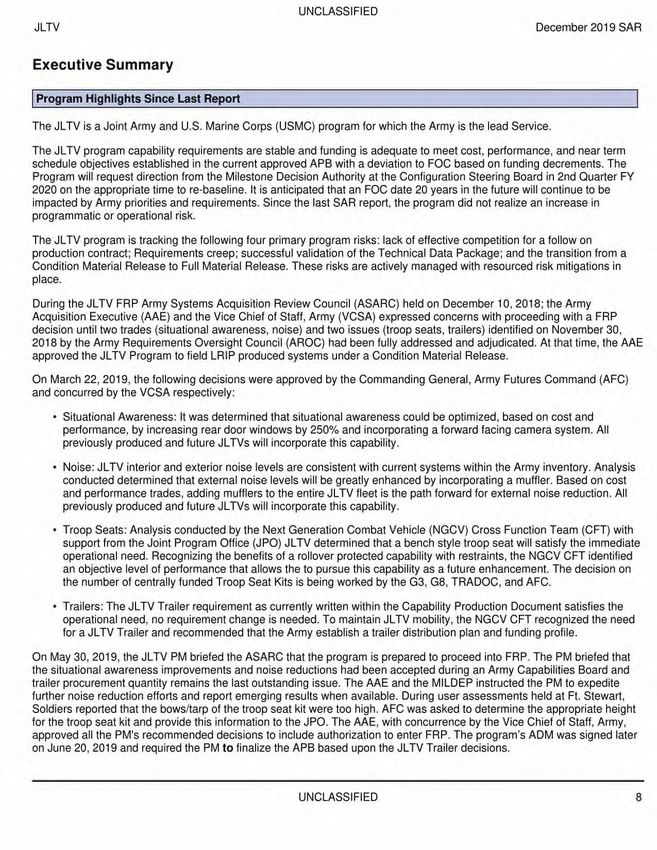
The JLTV is a Joint Army and U.S. Marine Corps (USMC) program for which the Army is the lead Service.

The JLTV program capability requirements are stable and funding is adequate to meet cost, performance, and near term
schedule objectives established in the current approved APB with a deviation to FOC based on funding decrements. The
Program will request direction from the Milestone Decision Authority at the Configuration Steering Board in 2nd Quarter FY
2020 on the appropriate time to re-baseline. It is anticipated that an FOC date 20 years in the future will continue to be
impacted by Army priorities and requirements. Since the last SAR report, the program did not realize an increase in
programmatic or operational risk.

The JLTV program is tracking the following four primary program risks: lack of effective competition for a follow on
production contract; Requirements creep; successful validation of the Technical Data Package; and the transition from a
Condition Material Release to Full Material Release. These risks are actively managed with resourced risk mitigations in
place.

During the JLTV FRP Army Systems Acquisition Review Council (ASARC) held on December 10, 2018; the Army
Acquisition Executive (AAE) and the Vice Chief of Staff, Army (VCSA) expressed concerns with proceeding with a FRP
decision until two trades (situational awareness, noise) and two issues (troop seats, trailers) identified on November 30,
2018 by the Army Requirements Oversight Council (AROC) had been fully addressed and adjudicated. At that time, the AAE
approved the JLTV Program to field LRIP produced systems under a Condition Material Release.

On March 22, 2019, the following decisions were approved by the Commanding General, Army Futures Command (AFC)
and concurred by the VCSA respectively:

    • Situational Awareness: It was determined that situational awareness could be optimized, based on cost and
      performance, by increasing rear door windows by 250% and incorporating a forward facing camera system. All
      previously produced and future JLTVs will incorporate this capability.

    • Noise: JLTV interior and exterior noise levels are consistent with current systems within the Army inventory. Analysis
      conducted determined that external noise levels will be greatly enhanced by incorporating a muffler. Based on cost
      and performance trades, adding mufflers to the entire JLTV fleet is the path forward for external noise reduction. All
      previously produced and future JLTVs will incorporate this capability.

    • Troop Seats: Analysis conducted by the Next Generation Combat Vehicle (NGCV) Cross Function Team (CFT) with
      support from the Joint Program Office (JPO) JLTV determined that a bench style troop seat will satisfy the immediate
      operational need. Recognizing the benefits of a rollover protected capability with restraints, the NGCV CFT identified
      an objective level of performance that allows the to pursue this capability as a future enhancement. The decision on
      the number of centrally funded Troop Seat Kits is being worked by the G3, G8, TRADOC, and AFC.

    • Trailers: The JLTV Trailer requirement as currently written within the Capability Production Document satisfies the
      operational need, no requirement change is needed. To maintain JLTV mobility, the NGCV CFT recognized the need
      for a JLTV Trailer and recommended that the Army establish a trailer distribution plan and funding profile.

On May 30, 2019, the JLTV PM briefed the ASARC that the program is prepared to proceed into FRP. The PM briefed that
the situational awareness improvements and noise reductions had been accepted during an Army Capabilities Board and
trailer procurement quantity remains the last outstanding issue. The AAE and the MILDEP instructed the PM to expedite
further noise reduction efforts and report emerging results when available. During user assessments held at Ft. Stewart,
Soldiers reported that the bows/tarp of the troop seat kit were too high. AFC was asked to determine the appropriate height
for the troop seat kit and provide this information to the JPO. The AAE, with concurrence by the Vice Chief of Staff, Army,
approved all the PM's recommended decisions to include authorization to enter FRP. The program's ADM was signed later
on June 20, 2019 and required the PM to finalize the APB based upon the JLTV Trailer decisions.

                                                      UNCLASSIFIED                                                           8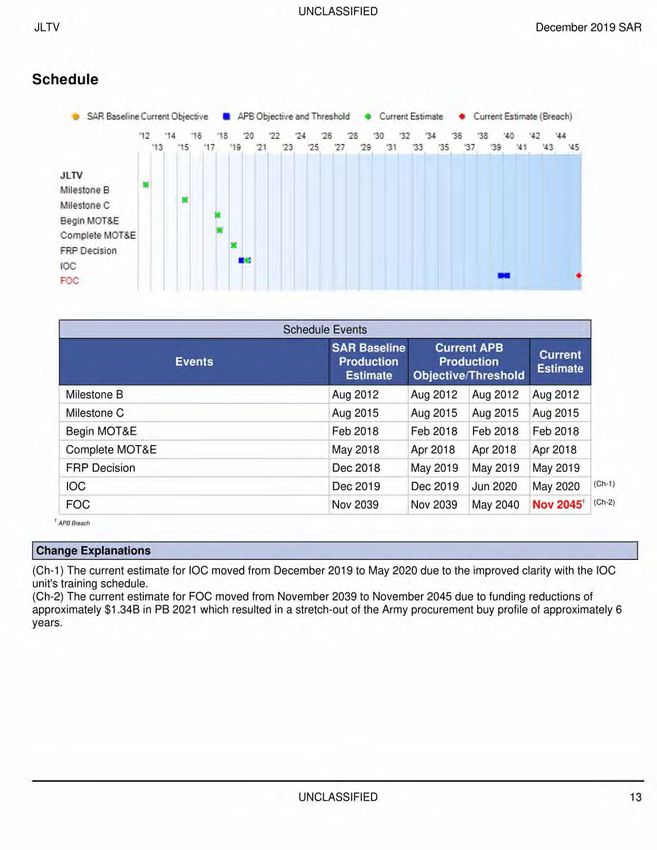
UNCLASSIFIED
JLTV                                                                                                December 2019 SAR

On June 7, 2019, the AROC approved fielding the JLTV and JLTV Trailer as a system and an initial trailer procurement of
7,523. On November 4th, the Commanding General of Army Futures Command approved the JLTV-T APO of 18,224 to
close out the AROC task. On November 19th, the Army Acquisition Executive approved the JLTV FRP APB.

There are no significant software-related issues with this program at this time.

                                                       UNCLASSIFIED                                                       9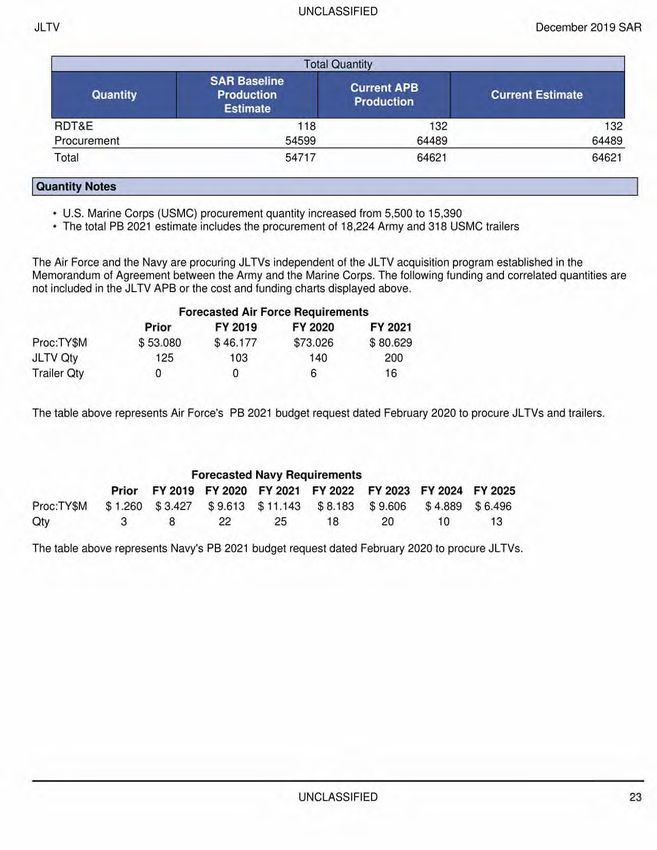
UNCLASSIFIED
JLTV                                                                                                 December 2019 SAR

History of Significant Developments Since Program Initiation

                   •          History of Significant Developments Since Program Initiation
                                                 Significant Development Description
   January 2007     JLTV is one of the first programs to fully implement the OSD September 2007 Competitive
                    Prototyping policy which calls for two or more competing teams producing prototypes through
                   'Milestone B with the goal of reducing risk and synchronizing requirements.
   December 2007 JLTV achieved Milestone A initiating the Technology Development (TD) phase.
   October 2008     Three cost reimbursable contracts with a total value of $239.8M were awarded under full and
                    open competition to BAE Systems Land & Armaments, General Tactical Vehicles LLC and
                    Lockheed Martin Corporation. TD efforts included the design, development, modeling, simulation,
                    fabrication, test and test support of 24 prototype JLTVs and companion trailers. The initial
                    requirements proved very challenging for the TD prototypes. Consequently, the requirements
                    evolved to incorporate lessons learned and were closely aligned with the capabilities and
                    performance demonstrated by the TD vendors.
   January 2012     A full and open competition solicitation was issued using a best value tradeoff source selection
                    process.
   August 2012     i The Milestone B decision authorized entry into EMD.
   August 2012     1Three firm-fixed price contracts with a total value of $184.8M were awarded to the AM General
                    LLC, Lockheed Martin Corporation and Oshkosh Defense LLC for a 27-month period of
                    performance. The EMD phase included 14-months of performance. reliability and ballistic testing
                    in order to validate that JLTV prototype vehicles achieve KPP and Key System Attribute
                    thresholds and to support the source selection process for Production and Deployment. Each
                    EMD vendor fabricated, assembled, tested and delivered a total of 66 prototype vehicles and 18
                    trailers (22-vehicles and six-trailers from each vendor), along with ballistic structures, armor
                    coupons and other test assets, vendor-furnished kits, trailers and data requirements. In
                    November 2014, the period of performance for all three contracts ended and all EMD testing
                    successfully completed.
   August 2015      On August 25, 2015, the Milestone C DAB was successfully held and the DAE signed the ADM
                    authorizing entrance into the Production and Deployment phase. The contract was awarded on
                    the same day to Oshkosh Defense LLC. On September 8, 2015 a Stop Work Order was issued
                    to Oshkosh after Lockheed Martin filed a protest with the Government Accountability Office
                    (GAO). On December 15, 2015 the GAO dismissed the protest due to Lockheed Martin's notice
                    of intent to file a Post-Award Bid Protest with the U.S. Court of Federal Claims (COFC). The Stop
                    Work Order was officially cancelled and Oshkosh resumed work. On December 17, 201 5
                    Lockheed Martin officially filed a complaint with the COFC. On February 12, 2016 the COFC
                    denied their request for a preliminary injunction and shortly after on February 17, 2016 Lockheed
                    Martin officially withdrew their protest of the JLTV contract award decision.
   April 2018       Between February and April 2018. Army and USMC units participated in the JLTV Multi-Service
                    Operational Test and Evaluation event. This was held at Twenty-Nine Palms, California, with a
                    USMC Amphibious Assault mission conducted at Camp Pendleton. California. A total of 39 JLTVs
                    ran approximately 36,500 miles during this event, which included unique mission cycles,
                    helicopter sling load, amphibious landings, and road marches.
   November 2018 Approval of increase to LRIP quantity and awarded an additional 6,097 vehicles on November 27,
                 2018.
   November 2018 Army Requirements Oversight Council provided guidance to obtain Soldier assessment on
                 situational awareness and provide additional information on noise, troop seats, and trailers.
   December 2018 Army System Acquisition Review Council approved fielding of LRIP production quantities under

                                                    UNCLASSIFIED                                                        10
UNCLASSIFIED
JLTV December 2019 SAR
Conditional Material Release.
May 2019
The Army Acquisition Executive (AAE) concurred with the information presented in the JLTV Full
Rate Production (FRP) Army System Acquisition Review Council briefing dated May 30, 2019,
which recommended approval to enter FRP. The FRP Acquisition Decision Memorandum was
signed by the AAE on June 20, 2019.
UNCLASSIFIED 11UNCLASSIFIED
JLTV December 2019 SAR
Threshold Breaches
APB Breaches
Explanation of Breach
Schedule
Performance The schedule breach for FOG moved from November 2039 to
Cost RDT&E November 2045 due to funding reductions of approximately $1.34B in
Procurement PB 2021. The full Army Procurement Objective of 49,099 will be
MILCON fielded and our Soldiers considered proficient and combat deployable
Acq O&M with the system by November 2045.
O&S Cost The Program will request direction from the Milestone Decision
Unit Cost PAUC Authority at the Configuration Steering Board in 2nd Quarter FY 2020
APUC on the appropriate time to re-baseline. It is anticipated that an FOG
date 20 years in the future will continue to be impacted by Army
Nunn-McCurdy Breaches priorities and requirements.
Current UCR Baseline Program Deviation Report is in process.
PAUC None
APUC None
Original UCR Baseline
PAUC None
APUC None
UNCLASSIFIED 12UNCLASSIFIED
JLTV December 2019 SAR
Schedule
BAR Baseline Current Objective le APB Objective and Threshold • Current Estimate • Current Estimate (Breach)
12 '14 '16 '18 20 '22 24 26 28 '30 '32 '34 '36 '38 '40 '42 '44
13 '15 '17 '19 '21 '23 '25 '27 29 '31 '33 15 '37 '39 '41 '43 '45
J LTV
•
Milestone B
Milestone C
Begin MOT&E
Complete MOT&E
FRP Decision
IOC
FCC
•
Schedule Events
UR Baseline Current APB
Current
Events Production Production
Milestone B
glE Estimate
Aug 2012
Objective/Threshold
Aug 2012 Aug 2012
Estimate
Aug 2012
Milestone C Aug 2015 Aug 2015 Aug 2015 Aug 2015
Begin MOT&E Feb 2018 Feb 2018 Feb 2018 Feb 2018
Complete MOT&E May 2018 Apr 2018 Apr 2018 Apr 2018
FRP Decision Dec 2018 May 2019 May 2019 May 2019
(C h -1 )
IOC Dec 2019 Dec 2019 Jun 2020 May 2020
(Ch-2)
FOG 1Nov 2039 1Nov 2039 May 2040 I Nov 2045'
1 APB Breach
Change Explanations
(Ch-1) The current estimate for IOC moved from December 2019 to May 2020 due to the improved clarity with the IOC
unit's training schedule.
(Ch-2) The current estimate for FOG moved from November 2039 to November 2045 due to funding reductions of
approximately $1.34B in PB 2021 which resulted in a stretch-out of the Army procurement buy profile of approximately 6
years.
UNCLASSIFIED 13UNCLASSIFIED
JLTV December 2019 SAR
Notes
On May 30, 2019, the Army System Acquisition Review Council approved JLTV to enter into FRP. The FRP ADM was
signed by the Army Acquisition Executive on June 20, 2019.
The above IOC is for the Army. The U.S. Marine Corps achieved IOC on August 2, 2019.
JPO JLTV will begin the IOC process upon the unit's return from their major training event at Fort Irwin National Training
Center in March of 2020. JLTV's First Unit Equipped (1-3 ABCT from Fort Stewart) was selected as the IOC unit.
The full APO of 49,099 will be fielded and our Soldiers considered proficient and combat deployable with the system by
November 2045. The Program will request direction from the Milestone Decision Authority at the Configuration Steering
Board in 2nd Quarter FY 2020 on the appropriate time to re-baseline. It is anticipated that an FOC date 20 years in the future
will continue to be impacted by Army priorities and requirements.
Acronyms and Abbreviations
ABCT - Armored Brigade Combat Team
APO - Army Procurement Objective
JP0 - Joint Program Office
MOT&E - Multi-Service Operational Test and Evaluation
UNCLASSIFIED 14UNCLASSIFIED
JLTV December 2019 SAR
Performance
Performance Characteristics
SAR Baseline CuiTent APB
Demonstrated Current
Production Production
Performance Estimate
Estimate Objective/Threshold
Mobility KPP
The JLTV mobility shall The JLTV mobility shall I The JLTV mobility shall
support continuous support continuous support continuous
operation across worldwide operation across worldwide operation across
terrains, climatic terrains, climatic worldwide terrains,
conditions, and soil types conditions, and soil types climatic conditions, and
at speeds consistent with at speeds consistent with soil types at speeds
conducting fast-paced conducting fast-paced consistent with
military operations. This military operations. This conducting fast-paced
includes paved primary includes paved primary military operations. This
road networks, gravel/dirt road networks, gravel/dirt includes paved primary
secondary roadways, secondary roadways, road networks. gravel/dirt
single track trails with no single track trails with no secondary roadways,
manmade improvements, manmade improvements, single track trails with no
and cross-country terrain and cross-country terrain manmade improvements,
with no roads, routes, or with no roads, routes, or and cross-country terrain
well-worn trails. The JLTV well-worn trails. The JLTV with no roads, routes, or
at GVW shall be capable of at GVW shall be capable of well-worn trails. The JLTV
traversing fine grain soils 'traversing fine grain soils at GVW shall be capable
with an RCI of 22 in a with an RCI of 22 in a of traversing fine grain
single pass and also single pass and also soils with an RCI of 25 in
ascend and descend ascend and descend a single pass and also
coarse grained, dry sand coarse grained, dry sand ascend and descend
(less than 1% moisture I (less than 1% moisture coarse grained, dry sand
content) 40% longitudinal content) 40% longitudinal (less than 1% moisture
slopes. The threshold slopes. The threshold content) 30% longitudinal
applies within the applies within the slopes. The threshold
confidence bounds of I confidence bounds of applies within the
established soft soil test established soft soil test confidence bounds of
procedures. ' procedures. established soft soil test
procedures.
Transportability KPP
The JLTV FoV shall be The JLTV FoV shall be The JLTV FoV shall be
transportable worldwide by transportable worldwide by transportable worldwide
air and sea modes to air and sea modes to by air and sea modes to
support strategic support strategic support strategic
deployment and operational deployment and operational deployment and
maneuver in accordance maneuver in accordance operational maneuver in
with service concepts and with service concepts and accordance with service
programs. Rotary Wing: programs. Rotary Wing: concepts and programs.
General Purpose — USMC: General Purpose — USMC: Rotary Wing: General
2x CH-53K 40NM high-hot 2x CH-53K 40NM high-hot Purpose — USMC: 2x CH-
@ GVW, USA: 1xCH-47F @ GVW, USA: 1xCH-47F 53K 40NM high-hot
50NM 4k/95F @ GVW, 50NM 4k/95F @ GVW, @FCC, USA: 1xCH-47F
UNCLASSIFIED 15UNCLASSIFIED
JLTV December 2019 SAR
USA: 1xMH-47 30NM IAT USA: 1xMH-47 30NM IAT 50NM SL/SD @ ECC.
4k/95F @ECC. Heavy 4k/95F @ECC. Heavy Heavy Guns Carrier —
Guns Carrier — USMC: 2x Guns Carrier — USMC: 2x USMC: 2x CH-53K 40NM
CH-53K 40NM high-hot @ CH-53K 40NM high-hot @ high-hot ©ECC, USA:
GVW, USA: 1xCH-47F GVW, USA: 1xCH-47F 1xCH-47F 50NM SL/SD
50NM 4k/95F @ GVW, 50NM 4k/95F @ GVW, @ ECC. Close Combat
USA: 1xMH-47 30NM IAT USA: 1xMH-47 30NM IAT Weapons Carrier —
4k/95F @ECC. Close 4k/95F @ECC. Close USMC: 2x CH-53K 40NM
Combat Weapons Carrier Combat Weapons Carrier high-hot @ECC, USA:
— USMC: 2x CH-53K 40NM — USMC: 2x CH-53K 40NM 1xCH-47F 50NM SUSD
high-hot @ GVW, USA: high-hot @ GVW, USA: @ ECC. Utility (2 Seat) —
1xCH-47F 50NM 4k/95F @ 1xCH-47F 50NM 4k/95F @ USMC: 2x CH-53K 40NM
GVW, USA: 1xMH-47 30NM GVW, USA: 1xMH-47 30NM high-hot @ECC, USA:
IAT 4k/95F @ECC. Utility IAT 4k/95F @ECC. Utility 1xCH-47F 50NM SL/SD
(2 Seat) — USMC: 2x CH- (2 Seat) — USMC: 2x CH- @ ECC. Utility (Shelter) —
53K 40NM high-hot @ 53K 40NM high-hot @ Not a KPP for JLTV Utility
GVW, USA: 1xCH-47F GVW, USA: 1xCH-47F vehicles when carrying a
50NM 4k/95F @ GVW, 50NM 4k/95F @ GVW, shelter. Note: Range,
USA: 1xMH-47 30NM IAT USA: 1xMH-47 30NM IAT temperature, and
4k/95F @ECC. Utility 4k/95F @ECC. Utility pressure data: 1) CH-
(Shelter) — Not a KPP for (Shelter) — Not a KPP for 53K: Navy High Hot: 91.5
JLTV Utility vehicles when JLTV Utility vehicles when deg F/33 deg C, 40NM
carrying a shelter. Note: carrying a shelter. Note: flight; sea-level take off &
Range, temperature, and Range, temperature, and 3,000ft landing; 2) CH-
pressure data: 1) CH-53K: pressure data: 1) CH-53K: 47F high hot: 95 F / 35
Navy High Hot: 91.5 deg Navy High Hot: 91.5 deg deg C, 4,000 feet, 50NM;
F/33 deg C, 40NM flight; F/33 deg C, 40NM flight; 3) CH-47F SL/SD: Sea
sea-level take off & 3,000ft sea-level take off & 3,000ft Level / Standard Day (70
landing; 2) CH-47F high landing; 2) CH-47F high F), 50NM. Sealift.
hot: 95 F / 35 deg C, 4,000 hot: 95 F / 35 deg C, 4,000 Transport by sea is an
feet, 50NM; 3) CH-47F feet, 50NM; 3) CH-47F essential part of force
SL/SD: Sea Level / SL/SD: Sea Level / deployment and a
Standard Day (70 F), Standard Day (70 F), hallmark aspect of USMC
50NM. Sealift. Transport by 50NM. Sealift. Transport by Expeditionary capabilities.
sea is an essential part of sea is an essential part of The USMC and Navy
force deployment and a force deployment and a JLTV (CTV variants and
hallmark aspect of USMC hallmark aspect of USMC the CSV Utility) shall be
Expeditionary capabilities. Expeditionary capabilities. capable of being loaded
The USMC and Navy JLTV The USMC and Navy JLTV into all deck spaces of the
(CTV variants and the CSV (CTV variants and the CSV prepositioning and
Utility) shall be capable of Utility) shall be capable of amphibious ships where
being loaded into all deck being loaded into all deck current HMMWVs are
spaces of the spaces of the loaded, including height
prepositioning and prepositioning and restricted deck spaces of
amphibious ships where amphibious ships where MPS and amphibious
current HMMWVs are current HMMWVs are class ships.
loaded, including height loaded, including height
restricted deck spaces of restricted deck spaces of
MPS and amphibious class MPS and amphibious class
ships. ships.
Survivability KPP
The JLTV FoV (at GVW) The JLTV FoV (at GVW) The JLTV FoV (at GVW) * .
shall provide a crashworthy shall provide a crashworthy shall provide a
UNCLASSIFIED 16UNCLASSIFIED
JLTV December 2019 SAR
vehicle structure capable of vehicle structure capable of crashworthy vehicle
maintaining structural maintaining structural structure capable of
integrity in a rollover; lintegrity in a rollover; maintaining structural
quantified as a crush quantified as a crush integrity in a rollover;
resistant roof structure resistant roof structure quantified as a crush
capable of supporting capable of supporting resistant roof structure
150% of its own GVW after 150% of its own GVW after capable of supporting
a dynamically applied a dynamically applied 100% of its own GVW
impact load. impact load. after a dynamically
applied impact load.
Payload KPP
Combat Tactical Vehicles I Combat Tactical Vehicles Combat Tactical Vehicles
(CTVs including GP, HGC, (CTVs including GP, HGC, (CTVs including GP,
and CCWC) shall have an and CCWC) shall have an HGC, and CCWC) shall
on vehicle payload of on vehicle payload of have an on vehicle
5,100Ibs. CSV Utility: 5,100Ibs. CSV Utility: payload of 3,500Ibs. CSV
11,000Ibs. Utility variants 1 11,000Ibs. Utility variants Utility: 5,100Ibs. Utility
shall transport the S250 'shall transport the S250 variants shall transport
LWMS. S-788 SICPS LWMS, S-788 SICPS the S250 LWMS. S-788
RWS, SECM and other RWS, SECM and other SICPS RWS, SECM and
Data Interchange shelters Data Interchange shelters other Data Interchange
within the payload within the payload shelters within the
capabilities of the variant, capabilities of the variant, payload capabilities of the
current as of June 2011. current as of June 2011. variant, current as of June
2011.
Sustainment KPP
JLTV shall have an Ao of JLTV shall have an Ao of JLTV shall have an Ao of
98% and a Am of 85%. 98% and a Am of 85%. 95% and a Am of 80%.
Net-Ready KPP
The JLTV FoV will achieve The JLTV FoV will achieve (T=0). The JLTV FoV will *
interoperability through the interoperability through the achieve interoperability
integration of Joint and integration of Joint and through the integration of
Service C4I systems Service C4I systems Joint and Service C4I
installed or mounted on the installed or mounted on the systems installed or
vehicle. JLTV NR KPP vehicle. JLTV NR KPP mounted on the vehicle.
compliance with CJCSI compliance with CJCSI JLTV NR KPP
6212.01F is fulfilled via the 6212.01F is fulfilled via the compliance with CJCSI
systems described in the systems described in the 6212.01F is fulfilled via
Platform Integration I Platform Integration the systems described in
Information Table (see Information Table (see the Platform Integration
Table 5-4) and the Table 5-4) and the Information Table (see
Interoperability KSA. Interoperability KSA. Table 5-4) and the
Interoperability KSA.
System Training KPP
The JLTV shall have The JLTV shall have (T=0). The JLTV shall
training for operators and training for operators and have training for operators
maintainers that maintainers that and maintainers that
incorporates and leverages incorporates and leverages incorporates and
existing training existing training leverages existing training
techniques, methods, techniques, methods, techniques, methods,
resources and licensing resources and licensing resources and licensing
UNCLASSIFIED 17UNCLASSIFIED
JLTV December 2019 SAR
requirements of each requirements of each requirements of each
Service. JLTV training shall Service. JLTV training shall Service. JLTV training
include in-vehicle training to include in-vehicle training to shall include in-vehicle
encompass demonstrating encompass demonstrating training to encompass
a capability to negotiate a capability to negotiate demonstrating a capability
operationally relevant operationally relevant to negotiate operationally
terrain profiles, which terrain profiles, which relevant terrain profiles,
include basic organic include basic organic which include basic
vehicle instrumentation, vehicle instrumentation, organic vehicle
controls and crew drills. controls and crew drills. instrumentation, controls
and crew drills.
Classified Performance information is provided in the classified annex to this submission.
Requirements Reference
CPD dated November 21, 2014 as amended in August 21, 2018, March 22, 2019 and April 9, 2019.
Change Explanations
None
Notes
* In accordance with Section 830 of the FY 2020 National Defense Authorization Act, furstse,e-e*I.data in this SAR
section has been eliminated. This data is available upon Congressional request to the Office of the Under Secretary of
Defense for Acquisition and Sustainment.
UNCLASSIFIED 18UNCLASSIFIED
JLTV December 2019 SAR
Acronyms and Abbreviations
@ - at
Am - Materiel Availability
Ao - Operational Availability
ATO - Approval to Operate
C - Celsius
CCWC - Close Combat Weapons Carrier
CJCSI - Chairman Joint Chiefs of Staff Instruction
CSV - Combat Support Vehicle
CTV - Combat Tactical Vehicle
DAA - Designated Approval Authority
Deg - Degree
DoD lEA - DoD Information Enterprise Architecture
DoDAF - DoD Architecture Framework
ECC - Essential Combat Configuration
F - Fahrenheit
FoV - Family of Vehicles
ft - Feet
GESP - GIG Enterprise Service Profiles
GIG - Global Information Grid
GP - General Purpose
GVW - Gross Vehicle Weight
HGC - Heavy Guns Carrier
HMMWV - High Mobility Multi-Purpose Wheeled Vehicle
IAT - Internal Air Transport
IP - Internet Protocol
IT - Information Technology
JTRS - Joint Tactical Radio System
k - Thousand
KSA - Key System Attribute
lbs - Pounds
LWMS - Light Weight Multipurpose Shelter
MPS - Maritime Pre-Positioning Squadron
nm - Nautical Miles - NM is used in the Performance Characteristics
RCI - Rating Cone Index
SAASM - Selective Availability Anti-Spoofing Module
SECM - Shop Equipment Contact Maintenance
SICPS RWS - Standardized Integrated Command Post System Rigid Wall Shelter
SUSD - Sea Level / Standard Day
TV-1 - Technical Standards Profile
USA - U.S. Army
USMC - U.S. Marine Corps
UNCLASSIFIED 19UNCLASSIFIED
JLTV December 2019 SAR
Track to Budget
RDT&E
Appn BA PE
Navy 1319 04 0603635M
Project Name
3209 Marine Corps Grnd Cmbt/Supt (Sunk)
Sys
Notes: Funding line used through FY 2012
Navy 1319 04 0605812M
Project Name
3209 Joint Light Tactical Vehicle (Sunk)
Notes: Funding line FY 2013- FY 2017
Navy 1319 05 0605813M
Project Name
3209 Joint Light Tactical Vehicle
Notes: Funding line FY 2018 and beyond
Army 2040 04 0603804A
Project Name
L04 Joint Light Tactical Vehicle (Sunk)
(JLTV) - Advanced
Development (AD)
Notes: Funding line used from FY 2008 - FY 2011
Army 2040 05 0604804A
Project Name
L50 Joint Light Tactical Vehicle (Sunk)
(JLTV) - System Development
and Demonstration (SDD)
Notes: Funding line used FY 2012
Army 2040 05 0605812A
Project Name
VU9 Joint Light Tactical Vehicle -
Engineering and Manufacturing
Development (EMD)
Notes: Funding line FY 2013 and beyond
Procurement
Appn BA PE
Navy 1109 05 0206211M
Line Item Name
5095 Joint Light Tactical Vehicle
Notes: Funding starts FY 2015
UNCLASSIFIED 20UNCLASSIFIED
JLTV December 2019 SAR
Army 2035 01 0216300A
Line Item Name
D15603 Joint Light Tactical Vehicle
Notes: Funding starts FY 2015
Acq O&M
Appn BA PE
Army 2020 04 0702806A
Subactivity
Name
Group
435 Acquisition and Management (Shared)
Support: Joint Light Tactical
Vehicle
Notes: Funding line FY 2019 and beyond
UNCLASSIFIED 21UNCLASSIFIED
JLTV December 2019 SAR
Cost and Funding
Cost Summary
Total Acquisition Cost
BY 2015 $M ,174%$m •
1 TV $M
ppropriation SAR Baseline Current APB SAR Baseline Current APB
Current Current
Production Production Production Production
Estimate
Estimatekpbjective/Threshold Estimate ObjectivAEstimate
RDT&E 941.4 910.1 1001.1 923.3 940.0 903.5 928.2
Procurement 18758.1 23267.8 25594.5 23522.6 23604.0 29179.7 30967.5
Flyaway 22116.4 29150.0
Recurring 20612.9 27174.5
Non Recurring 1503.5 1975.5
Support 1406.2 1817.5
Other Support 1162.0 1490.5
Initial Spares 244.2 327.0
MILCON 0.0 0.0 0.0 0.0 0.0 0.0 0.0
Acq O&M 0.0 165.6 182.2 179.8 0.0 212.1 236.6
Total 19699.5 24343.5 N/A 24625.7 24544.0 30295.3 32132.3
Current APB Cost Estimate Reference
JLTV Joint Cost Position dated September 05, 2019
Cost Notes
CAPE Cost Risks: A Joint Cost Position (JCP) was completed for the program during the 2019 SAR reporting
period. The JCP was used as a basis for the FRP APB which was signed by the Army Acquisition Executive on
November 19, 2019. Risks in the estimate include:
• If material costs increase, then manufacturing costs will increase.
• Variability in Add-on-Kit densities. If current model densities are lower than required, then the program could
experience cost growth that will impact the program unit cost.
• O&S Costs are based on Multi-Service Operational Test & Evaluation (MOT&E) which if fielded vehicles are
not indicative of MOT&E vehicles, then program O&S costs could either increase or decrease.
The FRP APB includes a procurement quantity increase from 5,500 to 15,390 U.S Marine Corps (USMC) vehicles,
the procurement of 18,224 Army and 318 USMC trailers. and inclusion of the approved situational awareness, noise
reduction and troop seat solutions. Updates to the current estimate includes funding reductions in PB 2021 which
resulted in a stretch-out of the Army procurement buy profile of approximately six years.
For the JLTV program the unit of measure for APUC and PAUC calculations is one vehicle.
UNCLASSIFIED 22UNCLASSIFIED
JLTV December 2019 SAR
Total Quantity
SAR Baseline
Current APB
Quantity Production Current Estimate
Production
Estimate
RDT&E 118 132 132
Procurement 54599 64489 64489
Total 54717 64621 64621
Quantity Notes
• U.S. Marine Corps (USMC) procurement quantity increased from 5,500 to 15,390
• The total PB 2021 estimate includes the procurement of 18,224 Army and 318 USMC trailers
The Air Force and the Navy are procuring JLTVs independent of the JLTV acquisition program established in the
Memorandum of Agreement between the Army and the Marine Corps. The following funding and correlated quantities are
not included in the JLTV APB or the cost and funding charts displayed above.
Forecasted Air Force Requirements
Prior FY 2019 FY 2020 FY 2021
Proc:TY$M $ 53.080 $ 46.177 $73.026 $ 80.629
JLTV Qty 125 103 140 200
Trailer Qty 0 0 6 16
The table above represents Air Force's PB 2021 budget request dated February 2020 to procure JLTVs and trailers.
Forecasted Navy Requirements
Prior FY 2019 FY 2020 FY 2021 FY 2022 FY 2023 FY 2024 FY 2025
Proc:TY$M $ 1.260 $ 3.427 $ 9.613 $ 11.143 $ 8.183 $ 9.606 $ 4.889 $ 6.496
Qty 3 8 22 25 18 20 10 13
The table above represents Navy's PB 2021 budget request dated February 2020 to procure JLTVs.
UNCLASSIFIED 23UNCLASSIFIED
JLTV December 2019 SAR
Cost and Funding
Funding Summary
Appropriation Summary
FY 2021 President's Budget / December 2019 SAR (TY$ M)
To
Appropriation Prior FY 2020 FY 2021 FY 2022 FY 2023 FY 2024 FY 2025 Total I
Complete
RDT&E 822.6 9.3 4.2 3.8 5.2 4.1 4.1 74.9 928.2
Procurement 4039.1 1528.0 1276.1 1034.4 1146.6 1260.7 1269.5 19413.1 30967.5
MILCON 0.0 0.0 0.0 0.0 0.0 0.0 0.0 0.0 0.0
Acq O&M 11.0 10.7 12.6 12.8 13.1 13.2 13.4 149.8 236.6
PB 2021 Total 4872.7 1548.0 1292.9 1051.0 1164.9 1278.0 1287.0 19637.8 32132.3
PB 2020 Total 4922.8 1569.6 1594.0 1551.6 1533.6 1542.0 1574.7 11422.7 25711.0
Delta -50.1 -21.6 -301.1 -500.6 -368.7 -264.0 -287.7 8215.1 6421.3
Funding Notes
Beginning in FY 2019, the Army realigned direct civilian personnel pay costs from RDT&E and Procurement investment
accounts to O&M to provide additional transparency and auditability.
The To Complete dollars include program funding from FY 2026 through FY 2049 (FY 2043 for Army and FY 2049 for USMC
to fund Government System Integration Labs through the end of vehicle operation).
Quantity Summary
FY 2021 President's Budget / December 2019 SAR (TY$ M)
FY FY FY FY FY FY To
Quantityik Undistributed Prior Tota
2020 2021 2022 2023 2024 2025 Complete
Development 132 0 0 0 0 0 0 0 0 132
Production 0 11136 3447 2672 2166 2458 2696 2617 37297 64489
PB 2021 Total 132 11136 3447 2672 2166 2458 2696 2617 37297 64621
PB 2020 Total 132 10885 3928 3666 3727 3632 3632 3716 25004 58322
Delta 0 251 -481 -994 -1561 -1174 -936 -1099 12293 6299
UNCLASSIFIED 24UNCLASSIFIED
JLTV December 2019 SAR
Cost and Funding
Annual Funding By Appropriation
Annual Funding
2040 I RDT&E I Research, Development, Test, and Evaluation, Army
Fiscal
Year
I
11.111111111
INNI-
Quantity End Item
Recurring
Flyaway
1
Recurring
Flyaway
1111Mr Ty sly!
Non End 1
Item
Non
Recurring
Flyaway
1
Total
Flyaway
111
r Total
Support
Total
Program
2008 105.2
2009 20.5
2010 26.3
2011 33.4
2012 84.5
2013 59.2
2014 81.4
2015 28.3
2016 21.6
2017 11.1
2018 13.8
2019
2020 7.2
2021 1.7
2022 1.8
2023 1.8
2024 2.0
2025 2.0
2026 2.3
2027 1.9
2028 3.0
2029 2.0
2030 3.7
2031 5.3
2032 4.3
2033 8.3
2034 4.5
2035 4.5
2036 4.6
2037 4.7
2038 4.8
2039 4.9
2040 5.0
2041 0.4
Subtotal 64 566.0
UNCLASSIFIED 25UNCLASSIFIED
JLTV December 2019 SAR
Annual Funding
2040 I RDT&E I Research, Development, Test, and Evaluation, Army
BY 2015 $M 1=1111.1
Fiscal Non End
Quantity End Item Non
Year Item
Recurring Recurring
Recurring
Flyaway Flyaway
Flyaway
2008 114.9
2009 22.1
2010 27.9
2011 34.8
2012 86.7
2013 59.7
2014 80.5
2015 27.5
2016 20.8
2017 10.5
2018 12.8
2019
2020 6.4
2021 1.5
2022 1.6
2023 1.5
2024 1.7
2025 1.6
2026 1.8
2027 1.5
2028 2.3
2029 1.5
2030 2.7
2031 3.8
2032 3.0
2033 5.8
2034 3.1
2035 3.0
2036 3.0
2037 3.0
2038 3.0
2039 3.0
2040 3.0
2041 0.2
Subtotal 64 556.2
UNCLASSIFIED 26UNCLASSIFIED
JLTV December 2019 SAR
Annual Funding
1319 I RDT&E I Research, Development, Test, and Evaluation, Navy
TY $IN
Fiscal Non End
Quantity End Item Non
Year Item Total Total Total
Recurring Recurring
Recurring Flyaway Support Program
Flyaway Flyaway
Flyaway
2008 38.7
2009 40.7
2010 47.8
2011 18.3
2012 45.1
2013 35.5
2014 52.9
2015 7.2
2016 24.8
2017 7.4
2018 18.9
2019
2020 2.1
2021 2.5
2022 2.0
2023 3.4
2024 2.1
2025 2.1
2026 2.5
2027 2.2
2028 3.3
2029 2.3
2030 0.4
Subtotal 68 362.2
UNCLASSIFIED 27UNCLASSIFIED
JLTV December 2019 SAR
Annual Funding
1319 I RDT&E I Research, Development, Test, and Evaluation, Navy
BY 2015 $411
Fiscal Non End
Quantity End Item Non
Year Item Total Total Total
Recurring Recurring
Recurring Flyaway Support Program
Flyaway Flyaway
Flyaway
2008 42.4
2009 44.0
2010 50.9
2011 19.0
2012 46.1
2013 35.9
2014 52.8
2015 7.1
2016 24.0
2017 7.0
2018 17.6
2019
2020 1.9
2021 2.2
2022 1.7
2023 2.9
2024 1.7
2025 1.7
2026 2.0
2027 1.7
2028 2.5
2029 1.7
2030 0.3
Subtotal 68 367.1
UNCLASSIFIED 28UNCLASSIFIED
JLTV December 2019 SAR
Annual Funding
2035 I Procurement I Other Procurement, Army
TY $1V1 IMF
Fiscal Non End
Quantity End Item Non
Year Item Total I Total Total
Recurring Recurring
Recurring Flyaway Support Program
Flyaway Flyaway
Flyaway
2015 397 127.9 24.6 152.5 12.1 164.6
2016 592 181.9 54.4 236.3 4.7 241.0
2017 1812 520.5 65.9 586.4 1.1 587.5
2018 2251 680.8 39.7 720.5 86.9 807.4
2019 3569 1079.4 60.4 1139.8 122.4 1262.2
2020 2205 841.7 53.3 895.0 77.4 972.4
2021 1920 759.5 53.4 812.9 81.5 894.4
2022 1521 619.9 51.1 671.0 40.7 711.7
2023 1869 743.8 55.2 799.0 46.9 845.9
2024 1818 743.9 54.1 798.0 47.2 845.2
2025 1701 747.9 50.1 798.0 47.2 845.2
2026 1840 757.8 55.5 813.3 48.9 862.2
2027 1879 780.4 56.6 837.0 42.0 879.0
2028 1900 803.1 50.6 853.7 43.3 897.0
2029 1903 819.2 51.2 870.4 44.3 914.7
2030 1898 833.5 54.1 887.6 45.1 932.7
2031 1893 839.1 66.1 905.2 46.3 951.5
2032 1880 856.9 67.1 924.0 46.8 970.8
2033 1887 870.5 71.9 942.4 47.9 990.3
2034 1820 868.8 93.9 962.7 47.4 1010.1
2035 1861 908.6 72.5 981.1 49.3 1030.4
2036 1883 929.0 71.0 1000.0 50.8 1050.8
2037 1884 947.7 72.2 1019.9 51.9 1071.8
2038 1905 974.7 65.4 1040.1 53.4 1093.5
2039 1938 1001.0 58.7 1059.7 55.3 1115.0
2040 1967 1029.1 51.1 1080.2 57.1 1137.3
2041 1106 608.8 40.8 649.6 33.2 682.8
2042 39.4 39.4 39.4
2043 40.2 40.2 40.2
Subtotal 49099 20875.4 1640.5 22515.9 1331.1 23847.0
UNCLASSIFIED 29UNCLASSIFIED
JLTV December 2019 SAR
Annual Funding
2035 I Procurement I Other Procurement, Army
-1 11111111 BY 2015 $M
Fiscal Non End 1
Quantity End Item Non
Year Item Total I Total Total
Recurring Recurring
Recurring Flyaway Support Program
Flyaway Flyaway
Flyaway
2015 397 124.2 23.9 148.1 11.7 159.8
2016 592 174.2 52.1 226.3 4.5 230.8
2017 1812 488.6 61.9 550.5 1.0 551.5
2018 2251 626.9 36.6 663.5 80.0 743.5
2019 3569 974.6 54.5 1029.1 110.5 1139.6
2020 2205 745.0 47.2 792.2 68.5 860.7
2021 1920 659.1 46.3 705.4 70.8 776.2
2022 1521 527.4 43.5 570.9 34.6 605.5
2023 1869 620.4 46.1 666.5 39.1 705.6
2024 1818 608.3 44.4 652.7 38.5 691.2
2025 1701 599.6 40.1 639.7 37.9 677.6
2026 1840 595.6 43.7 639.3 38.4 677.7
2027 1879 601.4 43.5 644.9 32.4 677.3
2028 1900 606.7 38.3 645.0 32.7 677.7
2029 1903 606.8 37.9 644.7 32.8 677.5
2030 1898 605.2 39.4 644.6 32.7 677.3
2031 1893 597.4 47.0 644.4 33.0 677.4
2032 1880 598.1 46.8 644.9 32.7 677.6
2033 1887 595.6 49.3 644.9 32.7 677.6
2034 1820 582.8 63.0 645.8 31.8 677.6
2035 1861 597.6 47.7 645.3 32.4 677.7
2036 1883 599.0 45.8 644.8 32.7 677.5
2037 1884 599.1 45.5 644.6 32.9 677.5
2038 1905 604.1 40.5 644.6 33.1 677.7
2039 1938 608.2 35.7 643.9 33.6 677.5
2040 1967 613.0 30.5 643.5 34.0 677.5
2041 1106 355.5 23.9 379.4 19.4 398.8
2042 22.6 22.6 22.6
2043 22.6 22.6 22.6
Subtotal 49099 15514.4 1220.3 16734.7 1014.4 17749.1
UNCLASSIFIED 30UNCLASSIFIED
JLTV December 2019 SAR
Annual Funding
1109 1 Procurement 1 Procurement, Marine Corps
TY $1V1
Fiscal Non End
Quantity End Item Non
Year Item Total I Total Total
Recurring Recurring
Recurring Flyaway Support Program
Flyaway Flyaway
Flyaway
2015 6 2.2 4.2 6.4 1.0 7.4
2016 128 42.8 15.8 58.6 58.6
2017 212 70.4 32.6 103.0 1.2 104.2
2018 527 169.7 29.5 199.2 34.2 233.4
2019 1642 528.4 17.6 546.0 26.8 572.8
2020 1242 458.8 23.8 482.6 73.0 555.6
2021 752 301.0 27.4 328.4 53.3 381.7
2022 645 279.1 18.6 297.7 25.0 322.7
2023 589 256.3 23.6 279.9 20.8 300.7
2024 878 377.4 23.1 400.5 15.0 415.5
2025 916 389.1 18.6 407.7 16.6 424.3
2026 2020 846.8 20.4 867.2 21.6 888.8
2027 1946 779.6 20.9 800.5 56.1 856.6
2028 1937 887.9 18.9 906.8 32.8 939.6
2029 1950 909.6 19.4 929.0 45.2 974.2
2030 20.6 20.6 18.1 38.7
2031 2.0 2.0
2032 2.0 2.0
2033 2.1 2.1
2034 2.1 2.1
2035 2.2 2.2
2036 2.2 2.2
2037 2.3 2.3
2038 2.3 2.3
2039 2.3 2.3
2040 2.4 2.4
2041 2.4 2.4
2042 2.5 2.5
2043 2.5 2.5
2044 2.6 2.6
2045 2.6 2.6
2046 2.7 2.7
2047 2.8 2.8
2048 2.8 2.8
2049 2.9 2.9
Subtotal 15390 6299.1 335.0 6634.1 486.4 7120.5
UNCLASSIFIED 31UNCLASSIFIED
JLTV December 2019 SAR
Annual Funding
1109 1 Procurement 1 Procurement, Marine Corps
BY 2015 $M
Fiscal Non End
Quantity End Item Non
Year Item Total I Total Total
Recurring Recurring
Recurring Flyaway Support Program
Flyaway Flyaway
Flyaway
2015 6 2.1 4.1 6.2 1.0 7.2
2016 128 41.0 15.2 56.2 56.2
2017 212 66.2 30.6 96.8 1.1 97.9
2018 527 156.4 27.3 183.7 31.5 215.2
2019 1642 477.7 15.9 493.6 24.2 517.8
2020 1242 406.6 21.1 427.7 64.7 492.4
2021 752 261.5 23.8 285.3 46.3 331.6
2022 645 237.7 15.8 253.5 21.4 274.9
2023 589 214.0 19.7 233.7 17.4 251.1
2024 878 309.0 18.9 327.9 12.3 340.2
2025 916 312.3 15.0 327.3 13.3 340.6
2026 2020 666.4 16.1 682.5 17.0 699.5
2027 1946 601.5 16.1 617.6 43.3 660.9
2028 1937 671.6 14.3 685.9 24.8 710.7
2029 1950 674.5 14.4 688.9 33.5 722.4
2030 14.9 14.9 13.2 28.1
2031 1.4 1.4
2032 1.4 1.4
2033 1.4 1.4
2034 1.4 1.4
2035 1.4 1.4
2036 1.4 1.4
2037 1.5 1.5
2038 1.4 1.4
2039 1.4 1.4
2040 1.4 1.4
2041 1.4 1.4
2042 1.4 1.4
2043 1.4 1.4
2044 1.4 1.4
2045 1.4 1.4
2046 1.4 1.4
2047 1.5 1.5
2048 1.4 1.4
2049 1.4 1.4
Subtotal 15390 5098.5 283.2 5381.7 391.8 5773.5
UNCLASSIFIED 32UNCLASSIFIED
JLTV December 2019 SAR
Annual Funding
Yea
2020 Acq O&M I Operation and Maintenance, Army
Fis
l. 2019
2020
111
TY "11
Total
Program
11.0
10.7
2021 12.6
2022 12.8
2023 13.1
2024 13.2
2025 13.4
2026 11.1
2027 11.1
2028 11.2
2029 11.4
2030 10.6
2031 10.8
2032 9.9
2033 9.0
2034 9.1
2035 9.3
2036 8.3
2037 7.3
2038 7.4
2039 7.6
2040 5.1
2041 5.2
2042 2.7
2043 2.7
Subtotal 236.6
UNCLASSIFIED 33UNCLASSIFIED
JLTV December 2019 SAR
Annual Funding
2020 I Acq O&M I Operation and Maintenance, Army
BY 2016111
Fisca
Year Total'
Program
2019 10.1
2020 9.6
2021 11.1
2022 11.1
2023 11.1
2024 11.0
2025 10.9
2026 8.9
2027 8.7
2028 8.6
2029 8.6
2030 7.8
2031 7.8
2032 7.0
2033 6.3
2034 6.2
2035 6.2
2036 5.4
2037 4.7
2038 4.7
2039 4.7
2040 3.1
2041 3.1
2042 1.6
2043 1.5
Subtotal 179.8
UNCLASSIFIED 34UNCLASSIFIED
JLTV December 2019 SAR
Charts
JLTV first began SAR reporting in December 2012
Program Acquisition Cost - JLTV
Base Year 2015 $M
3530D
353:0 A
!L"
IMF
7.": •
10012°-
5003
0
2013 zrte 2015 2:r75 2377 2018 2013
SAR Submission Date
—e— Aoq Cost (TYS) —6— Acq Cost (BYs) Percent Delfvered Percent Expended
Quantity - JLTV
80000
60000-
a-
t 40000
20000-
0
2013 2014 2015 2016 2017 2018 2019
SAR Submission Date
Development QTY Production QTY -- Total QV(
UNCLASSIFIED 35UNCLASSIFIED
JLTV December 2019 SAR
Unit Cost- JLTV
Base Year 2015 $M
0.5 10
0.4-
0
0.3-
0
5
0 2-
10
0.1- 15
0 -20
2013 2014 2015 2016 2017 2018 2019
SAR Submission Date
--•— PAUC E3YS —•— PAUC UCRB % Chg PAUC Original Chg PUC Original Chg
APUC BYS APUC UCRB % Chg
UNCLASSIFIED 36UNCLASSIFIED
JLTV December 2019 SAR
Risks
Significant Schedule and Technical Risks
Significant Schedule and Technical Risks
If the JLTV Family of Vehicles does not meet the Mean Miles Between Operational Mission Failure and Mean
Miles Between Hardware Mission Failure requirements, then the Key System Attributes will not be achieved.
Risk mitigated by including design for Reliability/Maintainability language into the EMD contract and Purchase
Description. All EMD repair actions were captured during shakedown and test. Data was analyzed and
Materiel Reliability/Mean Time to Repair was predicted and reviewed at Scoring Conferences. Corrective
Action Periods (CAP) were successfully executed which allowed the EMD vendors to implement corrective
actions on subsystems/components which reduced maintenance requirements and decreased failure rates.
2. If there are unexpected test delays or unforeseen mishaps, then the test program may not be completed
within schedule. Risk mitigated by successfully working with the Army Test and Evaluation Command to
effectively prioritize the timing of all testing which helped ensure test events were fully supported. Alternate
test site agreements were obtained by Test Management Community which confirmed their availability when
needed. Additionally, the successful execution of the CAPs mitigated test program issues. All EMD
performance, ballistic, reliability, availability and maintainability testing, as well as the Limited Users Test
were successfully completed and supported both the requirements of the LRIP down select process as well
as the data requirements necessary for the successful Milestone C decision.
3. If contractors do not make efficient use of time provided for Government Furnished Equipment (GFE)
integration or delays occur in procurement of long lead items, then integration of GFE Hardware and
Software may be unsuccessful in EMD. Risk mitigated by quickly obtaining a signed ADM with immediate
follow on buys of Phase I long lead GFE. Joint Project Office JLTV effectively collaborated with GFE PMs and
Original Equipment Manufacturers to acquire Interface Control Documents and temporary loans which
helped ensure the GFE was delivered on time to the vendors at contract award.
Milestone C (August 2015)
1. If the Cab / Armor design cannot defeat KPP Kinetic Energy and Underbody threats. then JLTV will not
receive Full Material Release (FMR) and may not receive a FRP decision.
2. If the system design cannot meet the Rating Cone Index and Sand Slope requirements, then JLTV will not I
receive FMR and may not receive FRP decision.
3. If the system design cannot be certified for transportability, then JLTV will not receive FMR and may not
receive FRP decision.
Current Estimate (December 2019)
1. If effective competition is not received in response to the Request For Proposal for follow-on production
contracts then program may experience cost growth as a result of increasing unit prices.
2. If new requirements continue to be generated post Full Rate Production, they will require new System
Technical Support Work Directives that yield new Engineering Change Propsals and additional funding will
be necessary, which could drive a potential cost breach to PAUC and APUC.
3. If the JLTV Technical Data Package is not successfully validated prior to the scheduled Request For
Proposal release for the follow-on production then the program's fielding schedule will be delayed since the
Government is unable to procure additional vehicles.
4. If fielded under a Conditional Material Release (CMR) and conditions of the CMR are not resolved within the
established timelines then the program will be unable to continue fielding without a valid material release.
UNCLASSIFIED 37UNCLASSIFIED
JLTV December 2019 SAR
Risks
Risk and Sensitivity Analysis
Risks and Sensitivity Analysis
Current Baseline Estimate (November 2019)
The JLTV Joint Cost Position (JCP), approved on September 5, 2019 by the Army Acquisition Executive,
was used to establish the FRP APB signed on November 19, 2019. The JCP cost model is a cost-risk
adjusted model and reflects a 50% Confidence Level in accordance with Army Cost Guidance, Army
Regulation 11-18. The most significant cost drivers in the JLTV estimate are manufacturing costs for
vehicles, trailers and add-on kits. Given the current and anticipated fiscal environment, there may be
budgetary pressures on the program which lead to a reduction in JLTV annual procurement quantities. The
JCP cost model projects increases to vehicle unit costs with quantity reductions. The first production
contract unit pricing is known but future contract pricing is not known making it difficult to calculate the
impact of changes in annual procurement quantity based on vehicle unit prices that a future vendor would
propose. Additionally, the JLTV Family of Vehicles (FOV) is made up of four vehicle configurations with
unique unit prices as well as trailers and add-on kits, which are procured at lower densities relative to total
vehicle quantities. The unit of measure for JLTV APUC and PAUC calculations is one JLTV truck.
Adjustments to configuration mix or increased densities of add-on kits relative to vehicle quantities could
also result in program unit cost increases. There is also cost risk associated with the length of the JLTV
procurement program; production is planned through the year 2035. Due to the length of the production
program and the difficulties in accurately forecasting future inflation increases, there is the potential for
increased TY cost if inflation increases at a rate greater than projected in the OSD inflation rates.
Original Baseline Estimate (October 2012)
The JLTV JCP, approved on July 12, 2012 by Assistant Secretary of the Army for Financial Management &
Comptroller was used to establish the APB. The JCP cost model is a cost risk adjusted model and reflects
a 50% Confidence Level in accordance with Army Cost Guidance, Army Regulation 11-18. The most
significant cost drivers in the JLTV estimate are manufacturing costs for vehicles and add-on kits. Given the
current and anticipated fiscal environment, there may be budgetary pressures on the program which may
lead to a reduction in JLTV annual procurement quantities. The JCP cost model projects increases to
vehicle unit costs with quantity reductions. However, prior to a production contract award, it is difficult to
calculate the impact of changes in annual procurement quantity to the vehicle unit prices that a vendor
would propose. Additionally, the JLTV FOV is made up of four vehicle configurations with unique unit prices
and add-on kits, which are procured at lower densities relative to total vehicle quantities. The unit of
measure for JLTV APUC and PAUC calculations is one JLTV. Adjustments to configuration mix or
increased densities of add-on kit relative to vehicle quantities could also result in program unit cost
increases. There is also cost risk associated with the length of the JLTV procurement program; production
is planned through the year 2040. Due to the length of the production program and the difficulties in
accurately forecasting future inflation increases, there is the potential for increased TY cost if inflation
increases at a rate greater than projected in the OSD inflation rates.
Revised Original Estimate (N/A)
Not Applicable
Current Procurement Cost (December 2019)
1. The JLTV Current Estimate is based upon the approved JCP completed for the FRP Decision and used to
establish the FRP APB signed on November 19, 2019. The JLTV Current Estimate cost model is a cost-
risk adjusted model and reflects a 50% Confidence Level in accordance with Army Cost Guidance, Army
Regulation 11-18. The JCP cost model projects vehicle unit costs throughout production. The first
UNCLASSIFIED 38UNCLASSIFIED
JLTV December 2019 SAR
production contract unit pricing is known but future contract pricing is not known making it difficult to
calculate the impact of changes in annual procurement quantity based on vehicle unit prices that a future
vendor would propose. Additionally, the JLTV Family of Vehicles (FOV) is made up of four vehicle
configurations with unique unit prices as well as trailers and add-on kits, which are procured at lower
densities relative to total vehicle quantities. The unit of measure for JLTV APUC and PAUC calculations is
one JLTV. Adjustments to configuration mix or increased densities of add-on kits relative to vehicle
quantities could also result in program unit cost increases. There is also cost risk associated with the
length of the JLTV procurement program; production is planned through the year 2041. Due to the length of
the production program and the difficulties in accurately forecasting future inflation increases, there is the
potential for increased TY cost if inflation increases at a rate greater than projected in the OSD inflation
rates.
UNCLASSIFIED 39UNCLASSIFIED
JLTV December 2019 SAR
Low Rate Initial Production
Item Initial LRIP Decision ' 41E Current Total LRIP
Approval Date 8/20/2012 11/20/2018
Approved Quantity 3100 11087
Reference Milestone B ADM ADM for LRIP Quantity Increase
Start Year 2015 2015
End Year 2017 2019
The Current Total LRIP Quantity is more than 10% of the total production quantity of 64,489. The LRIP increase from the
previously approved LRIP Quantity of 4,990 vehicles to 11,087 vehicles permitted an orderly increase in the production rate
for the system which was sufficient to lead to FRP.
UNCLASSIFIED 40UNCLASSIFIED
JLTV December 2019 SAR
Foreign Military Sales
Notes
* In accordance with Section 830 of the FY 2020 National Defense Authorization Act, For.iAitioie666eQ441.y.data in this SAR
section has been eliminated. This data is available upon Congressional request to the Office of the Under Secretary of
Defense for Acquisition and Sustainment.
Nuclear Costs
None
UNCLASSIFIED 41UNCLASSIFIED
JLTV December 2019 SAR
Unit Cost
Current UCR Baseline and Current Estimate (Base-Year Dollars)
BY 2015 $M
I Current UCR % Change
Current Estimate I
Baseline
(Dec 2019 SAR)
(Nov 2019 APB)
Program Acquisition Unit Cost
Cost 24343.5 24625.7
Quantity 64621 64621
Unit Cost 0.377 0.381 +1.06
Average Procurement Unit Cost
Cost 23267.8 23522.6
Quantity 64489 64489
Unit Cost 0.361 0.365 +1.11
Original UCR Baseline and Current Estimate (Base-Year Dollars)
BY 2015 $M 1. 1011 BY 2015 $M
Item Original UCR
Current Estimate I % Change
Baseline
(Dec 2019 SAR)
(Oct 2012 APB)
Program Acquisition Unit Cost
Cost 23868.6 24625.7
Quantity 54730 64621
Unit Cost 0.436 0.381 -12.61
Average Procurement Unit Cost
Cost 22822.7 23522.6
Quantity 54599 64489
Unit Cost 0.418 0.365 -12.68
UNCLASSIFIED 42You can also read


