JUNIOR ACADEMIC GUIDE 2018 - MOUNT ALBERT GRAMMAR SCHOOL - Course selection due date: Wednesday 18th October, 2017
←
→
Page content transcription
If your browser does not render page correctly, please read the page content below
MOUNT ALBERT GRAMMAR SCHOOL

   JUNIOR ACADEMIC GUIDE
           2018

Course selection due date: Wednesday 18th October, 2017
THE MAGS WAY
Values:
• Respect oneself.
• Aim for excellence.
• Value education.
• Be honest.
• Respect others.
• Respect property and the environment.
Guiding Principles:
• The MAGS way encompasses all individuals in the school community.
• The MAGS way is to guide all daily relationships between staff and students.
• The MAGS way is based on respect for others and the dignity of the individual.
• All individuals in the school have both rights and responsibilities as part of the MAGS Way.
2CONTENTS
The MAGS Way 2
School Conduct Code 2
Message from the Headmaster 4
Introduction 4
Who to seek assistance from: Key staff 5
Junior Graduation 6
Sport Academies 6
Year 10 courses 6
Choosing Year 10 Options for 2018 7
Year 10 Courses by Core and Options (TABLE A, B & C)
Arts Faculty 8
Commerce Faculty 10
English Faculty 11
English Language Faculty 11
Languages Faculty 12
Learning Support Faculty 13
Mathematics 13
Physical Education and Health 14
Science Faculty 15
Social Science Faculty 15
Technology Faculty 16
Te Tari Maori Faculty 16
3MESSAGE FROM THE HEADMASTER
I am pleased to present the Mount Albert Grammar School Junior Academic Guide for 2018.
A school’s primary goal should be to fulfil the academic potential of every student, and Mount Albert Grammar School
prides itself on its academic tradition.
Our school community is proud of the outstanding academic success that is currently being enjoyed by the young
people of our school. Academic results from recent years consistently place MAGS as a top performing school nationally
in NCEA and New Zealand Scholarship. This success is a reflection of the partnership between the school and the home
– high quality teaching and courses of learning supported by a student’s strong work habits and a supportive family
environment is a recipe which guarantees each student will achieve to the best of their ability.
I commend this booklet as a valuable tool in deciding courses of learning for next year and beyond, and I thank those
who have brought this publication together. Please use the information within to open the door to further discussions
with teachers and other staff about choosing the most appropriate academic options.
I encourage students to ask questions about curriculum pathways, and, most importantly, to follow their passion when
choosing their course of study.
All the best for your academic journey.
Patrick Drumm
Headmaster
INTRODUCTION
Our students and their parents/caregivers have to make very important decisions about which academic courses to
study. MAGS is determined to make this decision-making process as informed as possible. This Academic Course
booklet is designed to assist you in this process and be a key tool to providing you with the information you need.
This booklet covers all subjects offered to students in Year 10.
Prerequisites: It is important to note that many subjects in the senior school subjects can only be taken if earlier subject
success has been achieved. There is a significant change of focus for students. They must gain entry to the next course.
Entry into each course is determined by prerequisites which are unique to that course.
If the subjects chosen are seen as inappropriate or inaccessible for some students, Deans will interview students to
discuss the matter, and contact parents, if required.
4WHO TO SEEK ASSISTANCE FROM: KEY STAFF
Headmaster – Mr P Drumm Heads of Department
Acting Associate Principal – Ms J Williams Careers Mr Kubi Witten-Hannah
Ms Williams is in charge of the day-to-day operation of the school and Classical Studies Mr G Cave
responsible for Junior Girls.
Commerce Mr A Maunder
Deputy Principal Year 13 Mrs F Barker Dance Ms J Cesan
Drama Mr G Urquhart
Deputy Principal Year 12 Ms S Hayat
Deputy Principal Year 11 Ms C Horne English Language Ms P Godber
English Ms A Mason
Deputy Principal Junior Boys Ms S Hayes
Geography Mr C Adam
Deputy Principal Assessment/NZQA Mr M Rivalland
Health Ms J Lythe
Deputy Principal Director of School House Mr C Metcalfe History Ms O Markham
Food Technology Mrs M Sood
The Deputy Principals will be able to give you help, advice and guidance Languages Ms H Selaries
during your time at Mount Albert Grammar School.
Learning Support Mr M Tashmeer
Ms N Mahalingam
Director of International Students Ms J Lydia Mathematics Mr A Sangster
Ms Lydia looks after overseas fee-paying students
Media Studies Mr S Allen
Director of Sport Mr D Long Music Mrs M Zjajic-Moon
Mr Long is responsible for the coordination of all sports Outdoor Education Mr D Whitehead
within the school
Physical Education Mr M Dempster
Director of E-learning Mrs E Goddard
Mrs Goddard is responsible for all the Science Ms A Diegel
e-learning initiatives in the school SENCO Mrs P Drake
Social Science Mrs C Cato
Head of Guidance Ms T Montgomery
Ms Montgomery is responsible for the pastoral Technology Mr T van Zyl
side of the school Te Tari Māori Ms W Paul
Visual Arts Mr B Corkery
Guidance Counsellors Mrs M O’Carroll
Mrs R Weeks
Ms M Wilson
If you have any personal problems, problems with other students or are Heads of Department will be able to give advice about what is
concerned about anything going on at school, you can make an involved in a course of study and how best to achieve positive
appointment at the Student Support Office to see one of the results in that course.
counsellors.
Deans for 2017
Pacific Island Liaison Officer Mr A Taulapiu Year 10 Boys Mr A Coup
If you have any personal problems, problems with other students or are
concerned about anything going on at school, you can make an Year 10 Girls Ms G Leaso
appointment at the Student Support Office. Year 9 Boys Mr M Collins
Year 9 Girls Ms C Calvert
Careers Adviser Mr Kubi Witten-Hannah International Dean Mr J Cavanagh
The Careers Adviser can give you advice on the most suitable subjects
to take for particular jobs or entrance requirements for tertiary study.
The Careers Centre is in the Maurice Hall Building (D Block). You can Deans will help with your course. See them if you have any
book an appointment at any time. problems with schoolwork, or with other students.JUNIOR GRADUATION
Your Year 10 programme will continue your pathway towards the Mount Albert Grammar School Junior Graduation Diploma.
The aim of this diploma is to:
§ encourage students to work to achieve their best
§ actively reward both achievement and effort at all ability levels
§ better track student performance and achievement
§ provide more timely and indicative snap shots of progress and achievement
The focus of Junior Graduation remains largely on academic achievement and effort in subjects, but also rewards good attendance,
punctuality and tidy uniform. Points are earned by students for their work effort, and also for maintaining school standards and getting
involved in school activities. Each subject has allocated points to various assessments and, in most cases, to bookwork, effort and
organisation.
Your teachers will give you more information about their subjects at the beginning of the year.
SPORTS ACADEMIES
Sport Academies are under the supervision of the School’s Assistant Director of Sport, Mr G Moon.
Mount Albert Grammar School has employed a number of elite sports coaches and established unique sports academies within the School
environment.
Information on Academies
Year 9 and 10 courses will offer sports development in Basketball, Rugby, Football, Cricket, Netball, Swimming and Rowing. Sport academies are 2
periods per week as an option subject. Students will be selected on the basis of potential and ability. Entry is by trial only. These are practically based
courses concentrating on personal development and the development of skills in the selected sport.
Cricket: (CR1) Tony Sail
Netball: (NB1) Paula Smith
Rugby: (RU1) Geoff Moon
Football: (FB1 boys) Peter Smith
(FG1 girls) Peter Smith
Rowing: (RG1 girls) Judith Quinlan
(RB1 boys) Judith Quinlan
In addition, Basketball, Aquatics and Athletics are offered at pre-arranged times before and after school, for selected students.
YEAR 10 COURSES
, 2014
This section is for current Year 9 students when choosing their courses for 2018.
All students will study the core subjects of English, Mathematics, Science, Physical Education and Social Studies. The descriptors on the
following pages explain these courses.
In addition, descriptors have been provided for option subjects. You will be required to choose options from those offered in this academic
guide. Note in particular how options are divided into:
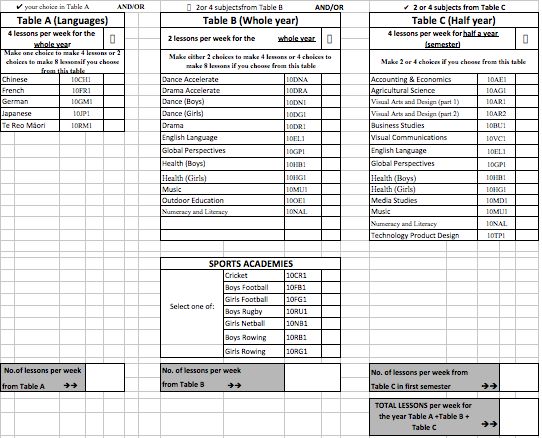
TABLE A subjects 4 lessons per week for the whole year
TABLE B subjects 2 lessons per week for the whole year
TABLE C subjects 4 lessons per week for half a year (semester)
Your choice of options for next year is your first crucial decision. The 2018 Senior Academic Guide which is on the MAGS website, will give you
more information about subject pathways through the senior school. You may find it useful to look at the senior course flowcharts and read
more information about senior courses as part of your Year 10 course selection.
6CHOOSING YEAR 10 OPTIONS FOR 2018
• In 2018 all students will study the core subjects of English, Mathematics, Science, Social Studies and Physical Education.
• Please refer to the course information in this booklet for information on the prerequisites for entry to the courses you wish
to study.
• Choose a combination of option subjects from Table A and/or Table B and/or Table C that will total 8 lessons per week for
the whole year.
• Option form to be completed, signed by Parents/Guardians and returned to your Form Teacher by Wednesday 18th
October.
NOTE:
1. Do you want to take Art courses?
You can take both semester 1 and 2 Visual Arts and Design courses in TABLE C.
2. Do you want to take 2 language courses?
You can do this but you cannot choose any other options.
Tick 2 languages in TABLE A. Do not tick any other boxes.
3. Your course can be made up of any combination from the tables below.
4. Complete your subject choices by ticking in one, two or three tables.
5. Some subjects are offered in TABLE B and TABLE C to give you flexibility.
6. Check that your total number of lessons adds up to 8 per week for the whole year.
NOTE: The final decision for placement of students for Academies is made by Academy Directors and the Assistant Director of Sport.
Example of the tables from the course selection sheet
7ARTS FACULTY
DANCE (TABLE B OPTION) DANCE ACCELERATE (TABLE B OPTION)
YEAR 10 BOYS (DN1), GIRLS (10DG1) YEAR 10 (DNA)
Prerequisites Prerequisites:
Students must have an appreciation of dance and a desire to Year 9 Academy and by application to HOD.
learn. Prior experience not necessary however preference given Experience essential.
to those who are wishing to pursue dance for NCEA in Year 11.
Course Information
Course Information Students study towards NCEA Level 1 Dance.
Students study basic dance techniques and elements for
performance, learn movement sequences in a variety of dance Supplementary materials/equipment: $25.00
genres, and are introduced to the creative process of making
dance.
Supplementary materials/equipment: $25.00
DRAMA (TABLE B OPTION) DRAMA ACCELERATE (TABLE B OPTION)
YEAR 10 (DR1) Year 10 (DRA)
Prerequisites Prerequisites:
Students must have an appreciation of drama and a desire to Year 9 Academy and HOD approval
learn. Prior experience not necessary however preference given
to those who wish to pursue drama for NCEA in Year 11. Course Information
Students study towards NCEA level 1 Drama
Course Information
Students study basic drama techniques, conventions and Supplementary materials /equipment: $25.00
elements for performance, and are introduced to the creative
process of making drama. Year 10 is designed to develop skills,
techniques and understanding of performance conventions in
preparation for senior Drama.
Supplementary materials/equipment: $25.00
MUSIC (TABLE B AND C OPTION)
YEAR 10 (10MU1)
Prerequisites
Pupils taking this course must have lessons on their major
instrument for the whole school year either privately, or as part
of the school instrumental programme. Pupils must be part of a
school musical group, either instrumental or vocals approved by
the Head of Music. Where possible, the instrumental group will
be any of our Orchestras, Concert Band, Jazz Band, Chamber
Groups or Junior Jazz Band. For vocalists and instrumentalists
who do not play a band-type instrument, the group will be the
Mount Albert Grammar School Choir (one of our four choirs) or
the group that they will form themselves with HOD/Music
teacher approval and guidance. Some of the groups are: the
flute choir, chamber groups, jazz band, saxophone group, junior
rock bands, drumline etc.
Course information
The course will cover the following aspects of music:
performance, composition, aural, score reading and musical
knowledge. We will concentrate on two topics of different
aspects of musical knowledge.
Assessment
Assessment will take the forms of performances, aural tests,
written assignments and composition.
Supplementary materials/equipment: Nil
8VISUAL ART - (TABLE C OPTION)
YEAR 10 - 10AR1 – semester one
10AR2 – semester two
Year 10 Visual Art is split into two half year courses that develop skills,
techniques and understanding of artistic conventions in Painting, Design,
Photography, Printmaking and Sculpture. The first and second semester
courses cover different disciplines, allowing students to follow Art for half
a year or the whole year. Students who opt to take art as a yearlong
option have the opportunity to develop a wider range of skills and
techniques to enhance their senior study.
Prerequisites
none
Course Information
The course will cover:
• Looking at artist models and painting conventions
• Developing in-depth drawing and compositional skills
• Working with wet and dry media to develop a range of
techniques
• Looking at contemporary design process and conventions
• Sculptural exploration
• May include NZQA Level 1 Assessments
Course progression: Level 1 Paint OR Level 1 Design for Print
Supplementary materials/equipment: $45.00 half-year or
$55.00 full year (if both courses are taken)
9COMMERCE FACULTY
BUSINESS STUDIES (TABLE C OPTION) ACCOUNTING & ECONOMICS (TABLE C OPTION)
YEAR 10 (10BU1) YEAR 10 (10AE1)
Prerequisites Prerequisites
Nil Nil
Course information Course information
This course will focus on issues facing small businesses. The students will In this course students cover a combination of both Accounting and
investigate marketing, human resources, financial literacy and Economics. Accounting topics include financial statements for personal
communication in relation to a business. Topics learnt in class will be Accounting and an introduction to business Accounting. Economic topics
applied to the setting up and running of a business at a school Market include an introduction to consumer and producer choices as well as
Day. This course leads to Accounting, Business Studies and Economics in Economic issues facing New Zealand. This course leads to Accounting,
Year 11, 12 and 13 as well proving the inspiration for students to become Business Studies and Economics in Year 11, 12 and 13 as well as a variety
Business owners and managers in the future. of careers in the business and government sectors.
Assessment Assessment
All assessments count towards junior graduation. Assessments include All assessments count towards junior graduation. Assessments include
end of topic tests and projects. end of topic tests and assignments.
Supplementary materials/equipment: Nil
Supplementary materials/equipment: Nil
10ENGLISH FACULTY
ENGLISH MEDIA STUDIES (TABLE C OPTION)
YEAR 10 (10EN1) YEAR 10 (10MD1)
Compulsory core subject
Prerequisites
Prerequisites Nil
Some classes are streamed on the basis of student performance in Year
9. The teaching strategies used for each class are differentiated in order Course information
to extend those who are already working at or above Level 5 on the A course for students who are interested in studying different
national curriculum and support those who are below the level to meet aspects of the media such as: film, television, the Internet,
NCEA requirements in Year 11. newspapers and magazines.
Course Information This course will extend their Year 9 English and Social Studies skills
This full year course further develops skills learnt in Year 9 in all six areas and give them an opportunity to apply those skills to more practical
of the national curriculum: listening, reading, viewing, speaking, media based activities. Students will study:
writing and presenting.
• A specific film genre
All Year 10 students will be assessed against the national standards in all • Production skills
six areas during the year. They will study a variety of written, visual and • Representation in the media
oral texts and develop a range of writing styles and deliver an oral • Close viewing of narrative conventions
presentation. Using language, symbols and text is central to this subject.
We aim to provide each student with a course that will involve Year 10 Media Studies will equip students with foundation skills to
stimulating text and language studies. succeed in senior Media Studies.
The English Faculty also provides students with the opportunity to take Assessment
part in co-curricular debating, writing club, film club, spoken word The course uses both written and practical tasks to evaluate
poetry and trips to the annual Auckland Writers’ Festival. Outside students’ understanding of concepts. Students are also assessed
writers and story-tellers are encouraged to visit the school. both in individual and group situations.
Assessment Supplementary materials/equipment: Nil
There are two summative assessments each term that contribute to
Junior Graduation points and an end of year examination. Placement in
differentiated Year 11 courses will rely on performance throughout the
year as well as the end of year examination.
Supplementary materials/equipment $10.00
ENGLISH LANGUAGE FACULTY
ENGLISH LANGUAGE (TABLE B AND C OPTION)
YEAR 10 (10ESL)
Prerequisites
Director of International or Head of English Language approval
Course Information
This programme supports English Language learners to practise and use
new language within a task and topic based framework across all four
skills.The textbook used covers most of the specifications of the Council
of Europe framework from level A1+ to A2+.
Assessment
Module tests at the end of topics.
Supplementary materials/equipment: Approx. $40.00 for Language
Workbook.
11LANGUAGES FACULTY
FRENCH (TABLE A OPTION) GERMAN (TABLE A OPTION)
YEAR 10 (10FR1) YEAR 10 (10GM1)
Prerequisites Prerequisites
A GPA of at least 50 in Year 9 French A GPA of at least 50 in Year 9 German
OR Head of Faculty approval OR Head of Faculty approval
Course Information Course Information
The students will learn how to understand, speak, read and write French The students will learn how to understand, speak, read and write
as it applies to: German as it applies to:
Plans and Celebrations Clothing Hobbies Dates and seasons
Food Family School Eating out
School Getting around Town Telling time Body + illnesses
Daily Activities Shopping Town Transport
Travel Weather Clothes Description of people
Going to Paris Weather Trips
Assessment Assessment
Tests and examinations Tests and Examinations
Approximate equal value will be given to the four skills of listening, Approximate equal value will be given to the four skills of listening,
speaking, reading and writing speaking, reading and writing
Supplementary materials/equipment: $50.00 for workbook, Language Supplementary materials/equipment: $50.00 for workbook, Language
Perfect and Immerseme Perfect and Immerseme
CHINESE (TABLE A OPTION JAPANESE (TABLE A OPTION)
YEAR 10 (10CH1) YEAR 10 (10JP1)
Prerequisites Prerequisites
A GPA of at least 50 in Year 9 Chinese A GPA of at least 50 in Year 9 Japanese
OR Head of Faculty approval OR Head of Faculty approval
Course Information Course information
The students will learn how to understand, speak, read and write Chinese The students will learn how to understand, speak, read and write Japanese
as it applies to: as it applies to:
Greetings Personal description Personal information Classroom and school life
Family/House Animals Dates Days
Classroom Dates Out and about Family
Numbers Food Describing people Daily routine
Sports Countries
All hiragana and katakana should be known by the end of the year.
Assessment
Tests and examinations along with assessed course work. Assessment
Approximate equal value will be given to the four skills of listening, Vocabulary and unit tests, examinations.
speaking, reading and writing Approximate equal value will be given to the four skills of listening,
speaking, reading and writing
Supplementary materials/equipment: $50.00 for workbook, Language
Perfect and Immerseme Supplementary materials/equipment: $50.00 for workbook, Language
Perfect and Immerseme
PLEASE NOTE: Language Perfect is an interactive vocabulary website based on NCEA requirements, which is an excellent resource for vocabulary
learning. Immerseme is a Virtual Reality interactive website which encourages pupils to practise their speaking skills in “real” situations, such as one
would encounter in the country of their chosen language.
FRENCH: French is a Romance Language (i.e. derived from Latin). The study of French develops overall communication and literacy skills.
GERMAN: German has the same origin as Anglo-Saxon (i.e. Germanic). The study of German gives an insight into how English grammar is
organised.
CHINESE: The official language Modern Standard Chinese is the form taught.
JAPANESE: Japanese is an Asian language with few links to other languages. It provides a contrast in structure and vocabulary with European
languages. The scripts used for NCEA Level 1 are hiragana, katakana and some Kanji.
CORRESPONDENCE SCHOOL: It is possible to study a language through correspondence only when the student can demonstrate previous
knowledge through family background
12LEARNING SUPPORT FACULTY
LEARNING SUPPORT NUMERACY AND LITERACY
YEAR 10LS4 (TABLE B AND C OPTION))
YEAR 10 (10NAL) (10NL)
Prerequisites: Head of Department Approval
Course information Prerequisites: Head of Department Approval
Students who find a Learning Support course useful are: Course information
• Those who need extra time to learn concepts or develop skills This is an option course designed to boost literacy and numeracy
in their other subjects learning to the level required to achieve Level 1 NCEA. Students
• Those for whom the existing courses are not relevant undertake a structured Numeracy learning programme, stream-
• Those who wish to undertake courses not available in the lined with the Mathematics Department and / or an individualised
school which are more suited to their learning needs Literacy learning programme. Computer-aided learning
programmes, intensive small group tutorials and effective learning
The Learning Centre offers a range of alternative education options for strategies are used in combination to achieve the objective of this
students at all levels. An individual learning plan is developed in course.
consultation with students, parents and teachers. Outside providers
such as tertiary providers and the Correspondence School contribute to Assessment
a wide range of alternative learning options. Continuous diagnostic assessment is embedded in the programme.
Supplementary materials/equipment: Nil Supplementary materials/equipment: Nil
MATHEMATICS FACULTY
MATHEMATICS
YEAR 10 (10MT)
Compulsory core subject
Course Information
The course continues to involve and extend students in practical, real-
life situations using the tools of:
Algebra, number, graphs, geometry, trigonometry, statistics, probability
and measurement.
Assessment
Regular topic tests and assignments
End of year examination
Supplementary materials/equipment:
Online mathematics subscription $25.00
Scientific calculator, protractor, ruler, 1J5 exercise books x 3, pens x 4,
pencil, clear file folder x 1.
Year 10 classes are streamed into three levels:
• Top Streams (10MTA, 10MTE) – study NCEA Level 1 and/or
NCEA Level 2.
• Main Stream (10MT1 and 10MT2) – preparing for a full Level 1
course. the following year (based around algebra) plus working
through 3/2 basic internally assessed Level 1 Achievement
Standards.
• Jump Start (10MT3) – working through a programme to assist
in preparation for entry into the appropriate Y11 Level 1
course the following year.
Students are encouraged to take part in the Mathematics competitions
offered: Mathex, Australian Mathematics Competition.
13PHYSICAL EDUCATION and HEALTH FACULTIES
HEALTH (TABLE B AND C OPTION) PHYSICAL EDUCATION
YEAR 10 (10HB1 - Boys) (10HG1 - Girls)
Compulsory core subject
Course Information
Students will cover a range of health and well-being topics. This will
include: Personal wellbeing, goal setting, growth mindset, relationships,
YEAR 10 (10PE1)
sexuality, nutrition, drugs and alcohol awareness, safety and self-
defence, building resilience and making health enhancing decisions. Prerequisites
None
Students will develop skills in critical thinking, communication, decision
making and resilience as well as strengthening their personal identity Course Information
and sense of self- worth. Students will develop the knowledge, skills, and attitudes to make
informed decisions and act in ways that contribute to their personal
well-being and to the well-being of others.
Supplementary materials/equipment: $10.00
The topics, taught through a range of activities, are:
• Sports Education
• Non-traditional Games
• What’s in a Game
• Skill Performance
Supplementary materials/equipment: Nil
OUTDOOR EDUCATION (TABLE B OPTION)
YEAR 10 (10OE1)
Prerequisites
Satisfactory completion of Year 9 Health and Physical Education with an
interest in Outdoor Education.
Course Information
Students will learn about and experience a variety of outdoor activities.
This course is predominantly in the classroom, about 70% of the time.
Students could cover any of the following topics: Adventure Based
Learning activities, surfing, environmental education, white water
kayaking, navigation, bush craft, first aid, rock climbing and mountain
biking.
Students will develop skills in communication, cooperation, problem
solving, teamwork, trust and self-confidence.
Supplementary materials/equipment: $200.00
(Initial payment of $100 to confirm place by
Wednesday 18th October 2017)
14SCIENCE FACULTY
SCIENCE Yr10 AGRICULTURAL AND HORTICULTURAL SCIENCE
YEAR 10 (10SI) 10AG1
Compulsory core subject
Prerequisites
Course Information At least all Year 9 Science topic tests attempted, including end of year
Year 10 science continues to develop scientific understanding of the Science exam. Students must be able to demonstrate the ability to listen
world in which we live and scientific skills and attitudes on which and follow safety instructions.
scientific investigation depends.
Course Information
Topics: The Year 10 course introduces students to the fundamental principles of
• Genetics and Ecology Agricultural and Horticultural science in a New Zealand context. 10AG1 is
• Electricity about the interaction between people, plants and animals in the New
• Chemistry Zealand environment. Students will be expected to practically
participate on the school farm to complete this course. The first term
• Force and Motion
focusing on an introduction to Agriculture, animal science and health,
• Geology
milk and beef production. The second term will focus on plant science
Assessment and soil science for the production of food and pasture.
The progress of students is monitored through tests and examinations
as well as practical work, research tasks and investigations. Assessment
The students will have a topic test after each unit of work and an end-of-
Supplementary materials/equipment: $35.00 for a Scipad Book 2 semester examination to assess their progress in this subject.
Approx Cost: $40.00 for resources, Writing book, clear file.
SOCIAL SCIENCE FACULTY
SOCIAL STUDIES GLOBAL PERSPECTIVES (TABLE B AND C OPTION)
YEAR 10 (10SS1) YEAR 10 (10GP1)
Compulsory core subject Prerequisites
Year 9 Social Studies
Course Information
Social Studies is a core subject in Year 10. From Social Studies,
students can move into specialist Social Science subjects in the senior Course Information
school, namely Geography, History, Classics and Tourism. Social This course provides you with an introduction to both Geography and
Studies is about how and why diverse cultures, in different times and History. Geography is all about people, places and the environment in
places, act, organise their way of life, interact with others and their which we live. History is about people and events of the past and how
environment. Social Studies also considers how cultures initiate and this can shape our future. A range of topics are studied including
th
respond to change, and meet their political, social, economic and legal environmental problems, religious issues, the Middle Ages and 20
needs. Century Conflict.
Topics taught in Year 10 include Leadership and Human Rights,
Government and Social Decision Making, World at War, Treaty of Assessment
Waitangi, Fair Trade and Development, Current Events and Skills. Tests and assignments occur in both the Geography and History
components of the course. Half the course is spent studying Geography
Assessment and half the course studying History.
A range of assessment methods are used to evaluate students’
understanding of concepts and level of skills. Emphasis is placed on
inquiry, values exploration and social decision-making. Supplementary materials/equipment: Nil
Supplementary materials/equipment: Nil cost
Individual classes may undertake local fieldtrips, which could involve
an additional cost to students.
Supplementary materials/equipment: Nil
15TECHNOLOGY FACULTY
TECHNOLOGY PRODUCT DESIGN DESIGN & VISUAL COMMUNICATION
(TABLE C OPTION) (TABLE C OPTION)
YEAR 10 (10TP1) YEAR 10 (10VC1)
Prerequisites Prerequisites
Nil Nil
Course Information Course Information
The Technology course encourages students to understand and use The Design and Visual Communication course, is designed to provide
processes and materials to create exciting, innovative solutions to a variety of design and drawing experiences that are challenging,
technological problems. An introduction to basic coding is also creative purposeful and enjoyable. It includes freehand and formal
covered in the course. drawing techniques and rendering skills. The course continues
through to Year 13 as an independent subject and qualifies for
Students will work with a range of materials to design and make a scholarship at Year 13.
product/project using their creativity and problem-solving skills. Visual Communication leads to design courses offered throughout
These skills will enable students to access a variety of Technology most tertiary institutions and universities.
related courses available at Year 11. These courses are Technology The career pathways can lead into architecture, draughting, product
Product Design, Building Carpentry/Furniture Making and Mechanical design, fashion and furniture design. Visual Communication is also a
Engineering. useful subject for students considering a career in the building or
engineering industries.
Assessment
• Technology assessment is based on three strands: Assessment
• The Nature of technology 3 Assignments
• Technological Knowledge Course work / exercises
• Technological Practice
Supplementary materials/equipment: $40.00
Supplementary materials/equipment: $45.00 To meet the cost of supplied stationery and take-home project
To meet the cost of supplied stationery and take-home project materials.
materials.
TE TARI MAORI FACULTY
TE PUNA O WAIRAKA TE REO MAORI (TABLE A OPTION)
YEAR 10 (10RM)
All subjects taught in the Te Puna use Te Reo Māori/English as a
medium of instruction. Course Information
The Year 10 Te Reo Māori programme has been devised for
This course is curriculum based and covers Te Reo Māori. Extra- second language learners and is a continuation of the Year 9
curricular activities may include kapa haka, toi, mau rākau and course. This is a full year course where topics may be studied
rāranga. through waiata, games and role-play. The topics for each term
include:
• Term 1: Ko Ahau, Tūtaki Tangata, Tōku Whānau
• Term 2: Tōku Akomanga, Tōku Kāinga
• Term 3: Tōku Kura, Te Moana
• Term 4: Ngā Huarere, Te Tunu Kai
Assessment
There are tests at the completion of each Unit of work and two
examinations throughout the year. The four skill areas covered are
reading, writing, speaking and listening.
Supplementary materials/equipment: $20.00
Education Perfect fee. All students must purchase a Reo Māori work
book, $20.00
16You can also read


