World Languages - Standards and Benchmarks - State of Michigan
←
→
Page content transcription
If your browser does not render page correctly, please read the page content below
Standards and Benchmarks

                                                           World Languages
                                                 • Communication
                                                 • Cultures
                                                 • Connections
                                                 • Comparisons
                                                 • Communities

                                                                                         4/07

        These are draft documents that are open for public comment. Please Do Not copy or distribute.
Michigan State Board of Education
Kathleen N. Straus, President
Bloomfield Township
John C. Austin, Vice President
Ann Arbor
Carolyn L. Curtin, Secretary
Evart
Marianne Yared McGuire, Treasurer
Detroit
Nancy Danhof, NASBE Delegate
East Lansing
Elizabeth W. Bauer
Birmingham
Reginald M. Turner
Detroit
Casandra E. Ulbrich
Rochester Hills
Governor Jennifer M. Granholm
Ex Officio
Michael P. Flanagan, Chairman
Superintendent of Public Instruction
Ex Officio
MDE Staff
Jeremy M. Hughes, Ph.D.
Deputy Superintendent/Chief Academic Officer
Dr. Yvonne Caamal Canul, Director
Office of School ImprovementMichigan World Language Standards and Benchmarks
Introduction
The Michigan World Language Standards and Benchmarks define what students should know and
be able to do to communicate effectively in a language other than English. These standards and
benchmarks outline three levels of proficiency: a level that meets the Michigan Merit Curriculum
requirements and two additional levels that describe the knowledge and skills attained by
students who complete an extended program of study.
Specifically, the standards and benchmarks describe:
1) the communicative functions, or tasks, that students should be able to carry out in that
language,
2) the contexts, or situations, in which students can understand and use written, spoken
and/or signed language to carry out these tasks, and
3) the level of accuracy and appropriateness of the language students use.
This three part functions-contexts-accuracy model can be used to describe language proficiency
at a variety of levels, from the very basic, like greeting and asking how someone is, to the highly
sophisticated, like supporting and defending an opinion or negotiating a business transaction.
There are many ways for language learners to develop and enhance their language proficiency.
However, all of these paths to language proficiency have five essential elements in common. All
proficiency-oriented opportunities to learn a world language emphasize:
• meaningful spoken, written and/or signed communication;
• the fundamental link between language and the culture or cultures in which the language
is used;
• the role of interdisciplinary content connections;
• the need for opportunities to compare languages and cultures; and
• frequent opportunities to learn and use language within the context of an authentic, living
language community.
These five essential elements are at the heart of the national Standards for Foreign Language
Learning in the 21st Century (National Standards in Foreign Language Education Project, 2006).
Vision
Michigan students, like students throughout the United States, are living in and contributing to
an increasingly diverse society and interdependent community of nations in the 21st century. To
realize their personal, social, and long-term career goals, individuals need to be able to
communicate with others skillfully, appropriately, and effectively. The challenge of contemporary
education is to prepare all students for life in this new world. Because language and
communication are at the heart of the human experience, the United States must equip students
linguistically and culturally to communicate successfully in a pluralistic American society and
abroad. This imperative envisions a future in which all students develop and maintain proficiency
in English and in at least one other language.
These are draft documents that are open for public comment. Please DO NOT copy or distribute. V.4.07 1Context for the World Language Standards and Benchmarks
The Michigan World Language Standards and Benchmarks were informed by the generic and
language-specific Standards for Foreign Language Learning in the 21st Century (National
Standards in Foreign Language Education Project, 2006), ACTFL Performance Guidelines for K-12
Learners, ACTFL Proficiency Guidelines: Speaking (1999 revision), ACTFL Proficiency Guidelines:
Writing (2001 revision), documents developed by other professional language associations,
available College Board Advanced Placement courses and exams, and related world language
standards documents from other states. In particular, the Michigan World Language Standards
and Benchmarks reflect the structure of the national Standards including the Statement of
Philosophy and the framework of Communicative Modes and Learning Scenarios. These
documents share a common theoretical and research foundation that emphasizes:
• language as communication;
• language learning through meaningful and significant use;
• cultural, social, and cognitive processes in language and academic development; and
• assessments that reflect the social, cultural and communicative nature of language.
General Principles of Language Acquisition
Current linguistic, psychological and educational research offers insight into the process of
learning additional languages and the pedagogy that supports language learning. Even though
language learning takes place in the community as well as in classrooms, in the school setting,
several general principles are fundamental to successful language teaching and learning for all
students:
• Language is functional.
The development of listening, speaking, reading, writing, or signing skills is essential
for students to function in social as well as academic situations.
• Language skills develop interdependently.
The acquisition of interpersonal, interpretive, and presentational language proficiency,
or receptive and expressive signed (ASL) proficiency, occurs simultaneously and
interdependently as students learn and use language in a variety of contexts. For
example, in interpersonal oral communication, students are required to both listen and
speak. Similarly, in interpersonal signed communication, students must operate in both
the receptive and expressive modes.
• Language learning is cultural learning.
Language is the primary vehicle for expressing cultural perspectives and participating
in social practices. Thus, the study of a new language provides opportunities for
students to develop cultural insights that are available in no other way. Since people
who share the same native language share many common values, beliefs, and
behaviors, language and culture are truly inseparable. It is also important to recognize
that members of one culture tend to make assumptions and draw corresponding
conclusions about other cultures based upon their own values. Through language
study, learners come to understand, respect, and value the practices, products, and
perspectives that are at the heart of cultures other than their own. To accomplish this,
teachers must integrate language and culture within each daily lesson and compel
students to make cultural comparisons and connections.
• Language proficiency develops through meaningful use and interaction.
World language learners must have multiple opportunities to learn and use authentic
language, to interact with others as they study meaningful and intellectually
challenging content, and to receive feedback on their language use. This means that
teachers and students should use the target language exclusively as the means of
communication within and beyond the classroom. To do this, teachers must both have
These are draft documents that are open for public comment. Please DO NOT copy or distribute. V.4.07 2a high level of language proficiency and must be able to tailor their language to the
level of their learners.
• Language acquisition is a long-term process and occurs at different rates.
Language acquisition occurs over time with learners moving through developmental
stages and gradually growing in proficiency. Teachers, parents and students must
recognize that language learning takes time and that learners acquire language and
develop proficiency at different rates.
• Language proficiency develops in varied ways.
A variety of factors influence students’ acquisition of another language. These factors
include students’ proficiency in their first/home language, their learning and cognitive
styles, motivation for language learning, personality, personal interests, and previous
language learning experiences. To help all students succeed in the language
classroom, teachers must take these differences into consideration and use a variety of
strategies, techniques and materials when teaching and assessing student learning.
These are draft documents that are open for public comment. Please DO NOT copy or distribute. V.4.07 3Expected Proficiency Levels
The Proficiency Guidelines of the American Council on the Teaching of Foreign Languages
describe language proficiency in terms of five levels: Novice, Intermediate, Advanced, Superior
and Distinguished. At the Novice, Intermediate, and Advanced levels, proficiency is further
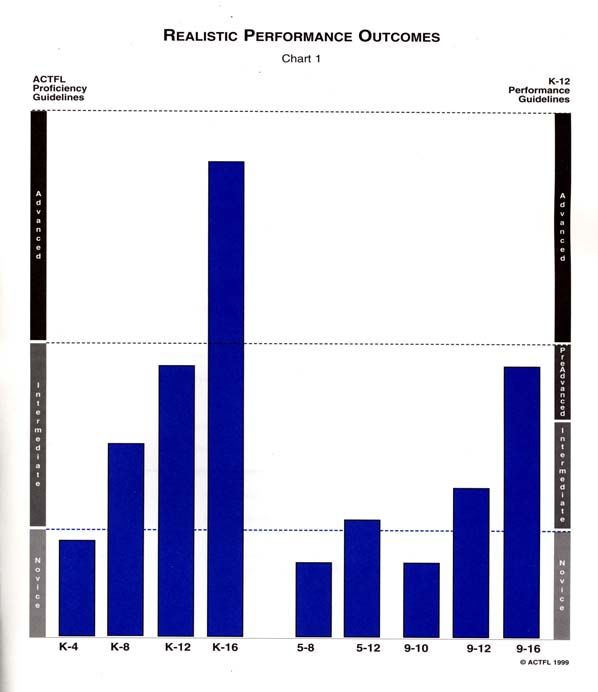
defined as low, mid, or high. As outlined in the following chart, ACTFL suggests that students
who study the same language from Kindergarten through Grade 12 can reach the levels of Pre-
advanced or Advanced Low.
As shown in the preceding figure, from the ACTFL Performance Guidelines for K-12 Learners
(1999), students’ proficiency in Grade 12 is directly related to the amount of sustained
instruction that they have in the language. For example, students who have daily and sustained
opportunities to learn and use a world language in Grades K – 4 can reach the level of Novice
Mid. Similarly, students who have daily, sustained and continuous opportunities to learn and
use a world language in Grades K –12 may reach the level of Intermediate Mid to Intermediate
High. Students who study the same world language beginning in Kindergarten and continue with
that language in an uninterrupted sequence of study throughout their college years, will have a
strong and sophisticated command of the language. Note that the preceding figure illustrates
expected levels of performance for students who have access to different opportunities to learn
and use a language; these levels of performance are fully consistent with the expected outcomes
for the various scheduling models presented in the Michigan Languages Other Than English
Guidelines.
These are draft documents that are open for public comment. Please DO NOT copy or distribute. V.4.07 4Proficiency Levels for K-12 Learners in Michigan
As students’ proficiency increases from the Novice through the Intermediate and into the
Advanced level, they are able to carry out more detailed, sophisticated and varied tasks in
increasingly wide-ranging and complicated situations with greater flexibility, complexity, and
accuracy. The following table illustrates what students know and are able to do at the Novice
High, Intermediate Mid - Intermediate High and Advanced Low levels.
Descriptions of Proficiency Levels
for K-12 Learners in Michigan
Novice High Intermediate Low Intermediate High
(Students have met the and Intermediate and Advanced Low
minimum two-credit Mid (Students can meet all
graduation requirement.) expectations at the
(Students can meet all
expectations at the Intermediate Low and
Novice High level and Intermediate Mid levels
the following.) and the following.)
Functions Effectively carries out Effectively carries out Effectively carries out
everyday social and everyday social and tasks that present
survival tasks that survival tasks that may complications and
present no complications present complications require negotiation of
meaning
Contexts Effectively communicates Effectively Effectively
about familiar topics communicates about communicates about
related to self, home, topics beyond self and topics related to work,
family, friends, home; developing current, public, and
neighborhood, school, ability to communicate personal interest;
community, professions, about topics related to developing the ability to
and environment work, current events, communicate about
and issues of personal unfamiliar topics
and public interest
Time Frames Communicates Communicates Can generally narrate
consistently about present consistently about and describe in past,
and future events; present and future present, and future time
reports series of isolated events; communicates
events in the past inconsistently about
past events
Level of Discourse Communicates in Communicates in Communicates in
sentence-length discourse sentences and short connected, paragraph
recombining and paragraphs length discourse
reformulating learned
phrases
Comprehensibility Are understood primarily Are consistently Are understood by
and Accuracy by native speakers who understood by native native speakers who are
are very accustomed to speakers accustomed to unaccustomed to
interacting with language interacting with interacting with
learners language learners language learners
Comprehension and Can identify the text type, Can identify the text Can identify and analyze
Accuracy topic, and some type, topic, main ideas the text type, topic,
significant details of an and some significant main ideas, details and
authentic presentational details of an authentic other features of an
or interpersonal oral, presentational or authentic presentational
written, or signed text interpersonal oral, or interpersonal oral,
written, or signed text written, or signed text
These are draft documents that are open for public comment. Please DO NOT copy or distribute. V.4.07 5Contexts
As learners increase in proficiency, they are able to function in increasingly varied, wide-ranging,
and complicated situations. It is important to note, however, that the range of contexts in which
Novice High and Intermediate Low–Mid students is quite similar. For example, students at both
the Novice High and the Intermediate Low-Mid levels can successfully carry out everyday social
and survival tasks such as purchasing an item of clothing. Unlike the Novice–High learner,
however, Intermediate Low-Mid learner can describe the item to be purchased in greater detail
and communicate successfully when the situation involves a complication. The Intermediate
High–Advanced Low learner can address all of those same topics as well as more sophisticated
and abstract topics that go beyond everyday social and survival situations.
The table below outlines the contexts in which students should be able to comfortably
understand and use the world language at the Novice High (N), Intermediate Low-Intermediate
Mid (M), and Intermediate High-Advanced Low levels (A).
CONTEXTS: WORLD LANGUAGE STANDARDS and BENCHMARKS
Proficiency
Units of Study Level
N M A
Myself, family • family members, family relationships, personal characteristics √ √ √
and friends (size, hair color, country of origin and nationality, character
and personality traits), and pets
• family activities, daily routines, chores and household tasks √ √ √
• personal possessions: toys, games, electronics, clothing (color, √ √ √
numbers, size, fabric, style, features)
• leisure activities: sports, hobbies, pastimes, television shows, √ √ √
movies, music, graphic arts
• foods and beverages: typical breakfast, lunch, snack, and √ √ √
dinner foods, regional specialties, favorite foods
• body parts, illness, injuries, and treatments, food choices,
diets, health behaviors, and fitness, healthy practices √ √ √
(exercise preferences, sports, diet and health choices)
My home, school, • rooms and furnishings in a house, table setting √ √ √
neighborhood, • recreational, commercial, and government buildings √ √ √
community • stores and shopping √ √ √
• transportation √ √ √
• school (school supplies, classes, schedules, activities, rules, √ √ √
routines)
• careers (professions, employment, future plans) √ √ √
• community services √
My country and • days, dates, months, seasons, and weather patterns √ √ √
the world
• geographical features and land forms, neighboring regions and √ √ √
countries
• holidays, ceremonies, and festivals, sites of interest, travel √ √ √
• nature, ecosystems, and living things (plants, animals) √
• the arts (music, sculpture, architecture, film, literature, visual √
arts)
• government and political systems √
• current events and public issues √
• beliefs and values √
These are draft documents that are open for public comment. Please DO NOT copy or distribute. V.4.07 6Overview to the Michigan World Languages
Standards and Benchmarks
The Michigan World Language Standards and Benchmarks are correlated with the national
Standards for Foreign Language Learning and are organized around the 5Cs: communication,
cultures, connections, comparisons, and communities. Local school districts are encouraged to
use these standards and benchmarks in developing an articulated K-12 world language program
that meets the needs of all learners.
The Standards and Benchmarks are coded as follows:
Example: 1.1.N.SL.a
First number indicates: Strand (Communication, Culture, Connection,
Comparisons, Communities)
Second number indicates: Standard
Upper-case letter indicates: Level of proficiency
N = Novice High
M = Intermediate Low – Mid
A = Intermediate High – Advanced Low
Second Upper-case letter indicates: Domain in Communication Strand or Topic within
Culture Strand
Communication Domain:
SL Speaking/Listening
RW Reading/Writing
L Listening
R Reading
S Speaking
W Writing
Culture Topic:
G Geography & History
RI Relationships and Identity
SE Schools and Education
T Time
E Economy/Money
H Holidays and Celebrations
C Cultural Heritage
F Food and Beverage
Lower case letter indicates: Benchmark within the standard describing what students
should know and be able to do at a particular level of
proficiency.
These are draft documents that are open for public comment. Please DO NOT copy or distribute. V.4.07 7The Michigan Standards and Benchmarks for World Language Proficiency for K-12 Schools are
generic and meant to be used by instructors of Languages Other Than English (LOTE).
Because of the generic nature of this document, some Standards and Benchmarks may not be
applicable to all languages. Therefore, certain languages are exempt from assessment and
proficiency in all four skills as described in the Standards and Benchmarks below:
Language Options
While most languages taught in Michigan schools require students to build proficiency in
listening, speaking, reading and writing, some languages do not have a written or oral form.
Students may fulfill the requirement in the following ways:
• For languages that are both written and spoken, students must demonstrate
proficiency at the Novice High level in speaking and writing (productive skills*) and in
listening and reading (interpretive skills*). (See ACTFL Proficiency Guidelines for Speaking
and for Writing for definition).
• For languages that are no longer spoken (i.e. Ancient Greek or Latin), students are
required to demonstrate proficiency at the Novice High level in writing (productive skill*)
and in reading (interpretive skill*). (See ACTFL Proficiency Guidelines for Speaking and for
Writing for definition).
• For languages without formally accepted orthographies, students are required to
demonstrate oral proficiency at the Novice High level in speaking
• For languages that are signed (i.e. ASL), students are required to demonstrate
receptive and expressive proficiency* equivalent to the Novice High level for languages
that are spoken and written. (Reference ASL document).
Exemptions:
For languages that are no longer spoken = reading & writing: Not spoken
For languages without formally accepted orthographies = speaking & listening: Not
written
For languages that are signed = Signed
These are draft documents that are open for public comment. Please DO NOT copy or distribute. V.4.07 8Michigan World Language Standards
Strand World Standards
Languages
Standard #
1 Communicate in Languages Other Than English
Communication
1.1 Interpersonal Communication: Students engage in
conversations, provide and obtain information, express
feelings and emotions, and exchange opinions.
1.2 Interpretive Communication: Students understand and
interpret written and spoken language on a variety of
topics.
1.3 Presentational Communication: Students present
information, concepts, and ideas to an audience of listeners
or readers on a variety of topics.
2 Gain Knowledge and Understanding of
Culture Other Cultures
2.1 Practices and Perspectives: Students demonstrate an
understanding of the relationship between the practices
and perspectives of the culture studied.
2.2 Products and Perspectives: Students demonstrate an
understanding of the relationship between the products
and perspectives of the culture studied.
3 Connect with Other Disciplines and
Connections Acquire Information
3.1 Knowledge: Students reinforce and further their knowledge
of other disciplines through the world language.
3.2 Point of View: Students acquire information and recognize
the distinctive viewpoints that are only available through
the world language and its cultures.
4 Develop Insight into the Nature of
Comparisons Language and Culture
4.1 Comparing Languages: Students demonstrate
understanding of the nature of language through
comparisons of the language studied and their own.
4.2 Comparing Cultures: Students demonstrate understanding
of the concept of culture through comparisons of the
cultures studied and their own.
5 Participate in Multilingual Communities at Home
Communities and Around the World
5.1 Use of Language: Students use the language both within
and beyond the school setting.
5.2 Personal Enrichment: Students show evidence of becoming
life-long learners by using the language for personal
enjoyment and enrichment.
These are draft documents that are open for public comment. Please DO NOT copy or distribute. V.4.07 9STRAND 1: COMMUNICATION
Novice High Intermediate-Low Intermediate High
(N) and and Advanced Low
Intermediate Mid (A)
(M)
1.1
Interpersonal
Communication
Students engage in
conversations,
provide and obtain
information,
express feelings
and emotions, and
exchange opinions.
Interpersonal- Interpersonal- Interpersonal-
Speaking/Listening Speaking/Listening Speaking/Listening
or Signed (SL) or Signed (SL) or Signed (SL)
Exemption: Signed Exemption: Signed Exemption: Signed
Socializing Socializing Socializing
1.1.N.SL.a 1.1.M.SL.a 1.1.A.SL.a
Use the target Use the target Use the target
language with language with language with
culturally appropriate culturally appropriate culturally appropriate
gestures in everyday gestures to greet one gestures to greet one
social situations such another and engage in another and engage in
as greeting, leave conversations about conversations about
taking or introductions everyday topics such past and future
as school and activities such as
community events and weekend plans,
activities vacation, jobs and
travel
1.1.N.SL.b
Ask and answer basic
questions about the
weather,
health/physical
conditions, self, family
and friends
1.1.N.SL.c 1.1.M.SL.b 1.1.A.SL.b
Use appropriate Use appropriate Use appropriate
register/honorifics register/honorifics register/honorifics
These are draft documents that are open for public comment. Please DO NOT copy or distribute. V.4.07 10Novice High Intermediate-Low Intermediate High
(N) and and Advanced Low
Intermediate Mid (A)
(M)
1.1.N.SL.d 1.1.M.SL.c 1.1.A.SL.c
Request, offer, invite, Request, offer, invite, Request, offer, invite,
and reply appropriately and reply appropriately and reply appropriately
using memorized using simple and provide rationale
phrases phrase/sentences and for the request, offer,
provide rationale for the invitation and reply
request and/or reply
Identifying and Identifying and Identifying and
Describing Describing Describing
1.1.N.SL.e 1.1.M.SL.d 1.1.A.SL.d
Asks questions about Share a detailed Share detailed
physical appearance, description about description and
character and physical appearance, analysis of physical
personality traits of character and appearance, character
friends, family, personality traits of and personality traits
classmates and answer contemporary figures of historical figures
using a list of traits in their own and the and characters in
target culture literature, TV, film and
the arts in the target
culture
1.1.N.SL.f 1.1.M.SL.e 1.1.A.SL.e
Ask questions about Share a detailed Share detailed
feelings, emotions and description about description and
health of friends, feelings, emotions and analysis of feelings,
family, classmates and health of emotions and health of
answer using a list of contemporary figures historical figures and
traits characters in
literature, TV, film and
the arts
1.1.N.SL.g 1.1.M.SL.f 1.1.A.SL.f
Ask questions about Share a detailed Share an analysis and
the attributes of places description of places comparison of
and things in their and things beyond attributes of places
immediate their immediate and things in the
environment and environment or in the target culture by
answer using a list of target culture providing a detailed
traits description
Exchanging Exchanging Exchanging
Information Information Information
1.1.N.SL.h 1.1.M.SL.g 1.1.A.SL.g
Exchange information in Exchange information Use target language to
the target language on in the target language discuss social issues
familiar topics such as about personal and and problems
personal interests, social, community or
memorable current events
experiences, school
activities, and family life
These are draft documents that are open for public comment. Please DO NOT copy or distribute. V.4.07 11Novice High Intermediate-Low Intermediate High
(N) and and Advanced Low
Intermediate Mid (A)
(M)
1.1.A.SL.h
Use target language to
discuss current or past
events that are of
significance in the
target culture
1.1.N.SL.i 1.1.M.SL.h 1.1.A.SL.i
Ask for and obtain Ask for and obtain Report to someone the
information in information in resolution of an
everyday situations in everyday situations everyday situation
the target language with a complication with a complication in
about time, place, that need to be the target language in
price, size, relating to resolved in the target person or on the
restaurants, stores, language in person or telephone relating to
transportation, and on the telephone restaurants, stores,
services relating to restaurants, transportation, and
stores, transportation, services
and services
Exchanging opinions Exchanging opinions Exchanging opinions
1.1.N.SL.j 1.1.M.SL.i 1.1.A.SL.j
Share likes and Interview a classmate Share their opinions
dislikes in the target in the target language via discussion on what
language with a about their likes, they have recently
classmate dislikes, preferences read or seen such as
and opinions articles, short stories,
books, comics, film,
video/DVD, music and
art
1.1.N.SL.k 1.1.M.SL.j 1.1.A.SL.k
Share opinions and Share opinions and Exchange, support and
preferences in the individual perspectives discuss opinions and
target language with on a variety of topics individual perspectives
their classmates dealing with on a variety of topics
contemporary issues dealing with
contemporary and
historical issues in the
target culture
These are draft documents that are open for public comment. Please DO NOT copy or distribute. V.4.07 12Novice High Intermediate-Low Intermediate High
(N) and and Advanced Low
Intermediate Mid (A)
(M)
Interpersonal- Interpersonal- Interpersonal-
Reading/Writing Reading/Writing Reading/Writing
(RW) (RW) (RW)
Exemption: Signed Exemption: Signed Exemption: Signed
Socializing Socializing Socializing
1.1.N.RW.a 1.1.M.RW.a 1.1.A.RW.a
Use the target Use the target Use the target
language in email language in email language in email
messages, text messages, text messages, text
messages, blogs, messages, blogs, messages, blogs,
webpages, letters, and webpages, letters, and webpages, letters, and
notes to greet, take notes to greet one notes to greet one
leave or make another and write another and write
introductions about everyday topics about past and future
such as school and activities such as
community events and weekend plans,
activities vacation, jobs and
travel
1.1.N.RW.b
Exchange information
by asking and
answering basic
questions in writing
about the weather,
health/physical
conditions, self, family
and friends
1.1.N.RW.c 1.1.M.RW.b 1.1.A.RW.b
Use appropriate Use appropriate Use appropriate
register/honorifics in register/honorifics in register/honorifics in
written communication written communication written communication
1.1.N.RW.d 1.1.M.RW.c 1.1.A.RW.c
Request, offer, invite, Request, offer, invite, Request, offer, invite,
and reply appropriately and reply appropriately and reply appropriately
in writing using in writing using simple in writing and provide
memorized phrases phrases/sentences and rationale for the
provide rationale for request, offer,
the request and/or invitation and reply
reply
These are draft documents that are open for public comment. Please DO NOT copy or distribute. V.4.07 13Novice High Intermediate-Low Intermediate High
(N) and and Advanced Low
Intermediate Mid (A)
(M)
Identifying and Identifying and Identifying and
Describing Describing Describing
1.1.N.RW.e 1.1.M.RW.d 1.1.A.RW.d
Ask questions in Share a written Share in writing a
writing about physical detailed description of detailed description
appearance, character physical appearance, and analysis of
and personality traits character and physical appearance,
of friends, family, personality traits of character and
classmates and answer contemporary figures personality traits of
in writing using a list in their own and the historical figures and
of traits target culture characters in
literature, TV, film and
the arts in the target
culture
1.1.N.RW.f 1.1.M.RW.e 1.1.A.RW.e
Ask questions in Share a written Share in writing a
writing about feelings, detailed description of detailed description
emotions and health of feelings, emotions and and analysis of
friends, family, health of feelings, emotions and
classmates, and contemporary figures health of historical
answer in writing using figures and characters
a list of traits in literature, TV, film
and the arts
1.1.N.RW.g 1.1.M.RW.f 1.1.A.RW.f
Ask questions in Share a written Share in writing an
writing about the detailed description of analysis and
attributes of places places and things comparison of
and things in their beyond the student’s attributes of places
immediate immediate and things in the
environment, and environment or in the target culture by
answer in writing using target culture providing a detailed
a list of traits description
Exchanging Exchanging Exchanging
Information Information Information
1.1.N.RW.h 1.1.M.RW.g 1.1.A.RW.g
Exchange information Exchange information Exchange information
in writing in the target in writing in the target in writing about social
language on familiar language about issues and problems
topics such as personal personal and social,
interests, memorable community or current
experiences, school events
activities, and family
life
These are draft documents that are open for public comment. Please DO NOT copy or distribute. V.4.07 14Novice High Intermediate-Low Intermediate High
(N) and and Advanced Low
Intermediate Mid (A)
(M)
1.1.N.RW.i 1.1.M.RW.h 1.1.A.RW.h
Inquire in writing to Resolve in writing an Report in writing to
obtain information in everyday situation that someone, the
the target language presents a resolution of an
about time, place, complication that everyday situation
price and size relating needs to be resolved in with a complication in
to restaurants, stores, the target language the target language
transportation, and relating to stores, relating to stores,
services transportation, transportation,
services, and online services, and online
purchases purchases
1.1.A.RW.i
Use target language to
write about current or
past events that are of
significance in the
target culture
Exchanging opinions Exchanging opinions Exchanging opinions
1.1.N.RW.j 1.1.M.RW.i 1.1.A.RW.j
Share likes and Create and use a Share opinions in
dislikes in the target questionnaire to writing about
language with a interview a classmate something read or
classmate in writing, in the target language viewed, such as,
using email messages, about their likes, articles, books,
notes, letters dislikes, preferences films/DVDs, TV shows,
and opinions, and music presentations,
write a summary of or art
the information
1.1.N.RW.k 1.1.M.RW.j 1.1.A.RW.k
Share opinions and Share in writing Exchange, support and
preferences in the opinions and individual discuss opinions and
target language with perspectives on a individual perspectives
their classmates in variety of topics on a variety of topics
writing using email dealing with dealing with
messages, notes, contemporary issues contemporary and
letters historical issues in the
target culture
These are draft documents that are open for public comment. Please DO NOT copy or distribute. V.4.07 15Novice High Intermediate-Low Intermediate High
(N) and and Advanced Low
Intermediate Mid (A)
(M)
1.2
Interpretive
Communication:
Students
understand and
interpret written
and spoken
language on a
variety of topics.
Interpretive Interpretive Interpretive
Language -Listening Language -Listening Language -Listening
(L) (L) (L)
Or Signed Language Or Signed Language Or Signed Language
(L) (L) (L)
Exemption: Not Exemption: Not Exemption: Not
Spoken Spoken Spoken
1.2.N.L.a 1.2.M.L.a 1.2.A.L.a
Demonstrate Demonstrate Demonstrate
understanding of oral understanding of oral understanding of oral
classroom language in classroom language in classroom language in
the target language the target language on the target language on
including directions, familiar topics a variety of familiar
commands, and and unfamiliar topics
requests
1.2.N.L.b 1.2.M.L.b 1.2.A.L.b
Understand Understand Understand
interpersonal interpersonal interpersonal
communication on communication, communication,
topics of personal spoken messages, and spoken messages,
interest such as group discussions in interviews, group
preferences, family the target language on discussions and
life, friends, leisure familiar topics related lectures in the target
and school activities, to family, school, and language on a variety
and everyday community of familiar and
occurrences unfamiliar topics
1.2.N.L.c 1.2.M.L.c 1.2.A.L.c
Understand main idea Understand main idea Analyze a visual media
of a visual media or and supporting detail, or live presentation
live presentation and summarize a visual (film/DVD, TV shows
(film/DVD, TV shows media or live and commercials,
and commercials, presentation (film/DVD, theatre and musical
theatre and musical TV shows and production)
production) commercials, theatre
and musical production)
These are draft documents that are open for public comment. Please DO NOT copy or distribute. V.4.07 16Novice High Intermediate-Low Intermediate High
(N) and and Advanced Low
Intermediate Mid (A)
(M)
1.2.N.L.d 1.2.M.L.d 1.2.A.L.d
Understand main idea Understand main idea Analyze an audio
of an audio and supporting detail, presentation (CD,
presentation (CD, and summarize an lecture, radio, podcast,
lecture, radio, podcast, audio presentation songs/music)
songs/music) (CD, lecture, radio,
podcast, songs/music)
Interpreting Written Interpreting Written Interpreting Written
Language-Reading Language-Reading Language-Reading
(R) (R) (R)
Exemption: Signed Exemption: Signed Exemption: Signed
1.2.N.R.a 1.2.M.R.a 1.2.A.R.a
Demonstrate Demonstrate Demonstrate
understanding of understanding of understanding of
written classroom written classroom written classroom
language in the target language in the target language in the target
language including language on familiar language on a variety
directions, commands topics of familiar and
and requests unfamiliar topics
1.2.N.R.b 1.2.M.R.b 1.2.A.R.b
Understand main idea Understand main idea Understand and
of simple accessible and supporting detail, analyze written
written materials in and summarize materials in the target
the target language accessible written language on unfamiliar
such as, textbook materials on familiar topics such as, literary
passages, age- topics in the target works, print media,
appropriate magazine language such as, websites/internet,
and newspaper textbook content, directions
articles/ads, magazine and
websites/internet, newspaper
poetry or stories articles/ads,
websites/internet,
poetry or stories.
1.2.N.R.c 1.2.M.R.c 1.2.A.R.c
Understand written Understand written Understand written
interpersonal interpersonal interpersonal
communication on communication in the communication in the
topics of personal target language on target language on a
interest such as familiar topics related variety of familiar and
preferences, family life, to family, school, and unfamiliar topics
friends, leisure and community (email, (email, letters,
school activities, and letters, messages, messages, notes, and
everyday occurrences
notes, and text text messages)
(email, letters,
messages)
messages, notes, and
text messages)
These are draft documents that are open for public comment. Please DO NOT copy or distribute. V.4.07 17Novice High Intermediate-Low Intermediate High
(N) and and Advanced Low
Intermediate Mid (A)
(M)
1.3
Presentational
Communication
Students present
information,
concepts, and
ideas to an
audience of
listeners or readers
on a variety of
topics.
Presentational Presentational Presentational
Language-Speaking Language-Speaking Language-Speaking
(S) (S) (S)
Or Signed Language Or Signed Language Or Signed Language
(S) (S) (S)
Exemption: Not Exemption: Not Exemption: Not
Spoken Spoken Spoken
1.3.N.S.a 1.3.M.S.a 1.3.A.S.a
Present songs, poems Present skits or short Participate in and
or stories in the target plays in the target perform scenes in the
language language target language from
plays, and/or poems,
or excerpts from short
stories
1.3.N.S.b 1.3.M.S.b 1.3.A.S.b
Present brief personal Retell a story to an Present a summary of
descriptions on familiar audience in the target a story including plot
topics in target language and characters or an
language such as self, event to an audience
friends, family, home
and school
1.3.N.S.c 1.3.M.S.c 1.3.A.S.c
Record materials in the Present brief oral Present oral reports on
target language, such reports about personal familiar and unfamiliar
as a puppet show, experiences, school topics in target
fashion show, or and community language
weather report happenings in target
language
1.3.M.S.d 1.3.A.S.d
Produce a short original Produce an original
target language target language
video/DVD recording, information video/DVD
such as a segment of a recording of a complete
newscast, talk show or newscast or target
game show culture topic
These are draft documents that are open for public comment. Please DO NOT copy or distribute. V.4.07 18Novice High Intermediate-Low Intermediate High
(N) and and Advanced Low
Intermediate Mid (A)
(M)
Presentational Presentational Presentational
Language-Writing Language-Writing Language-Writing
(W) (W) (W)
Exemption: Not Exemption: Not Exemption: Not
Written Written Written
1.3.N.W.a 1.3.M.W.a 1.3.A.W.a
Illustrate and present Illustrate and present Create and
materials in the target materials in the target disseminate a
language such as an language such as an newsletter or webpage
advertisement, poster informational brochure in the target language
or menu or instructions for
accomplishing a task
1.3.N.W.b 1.3.M.W.b 1.3.A.W.b
Prepare illustrated Create original Prepare a written
stories (big books, compositions or analysis of a literary
posters, dioramas, journal entries in the work, journalistic
cartoons) about target language article, publication or
activities or events in media/TV/DVD
student’s personal life, presentation intended
and share these with for native speakers of
an audience the language
1.3.N.W.c 1.3.M.W.c 1.3.A.W.c
Write brief personal Present brief written Present written reports
descriptions on familiar reports about personal on familiar and
topics in the target experiences, school unfamiliar topics in the
language such as self, and community target language
friends, family, home happenings in the
and school target language
These are draft documents that are open for public comment. Please DO NOT copy or distribute. V.4.07 19STRAND 2: CULTURES
Novice High Intermediate Intermediate High-
(N) Low-Mid Advanced Low
(M) (A)
2.1
Practices and
Perspectives
Students
demonstrate an
understanding of
the relationship
between the
practices and
perspectives of the
culture studied.
Geography & History Geography & History Geography & History
(G) (G) (G)
2.1.N.G.a. 2.1.M.G.a 2.1.A.G.a
Identify countries and Recognize important Identify political issues
their capital city where features of country(s) and current events
language is spoken where language is where language is
spoken spoken
2.1.N.G.b 2.1.M.G.b 2.1.A.G.b
Identify history of Identify major cities Identify the
target language and regions within the role/importance of
expansion country urban, rural, suburban
areas
2.1.N.G.c 2.1.M.G.c 2.1.A.G.c
Identify community Identify major Identify population
services/buildings geographic features demographics
(parks, post office, (rivers, mountains,
fire, police) deserts, forests)
2.1.N.G.d 2.1.M.G.d 2.1.A.G.d
Identify types of Identify additional Describe the
housing available languages spoken in governmental
the country and region system(s) of the target
culture(s)
2.1.N.G.e 2.1.M.G.e 2.1.A.G.e
Identify transportation Identify the Identify and discuss
modes and how to get relationship to major tensions within
around in a city neighboring countries and outside the
and the world country
These are draft documents that are open for public comment. Please DO NOT copy or distribute. V.4.07 20Novice High Intermediate Intermediate High-
(N) Low-Mid Advanced Low
(M) (A)
2.1.N.G.f 2.1.M.G.f 2.1.A.G.f
Identify a major Identify the chronology Research and discuss
historic event that of major historical major historical events
impacted the culture events and their and their impact on the
impact on the culture culture
2.1.N.G.g 2.1.M.G.g
Identify the Describe the
relationship between relationship of weather
geography and and seasonal patterns
weather and seasonal on systems (school,
patterns work)
Relationships and Relationships and Relationships and
Identity (RI) Identity (RI) Identity (RI)
2.1.N.RI.a 2.1.M.RI.a 2.1.A.RI.a
Recognize national Recognize cultural and Describe who is
identity national identity within considered majority
the target culture and minority within a
culture
2.1.N.RI.b 2.1.M.RI.b 2.1.A.RI.b
Identify family Describe the role of Describe issues of
members and pets in the family within the gender, class and/or
the target culture target culture status in the target
culture
2.1.N.RI.c 2.1.M.RI.c 2.1.A.RI.c
Identify leisure Describe the concept Describe the role of
activities for self, of friendship within the leisure time activities
family and friends target culture (soccer, spending time
in a café, attending
concerts)
2.1.N.RI.d 2.1.M.RI.d 2.1.A.RI.d
Identify articles of Describe how students Describe
clothing for self, family spend their free characteristics and
and friends time/entertain beliefs that define
themselves national identity
Schools and Schools and Schools and
Education (SE) Education (SE) Education (SE)
2.1.N.SE.a 2.1.M.SE.a 2.1.A.SE.a
Identify school levels Describe educational Describe secondary
of instruction, courses, system and levels of and post- secondary
and schedule instruction in the educational
target country opportunities that lead
to careers in the target
2.1.N.SE.b country
Identify school
activities
These are draft documents that are open for public comment. Please DO NOT copy or distribute. V.4.07 21Novice High Intermediate Intermediate High-
(N) Low-Mid Advanced Low
(M) (A)
Time (T) Time (T) Time (T)
2.1.N.T.a 2.1.M.T.a 2.1.A.T.a
Describe a daily Describe a schedule Describe cultural
schedule in the target that reflects daily beliefs, values and
culture (breakfast, activities/routine of perspectives
lunch, dinner, hours students at appropriate associated with time
for work, store/office times (meal time, and daily schedule
hours) school day,
extracurricular
activities)
2.1.N.T.b
Express time using 12
hr. or 24 hr. clock as
appropriate
Economy/Money (E) Economy/Money (E) Economy/Money (E)
2.1.N.E.a 2.1.M.E.a 2.1.A.E.a
Recognize the currency Identify the economic Describe cultural
of the target system(s) of the target beliefs, values and
country(s) culture(s) perspectives
associated with money
and wealth
2.1.N.E.b 2.1.M.E.b 2.1.M.E.b
Convert the local Describe how students Describe the role of
currency into US get discretionary work in the target
dollars money and how it is culture
spent
2.1.N.E.c 2.1.M.E.c
Identify how people Recognize the social
earn a living status of various jobs
and professions
Holidays and Holidays and Holidays and
Celebrations (H) Celebrations (H) Celebrations (H)
2.1.N.H.a 2.1.M.H.a 2.1.A.H.a
Recognize the date and Describe specific Explain how cultural
significance of an country or regional beliefs, values and
important civil, practices associated perspectives serve as
religious and with civil, religious, the basis for the
personal/family holiday and personal/family practices associated
or celebration in the holidays or with civil, religious,
target culture celebrations in the and personal/family
and the practices target culture holidays or
associated with them celebrations
These are draft documents that are open for public comment. Please DO NOT copy or distribute. V.4.07 22Novice High Intermediate Intermediate High-
(N) Low-Mid Advanced Low
(M) (A)
2.2
Products and
Perspectives
Students
demonstrate an
understanding of
the relationship
between the
products and
perspectives of the
culture studied.
Geography & History Geography & History Geography & History
(G) (G) (G)
2.2.N.G.a 2.2.M.G.a Identify 2.2.A.G.a Discuss
Identify indigenous natural resources (Ex. natural resources (Ex.
foods products and silver, copper, oil) silver, copper, oil) and
beverages their impact on the
economy
Cultural Heritage (C) Cultural Heritage (C) Cultural Heritage (C)
2.2.N.C.a 2.2.M.C.a 2.2.A.C.a
Recognize current Describe the Describe the enduring
cultural icons significance of current contributions of this
(arts, music, literature, cultural and historic culture to the world
film, and the creators icons (arts, (arts, music,
of these products as architecture music, architecture, literature,
well as natural sites) literature, film, media, film, media, TV,
TV, newspapers, and newspapers, important
the creators of these people)
products)
2.2.N.C.b
Recognize historic
culture icons
(arts, music, literature,
film, and the creators
of these products as
well as natural sites)
Holidays and Holidays and Holidays and
Celebrations (H) Celebrations (H) Celebrations (H)
2.2.N.C.a 2.2.M.C.a 2.2.A.C.a
Identify the products Describe specific Explain how cultural
associated with civil country or regional beliefs, values and
and religious holidays products associated perspectives serve as
and personal with civil, religious and the basis for the use of
celebrations personal/family products associated
holidays or with civil, religious and
celebrations in the personal/family
target culture holidays or
celebrations
These are draft documents that are open for public comment. Please DO NOT copy or distribute. V.4.07 23Novice High Intermediate Intermediate High-
(N) Low-Mid Advanced Low
(M) (A)
Foods and Foods and Foods and
Beverages (F) Beverages (F) Beverages(F)
2.2.N.F.a 2.2.M.F.a 2.2.A.F.a
Identify what foods Describe what foods Explain the significance
and beverages are and beverages are of various foods and
routinely consumed at popular in a specific beverages to the
each meal in the target country of the target population of a specific
culture culture country of the target
culture
2.2.N.F.b 2.2.M.F.b 2.2.A.F.b
Identify the types of Describe where people Describe the cultural
places where foods and eat and drink outside significance of eating
beverages may be their home in the out in the target
purchased in the target target culture culture
culture
2.2.N.F.c
Identify the types of
places where foods and
beverages may be
consumed outside the
home in the target
culture
Economy and Money Economy and Money Economy and Money
(E) (E) (E)
2.2.N.E.a 2.2.M.E.a 2.2.A.E.a
Identify major natural Describe essential Explain the significance
resources and products, services and of the target culture’s
indigenous products industries that are the or country’s economy
within the target basis of the economy in the world
culture in the target culture
2.2.N.E.b
Identify types of stores
and where products
are sold in the target
culture
These are draft documents that are open for public comment. Please DO NOT copy or distribute. V.4.07 24STRAND 3: CONNECTIONS
Novice High Intermediate Intermediate High-
(N) Low-Mid Advanced Low
(M) (A)
3.1
Knowledge
Students reinforce
and further their
knowledge of other
disciplines through
the world language.
3.1.N.a 3.1.M.a 3.1.A.a
Reinforce previously Acquire new content Acquire new content
learned content knowledge about knowledge about
knowledge through familiar topics through unfamiliar topics
the target language the target language through the target
language
3.2
Point of View
Students acquire
information and
recognize the
distinctive
viewpoints that are
only available
through the target
language and its
cultures.
3.2.N.a 3.2.M.a 3.2.A.a
Use audio, visual Use audio, visual Use information
and/or print materials and/or print materials available only through
available only in the available only in the the target language to
target language to target language to identify and compare
recognize that a topic acquire information distinctive cultural
or situation may be viewpoints
viewed differently in
one’s own culture
than in the target
culture
These are draft documents that are open for public comment. Please DO NOT copy or distribute. V.4.07 25STRAND 4: COMPARISONS
Novice High Intermediate Intermediate High-
(N) Low-Mid Advanced Low
(M) (A)
4.1
Comparing
Cultures
Students
demonstrate
understanding of
the concept of
culture through
comparisons of the
cultures studied
and their own.
4.1.N.a 4.1.M.a 4.1.A.a
Identify basic target Identify the Describe the
culture practices and significance of the institutions, values,
compare them to one’s cultural practices beliefs and
own within the target perspectives that serve
culture(s) and as the foundation of
compare them to one’s the target culture
own practices and compare
them to one’s own
4.1.N.b 4.1.M.b 4.1.A.b
Identify basic target Identify the Describe the
culture products and significance of the institutions, values,
compare them to one’s cultural products beliefs and
own within the target perspectives that serve
culture(s) and as the foundation of
compare them to one’s the target culture
own practices and compare
them to one’s own
These are draft documents that are open for public comment. Please DO NOT copy or distribute. V.4.07 26Novice High Intermediate Intermediate High-
(N) Low-Mid Advanced Low
(M) (A)
4.2
Comparing
Languages
Students
demonstrate
understanding of
the nature of
language through
comparisons of the
language studies
and their own.
4.2.N.a 4.2.M.a 4.2.A.a
Identify basic Select vocabulary Recognize that
differences and recognizing that vocabulary reflects
similarities in meaning is not always culture and use this
vocabulary between conveyed through knowledge to adjust
one’s own language direct word-for-word language accordingly
and the target translation from one’s and strengthen an
language (cognates own language to the understanding of both
and borrowed words) target language languages
4.2.N.b 4.2.M.b 4.2.A.b
Identify basic Select grammatical Recognize that
differences and structures recognizing grammatical structures
similarities in that meaning is not reflect culture, and use
grammatical structures always conveyed this knowledge to
between one’s own through direct word- adjust language
language and the for-word translation accordingly and
target language from one’s own strengthen an
language to the target understanding of both
language languages
4.2.N.c 4.2.M.c 4.2.A.c
Identify basic Select Recognize that
differences and register/honorifics register/honorifics
similarities in recognizing that reflect culture, and use
register/honorifics meaning is not always this knowledge to
between one’s own conveyed through adjust language
language and the direct word-for-word accordingly and
target language translation from one’s strengthen an
own language and the understanding of both
target language languages
4.2.N.d 4.2.M.d 4.2.A.d
Identify basic Select phonological Recognize that
differences and features recognizing phonological features
similarities in that meaning is not reflect culture, and use
phonological features always conveyed this knowledge to
(such as through equivalent adjust language
These are draft documents that are open for public comment. Please DO NOT copy or distribute. V.4.07 27Novice High Intermediate Intermediate High-
(N) Low-Mid Advanced Low
(M) (A)
pronunciation, application of the same accordingly and
intonation and tone) features from one’s strengthen an
between one’s own own language to the understanding of both
language and the target language languages
target language
Exemption: Signed Exemption: Signed Exemption: Signed
These are draft documents that are open for public comment. Please DO NOT copy or distribute. V.4.07 28STRAND 5: COMMUNITIES
Novice High Intermediate Intermediate High-
(N) Low-Mid Advanced Low
(M) (A)
5.1
Use of Language
Students use the
language both
within and beyond
the school setting.
5.1.N.a 5.1.M.a 5.1.A.a
Exchange information Exchange information Exchange information
in the target language in the target language in the target language
with people locally and with people locally and with people locally and
around the world around the world around the world
through avenues such through avenues such through avenues such
as pen and key pals, as pen and key pals, e- as pen and key pals, e-
e-mail, and electronic mail, electronic mail, electronic
presentations presentations, and presentations,
newsletters and/or publications, and
web pages speeches
5.1.N.b 5.1.M.b 5.1.A.b
Provide services to Provide services to Provide services to the
others in the school others in the school school district and
district through district and community community through
activities in the target through activities in activities in the target
language such as skits the target language language such as
and/or musical such as serving as tutoring and helping
presentations or by conversation partners speakers of the target
reading to others in for other students in language to function
the target language the target language within the school or
community
These are draft documents that are open for public comment. Please DO NOT copy or distribute. V.4.07 29Novice High Intermediate Intermediate High-
(N) Low-Mid Advanced Low
(M) (A)
5.2
Personal
Enrichment
Students show
evidence of
becoming life-long
learners by using
the language for
personal
enjoyment and
enrichment.
5.2.N.a 5.2.M.a. 5.2.A.a
Willingly use the Seek out opportunities Seek opportunities and
target language within and use in the target use the target
the classroom setting language with language in real life
teachers, friends or situations within the
family outside of the community
classroom
5.1.N.b 5.1.M.b 5.1.A.b
Use authentic target Use authentic target Use authentic target
language print language print language print
materials and materials and materials and
electronic media to electronic media to electronic media to
explore topics of explore topics of explore topics of
personal interest and personal interest personal interest from
enjoyment within their own the points of view of
culture and the new the new culture
culture
5.1.N.c 5.1.M.c 5.1.A.c
Identify careers where Investigate and Participate in school-
skills in another present information to to-work projects such
language or cross- others about careers as an internship or
cultural understanding where skills in another outreach program that
are needed language, or cross- requires proficiency in
cultural understanding, the target language
are needed
These are draft documents that are open for public comment. Please DO NOT copy or distribute. V.4.07 30You can also read


