KEAN UNIVERSITY New Faculty and Adjunct Academic Policy Manual 2020 - 2021 Academic Year
←
→
Page content transcription
If your browser does not render page correctly, please read the page content below
KEAN UNIVERSITY

 New Faculty and Adjunct
 Academic Policy Manual

2020 - 2021 Academic Year
                  Revised July 2020 for Fall 2020
TABLE OF CONTENTS
PURPOSES OF MANUAL 4
OUR MISSION 5
ACADEMIC CALENDAR 6
ACADEMIC COLLEGE DIRECTORIES 7
WHAT THE BEST COLLEGE TEACHERS DO 9
SECTION I: STARTING THE SEMESTER 10
A. The Student Body at Kean University 10
B. Course Syllabus Information 11
1. General Education Rubrics 13
C. Assessment of Student Learning and Development 13
D. Ellucian CRM Advise 14
E. Grading Policies 15
F. Instructional Support Services 15
G. Procedure for Class Cancellation 17
H. Procedures for Emergencies 18
I. CampusAlert™ system 18
J. Faculty ID Cards 18
K. E-Mail Web Account Form 18
L. Kean Live 19
SECTION II: REGISTRATION PROCEDURES 20
A. Registration Calendar (Add/Drop Dates) 20
B. Closed Sections: Overload Authorization Procedures 21
C. Verification of Official Enrollment 21
D. Section Verification Lists 22
E. Never Attended Students 22
SECTION III: ACADEMIC POLICIES AND PROCEDURES 24
A. Class Attendance Policy 24
B. Academic Integrity Policy 24
C. Grade Recalculation Policy 26
2D. Academic Amnesty Policy 26
E. Pass/Fail Option 26
F. The Audit Policy 27
G. Academic Early Alert/Midterm Progress Reporting 27
H. Withdrawal from Courses 29
I. Incomplete Grades 30
J. Semester Grade Reporting 32
K. Change of Grades 32
L. Grade Grievances 33
SECTION IV: ACADEMIC STRUCTURE AT KEAN UNIVERSITY 35
A. The Structure of Baccalaureate Degree Program 35
B. General Education Program 36
C. Academic Advisement 43
D. Student Support Services 44
1. Office of Counseling, Disability, Alcohol and Other Drug Services 44
2. Disability Services 45
3. Office of Student Success and Retention 45
4. Community Standards and Student Conduct 46
5. KUBIT Cares 47
6. Career Services 48
7. Center for International Studies 48
8. University Police 48
9. The Nancy Thompson Library Learning Commons 49
10. Bookstore 49
11. East Campus Shuttle 49
E. The Office of Research and Sponsored Programs 49
F. Graduate Program Information 50
SECTION V: CONCLUSION 52
3PURPOSES OF THIS MANUAL
The primary focus of this manual is on the academic policies and procedures that will affect
your course(s) and the students who are enrolled. There also are sections containing general
information about Kean University and about some of the resources that are available to
you. It is hoped that the material in this manual will assist you in the preparation of
materials for classroom use at the start of the semester and that some of the information will
serve as a stimulus for you to reflect on your goals and objectives for the coming semester.
As a classroom instructor, you are a very important medium for communication of
information about academic policies, procedures, and deadlines to your students. Section II
of the manual contains information about the registration calendar and enrollment
verification procedures. Your attention to this information will help insure the uniform
administration of academic policies and procedures.
Your executive director/department chairperson should be consulted for additional
information about any of the policies and procedures contained in this manual. Compre-
hensive statements of the regulations at Kean University and of academic policies and
procedures may be found in the University Catalogs (Undergraduate and Graduate) and on
the website at www.kean.edu under Academic Affairs.
Faculty teaching at Ocean County College in either Toms River or Manahawkin should also
consult with their department chair/executive director. Assistance is also available in the
Gateway Building Room 103 or at (732) 255-0356.
Return to Campus for Fall 2020
As New Jersey begins a phased reopening, the leaders of Kean University are working
diligently to plan a smooth and safe return to campus in Fall 2020. For the most updated
information regarding the University’s policies and procedures related to the COVID-19
pandemic please see the Return to Campus banner on the University’s home page and
consult with your Executive Director, Chairperson, or Dean’s office.
4OUR MISSION
Kean University is a public cosmopolitan university serving undergraduate and graduate
students in the liberal arts, the sciences, and the professions. The University dedicates itself
to the intellectual, cultural, and personal growth of all its members — students, faculty, and
professional staff. In particular, the University prepares students to think critically,
creatively and globally; to adapt to changing social, economic, and technological
environments; and to serve as active and contributing members of their communities.
Kean offers a wide range of demanding programs dedicated to excellence in instruction and
academic support services necessary to assure its socially, linguistically, and culturally
diverse students the means to reach their full potential, including students from
academically disadvantaged backgrounds, students with special needs, and adults returning
or entering higher education.
Kean is steadfast in its dedication to maintaining a student-centered educational
environment in which diversity can flourish and an atmosphere in which mutual respect
characterizes relations among the members of a pluralistic community. The University seeks
to combine excellence with equity in providing opportunities for all students.
Kean is a teaching university, and Kean faculty dedicate themselves to student learning as
well as academic rigor. The focus on teaching excellence is supported by a commitment to
research, scholarship, creative work, and innovative uses of technology. The focus includes
the advancement of knowledge in the traditional disciplines and the enhancement of skills in
professional areas. Kean is committed to providing global educational opportunities for
students and faculty. Kean is an interactive university, and the University serves as a major
resource for regional advancement.
Kean collaborates with business, labor, government and the arts, as well as educational and
community organizations and provides the region with cultural events and opportunities for
continuous learning. Kean is also committed to providing students and faculty educational
opportunities in national and international arenas.
Revised and Adopted March 2007
5Academic Calendar
Detailed Academic Calendars are subject to change and are posted on the University
Website (https://www.kean.edu/) under the Quicklinks tab at the upper right corner of
the page. For the most updated calendars, please go to
https://www.kean.edu/offices/registrars-office/academic-calendar
62020-2021 Academic College Listing & Directory
COLLEGE OF BUSINESS & PUBLIC MANAGEMENT*
Dr. Jin Wang, Dean 74700 GL229
Dr. Tobin Porterfield, Associate Dean TBA TBA
Mr. David Farrokh, Assistant Dean 74703 GL228
School of Global Business, (Contact the Dean’s Office) 74700 GL229
School of Criminal Justice & Public Administration, Dr. James Drylie 70562 J305Q
School of Management and Marketing, Dr. Shanggeun Rhee 73372 T116B
School of Accounting and Finance, Veysel Yucetepe 74762 GL226
*Please note that the College of Business and Public Management is scheduled to move to Hynes
Hall during the Fall 2020 semester. Check the University directory for updates.
COLLEGE OF EDUCATION
Dr. Barbara Ridener, Dean 73750 HH443
Mr. Ronald Dowdell, Assistant to the Dean 73750 HH448
School of Curriculum and Teaching, (contact the Dean’s office) 73902 J330B
School of Global Education and Early Learning, Dr. Gail Verdi 73908 J330K
School of Special Education and Literacy, Dr. Randi Sarokoff 73750 HH443
School of Health and Human Performance, Dr. Jessica Adams 70654 D219
COLLEGE OF LIBERAL ARTS
Dr. Jonathan Mercantini, Acting Dean 70430 CAS405
Ms. Deborah Skibitsky, Acting Assistant Dean 70430 CAS405
School of General Studies, Dr. Bridget Chapman 70333 CAS201
School of Psychology, Dr. Verneda Baugh 75874 EC234
School of Social Sciences, Dr. Vicky Cannon 74053 J103D
School of Communication, Media & Journalism, Prof. Jeremiah Sullivan 70467 CAS402
School of English Studies, Dr. Charles Nelson 70394 CAS301
Department of History, Dr. Elizabeth Hyde 75252 T117A
The School of Fine and Performing Arts (contact the Dean’s Office) 70430 CAS405
The Center for Interdisciplinary Studies, Dr. Sarah Compion 73985 J104H
MICHAEL GRAVES COLLEGE
Professor David Mohney, Dean 74740 GL 429
Professor Rose Gonnella, Associate Dean 74752 GL 522
Robert Busch School of Design, Prof. Rose Gonnella 74752 GL 522
The School of Public Architecture 74772 GL 429
7HENNINGS COLLEGE OF SCIENCE, MATHEMATICS AND TECHNOLOGY
Dr. George Chang, Dean 73600 B104D
Dr. Brian Teasdale, Associate Dean 73654 C124
School of Environmental & Sustainability Sciences, Dr. Daniela Shebitz 73745 C317
School of Natural Sciences, Dr. Brian Teasdale 73654 C123
School of Mathematical Sciences, Dr. Louis Beaugris 73707 C232
School of Computer Science, Dr. Patricia Morreale 76158 NAAB 238
NEW JERSEY CENTER FOR SCIENCE, TECHONOLOGY & MATHEMATICS
Dr. Keith Bostian, Dean 77200 STEM 513
Dr. Michael Tocci, Associate Dean 77200 STEM 513
Ms. Marianne Gass, Assistant to the Dean 77204 STEM 513
Prof. Jill Fischer, Director, Genetic Counseling Graduate Program 77209 STEM 518
NATHAN WEISS GRADUATE COLLEGE
Dr. Christine Thorpe, Dean 75900 EC211
Ilaf Sattar, Assistant to the Dean 75900 EC211
Advanced Studies in Psychology, Dr. Jennifer Lerner 75864 EC125G
School of Communication Disorder and Deafness, Dr. Machid Namazi 75802 EC106A
Counselor Education, Dr. Barry Rebekah Pender 75959 EC311
Educational Leadership, Dr. Steven LoCasio 75977 EC205H
Graduate Social Work, Dr. Myra Robinson 75916 EC218C
Occupational Therapy, Dr. Mariann Moran 75859 EC224E
School of Physical Therapy, Dr. Elizabeth Locke 76179 NAAB 429
School of Physician Assistant Studies, Dr. Carol Biscardi 75919 EC213B
School of Nursing, Dr. Prisca Anuforo 76213 NAAB 327
KEAN UNIVERSITY-OCEAN
Gateway Building 103
Dr. Stephen Kubow, Associate Vice President 732-255-0504
Dr. Jessica Adams, Acting Associate Dean 732-255-0400 x2002 (Ocean Gateway 333)
Ms. Maureen Morlando, Associate Director 732-255-0356
To access the Kean University directory (including email addresses), please go to:
http://directory.kean.edu/
8What the Best College Teachers Do
· Have faith in their students' ability to learn and grow
· Are role models
· Current in their field
· Passionate about their subject
· Treat their students as professionals
· Respect every student
· Recognize that they can learn from their students
· Their teaching methods reflect how students learn today, not when they
were a student.
· Relate the subject to everyday life
· Relate the course to the broader curriculum
· Ask fascinating questions that challenge students to rethink some of their
fundamental paradigms.
· Frequently ask students for feedback
· Have fun
(adapted from What the Best College Teachers Do by Ken Bain, Harvard University Press,
2004 used with permission from the author)
9SECTION I
STARTING THE SEMESTER
Your primary responsibility as a faculty member is to help students achieve the objectives of
your course--objectives that include understanding principles and modes of thought within a
discipline as well as mastery of content in a particular area of knowledge.
Your course is being offered at Kean University, however, and it seems important at the
outset for you to have some basic information about our student body, to be aware of some
resources that are available to you, and to have a working knowledge of the academic
policies and procedures that govern registration, grading and other matters with which you
will be confronted in the classroom.
This section provides a brief overview of our student body and then moves directly to
"operational" matters and begins with a format for your syllabus. The other two subsections
pertain to instructional resources and to procedures to follow in case it is necessary to cancel
a class because of an emergency.
In subsequent sections, you will find more detailed material about the University's programs
and about policies and procedures that govern our institution.
A. THE STUDENT BODY
Kean University serves approximately 16,000 full-time and part-time students on both our
Union Campus and Ocean County College locations. Our newest campus is Kean Skylands,
located in the Oak Ridge section of Jefferson, New Jersey. Kean Skylands offers degree
completion programs. The student body is diverse and includes a large population of adults
returning to school, a steadily increasing percentage of ethnic and racial minorities, and a
large proportion of students who are among the first generation of their families to attend
college. A very large majority of students work while attending school and many are
attending college for reasons related to career advancement or career change. Much of the
strength and uniqueness of Kean University derives from the heterogeneity of the student
body. This heterogeneity also poses challenges for those seeking to provide effective
instruction.
In planning and structuring your course, the consequences of student diversity should be
considered. The students in your class are likely to differ considerably in their motivation
for attending college, in their commitment to a specific course of study, in self-confidence,
and in their level of basic skills. It is a good idea at the start of the semester to devote some
class time to finding out something about your students, their reasons for taking the course,
their majors, and their expectations for the semester.
10B. COMMUNICATION OF COURSE REQUIREMENTS TO STUDENTS
(CLASS SYLLABUS)
It is important that you communicate to the students your expectations for the semester and
the specific requirements for your course. This should be done in a written syllabus
distributed at the first session; the required formats are provided. The required syllabus
templates and downloadable word documents of syllabus templates are available on the
syllabus website: http://syllabus.kean.edu.
The syllabus should contain course information from approved course outlines from
within three years to be accepted. All syllabi must conform to KEAN ONLINE format
with unit learning outcomes and assessment. This is required to ensure smooth
conversions in cases of emergencies. The Deans and Executive Directors are
responsible for ensuring compliance.
The syllabus website is accessible only to those with Kean University email accounts (Kean
University faculty, staff, and students). If you have difficulty with log in, the Office of
Computer and Information Services (OCIS) is available to assist you at 908-737-6000.
When you arrive on the website, click on “Syllabus Guidelines” under “For Instructors” in
the left column. Once on the “Syllabus Guidelines” page, you will have access to the
required syllabus templates. The “short version” is the required template for all courses
except undergraduate capstone or graduate culminating courses. Undergraduate capstone
and graduate culminating courses must use the “Capstone/Culminating Syllabus”
guideline.
If you are unsure which template to use, or if you have questions about the syllabus
templates, please contact your Executive Director or Chairperson for assistance. All syllabi
must be submitted for approval (by the Chairperson, Executive Director, or Dean) prior to being
uploaded to the syllabus website by the appropriate site manager. Contact your Chairperson or
Executive Director for the appropriate procedure and deadlines.
Sample Course Syllabus (Short)
It is important that the essential information concerning the course be communicated in
writing to students at the first class meeting. A syllabus is a contract with the students.
Any changes in course requirements made after the start of the semester should also be
communicated in writing to students. A copy of the syllabus is to be filed with the
School/department. The following information is included in the syllabus template (as
per Council of Deans Policy on Course Syllabi 2/16/11):
ITEMS TO BE INCLUDED ON COURSE SYLLABUS
1. Course name, number, section
2. Semester
3. Instructor contact information, including phone number, e-mail address and
11academic program/department office location
4. Faculty office hours (times/place) – Adjuncts should provide location of academic program
office
5. Prerequisites, if any, to the course (Students who have not met the required
prerequisites should be asked to withdraw)
6. Required textbooks or public domain information addresses (OER)
7. Course objectives, weekly learning outcomes/assessment (Please ask your
program’s Coordinator, Executive Director, or Chair to provide you with the
Program Assessment Plan and the course outline of the course you are preparing to
teach.)
8. Outline of course content (from within the last three years) and compliant with the
format of Kean Online
9. Course requirements, methods of evaluation, and the basis by which the final grade
is derived
10. Special features of the course
e.g., field trips or visits to facilities off campus
11. Academic deadlines
e.g., the last day to withdraw, the last day to declare P/F option
12. Academic Integrity Policy -available at
https://www.kean.edu/academic-integrity
13. Student Code of Conduct, as it discusses expectations of appropriate conduct in
the classroom:
https://www.kean.edu/offices/community-standards-and-student-conduct/student-code-conduct
14. Information on CampusAlert, the University's emergency notification system
(http://www.kean.edu/campusalert), students are encouraged to register in the system
in order to be informed of campus emergencies, weather notices and other
announcements. Kean Ocean students and instructors should also register for
Viking Alert at ocean.sendwordnow.com.
15. Faculty must emphasize that all students must have a valid Kean e-mail account.
For those who do not already have one, forms are available on-line at
https://www.kean.edu/offices/computer-and-information-services/ocis-forms
The following statements are also included in full on the syllabus templates:
16. Americans with Disabilities Statement & Non-Discrimination Statement
17. Title IX statement
18. KU Non-Discrimination Policy
Effective the Fall 2018 semester, information regarding the Academic Early Alert must
also be included. For more information about Academic Early Alert Reporting, please
see Section III later in this manual.
SAMPLE CULMINATING/CAPSTONE SYLLABUS
For an updated copy of the Culminating/Capstone Syllabus template and the downloadable
word document of the syllabus template, please visit the syllabus website:
http://syllabus.kean.edu.
GENERAL EDUCATION RUBRICS
12Effective Spring 2016, these assessment tools (“rubrics”) are required in all courses that
fulfill a student’s general education requirement (Foundation or Distribution) and all
Capstone experiences (Major or GE). Training will be available for the use of these
assessment tools. If you have any questions, contact the School of General Studies.
All General education courses assess two of the GE Student Learning Outcomes. The
SLOs for each course are chosen by the course coordinator in cooperation with the GE
assessment coordinator and the Executive Director.
All rubrics are available on the syllabus website http://syllabus.kean.edu and at the GE
Assessment google site: https://sites.google.com/a/kean.edu/sgsassess/
C. ASSESSMENT OF STUDENT LEARNING AND DEVELOPMENT
In order for the University to assess and improve its academic programs and student
services, periodic measurements of student perceptions and learning must be obtained.
As a component of the assessment program developed by Kean University, faculty
teaching in academic programs and staff professionals providing student services may
require (in their own respective areas) students to participate in one or more evaluative
procedures. Assessment activities may include examinations and performances as well as
surveys and questionnaires about students’ experiences. The assessment information
obtained will be used to improve the quality of educational experiences for students, and
ensure the integrity of degrees earned at Kean University. This information will not be
used to restrict students’ access to, or completion of, any program. For information
regarding program student learning outcomes please see the listing of College and
Program Assessment Plans at
https://www.kean.edu/offices/accreditation-and-assessment/academic-assessment
Additional Assessments by the Office of Student Success & Retention
The Office of Student Success & Retention at Kean University partners with Ruffalo Noel
Levitz (RNL) to support student success through the College Student Inventory (CSI), Mid-
Year Student Assessment (MYSA) and Second-Year Student Assessment (SYSA). These three
assessments provide us with the most comprehensive way to nurture and develop
successful Kean University students from pre-enrollment through graduation. Continue
below to learn more about these assessments and how you can utilize the data for advising
purposes.
College Student Inventory (CSI):
The College Student Inventory is distributed during New Student Orientation and identifies
at-risk students in the incoming class using the “leading non cognitive indicators of college
student success”. You and your colleagues receive detailed information about each student’s
academic motivations, areas of risk, and receptivity to specific student services. This survey
can be administered before classes get under way or soon after classes begin, providing you
with data to make interventions more meaningful and relevant, before a student begins
13disengaging. Learn how to use the CSI to:
■ Identify which students are at risk and receptive to assistance.
■ Intervene with students earlier, when the chance for success is greater.
■ Make retention strategies more effective and efficient by basing them on reliable
student data.
The Mid-Year Student Assessment (MYSA) is the follow-up survey to the CSI and examines
the non-cognitive, motivational needs of our students in early November. MYSA results are
shared with full time faculty advisors for first-year students in January in preparation for the
upcoming fall term advising appointment. Based on this data, the advisor may choose to
adjust your interventions to meet students’ current needs and receptivity to assistance.
Second Year Student Assessment (SYSA): The SYSA was introduced to Kean University in
Spring 2020 for our Kean_Skylands community. As of Fall 2020, all transfer students will
receive a link to complete the SYSA, which similar to the CSI and MYSA, serves as a non-
cognitive assessment determining a student’s receptivity to support services, motivations for
attending college, and support systems. Additionally, it evaluates a student’s past
educational experiences and based on the data, allows advisors to support students as they
continue on their college journey and transition as a new student to Kean.
Similar to the MYSA data, SYSA reports will be shared in the early part of each term for
incoming transfer students.
For additional support with utilizing CSI, MYSA, or SYSA data, please contact Gilly Scott in
the Office of Student Success and Retention at gscott@kean.edu .
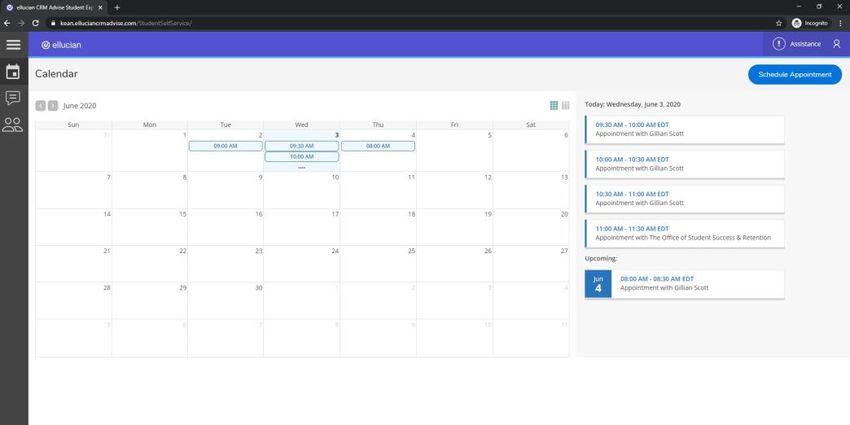
D. Ellucian CRM Advise
Ellucian CRM Advise is Kean University's Client Relationship Management (CRM) system
that allows us to unite across departments to provide intentionally designed outreach to
support all students resulting in increased engagement, retention, and student success
outcomes. There are three experiences for Advise, the Faculty, Advisor and Student
experiences. Below is a view of the Student Experience. This system provides students with
the space to schedule appointments with those who are part of their Student Success Team
including their Academic Advisor, Career Advisor, Financial Aid Counselor, Step-it-Up
Advisor, Educational Excellence Opportunity (EEO) Counselor and also, raise alerts and ask
for assistance related to topics of academic support services, campus involvement,
adding/dropping a class, career guidance, financial aid, scholarships, and more.
14For the Faculty Experience, you have the opportunity to build bridges for your students
from day one of the term through the last day of classes. Accessible through the Quick Links
on the main Kean Website under Faculty Experience, faculty are responsible for raising
alerts for their students when they have multiple absences, are missing assignments, show
unsatisfactory progress, would benefit from academic support services (tutoring, writing
public, speaking, or Supplemental Instruction), and so on. Once an alert is raised, the student
will receive an automated email communication specific to the raised alert. A complete list of
alerts that faculty can raise and accompanying emails can be found via the following link:
https://sites.google.com/kean.edu/ellucian-crm-advise/submitting-an-alert/alert-activities-and-email-
templates?authuser=0
A step-by-step guide for raising an alert for your students can be found via the following
link:
https://sites.google.com/kean.edu/ellucian-crm-advise/navigating-advise/training-videos/submitting-an-
alert?authuser=0
If you have any questions regarding the Faculty Experience, please contact Gilly Scott in the
Office of Student Success & Retention at gscott@kean.edu
E. GRADING POLICIES AT KEAN UNIVERSITY
Please see the Undergraduate and Graduate University Catalogs for the current grading
polices and consult with your Executive Director, Coordinator, or Dean’s office with any
questions. Please also see section III regarding semester grade reporting.
F. INSTRUCTIONAL SUPPORT SERVICES
Nancy Thompson Library Learning Commons
From library instruction classes to help your students be more effective users and
evaluators of information, to interlibrary loan and reciprocal borrowing privileges at
other NJ academic institutions, the Library provides a comprehensive set of services and
resources for faculty and the students they teach. Please go to
15http://libguides.kean.edu/Library for information on services and resources available to
all faculty.
If you would like to meet with a librarian to talk about what the Library offers, please
contact the University Librarian (ext 74600), to arrange a one-on-one session.
AUDIO VISUAL TECHNOLOGY
Technology Building 110
Main extension: X76120
Audio Visual Technology provides A/V planning and support for diverse programs
including, but not limited to, conferences, seminars, distance learning, interactive
television, and lectures. For more information, please go to:
http://www.kean.edu/offices/audio-visual-technology
Meeting and Conference Support
Service and equipment needs for campus conferences, seminars, lectures, as well as evening
and weekend programs must be scheduled at least 2 weeks prior to the event date. We
strongly recommend setting an appropriate test date prior to the event allowing for any
needed corrections or changes. Planning and resource allocation must be planned in
advance. Service is contingent on the availability of staff and resources, and assumes
appropriate university approval, room reservation, and other contractual arrangements have
been completed. To schedule A/V support, please call the main line listed above or visit the
website to sign up for online submissions at http://www.kean.edu/offices/audio-visual-
technology
Classroom Support
Kean University has over 120 multi-media (technically “smart” or “enhanced”)
classrooms on the main campus and 24 classrooms on the east campus. Our “smart”
rooms are equipped with projectors, computers, DVD/VHS players, laptop plug-ins,
speaker systems, and touch panel controls. Our “enhanced” rooms are equipped with
projectors, DVD/VHS players, laptop plug-ins, speaker systems, and push button
controls. For a list of classrooms equipped with this technology, please visit our website
at : http://www.kean.edu/~avttraining/
Faculty members who regularly integrate technology into their lectures are strongly
recommended to book a smart or enhanced classroom in advance of the start of the semester.
All keys for A/V classroom equipment must be obtained from your Dean, Executive
Director or Chairperson.
For technical problems – contact the Office of Audio Video Technology at 908-737-6120
Monday through Friday from 7:30 a.m. to 10 p.m.
16Loaner Program
The Audio Visual Technology Department has a variety of equipment for daily use by Kean
University faculty and staff.
Laptops: If you teach in a technologically “enhanced” classroom and require a laptop for the
class period, please call x76120 to reserve a unit for pick-up. Laptops are limited. The faculty
member is responsible for the pick-up and return of the unit (with all of the peripherals),
to/from our office in HH-110.
Training
Individual Classroom Equipment Training: One-on-one training of technologically
“Enhanced” or “Smart” classrooms can be scheduled by calling the office at x75360.
A/V Repairs
For any audio visual equipment (projector, DVD/VHS player, audio system, touch panel, or
push button controller) malfunction or damage, please contact the office at the extension
listed above.
For any problems or issues with a PC or monitor, please contact x76000.
For any problems or issues with keys or alarm codes, please contact Facilities or your
Executive Director/Chairperson.
G. PROCEDURES FOR CLASS CANCELLATION
A rather pragmatic consequence of the fact that most Kean students work and commute
to classes is the importance of notifying the University in case an emergency necessitates
cancellation of your class. Your Executive Director/Chairperson/Coordinator/or the
program office must be informed if you cannot meet a class. Executive Director/Chair-
persons must then notify their Dean.
Most students attending in the evening take only one class on a given night, and many travel
long distances to get to the University. It is recommended that you establish a telephone
chain or email chain within your class to notify your students in advance if a class is to be
cancelled. This chain should be established at the first session of class and should include
students' telephone numbers and email addresses.
If you need to cancel a class, CALL YOUR EXECUTIVE DIRECTOR/ DEPARTMENT
CHAIRPERSON AND THEN INITIATE THE TELEPHONE/EMAIL CHAIN.
17H. PROCEDURES FOR EMERGENCIES
For Fire and Environmental Health & Safety, instructors must review protocol with their
students on the first day of class. Please review the General Safety Emergency Action
Plan and the Emergency Management Quick Reference Guide at the following link:
https://www.kean.edu/offices/university-police/emergency-management
on the University Police website.
I. CAMPUSALERT
The university has purchased CampusAlert™, a notification system for Campus Crisis
Management, and First Responder Communication. It is a secure, notification platform
for sharing critical information. The CampusAlert™ system allows for the most flexible
means of communicating with our students, faculty and staff. Whether your preference is
a text message, email or a phone call, the system supports any of these options or all
simultaneously.
Kean University will utilize this system to notify the university community of
announcements and/or emergencies. Please see the following link for more information:
http://www.kean.edu/campusalert
In order to take advantage of the benefits this service provides; students and faculty (at
the Kean Union location) must register via the following link and follow the instructions
provided: https://ondemand.mir3.com/kean/login/
Please encourage your students to sign up for this benefit.
NOTE: When filling out the registration form please select “other” if your
program/department or location is not currently listed.
Instructors and students at the Kean Ocean location should also sign up via the following
link: https://ocean.sendwordnow.com/LicensePage.aspx
J. FACULTY ID CARDS
Faculty ID cards are required to utilize University services, including the library. Photos are taken in
Administration Building, 3rd floor and bar codes for the Library are applied at the Library. Contact the
ID office at ext. 43240 and the Library at 908-737-4618 for their schedules.
K. E-MAIL WEB/DATATEL ACCOUNT REQUEST FORMS
This form is included as part of the package of materials you will receive from Human Resources to
complete your hiring status. Confirmation of your request will be sent to you at your address of
record. Access to the student record system (Colleague/Datatel) is necessary for you to assign grades,
and perform other necessary verifications during the semester. Once you have been assigned a class in
Datatel, your access codes will be sent to you. Copies of the form are available through the academic
program offices. Confirmation of your request will be sent to you at your address of record.
Your Kean University email account must be set up as soon as possible as all Kean University business
18must be conducted via your Kean University email account and all email notifications from the
University will be sent to your Kean University email account.
L. KEAN LIVE
Visitors to Kean Live have a variety of enhanced media options for accessing athletic, theater and
special event content. Kean Live events are made available to the public via live webcasts, providing
visitors with the ability to view broadcasts of certain events as they happen. Webcast events are also
made available as Podcasts to be view at a later time. We stream and record live events to be view by
student, faculty, staff and family members alike. The goal at Kean Live is to provide an exemplary
and comprehensive video experience for the Kean University community. Kean Live is accessible via
the following link: https://sites.google.com/a/kean.edu/keanlive/
19SECTION II
REGISTRATION PROCEDURES
A. REGISTRATION CALENDAR FOR THE ACADEMIC YEAR
All students should have registered for their courses prior to the start of the semester
(either during the registration period beginning last semester or the current online
registrations). Change of registration (adding and/or dropping courses) can be
processed through the ADD/DROP period.
ADD/DROP
Add/Drop is available on the KeanWISE System
during the first week of classes.
The system is available Sunday through Saturday.
Please do not encourage students to enter your class after the
add/drop date.
NOTE: INITIAL REGISTRATION OFFICIALLY CLOSES ONE WEEK AFTER THE
FIRST DAY OF CLASSES. STUDENTS DESIRING TO REGISTER, FOR THE
FIRST TIME, AFTER THIS DATE SHOULD BE REFERRED TO THE DEAN
OF THE COLLEGE OF THEIR MAJOR.
Students may officially change classes until the end of the Add/Drop period. After this
point, changes can only be made with Dean’s approval. You may also encounter students
seeking to gain access to your class or describing other registration-related problems. In
responding to these students adherence to the established procedures and deadlines
described in this section is important to insure that all students are treated fairly and that
each student in your class has registered properly and is eligible to receive a grade at the end
of the semester.
Your Executive Director/Department Chairperson should be consulted for any procedures
that are specific to your academic program.
20Please see the Academic Calendar as published
by the Office of the Registrar via the Quick Links button on the top
right of the Kean home page or via the following link:
https://www.kean.edu/offices/registrars-office/academic-calendar
for a complete list of withdrawal and refund deadlines.
B. CLOSED SECTIONS: OVERLOAD AUTHORIZATION PROCEDURES
Toward the end of the registration period, the enrollment in many classes reaches the
course capacity and the class is "closed". Students seeking entrance to closed courses
should be advised to check KeanWISE to see if a section has re-opened as a result of
other students dropping the course. In circumstances that are unusual and compelling
(generally involving seniors needing a course for graduation), an EXECUTIVE
DIRECTOR/CHAIRPERSON/OR COORDINATOR may elect to authorize a course
overload. Students who request "overload" permission should be referred to your
academic program office. In making a referral, please do not give an indication that
overload permission will be granted. There are legitimate needs that should be met by
overload authorization, but it is important that the process be centralized with your
academic program office and administered equitably.
Course overload permission is processed on line by the EXECUTIVE
DIRECTOR/CHAIRPERSON/OR COORDINATOR.
Once the student receives the overload authorization they are to register on line using
KeanWISE.
UNDER NO CIRCUMSTANCES should students who are not
enrolled in your class be permitted to attend with the under-
standing that they may be registered later.
C. VERIFICATION OF OFFICIAL ENROLLMENT
It is important that you verify that each student attending your class has registered officially.
This may be done by checking that the student's name appears on your first day class roster
or by checking a schedule that is presented to you by a student.
The First Day Class Roster is made available on KeanWise prior to the start of the semester
and the course and section numbers appearing on it should correspond to your assignment.
21(If you do not have access to the roster or receive an incorrect one, seek assistance from your
Executive Director /Chairperson.)
A general explanation of the column headings will accompany your first-day roster, so the
explanation provided below will focus on interpreting the registration status of the students
listed. All active or registered students will be listed first. Students who have dropped the
course will be listed next. Any student who is listed under DROPPED/WITHDRAWN is not
officially registered and should be referred to the Registrar's Office for enrollment
verification. Be sure to print out a class roster immediately prior to your first class meeting
(as add/drop occurs continuously) and immediately after the add/drop period for the most
accurate class roster.
Students who are not listed on your roster and who do not present a class schedule should be
advised of the ADD/DROP dates listed under the Registration Calendar. UNDER NO
CIRCUMSTANCES SHOULD A STUDENT WHOSE REGISTRATION CANNOT BE
VERIFIED BE PERMITTED TO SIT IN ON YOUR CLASS.
Any difficulties should be resolved with the Office of the Registrar by the student, who must
present you with official evidence of registration before re-entering your class.
D. SECTION VERIFICATION LISTS
Section Verification lists will be available online to all faculty members immediately after
the ADD/DROP period with the request that the list be checked against the instructor's
records. These lists include the names of all students who were registered in your class as of
the first day of the semester. The names of students who dropped your class appear at the
bottom of the roster under DROPPED/WITHDRAWN.
Please follow carefully the instructions that accompany the Section Verification List; your
cooperation is essential if final grade rosters are to be accurate.
THE REGISTRAR'S OFFICE WILL ACCEPT SEMESTER GRADES ONLY FOR STUDENTS
WHO ARE OFFICIALLY ENROLLED. TO BE OFFICIALLY ENROLLED, A STUDENT
MUST REGISTER FOR YOUR SECTION ON OR PRIOR TO THE END OF THE FIRST
WEEK OF CLASSES. STUDENTS WHO DO NOT APPEAR ON THE VERIFICATION
ROSTER DISTRIBUTED IMMEDIATELY AFTER THE FIRST WEEK OF CLASSES SHOULD
BE ADVISED THAT THEY MAY NOT REMAIN IN YOUR CLASS. FACULTY SHOULD
REFER STUDENTS TO THE REGISTRAR’S OFFICE TO RESOLVE THIS MATTER.
F. NEVER ATTENDED STUDENTS
Federal regulations now require that all institutions receiving Title IV funds must verify
attendance. To comply with these regulations, you are required to report your class
attendance each semester. You will receive notification of the deadline dates by the Office of
the Registrar via your Kean email account approximately two weeks after the start of the
semester.
22Reporting this data is through the use of the “Never Attended Student Tracking” option
found on KeanWISE. Class rosters are not sent to faculty for verification.
If you have any questions, cannot access the proper roster, or cannot log into KeanWISE,
please contact the Office of the Registrar at (908) 737-3290.
Verification of Official Student Enrollment must be submitted
Log into KeanWISE
Click on Web Advisor for Faculty
Click on “Never Attended Student Tracking”
You must check one of the following:
1) IF ALL STUDENTS APPEARING ON YOUR ROSTER ARE CURRENTLY
ATTENDING:
Check the box “All students have attended” and click SUBMIT.
2) IF ANY STUDENTS APPEARING ON YOUR ROSTER HAVE NEVER
ATTENDED:
Check the “Never Attended” box next to their name and click SUBMIT.
23SECTION III
ACADEMIC POLICIES AND PROCEDURES
INTRODUCTION
The policies summarized in this section are published in the University catalogs, and specific
academic deadlines appear on the academic calendar and registration information provided
on the Registrar’s website. Because almost all academic policies affect individual classes, you
are an important link in the communication of these policies to students.
Please read these policies and procedures carefully, and discuss their enforcement with your
Executive Director/Chairperson/or Coordinator prior to the start of classes.
As noted in Section I, the start of the semester is a crucial time for communication of academic
policies and deadlines. Incorporation of course requirements, academic deadlines and other
relevant information into a written syllabus distributed at the beginning of the semester will
help avoid misunderstandings later.
A. CLASS ATTENDANCE POLICY
Attendance is expected in all courses. Attendance will be a component of the grade of any
course if so stated in the syllabus. Students are responsible for informing the instructor in
advance or in a timely manner of the reasons for their absence. Instructors, in consultation
with their Executive Directors/Department Chairs, are expected to respect university
practices and policies regarding what counts as an excused absence. Typically excused
absences include illness, bereavement, or religious observances. Serious tardiness may be
dealt with at the discretion of the instructor.
It is hoped that all instructors will try to structure and teach their courses in a way that
encourages students to recognize the need for regular attendance and the opportunities that
regular attendance affords.
The instructor can use the quality of class participation in determining students' grades if
class participation has been stated as a requirement of the course at the beginning of the
term.
When, in the opinion of the instructor, a student's excessive absences are jeopardizing
his/her academic standing in the course, the instructor, where possible, will notify the
student. It is the student's responsibility to arrange a meeting with the instructor to review
the situation.
B. ACADEMIC INTEGRITY POLICY
(Approved by Kean University Board of Trustees June 25, 2012)
Kean University is aware of and sensitive to the pressures exerted by peers and family,
work environment, the academic process, and society in general, and is committed to
creating an environment in which academic integrity is supported and academic
24dishonesty is not tolerated. To that end, the University has taken steps to ensure that all
members of the academic community are fully aware of the Academic Integrity Policy
by: widely distributing the policy, posting it on the University’s Web site, identifying
material on all course syllabi, and provide training to increase awareness of Academic
Integrity issues among all members of the Kean University Community.
Thus, administrators, staff, Board of Trustees Members, and faculty at Kean University
have an obligation to support academic integrity by ensuring that all members of the
University community understand:
• What constitutes academic integrity
• How to prevent academic dishonesty
• What sanctions are imposed for academic dishonesty
• What consequences ensue as a result of such sanctions, and
• What process is used to impose those sanctions
All members of the Kean Community shall actively engage in the academic process. In
order to ensure compliance with the Academic Integrity Policy, administrators, faculty,
staff, librarians, and students should:
• Represent their identity truthfully in all situations
• Protect their materials, including papers, tests, and other academic
exercises, from unauthorized access
• Protect their means of access to resources, including computer passwords
and library access codes, from unauthorized use of the system
• Respect the work of others by acknowledging their words, ideas, opinions,
theories, data, programs, and other intellectual material in accordance
with the guidelines of the discipline or other faculty instruction
• Report data or source information accurately
• Refuse to participate in activities that violate the Academic Integrity Policy
• Read, understand, and comply with the code of ethics and/or clinical code
of their chosen discipline, and
• Represent their mastery of material truthfully and accurately.
The Academic Integrity Policy is available on the Academic Affairs website at:
https://www.kean.edu/academic-integrity
Please note that the Academic Integrity policy will be revised to include procedures for
Faculty, Staff, and Librarians following the appropriate negotiations.
Please review this policy thoroughly as it is referenced (with the link) on the syllabus
template for your syllabus. Questions about the Academic Integrity Policy should be
directed to your Executive Director/Chairperson/or Coordinator.
25C. GRADE RECALCULATION POLICY (Undergraduate Students Only)
Effective with courses taken from Fall 1987, a maximum of 4 courses or 12 credits
undergraduate courses (only) taken by undergraduate matriculated students may be
repeated once for a higher grade and recalculation of the cumulative GPA prior to
graduation. Students must apply for grade recalculation through the Registrar’s Office. See
the undergraduate catalog for complete details on this policy.
D. ACADEMIC AMNESTY POLICY (Undergraduate Students Only)
The Academic Amnesty Policy was designed to provide former Kean University students an
opportunity to eliminate previously unacceptable grades on their readmission to Kean
University beginning Fall 2009 provided certain criteria are met. Please refer to the complete
instructions and policy at:
https://www.kean.edu/division-academic-affairs/academic-amnesty
E. PASS/FAIL OPTION (Undergraduate Students Only)
Students who meet the requirements specified below may choose to take a maximum of six
courses (exclusive of developmental studies courses) from their free elective credits on a
pass/fail basis. THIS OPTION IS AVAILABLE FOR FREE ELECTIVE COURSEWORK
ONLY. COURSES NEEDED TO SATISFY REQUIREMENTS (E.G., GENERAL
EDUCATION, OR MAJOR REQUIREMENTS) MAY NOT BE TAKEN ON A PASS/FAIL
BASIS.
To qualify, a student must be matriculated, in good academic standing and have earned at
least thirty (30) semester hours of credit.
A grade of "P" represents achievement at the level of "C" or better, while a grade of "U"
represents failure (and is equivalent to the letter grades "D" or "F"). The student's cumula-
tive grade point average is not affected by coursework taken on a pass/fail basis.
The pass/fail option must be declared at the Office of the Registrar and may be done
through the first three weeks of classes. This period allows the student a reasonable but
limited amount of time to become familiar with the course content before exercising the
pass/fail option.
Please see the Academic Calendar as published
by the Office of the Registrar via:
https://www.kean.edu/offices/registrars-office/academic-
calendar
for an updated list of Pass/Fail
26 declaration dates.Changes from letter grade status to pass/fail and vice versa will not be permitted after
the above deadlines.
Transfer students should also be reminded that utilizing the Pass/Fail option may impact
their eligibility for Honors designation at graduation. See the Pass/Fail policy in the
current undergraduate catalog.
F. THE AUDIT POLICY
The audit policy is intended to permit a limited number of students to engage informally in
regular college coursework. A student may audit one course per semester. Students
auditing a course attend classes but do not complete formal course requirements. NO
ACADEMIC CREDIT IS EARNED FOR AUDITED COURSES AND AUDIT COURSES
ARE NOT COUNTED IN ENROLLMENT STATUS WHEN DETERMING FINANCIAL
AID AWARDS. The transcript shows the course with grade symbol “AU”. Full tuition is
paid for audited courses.
As is the case with the pass/fail option, the period for declaration of the audit option is the
first three weeks of the semester.
Changes from audit to credit and vice versa will not be permitted after the deadlines.
G. ACADEMIC EARLY ALERT REPORTING
Effective Fall 2018, in order to ensure student success with all learning outcomes and
objectives, all instructors must submit Academic Early Alert Reports for students enrolled
in their classes. Students view and instructors enter Academic Early Alerts/Midterm
Progress Reports on KeanWISE. Reporting dates and detailed instructions are sent via
Kean University email in advance of reporting.
Purpose of Academic Early Alert Reports:
Reports serve to give students and faculty advisors early feedback on how students are
performing in their classes. These reports are especially meant to give students an early
warning if they are currently at-risk for earning a poor or failing final grade in a course. The
academic early alert report only indicates the student’s performance in the class at that
time. Students are encouraged to consult with their instructors throughout the remainder
of the class to ensure they are on track for the particular letter grade they are expecting.
Academic early alert reports are not meant to be an absolute predictor of final grades, since
efforts throughout the entire semester will determine the final grade. The academic early
alert report will NOT be a part of student permanent records and will be available for
viewing on KeanWISE only until the final grade is entered. However, these progress
reports will be shared with the Student Success and Retention staff, and faculty advisor(s)
(and counselor for students in the EEO Program, EPIC Program, PASSPORT Program, or
Spanish Speaking Program)—so they may provide assistance to students encountering any
academic difficulties.
27Grade Types and Instructor Comments:
The academic early alert report received for the course could be a grade, a comment, or
both. Grades could be a “P” (Pass), a “U” (Unsatisfactory) or an A, A-, B+, B, B-, C+, C, D,
or F.
In addition to, or instead of, submitting a midterm grade for each student, instructors also
have the option of submitting comments (Multiple Absences, Please schedule to meet with
Instructor, Recommend Tutoring Center, Recommend Writing Center, Satisfactory Progress,
Exceptional Progress, Missing Assignments, Low Test/Quiz Scores, Unprepared for Class, or
Unsatisfactory Work).
If any of Academic Early Alert Reports indicate early warning:
Kean University has a wide range of academic and student support services to help
students succeed in courses, and students will have time to take actions that can result in
improved final grades:
Students having difficulty with the content of a particular course are encouraged to
take advantage of the tutoring available for that course. Course instructors will refer
students to the specialized tutoring available and/or visit the Nancy Thompson
Library Learning Commons for additional, extensive tutorial services.
Students with multiple class absences or missing assignments should speak with
their course instructor to see if there is an opportunity to make up any of the work
missed.
For multiple absences and/or lateness for a course, students should evaluate any
on-going circumstances that are causing the problem—i.e., transportation and
parking issues, work schedule, etc. Any adjustments that seem necessary to ensure
attendance can be made. Remember that poor attendance is often the primary
reason students earn poor or failing grades.
Students should meet with their faculty advisor, or a Student Success and Retention
staff member (in CAS 123) to discuss academic success strategies and academic
support services that can help improve their grades.
In some cases, students may elect to withdraw from classes based on their academic
early alert/midterm progress report. Keep in mind that course schedule changes
may have financial aid implications. Students are encouraged to speak with their
faculty instructor, faculty advisor, Student Accounting, and a financial aid
representative before withdrawing from any classes. The last day to withdraw from
a course(s) with a mark of “W” and no refund is published in the Academic
Calendar on the Registrar’s webpage for each semester.
Students needing additional information about grading policies and procedures
should meet with their faculty advisor, Executive Director/Chairperson or a
Student Success and Retention staff member to discuss such matters as minimum
acceptable grades, special grade requirements of the intended major, GPA
calculation, and/or the serious implications of earning failing grades. If a required
course is failed, the course must be repeated. A pattern of failing grades can lead to
academic probation/dismissal and/or loss of financial aid eligibility.
28Kean University is dedicated to supporting students to succeed in their courses. The
University offices/programs that can provide assistance and guidance include the faculty
advisor, Executive Director/Chairperson, the Student Success and Retention Office, the
Counseling Center, and (as applicable) the EEO, EPIC, ESL, PASSPORT, Spanish Speaking
Programs, and Veterans’ Student Services. Students not sure where to go for assistance or
information should be referred to the office of Student Success and Retention (in CAS 123
or call 908-737-0323).
For more information about the Academic Early Alert Reporting process, please consult the
Undergraduate University Catalog and/or the Executive Director, Chairperson, or Dean’s
office.
H. WITHDRAWAL FROM COURSES: POLICY AND PROCEDURES
Please see the Academic Calendar as published
by the Office of the Registrar via:
https://www.kean.edu/offices/registrars-office/academic-
calendar
for a complete list of withdrawal and refund deadlines.
The results of your midterm examination and or other grades that would serve as a mid-
semester evaluation should be communicated to your students PRIOR to this date so that
each student is able to make an informed decision about whether or not to continue in
the course.
The transcripts for students who withdraw from a course on or before this date will show a
"W" for the course concerned. A student who does not withdraw officially, but stops
attending, should be given a letter grade that reflects his or her performance in the course
and the date the student stopped attending should be noted on the online grade roster.
Students wishing to withdraw from a course should complete the process at the Office of
the Registrar by the designated deadline. The grade roster available at the end of the
semester will indicate a grade of “W” beside the name of each student who has withdrawn
officially. All other students are subject to the regular system of earned grades.
Students with documented extreme extenuating circumstances who need to withdraw from
the course after the established deadline must be referred to the Dean of the course (or
Dean of their major if the student needs to withdraw from the entire semester).
29I. INCOMPLETE GRADES
1. Policy: Incompletes
Grades of Incomplete (“IN””IC””IP”) may be reported for a student who has
completed course requirements throughout the semester and then, because of illness
or other unusual and substantiated cause, has been unable to take the final examina-
tion or to complete a limited amount of assigned work due near the end of the
semester. Unsubstantiated absences from class may not be used to justify an
incomplete grade. If a substantial amount of work has been missed for medical or
other reasons, the student should petition the College Dean to withdraw him or her
from all courses.
It is the responsibility of the student to initiate the request for a grade of Incom-
plete. The instructor of the course must receive this request prior to the submis-
sion of grades at the end of the semester. If no such request if received, or if the
instructor judges the request to be unacceptable, an appropriate letter grade shall
be submitted based upon the student's attainment of the stated goals of the
course.
2. Granting of an Incomplete Grade
As explained above, Incomplete grades should be given only for students who
have completed course requirements throughout the semester, but then are
unable to complete a limited amount of work at the end of the semester. A
student who has missed a substantial amount of work should not be given an
incomplete grade. If a medical reason is involved, the student should be referred
to the College Dean; if unsubstantiated absences are involved, the student should
be given a grade based on his or her performance in the course.
Under the Incomplete Grade policy, a student should initiate the request for an
“IN””IC””IP” and, if this request is granted, a contract must be filled out by
both the instructor and the student. Provision is made on the contract for
entering a deadline by which the work must be made up and a grade to be
entered if the work is not made up. Please be sure to complete each item on the
contract.
One copy of this contract should be retained by the instructor and one given to
the student. A third copy should be submitted to your Executive
Director/Chairperson/or Coordinator. These contracts are available from your
academic program office. Please read carefully the policy and procedures for
granting of an Incomplete grade which follow below.
Procedure: Granting of an Incomplete Grade
1. For each incomplete grade awarded at the end of the semester, the instruc-
30You can also read


