LAUNCH PRESENTATION G20 Energy Efficiency Forum - Hamburg 2nd May 2017
←
→
Page content transcription
If your browser does not render page correctly, please read the page content below
LAUNCH PRESENTATION

    G20 Energy Efficiency Forum – Hamburg 2nd May 2017

1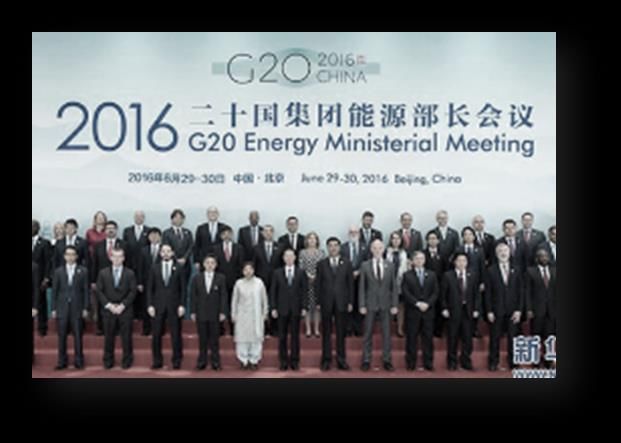
Why a G20 Toolkit to Scale-up Energy Efficiency Investments ?

                                  G20 EE Investment Toolkit

                                          Private Sector                 Public Sector
            Policy                            Finance                      Finance

                                            Institutional    Insurance
                                  Banks
                                              Investors     Companies
      EEFTG Energy Efficiency
     Investment Principles for
    G20 Participating Countries

      G20 Energy Ministers in
    Istanbul in 2015 & attached
        to the G20 Leaders’
    Communique from Antalya

    G20 Energy Efficiency
     Leading Programme

2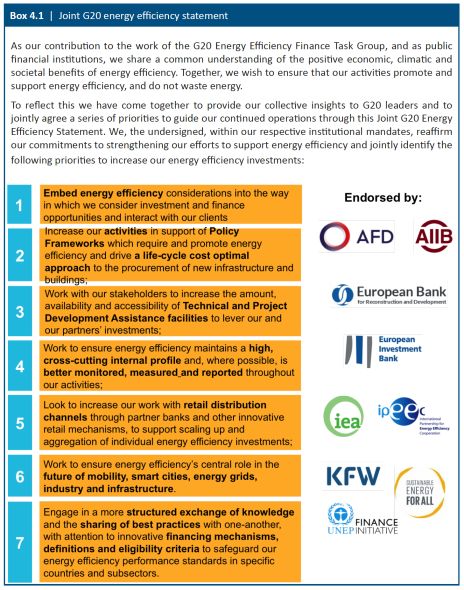
I. Measurement and Definitional Tools

Global Energy                                                               Investment in Energy Efficiency,
Investment 2015:                                                                      Concepts:
                                                                              • Method 1, Total Spend: Market
                                                                                size for energy efficient goods and
                                                                                technologies.

                                                                              • Method 2, The Incremental
                                                                                Investment: Additional investment
                                                                                needs that would lead to energy
                                                                                efficiency improvements above BAU
                                                                                levels.
                                                                                         Transport
                                                                                                       29%         13%
                                                                                                              1%                     25%

• Energy efficient investment needs to
                                                                            EE Investments by           15%

                                                                            Sector 2015: USD 221 billion                                      53%
                                                                                                                                                     Buildings
  increase (independent of source)                                                                        9%
                                                                                                                                       12%
                                                                                                       Transport
                                                                                                                   9%            6%13%
                   Transport                                                                             18%             29%
                                                                                                                         10%
• While EnergyEfficiency     Financing
                             29%      13%       is a                          Envelope       Industry                           1%                   25%
                                   1%         25%                             HVAC and controls
                                                                                                                          15%
 mechanism (means to an end    15%
                                     ) which can                              Appliances
                                                                                                                                 USD 221 billion
                                                                              Lighting                                                                         53%
                                        USD 221 billion         Buildings
 accelerate the growth of energy efficient business53%                        Energy-intensive industry                    9%
                                                                                                                                                         12%
                                                          12%                 Other industry
 models, enabling the up-scaling   9%
                                         of energy                            Light-duty vehicles                         18%
                                                                                                                                     9%
                                                                                                                                             10%
                                                                                                                                                    6%
                                         9%         6%                                                    Industry
                                  18%         10%                             Freight vehicles
 3efficiency   investments
                      Industry
                                                                              Rail, shipping and aviation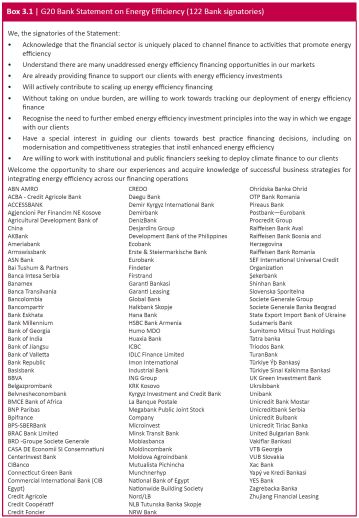
Energy Efficiency Premium: How G20 can “Take it to Zero”

Example:              Consumer or
                       business                          The base plus this
                                                     “Premium” equals the
         To invest in:                             full technology cost, or the
                                                         “Total Spend” in
            Energy Efficient Equipment
                                                            Efficiency

           Full cost can be divided into

             1.                       2.
      Cost of a new but                                   Energy Efficiency
      very standard and
                               Cost of the added
    less efficient piece of      increments of              “Premium”
                               energy efficiency
          equipment
                                                           [or “discount”]
       (Base Cost)

4
Mapping Tools: “Energy Efficient World” for the G20…

                                                              Integrated                                Core
                                                                                                ESCOs (USD 24 bn);
                      USD trillions                           USD 221bn                           “Self-financed”

                                                          Energy Transition; National             “EE First”; Mandatory
                Energy subsidies; Inefficient                                                      targets/ standards;
                                                        Renovation Strategies; Vehicle
                                                                                                  NZEBs; EE Obligation
                markets; Supply-led planning.            Fleet Standards; Transparent             schemes; National EE
                                                               Energy Planning.                       Action Plans.

                                     Mainstreaming                             Enabling

               Finance undertaken without explicit                                                 EE mortgages;
                                                       Green tagging; Green buildings            Building renovation
                    consideration of energy
                                                       lending; green lending; climate         loan; EE credits/loans;
                 “externalities” or cost effective
                                                         lending; Equator principles.                EE tagging.
                     energy improvements.

               Finance undertaken without explicit        Green tagging and company               EE funds; Energy
                    consideration of energy                 disclosure; Collaborative           Productivity Indexes;
                 “externalities” or cost effective     shareholder activism; Green funds;        Own real estate EE
                     energy improvements.                Sustainable real estate funds.        renovation; EE tagging.

                                                        Green buildings insurance; Climate     Energy saving insurance;
               Product and services without explicit                                             energy performance
                                                       mitigation insurance and investments;
                    consideration of energy                 Addon coverage; Technical           guarantee; EE advisory
                         “externalities”.                  assistance, advisory services.              services.

               Finance undertaken without explicit                                               Direct EE Lending; EE
                    consideration of energy            Resource Efficiency; Safeguards;        Policy lending; EE targets;
                 “externalities” or cost effective      ESG & Climate Commitments;               Technical assistance.
                     energy improvements.
                                                                                    $33 bn                          $7 bn
5
II. G20 Policy Tools: voluntary EE Investment Principles (vEEIP)
     Framework, Databases & TEWs
• EEFTG reviewed 2,000 policies in the IEA’s             Concentration of PAMS policies in the
  PAMS database, focusing on G20 countries, in            vEEIP Framework for G20 countries
  combination with the results of its 2016 global
     expert survey.
• To then sort the data by principle and sub-principle
  of the vEEIP for G20 participating countries

      ‒ Attaining an approximate view of the
        Principles and sub-Principles that are
        widely implemented in existing policies and
         identified the gaps where further
         progress can be made.

       Policy toolkit: based on the                                EEFTG’s Tools for Bilateral
                Principles                                       Engagement with G20 Countries
      will
                   • Rationale
                                                            I.   Supporting the development of an enabling
 provide           • Key Findings
                                                                 national policy framework
                   • Case Studies (policy innovations
                     that promote EEI)                      II. Providing an engagement platform and
 for each          • Action Areas                               mechanism through its Technical Engagement
                                                                Workshops (TEWs)
                  of the Principles and sub-
 6              Principles in the G20’s vEEIP               III. Exchanging knowledge of good practices
III. Private Sector Tools: Collective Statements, Green Tags,
     Best Practice Surveys and De-Risking
2016 EEFTG’s Bank Survey                                       Green Tagging to Track the Energy
    Key Conclusions:                                             Performance of Banks’ Assets
                                                          80
    a. Well-recognized opportunity

                                       % of respondents
                                                                                                                       58
                                                          60
    b. Needing awareness raising                          40       29
       and supportive policies                                                  21            18
                                                          20                                             16
    c. Requiring tracking of energy
       efficiency finance                                 0
                                                               Real estate Energy sector   Industry   Transport   No tracking

            G20 Energy Efficiency                                          Insurers can help De-Risk Energy
             Investor Statement                                                 Efficiency Investments:

                                                                        1. Technical risks - particularly during the
                                                                          implementation of the energy efficiency
                                                                          improvements as a multi-stakeholder process and
                                                                          when using complex equipment.

                                                                        2. Financial/performance risk - the level of
                                                                          energy savings and the financial value of these
                                                                          savings.

7
    Endorsed by more than USD 4tn of Investors!
IV. Public Finance Tools: Joint Statement, Focus Action
    Framework, Structured Engagement for Development
 Public Financial Institutions have led                            Joint G20 Energy Efficiency
    Energy Efficiency in 3 Areas:                                          Statement
1. Showcasing & replication of energy efficiency
   investment models.
2. Identification & implementation of new financial
   instruments that facilitate the replication and scale
   up of energy efficiency investments.
3. Identification of internal policies that mainstream EE
   investing across all activities of the organisation.

                                          1. Increase Policy-based Lending to Support Investment
                                             Grade Policy Frameworks that require and promote EE
    Framework of Action                      and to drive “Life-cycle Cost Optimal” Procurement of
                                               Public Infrastructure and Buildings
    for Public Financial
    Institutions and                      2. Increasing the amount, availability, simplicity and
    Country Partners to                      connectedness of Technical Assistance/ Project
    scale-up Energy                          Development Assistance facilities
    Efficiency Investments                3. Lever Multiple Retail Distribution Mechanisms
                                          4.   Energy Efficiency’s Central Role in the Future of Mobility,
8
                                               Smart Grids and Infrastructure
Summary for Policymakers: 10-pages, 24x Recommendations
  … supported by 30x Case Studies (Annex)
                                    G20 Energy Efficiency policies, financing tools and
      EEFTG’s G20   Energy             best practices developed through the flexible and
                                    collaborative architecture of this Toolkit provide
    Efficiency Investment           an integrated approach to enhancing capital flows
     Toolkit provides voluntary                    towards energy efficiency
      options & insights to G20
    members on pathways to begin     Embedding energy efficiency in investment
            this market                 processes through an enabling policy
        transformation.              framework is key to accelerating G20 energy
                                              intensity improvement
                                    G20 Energy Efficiency Investment Toolkit
                                   is a vehicle to showcase best practices, strengthen
                                      the visibility of energy efficiency in private
       It also includes tools,
                                     financial disclosure and support commitments to
        actions, best                 scale-up energy efficiency investments
      practices and case
       studies for G20             G20 countries can lever the experience of public
                                   financial institutions to ensure energy efficiency’s
     countries to take-up as         central role in the future of mobility, smart cities,
9       they consider useful            energy grids, industry and infrastructure
What next for the G20 Toolkit ? (Debate)

                                                     The G20 Toolkit Provides:
            No single
       Stakeholder group                               Collaborative Architecture
     can deliver the scale
                                                   ● G20 policy makers can engage in a
        up of G20 energy                             structured dialogue with investment
     efficiency investment                                        providers

      required on its own                                             +
                                                     ● Jointly develop and deliver the
                                                       targeted economic, social and
                                                           environmental benefits

            Value Created:                    G20 Leaders grow EE        investments together
 ● The network effect created by convening
   and connecting the multiple stakeholders        ● In their national interests
   responsible for its components; and

 ● Uniting them in the pursuit of a shared         ● And for the benefits of the global
   objective with benefits for all.                  community
10
3x Toolkits in One to Scale-up Energy Efficiency Investments
G20 EE Investment Toolkit
“10-pager” Comprehensive 30x G20 Case
For Policymakers Toolkit Studies
11By G20 Energy Efficiency Finance Task Group (EEFTG)
(Work & Achievements)
In 2016 EEFTG engaged with around 1,200
Comprised of
15 countries
individuals through a programme of 18
and co-chaired workshops or contributions to G20 and
by France & related activities in Europe, USA, China
Mexico and Latin America
EEFTG global survey generated
140 specific ideas, instruments,
approaches, mechanisms, instruments
and practices shared by 72 experts
Beijing G20 Energy Ministerial
Communique calls for “upscaling
energy efficiency investment”
Launched campaign to
engaging with 122 banks
& asset managers managing
12 $4+ trillion of fundsThank You
G20 Energy Efficiency Finance Task Group
Contact: ailin.huang@ipeec.org
Information: ipeec.org/EEFTG
Supported by:
13You can also read


