MicroLED Displays: Global Trends & Opportunities for Equipment and Material Suppliers - SEMI
←
→
Page content transcription
If your browser does not render page correctly, please read the page content below

Picture: Sony                                    From Technologies to Market

          MicroLED
           Displays:
         Global Trends &
        Opportunities for
         Equipment and
        Material Suppliers

                                                       SEMICON EUROPA
                             Jean-Christophe ELOY - CEO - Yole Développement
                                                                         © 2017
AGENDA

  • Presentation of Yole Développement - From Technologies to Market

  • What Are MicroLED Displays?

  • MicroLED Challenges

  • MicroLED Competitive Landscape

  • MicroLED Applications

  • Opportunities for Equipment and Material Suppliers

  • Conclusion

                                                            ©2017 | www.yole.fr | MicroLED Displays   2
Presentation of Yole
          Développement
From Technologies to Market

                ©2017 | www.yole.fr | MicroLED Displays   3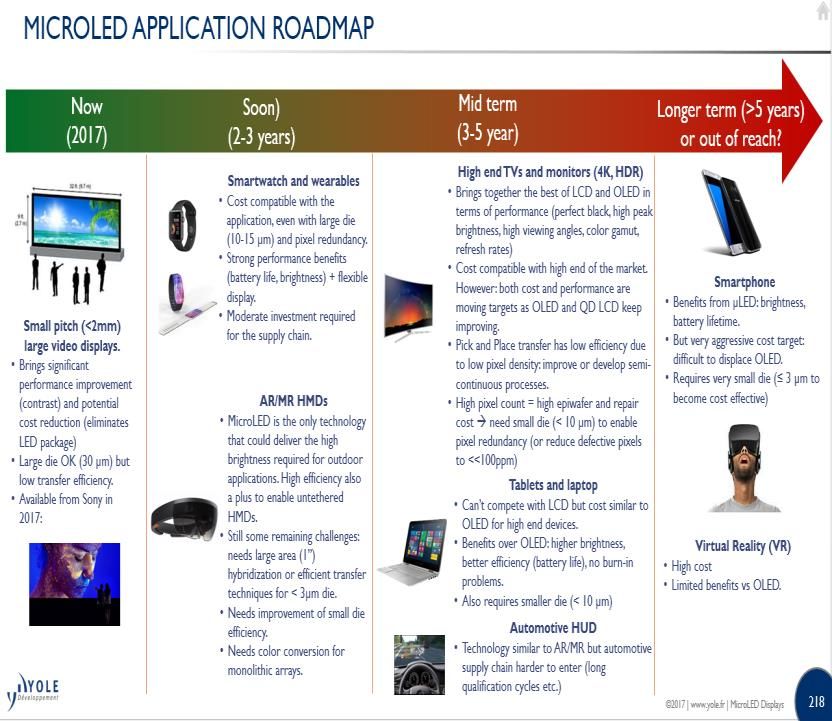
A GROUP OF COMPANIES

                                     M&A operations
                                      Due diligences
                                      www.yolefinance.com

                               Innovation & Business maker
                                       www.bmorpho.com

                                Manufacturing costs analysis
        Market, technology   Teardown and reverse engineering
          and strategy             Cost simulation tools
                                       www.systemplus.fr
           consulting

             www.yole.fr                IP analysis
                                    Patent assessment
                                       www.knowmade.fr

                                   Test & Measurement
                                         Expertise
                                  Research & Innovation
                                         www.piseo.fr
                                                            ©2017 | www.yole.fr | MicroLED Displays   4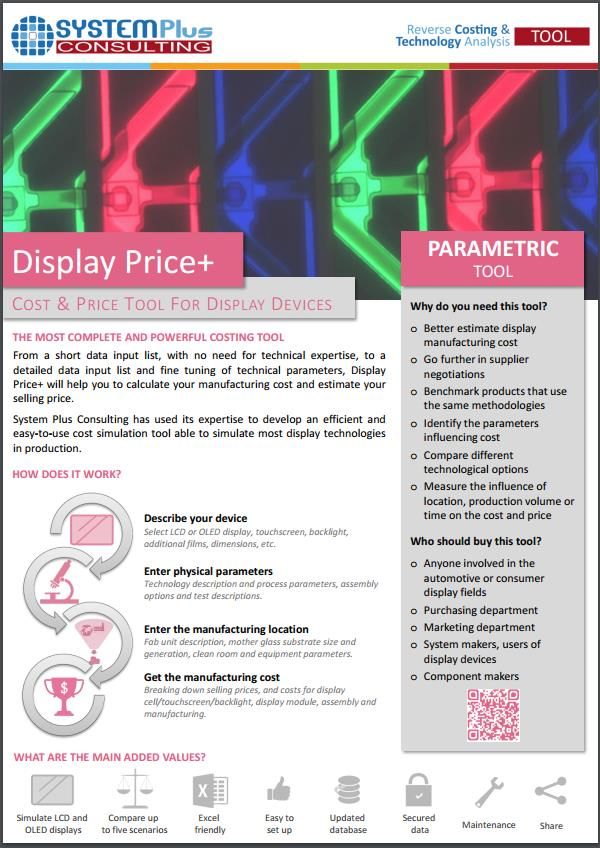
DISPLAY ACTIVITIES: RECENT REPORTS
                                 Available:

Off the shelf
reports and
  custom
  analysis.

                         Visit: www.i-micronews.com
                                                      ©2017 | www.yole.fr | MicroLED Displays   5
DISPLAY ACTIVITIES: COST MODELING,TEAR DOWN ANALYSIS AND REVERSE COSTING

   Cost
Simulation
  Tools

                                                            ©2017 | www.yole.fr | MicroLED Displays   6
What Are MicroLED
          Displays?

          ©2017 | www.yole.fr | MicroLED Displays   7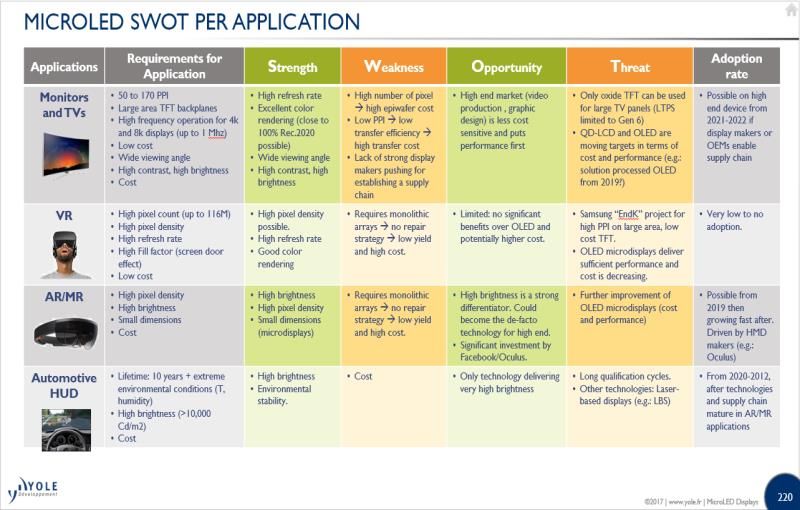
LCD VS EMISSIVE DISPLAYS

                                                                                                        LCD
                                                                                         Light is generated by an LED
   LCD                                                                                   backlight and goes through a
                                                                   (transistor matrix)
                                                                                         matrix of liquid crystal “light
                                                                                          switches” and colour filters
                                                                                           constituting the individual
                                                                                                    subpixel.

                                                   Encapsulation                                   Emissive

                                                                                          Each sub-pixel is a tiny light
    Emissive                                                                             emitter which brightness can
  (e.g: OLED)                                                                              be individually controlled

                 Illustrations: Ignis Technology
                                                                                                    ©2017 | www.yole.fr | MicroLED Displays   8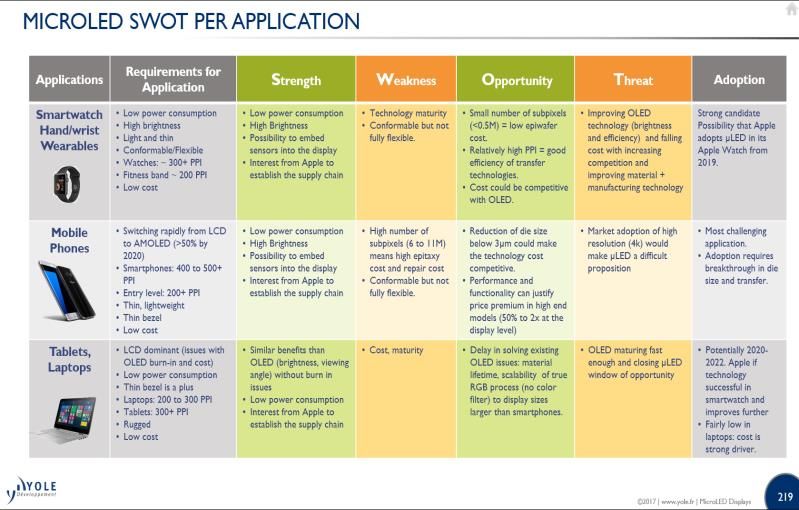
WHAT IS A MicroLED DISPLAY?

  Self emitting displays (just like OLED) that use individual, small LED chips as the emitters.

                                                       Sorting and Pick and place + hybridization/connection to the transistor matrix that
        Red, Green, Blue LED   Chip singulation
                                                                                   controls individual pixels
              Epiwafers

                                                                                                       ©2017 | www.yole.fr | MicroLED Displays   9
POTENTIAL MICROLED BENEFITS

   • Low power consumption.                                                          Large video
                                                                                       displays

   • Perfect black + high brightness =
     High Dynamic Range (contrast).                    Smartwatches
                                                       and wearables                               Sony
                                                                                                                              TV

   • Wide color gamut.
                                                                                                                                 LG

   • Long lifetime, environmental stability.   Virtual reality
                                                                Apple
                                                                                                                                 Smartphones

   • High Resolution/Pixel density.
   • Fast refresh rates.                               Oculus
                                                                                                                                            Samsung

                                                                                                                               Laptops and
   • Wide viewing angles.                          Augmented/Mixed
                                                       Reality
                                                                        MicroLED TV prototype (Sony, CES 2012)                 convertibles

   • Curved/flexible backplanes.                                                                                                          HP
                                                            Microsoft    Automotive                       Tablets

   • Integration of sensors within the                                      HUD

     display front-plane.
                                                                               BMW                          Acer

                                                                                                          ©2017 | www.yole.fr | MicroLED Displays     10
SO,THIS IS IT?
Do we have
the best
display
technology
ever?
©2017 | www.yole.fr | MicroLED Displays 11Challenges ©2017 | www.yole.fr | MicroLED Displays 12
MICROLED DISPLAY MANUFACTURING CHALLENGES
    While very promising in terms of performance, there are still multiple manufacturing challenges
    that need to be addressed to enable cost effective, high volume manufacturing of µLED Displays.

                                                              Color
                                                            Conversion
                                    Light
                                                                                        Backplane
                               extraction and
                                                                                       hybridization
                                beam shaping

                    Massively
                   Parallel and                                                                              Defect
                 High Accuracy                                                                             Management
                 Pick and Place                                                                             & Testing
                  Technologies

                  LED
              Technology
                                                          LED                                                     Supply Chain
            (epitaxy, chips)                            µDisplays

                                  Multiple challenges need to be tackled to enable the µLED display opportunity

                                                                                                                                 ©2017 | www.yole.fr | MicroLED Displays   13
MICROLED DISPLAY ASSEMBLY
4K Display (TV, smartphone…): 24.9 million µLED chips
• Traditional pick and place equipment
~ 1000 hours 41 days…
• Small chip handling (DEFECT MANAGEMENT
µLED Yield Transfer Yield
Die not properly
Epitaxy + chip picked or placed, or Combined
manufacturing:
X
faulty connection to = Defect Rate
dead or dim µLED the TFT: (in ppm)
pixel. missing, dead, or
“always-on” pixels.
99.9% 99.9% 20 ppm
99.99% 99.99% 2 ppm
99.999% 99.999% 0.2 ppm
Most high-end displays are guarantied zero defects
©2017 | www.yole.fr | MicroLED Displays 15SUPPLY CHAIN
Large scale µLED displays manufacturing?
Bringing together disparate technologies and industries.
LED Makers Display Makers
Cultural and technology • TFT backplanes + LCD/OLED
• LED epitaxy.
chasm frontplanes
• Small diameter wafers 4” to 6”
• Large substrates (1 to 10 m2)
• Cleanroom class 10,000 at
• Clean room class 100 -1000
best
• Semi-finished products (panels)
• Produce components / chips
• Typical fab CapEx for large
• Fab CapExCompetitive Landscape
©2017 | www.yole.fr | MicroLED Displays 17MICROLED PLAYERS - A LOT OF SMART PEOPLE WORKING ON IT
Increasing activity from all types of companies: display makers, LED makers, semiconductor companies, start ups…
Patent activity in the field of MicroLED
300 1,570+ patents (500+ patent families*), including 680+ granted patents and 690+ pending patent applications
Patents
250 Patent families
Granted patents Note: Due to the
delay between the
Number of applications
CREE Kansas State University filing of patents and
200 US6410940 (granted) The second wave of patent filings the publications by
US6410942 (granted)
GaN microdisk LED with combined to an increase of patent patent offices,
Arrays of interconnected LEDs
12µmdiameter and extensions worldwide is an usually 18 months,
with individual sizes of less Extension of
50µmpitch indication of the technology
than 30 µm. The purpose of priority patents the data
maturity
150 the invention was to improve corresponding to
light extraction per unit the year 2015 and
surface 2016 may not be
105
complete since
CAGR
100 First wave 48% 2009-2014
most patents filed
of patent extensions 87 during these years
are not published
64 yet.
56
Extension of
50 37
Innovation priority patents 32
31
triggers
14 13 11 15
8 8 6 6 10
3
0
1996 1997 1998 1999 2000 2001 2002 2003 2004 2005 2006 2007 2008 2009 2010 2011 2012 2013 2014 2015 2016
Year of application
* A patent family is a set of patents filed in multiple countries by a
common inventor(s) to protect a single invention. ©2017 | www.yole.fr | MicroLED Displays 18Applications ©2017 | www.yole.fr | MicroLED Displays 19
HOW DO WE FORECAST?
• Performance, features
• Technology requirements
• Cost requirements
• Incumbent technologies
For each application: SWOT analysis applications
roadmap adoptions rates forecast
©2017 | www.yole.fr | MicroLED Displays 20SMARTWATCHES: THE LOW HANGING FRUIT?
Cost
Small amount of pixels +
high PPI = low cost
Technology
Getting there
Performance
Differentiating improvement
in power consumption.
Supply Chain
Doug Marshall
~low volumes / low capex
©2017 | www.yole.fr | MicroLED Displays 21AUGMENTED / MIXED REALITY: A POTENTIAL KILLER APP
Performance
Only technology that could deliver the
high brightness required for outdoor
applications.
Technology
CMOS integration / hybridization
Color conversions issues
Cost
NeedWHAT’S HAPPENING IN THE SHORT TERM?
2017 2018 2019 2020 2021
Set up supply chain.
Finalize technology Manufacturing of Test and First high volume More high volume
development dedicated ramp up consumer products consumer products ?
equipment
Remaining technical and manufacturing Niche product only (where µLED
challenges prove to difficult to overcome. performance are highly differentiating)
µLED remain too expensive & difficult to manufacture
for high volume consumer applications, and or
Crash and burn: no µLEDs displays?
incumbent technology keep improving too fast
©2017 | www.yole.fr | MicroLED Displays 23Opportunities for
Equipment and Material
Suppliers
©2017 | www.yole.fr | MicroLED Displays 24REMAINING ROADBLOCKS
MicroLED chip
Epitaxy Assembly Technologies: Defect Management Others
architecture:
• Need improved • Many applications require • Efficiency of massively pick • Systematic pixel • Color
wavelength µLED die size below 10 µm, & place (P&P) processes redundancy could increase conversion:
Technology
homogeneity vs as low as 2 µm. At those sizes, decrease for larger displays cost and is not feasible in need high
current efficiency is only 1-10% vs. up to with low pixel densities. displays with high pixel flux
standards. 70% for traditional LEDs. At • Challenging to manipulate density. resistant
• Requires lower those levels, µLED can’t deliver die size below 10µm which • Individual pixel repair is QDs
epi-defects: on one of their key promises: are required in most challenging, can be costly and/or
cleaner substrates. lower energy consumption. applications. and is not doable with nano-
monolithic µLED arrays. phosphors.
• Need improved • The LED industry's existing • Challenging alignment and • Need to develop
clean rooms and infrastructure and positioning accuracy specific testing and
Manufacturing
reactor equipment are not requirements. laser repair tools.
cleanliness. suitable for µLED: requires • Equipment not available • Need to develop
• Improving better clean rooms (class commercially. specific electrode
homogeneity might 100 or better) + high deposition tools to
require single resolution lithography individually connect
wafer reactors. tools (steppers vs mask pixels.
aligners)
©2017 | www.yole.fr | MicroLED Displays 25Conclusion ©2017 | www.yole.fr | MicroLED Displays 26
CONCLUSIONS
                                                                                      Large video
 • MicroLED is inherently more complex                                                  displays

   than OLED and LCD.
                                                        Smartwatches                                                         TV
 • MicroLED won’t      completely    displace           and wearables                               Sony

   OLED and LCD.
                                                                                                                                LG

 • MicroLED could end up dominating a few                        Apple
                                                                                                                               Smartphones
                                                Virtual reality
   niches: wearable,AR/MR/HUD
 • MicroLED could compete with OLED on                                                                                                     Samsung
   the very high end of the market in various           Oculus
                                                                                                                             Laptops and
   other applications…                              Augmented/Mixed      MicroLED TV prototype (Sony, CES 2012)              convertibles
                                                        Reality

 • …or not.
                                                                                                                                        HP
                                                             Microsoft    Automotive                       Tablets
 • In any case, several opportunities among                                  HUD

   the supply chain for equipment and
   material suppliers                                                           BMW                         Acer

                                                                                                     ©2017 | www.yole.fr | MicroLED Displays         27
Thank You!
Visit us at booth B1-1434
©2017 | www.yole.fr | MicroLED Displays 28You can also read


