Level 3 Training Candidate Guide - CSIA | Connexence
←
→
Page content transcription
If your browser does not render page correctly, please read the page content below
CANADIAN SKI INSTRUCTORS’ ALLIANCE

Level 3 Training Candidate Guide
                                                                       2019-2020

                                                  Mission Statement:
   “The Canadian Ski Instructors’ Alliance
    provides excellence in education for the
  profession of ski teaching, contributing to
      the growth and enjoyment of skiing.”

                   Certified as a designated Educational Institute by the
                 Canadian Department of Human Resources Development

                                                                              L3GUIDE-ENG-20
Table of Contents
L3 Introduction 3
L3 Training Schedule 4
Day 1 Overview 5
Day 2 Overview 6
Day 3 Overview 7
L3 Standard and Testing 8
Level 3 Development Plan Forms 13
Canadian Ski Instructors’ Alliance
©Copyright 2019, all rights reserved
Printed in Canada
401-8615, Saint-Laurent Blvd.
Montréal, QC H2P 2M9
Canada
www.snowpro.com
2 Level 3 Training Candidate GuideLevel 3 Introduction
The Level 3 Ski Instructor Certification is for advanced skiers that have passed the Level 2
Certification. The Program develops Ski Instructors to an advanced level in practical ski
teaching methods, technical understanding and development, and guest service skills. The
successful Candidate is certified to teach skiers up to an advanced parallel skill level.
Level 3 Certification Structure
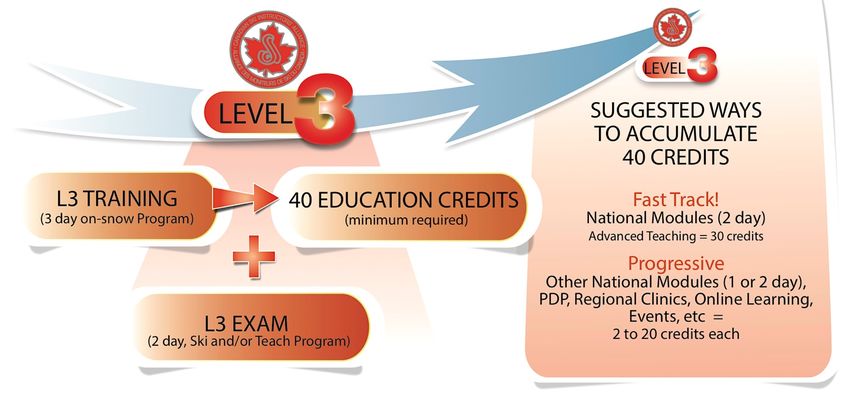
• Both the Level 3 Training Program and the “Level 3 eprep” Online Module must be
completed and the Education credits requirements must be fulfilled before attending the L3
Exam.
• Level 2 Instructors have already acquired at least 10 credits through the Certification’s
requirements.
• Exam Candidates, including first-time participants, have the option to attend only the Ski or
Teach Exam.
• Members needing a Re-test on either component (Ski or Teach) can re-attend the Exam at
any time, without ever having to re-attend the L3 Training Program.
• The process of Certification is not limited in time.
3 Level 3 Training Candidate GuideLevel 3 Training Schedule
The Level 3 Training Program provides training in advanced skiing and teaching skills, with
development strategies and recommendations for Level 3 Exams.
DAY 1
Registration
On-Snow (4.5 hours)
⟩ Ski improvement at advanced performance level
o Establishing Technical Reference points for advanced skiing
o Exposure to varied terrain
o Individual development objectives
Indoor (1 hour)
⟩ Group Debrief with video from the day
DAY 2
On-Snow (4.5 hours)
⟩ Development of advanced teaching skills
o Practice teaching with Course Conductor facilitation, based on technical priorities
of Day 1
Decision Making Process
Indoor (45 min)
⟩ Group Debrief
⟩ L3 Standards and Exams workshop
DAY 3
On-Snow (4 hours)
⟩ Ski-Off and individual strategies review
o Review individual development strategies with skill / drill practice
o Review Ski-Off Runs and terrain
Indoor (2 hours)
⟩ One-on-One Assessments and Exam recommendations (approx. 15 min per Candidate)
4 Level 3 Training Candidate GuideDay 1 Overview
Interpreting the charts in this section:
Performance Criteria define the standard for the Evaluation Process.
Learning Objectives are the goals for each session and align with the Performance Criteria.
By the end of the day, you will have been exposed to the following:
On-Snow - AM / PM – Ski Improvement (Canadian Ski Teaching Manual, Chapter 6)
Performance Criteria
7. Skiing Objectives
8. Technique
Learning Objectives Performance
Criteria
7 8
Establish Technical Reference for advanced skiing X X
Exposure to varied terrain X
Individual development objectives X X
Indoor - PM - Group Debrief with video from the day
Reading assignment (CSIA Manual):
o Reflective Learning - Chapter 2
o Motor Skills Development – Chapter 5
o Technical Reference – Chapter 6
5 Level 3 Training Candidate GuideDay 2 Overview
By the end of the day, you will have been exposed to the following:
On-Snow - AM – Advanced Teaching Skills (Canadian Ski Teaching Manual, Chapter 2, 3, 5)
Performance Criteria
1. Learning Contract
2. Situation
3. Skiing Objectives
5. Reflective Learning
Learning Objectives Performance Criteria
1 2 3 5
Reflective Learning X
Learning Contract - student X
Practice Teaching – situation/skiing objectives X X
On-Snow - PM – Advanced Teaching Skills (Canadian Ski Teaching Manual, Chapter 2, 3, 5)
Performance Criteria
4. Motor Skill Development
6. Demonstrations
Learning Objectives Performance Criteria
Advanced Teaching 4 6
Practice Teaching – Motor Skill Development X
Demonstration development X
Indoor - PM
⟩ Group Debrief
⟩ L3 Standards and Exams workshop
6 Level 3 Training Candidate GuideDay 3 Overview
Day 3 reviews all of the Performance Criteria and focuses on individual development strategies. Typical Ski-Off
terrain will be used.
On-Snow - AM / PM – Ski improvement and Individual strategies review
Indoor - PM - One-on-One Assessments and Exam recommendations
7 Level 3 Training Candidate GuideLevel 3 Standard and Testing
Level 3 Exam Review
After completing the Level 3 Training Program and the Level 3 eprep Online Module, and
having accumulated a total of 40 Education credits or more, the participants can attend a
scheduled 2-day Exam with no time limitation. The Exams are scheduled over two
consecutive days; the Teaching Exam being held on Day 1 and the Ski-Off being held on
Day 2. Candidates have the option of challenging only one of the two Exams, but must
pass both Skiing and Teaching aspects to receive the full Level 3 Certification.
Re-test on Skiing or Teaching
Candidates who fail Skiing or Teaching can be re-tested on that portion with no time
limitation. Candidates passing one portion will never have to be re-tested for that portion.
EXAMS SCHEDULE
DAY 1
AM - Warm-up and terrain review
- Teaching Exam
PM - Teaching Exam
DAY 2
AM - Warm-up and terrain review
- Ski-Off
PM - Ski-Off
- Results Presentation
This schedule may be adjusted in consideration of conditions, weather and facilities.
8 Level 3 Training Candidate Guide SKIING EVALUATION:
Skiing is evaluated in a Ski-Off. The Ski-Off is reviewed during the Course and each Candidate
will be given clear directions for Exam preparation. Adequate time must be devoted to skiing
preparation and it is recommended to seek coaching from a current Level 4 during the winter
training period.
• Brief review of the Ski-Off Runs during the warm-up
• Ski-Off Runs: Intermediate Parallel Turns, Advanced Parallel Turns, Advanced Short
Radius Turns and a Bump Run
• Candidates will have 2 runs, with the best run to be counted
• Course Conductors determine the terrain and length for each run
• Run Criteria will be explained by the Course Conductors
Marking System: Each run is marked on 10 points and the passing mark is 6 out of 10
Passing Criteria.
o Obtain an overall of 60 % average
o Must pass 3 runs out of 4
o Must pass the Bump Run
o Must pass the Intermediate Parallel Run
Each Ski-Off Run has an objective that relates to speed, turn shape and level of ski
performance. Within all Ski-Off Runs, the CSIA technique is to be used to achieve these
objectives. Both the objective and technique are considered in determining individual
marks. The scale works as follows (read the mark of 6 first)
8 or higher – precise execution of run objective AND precise technical execution. Example: can
effectively control line in the bumps and maintain fast/advanced speeds AND is precise technically, well above the
Level 3 Standard
7 – precise execution of run objective OR precise technical execution. Example: skier is able to
control turn shape but at a higher speed and level of performance OR timing and coordination is more precise
resulting in a more dynamic run
6 – achieves the objective of the run AND uses appropriate technique
5 – achieves the objective of the run, but does not use appropriate technique OR uses
appropriate technique but does not achieve the objective of the run. Example: correct speed and turn
shape, however, shows rotation OR good technique, but speed is too slow or too fast for the objective of the run
4 – fails to achieve the objective of the run AND does not demonstrate appropriate technique
Example: rotation affects the ability to maintain speed control and turn shape
3 or lower – does not achieve the run objective AND technique is well below the L3 Standard
Example: basic skiing skills are deficient such as stance and balance, therefore, speed, turn shape and ski
performance are greatly affected
9 Level 3 Training Candidate Guide TEACHING EVALUATION:
• The Teaching Exam is 60 minutes in duration, including chairlift time
• Candidates must teach to a minimum of 4 students and a maximum of 6
• The choice of terrain is at the discretion of the Candidates. However, if time or terrain
availability is a problem, the Course Conductor may help direct terrain choice
• Each Candidate will teach an advanced lesson, based one of these themes:
o Advanced Ski Improvement
o Bumps
• Teaching Assignments are given the morning of the Exam
• Teaching order is determined by assignments and terrain at the discretion of the Course
Conductor
Marking System: NI = Needs Improvement, ME = Meets Expectations
10 Level 3 Training Candidate GuideTEACHING ASSESSMENT
Learning
Performance Criteria
Outcomes
Decision Making Process
In an Advanced
Lesson teaching 1. Learning Contract:
peers, apply the • Identify students’ experience
CSIA Decision • Establish achievable goals
• Assess students’ physical condition and psychological state
Making Process • Apply two-way communications
• Provide individual feedback
• Use debriefings
2. Situation:
• Use safe teaching practices
• Apply class control tactics
• Select terrain to assist development
• Adapt to snow and weather conditions
• Develop appropriate lesson pace
3. Skiing Objective:
• Develop Skiing Objectives based on assessment
• Use Skiing Objectives based on the situation
• Choose Skiing Objective related to Technical Reference
4. Motor Skill Development:
• Identify area for development using the Technical Reference
• Use task based on technical assessment
• Use task based on the situation
• Apply knowledge of Cause and Effect
• Identify time on task
• Select complexity or simplicity of task
5. Reflective Learning
Task:
• Use concrete tasks for learning
Reflect:
• Initiate reflection on the task
Understand:
• Use debriefings to compare objectives and outcomes
Vary:
• Adjust one variable at a time relative to Skiing Objective
6. Demonstrations
• Adapt to skill level of student
• Apply turn shape
• Adapt to terrain
• Apply CSIA technical principles
11 Level 3 Training Candidate GuideTECHNICAL ASSESSMENT
Learning
Performance Criteria
Outcomes
Demonstrate General Performance Criteria for Advanced Parallel on groomed black
effectively from terrain:
intermediate to 7. Objective:
advanced level • Maintain advanced speeds
• Blend skills to achieve a steered arc
• Maintain consistent turn shape relative to speed and terrain
8. Technique:
• Use of all joints helps maintain balance, providing the ability to
manage forces acting on the ski and skier
• Turning is led by the lower body and the ski design
• Managing upper and lower body separation allows for angulation to
provide grip
• Coordinated movement patterns direct the forces acting on the skis
and the momentum of the skier from turn to turn
Ski-Off Run Objectives: (maintaining technical Performance Criteria
above)
Intermediate Parallel Turns:
• Symmetrical/rhythmical parallel turns on intermediate terrain
(blue/black)
• Maintains intermediate speeds
• Consistent medium-sized turns relative to speed and terrain
• Steering adjusted to terrain and speed
Advanced Short Radius:
• Controlled round short turns on advanced (black) terrain
• Maintain consistent speed
• Maintain rhythm and symmetry for the entire run
• Maintain a consistent and rhythmical pole plant
Bumps:
• Demonstrate control in advanced varied terrain (moderate black terrain)
• Adjust technique to terrain and snow conditions
• Show the ability to choose a line in varied terrain
• Maintain snow contact the majority of the run
Advanced Parallel:
• Linked and efficient parallel turns executed at advanced speed on
groomed advanced (blue/black) terrain
• Manage medium to long radius turn shape relative to speed and terrain
• Utilize ski design to assist in a steered arc
12 Level 3 Training Candidate Guide13 Level 3 Training Candidate Guide
14 Level 3 Training Candidate Guide
15 Level 3 Training Candidate Guide
You can also read


