Living Structure down to earth and up to heaven - Coordinates
←
→
Page content transcription
If your browser does not render page correctly, please read the page content below
RNI: DELENG/2005/15153                                                              No: DL(E)-01/5079/20-22
                 Publication: 15th of every month                    Licensed to post without pre-payment    U(E) 28/2020-22
                 Posting: 19th/20th of every month at NDPSO                                                           Rs.150
ISSN 0973-2136

                 Volume XVI, Issue 3, March 2020              THE MONTHLY MAGAZINE ON POSITIONING, NAVIGATION AND BEYOND

                              Living Structure
                                        down to earth and up to heaven

                 Challenges for validation of automated driving for GNSS
i50 GNSS
Versatile and easy-to-use

Exclusive GNSS
technology to improve
your productivity
in harsh environments

Turnkey solution with
field proven Landstar7
survey software

                            WWW.CHCNAV.COM
Incorporating:

                                                       BUSINESS 2020
                                                       LONDON • UK 20 – 21 MAY

   Keep your finger on the pulse
      of the geospatial industry
                                         GEO Business is the UK’s largest geospatial
                                           event designed for everyone involved in
                                             the gathering, storing, processing and
                                                 delivery of geospatial information.

                                                           GeoBusinessShow.com

                                                                REGISTER
                                                                NOW FOR
                                                                  FREE

Exhibition   •   Keynote       •     Seminars          •   Showcases   •       Networking

                               In collaboration with                       Part of
COLOPHON AND CONTENTS

    In this issue
    Coordinates Volume               16, Issue 3, March 2020

    Articles
    Challenges for validation of automated driving for GNSS Martin Grzebellus 6 Living Structure
    Down to Earth and Up to Heaven: Christopher Alexander Bin Jiang 10 Smart total stations in land
    surveying activity Glenford V. D’Souza 29

    Columns
    My Coordinates Editorial Old Coordinates 30 Conference Fourteenth meeting of the International Committee on
    Global Navigation Satellite Systems 31 News GIS 35 LBS 38 GNSS 39 UAV 41 Imaging 42 Industry 43                                            Mark your calendar
    May 2020 to November 2020

    This issue has been made possible by the support and good wishes of the following individuals and companies
    Bin Jiang, Glenford V. D’Souza and Martin Grzebellus; CHC, Javad, Labsat, Riegl, SBG System, and many others.

 Mailing Address                                    Coordinates is an initiative of CMPL that aims to broaden the        Printed and published by Sanjay Malaviya on behalf of
 A 002, Mansara Apartments                          scope of positioning, navigation and related technologies.           Coordinates Media Pvt Ltd
 C 9, Vasundhara Enclave                            CMPL does not neccesarily subscribe to the views expressed           Published at A 002 Mansara Apartments, Vasundhara
 Delhi 110 096, India.                              by the authors in this magazine and may not be held liable for       Enclave, Delhi 110096, India.
 Phones +91 11 42153861, 98102 33422, 98107 24567   any losses caused directly or indirectly due to the information      Printed at Thomson Press (India) Ltd, Mathura Road,
                                                    provided herein. © CMPL, 2020. Reprinting with permission is         Faridabad, India
 Email                                              encouraged; contact the editor for details.
 [information] talktous@mycoordinates.org                                                                                Editor Bal Krishna
 [editorial] bal@mycoordinates.org                  Annual subscription (12 issues)                                      Owner Coordinates Media Pvt Ltd (CMPL)
 [advertising] sam@mycoordinates.org                [India] Rs.1,800 [Overseas] US$100
 [subscriptions] iwant@mycoordinates.org
 Web www.mycoordinates.org                                                                                            This issue of Coordinates is of 48 pages, including cover.

4 | Coordinates March 2020
MYCOORDINATES

                                                  Novel Scare
                                              COVID-19 has spread

                                              All across the globe, almost.

                                              With over 4000 death counts

                                              And over 1,27,000 infected,

                                              Countries struggle to contain it.

                                              The World Health Organization declares it a pandemic.=

                                              This is unprecedented.

                                              Along with the health crisis, the world economy is in a quandary.

                                              A time for self-isolation, if needed

                                              But to collaborate and support each other, surely.

                                              A global crisis looms large.

                                              Humankind is challenged.

                                                                                                             Bal Krishna, Editor
                                                                                                         bal@mycoordinates.org

  ADVISORS Naser El-Sheimy PEng, CRC Professor, Department of Geomatics Engineering, The University of Calgary Canada, George
  Cho Professor in GIS and the Law, University of Canberra, Australia, Professor Abbas Rajabifard Director, Centre for SDI and Land
  Administration, University of Melbourne, Australia, Luiz Paulo Souto Fortes PhD Associate Professor, University of State of Rio Janeiro
  (UERJ), Brazil, John Hannah Professor, School of Surveying, University of Otago, New Zealand

                                                                                                                  Coordinates March 2020 | 5
GNSS

   Challenges for validation of
   automated driving for GNSS
   Automotive industry will deploy vehicles equipped for automated driving. One main challenge at the
   time being is the validation of the intended functionality with required level of safety. The absolute
   position as a prerequisite today only is provided via GNSS for which no trace back to SI units exists.
   Therefore, today everybody is looking for a reliable way to assure integrity of provided position.

                       Martin Grzebellus   Automated driving                             the highest level all driving functions are
                       Managing Director                                                 performed by the system fully automatic.
                       NavCert GmbH        The automation in driving as defined
                                           by SAE is categorised by the split            The absolute position of a vehicle can
                                           of responsibility between driver and          only be determined by GNSS. A delta
                                           vehicle and the level of support functions    to the absolute position especially in so-
                                           provided by the vehicle. into six different   called GNSS denied environments may
                                           categories as illustrated in Figure 1.        be determined by auxiliary sensors i.e.
                                                                                         INS, odometer, etc. supporting GNSS.
                                           SAE defined 5 different levels of
                                           automation starting from level 0 with no      For autonomous driving absolute
                                           command of automation to level 5, which       positioning capability with, at least,
                                           represents fully autonomous driving.          lane accuracy and with high integrity
                                           With increasing levels of automation,         in all driving environments is required.
                                           the system is entrusted to substitute the     The required lane accuracy and
                                           human driver incrementally e.g. vehicle       performance integrity in AD are 10 cm-
                                           steering, driving environment perception      level and meter-level, respectively (for
                                           and vehicle fallback operation whereas in     more details see https://inlane.eu).

                                           Figure 1: Levels of automation (SAE, 2016).

6 | Coordinates March 2020
Validation Position Engine                                             is assessed and qualified in respect to the reference position.
                                                                       According to ISO 26262:2015 tools used in the development
All OEMs and tier 1 are developing solution / have developed           process have to be qualified if the tool may cause an error in
solutions which shall be used in safety critical applications.         the final product. As the only reason for using the reference
However worldwide there is no way to assure the proper working         system is the validation of the position engine in according to
of the implemented solutions. One example is Tesla creating the        the ISO 26262:2015, the reference system obviously has a strong
impression via PR that their smart vehicles drive on their own.        impact on the final product. The standard defines 4 levels of tool
Due to this misunderstanding driver share videos how their Tesla       confidence, for the lowest level (TCL1), no confidence is needed
vehicle is driving although they are distracted by reading or even     so a tool qualification is not necessary, and all other levels up
worse other activities. In case of an incident they refer to their     to TCL4 require qualification. The following four qualification
Ts&Cs where in the contrary it is specified that the driver is of      methods are suggested with a fitting to the intended ASIL level
course all the time responsible for the activities of the vehicle      from A to D:
in phases of automated driving and shall have every time the
possibility to control steering wheel and speed of vehicle.            1.   Increased confidence from use
                                                                       2.   Evaluation of the development process
A position engine as depicted in Figure 2 is used for the              3.   Validation of the software tool
determination of the position combining information                    4.   Development in compliance with a safety standard
form GNSS supported by other sensors like IMU
and additional information as correction data.                         The available reference equipment is a commercial off-
                                                                       the-shelf product typically introduced to the market
For the development of safety critical components, the standard        recently. Therefore method 1, 2 and 4 will not be applicable
ISO 26262:2015 is used in the automotive industry and                  and the only alternative left is the validation.
quite recently complemented by the ISO PAS 21448:2019.
Looking to the modules of the position engine, all might be             Since quite some years various methods for assessment
developed from scratch according to the specific requirements           have been experienced, however so far nobody really was
starting with the definition of safety goals except the GNSS            successful. Looking to the task, it’s obvious why this approach
correction service as this exists since quite some time.                is very complex. In principle the reference system is also a
                                                                        position engine according to Figure 2 but with expected better
                                                                                               performance like increased accuracy. In
                                                                                               the past one approach was to construct
                                                                                               tracks for which the trajectory could
                                                                                               be determined with high accuracy. The
                                                                                               device under test was fixed to a wagon
                                                                                               driving on the track. By repeating the
                                                                                               tests, one could statistically assess
                                                                                               accuracy of the tested position engine
                                                                                               or reference system. However, there
                                                                                               was a sever disadvantage preventing the
                                                Figure 2: Position Engine                      commercialization of this approach. The
                                                                                               trajectory was reflecting the capabilities
                                                                                               required for rail not for automotive
Therefore special attention has to be given how to
integrate correction data into the development and                        For autonomous driving absolute
validation process according to ISO 26262:2015.
                                                                         positioning capability with, at least,
Determination of ground truth                                            lane accuracy and with high integrity
For the evaluation of the functionality of the sensors, one main         in all driving environments is required.
challenge is to determine the ground truth of the position of the
vehicle in dynamic scenarios. Here typically expensive GNSS              The required lane accuracy and
equipment with IMU and other sensors with a higher accuracy
than the position engine under test is used as a reference system.       performance integrity in AD are 10 cm-
The position determined by the reference system is regarded as
ground truth and the position determined by the position engine          level and meter-level, respectively

                                                                                                                    Coordinates March 2020 | 7
The validation of the position engine can                           method for validation. The laboratory has to provide evidence
                                                                         during accreditation and in regular internal and external audits
     be done twofold, first driving in real world                        that it is experienced in selection, verification and validation
                                                                         of methodologies assuring traceability and validity of results.
     for a huge amount of time providing                                 Here special attention is required in the determination of the
                                                                         measurement uncertainty with an in-depth analysis of impacting
     evidence on error behavior and second,                              factors, quantification and respective mathematical analysis.

     in a simulation environment focusing                                The validation of measurement equipment is valid only for
                                                                         a dedicated period same as the calibration. Thereafter the
     on behavior in challenging situations                               validation has to be repeated by the accredited laboratory.

   and as such the potential limits of the sensors could not be          Validation of correction services
   assessed nor critical scenarios for road approximated.
                                                                         The usage of correction service implies same impact to the
                                                                         position engine as the determination of the ground truth. If
   Qualification of tools                                                the provided information as correction service is incorrect
                                                                         or misleading the intended accuracy of the position engine
   In aviation since quite some years the assessment of GNSS             cannot be achieved and will result into an error. For that reason,
   receiver is done with laser trackers. The position engine is          the correction service itself has to be validated as well. For
   installed in an airplane to which a mirror is attached. On ground     SBAS a certification for aviation has been done some years
   there are laser stations automatically following the mirror           ago for EGNOS assessing the respective service provider
   attached to the airplane. By this in a limited space but under        ESSP in France with the result to be a certified air navigation
   real world conditions the airplane is traceable, and the trajectory   service provider. Therefore, the correction service provided by
   can be determined as ground truth to which the calculated             ESSP may be used in aviation in safety critical applications.
   position of the position engine in the airplane is compared.          There are ideas to certify as well the new services of Galileo
                                                                         the High Accuracy Service (HAS) and/or the Commercial
   A similar approach is nowadays feasible with robot                    Authentication Service (CAS) in the context of automotive.
   stations for vehicles. The robot stations may be installed
   in testbed suitable for required driving maneuvers with               For service provider offering correction service today there is
   respect to speed and curve radiuses. Also, this tool requires         already an assessment in place resulting into a certificate by TÜV
   prior use validation. However, as not any technology                  SÜD. The real time accuracy is validated and the process of
   of the position engine is used, the assessment can be                 offering the service assessed. Due to this approach one can derive
   done in a different way as depicted in the following.                 that the offered service will work as specified for the lifetime of
                                                                         the certificate. The certificate is issued always for a period of one
   A laboratory accredited according to ISO 17025:2017 shall             year with a recertification in year 2 and year 3. The respective
   use only measurement equipment traceable back to SI units             certification mark is depicted in Figure 3. Latest in year 4 a
   calibrated when used. In cases this is not feasible as in the         complete new certification is required even if nothing changed.
   GNSS environment, the laboratory shall implement its own

                                                                                     Validation of position engine

                                                                                     The validation of the position engine can be
                                                                                     done twofold, first driving in real world for a
                                                                                     huge amount of time providing evidence on error
                                                                                     behavior and second, in a simulation environment
                                                                                     focusing on behavior in challenging situations.
                                                                                     As a first step, an analysis has to be done
                                                                                     identifying critical scenarios. Then the critical
                                                                                     scenarios may be mapped to real world scenarios
                                                                                     but mainly implemented in a simulation.

                                                                                     For the simulation the same challenge applies as
   Figure 3: Certification Mark                                                      for the validation of the reference system. All tools

8 | Coordinates March 2020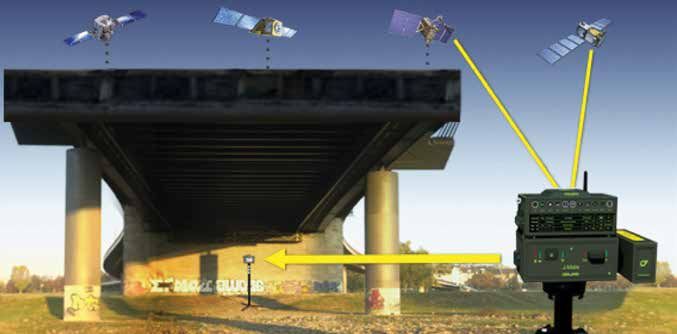
All components developed for safety            have to be qualified according IS26262:2015
                                                prior usage. This applies for the used simulation
 critical applications like automated driving   environment including hard- and software.
                                                As the environment cannot be calibrated, a
 require an intensive testing according to      validation has to be developed according to
                                                a standard like ISO17025:2018. Based on
 ISO 26262. The main challenge so far was       the specified KPIs of the position engine the
                                                respective error impact will be analysed. Then
 the qualification of the required tools        the measurement uncertainty has to be calculated
                                                to determine if the intended methodology fulfills
                                                all specific requirements and may be used.

                                                Conclusion

                                                All components developed for safety critical
                                                applications like automated driving require an
                                                intensive testing according to ISO 26262. The
                                                main challenge so far was the qualification of the
                                                required tools. Here now a feasible way forward
                                                exists for qualification of reference systems used
                                                for determination of ground truth, for the correction
                                                service intended to be used as an improvement
                                                to the GNSS determined position in the position
                                                engine and finally for the simulation environment
Figure 4: Critical Scenario real world          by accredited laboratories for GNSS.
GIS

   Living structure down to
   earth and up to heaven:
   Christopher Alexander
   This paper is intended to defend living structure as a physical phenomenon, and a mathematical
   concept, clarifying some common questions and misgivings surrounding Alexander’s design thoughts,
   such as the objective or structural nature of beauty, building styles advocated by Alexander, and
   mysterious nature of his concepts. This paper helps people understand why beautiful things are
   beautiful, and why ugly things are ugly, through the underlying living structure. Living structure is to
   beauty what temperature is to warmness. We present here the first part of the paper or the down to
   earth part. The second part or the up to heaven and concluding part will be published in April issue.

                       Bin Jiang                  “All of my life I’ve spent trying to learn   make beautiful things and environments.
                       Professor, Faculty         how to produce living structure in           Living structure is not only empirical,
                       of Engineering and         the world. That means towns, streets,        but also philosophical and visionary,
                       Sustainable Development,   buildings, rooms, gardens, places            enabling us to see the world and space
                       Division of GIScience      which are themselves living or alive…        in more meaningful ways. This paper is
                       University of Gävle,       depending on who you talk to, they’d         intended to defend living structure as a
                       Gävle, Sweden              say, ‘Well, this stuff Alexander’s been      physical phenomenon, and a mathematical
                                                  discovering is a lot of nonsense. There is   concept, clarifying some common
                                                  no such thing as objectivity about life or   questions and misgivings surrounding
                                                  quality.’ ... They are simply mistaken.”     Alexander’s design thoughts, such as the
                                                                                               objective or structural nature of beauty,
                                                  Christopher Alexander (1999)                 building styles advocated by Alexander,
                                                                                               and mysterious nature of his concepts.
                                                                                               For this purpose, we first illustrate
                                                  Abstract                                     living structure – essentially organized
                                                                                               complexity, as advocated by the late Jane
                                                  Discovered by Christopher Alexander,         Jacobs (1916–2006) – that is governed
                                                  living structure is a physical phenomenon,   by two fundamental laws (scaling law
                                                  through which the quality of the built       and Tobler’s law), and generated in
                                                  environment or artifacts can be judged       some step by step fashion by two design
                                                  objectively. It has two distinguishing       principles (differentiation and adaptation)
                                                  properties just like a tree: “far more       through the 15 structural properties.
                                                  small things than large ones” across all     We then verify why living structure is
                                                  scales from the smallest to the largest,     primarily empirical, drawing evidence
                                                  and “more or less similar things” on each    from Alexander’s own work, as well as
                                                  scale. As a physical phenomenon, and         our case studies applied to the Earth’s
                                                  mathematical concept, living structure       surface including cities, streets, and
                                                  is essentially empirical, discovered and     buildings, and two logos. Before reaching
                                                  developed from miniscule observation in      conclusions, we concentrate on the most
                                                  nature- and human-made things, and it        mysterious part of Alexander’s work – the
                                                  affects our daily lives in some practical    luminous ground or the hypothesized “I”
                                                  ways, such as where to put a table or        – as a substance that pervasively exists
                                                  a flower vase in a room, helping us to       everywhere, in space and matter including

10 | Coordinates March 2020
our bodies, in order to make better beautiful or alive structurally, regardless touching the fundamental issues of what
sense of living structure in our minds. of whether it is alive biologically. the universe constitutes, and where our
consciousness comes from. He conceived
Based on the notion of “far more smalls and developed – from the phenomenon
1. Introduction than larges”, a simple shape that lacks of living structure – a third view of
of detailed smaller structures is neither space, and a new cosmology in which we
If the life’s work of Alexander (2002– beautiful nor alive. This is for the same human beings – not only the body but
2005) – The Nature of Order – had to reason why sans-serif fonts are less also the mind – are part of the universe
be summarized in one word, “beauty”, beautiful or less alive than serif ones. For (Alexander 2002–2005, Volume 4, c.f.
“life” and “wholeness” would be the three example, the font “I” (when shown as a Section 5 for a more detailed discussion).
top candidates. If allowed two words, sans-serif) is not a living structure (one The third view of space states that space
it would be “living structure”. What vertical line only) without “far more smalls is neither lifeless nor neutral, but a living
do these terms really refer to? Instead than larges”, whereas the font “I”(when structure capable of being more living or
of getting into their detailed meanings shown as a serif) is a relatively living less living. This new view of space sets
(see Section 2), let us use an analogue structure (one vertical line and two little a clear difference from two traditional
to clarify them first. If wholeness were bars) with “far more smalls than larges”. views of space: absolute space by Isaac
compared to temperature, then beauty or The difference between the non-living and Newton (1642–1727) and relational space
life would be like the feeling of warmness living fonts may be hardly sensed when by Gottfried Wilhelm Leibniz (1646–
or coldness. The higher the temperature, the two fonts are too small, in particular 1716), both of which are framed under
the warmer one feels, and the lower the when the letter’s meaning is focused on. the mechanistic world view of Descartes
temperature, the colder one feels. The As a matter of fact, serif fonts in general (1637, 1954). This new view of space
higher the wholeness, the more beautiful are objectively more beautiful than sans- constitutes part of the new cosmology
or the more life one feels; the lower serif ones. It is based on this kind of that unifies the physical world and our
the wholeness, the less beautiful or the structural fact – actually the phenomenon inner world as a coherent whole.
less life one feels. Therefore, a thing or of living structure – that Alexander
structure that exhibits a high degree of (2002–2005) established a scientific Despite a large body of literature on
wholeness is called a living structure. foundation of architecture. Unfortunately, or inspired by Alexander’s work (e.g.,
Opposite to living structure is non-living the phenomenon of living structure has not Gabriel 1998, Salingaros 2006, Quillien
(or dead) structure. There is a wide range yet been well accepted by the scientific 2008, Jiang and Sui 2014, Leitner 2015,
between the living and the dead, so living community as a fact, but been sidelined Wania 2016, Mehaffy 2017, Guttmann et
is always to some degree or other, just as as a human taste or personal preferences. al. 2019, Jiang 2019a), living structure has
the feeling of warmness relates to a range This situation constitutes a major not yet been well recognized as a physical
of temperatures. Living structure is what motivation of this paper. Human history phenomenon or mathematical concept,
Alexander (2002–2005) discovered and is full of many great builders or architects for people to understand the objective or
further pursued, and it is independent who made great buildings, but few of them structural nature of beauty. This paper is
of any style or culture from for example really made it clear – or even intended to an attempt to fill this gap, by setting up
Indonesia, Japan, Russia, Africa, Turkey, think about – how to make great buildings a dialogue with those who are skeptical
Iran, India, or China. Having said that, and why the great buildings are great. about Alexander’s design thoughts. It is
Alexander has no particular style of intended to clarify some doubts in order
buildings, contrary to what his rivals or As an architect who was initially trained for skeptics to understand three main
critics tend to think. Or to put it different, in science, Alexander wanted to make points. First, the essence of beauty is
living structure is a living style, just as beautiful buildings, and he wanted structural or objective, lying in the notion
nature itself, being able to trigger a sense to know in particular why beautiful of “far more smalls than larges”, which
of belonging or well-being or healing buildings are beautiful. His classic work accounts for a majority of our sense of
in people who are exposed to it. To on the pattern language (Alexander et al. feeling on beauty. There is a clear sign
know whether a thing or space exhibits 1977) is widely read by ordinary people that beauty is beginning to be accepted
living structure, one can simply examine looking to make beautiful rooms, houses as an objective concept in the literature
whether it possesses “far more smalls than and gardens, and to facilitate their daily of philosophy (Scruton 2009). Second,
larges” across all scales ranging from the lives, for example, where to put a lamp the phenomenon of living structure is
smallest to the largest. For example, at the or a flower vase, and how to lay a table universal and pervasive, not only in
multiple levels of scale or in a recursive cloth. His design thoughts are therefore nature but also in what we made and built
manner – an entire tree, its branches, very practical – down-to-earth – and across all cultures, ethics, and religions,
and its leaves (in terms of the detailed his research is essentially empirical. On involving ancient buildings and cities, as
texture) – there are always “far more the other hand, his research is deeply well as ancient carpets and other artifacts.
smalls than larges”. Therefore, a tree is philosophical and visionary, up to heaven, Thus, there is no so-called Alexander’s
Coordinates March 2020 | 11style of architecture; if there is, it is the Table 1: The 15 structural properties of wholeness
living structure (just as nature itself), Levels of scale Good shape Roughness
which is able to trigger a sense of beauty Strong centers Local symmetries Echoes
or life in the human mind. Third, there is Thick boundaries Deep interlock and ambiguity The void
no mystery at all regarding the “quality Alternating repetition Contrast Simplicity and inner calm
without a name” (Alexander 1979), which Positive space Gradients Not separateness
is actually living structure, yet the mystery
of a non-material world view remains.
The remainder of this paper is structured
as follows. Section 2 introduces and
illustrates the living structure as a physical
phenomenon, using a sketch by Alexander,
in terms of its governing laws (scaling law
and Tobler’s law), its design principles
(differentiation and adaptation), and its
15 structural properties (Table 1). Section
3 argues why living structure is scientific
or empirical by drawing evidence from
Alexander’s own works such as the pattern
language. Section 4 further presents
case studies to demonstrate that living
structure is objective or structural rather
than just a matter of opinion. Section 5
discusses the metaphysical aspects in
order to make better sense of the living
structure in terms of why living structure
evokes a sense of beauty or life in our
minds. The paper concludes with a few
remarks and suggestions for future work.
Figure 1: (Color online) A living (6a and 6b) versus a less-living structure (6c and 6d)
(Note: The living structure is evolved as a product of living process, while the less-living structure
2. Living structure: Its comes from a simple drawing. The living structure is well differentiated and well adapted, not
governing laws and only among those in the figure, but also among those in the ground, whereas the less-living
design principles, and 15 structure looks like an assembly from pre-determined pieces, which are not well adapted to each
structural properties other. For example, the four dots outside the square in 6c and 6d are less integrated into the whole
than those in 6a and 6b. The coloring indicates the degree of wholeness, with blues showing
The four terms mentioned at the outset the lowest, red showing the highest, and other colors in between the lowest and highest.)
of this paper can be placed into two
categories − wholeness and living (Alexander 1979). The term wholeness is structure, demonstrating many of the 15
structure in the first group, and beauty and also a key concept in Gestalt psychology properties (Table 1). It consists of at least
life in the second group − representing (Köhler 1947), in quantum physics (Bohm 19 different sized mutually overlapping,
the outer and inner worlds, respectively. 1980), and in many other religious and nested shapes or centers in Alexander’s
The central concept among these four philosophical contexts. Semantically, terms, namely the four outmost black dots,
is wholeness, which can be defined there may be some overlap across these the square, the big circle, the eight tiny
mathematically (Alexander 2002–2005, different fields, but Alexander’s wholeness triangles, the four small circles, and the
Jiang 2015b). It exists pervasively in our is unique with its distinguishing features. tiny dot in the middle. Among many of the
surroundings; in an ornament, in a room, It is not only a static structure, but also a other properties, the first property of the
in a building, in a garden, and in a city. It dynamic process, through which living levels of scale is the most distinguishing
was previously referred to by Alexander as structure emerges. In the next part of this one. The sketch is with six levels of scale,
the “quality without a name”: “a central section, we will use a sketch by Alexander indicated by the six colors with red being
quality which is the root criterion of life (2002–2005) (6a in Figure 1) to introduce the highest, blues being the lowest, and
and spirit in man, a town, a building, or and illustrate living structure or wholeness. other colors in between (6b in Figure 1).
a wilderness. This quality is objective It should be noted the six levels of scale is
and precise, but it cannot be named” The sketch shows the evolution of a living not in terms of their sizes, but the supports
12 | Coordinates March 2020From a design or dynamic point of view, a space, or 1970), probably except for the property
of “not separateness”. Tobler’s law,
structure is continuously differentiated toward scaling which is commonly called the first law
of geography, states that “everything is
hierarchy of “far more smalls than larges”. Actually, related to everything else, but near things
are more related than distant things”.
these two laws are largely statistical, which does not Essentially, Tobler’s law is complementary
to – rather than contradictory to – scaling
guarantee living structure. To make the structure really law (Table 2), indicating that on each
scale, centers are “more or less similar”.
living or beautiful, we must consider geometric aspects. It is important to stress that centers that
are “more or less similar” are more
they receive. Overall, there are “far more figure and ground relationship (Rubin beautiful or more alive than centers that
blues than red”, and some in between the 1921), or the fact that the space between are precisely the same. For example,
blues and the red in the colored sketch, the these geometric shapes is not well shaped, in the living structure, the four small
spectral coloring in terms of the degree or not convex like ripening corn, “each circles are “more or less similar”, and
of wholeness of individual centers. For kernel swelling until it meets the others, eight triangles are “more or less similar”,
example, the tiny center in the middle each one having its own positive shape so they are much more living than if
has the highest degree because it receives caused by its growth as a cell from the they were precisely the same in size,
many supports from other centers. The inside” (Alexander 2002–2005). Second, as shown in the less-living structure.
notion of “far more smalls than larges” the four dots outside the square of the With the perfectly drawn shapes, some
reflects the very first property of living less-living structure are less integrated of the 15 structural properties are no
structure, namely levels of scale (Table into the whole inside the square. This is longer available, such as positive space
1), or “scaling hierarchy” or scaling law because the space outside of square is and roughness, which can be phrased as
(Jiang 2015c). As a reminder, the scaling fully open and therefore lacks a sense of “the perfection of imperfection” (Junker
hierarchy of “far more smalls than larges” belonging for the four dots, as strikingly 1991). These two properties are the most
should be – more correctly – understood shown in the living structure. Third, the important for naturally evolved things,
in a recursive manner, implying that “far less-living structure misses the property of such as cell structures and maize grains.
more smalls than larges” for a whole, for a roughness. Interested readers can compare On the surface, naturally evolving things
sub-whole, and a sub-whole of sub-wholes against the 15 structural properties (Table may look rather rough or irregular, yet
and so on (c.f. the above tree example). 1) to learn why one structure is more they tend to exhibit the essence of natural
The scaling hierarchy of “far more smalls living than the other: the more structural beauty. As for Tobler’s law or the notion
than larges” recurs multiple times rather properties, the more living a structure is. of “more or less similar” on each scale,
than just once, except for some simple we can add another example: a coastline
cases like font “I”. In the living structure, There are two fundamental laws of living with the same degree of complexity as
the recurring happens five times (steps 2–6 structure, scaling law and Tobler’s law, the Koch curve (Koch 1904), with which
in Figure 1), leading to six hierarchical which also underlie the 15 structural things (or segments) are precisely the same
levels. The living structure can be said, properties (Table 1). The first structural at each of scales such as 1/3, 1/9, 1/27 and
more precisely, to be evolved, which property (levels of scale) reflects so on. The coastline at each of its scales
implies that centers are well adapted to scaling law, as elaborated above, while exhibits the property of “more or less
each other as a coherent whole. The living the remaining properties are largely similar” segments rather than precisely
structure is not simply an assembly of a reflection of Tobler’s law (Tobler the same ones, so the coastline is more
pre-existing components. In this regard,
the less-living structure (6c in Figure 1) is Table 2: Scaling law and Tobler’s law of living structure
indeed an assembly of pre-existing units. (Note: These two laws are complementary of – rather than contradictory to –
each other and they recur at different levels of scale of living structure.)
The less-living structure (6c and 6d
in Figure 1) looks smooth, glassy, and Scaling law Tobler’s law
uniform, but it exhibits a lower degree of There are far more small things than large ones There are more or less similar things
wholeness. There are several reasons for across all scales, and available at each scale, and
this, a few of which are highlighted here. the ratio of smalls to larges is disproportional (80/20). the ratio of smalls to larges is closer to proportional (50/50).
First, the less-living structure is created (at Globally, there is no characteristic scale, so exhibiting Locally, there is a characteristic scale, so exhibiting
once) by assembling rather than generated Pareto distribution, or a heavy tailed distribution, Gauss-like distribution,
(step by step) by adaptive design. The lack due to spatial heterogeneity or interdependence, due to spatial homogeneity or dependence,
of adaptation can be clearly seen from indicating complex and non-equilibrium phenomena. indicating simple and equilibrium phenomena.
Coordinates March 2020 | 13natural, more beautiful, or more living than the Koch curve.
From a design or dynamic point of view, a space, or structure
is continuously differentiated toward scaling hierarchy of “far
more smalls than larges”. Actually, these two laws are largely
statistical, which does not guarantee living structure. To make the
structure really living or beautiful, we must consider geometric
aspects. This is the idea of adaptation: on each level, things
should be “more or less similar”, or nearby things should be
“more or less similar”. Note that “nearby” is usually referred
to in a geometrical distance, but a topological distance is better Figure 2: The mouse foot as a living structure emerging from day 11 to
in many instances. For example, my neighbor is defined within 15 (Alexander 2005)
a certain geometric distance, but an airport’s neighbor is better (Note: Every step is based on the previous step for enhancing
defined in terms of topological distance of flight connections. the degree of wholeness. Apparently, the number of centers
My neighbor’s house should look “more or less similar” (in size induced is increased in the course of growth from day 13 to 15.)
and shape) to my house, whereas Heathrow Airport should look
“more or less similar” (in size or capacity) to the Paris Charles
De Gaulles Airport rather than the Gatwick Airport, because
there is no flight between the Heathrow and the Gatwick. Along
these two laws, there are two design principles: differentiation
and adaptation. The living structure in Figure 1 is continuously
differentiated to reach the status of living structure.
It is important to realize – as Alexander noted repeatedly – that
the evolution process is not simply about adding new centers;
more correctly, centers are induced by the wholeness. In other
words, it is incorrect to say a whole comes from parts, or a
whole consists of parts; it is the wholeness that induces centers
to generate a coherent whole. It is incorrect to say a flower
consists of petals; it is the flower as a whole that induces petals.
Another design principle is adaptation. On each level of scale,
saying that things are “more or less similar” implies things
are adapted to each other. Again, this notion of “more or less Figure 3: (Color online) Alexander’s miniscule observation on
similar” things should really be understood literally. If things architecture and nature
are exactly the same, it tends to generate a structure that is less (Note: (a) a waist-high shelf, (b) a sunbeam coming
living or less beautiful; see also examples mentioned above into a room, (c) the interlocking blue sky and white
about the coast line versus the Koch curve. It should be noted clouds, and (d) positive space generated between a tree’s
that adaptation could imply things adapted across scales. This branches (Alexander et al. 1977, Alexander 2005).)
is again a good example of Alexander’s observation (see more
in Section 3). Alexander found that, across levels of scale, the nature and to make sure that what he observed from what
scaling ratio should be between 2 and 3; otherwise structure humans built or made also applied to nature. For example,
would look less living (see Figure 4 in Section 3). It is in this the 15 properties of living structure are pervasively seen
sense that Alexander’s living geometry generally surpasses not only in the built environment, but also in nature. In this
fractal geometry (Mandelbrot 1983). Fractal geometry hardly section, we draw evidence from Alexander’s earlier works
cares about whether the generated pattern is beautiful or not, to learn why living structure is scientific and empirical, and
and it only cares about automation of some structure. why this is a correct way of conducting science and art.
Alexander first described the idea of living
3. A commonsense and humane structures in a corner of an English country garden,
approach to architecture where a peach tree grew against a wall:
The phenomenon of living structure exists not only in “The wall runs east to west; the peach tree grows flat against
human-made or -built things, but also in nature. Alexander’s the southern side. The sun shines on the tree and, as it warms
approach to architecture is very much commonsense and the bricks behind the tree, the warm bricks themselves warm
humane. More importantly, he wanted to be inspired by the peaches on the tree. It has a slightly dozy quality. The
14 | Coordinates March 2020The phenomenon of living structure precious Earth’s surface and our surroundings are treated as our
garden, we will be able to reach the true sense of sustainability.
exists not only in human-made or -built
Back in the 1970s, when he was granted a project by National
things, but also in nature. Alexander’s Institute of Mental Health in the United States to investigate on
relationship between the built environment and human well-being,
approach to architecture is very much Alexander and his colleagues started learning what works and
what does not. To a great extent, traditional buildings and artifacts
commonsense and humane. More were his great teacher. His research is not limited to a certain
type, but all types of building – across all cultures and countries –
importantly, he wanted to be inspired that people know, deep in their heart, are universally beautiful or
alive. For example, he noted that a waist-high shelf can be very
by nature and to make sure that what convenient for people to leave things while searching for keys
(Figure 3a), whereas a room with a sunbeam is more uplifting
he observed from what humans built (Figure 3b). Thus, both the shelf and sunbeam are supportive to
human well-being. It is these kinds of materials that constitute
or made also applied to nature. the major content of pattern language (Alexander et al. 1977).
tree, carefully tied to grow flat against the wall; warming Alexander describes his early work on
the bricks; the peaches growing in the sun; the wild grass pattern language as follows:
growing around the roots of the tree, in the angle where the
earth and roots and wall all meet.” (Alexander 1979) “To get my feet on the ground, and to have something solid
that I could be sure of, I started by examining the smallest
In this living structure of the garden corner, there are many particles of functional effect, that I could discern in buildings,
interconnected living centers, such as the wall, the peach tree, with small and sometimes barely significant aspects of the ways
the sun, the bricks, the wild grass, the roots of the tree, and that buildings affect people. My purpose in doing this, was to
even the garden. This is a very good example of Alexander’s focus on the smallest particles of fact that I could be certain
miniscule observations on nature and on our surroundings. of: something that was extraordinarily difficult when faced
with the porridge of mush that then passed for architectural
Considering another example of embryogenesis, a growing mouse theory. In the early years my studies were based on the most
foot is a living structure that comes from continuous differentiation ordinary, miniscule observations about usefulness and the
and adaptation (Figure 2, Alexander 2005). In the course of effect of buildings on the people who lived in them, always
the step-by-step development of the five days, many of the 15 keeping the observations modest, reliable -- small enough and
structural properties can be observed, such as strong centers, thick solid enough so that I could be sure that they were true.
boundaries, gradients, levels of scale, contrast, local symmetries,
and finally, good shape of the whole. Alexander started his research
on architecture – nearly from scratch – not only from traditional
buildings and cities, but also from ancient artifacts such as carpets.
Two of his books have accurately documented his miniscule
observations: one on built environment (Alexander et al. 1977)
– part of the trilogy with Alexander et al. (1975) and Alexander
(1979) – and the other on carpets (Alexander 1993). His dream
was to build beautiful buildings and cities, sharing the same order
or beauty – or spirit – of nature, and his understanding of the kind
of natural beauty that exists in deep structure rather than on the
surface, such as thermal comfort, energy saving or illumination
of surfaces. Nowadays, so-called “green” buildings are not really
green according to Alexander, and “a world built according to
the present sustainable paradigm, the technical sustainability Figure 4: Good or bad as a matter of fact rather than an opinion
paradigm, would be quite a horrible place”. Instead, living (Note: A bad space – (a) too close or (b) too open – is
structures “represent true sustainability, they sustain the heart, transformed into a good space, creating a sense of belonging
and sustain the soul. They sustain the humanness of the person, (Alexander et al. 1977). The scaling ratio is between 2 and
and they sustain the Earth” (Alexander 2004). When nature and 3, as observed by Alexander (2002–2005), tends to lead to a
the built environment are treated as one, when the physical world good design or structure, while the scaling ratios of 1.6 (d) or
and our human’s inner world are treated as one, and when the 10 (e) are either too close or too far apart (Salingaros 2006).)
Coordinates March 2020 | 15Digital technology, particularly GIS, recovery. Taylor (2006), a physicist, found that fractal patterns, if
they are living structures, in nature and art have stress-reducing
now provides enormous data about the effect on people. Because both natural scenes and living structures
are living rather than non-living, I conjecture that, essentially,
Earth’s surface, about cities, buildings, it is living structures that have healing effects on people.
and about artifacts for revealing living Alexander made another important discovery related to the property
of levels of scale or scaling hierarchy. He found that the scaling
structure in our surroundings. ratio between two consecutive scales should be between 2 and 3;
having it too close or too far apart would reduce the goodness or
At first I included very small particulars of functional effect in coherence of space or structure (Figure 4c, d and d). The major
any matter that actually made a practical difference to daily difference between fractal geometry (Mandelbrot 1983) and
life… a shelf besides the door where one could put a packet down Alexander’s work – or living geometry (Alexander et al. 2012) – is
while searching for ones keys, for instance, or the possibility that the former is largely for understanding complexity of fractals.
of a sunbeam coming into a room and falling on the floor. Although fractal geometry is able to create artificial fractals, it
often ends with “pretty pictures, pretty useless” (Mandelbrot
But I quickly realized that some of these details were very much 1983). By contrast, living geometry aims not only to understand
more significant than others. Those like the first (the shelf) tended complexity, but also to create organized complexity, or beautiful
to be pedestrian, even though useful; while those like the second or living structures, which are able to trigger a sense of beauty or
(the sunbeam) were more uplifting, and clearly mattered more life. The creation or the making of living structures is what makes
in some obvious but profound sense. I began to focus on those Alexander (2003) differ from other pioneers in complexity science.
miniscule points which mattered more, in the sense of the second
example. Gradually, then, I was able to pave the way to the The following quote shows how Alexander explained
possibility of seeing how buildings support human well-being – the property of the levels of scale or scaling hierarchy
not so much mechanical or material well-being, but rather the pervasively seen in nature and in what we make and build,
emotional well-being that makes a person feel deeply comfortable and how it triggers the feeling of life in our hearts:
in himself. And as I studied these small effects carefully, gradually
I was led to a conception of wholeness, wellness, and spiritual “I would like to summarize the content of this new kind of
support that might, under ideal circumstances, be present empirical complex in the following way. In any part of what
between buildings and human beings.” (Alexander 2007a) we call nature, or any part of a building, we see, at many
levels of scale, coherent entities or centers, nested in each
Built on this earlier work of pattern language, Alexander realized other, and overlapping each other. These coherent entities
that there are some structural aspects – the 15 properties – that all have, in varying degree, some quality of “life.”
are the most fundamental to human well-being. For example,
the beauty of the blue sky and clouds comes from the property For any given center, this quality of life comes about as a result
of positive space (Figure 3c); not only the white clouds but also of cooperation between the other living centers at several scales,
the blue sky are well shaped. The same positive space appears which surround it, which contain it, and which appear within it.
between a tree’s branches (as Alexander sketched himself The degree of life any one center has, depends directly on the
in Figure 3d). This property of positive space is particularly degree of life that is in its associated centers at these different
important for urban environments. It implies that not only scales. In short, I had identified a kind of wholeness: in which
buildings, but also the space between buildings, should be the life of any given entity depended on the extent to which that
well shaped like convex spaces, as we discussed with the entity had unfolded from the wholeness.” (Alexander 2007a)
living versus less-living structures presented in Figure 1.
In addition to what is summarized above, there are many other
Goodness of space is a matter of fact rather than opinion or empirical findings (Alexander 2007b) that support living structure
personal preferences, and good space has a healing effect, as a physical phenomenon, as well as a well-defined mathematical
sustaining and promoting health. For example, two spaces that concept. In following section, we will carry out some case studies
are either too close or too open are transformed into positive to support living structure is not only a phenomenon and concept,
spaces to which people can develop a sense of belonging (Figure but also can be used to objectively judge quality of things.
4 a and b). This sense of belonging further triggers human well-
being, security, or safety. Well-being or comfort provided by
environments or space is an important factor for human healing. 4. Case studies on living structure
In this regard, Ulrich (1984), an architect, found that the view
from a window may influence a patient’s recovery from surgery; Digital technology, particularly geographic information
that is, natural scenes are better than urban scenes for post-surgery systems, now provides enormous data about the Earth’s surface,
16 | Coordinates March 2020about cities, buildings, and about artifacts for revealing living
structure in our surroundings. This section reports several case
studies for revealing ubiquitous living structure. To make this
paper more readable, we do not use the mathematical model
of wholeness for computing the degree of wholeness (Jiang
2015b, Jiang 2016). Instead, the case studies do no more than
count the number of centers, and compute scaling hierarchy
of “far more small centers than large ones”. Previous studies
have illustrated that this simple way of computing degree of
wholeness is good enough in particular for comparison purposes
(Jiang 2018, Jiang and Ren 2018). Anyone who is able to count
can easily follow the case studies. Before the case studies, it
is necessary to first introduce head/tail breaks (Jiang 2013,
2015a), which helps compute the scaling hierarchy of “far more Figure 5: (Color online) The Earth’s surface as a coherent whole, being
smalls than larges”. The scaling hierarchy is visualized by a a living structure
series of spectrum colors ranging from blue for the lowest to (Note: The living structure – scaling hierarchy of “far more
red for the highest; the more colors, the more levels of scale, smalls than larges” – recurs at different levels of scale of the
the more beautiful or living. Through the coloring, the notion of Earth’s surface from (a) the global scale, (b) the European
“far more smalls than larges” is equivalent to “far more blues scale, (c) the country scale of Italy, (d) the city scale of
than reds”; see Figure 5d, 5e, 6, 7 and 8 for the coloring. Rome, and to (e) the building scale of St. Peter’s Basilica.
For panels (d) and (e), the blue indicates the least-connected
4.1 Head/tail breaks for calculating scaling hierarchy or smallest, red indicates the most-connected or the largest,
and other colors are between the smallest and largest.)
Given a dataset with a heavy tailed distribution or with “far more
smalls than larges”, head/tail breaks can help obtain the inherent
scaling hierarchy by recursively breaking the dataset into two
parts (the head and the tail) around the mean (Jiang 2013, 2015a).
Those greater than the mean are called the head, and those
less than the mean are called the tail. To illustrate the head/tail
breaks, consider the 10 numbers – 1, 1/2, 1/3, …, and 1/10 – that
exactly follow Zipf’s law (1949) as a working example. These 10
numbers are already ranked from the biggest to the smallest. Their
mean is ~0.29, which partitions the 10 numbers into two groups:
the biggest three as the head, and the smallest seven as the tail.
The mean of the biggest three is ~0.61, which further partitions
the largest three into two groups again: the biggest 1 as the head,
and the smallest two 1/2 and 1/3 as the tail. The notion of “far
more smalls than larges” recurs twice, so the scaling hierarchy
is three (or, in other words, three levels of scale). In general, the
head/tail breaks is formatted as a recursive function as follows:
Recursive function Head/tail Breaks:
Rank the input data values from Figure 6: (Color online) The Taj Mahal as a living structure from the
the biggest to the smallest; façade perspective
Compute the mean value of the data (Note: There are “far more small centers than larges” in the
Break the data (around the mean) façade (a) with blue being the smallest, red being the largest,
into the head and the tail; and other colors in between the smallest and largest. This is
// the head for the data values the essence of objective beauty or life. The scaling hierarchy
greater than the mean of “far more smalls than larges” recurs six times; for example,
// the tail for the data values (b), (c), and (d) each indicate an occurrence. The notion of “far
less than the mean more smalls than larges” is more powerful than the concept
while (length(head)/length(data)Figure 9: (Color online) Two UCL logos with different degrees of beauty
or life
(Note: The old logo (the left, panel a and b) is more beautiful
or more living than the new one (the right, panel c and d).
This is because the old one has at least 19 centers with a
scaling hierarchy of 5 by the five colors, whereas the new
Figure 7: The Sydney Opera House as a less-living structure one has a maximum of six centers with a scaling hierarchy
(Note: The scaling hierarchy of “far more smalls than of only 2 by blue and red. Beauty or life is determined
larges” occurs only once (a), and the opera house shows (1) by the number of centers – the more centers, the
monotonic repetition at many levels of scale or on each more beautiful − and (2) by the scaling hierarchy – the
scale (b), (c), (d). The drawing is by Celine Hedin.) more levels of scale, the more beautiful structurally.)
The Earth’s surface is a living structure, seen from the global
scale, down to the continent, to the country, to the city, and to the
building façade, as shown in Figure 5. At every scale, there are
“far more smalls than larges”. For example, at both the global and
continental scales, there are “far more small countries than large
ones” in terms of their population (Figure 5a, 5b). At the country
scale, there are “far more small cities than large ones” (Figure 5c).
At the city scale, there are “far more less-connected streets (by
cold colors) than well-connected ones (by warm colors)”, with
Figure 8: (Color online) Two building façades with different degrees of blues being the least-connected, reds being the most-connected,
life or beauty and other colors between the least- and most-connected. At the
(Note: The façade on the left (a) has a steep scaling hierarchy building scale, the façade of St. Peter’s Basilica contains “far
with six levels of scale (the six colors), whereas the one on more small centers than large ones”. It is important to note that,
the right (b) has a very flat scaling hierarchy with only two across the scales ranging from the globe to the city, there is no
levels of scale (the two colors). More importantly, all blue global symmetry, but there are full of local symmetries that
centers of the right façade are exactly the same without any make the Earth’s surface beautiful or alive. There are “far more
variation. Beauty or life is determined (1) by the number of smalls than larges” globally, yet at each scale, things are “more
centers – the more centers, the more beautiful − and (2) by the or less similar”. It is scaling law and Tobler’s law that govern the
scaling hierarchy – the more levels of scale, the more beautiful Earth’s surface as a living structure, being beautiful and alive.
structurally.) Source: This figure is created by the author based
on the scanned black and white images from Kleineisel (1970). Unlike many larger scales, building façades usually maintain their
global symmetry, just as carpets must (Alexander 1993). However,
for building plans, there is no need to retain the global symmetry,
Note that 40% is the threshold for the condition of whether to like the plan of the Alhambra (Alexander 2002–2005, Jiang 2015b),
continue partitioning for the head. In other words, if the head and the Eishin campus (Alexander et al. 2012, Guttmann et al.
percentage is greater than the set threshold, the function will 2019). The Taj Mahal is undoubtedly a living structure, and it holds
stop. However, for many real-world data, this 40% threshold seven hierarchical levels of scale, some of which are illustrated
for every head can be relaxed to 40% on average for all the in Figure 6. In this figure, we show different scales down to
heads. This implies that, for some iterations, we can break centimeters, but it can actually be shown down to millimeters, or
up the 40% as long as, on average, the head percentage the scale of an ornament. It should be noted that the Taj Mahal’s
is equal to or less than 40%. The relaxed version of head/ facade is probably too symmetric or too restrict in terms of scaling
tail breaks is called head/tail breaks 2.0 (Jiang 2019b), ratio. The Taj Mahal is indeed living, but can become more living
while the above version is called head/tail breaks 1.0. if some of the 15 properties – for example, alternating repetition
– can be introduced, just as the Koch curve is indeed living,
4.2 The Earth’s surface as a living structure but it is less living than the coastline, as remarked in Section 2.
from the globe to the building façade Essentially, the Earth’s surface in the wide range of 10-3 up to 107
18 | Coordinates March 2020You can also read


