Mercy Medical Center Reverence Integrity Compassion Excellence
←
→
Page content transcription
If your browser does not render page correctly, please read the page content below
Mercy Medical Center

                 Reverence
                   Integrity
                Compassion
                 Excellence

       Fiscal Year 2013
    Community Benefit Report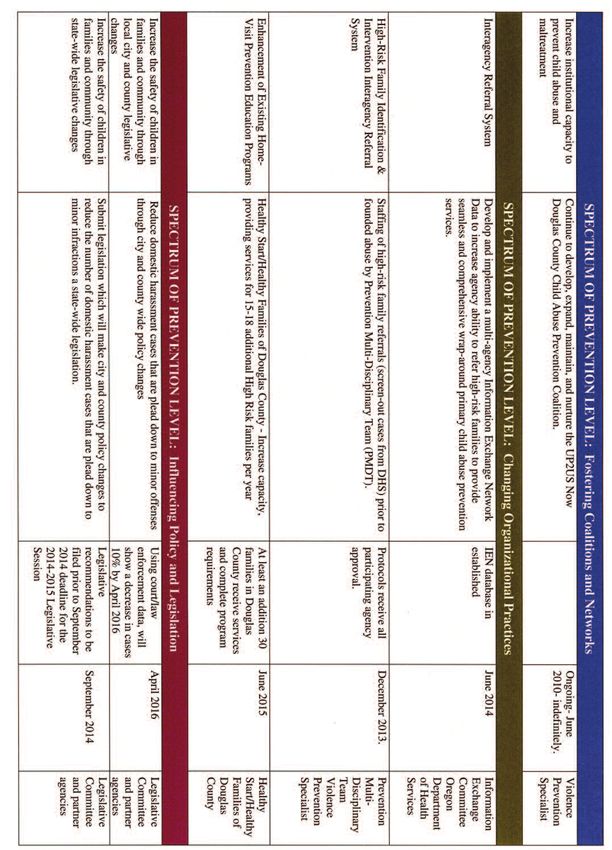
Mercy Medical Center • Fiscal Year 2013 • Community Benefit Report
Executive Summary
     This Community Benefit Report and Health Improvement Plan is a strong example of
     Mercy Medical Center’s ongoing commitment to promote and support the health and
     wellbeing of our Community members.
     Our tradition of providing charitable aid to the poor and medically underserved is part of
     our legacy. Despite declining revenue, Mercy provided more than $29 million in uncom-
     pensated medical care to vulnerable, uninsured and underinsured members in our com-
     munity in 2012.
     The Community Benefit Report and Health Improvement Plan outline’s our dedication to
     - and strategy for - optimizing the health of all of our County residents. Our commitment
     remains to work collaboratively with local community partners to strengthen existing
     public health programs and advance evidence- based wellness initiatives. Additionally,
     Mercy will work to reinforce and expand health improvement and disease prevention
     services currently offered by the hospital. Our long-term goal is to promote greater levels
     of health, health awareness and wellness for everyone in our community.
     At Mercy, we are committed to managing our resources and advancing our healing min-
     istry in a manner that benefits the common good now and long into the future. Despite
     today’s challenges, we see this as time of great hope and opportunity for the future of
     health care.
     We want to use this venue to also extend a special note of appreciation to the women
     and men who, with a spirit of collaboration, work alongside us to help address the health
     priorities of our community by offering an array of health and wellness programs and
     services.
     In accordance with policy, the Mercy Medical Center Board Members have reviewed and
     approved the annual Community Benefit Report and Health Improvement Plan as of
     June 21, 2013.

1   Mercy Medical Center 2010 Annual Report
                                                                                  Caring for our community   2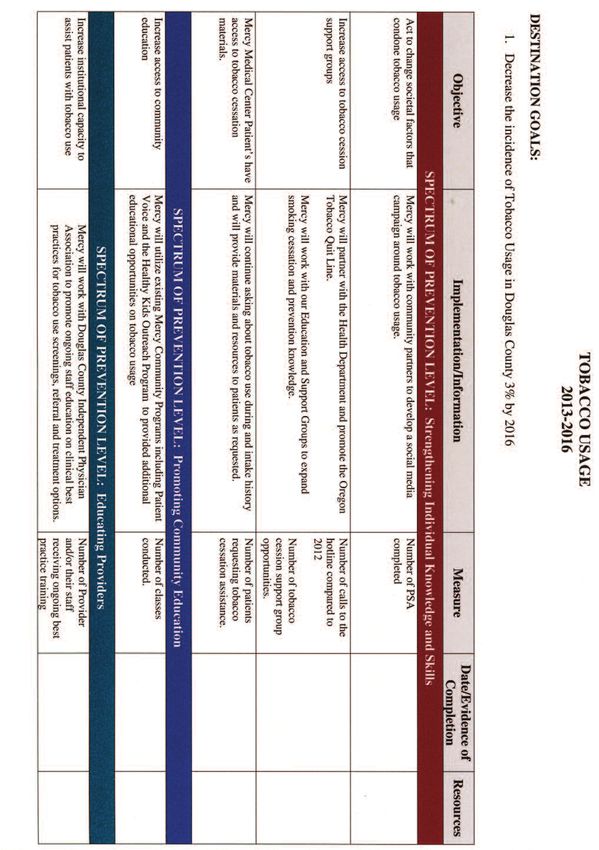
Mercy Medical Center
                                            Community Health
                                            Needs Assessment
                                            Mercy Medical Center (Mercy) is a private, not-for-profit healthcare
                                            174-bed medical center located on a 90-acre campus on the north side of
                                            Roseburg, Oregon. Mercy is affiliated with Catholic Health Initiatives, the
                                            second largest Catholic health network in the country. Founded in 1909
                                            by the Sisters of Mercy, Mercy Medical Center’s core values are reverence,
                                            compassion, integrity and excellence. Our mission is to nurture a healing
                                            ministry by bringing it new life, energy, and viability. We emphasize
                                            human dignity and social justice as we move towards the creation of
                                            Healthier Communities.

                                            Mercy’s specialized and comprehensive inpatient and outpatient care
                                            includes: A 24-hour emergency center; acute medical and surgical
                                            services; critical care (ICU and PCU); diabetes education; diagnostic
                                            imaging; Shaw Heart and Vascular Center, including catheterization labs
                                            and interventional cardiology and peripheral; Outpatient Imaging Center;
                                            Family BirthPlace, laboratory services, spiritual care, rehabilitation
                                            services, including physical, occupational and speech therapies; day
                                            surgery, hospice, home health, and Parkway Mobility and Medical
                                            Supply. Gifts and grants to Mercy are received and administered by the
                                            Mercy Foundation, a 501(c)3, tax-exempt, non-private, charitable
                                            foundation. Mercy’s inpatient market share is 67.1%

                                            Community Description
                                            Douglas County, Oregon extends west to east from sea level at the Pacific
                                            Ocean to the 9,182 foot Mt. Thielsen in the Cascade Range. Douglas
                                            County covers an expansive 5,071 square miles and is comprised of 12
                                            incorporated cities Roseburg ñ the county seat, Canyonville, Drain,
                                            Elkton, Glendale, Myrtle Creek, Oakland, Reedsport, Riddle, Sutherlin,
                                            Winston, and Yoncalla. Douglas County, as with many rural jurisdictions,
                                            faces the challenges of a migration of seniors as well as a baby boomer
                                            aging population, high rates of unemployment and poverty, few educa-
                                            tional opportunities, high rates of tobacco and other drug use, and fewer
                                            local resources dedicated to addressing these and other known health risk
                                            factors. Nearly 70% of residents live outside the county seat of Roseburg,
                                            where most health services are provided. Douglas County is a federally
                                            designated medically underserved area, as well as a primary care shortage
                                            area.

3 Mercy Medical Center 2013 Annual Report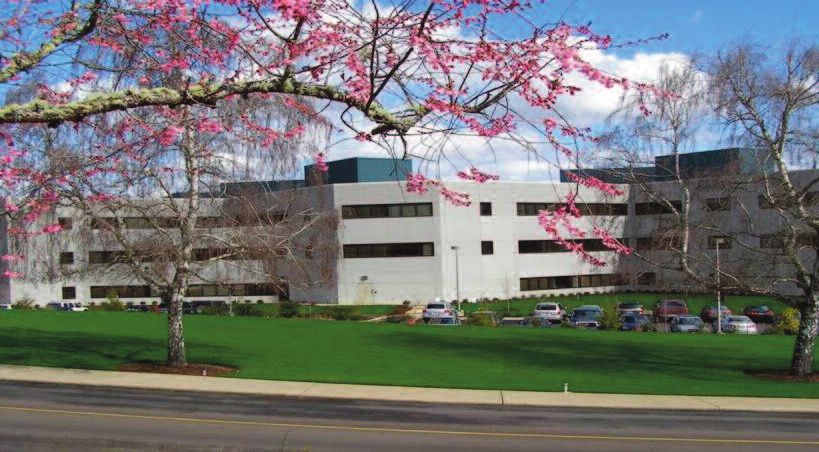
Population                                                which is the largest employer in Roseburg proper; Cow
                                                          Creek Indian Tribe, city and county and federal govern-
According to the 2011 US Census Bureau’s American         ment including the VA healthcare system, agriculture,
Community Survey, the demographics of Douglas             the warehouse industry, building trades and education.
County’s 107,490 residents are as followed: 0-17
(20.1%), 18-64 (58.6%), and 65 and over (21.3%).          Income Level
About 89% of the county’s population is white non-
Hispanic, as compared to 84% statewide, and approxi-      Stagnant economic recovery continues to greatly im-
mately 5% of the population is Hispanic/Latino,           pact the lives of all Douglas County residents, as it has
followed by 3% American Indian, 1% Asian/Pacific Is-      one of the highest poverty and unemployment rates in
lander, and 0.3% African American. Over the last few      Oregon— 11.1% (March 2013). Family-wage jobs
years, we have experienced an approximately 25%           have diminished with the dwindling timber industry
outmigration rate of 20-45 year olds, with more seniors   over the last two decades. As a large county with
moving to our county because of the seasonal weather      many rural communities, our socio-economic profile is
conditions.                                               like that of Appalachian America. According to the
                                                          2011 American Community Survey, 16.1% of Douglas
Economy                                                   County residents have a bachelor’s degree or higher
                                                          compared to the Oregon State average of 28.8%. The
Traditionally, the timber and wood product industries     median household income is $38,502, compared with
have been the major employers in Douglas County.          the Oregon State average of $46,876. 17.0% of all
Even with the downturn, it still remains one of the       residents and 25.3% of children under 18 live in
biggest sources of employment in Douglas County;          poverty, and 17.9% of all residents do not have health
with approximately 25% of Douglas County’s labor          insurance. 68% of children in schools located outside
force employed in the forest products industry. The       of Roseburg are on the free-and-reduced lunch pro-
largest timber supplier is Roseburg Forest Products.      gram, a widely held poverty indicator.
Other large employers include Mercy Medical Center,

                                                                                                 Caring for our community   4
Who was Involved
    in the Assessment
    The assessment process has taken place over the last two years, and was led by Mercy Medical Center staff in
    partnership with community stakeholders. To ensure broad input from community residents and partners, out-
    reach was conducted via a Community Perception phone survey, a Community Engagement Forum; one-on-one
    interviews with key community leaders and residents; and a survey monkey was provided electronically to ap-
    proximately 200 not-for-profit and human services organizations. In addition, results from Mercy’s 2012 Patient
    Survey regarding access to and usage of healthcare services were used in determine the priority topics.

    Initial stakeholders participating in one-on-one
    interviews include:

    Adapt Substance Abuse Treatment Program (ADAPT) - Jerry O’Sullivan, Pauline Martel
    Douglas County Health and Human Service Department - Marylin Carter
    Oregon Health Sciences University, Office of Rural Health - Troy Sonen

    How the Assessment
    was Conducted
    The assessment was conducted over multiple phases. First was a review of state, county, city, and national statisti-
    cal information:

    Health Factors

    The Robert Wood Johnson Foundation’s 2013 County Health Rankings rank Douglas County 30th out of 33 Ore-
    gon Counties for Health Outcomes — which represent how healthy a county is, and 28th out of 33 counties for
    Health Factors — which are what influences the health of the county. Douglas County rankings are significantly
    worse than the state’s most metropolitan county that includes the City of Portland:

5 Mercy Medical Center 2013 Annual Report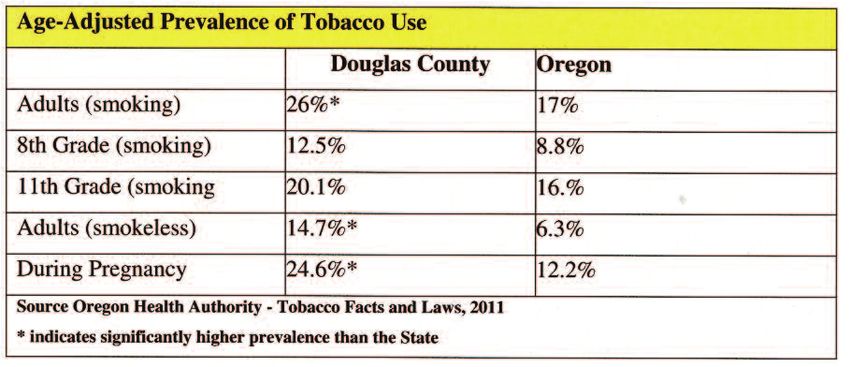
Chronic Disease

Douglas County has higher instances of major chronic diseases as compared to the state averages and poor health
behaviors, as shown by the table below.1

                                                                                               Caring for our community   6
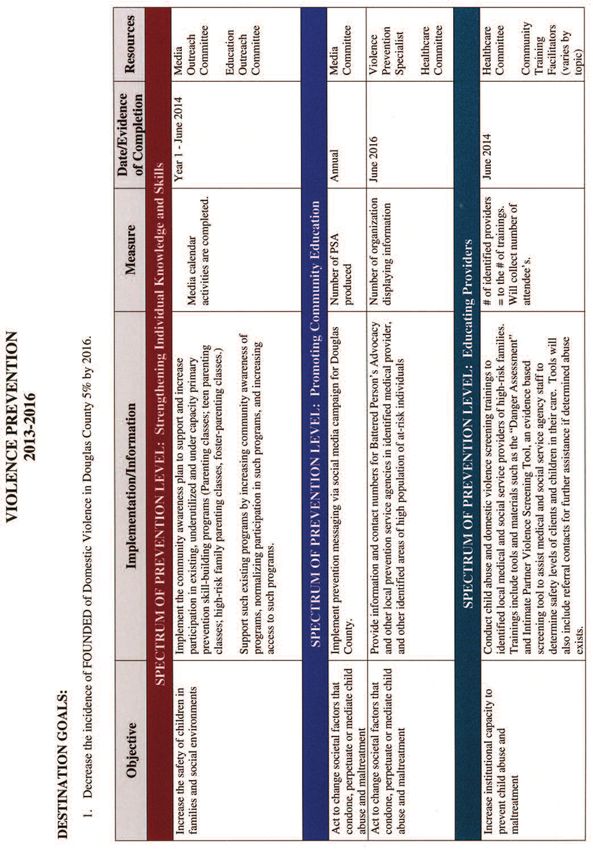
Incidences of Violence
                                                               • Violence Prevention.
    The impact of domestic violence in Douglas County:2
                                                               • Accident Mortality
    • In 2009, there were over 8,309 allegations of abuse      • Obesity
      or neglect towards seniors and people with               • Tobacco Usage
      disabilities. 45% of these allegations indicated that    • Motor Vehicle Crash Mortality
      the perpetrator was an adult child, family member,       • Access to Primary Care
      spouse or intimate partner.                              • Dental Care
                                                               • Suicide Prevention
    • Of the 35 impact of domestic violence deaths in          • Asthma
      2010, 48% had some known connection to                   • Lung Disease
      Department of Human Services. They currently or
      have in the past received Supplemental Nutritional       Initial Goal Setting Process
      Assistance Program (SNAP) benefits, medical
                                                               In order to determine the top three community needs
      assistance, cash relief or utilized some other special
                                                               for Mercy to focus on, four factors were used:
      assistance service.

                                                               1) The size of the problem (number of people affected)
    • Over 4,000 shelter nights at Battered Persons
                                                               2) The seriousness of the problem
      Advocacy (BPA) are reported for families fleeing
                                                               3) Community support (evidence that the issue is
      domestic violence annually.
                                                                  important to diverse community stakeholders)
                                                               4) Economic feasibility
    • Over 700 restraining orders are filed each year in
      Douglas County.
                                                               Through this process three priority Community Health
                                                               Improvement Needs were identified:
    • Over 6,000 Crisis call occurrences are documented
      annually.
                                                               • Reducing Incidence of Domestic Violence
                                                               • Reducing Obesity Rates
    Community Benefit                                          • Reducing Tobacco Usage
    Perception Survey
    A 13 question phone survey was conducted to assess
    residents’ views on current health needs. Mercy
    reached out to 4,955 residents and received responses
    from 400 residents for a average response rate of 8.1%.
    From this survey a list of 10 community health needs
    were identified:

7   Mercy Medical Center 2013 Annual Report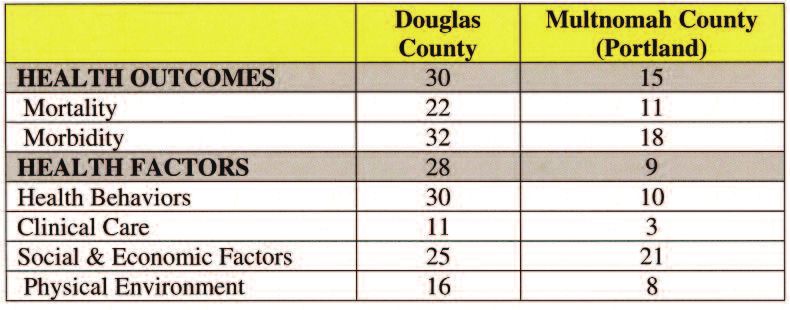
Community Benefit Needs                                    Government
                                                           Douglas County Health and Social Services
Assessment Partner Forum                                    Department - Dawnelle Marshall
With the results of the Community Perception Survey        Department of Human Services - Lisa Lewis
analyzed, and the priorities needs narrowed to three, a    Douglas County Senior Resource Coalition -
partner forum was held with representatives from over       Shawn Ramsey-Watson
16 community organizations. This meeting enabled
partners to come together to first brainstorm on identi-   Description of What the Hospital Will do to Address
fying existing community resources that we could           the Community Needs
collaborate with and second identify gaps in services      Even with great challenges, Douglas County residents
associated with domestic violence, obesity, and            have a strong history of collaboration on initiatives to
tobacco usage.                                             improve the health of our community members.
Health and Human Services Organizations                    Stakeholders know that a healthier Douglas County is
                                                           not the responsibility of a single entity, nor a single
Mercy Medical Center-Kelly Morgan, President & CEO,        sector of the community; rather, achieving measure-
Wally Gwaltney, CHI Corporate Responsibility Officer,      able health improvements requires broad community
 and Jean Larson, Controller                               involvement and collective action across all sectors of
Umpqua Training & Employment - Susan Buell                 our community3. Partnerships and collaborations are
Greater Douglas United Way - Bryan Trenkle,                key to the success of any initiative undertaken by
 Annette Rummell                                           Mercy. Opportunities must be taken advantage of to
Cow Creek Health & Wellness - Sharon Stanphill, PhD        support existing programs, and leverage community
Umpqua Health Alliance - Patti LaFrienere                  resources and expertise to build a more accessible and
Mark Herscher, DO - Family Practice Practitioner and       sustainable network of programs and services for the
 Mercy Medical Center Board Member                         prevention, early detection and management of
Battered Person’s Advocacy - Sami Gloria                   chronic disease.
Umpqua Community Health Ctr. - Christi Parazoo,
 Brenda Lewis                                              Efforts to improve the health of the community will
United Community Action Network (UCAN) Senior              model The Spectrum of Prevention, “a fundamental
 Services - Judy Applegarth, Carolyn Parks                 model in public health, acknowledges that a broad
                                                           range of factors play a role in health.”
School Districts
North Douglas School District - John Lahley
Oakland School District - Nanette Hagen
Roseburg School District - Larry Parsons, PhD
Sutherlin School District - Steve Perkins
Douglas County Educational Services District
  Andy Boee

 www.co.douglas.or.us/health/PH/livewell.asp

                                                                                                  Caring for our community   8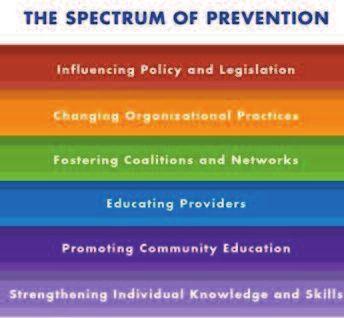
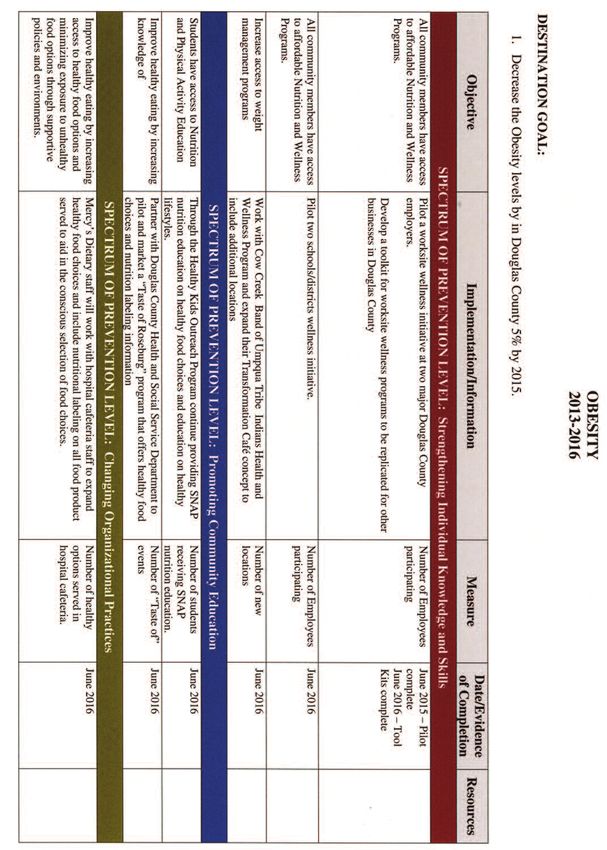
Action Plans                                              (SNAP, on-site wellness nurses, health resource refer-
                                                              rals and direct medical care to children through our
    (see Attachment A)                                        area schools.
    Violence Prevention - Goal to Reduce Incidences of        Adult
    Domestic Violence
                                                              • Mercy’s dietary staff will work with hospital cafeteria
    As domestic violence is the leading indicator of child    staff to expand healthy food choices for employees
    abuse, Mercy will continue the ongoing work of the        and staff.
    UP2US Now Violence Child Abuse Prevention Initia-
    tive, and partner with stakeholders to develop            • Mercy will work with Cow Creek Indian Tribe
    programs to reduce incidences of domestic violence.       and other local employers, to pilot and implement
                                                              Wellness Programs on their campus.
    Work of the Collation includes:
                                                              Tobacco Usage - Goal to Reduce Proportion of
    • Enhancement of Existing Home-Visit Prevention           Residents Using Tobacco
      Education Programs.
                                                              • Mercy will continue asking about tobacco use
    • Conducting child abuse and domestic violence            during and intake history and will provide materials
      screening trainings to identified local medical and     and resources to patients as requested.
      social service providers of high-risk families.
                                                              • Mercy will work with our Education and Support
    * Development of Interagency Referral System to           Groups to expand smoking cession support group
      identify high-risk families and provide intervention    opportunities.
      services.
                                                              • Mercy will utilize existing Mercy Community
    • Implement Community Awareness campaigns.                Programs to provided additional educational
                                                              opportunities on tobacco usage.
    • Developing Legislation proposals regarding Oregon
      State Domestic Violence laws.                           • Mercy will work with Douglas County Independent
                                                              Physician Association to promote ongoing staff
    Obesity — Goal to Reduce Proportion of Child and          education on clinical best practices for tobacco use
    Adult Obesity                                             screenings, referral and treatment options.
    Mercy currently has successfully partnership with local
    Douglas County Schools to deliver the Healthy Kids        • Mercy will partner with the Douglas Health and
    Outreach Project. The Healthy Kids Outreach Program       Social Services Department to promote the Oregon
    is the only program providing school based basic          Tobacco Quit Line.
    health education and healthcare to underserved, rural
    school age children in Douglas County. Our program        • Mercy will work with community partners to
    provides health education, nutrition education with       develop a social media campaign around tobacco
    the Supplemental Nutritional Assistance Program           usage.

9 Mercy Medical Center 2013 Annual Report
Priority Community Health Needs Not Being Mercy Medical Center
Board of Directors
Addressed by the Hospital and Reasons Why Joyce Akse
Neal Brown
Marty Daley
From the survey process the largest community need not being addressed
Tom Davidson
by Mercy is motor vehicle safety, including speeding, DUI occurrences, Bret Hansen, MD
motor vehicle crash mortality. While Mercy recognizes the seriousness of Mark Herscher, DO
this issue, we believe that our resources can be more effectively used to Gabrielle Jones, RSM
impact health needs currently in place. We are committed to supporting Dave Leonard
Gary McCormack
local government efforts to improve motor vehicle safety, and will partner
Kelly Morgan
in initiatives when possible, Mercy is not in a position to lead this effort at Amy Palm
this time. John Powell, MD
Joe Wilczek
Mercy Foundation
Approval Board of Directors
Mercy Medical Center is governed by at 13 member Board of Directors. Syndi Beavers
John Blodgett
The Board has designated the Mission Services to develop implementa-
Beverly Brandt
tion plan objectives. The Board and Senior Management staff of Mercy Peter Carhart
Medical Center will direct, monitor strategies and will review progress on Jerry Duncan
an annual basis. Linda Folk
Jacquelyn Groshong, MD
Tony Haber
Paul Kremser, MD
Dave Leonard
Jerry Moneke
Patrick Moore
Kelly Morgan
Kathleen Nickel
Lisa Platt
Tammy Rondeau
Julie Ryan
Christine Seals, MD
David Sutton, DDS
Gary Wayman
Mercy Medical Center
Executive Committee
Sarah Agsten, DO
Faye Ameredes, DO
Kurt Brickner, DO
Howard Feldman, MD
Deidre McCann, MD
Marc Smith, MD
Community Benefit Team
David Price
Lisa Platt
Kathleen Nickel
Nancy Lehrbach
Joan Sonnenburg
Katy Rowlands
Caring for our community 1011 Mercy Medical Center 2013 Annual Report
Caring for our community 12
13 Mercy Medical Center 2013 Annual Report
Caring for our community 14
Caring for our Community
  Since 1909.

     Mercy Medical Center
     2700 Stewart Parkway
     Roseburg, OR 97471
You can also read


