MIGRANT LABOURS IN THAILAND: AN ANALYSIS OF CURRENT
  SITUATION AFFECTED BY THAI GOVERNMENT POLICIES
←
→
Page content transcription
If your browser does not render page correctly, please read the page content below

MIGRANT LABOURS IN THAILAND: AN ANALYSIS OF CURRENT SITUATION AFFECTED BY THAI GOVERNMENT POLICIES
World Map                               Map of Thailand

            Area
            513,115 sq. km.
            Population
            68 million

            Economy is the second
            largest in Southeast Asia
            and the twentieth largest
            in the world by gross
            domestic product (GDP)
            at PPP.
BRIEF HISTORY OF FOREIGN LABOUR MIGRATION TO THAILAND
 • 1882 - 1898   Chinese people migrated to Thailand for work
                 (Chinese population in Bangkok increased from 45,000 to 600,000)

 • 1970          Rapid expansion of urban industrial sector         Demand for industrial labours
                 (Number of rural Thais migrated to work in urban areas)

 • 1990          Economic boom           Shortage of Thai labours
                 (Imported foreign workers from neighbouring countries; Myanmar, Laos,
                 Cambodia)

 • 1997          Economic crisis          Repatriation of foreign workers back to their counties

 • 2001          Foreign labourers returned to Thailand after economic crisis

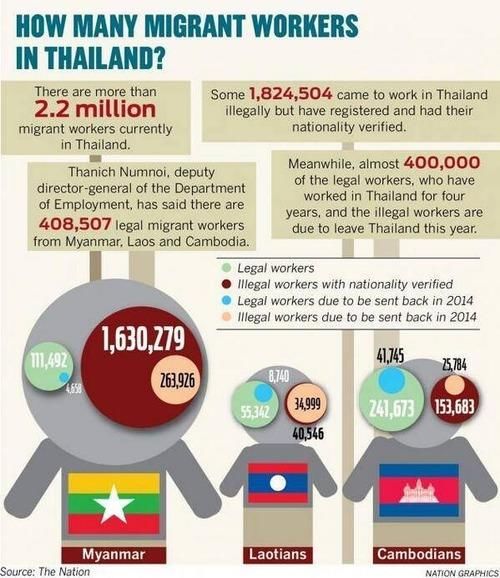
 • 2015          Number of migrant workers reached to more than 3,000,000
                 (6% of Thai population)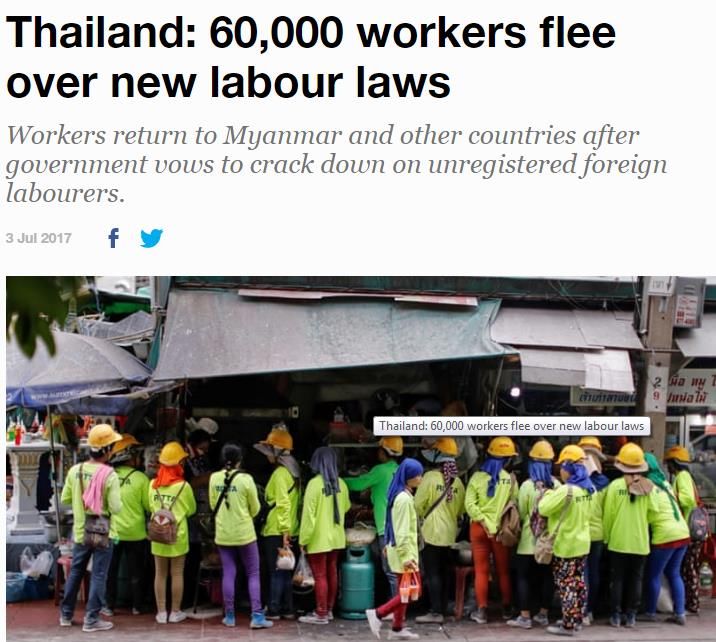
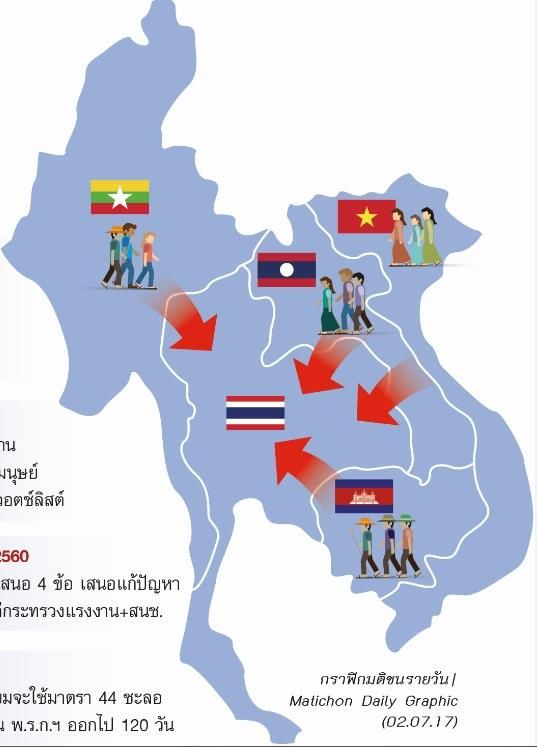
Cross-border migrant workers from the

three neighbouring countries of Thailand

                       Myanmar

                                           Lao PDR

                                           Cambodia
Push factors                            Pull Factors

• Disparities in economic and social   • Higher income
  development
                                       • Better living condition
• Political situations in the
  migrant’s’ homeland                  • High demand of labour market
                                         (3 Ds work)
• High unemployment and low wage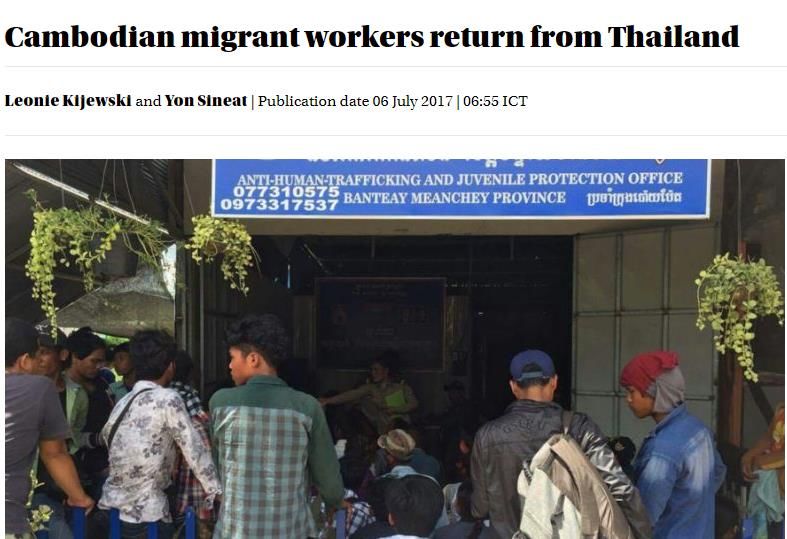
THAILAND GDP PER CAPITA 2010-2016
Comparison of GDP per capita in average from 2010 to 2016
             (Thailand and three neighbouring countries)

USD
7.000
6.000
5.000
4.000
3.000
2.000
1.000
   0
            Thailand       Myanmar         Cambodia        Lao PDR

TYPES OF MIGRANT WORKERS IN THAILAND

 1. Registered migrants

 2. Unregistered migrants

 3. National Verification (NV) migrants

 4.   MOU migrants
POLICIES AND REGULATIONS
Terminology to be understood of migrants to Thailand

   - Legal entry

   - Legal work
Year          Type             Duration                              Details
                                         1992      Registration        1 year            Only for migrants from Myanmar in nine Thai-
                                                                                         Myanmar border provinces
                                         1996      Registration        2 years           Expanding to cover Laos and Cambodian workers
                                                                                         from 39 (later 43) provinces
                                         1998      Registration        2 years           Expanding to cover Laos and Cambodian workers
                                                                                         from 39 (later 43) provinces
                                         2001      Registration        1 year            All migrant workers from Myanmar, Loa PDR and
                                                                                         Cambodia; cover all provinces and industries
                                         2004      Registration        1 year            All migrant workers including their dependents from
  The scheme and its details by year                                                     the 3 nations mentioned above register their
                                                                                         residential status in the TR38/1 in all provinces

and work permit duration (1992 – 2016)   2002      Memorandum of
                                                   Understanding
                                                                       2 years with
                                                                       extension of
                                                                                         Thailand signed MOUs with Laos (October 2002),
                                                                                         Cambodia (May 2003) and Myanmar (June 2003).
                                                   (MOU)               another 2 years   Exporting of migrant workers with a maximum of
                                                                                         working in Thailand is 4 years
                                         2010      National            2 years with      Thailand government agreed with Myanmar, Lao PDR
                                                   Verification (NV)   extension of      and Cambodia to implement the process of national
                                                                       another 2 years   verification from the migrant workers’ origin country.
                                                                                         Existing undocumented migrant workers in Thailand
                                                                                         who passed the NV receive a “temporary passport”,
                                                                                         which is valid for a maximum of 4 years
                                         2014      One Stop Service    2 years           All migrant workers including their dependents from
                                                   Center (OSSC)                         the 3 nations mentioned above are allowed to
                                                                                         register their residences and workplaces. They will
                                                                                         receive a “pink card”
ANNOUNCEMENT OF ROYAL DECREE 2017 ** An order with the power of legislation issued by a ruler or other person or group with authority
NEW ROYAL DECREE ON MANAGING THE WORK OF ALIENS B.E. 2560 (2017)
  Address two issues previously covered under the Previous Legislations
  1. Foreign employees working in Thailand (e.g. work permit issues)

  2. Hiring and bringing in migrant workers to work in Thailand

  Main objectives
  •   To tackle human trafficking issues

  •   To solve the problems of foreign lobours working in Thailand

  •   To maintain the national security
Alien’s Work Act                        New Royal Decree on Managing the Work of
                 Significant Changes
                                                                             B.E. 2551 (2008)                                 Aliens B.E. 2560 (2017)
Definition of “Work”                                         “Engaging in a work by exerting one’s physical energy   “Exerting one’s physical energy or employing one’s
                                                             or employing one’s knowledge, whether or not for        knowledge to perform a profession or perform
                                                             wages or other benefits”                                works, whether or not for wages or other
                                                                                                                     benefits”

                                                                                                                     Notably, the new definition of “work” is narrower
                                                                                                                     than that under the old Act.
Increased penalties and new penalties for various offences

Employing a foreigner without a work permit                  A fine from Baht 10,000 to Baht 100,000 per foreigner A fine from Baht 400,000 to Baht 800,000 per
                                                             (USD 300 to USD 3,000)                                foreigner      (USD 12,500 to USD 25,000)

Employing a foreigner to work differently than the           A maximum fine of Baht 10,000 (USD 300)                 A maximum fine of Baht 400,000 (USD 12,500)
conditions specified in a work permit
Working differently than the conditions specified in a work A maximum fine of Baht 20,000 (USD 600)                  A maximum fine of Baht 100,000 (USD 3,000)
permit
Working on an urgent and necessary basis without             A maximum fine of Baht 20,000 (USD 600)                 A fine from Baht 20,000 to Baht 100,000 per
notifying officials                                                                                                  foreigner (USD 635 to USD 3,000)

Confiscating a work permit or identification document of a None                                                      A maximum of 6-month imprisonment and/ or a
foreigner                                                                                                            maximum fine of Baht 100,000 (USD 3,000)
New Royal Decree on Migrant workers
Pros vs ConsNew Royal Decree on Migrant workers
Advantages Disadvantages
Pros Cons Organizing migrant workers effectively Huge burden to employers and migrant
workers
Solving the problem of illegal workers for Labour shortages
a long term
Protecting the migrant workers; wages, Disruptions to the Thai economy
benefits and other employment
conditions
Preventing the problem of human Humanitarian problems
trafficking, labour exploitation and child
labour
Protecting the discrimination and Widespread corruption among law
violations of individual rights enforced officialsHUMAN TRAFFICKING AND EXPLOITATION
Human trafficking and exploitation

“On July 9, 2017, the two Yu brothers were among 21 migrants from Myanmar who left Phuket to
return home. Each paid a border broker 13,000 baht (US$390) to arrange transport and
government documents to enable them to leave the Phuket province and return home. A broker
gave them fake Thai documents, and when police pulled over the bus the migrants were travelling
in, they arrested all 21 of them and took them to Phetchaburi prison. The Yu brothers now face fines
of between 2,000 to 100,000 baht (US$60 to US$3,000) or a five-year prison sentence for forging
official documents, despite not being able to read or write in Thai” (ASEAN Today, 2017).
CONCLUDING REMARKS
New Royal Decree

          Solving the      Protection of         Tackling the
         problems of     migrant workers      problem of human
       illegal workers   and their benefits       trafficking
Expensive Lesson
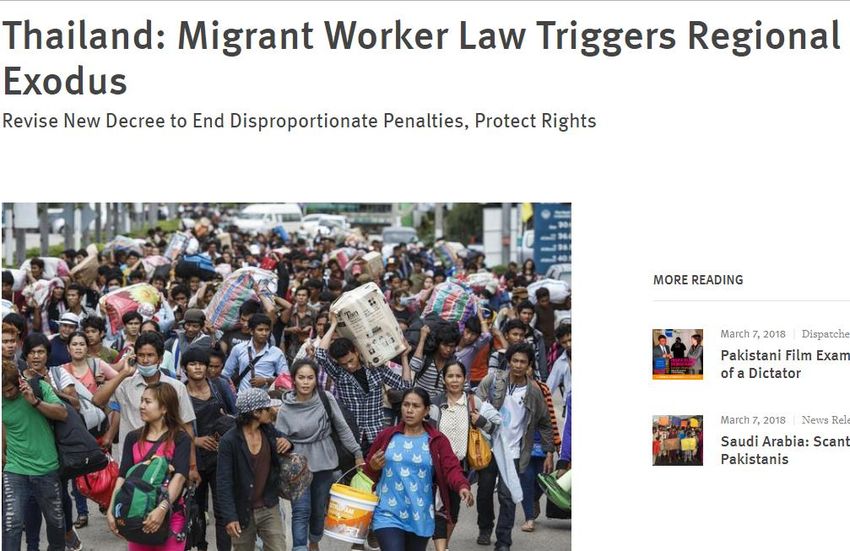
Sudden new law enforcement without any prior
notification brought about problems
More effective and concise measures for
legislation is essential
Public hearing to all parties involved should be
done before publish the policies and law
enforcementYou can also read


