Better protection sought for Thailand's helmeted hornbill
←
→
Page content transcription
If your browser does not render page correctly, please read the page content below
Better protection sought for Thailand's
helmeted hornbill
11 October 2019, by Busaba Sivasomboon

                                                          considered "extinct."

                                                          Demand from China is helping drive demand for
                                                          their distinctive casques, "helmets" in French,
                                                          which males deploy in battle. The material is used
                                                          to make rings, pendants and other decorative
                                                          items.

                                                          Worries over the species' survival intensified after
                                                          the wildlife trade monitoring group TRAFFIC
                                                          recently posted photos online of dozens of skulls of
                                                          the endangered avian for sale.

                                                          A campaign on the change.org online petition site is
                                                          pressuring the government to add the bird to
                                                          Thailand's Wildlife Preservation List as soon as
In this photo taken in 2012, a skull of an endangered
                                                          possible. It now lists 19 other species.
helmeted hornbill is displayed in Bangkok, Thailand.
Conservationists say time is running out for Thailand's
dwindling population of helmeted hornbills thanks to      The bird is already on Thailand's official list of
poaching of the exotic birds for the ivory-like casques   protected animals, but would get much better
atop their big yellow beaks. (Kaset Sutasha/The Bird      protection if it's included in the Wildlife Preservation
Conservation Society of Thailand via AP)                  List, Kaset said.

                                                          That "means we can get money, officers and tools
                                                          from the government, including a national
Time is running out for Thailand's dwindling              conservation plan designed just for this species,"
population of helmeted hornbills thanks to                he said.
poaching of the exotic birds for the ivory-like
casques atop their big red and yellow beaks.              The population of the bird, found in Indonesia,
                                                          Malaysia and parts of Myanmar and southern
The species, known by the scientific name                 Thailand, is dwindling, the IUCN says.
Rhinoplax vigil, is listed as "critically endangered"
by the International Union for Conservation of            Most types of hornbills have hollow casques. The
Nature.                                                   helmeted hornbills' are a hard, solid block that in
                                                          the illegal wildlife market is called "red ivory."
"Currently, there are fewer than 100 of the birds in
Thailand's forests," says Dr. Kaset Sutacha,              The London-based Environmental Investigation
chairman of the Bird Conservation Society of              Agency says black market prices are up to five
Thailand and head of the Exotic Pet and Wildlife          times higher than for elephant tusks.
Clinic at Kasetsart University's Faculty of
Veterinary Medicine in Bangkok.                           China appears to be the main market for helmeted
                                                          hornbill parts and products, though there is also
"Critically endangered" is just a step away from          demand in Laos and Thailand, says Elizabeth John,
"extinct in the wild" and two steps from becoming         TRAFFIC Southeast Asia's senior communications

                                                                                                          1/3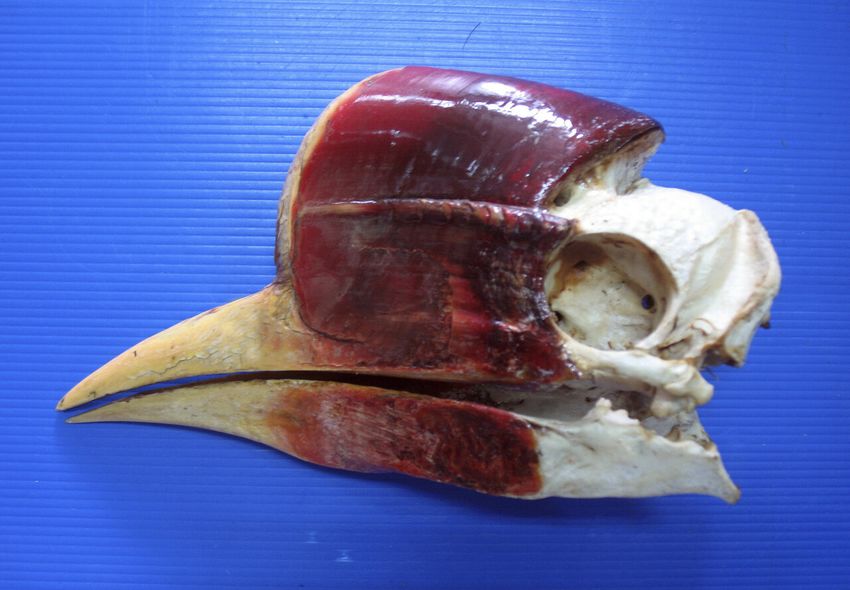
officer.                                                      who hunt the bird to cater to demand from outside
                                                              Thailand."
TRAFFIC has spotted at least 546 hornbill parts,
mostly casques of helmeted hornbills, for sale on             Traders will pay villagers 5,000-6,000 baht
Thai Facebook groups in the past five years.                  ($165-$200) for a hornbill head, Preeda said he
                                                              was told. Prices are double or triple that in cities
                                                              and increase exponentially when sold overseas.

                                                              Preeda walks through the forest every day to check
                                                              on the hornbills.

                                                              "Right now, there are two nests that have baby
                                                              birds inside. We have to pray that the male will be
                                                              safe and bring back food every day," he says.
                                                              "Otherwise, the mother and its babies will die."

                                                              Local loggers tend to heed appeals not to cut down
                                                              trees with hornbill nests, but poachers from
                                                              elsewhere tend not to listen and sometimes
                                                              threaten people who try to stop them, Preeda said.

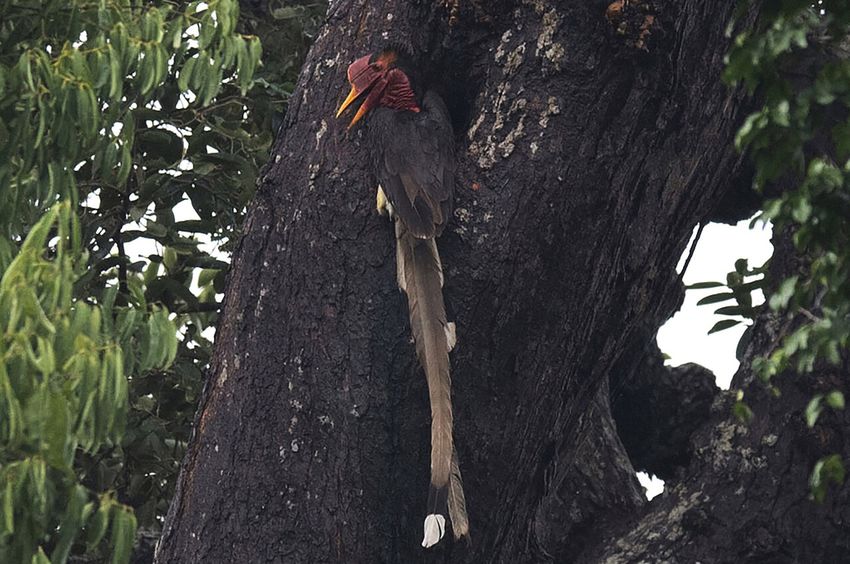
In this June 16, 2017, photo, a helmeted hornbill sits in a   A longstanding Muslim insurgency has complicated
tree at the Khao Sok National Park in Surat Thani             efforts to save the birds, since the rebels
province southern Thailand. Conservationists say time is      sometimes target forest rangers they consider to be
running out for Thailand's dwindling population of            on the side of the government, their enemy.
helmeted hornbills thanks to poaching of the exotic birds
for the ivory-like casques atop their big yellow beaks. (AP   The bird is so imperiled it's likely to be added to the
Photo/Ronayuth Sribanyaranond)
                                                              Wildlife Preservation List, said Thon
                                                              Thamrongnawasawat, a respected government
                                                              consultant on conservation and development.
The Bird Conservation Society of Thailand has
                                                    Last year, Thon got four species added to the list.
seen the number of helmeted hornbills depleted
over the past 40 years by deforestation and climate
                                                    But implementing a conservation plan doesn't
change.
                                                    guarantee the species will survive, he said.
"If we let the poaching goes on, it will wipe out the
                                                              "It's not only the animals that we have to take care
entire species in Thailand in no time," Kaset said.
                                                              of. The people who live in the area should be
                                                              looked after as well," says Thon.
Preeda Tiansongrasamee, a researcher who has
lived in Budo-Sungai Padi National Park in the
                                                              "They have to survive and have a better life if they
Budo range in Narathiwat province for 20 years,
                                                              are to refrain from cutting trees, and poaching.
said hunters traditionally sought helmeted hornbills'
                                                              Without cooperation from people, no conservation
casques and heads because they were thought to
                                                              plan will last long."
bring good luck.
                                                              © 2019 The Associated Press. All rights reserved.
"In the past, we could see heads of the bird in
homes and people wore amulets made from
casques," he said by phone. "That belief has faded
away, but a new group of poachers has emerged

                                                                                                              2/3
APA citation: Better protection sought for Thailand's helmeted hornbill (2019, October 11) retrieved 2
                                   November 2021 from https://phys.org/news/2019-10-sought-thailand-helmeted-hornbill.html

                                   This document is subject to copyright. Apart from any fair dealing for the purpose of private study or research, no
                                   part may be reproduced without the written permission. The content is provided for information purposes only.

                                                                                                                                                3/3

Powered by TCPDF (www.tcpdf.org)
You can also read


