Tiger geckos in Vietnam could be the next species sold into extinction, shows a new survey - Phys.org
←
→
Page content transcription
If your browser does not render page correctly, please read the page content below
Tiger geckos in Vietnam could be the next
species sold into extinction, shows a new
survey
1 April 2019

                                                       By presenting both direct and online observations,
                                                       interviews and existing knowledge, the scientists
                                                       point out that strict conservation measures and
                                                       regulations are urgently needed for the protection
                                                       and monitoring of all tiger geckos. The research
                                                       article is published in the open-access journal
                                                       Nature Conservation.

                                                       Tiger geckos are a genus (Goniurosaurus) of 19
                                                       species native to Vietnam, China and Japan. Many
                                                       of them can only be found within a single locality,
                                                       mountain range or archipelago. They live in small,
                                                       disjunct populations, where the population from Ha
                                                       Long Bay is estimated at about 120 individuals.
                                                       Due to demands in the international pet trade in the
                                                       last two decades, as well as habitat destruction,
                                                       some species are already considered extinct at the
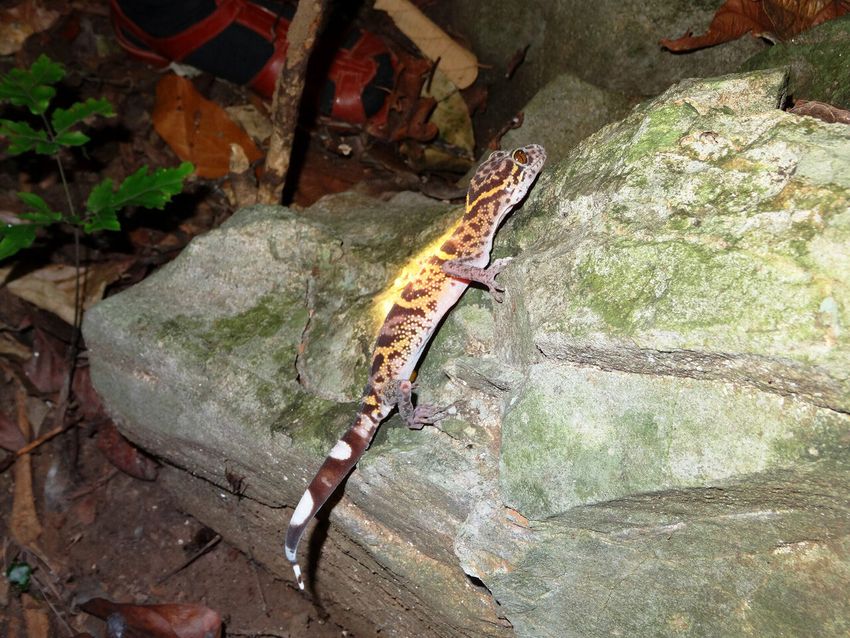
Cat Ba tiger gecko (Goniurosaurus catbaensis) in its
                                                       localities where they had originally been
natural habitat. Credit: Mona van Schingen
                                                       discovered.

While proper information about the conservation
status of tiger gecko species is largely missing,
these Asian lizards are already particularly
vulnerable to extinction, as most of them have
extremely restricted distribution. Furthermore, they
have been facing severe declines over the last two
decades, mostly due to overcollection for the
international exotic pet market. Such is the case of
the Cat Ba Tiger Gecko, whose tiny populations
can only be found on Cat Ba Island and a few
islands in the Ha Long Bay (Vietnam).

In their study, a Vietnamese-German research
team, led by Ph.D. candidate Hai Ngoc Ngo of the
Vietnam National Museum of Nature in Hanoi,
                                                       Signboard handed over to the Ha Long Bay Management
provide an overview of the evidence for domestic       Department to point to the threats and conservation need
and international trade in tiger gecko species and     of the Cat Ba tiger gecko in English and Vietnamese
update the information about the abundance and         languages. Credit: Hai Ngoc Ngo
threats impacting the subpopulations of the
Vietnamese Cat Ba Tiger Gecko in Ha Long Bay.

                                                                                                       1/3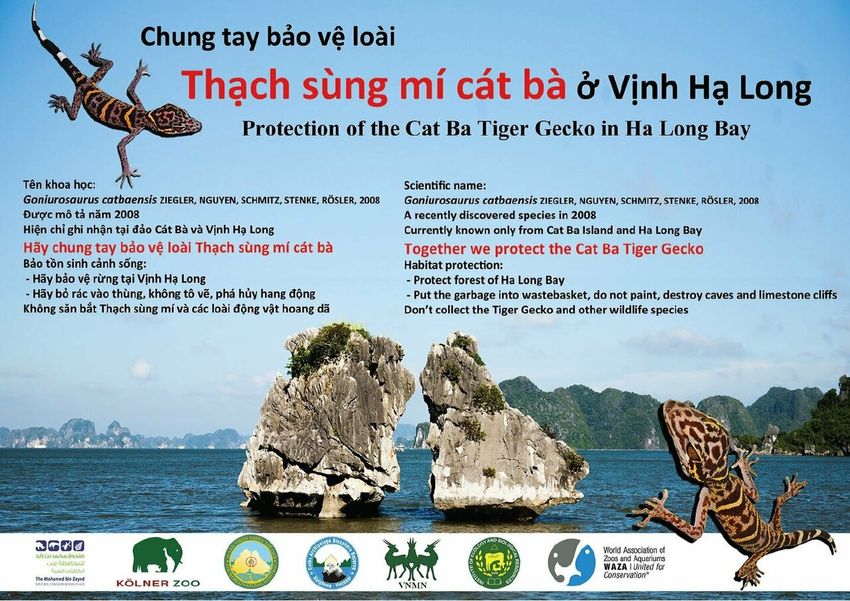
However, it was not until very recently that some         Indeed, although the researchers reported a large
species of these geckos received attention from the       quantity of tiger geckos labelled as captive-bred in
regulatory institutions in their home countries,          Europe, it turns out that their availability is far from
leading to the prohibition of their collection without    enough to meet the current demands.
a permit. Only eight tiger geckos have so far had
their species conservation status assessed for the        In conclusion, the team provides a list of several
IUCN Red List. Not surprisingly, all of them were         recommendations intended to improve the
classified as either Vulnerable, Endangered or            conservation of the Asian geckos: (1) inclusion of
Critically Endangered. Nevertheless, none is              all tiger geckos in the Appendices of CITES; (2)
currently listed by the Convention on International       assessment of each species for the IUCN Red List;
Trade in Endangered Species of Wild Fauna and             (3) concealment of any currently unknown
Flora (CITES), which could be the only efficient and      localities; and (4) improvement/establishment of
reliable method to monitor, regulate and police the       coordinated ex-situ breeding programmes for all
trade of the species on a global scale.                   species.

"Tiger geckos are neither sufficiently protected by         More information: Hai Ngoc Ngo et al, A case
law nor part of conservation programmes, due to           study on trade in threatened Tiger Geckos
the lack of substantial knowledge on the species          (Goniurosaurus) in Vietnam including updated
conservation status and probably due to the               information on the abundance of the Endangered
general lack of public as well as political interest in   G. catbaensis, Nature Conservation (2019). DOI:
biodiversity conservation," they explain. "To date,       10.3897/natureconservation.32.33590
exact impacts of trade on the species cannot be
identified, as data of legal trade are only recorded
for species listed in the CITES Appendices".
                                                           Provided by Pensoft Publishers
During their survey, the researchers tracked local
traders in possession of wild-caught tiger geckos
representing all five Vietnamese species en route
to foreign exotic pet markets, mainly in the United
States, the European Union and Japan. The
species were also frequently found to be sold in
local pet shops in Vietnam, as well as being offered
via various online platforms and social media
networks like Facebook.

Having spoken to local dealers in Vietnam, the
team found the animals were traded via long and
complex chains, beginning from local villagers living
within the species' distribution range, who catch the
geckos and sell them to dealers for as little as
US$4—5 per individual. Then, a lizard either ends
up at a local shop with a US$7—25 price tag or is
either transported by boat or by train to Thailand or
Indonesia, from where it is flown to the major
overseas markets and sold for anywhere between
US$100 and 2,000, depending on its rarity.
However, many of these delicate wild animals do
not arrive alive at their final destination, as their
travels include lengthy trips in overfilled boxes
under poor conditions with no food and water.

                                                                                                            2/3
APA citation: Tiger geckos in Vietnam could be the next species sold into extinction, shows a new survey
                                   (2019, April 1) retrieved 9 July 2019 from https://phys.org/news/2019-04-tiger-geckos-vietnam-species-
                                   sold.html

                                   This document is subject to copyright. Apart from any fair dealing for the purpose of private study or research, no
                                   part may be reproduced without the written permission. The content is provided for information purposes only.

                                                                                                                                                3/3

Powered by TCPDF (www.tcpdf.org)
You can also read


