Governors Executive Order 2021-18 Nevada Habitat Conservation Framework - Alan Jenne, Habitat Division Administrator September 24, 2021
←
→
Page content transcription
If your browser does not render page correctly, please read the page content below
Governors Executive Order 2021-18
Nevada Habitat Conservation Framework

         Alan Jenne, Habitat Division Administrator
                   September 24, 2021
Nevada Habitat    • The concept discussion began with conservation partners relative to
                    protecting big game migratory corridors.
Conservation      • It was soon expanded beyond the corridors to consider actions to
Framework (HCF)     improve, maintain and protect the sagebrush habitats supporting the
                    migrations.
- Background      • In the end the EO scope was broadened to encompass all Nevada’s
                    habitats to afford conservation opportunities that may be identified in
                    the required Wildlife Connectivity Plan.
The Executive Order (EO) recognizes:

• Nevada’s native habitats are decreasing due to ever                                                                           - -~)
  increasing risks and threats such as climate change,
                                                                                                                                      .=:2-
                                                                                                                                            artmen      .-
  development, wildfire and invasive, fragmentation
  and conversion.
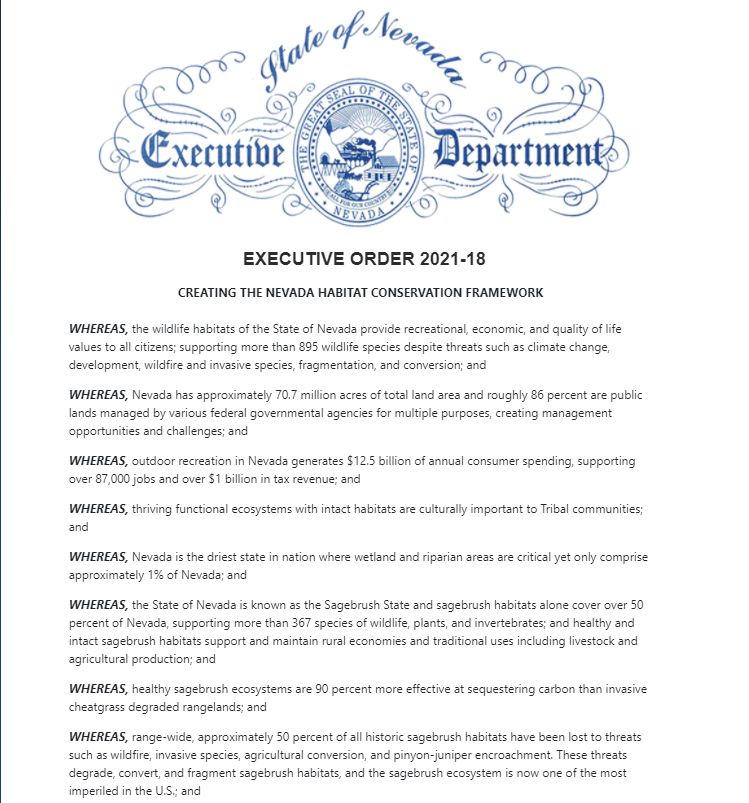
• Nevada’s wildlife habitats support over 895 wildlife
                                                                                           EXECUTIVE ORDER 2021-1 B
                                                                              OREATIING THE INEVADA HABITAT CONSERVATION!FRAMEWORK
  species across the 70.7 million acres of the state     WHEREAS, the wildlife habitats of the State of Nevada provide recreationa t eco nomic, and quality of life

• Some habitats such as sagebrush are being lost or      values to all citizens; supporting more than 395 wildlife species despit e threats such as climate change,
                                                         deve lopm ent, wildfire and inva.sive species, fragmentation, and rnnversion; and

  converted at an astonishing rate.                      WHEREAS, Nevada has approximately 70.7 million acres of total land area and roughly 36 percent are public
                                                         lands managed by various edera I g ovemme nta I agencies for multiple purposes, creating management

• Nevada’s lands and associated habitats support our     opportunities and challenges; and

  communities and economies not only through             WHEREAS, outdo or recreation in Nevada gene rat es S12.5 billion of annual consumer spend ing, supporting
                                                         over 87,000 jobs a nd over 51 billion in tax revenue'; and

  traditional uses such as mining, and grazing, but      WHEREAS, thriving functiona l ecosystems with intact habitats are culturally im portant to Tribal co mmuniti es;

  also outdoor recreation.
                                                         a nd

                                                         WHEREAS, Nevada is the driest state in nation where we tl.a nd and ri parian areas are critical yet only comp rise

• The plight of Nevada’s wild places and encourages
                                                         approximately 1% of Nevada; a nd

  additive collaborative efforts, resources, and
                                                         WHEREAS, t he State o Nevad a is known as the Sagebru sh State a nd sagebru sh habitats a lone cover over 50
                                                         percent o Nevada, supporting more than 367 species of wildlife, plants, and inverteb rates; and hea lthy and

  capacity to collectively design and implement on-
                                                         intact sagebru sh habitats support and ma inta in rural economies a nd traditiona l uses including livestock a nd
                                                         agricultural prod uction; and

  the-ground conservation and restoration activities.    WHEREAS, healthy sagebrush ecosyste ms are 90 pe rce nt more effective at sequestering ca rbon than invasive
                                                         cheatgrass degrad ed rangelands; and

• The HCF will consider all key habitats of Nevada but   WHEREAS, range-wide, approximately SO percent of a ll hi storic sagebrush hab itats have been rost to threats
                                                         suc h as wirdfire, invasive species, agricultural conversion, and pinyon-juniper e ncroachme nt. These threats
  will start with sagebrush and migratory corridors.     degrade, convert, a nd fragment sageb rush habitats, and the sagebrush ecosystem is now one of the most
                                                         imp erifed in the U.S~ and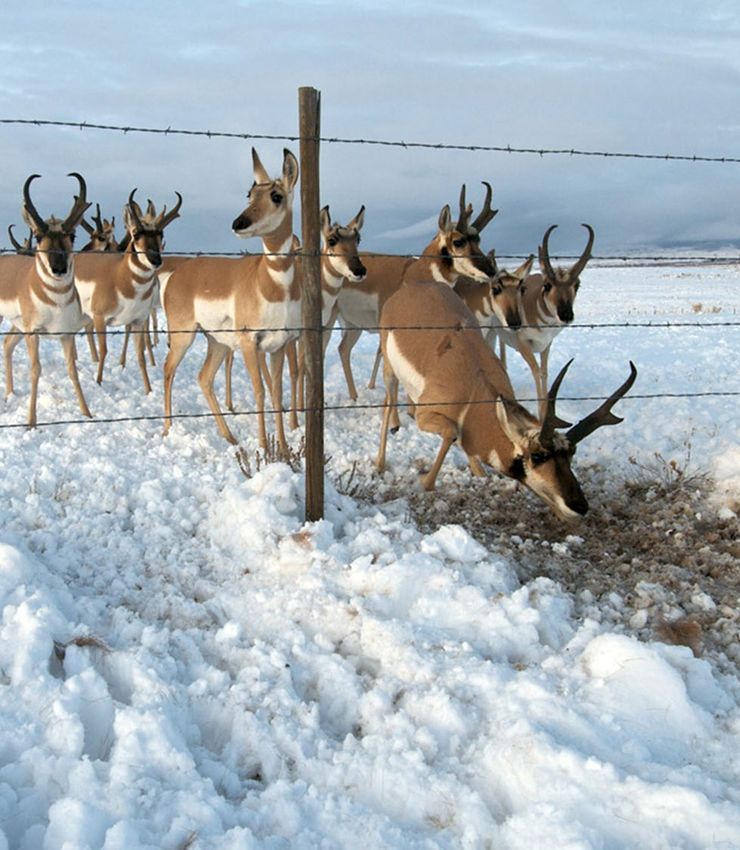
The EO will establish a Nevada Habitat
Conservation Framework (HCF).

• The HCF will provide for habitat
conservation, restoration, rehabilitation, and
protection in a coordinated and inclusive
manner across landownerships and in
partnership with federal land management
agencies, other relevant state and local
agencies, stakeholders, and local entities
• The HCF will be led by NDOW working with
partners on the following goals:
1) Conserving and propagating diverse and
productive wildlife habitats;
2) Addressing the priority threats to key
habitats such as the wildfire and annual
invasive grass cycle, and conifer
encroachment; and
3) Maintaining connectivity of habitats and
corridors
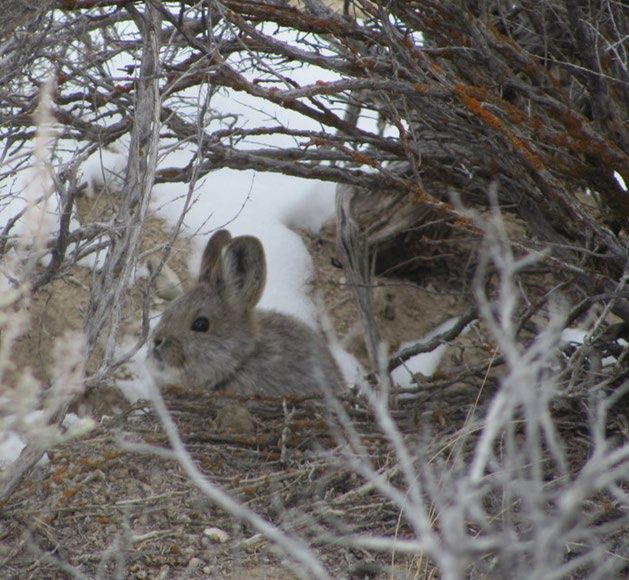
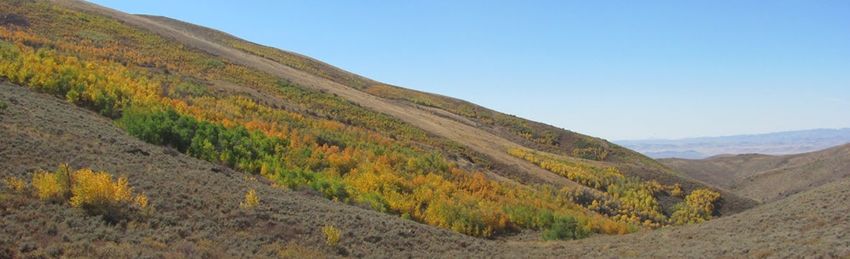
Two initial EO products

Nevada Sagebrush Habitat Plan will:
1) Be developed collaboratively with counties,
federal land management and state agencies,
and other stakeholders
2) Include identification of the primary threats
and challenges to Nevada’s sagebrush biome;
3) Identify priority landscapes for action in
consideration of associated resource values, site
potentials and feasibility;
4) Identify and prioritize strategies and actions
to enhance, restore, or maintain priority
habitats for all species dependent upon those
habitats for their lifecycles;
5) Be informed by best available science and
reference of relevant cooperator management
plans that overlap within different priority
habitats
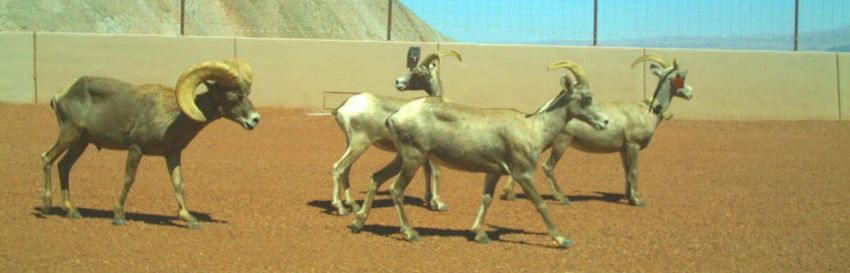
Two initial EO products

The Wildlife Connectivity Plan will:
• identify and conserve migratory corridors of
  wild ungulates and other key species and
• identify and delineate migration corridors
  supported by existing and ongoing scientific
  research
• identify habitat definitions, conservation
  recommendations, and best management
  practices or measures
NDOT MOU upon completion of Connectivity Plan

• Identifying opportunities to protect or restore habitats and migratory corridors in new or existing NDOT policies,
  regulatory permitting processes, and planning processes
• Identifying key wildlife habitat, wildlife migration corridors, and highways intersect;
• Identifying and implementing strategies to avoid, minimize and mitigate wildlife-vehicle collisions; and
• Prioritizing areas for implementation of wildlife crossings or other highway features to improve permeability for
  wildlife while maintaining highway user safety.
• The EO was created with the understanding that no
  one entity or agency has the capacity or resources to
  individually change the trend of loss or conversion
  across our wild landscapes.
• The EO does not dictate direction or resources of any
  agency or associated boards except NDOW or NDOT.
• The intent is to compile knowledge, strategies, and
  techniques from all partners and available science to
  assist in implementing conservation actions across
  Nevada wildlands.
• This EO will build upon the past actions and plans to
  conserve, restore, and rehabilitate our habitats
  through a collaborative evaluation of existing
  ecological threats, opportunities, and priorities to
  maximize our collective efforts to better deliver
  effective on-the-ground conservation.
You can also read


