Minimum standard for determining the recyclability of packaging subject to system participation pursuant to section 21 (3) VerpackG
←
→
Page content transcription
If your browser does not render page correctly, please read the page content below
Please note: This English version is a convenience translation – the German
version shall prevail

Minimum standard for determining the recyclability of
packaging subject to system participation pursuant to
              section 21 (3) VerpackG

     in consultation with the German Environment Agency
                      (Umweltbundesamt)

                         Osnabrück, 31 August 2021

                                                                        Page 1 of 31
Table of contents
1. Introduction ..................................................................................................................... 3
2. Minimum criteria ............................................................................................................. 3
3. Object of determination ................................................................................................... 4
4. Details of the requirements set forth in 2......................................................................... 4
Existence of sorting and recycling infrastructure ......................................................... 4
Sortability and separability .......................................................................................... 6
Recycling incompatibilities .......................................................................................... 6
Available recyclable content and determining recyclability .......................................... 6
5. Determination procedure ................................................................................................ 7
6. Definitions ....................................................................................................................... 7
Recyclability................................................................................................................ 7
Combination packaging .............................................................................................. 7
Packaging as a whole ................................................................................................. 7
Metallisation................................................................................................................ 7
Metric scaling.............................................................................................................. 8
Ordinal scaling ............................................................................................................ 8
Recyclates .................................................................................................................. 8
Recyclable materials / recyclables .............................................................................. 8
Foreign materials ........................................................................................................ 8
Available recyclable content ....................................................................................... 8
Good materials ........................................................................................................... 8
Fibrous material .......................................................................................................... 8
Composites and differentiation from single-component materials ............................... 9
Plastics ....................................................................................................................... 9
7. Abbreviations .................................................................................................................. 9
II. Appendices ................................................................................................................... 11
Appendix 1: material types, material groups and recycling paths ............................................ 13
Appendix 2: packaging characteristics requiring the testing of identifiability in sensor-based
sorting by measurement ............................................................................................... 28
Appendix 3: overview of packaging groups/sorts and material-specific recycling
incompatibilities ............................................................................................................ 29
Appendix 4: flowchart of the determination procedure............................................................. 30
Page 2 of 311. Introduction
An essential goal of extended producer responsibility regulations is to provide producers with
incentives to take the environmental impact of their products throughout the entire product lifecycle
and in particular their eventual disposal into account as early as in the process of designing and
producing their products. 1 For this reason, the legislative body has broadened extended producer
responsibility provisions under the Verpackungsgesetz (Packaging Act – VerpackG) to include an
obligation for systems (system operators according to section 18 VerpackG) to set monetary
incentives within the framework of system participation fees.
Section 21 VerpackG requires taking general recyclability into account when calculating
participation fees. In this context, legal requirements in the form of specific increases or reductions
in participation fees have not been enacted since, on the one hand, with the current state of
knowledge they could not be quantified in a generally binding manner and, on the other hand, it
would be a significant encroachment on the freedom of the systems to set prices as protected
under German antitrust law. 2 Specifically, section 21 (1) VerpackG stipulates that:
'(1) Systems are obliged to calculate their participations fees in such a way that incentives are
included with a view to the production of packaging subject to system participation
1. to promote the use of materials and material combinations that allow for the highest
possible percentage to be recycled, taking into account the practice of sorting and
recovery [...]'
In order to provide the systems with a uniform framework for the determination of recyclability as
defined in section 21 (1) no. 1 VerpackG , section 21 (3) VerpackG provides for the annual
publication of a minimum standard by the Zentrale Stelle Verpackungsregister (Central Agency
Packaging Register – ZSVR), in agreement with the German Environment Agency
(Umweltbundesamt – UBA). 3 The Verpackungsgesetz requires for publication, in agreement with
the German Environment Agency, by no later than 1 September.
The stakeholders were initially involved in the preparation of this minimum standard in the form of
an expert committee. The minimum standard was drafted largely on the basis of the
recommendations of the ZSVR's Expert Committee III; following that, results from a consultation
procedure on the draft guidelines were included as well. The minimum standard was finalised
following completion of the consultation procedure.
2. Minimum criteria
When determining recyclability, the available recyclable content of a packaging should be taken as
the minimum starting point for further considerations. In determining the available recyclable
content, at least the following three requirements must be verified and taken into account:
1) There must be a sorting and recycling infrastructure that allows for high-quality
mechanical recycling for this packaging.
1 Bundestag-Drucksache 18/11274, explanatory statement for section 21, p. 107
2 ibid
3 ibid
Page 3 of 312) The packaging must be designed in a way that the share to be transferred for high-quality
recycling can be sorted; the packaging components must be separable to the extent that
this is required for high-quality mechanical recycling.
3) The packaging components, or substances contained in the packaging materials, must not
be recycling-incompatible; recycling incompatibilities could render recycling
unsuccessful.
If a packaging meets these requirements, the available recyclable content (per packaging as a
whole, see 6.10 below) determines (maximum) recyclability. If the minimum criteria no. 1 or 3 are
not met, the packaging is not recyclable under this minimum standard. Criterion no. 2 can have a
quantitative impact upon determination. Systems may also take further criteria into account when
determining recyclability.
3. Object of determination
It is the packaging as a whole 4, after use, that is the object of determination.
The determination of recyclability refers to the unfilled packaging as a whole, including all related
packaging components such as labels, sealing films, lids and closures, adhesive applications, etc.
(packaging as a whole). Determination of recyclability must not be based on individual packaging
components that could only be obtained by a merely theoretical dismantling of the packaging.
Components of combination packaging can only be determined separately if they necessarily and
irrevocably have to be separated for consumption or use. Determining recyclability based on
individual packaging components is also permissible in cases where the packaging components
can be separated from each other simply through mechanical stress during transportation or
sorting; as such, they would appear separately in sorting, as can be assumed, e.g., for slip or snap-
on lids.
The determination of packaging in groups is permissible if the individual packagings in such a group
possess the same material structure and only differ in terms of contents and/or quantity, but not in
terms of relevant process-specific criteria (see criteria in 4 and the respective appendices). An
example of where classification of packaging as a group is not possible, are plastic articles which
are identical in their material structure but which are only partially sortable due to their different
colouring.
4. Details of the requirements set forth in 2
Existence of sorting and recycling infrastructure
If a packaging matches the 'good material description' in Appendix 1, column 4 ('Good material
description') (taking into account any disqualifications in column 5), it can be assumed that an
infrastructure of sorting and high-quality mechanical recycling is available on the market. In the
determination, the recyclable materials named in Appendix 1, column 6, are included
proportionally.
4'Functional unit of packaging' within the meaning of DIN/EN 13430, or DIN/EN 13427. This functional unit of packaging
usually consists of various components (the smallest parts of a packaging).
Page 4 of 31If a packaging material cannot be assigned to one of the (listed) material groups, the packaging
material is considered to be not recyclable according to current common practices.
If, in individual cases, the existence of the infrastructure required for high-quality mechanical
recycling as well as its use can be proven, an exception may apply. Proof must be provided for
each individual case, and comprise the following:
1) evidence that the result of the recycling process is of high quality within the meaning of the
minimum standard, and
2) weighing notes evidence that this recycling path has received at least the equivalent of the target
material volume.
The following examples serve to clarify the procedure:
Example 1:
A producer of frozen products distributes these goods in large polystyrene (EPS) boxes. It has been
determined that the packaging complies with the process-specific criteria under 4.2 and 4.3 of this
minimum standard. To fulfil their producer responsibility, the party subject to system participation has
agreed that the system will ensure that during the reference year at least the equivalent of the specific
EPS participation volume be transferred for high-quality recovery. The system has classified the
packaging as recyclable.
Evidence must be produced as follows:
− certificate issued for the EPS recycling plant as the final recipient pursuant to the
Verpackungsgesetz, certifying high-quality, mechanical EPS recycling, and
− verifiable documentation demonstrating that packaging subject to system participation in a
volume in line with the specific participation volume has been collected, as well as verifiable
documentation of the corresponding volumes delivered to the certified EPS recycling
plant(s).
Example 2:
A producer packages goods in transparent PET-A monolayer trays. All packaging characteristics
comply with the process-specific criteria under 4.2 and 4.3, for example labels made from PP have
been applied with wash-off adhesives. The participation volume is 600 tonnes p.a. The system has
classified the packaging as recyclable. The system has committed to transferring a corresponding
volume of PET trays for high-quality mechanical recycling in the reference year. To this end, the
system has entered into an agreement with a PET recycling plant that produces PET pellets from
these trays and has been certified for the 328-2 group with a mechanical recycling rate of 100%.
Evidence must be produced for:
− In the case of the 328-2 group, a delivery volume of at least 2,000 tonnes (equivalent to a
maximum of 600 tonnes of trays)
− Actual existence of the equivalent in trays
− Transfer for high-quality mechanical recycling (facility certificate)
Page 5 of 31Sortability and separability
For the determination of recyclability, sortability by means of sensor-based sorting must be
taken into account for the following materials: glass, plastics (excluding films group), liquid
packaging board, and PPC. Empirical testing is only required if one of the exclusion criteria listed
in Appendix 2 ('Packaging characteristics requiring the testing of identifiability in sensor-
based sorting by measurement') applies. 5
For fibre-based packaging, the separability of the fibrous material is decisive. In this context, it
has to be taken into account that different operating conditions apply depending on the actual
recovery path; for example, dwell time and other operating parameters in the processing of the
material will differ depending on whether the packaging was collected as part of the PPC or
lightweight packaging collection. 6 Where wet-strength agents, impregnating agents, waxes, etc.,
are used for fibre-based packaging, and in the case of paper or cartons (excluding liquid packaging
board) coated or metallised on both sides, the determination of recyclability needs to be based on
the relevant testing methodology.
When determining the recyclability of plastic packaging, it must be ensured that the density of
the shredded material (usuallyFor fibre-based packaging that does not contain any metal the determination of recyclability must
be limited to the fibrous material content; their recyclability must be determined according to their
fibrous material content. 9
Recyclability must then be ranked on a metric or ordinal scale (the latter with more than three scale
degrees). 10 The scale value and, if not self-explanatory, the scale units are required for the
documentation of the determination result by the systems.
In addition, the assignment according to 4.1 must be specified.
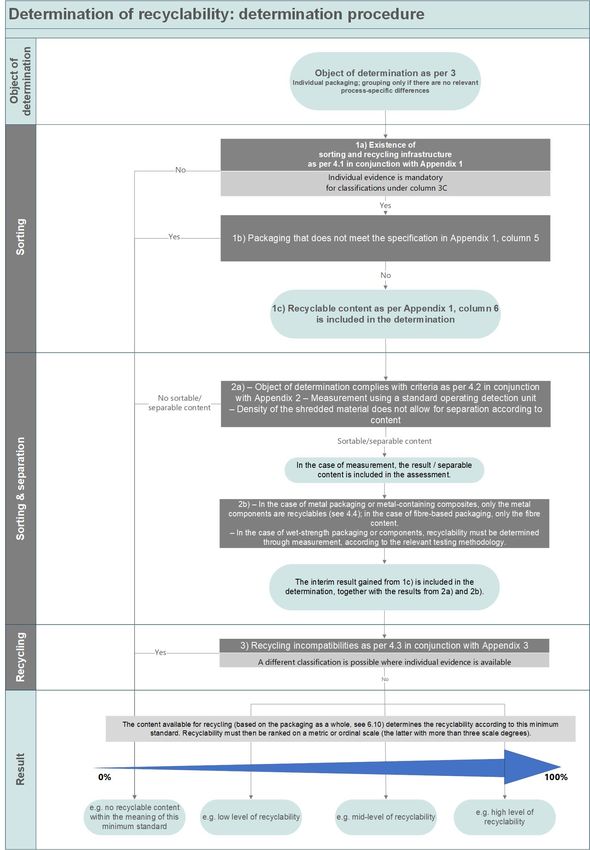
5. Determination procedure
A flowchart of the determination procedure is contained in Appendix 4.
6. Definitions
In this document, the following definitions apply:
Recyclability
In contrast to the recycling concept as defined in the Kreislaufwirtschaftsgesetz (Circular Economy
Act – KrWG), 'recyclability' in this document always refers to high-quality and mechanical recycling
(mechanical recycling is defined in section 3 (19) VerpackG) This concept of recyclability
encompasses the fundamental and gradual suitability of any given packaging to substitute virgin
material in applications typical for that material after undergoing recovery processes available on
an industrial scale.
Combination packaging
Combination packaging is multi-part retail packaging that consists of different materials separable
by hand.
Packaging as a whole
The packaging as a whole is the entire unfilled packaging, including all related packaging
components such as labels, sealing films, lids and closures, adhesive applications, etc.
Determining the recyclability based on the individual packaging components as a result of a
theoretical decomposition of the packaging is not permitted (exception: combination packaging;
see 3: Object of determination).
Metallisation
Metallised films are produced by coating a carrier film, e.g. made of plastic, with a very thin film of
(ultrapure) aluminium. This gives the film a metallic sheen; also, metallised film offers protection
against light and oxygen.
9 Otherwise, an individual statement including supportive evidence must be provided.
10 Once the system reports submitted in 2021 have been evaluated, a decision will be made on further requirements for
the representation of recyclability in the minimum standard (2022).
Page 7 of 31Metric scaling
A characteristic that consists of a number and has a dimension as well as a zero point.
Ordinal scaling
A qualitative characteristic with a natural order (e.g. school grading system or 'very good', 'good',
'bad', etc.).
Recyclates 11
A product (substance or mixture) obtained from waste which is suitable to substitute virgin material
in applications typical for that material.
Recyclable materials / recyclables
Recyclable materials / recyclables are those materials of a packaging that are to be recovered as
recyclates through the respective material-specific recycling process (e.g. steel, metallic
aluminium, PE, (cellulose) fibre, PET, etc.).
Foreign materials
Foreign material is material that cannot be classified as recyclable content of any given packaging.
Available recyclable content
The available recyclable content is the proportion of recyclable materials of the packaging as a
whole that is available for recycling, taking into account the provisions of this minimum standard
(see 2 to 5 above).
Good materials
Within the meaning of this document, good materials are the components of any given packaging
designated as desirable in a waste specification/sorts definition. Examples of good material – in
particular in contrast to 'recyclable materials/recyclables' – include: tinplate packaging, aluminium
packaging, PE bottles, liquid packaging board, PET bottles, each including ancillary components
such as labels and closures.
Fibrous material
For determining the recyclable content, 'fibrous material' can be defined as the sum of fibre, filling
material, starch, coating colour including binder as well as additives typically used in the paper
industry such as wet-strength agents, glue and bound water.
11 This definition of recyclates is applicable only to the minimum standard in relation to section 21 (1) no. 1 VerpackG.
Page 8 of 31Composites and differentiation from single-component materials
Composite packaging within the meaning of this minimum standard is packaging made from
various material types that cannot be separated by hand; no single material type exceeds 95% of
mass (section 3 (5) in conjunction with section 16 (3) VerpackG).
As a consequence, single-component materials are materials where a single material type
accounts for more than 95% of packaging mass (e.g. hence, metallised plastic films are to be
classified as plastics).
Plastics
To the determination of recyclable content for plastic-based packaging the following applies: the
recyclable content (PE, PP, PO, etc.) for 'plastic-based packaging' is equal to the eponymous main
part of polymer (plus additives, fine-disperse filling and strengthening agents, as well as pigments
included in the polymer matrix composite).
7. Abbreviations
In this document, the following relevant abbreviations are used:
Al Aluminium
BT Bundestag (German parliament)
EPS Expanded polystyrene
EVOH Ethylene vinyl alcohol copolymer
FKN Liquid packaging board
HDPE High-density polyethylene
KrWG Kreislaufwirtschaftsgesetz (German Circular Economy Act)
KS Plastic
LDPE Low-density polyethylene
Lightweight packaging Lightweight packaging
MHD Minimum shelf life
MPO Mixed polyolefin
PE Polyethylene
PE-X Cross-linked polyethylene
PET Polyethylene terephthalate
PET-A (Amorphous) PET
PET-G Glycol-modified polyethylene terephthalate
PO Polyolefin
POM Polyoxymethylene
PP Polypropylene
Page 9 of 31PPC Paper/paperboard/cardboard
PPC from lightweight Paper/paperboard/cardboard from the lightweight packaging collection
packaging group
PS Polystyrene
PVDC Polyvinylidene chloride
VerpackG Verpackungsgesetz (Packaging Act)
Page 10 of 31II. Appendices
Appendix 1 Material types, material groups and recycling paths Page 13
Appendix 2 Packaging characteristics requiring the testing of Page 28
identifiability in sensor-based sorting by measurement
Appendix 3 Overview of packaging groups/sorts and material-specific Page 29
recycling incompatibilities
Appendix 4 Flowchart of the determination procedure Page 31
Page 11 of 31Appendix 1: material types, material groups and recycling paths12
The following steps are required to verify whether there is a sorting and recovery infrastructure (recycling infrastructure) for a certain packaging and to
determine its recyclable content, based on this Appendix:
1. Packaging whose recyclability is to be determined is assigned to a packaging type and the corresponding material of the main component based on the
listing in column 1 in conjunction with column 2. Assignments based solely on column 4 – with column 1 in conjunction with column 2 being
disregarded – are not permissible.
For packaging types and materials that are not included in this Appendix (see column 1 in conjunction with column 2), e.g. biodegradable plastics or
natural materials such as wood, a lack of recycling infrastructure is to be assumed as a matter of principle. These packaging types and materials are
usually not sorted out and therefore not recycled; as a consequence, they are to be classified as non-recyclable.
2. Check conformity of the packaging whose recyclability is to be determined (example: PP yoghurt pot with PP/EVOH sealing film) with the corresponding
good material description in column 4 (result, for example: the 'pot' packaging type with PP as the main component, in the subgroup of 'three-dimensional
plastic packaging, matches column 4).
3. Check conformity of the packaging with the specification. This is the case if the packaging does not match the corresponding description in column 5
(result, for example: no conformity).
4. Case A: If the previous steps have yielded positive results: identify the recyclable materials from column 6 (result, for example: PP (PO) share).
Case B: If the previous steps have yielded negative results: check for an alternative in column 1 in conjunction with column 2 (see first step).
12 The Appendix is based on the following product specifications:
- Duales System Deutschland GmbH, DSD: Downloads – specifications, as per 2014. Available online at https://www.gruener-punkt.de/en/downloads.html;
- Duales System Deutschland GmbH, DSD: Downloads – specifications, as per 2017. Available online at https://www.gruener-punkt.de/en/downloads.html;
- EcoPaperLoop: Enhancing Paper Recycling in Europe – Optimising Paper Products, Packaging and Collection Systems, as per 2014. Available online at
http://www.ecopaperloop.eu/outcome/EcoPaperLoop-Complete.pdf;
- BDE, BV Glas, bvse: T 120 guideline on 'Quality requirements for glass fragments, to be used in the container glass industry';
- List of grades of paper: DIN EN 643: paper, cardboard and paperboard – European List of Standard Grades of Paper and Board for Recycling, as per 2014.
Page 13 of 305. Check whether it can be assumed – without further evidence – that there is a recycling infrastructure.
If the group number corresponding to the packaging's assignment is listed in column 3A, it can be assumed that the packaging will be transferred
extensively, or to a high degree, to high-quality, mechanical recycling procedures (subject to the remaining minimum criteria being met). 13
If the corresponding group number is listed in column 3C, the sorting and recycling infrastructure for this packaging only marginally or in individual cases
meets the criterion specified under 4.1 (subject to the remaining minimum criteria being met; e.g. EPS). 14 In such cases, individual evidence supporting
a high-quality, mechanical recycling is strictly necessary 15. The criterion of 4.1 above is only deemed met for the volumes for which evidence can be
produced that the competent system has transferred them for high-quality recycling. Evidence for the applicable reference period must be included in the
report pursuant to section 21 (2) VerpackG; if no such evidence is included, it will be assumed that no recycling infrastructure is available.
If the corresponding group number is listed in column 3B, it is generally and technically possible to recycle the packaging (subject to the remaining
minimum criteria being met), or the packaging is generally recycled, but as things currently stand a high-quality, mechanical recycling only applies in part.
In this case it is also recommended that individual evidence be supplied for the transfer for high-quality, mechanical recycling (see the procedure in the
case of classifications under column 3C).
If a group number is given in brackets, evidence is required exclusively for those shares that are assigned to the packaging type group listed in column 1.
6. If there is a recycling infrastructure, the recyclable content will be taken into account when determining recyclability. The remaining minimum criteria must
be verified (see 4.2 et seqq. above).
13 Explanation: The ZSVR and UBA define the delineation criterion for column 3A as the availability of sorting and recovery capacities for at least 80% of the corresponding
packaging material based on the current practice of sorting and recovering the waste collected by the systems.
14 Explanation: The ZSVR and UBA define the delineation criterion for column 3C as a maximum of 20% of the packaging material being transferred to the corresponding sorting
and recovery paths.
15 See 4.1.
Page 14 of 30Material group: plastic packaging
Subgroup: three-dimensional (rigid and semi-rigid) plastic packaging made from PE, PP, PS or PET
1 2 3 4 5 6
Recycling infrastructure
existence per group number
3A 3B 3C Packaging/
Main component materials that
Recyclable
Packaging types material In Good material description 16 do not meet
material
individual the
To a
cases / to specification
Given limited
a
extent
marginal
extent
Rigid, system-compatible plastic articles made from PE, ≤
- Bottles ≤ 5l in 329 Sealant HDPE (PO)
PE 5l in volume, such as bottles and trays, including ancillary
volume (323, 351) cartridges share
components such as closures, labels, etc.
- Cups, pots
- Trays, blisters
Rigid, system-compatible plastic articles made from PP, ≤
- Tubes 324 Sealant PP (PO)
PP 5l in volume, such as bottles, trays and cups, including
- Tins (323, 351) cartridges share
ancillary components such as closures, labels, etc.
- Buckets ≤ 5l in
volume
Foamed
- Canisters ≤ 5l in Rigid, system-compatible plastic articles made from PS, ≤
331 plastics, PS share
volume PS 1l in volume, such as cups and trays, including ancillary
(351) including EPS
- etc. components such as closures, labels, etc.
articles
16For many groups, the product specification for good material (see footnote 12) includes the addition that packaging must be 'used, emptied'. Within the meaning of this minimum
standard, this passage would be ambiguous; it was thus not added to this Appendix.
Page 15 of 30Material group: plastic packaging
Subgroup: three-dimensional (rigid and semi-rigid) plastic packaging made from PE, PP, PS or PET
1 2 3 4 5 6
Recycling infrastructure
existence per group number
3A 3B 3C Packaging/
Main component materials that
Recyclable
Packaging types material In Good material description 17 do not meet
material
individual the
To a
cases / to specification
Given limited
a
extent
marginal
extent
- Buckets > 5l in Rigid, system-compatible plastic articles, such as bottles >
322 PO share
volume 5l in volume, and buckets, canisters and bulk packs ≤ 200l Sealant
PE, PP (324, 329,
- Canisters > 5l in volume, including ancillary components such as cartridges
323, 351)
in volume closures, labels, etc.
17For many groups, the product specification for good material (see footnote 12) includes the addition that packaging must be 'used, emptied'. Within the meaning of this minimum
standard, this passage would be ambiguous; it was thus not added to this Appendix.
Page 16 of 30Material group: plastic packaging
Subgroup: three-dimensional (rigid and semi-rigid) plastic packaging made from PE, PP, PS or PET
1 2 3 4 5 6
Recycling infrastructure
existence per group number
3A 3B 3C Packaging/
materials that
Main component Recyclable
Packaging types In Good material description 18 do not meet
material material
individual the
To a
Given cases / to specification
limited
a
extent
marginal
extent
PET bottles, 325 Rigid, system-compatible articles made from PET, ≤ 5l in Opaque PET
PET, PO
transparent (328-1) volume. Includes ancillary components such as closures, bottles and
PET-A from
(328-2) labels, etc. Examples include bottles containing other PET
closures
(328-3) beverages, detergent and household cleaning agents. articles
Other PET System-compatible tray packaging made from
packaging polyethylene terephthalate (PET), ≤ 5l in volume when
328-5 19 assembled
- Trays (328-1)
- Slip lids PET-A monolayer PET
(328-2) 1. Trays, e.g. for cold cuts, fruits and vegetables, salads,
- Cups, pots (328-3) etc.
- Other 2. Transparent PET bottles,
thermoforms including ancillary components such as labels, etc.
18 For many groups, the product specification for good material (see footnote 12) includes the addition that packaging must be 'used, emptied'. Within the meaning of this minimum
standard, this passage would be ambiguous; it was thus not added to this Appendix.
19 For the 328-5, 328-1, 328-2 and 328-3 groups, a recycling infrastructure can only be deemed to exist where individual evidence is provided.
Page 17 of 30Material group: plastic packaging
Subgroup: films and flexible plastic packaging, as well as foams
1 2 3 4 5 6
Recycling infrastructure
existence per group number
3A 3B 3C
Packaging/
Main component materials that do Recyclable
Packaging types material In Good material description 20
not meet the material
individual
To a specification
cases / to
Given limited
a
extent
marginal
extent
Large-format films > LDPE (PO)
A4 PE 310
share
- Films System-compatible articles made from plastic film,
- Bags surface area > A4 in size, such as bags, carrier bags Aluminised
- Carrier bags and shrink wrap, including ancillary components such plastics
- Shrink wrap as labels, etc.
- Bubble wrap PP (310) PO share
- etc.
20For many groups, the product specification for good material (see footnote 12) includes the addition that packaging must be 'used, emptied'. Within the meaning of this minimum
standard, this passage would be ambiguous; it was thus not added to this Appendix.
Page 18 of 30Material group: plastic packaging
Subgroup: films and flexible plastic packaging as well as foams
1 2 3 4 5 6
Recycling infrastructure
existence per group number
3A 3B 3C
Packaging/
Main component materials that do Recyclable
Packaging types material In Good material description 21
not meet the material
individual
To a specification
cases / to
Given limited
a
extent
marginal
extent
Flexible plastic System-compatible, flexible articles that are typically
packaging made considered packaging, made from PO plastics (PE,
323-2
from PP and PE PE PP), such as films, bags (incl. aluminised), and rigid PO share
(310, 323)
- Sachets PO plastics, such as trays, lids, including ancillary
- Bags components such as closures, labels, etc.
- Pouches
- Stand-up System-compatible, flexible articles that are typically
pouches considered packaging, made from PO plastics (PE,
323-2
- Tubular bags PP (324-1) 22 PP), such as films, bags (incl. aluminised), and rigid PO share
(323)
- Foams PO plastics, such as trays, lids, including ancillary
- etc. components such as closures, labels, etc.
21 For many groups, the product specification for good material (see footnote 12) includes the addition that packaging must be 'used, emptied'. Within the meaning of this minimum
standard, this passage would be ambiguous; it was thus not added to this Appendix.
22 For the 324-1 group, a recycling infrastructure can only be deemed to exist where individual evidence is provided.
Page 19 of 30Material group: plastic packaging
Subgroup: films and flexible plastic packaging as well as foams
1 2 3 4 5 6
Recycling infrastructure
existence per group number
3A 3B 3C
Packaging/
Main component materials that do Recyclable
Packaging types material In Good material description 23
not meet the material
individual
To a specification
cases / to
Given limited
a
extent
marginal
extent
Expanded
polystyrene
(EPS)
- Coolboxes System-compatible components made from white and
- Edge protectors PS 340 24 granular expanded polystyrene, including ancillary PS
and other shock components such as labels, etc.
absorbers for
electronic
equipment
- etc.
23 For many groups, the product specification for good material (see footnote 12) includes the addition that packaging must be 'used, emptied'. Within the meaning of this minimum
standard, this passage would be ambiguous; it was thus not added to this Appendix.
24 For the 340 group, a recycling infrastructure can only be deemed to exist where individual evidence is provided. Another requirement whose fulfilment must currently be
evidenced is that the volumes in question were previously collected by the competent system in a mono-collection, outside the usual LVP kerbside collection.
Page 20 of 30Material group: fibre-based packaging
Subgroup: liquid packaging board
1 2 3 4 5 6
Recycling infrastructure
existence per group number
3A 3B 3C
Packaging/
Main component materials that do Recyclable
Packaging types material In Good material description 25
not meet the material
individual
To a specification
cases / to
Given limited
a
extent
marginal
extent
System-compatible retail packaging made from
cardboard composite materials, consisting of Other articles
Share of
Liquid packaging Paper, paperboard, cardboard/PE or cardboard/aluminium/PE, for liquid made from paper,
512/510 fibrous
board cardboard or flowable product filling (liquid, paste or paperboard,
material 26
flowable/lumpy), including ancillary components such cardboard
as closures, etc.
25For many groups, the product specification for good material (see footnote 12) includes the addition that packaging must be 'used, emptied'. Within the meaning of this minimum
standard, this passage would be ambiguous; it was thus not added to this Appendix.
26Where polyolefin and metal shares are to be accounted for as recyclable material, individual evidence must be produced for their high-quality mechanical
recycling.
Page 21 of 30Material group: fibre-based packaging
Subgroup: other fibre-based composite packaging
1 2 3 4 5 6
Recycling infrastructure
existence per group number
3A 3B 3C
Packaging/
Main component materials that do Recyclable
Packaging types material In Good material description 27
not meet the material
individual
To a specification
cases / to
Given limited
a
extent
marginal
extent
Other fibre-based
composite
packaging (main
component not
metal) such as Liquid packaging Share of
Paper, paperboard, System-compatible PPC articles as well as PPC- board, waxed, fibrous
- Laminated 550
cardboard based composites, including ancillary components. paraffin, bitumen material
folding boxes
and oil paper
- Composite cans
- Coated paper
- Paper cups
coated on both
sides
27For many groups, the product specification for good material (see footnote 12) includes the addition that packaging must be 'used, emptied'. Within the meaning of this minimum
standard, this passage would be ambiguous; it was thus not added to this Appendix.
Page 22 of 30- Cardboard
tubes
etc.
Material group: fibre-based packaging
Subgroup: PPC packaging
1 2 3 4 5 6
Recycling infrastructure
existence per group number
3A 3B 3C
Packaging/
Main component materials that do Recyclable
Packaging types material In Good material description 28
not meet the material
individual
To a specification
cases / to
Given limited
a
extent
marginal
extent
PPC packaging
- Corrugated Liquid packaging Share of
board Paper, paperboard, System-compatible PPC articles as well as PPC- board, waxed, fibrous
- Folding boxes 1.01.00 29 paraffin, bitumen material
cardboard based composites, including ancillary components.
- Paper bags and and oil paper
pouches
- etc.
28 For many groups, the product specification for good material (see footnote 12) includes the addition that packaging must be 'used, emptied'. Within the meaning of this minimum
standard, this passage would be ambiguous; it was thus not added to this Appendix.
29 As per DIN EN 643.
Page 23 of 30Material group: ferrous metals packaging and ferrous metals composite packaging
1 2 3 4 5 6
Recycling infrastructure
existence per group number
3A 3B 3C
Packaging/
Main component materials that do Recyclable
Packaging types material In Good material description 30
not meet the material
individual
To a specification
cases / to
Given limited
a
extent
marginal
extent
Tinplate and sheet
metal packaging, as
well as composites
containing tinplate
such as
- Tins of
System-compatible articles made from tinplate, such FE share
preserves
Steel 410/412 as beverage or food cans and buckets, including and Al
- Aerosol cans
ancillary components such as labels, etc. share
- Lacquer and
paint cans
- Tin buckets
- Composite cans
with a tinplate
bottom
- etc.
30For many groups, the product specification for good material (see footnote 12) includes the addition that packaging must be 'used, emptied'. Within the meaning of this minimum
standard, this passage would be ambiguous; it was thus not added to this Appendix.
Page 24 of 30Material group: aluminium packaging, and packaging containing aluminium
Subgroup: aluminium packaging and aluminium-based composites
1 2 3 4 5 6
Recycling infrastructure
existence per group number
3A 3B 3C
Packaging/
Main component materials that do Recyclable
Packaging types material In Good material description 31
not meet the material
individual
To a specification
cases / to
Given limited
a
extent
marginal
extent
Aluminium
packaging and
aluminium-based
composites such as
System-compatible articles made from aluminium or FE share
- Tins of containing aluminium foil, such as trays and wrapping
Aluminium 420 and
preserves film, including ancillary components such as closures, Al share
- Aerosol cans labels, etc.
- Aluminium trays
- Aluminium
tubes
- etc.
31For many groups, the product specification for good material (see footnote 12) includes the addition that packaging must be 'used, emptied'. Within the meaning of this minimum
standard, this passage would be ambiguous; it was thus not added to this Appendix.
Page 25 of 30Material group: aluminium packaging, and packaging containing aluminium
Subgroups: composite packaging containing aluminium foil
1 2 3 4 5 6
Recycling infrastructure
existence per group number
3A 3B 3C
Packaging/
Main component materials that do Recyclable
Packaging types material In Good material description 32
not meet the material
individual
To a specification
cases / to
Given limited
a
extent
marginal
extent
Composite
packaging
containing
aluminium foil
System-compatible articles made from aluminium or
- Tablet blisters containing aluminium foil, such as trays and wrapping
Plastic or PPC 420 Al share
- Stand-up film, including ancillary components such as closures,
pouches labels, etc.
- Powdered soup
pouches
- Tubes
- etc.
32For many groups, the product specification for good material (see footnote 12) includes the addition that packaging must be 'used, emptied'. Within the meaning of this minimum
standard, this passage would be ambiguous; it was thus not added to this Appendix.
Page 26 of 30Material group: glass packaging
1 2 3 4 5 6
Recycling infrastructure
existence per group number
3A 3B 3C
Packaging/
Main component materials that do Recyclable
Packaging types material In Good material description 33
not meet the material
individual
To a specification
cases / to
Given limited
a
extent
marginal
extent
Lead glass,
untreated safety Glass
Container glass and glass, glass- share;
glass packaging ceramic, FE share
- Food jars Container glass from households, commerce and illuminants, TV and Al
- Bottles T 120 manufacturing, such as bottles, glasses, glass, quartz share
- Cosmetic jars pharmaceutical and cosmetic glass (soda-lime glass). glass, borosilicate from lids
- Flacons glass and any and
- etc. other lead- closures
containing glass
33For many groups, the product specification for good material (see footnote 12) includes the addition that packaging must be 'used, emptied'. Within the meaning of this minimum
standard, this passage would be ambiguous; it was thus not added to this Appendix.
Page 27 of 30Appendix 2: packaging characteristics requiring the testing of
identifiability in sensor-based sorting by measurement
Plastic packaging
- Large labels (taking up > 50% of the surface) made from foreign material
- Full sleeve label
- Multi-layer structure (excluding PE/PP EVOH)
- Metallisation (excluding on the inside/in the middle layer)
- Dark colours using soot-carbon-based pigments (also when used for internal layers)
- Different types of plastic used on front and back sides
- Metal pigments applied on a large scale (taking up > 50% of the surface) (lacquering, coating or
embossing)
PPC packaging as well as PPC-based composites
- Lacquered surface (excluding clear protective lacquer up to a thickness ofAppendix 3: overview of packaging groups/sorts and material-
specific recycling incompatibilities
Group/sort Incompatibilities
Glued cellulose-based labels that cannot be removed in cold washing;
PA layers, PE-X components, PVDC layers, other non-PE polymeric layers
Film and LDPE
(excluding adhesion promoters, adhesives, PP, EVA and EVOH), non-polymeric
layers (excluding SiOx/AIOx/metallisations)
Silicone components;
components of foamed non-thermoplastic elastomers;
glued cellulose-based labels that cannot be removed in cold washing; PET
Rigid PE
sleeves with a density of < 1g/cm³;
PA layers, PE-X components, PVDC layers;
non-PO plastics with a density of < 1 g/cm³.
Silicone components;
components of foamed non-thermoplastic elastomers;
glued cellulose-based labels that cannot be removed in cold washing; PET
Rigid PP
sleeves with a density of < 1g/cm³;
PA layers; PVDC layers;
non-PO plastics with a density of < 1 g/cm³.
Foreign plastics or multi-layers with a density of 1.0-1.08 g/cm3;
Rigid PS
glued cellulose-based labels that cannot be removed in cold washing.
PET-G components; POM components; PVC components;
EVOH layers; silicone components; PA monolayers for transparent PET bottles,
colourless and 'light blue';
Transparent PVC labels/sleeves, PS labels/sleeves, PET-G labels/sleeves; other blended
PET bottles and other barriers;
transparent, rigid PET PA additives for transparent PET bottles, colourless and 'light blue';
packaging non-removable washable adhesive applications (in water or alkaline at 80° C);
non-magnetic metals;
elastomer components with a density of > 1 g/cm³;
direct print (excluding production codes and 'best before' dates).
Silicone components;
foamed non-thermoplastic elastomers with a density of < 1 g/cm³;
PO
foamed non-polyolefin components;
glued cellulose-based labels that cannot be removed in cold washing.
Water-insoluble or non-redispersing adhesive applications where it has not been
specifically proven that they can be removed. A testing method suitable for
proofing the removability of adhesive applications is PTS-RH 021/97, or
PPC
INGEDE Method 12 adjusted for packaging. 34 The exceptions granted for
PPC composites
hotmelt adhesives in the ERPC Scorecard 35 apply (softening temperature of
Liquid packaging
thermoplastic adhesives (according to R&B): ≥ 68°C, layer thickness (non-
board
reactive adhesives): ≥ 120 µm, layer thickness (reactive adhesives): ≥ 60 µm,
horizontal dimension of the adhesive application (in either direction): ≥
1.6 mm). 36
Lead from crystal glass packaging;
Glass
swing tops with non-ferromagnetic metal shares only.
34As INGEDE Method 12 was designed for deinking products (graphic paper), the defibration parameters must be
adjusted to packaging paper for recycling: defibration in the case of low consistency, with no chemicals added (e.g. DIN
EN ISO 5263). If a method is developed that includes a determination model for packaging paper, a corresponding
adjustment of the minimum standard will be decided upon in the following year.
35 www.paperforrecycling.eu/download/882.
36 These exceptions were defined based on INGEDE Method 12, not adjusted to packaging. They must be reviewed
before the minimum standard is revised in 2022, using a methodology adjusted to packaging paper for recycling. Failing
this, the exception shall be void.
Page 29 of 30Appendix 4: flowchart of the determination procedure
The flowchart models the determination procedure according to 2 to 4 above. It should be noted that the
packaging being determined (object of determination) always undergoes the whole test, but that only the
determined proportion of the relevant recyclable material is included in the final measurement/scaling.
Page 30 of 30You can also read


