MORALLY BANKRUPT How the Student Loan Industry Stole a Generation's Right to Debt Relief January 2022 - Student Borrower Protection Center
←
→
Page content transcription
If your browser does not render page correctly, please read the page content below
MORALLY
BANKRUPT
How the Student Loan Industry Stole a
Generation’s Right to Debt Relief

January 2022

PROTEC TBOR ROWER S .ORG
Acknowledgments
This paper was prepared with foundational guidance and technical assistance from Austin
Smith of Smith Law Group, LLP. Mr. Smith’s article, The Misinterpretation of 11 USC 523(a)
(8), was foundational in articulating the proper scope and application of the student loan
non-dischargeability provision of the Bankruptcy Code, and its arguments and reasoning
have been adopted by bankruptcy courts all across the country. Mr. Smith’s work on behalf
of student loan borrowers has been profiled by the Wall Street Journal, NPR, ABC News, Fox
News, People Magazine, GOOD Magazine, the National Law Journal, Law 360, the American
Bankruptcy Institute, and more. Business Insider has described Mr. Smith as the ‘Don Quixote'
of canceling student debt.

This paper also benefited from gracious review and input by John Rao of the National
Consumer Law Center and Leigh Ferrin of the Public Law Center.

                                  Protect Borrowers
MORALLY BANKRUPT 2022
Table of Executive Summary 4
Contents Introduction: Student Loan in Name Only 6
The Law Clearly Defines Only a Specific Subset
of Private Student Loans as Being Exempt From
Presumptive Bankruptcy Discharge 8
Creditors Have Developed Various Products that
are Advertised as Private Student Loans but are
Not “Qualified Education Loans” for the Purpose
of Bankruptcy Law 13
Creditors Have Developed Various Predatory
Tactics to Keep Borrowers from Discharging their
Debts and to Continue Collecting on Debt that
Has Already Been Discharged 18
Law Enforcement Must Step in to Protect
Borrowers 22
Endnotes 31
3MORALLY BANKRUPT 2022
Executive Summary
It is a commonly held belief that private student loans in the U.S. are simply not dischargeable in bankruptcy, or
that they are dischargeable only after a showing of exceptional financial hardship. Both conceptions are false.
Instead, there are likely tens of billions of dollars of private student loans owed by countless borrowers that can
be discharged as a matter of course through the normal personal bankruptcy process—or that have already been
discharged through that path, but for which borrowers continue to unlawfully face bills and collections notices.
This report exposes the truth about the dischargeability of private student loans in bankruptcy, reveals the
nefarious industry schemes that have served to defraud financially strapped borrowers to boost the student loan
industry’s bottom line, and illustrates a path forward for law enforcement to hold accountable the companies that
have perpetuated this harmful fraud.
In particular, this report finds the following:
Only a narrow subset of “private student loans” actually face limits to dischargeability in
bankruptcy. The Bankruptcy Code does generally limit the dischargeability of certain “qualified
education loans,” but that statutory term references a very specific and limited subset of what one might
colloquially refer to as a “private student loan.” In particular, a “qualified education loan” is a loan that is
incurred solely to pay for certain higher education expenses at an accredited institution by an “eligible”
student. Loans that do not meet these specifics are not “qualified education loans,” and they do not fall
under the associated limits to dischargeability in bankruptcy.
Many loans that a consumer might consider “private student loans” are presumptively
dischargeable in bankruptcy. In the 2000s and early 2010s, students took on tens of billions of dollars
of loans that were branded as education credit but that do not meet the definition of a “qualified
education loan,” and are therefore presumptively dischargeable in bankruptcy. These products include
loans that law students take on while studying for the bar exam, “direct to consumer” student loans that
exceed schools’ cost of attendance, loans to students at non-accredited schools, and more. We identify
as much as $50 billion of “private student loans” owed by more than 2.6 million people that could
fall under this category of presumptively dischargeable debt.
4MORALLY BANKRUPT 2022
Industry schemes have robbed borrowers of their right to discharge, even when those borrowers
have already gone through bankruptcy. Big banks and other private creditors have systematically lied
to borrowers for years about the availability of bankruptcy as it relates to loans that are not qualified
education loans. In many cases, private creditors have even continued to collect on the discharged debts
of borrowers who have already gone through the bankruptcy process—that is, borrowers whose debts
have legally already been discharged. Many times, firms even told borrowers that their loans were not
dischargeable in bankruptcy at the same time that they admitted to Wall Street that those same loans
were, in fact, presumptively dischargeable. Firms engaged in this double-speak so that they might avoid
liability under securities fraud statutes while still padding their profits. Through their misrepresentations,
student loan companies have collected potentially hundreds of millions of dollars of payment on debt
that borrowers did not—or did not have to—owe.
It is time for consumer protection and law enforcement officials at all levels to fight back. There is
both an opportunity and a dire need for public and private actors to use the tools of consumer financial
protection to safeguard borrowers and to hold industry accountable for nearly two decades of
malfeasance. Courts have increasingly sided with borrowers in private litigation related to the
dischargeability of the debts discussed here. It is long past due for state and federal law enforcement to
build on this momentum, wielding their powers under the law to end this charade and deliver borrowers
their rights.
5MORALLY BANKRUPT 2022 Introduction: Student Loans in Name Only It is a commonly held and widely repeated conception that all private student loans are not dischargeable in bankruptcy, or that they are dischargeable only after a showing of extreme financial hardship. 1 Both beliefs are false. Instead, there are likely tens of billions of dollars of private student loans owed by countless borrowers that can be discharged as a matter of course through the normal personal bankruptcy process. Borrowers across the country are currently struggling under the weight of these loans wholly unaware of their ability to discharge them in a typical consumer bankruptcy, having either adopted the same widely held beliefs cited above regarding private student debt’s non-dischargeability or having been affirmatively lied to by a student loan company. Moreover, borrowers across the country are being ripped off by student loan companies that continue to collect on debt that has already legally been discharged by borrowers who have completed bankruptcy proceedings. Although there is no itemization of each debt discharged in bankruptcy, and consequently borrowers who have undergone bankruptcy proceedings may have never affirmatively been told that their private student loans were in fact discharged, these debts were nonetheless discharged. Unfortunately, in the vast majority of cases, these borrowers either assumed that their loans could not be and therefore had not been discharged, or they were directly—and falsely—told by a student loan company that they continued to owe on these debts. In many cases, these affirmative representations have come in the form of debt collection notices. The crux of the issue is that many products that one may refer to in common parlance as “private student loans” do not actually meet the specific definition of a student loan relevant to the Bankruptcy Code, which does generally limit the dischargeability of a specifically defined subset of private credit. 2 The particular definition of a private education credit relevant for the purposes of bankruptcy is that of a “qualified education loan”—a loan that is taken on by legally defined “eligible students,” used to finance attendance at recognized colleges and universities that are eligible to offer students federal financial aid, and originated in amounts that do not exceed the cost of attendance at the student’s school, among other requirements. 3 Regardless of how industry may brand them for marketing purposes, loan products that do not meet this specific definition of a qualified education loan are not subject to the Bankruptcy Code’s generally restrictive treatment of qualified education loans in bankruptcy. Instead, many products that are branded as “private student loans” but that do not meet this definition are likely eligible for discharge through the same process that provides relief from credit card debt, medical debt, and other common categories of consumer debt. 6
MORALLY BANKRUPT                                                                                                     2022

As this report outlines, the set of products branded or otherwise thought of as private student loans that do not
meet the specific legal definition of a qualified education loan is vast. These products include loans that law
students take on while studying for the bar exam, 4 “direct to consumer” student loans that exceed schools’ cost
of attendance, 5 loans to students at non-accredited schools, 6 and many others.

Courts have increasingly acknowledged that borrowers have discharged these types of loans as part of a typical
consumer bankruptcy, regardless of whether borrowers or their creditors acknowledged this fact at the time. 7
Further, although the battle to allow borrowers to discharge already presumptively dischargeable private student
loans has so far mostly been fought in bankruptcy courtrooms, there is both a need and an opportunity for public
and private actors to use the tools of consumer financial
                                                                     A wide range of the most prominent
protection to hold industry accountable for nearly two
                                                                     student loan companies in America
decades of malfeasance—and to aid some of the most
                                                                     have engaged in a startling array of
vulnerable borrowers in the student loan system along the
                                                                     illegal practices related to the
way.
                                                                     marketing, servicing, and collection
                                                                     of these private student loans.
A wide range of the most prominent student loan
companies in America have engaged in a startling array of illegal practices related to the marketing, servicing,
and collection of presumptively dischargeable private student loans. Big banks and other private creditors have
lied to borrowers about the availability of bankruptcy and have even continued to collect on the discharged debt
from borrowers who have gone through the bankruptcy process. In doing so, these companies have collected
potentially hundreds of millions of dollars of payments on debt that borrowers did not owe.

The following report briefly identifies the specific legal questions at play with regard to private student loans’
dischargeability, answers those questions through well-settled case law, and illustrates their application to a
decade of predatory practices by student loan companies. First, the report examines the Bankruptcy Code and
other relevant statutes to identify the types of debts that are and are not presumptively dischargeable in
bankruptcy. Then, the report discusses the broad set of products that are presumptively dischargeable in the
ordinary course of bankruptcy, even though student loan companies market them as private student loans and
sometimes affirmatively represent that these loans are not presumptively dischargeable. In doing so, the report
discusses the various harmful and illegal tactics student loan companies have used to mislead borrowers away
from understanding, utilizing, or enjoying their right to discharge these debts in bankruptcy. Finally, the report
examines the legal landscape related to efforts to hold these companies accountable, noting an estimate of the
scope of the problem and outlining the broad set of tools that law enforcement agencies at the state and federal
level can and must utilize to deliver borrowers justice.

7
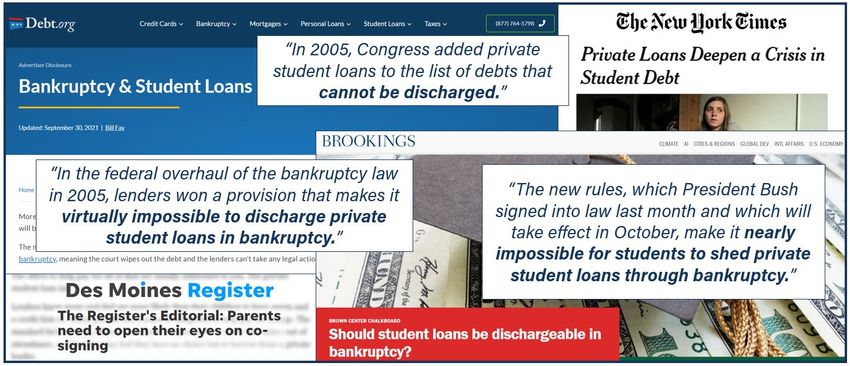
MORALLY BANKRUPT 2022 The Law Clearly Defines Only a Specific Subset of Private Student Loans as Being Exempt from Presumptive Bankruptcy Discharge When a borrower decides to pursue bankruptcy, as part of her application she must list all of her outstanding debts in her bankruptcy petition. At the end of a successful bankruptcy under Chapter 7 of the Bankruptcy Code, generally all debts owed by the debtor and included in her petition are discharged by operation of law. This is the case unless a debt is specifically exempt from discharge under Section 523(a) of the Bankruptcy Code, 8 which provides that certain student loans are not presumptively discharged even if listed on the borrower’s bankruptcy petition. For these covered student loans to be discharged, the borrower must meet a higher burden of financial hardship. Figure 1: Industry, the media, and even scholars perpetuate the myth that all private student loans simply cannot be discharged in bankruptcy. However, not all of what might be referred to colloquially as a private student loan meets the statutory definition of a student loan that is relevant to any exemption from presumptive discharge in bankruptcy. In particular, 8
MORALLY BANKRUPT 2022
Section 523(a)(8) of the Bankruptcy Code exempts only certain educational debts from presumptive discharge,
stating: 9
“(a) A discharge [of personal debt in bankruptcy] . . . does not discharge an individual debtor from any debt —
...
(8) unless excepting such debt from discharge under this paragraph would impose an undue hardship
on the debtor and the debtor’s dependents, for —
(A) (i) an educational benefit overpayment or loan made, insured, or guaranteed by a
governmental unit, or made under any program funded in whole or in part by a governmental unit
or nonprofit institution; or
(ii) an obligation to repay funds received as an educational benefit, scholarship, or stipend; or
(B) any other educational loan that is a qualified education loan, as defined in section 221(d)(1) of
the Internal Revenue Code of 1986, incurred by a debtor who is an individual[.]”
If an “educational loan” or “student loan” does not fit within the ambit of Section 523(a)(8), 10 that debt is treated
just like any other presumptively dischargeable debt, and, if listed on the bankruptcy petition, is discharged
automatically upon entry of a discharge order at the conclusion of the bankruptcy process. 11 Thus, for a student
loan to be excluded from discharge in a typical consumer bankruptcy, it must fall into one of the following three
categories: 12
Student loans made under government or nonprofit loan programs (Section 523(a)(8)(A)(i)). The
first group of debts exempt from presumptive discharge under the law are loans funded by the
government and/or nonprofit institutions. The statute reads, “an educational benefit overpayment or loan
made, insured, or guaranteed by a governmental unit, or made under any program funded in whole or in
part by a governmental unit or nonprofit institution[.]” 13 The first part of this statute—loans “made,
insured, or guaranteed by a governmental unit”—is relatively straightforward, and includes loans made
under both the federal Direct Student Loan Program and the defunct Federal Family Education Loan
Program, as well as loans extended by state or local governments. The second part of the statute’s
clause—referencing loans “made under any program funded in whole or in part by a . . . nonprofit
institution”—was intended to apply to debts for loans made under the National Direct Student Loan
Program, protecting from discharge loans made directly to students by nonprofit colleges and
universities, funded either partially or wholly by the government. 14
9MORALLY BANKRUPT 2022
Conditional educational grants (Section 523(a)(8)(A)(ii)). The second group of exempt debts covers
any “obligation to repay funds received as an educational benefit, scholarship, or stipend.” 15 This
exemption clearly refers to the extension of an educational grant or support that is required to be repaid,
creating a debt. Here, Congress used the term “obligation to repay funds,” not “loan.” “Congress was
certainly aware of the term ‘loan’ and is presumed to have made a conscious decision of when to use it
and when to choose something different.” 16 Section 523(a)(8)(A)(ii) refers to a specific type of defaulted
conditional educational grant, not student loans, and applies to funds received in the character of an
educational benefit—like veteran’s benefits or employment benefits—not funds received in exchange for
an educational benefit, which would illogically cover “a loan for a car used by a commuter student to
travel to and from school every day.” 17 A narrow interpretation dominates the trend of the most recent
slate of decisions, which have looked at this issue using all of the tools of statutory interpretation. 18
Qualified educational loans (Section 523(a)(8)(B)). The third group of exempt debts applies to
“qualified educational loans,” as defined in section 221(d)(1) of the Internal Revenue Code. A qualified
education loan is any indebtedness incurred solely to pay qualified higher expenses, which are limited to
the cost of attendance (as published and concrete) at an eligible educational institution. 19 At a minimum,
a qualified education loan is any indebtedness (i) incurred by a (ii) taxpayer (iii) solely (iv) to pay qualified
higher education expenses (v) which are incurred on behalf of the taxpayer as of the time the
indebtedness was incurred, (vi) which are paid or incurred within a reasonable period of time before or
after the indebtedness is incurred, and (vii) which are attributable to education furnished during a period
during which the recipient was an eligible student. 20
Examining the Definition of a Qualified Educational Loan
To better understand the definition of a qualified education loan, and thus the circumstances under which a
borrower would be denied access to discharge in a typical bankruptcy, it is necessary to examine the elements
outlined above.
First, the term “qualified higher education expenses” is defined in the statute as “the cost of attendance . . . at an
eligible educational institution, reduced by the sum of,” among other things, the amount of any scholarship,
allowance, or such kind of payment. 21 In essence, a qualified educational loan is a loan taken out to pay for
approved educational expenses only at a specific type of approved institution, a so-called Institution of Higher
Education as defined under the Higher Education Act of 1965.
10MORALLY BANKRUPT 2022 There is also an additional relevant aspect to this definition: the borrower’s intention. A qualified education loan requires an element of intentionality that the debt be used solely for qualified higher education expenses. 22 For that reason, lenders cannot create “non-dischargeable” debts by simply labeling them as “undergraduate loans” in advertising or on the relevant credit agreements. 23 College students have credit cards and car loans, and they borrow money from friends and family; indeed, when pursuing a higher education, there is often a great need for borrowing and lending. 24 But every dollar a person borrows while pursuing a higher education is not automatically deemed non-dischargeable because its purpose was to help the student or because it is for an amount below the published “cost of attendance” at the institution they attend. As the courts have ruled, the law “must be applied in a way that provides discernable boundaries between a dischargeable and a nondischargeable debt.” 25 In fact, the Second, the Fifth, and the Tenth Circuit Courts of Appeals have all rejected arguments made by creditors that courts need only confirm that the promissory note expresses an educational purpose for the loan to be non-dischargeable. 26 Figure 2: Many “private student loans” are not “qualified education loans” for the purposes of the bankruptcy code. Finally, the definition of a qualified educational loan must be interpreted narrowly, lest it become an exception that swallows the rule. Were it read to include any loan used to obtain an education of any kind, then its coverage would extend to include those loans already excepted by Section 523(a)(8)(A) in violation of the rule against surplusage. Since Congress did not act so broadly as to except all loans used for an education, as evidenced by 11
MORALLY BANKRUPT                                                                                                    2022

its particular attention to the first two identified groups, this final group must be understood to be equally as
precise.

The various components of the definition of a qualified education loan may seem complex and arbitrary, but they
are natural outgrowths of the term’s origin. Starting in 1978 and culminating in 1998, Congress narrowed and
                                           eventually completely limited the dischargeability of federal student
Congress limited
                                           loans. 27 In 2005, private education lenders and debt collectors
protection for private
                                           successfully lobbied Congress to extend provisions limiting
education loan
                                           dischargeability to certain private student loans. 28 However, in doing so
borrowers in bankruptcy
                                           Congress limited protection for private education loan borrowers in
only to the extent that
                                           bankruptcy only to the extent that their private student loans
their private student
                                           supplemented and mirrored federal student lending. Loans that do not
loans supplemented and
                                           fall into the narrow subset of being directed to eligible students at
mirrored federal student
                                           accredited schools for expenses such as tuition, room, board, and
lending.
                                           books do not mirror federal student loans, and therefore were not
meant to face similar limitations to federal student loans in bankruptcy. 29

12
MORALLY BANKRUPT 2022
Creditors Have Developed Various Products
That are Advertised as Private Student Loans
but are Not “Qualified Education Loans” for
the Purpose of Bankruptcy Law
Although commercial lenders could originate the newly non-dischargeable qualified education loans that
Congress created in 2005, they were not satisfied with the origination volume that this business line produced. 30
The paperwork these loans involved was burdensome, schools would not agree to certify loan sums that
exceeded students’ cost of attendance, and the Title IV accreditation
requirement prevented lending to students at thousands of for-profit
Regardless of corporate
colleges and institutions that had not obtained Title IV accreditation. 31
branding, public
Looking to sidestep these hurdles, private commercial lenders initiated misconceptions, or
new programs that lent money directly to students, bypassing schools’ industry’s underhanded
financial aid offices and creating a channel to reach students attending insistence, these forms of
non-accredited schools. 32 credit were always and
remain presumptively
Of course, while these products are and were generally advertised as dischargeable in
being or strongly resembling something commonly thought of as a bankruptcy.
private student loan, key aspects of their design place them outside of
the statutory definition of non-dischargeable qualified education loans discussed above. Indeed, regardless of
corporate branding, public misconceptions, or industry’s underhanded insistence, these forms of credit were
always and remain presumptively dischargeable in bankruptcy.
The following are only a few examples of the various types of credit products available in the market that are
presumptively dischargeable under the law, even though they are branded as private student loans and often
improperly exempted from discharge by the courts.
13MORALLY BANKRUPT 2022
Direct to Consumer Loans
In the early 2000s, commercial lenders began experimenting with a new student loan product called the “direct
to consumer” (“DTC”) loan. 33 DTC loans were marketed and disbursed outside of financial aid offices to avoid
regulatory restrictions under the Higher Education Act that prohibited lenders from originating loans for more
than a school’s published cost of attendance. 34 Accordingly, DTC loans are not typically qualified education loans
because they often a) exceeded the cost of attendance (or exceeded the cost of attendance less other federal aid
and/or qualified education loans already received), 35 b) were made to ineligible students, and/or c) were made to
students at non-accredited schools. These DTC loans are presumptively dischargeable in bankruptcy.
A prominent example of these DTC products is the Tuition Answer Loan that Sallie Mae introduced in 2004. 36
Sallie Mae described the loan by saying, “[u]nder the Tuition Answer loan program, creditworthy parents,
sponsors and students may borrow between $1,500 and $30,000 per year . . . to cover any college-related
expense. No school certification is required, although a borrower must provide enrollment documentation.” 37
Clarifying the definition of a “college-related” expense, Sallie Mae touted in advertising materials that these loans
could be used for anything “from tuition and books to living expenses and even laptops.” 38 This set of uses
notably departs from the limited set of “qualified higher education expenses” that a loan must be used exclusively
for if it is to be a non-dischargeable qualified education loan, which are strictly based on a college’s listed cost of
attendance. 39
In order to make its DTC loans look like non-dischargeable qualified education loans, Sallie Mae inserted
representations and warranties into the promissory notes that read, “I certify that this is a qualified education
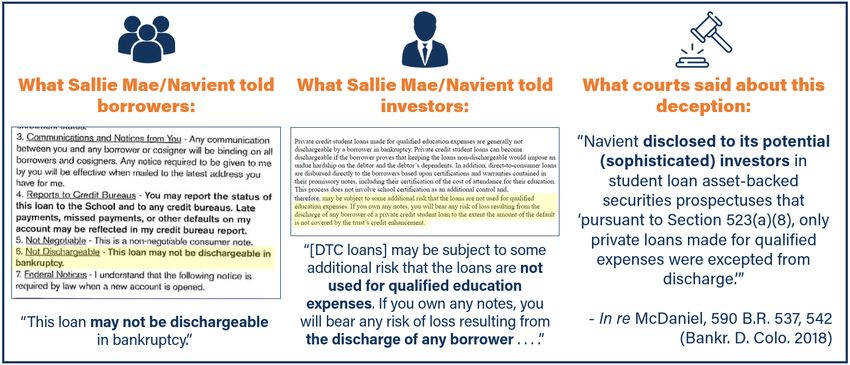
loan as that term is defined in 26 U.S.C. § 221(d),” and, “Not Dischargeable: This loan may not be dischargeable
in bankruptcy.” 40 These legal conclusions purport to affect a pre-petition waiver of discharge, and are therefore
unenforceable. 41 As discussed below, they are also deceptive because they intentionally foster and perpetuate
the false net impression that the loans are not dischargeable in bankruptcy. Years after this deceptive marketing,
courts are beginning to confirm that loans like Tuition Answer Loans are not “qualified education loans” and may
therefore be discharged through bankruptcy as a matter of course. As a judge in one case ruled: 42
“Tuition Answer Loans were made through the Defendants' direct-to-consumer lending program,
and not through the financial aid office of an eligible school. And for this reason, the loans were
not limited in amount, and could be for sums that were ‘above and beyond the published cost of
attendance.’”
14MORALLY BANKRUPT 2022 In contrast to their consumer-facing representations, when Sallie Mae and its successor, Navient, later sold these loans to sophisticated investors, they explicitly disclosed that DTC Loans bore a risk of discharge. 43 As one court noted, “Navient disclosed to its potential (sophisticated) investors in student loan asset-backed securities prospectuses that ‘pursuant to Section 523(a)(8), only private loans made for qualified expenses were excepted from discharge.’” 44 Many additional prominent examples exist of firms such as Navient engaging in this duplicitous double-speak. 45 Figure 3: Sallie Mae and Navient actively lied to borrowers, all while telling investors on Wall Street the truth to avoid liability. The latter disclosures underscore the reality of the situation. DTC loans may, as above, be private credit advertised as helping students address college-related expenses. However, these products nevertheless fall far outside of the definition of qualified education loan relevant to the Bankruptcy Code. As Sallie Mae and Navient’s actions illustrate, many of the companies originating, securitizing, holding, and/or servicing these loans are and have always been well aware of this fact. Loans to Students at Non-Accredited Schools and Institutions To be eligible for Title IV funding, including federal student loans and grants, an institution of higher education must “satisfy the program integrity triad, under which it must be: 15
MORALLY BANKRUPT 2022
licensed or otherwise legally authorized [by a state agency] to operate in the state in which it is
physically located;
accredited or pre-accredited by an agency recognized for that purpose by the Department of Education
(ED); and
certified by ED as eligible to participate in Title IV programs.” 46
As mentioned above, a private student loan can meet the definition of a qualified education loan only if (among
other requirements) the institution a student uses the loan to attend is eligible for Title IV funding. In turn, this
means that a private student loan can be a qualified education loan only if it is used to finance attendance at a
school that has been both licensed or authorized by the relevant state regulator in the state where the school is
physically located and accredited by an accrediting agency recognized by the Department of Education.
Many of the DTC loan products created in the early 2000s were marketed toward students attending non-
accredited schools. 47 Because these schools were not Title IV-eligible, loans made to students attending them
necessarily fail to meet the statutory limitation that qualified education loans include only those loans made to
students at Title IV-eligible institutions. 48 Loans made to students at non-accredited schools are therefore not
qualified education loans for the purposes of the Bankruptcy Code. Like student credit card debt, these loans are
simply unsecured consumer debts, and they are discharged automatically upon entry of a discharge injunction.
The intersection of predatory lending, non-accredited schools, and misrepresentations surrounding
dischargeability in bankruptcy has created a great risk for a uniquely vulnerable population of consumers.
Predatory schools' recruiting often targets communities of color,
The intersection of predatory
and the lack of even an accreditor's loose oversight for non-
lending, non-accredited
accredited schools means that their educational product is likely to
schools, and
be sub-par, therefore increasing the likelihood that the borrower
misrepresentations
will need to seek bankruptcy protection. 49 These schools are also
surrounding dischargeability
likely to drive students toward various forms of risky and expensive
in bankruptcy has created a
private credit, exacerbating the consequences of poor educational
great risk for a uniquely
outcomes. 50 This is the backdrop against which borrowers are
vulnerable population of
seeking to discharge their unaffordable credit, and why the
consumers.
affirmation of their right to do so is so important.
16MORALLY BANKRUPT 2022 As above, the actions of the private student loan company Navient are notable with regard to efforts to block borrowers from discharging loans from non-accredited schools. One party to the case Crocker v. Navient, Michael Shahbazi, took on a $11,658.99 Sallie Mae Career Training loan in 2002 to finance attendance at STMC, a non-accredited technical school in Virginia. 51 Shahbazi was told that his loan was “an education loan that must be repaid,” playing into the false perception that his loans would not be presumptively dischargeable in bankruptcy. 52 But this was false. Because the school that Shahbazi attended lacked accreditation and was therefore not eligible for Title IV aid, any private credit extended to finance attendance at that institution necessarily fell outside of the definition of a qualified education loan for the purposes of discharge in bankruptcy. 53 Nevertheless, even after Shahbazi declared bankruptcy in 2011 and had all “properly scheduled pre-petition debt” discharged, Navient—which by that time had taken ownership of the loan from Sallie Mae—continued to collect on his loan. 54 Navient hired collectors who regularly and harassingly demanded Shahbazi pay on the discharged debt, contacting him multiple times per day and even calling his mother-in-law, his brother, and his wife’s employer. 55 This happened, as described above, just as Navient warned investors in securities backed by loans like Shahbazi’s that these debts were “generally dischargeable by a borrower in bankruptcy.” 56 Courts across the country have gone on to affirm that Shahbazi’s loans and ones like them are presumptively dischargeable due to their having financed attendance at a non-Title IV school. 57 17
MORALLY BANKRUPT                                                                                                   2022

Creditors Have Developed Various Predatory
Tactics to Keep Borrowers from Discharging
their Debts and to Continue Collecting on
Debt that Has Already Been Discharged
Prior to 2005, Section 523(a)(8) of the Bankruptcy Code was easy to apply because it denied special bankruptcy
treatment to all private student loans made by commercial lenders. If a student loan was issued or guaranteed by
the federal government, it was non-dischargeable absent a showing of “undue hardship.” All other student loans
received the same bankruptcy treatment as other types of consumer debt. When Congress amended the
Bankruptcy Code to give special treatment to certain private student loans in 2005, it fueled the belief that all
student loans are non-dischargeable—a belief that was echoed and cemented by industry and the media. 58 But
private lenders were only given qualified protection in 2005 such that, as discussed above, Section 523(a)(8)(B)
exempts a limited set of private education loans from discharge. 59 This situation created an opportunity for
unscrupulous creditors to exploit the application of Section 523(a)(8) and to deceive debtors into thinking that all
private student loans, like their federal counterparts, were non-dischargeable.

This problem was made worse because Section 523(a)(8) is “self-executing,” meaning that its correct application
relies on the good faith and honesty of creditors. In particular, when a debtor files a bankruptcy petition, the
debtor includes all unsecured debts on a “Schedule F” form, listing only the amount of the debt, the name of the
creditor, and the consideration received. After demonstrating compliance with the Bankruptcy Code, a court then
issues an order discharging all pre-petition debts listed on the bankruptcy petition except for those covered by
Section 523(a). 60 But the discharge order does not specifically enumerate which loans, if any, have been
discharged and which ones have not. Rather, it simply states generally that the order does not discharge some
debts, including “debts for most student loans.” Against the backdrop of the widely accepted narrative that all
forms of private credit used to help students attend college are non-dischargeable, this ambiguity is likely to
leave borrowers under the impression that their loans were exempted and are still owed.

If a creditor believes that a debt they hold is excepted from discharge, they have the legal burden to prove that
the debt is encompassed by Section 523(a)(8). 61 To meet this burden, the creditor must prove that it is more likely
than not that the debt falls entirely within the meaning of one of Section 523(a)(8)’s exceptions. 62 Once the

18
MORALLY BANKRUPT                                                                                                 2022

creditor proves the debt is presumptively non-dischargeable, the debtor must prove that repaying the debt would
constitute an “undue hardship” in order to receive a discharge of that debt. 63 Thus, any educational debt not
encompassed by Section 523(a)(8) is automatically and as a matter of law discharged upon entry of the
discharge order. 64

                                              Unfortunately, this burden-shifting framework rarely plays out so
Borrowers who have already
                                              simply for the borrower in practice. Often, unscrupulous creditors
been through the
                                              continue collections activity even in the face of a discharge order
bankruptcy process but who
                                              and it is left to the debtor to initiate either an adversary proceeding
labor under the widespread
                                              to specifically determine the dischargeability of the debt or an
belief that private student
                                              action asking the court to enforce the discharge injunction. 65
loans cannot be discharged
in bankruptcy may therefore                   The creditor’s good faith and the threat of sanctions are the only

not even know that they                       checks on compliance with discharge injunctions. Accordingly, the

have already been freed                       upshot for borrowers is deceptively simple. If a borrower has gone

from their debts.                             through bankruptcy while owing a so-called “private student loan”
                                              that is not entitled to special treatment in bankruptcy and a creditor
did not take specific steps in court to prevent that debt from being discharged, then the debt has already
automatically been discharged. However, even borrowers well-versed in this niche area of bankruptcy law will
likely need further court intervention to force creditors to comply with the law. Worse still, borrowers who have
been through the bankruptcy process but who labor under the widespread belief that private student loans
cannot be discharged in bankruptcy may therefore not even know that they have already been freed from their
debts.

Of course, borrowers’ misunderstanding may involve not just passive ignorance but rather may be the result of
active steps by student loan companies to keep borrowers in the dark. The following are a few of the ways that
student loan companies have attempted to prevent borrowers from accessing or enjoying their right to
discharge.

19
MORALLY BANKRUPT 2022 Creditors Manipulate the Application of Section 523(a)(8) and Deceive Debtors into Believing their Non-Qualified Student Loans Were Not Discharged Not content with the protections won from Congress in 2005, creditors soon devised a scheme to leverage the widespread presumption of non-dischargeability and deceive debtors and the bankruptcy courts into thinking that all private student loans—both qualified and non-qualified, made to students at both accredited and non- accredited schools—were excepted from discharge. To effectuate this fraud, creditors represented to student debtors that the Bankruptcy Code prohibited discharge of any loan made to any person for any educational purpose. 66 Low-income students who lack the resources and knowledge to seek relief in an adversary proceeding, which is an expensive and time-consuming undertaking, are disproportionately likely to struggle to repay on private student loans. 67 And only one tenth of one percent (0.1 percent) of debtors in bankruptcy actively seek to discharge their student debts, an affirmative right they have at their disposal even given creditors’ existing obligation to establish that a given debt was not discharged in bankruptcy. 68 In the rare event a debtor has filed an adversary proceeding seeking a determination related to dischargeability of their student loans, creditors often settle or forgive student debts that were already legally discharged. Further, when lenders put language into a contract expressly invoking 523(a)(8), some courts have declared the loans non-dischargeable. 69 Even if the lenders do not use the same statutory language in their promissory notes, some courts will conclude that any education-related statement related to use of the proceeds of the loans is close enough for the loan to fall under 523(a)(8). 70 With these traps in place, a law that was originally designed to prevent students from taking advantage of the bankruptcy system has enabled unscrupulous creditors to take advantage of the bankruptcy system. 71 Creditors Collect or Attempt to Collect on Discharged Debt Though many of the loans considered here are presumptively dischargeable in bankruptcy, lenders nevertheless continue to collect on them post-bankruptcy. 72 For example, in one case the plaintiffs obtained bankruptcy discharges for their non-qualified education loans (DTC loans owned by Navient), but alleged that even after discharge “Navient had both of these plaintiffs contacted frequently by telephone and email to demand repayment” of their loans. 73 In another case, even after the bankruptcy discharge of non-qualified education loans, the plaintiff alleged that the lender “sought to collect on his debts by use of ‘dunning letters, phone calls, 20
MORALLY BANKRUPT                                                                                                 2022

negative reports made to credit bureaus, failure to update credit reports, and commencing or continuing legal
action to recover’ on the discharged debt.” 74

When private citizens have responded to predatory action along these lines by bringing suit to enjoin creditors
from continuing to collect on discharged private student debts, the courts have agreed that their loans are
presumptively dischargeable and were, in fact, discharged during preceding bankruptcy. 75 In Homaidan v. Sallie
Mae, Inc., the U.S. Second Circuit Court of Appeals held that two DTC Tuition Answer Loans issued by Sallie Mae
Inc. were not presumptively excepted from discharge by Section 523(a)(8)(A)(ii), finding that it stretched the
limits of the English language and rules of statutory interpretation to read private student loans into the scope of
“funds received as an educational benefit.” 76 Unfortunately, some courts have also concluded that, while these
loans are presumptively dischargeable, debtors cannot bring claims for injunctive relief to stop unlawful post-
discharge collection activity outside of the bankruptcy court where their original bankruptcy proceeding
occurred. 77 Consumers’ ability to prevent unlawful post-discharge collection against themselves is therefore
somewhat limited, but worse their ability to act as private attorneys general and protect their fellow consumers is
all but non-existent.

Illustratively, in 2017, while the In re Cocker case was pending, the bankruptcy
                                                                                           Navient’s CEO
court was able to convince Navient to temporarily stop collecting on DTC loans
                                                                                           acknowledged the
on a nationwide basis as a “responsible corporate citizen.” 78 Unfortunately, faced
                                                                                           presumptive
with a ruling that DTC loans are presumptively dischargeable but that
                                                                                           dischargeability of
consumers’ ability to stop post-discharge collection was limited, Navient did not
                                                                                           the company’s DTC
proactively change its collection policies. Instead, the company’s CEO
                                                                                           loans but implied
acknowledged the presumptive dischargeability of the company’s DTC loans but
                                                                                           that enforcement of
implied that enforcement of the ruling would be nearly impossible, saying
                                                                                           the ruling would be
“[W]hile these loans may in fact be dischargeable, the [bankruptcy judge] was
                                                                                           nearly impossible.
wrong when he found that the plaintiffs had jurisdiction to bring these claims
outside of the bankruptcy court that originally heard their bankruptcy case.” 79 This attitude appears to be
representative of the industry’s approach, and the need for federal and state law enforcement to act on this issue
is therefore clear.

21
MORALLY BANKRUPT 2022
Law Enforcement Must Step in to Protect
Borrowers
The Scope of the Problem is Massive
The fact pattern laid out above makes clear that borrowers are already being taken advantage of nationwide. But
even that does not capture the full scope of the problem. For numerical scale, we estimate that almost $50
billion private student loans owed by more than 2.6 million people may be presumptively dischargeable in
bankruptcy.
Those figures stem from a combination of three underlying estimates: the proportion of private student loan debt
that has been used for expenses that make them ineligible to qualify as “qualified education loans,” the
proportion of private student debt that has been used to finance attendance at non-Title IV schools, and the
proportion of private student loan debt to owed by students who were not “eligible students” for the purposes of
the definition of a qualified education loan when they took on the relevant credit. 80 In turn, those underlying
estimates consist of the following:
The proportion of private student loan debt used for ineligible expenses: Between 2005 and 2011,
lenders originated $98 billion in private student loans. 81 Based on Consumer Financial Protection Bureau
(“CFPB”) data, we estimate that 10 percent of private student loans originated overall between 2005 and
2011 overall were DTC loans. 82 DTC lending was severely restricted after 2010, and we therefore cannot
suppose that these numbers can be extrapolated across all private student loan originations over time. 83
But the total amount of private student debt originated between 2005 and 2011 constitutes roughly 59
percent of all private student debt originations between 2000 and 2014 (roughly the time period
bounding the rise and fall of most DTC lending). 84 Thus, if we multiply 10 percent (the total share of
private student loans originated between 2005 and 2011 that we estimate were DTC loans) by 59 percent
(private student loan debt originated from 2005 to 2011 as a proportion of all private student loan debt
originated from 2000 to 2014), we can conservatively estimate that 6 percent of private student loans
originated between 2000 and 2014 were presumptively dischargeable DTC loans.
22MORALLY BANKRUPT 2022
The proportion of private student loan debt used to finance attendance at ineligible schools: An
estimate of the overall share of private student loans that are presumptively dischargeable because they
financed attendance at non-Title IV eligible programs can be extrapolated based on Sallie Mae’s
portfolio. Sallie Mae offers various credit products aimed at specific student populations.85 Sallie Mae
describes one product, the Career Training Smart Option Student Loan (“Career Training loans”), as
being designed for students attending “professional training and trade certificate courses (culinary,
technical, etc.) at a non-degree-granting school.”86 Sallie Mae’s then-CEO Tim Fitzpatrick clarified in
2007 that these loans are “not made to the Title IV-sponsored schools, they're made to the non-Title IV
certificates and 2-year award granting programs.”87 Accordingly, Career Training loans are generally not
qualified education loans for the purposes of the Bankruptcy Code.
Sallie Mae has disclosed that it originated $3.97 billion in Career Training loans between 2003 and 2010
in a rise-and-fall trajectory typical of the industry for that period.88 The company has also disclosed that it
originated $40.96 billion in “private education loans” as a whole during that same timeframe.89
Accordingly, Sallie Mae’s Career Training originations constitute 9.7 percent of its self-described private
student loan originations from 2003 to 2010. Assuming that this rate of Career Training loan origination
as a proportion of overall private student lending is representative of the company’s lending from the
2000 to 2014 period discussed above, and that—given Sallie Mae’s position as one of the largest players
in the private student loan market during that time90—the company’s actions are representative of most
other firms in the market, we can estimate that roughly 10 percent of all private student loans made from
2000 to 2014 were made to students attending non-Title IV eligible programs. As mentioned, these loans
are not qualified education loans for the purposes of the bankruptcy code.
The proportion of private student loan debt used to finance ineligible students: Estimates of
ineligible students admittedly do not involve the same reliability as figures drawn directly from SEC
disclosures and government data. However, reasonable assessments can nonetheless be made. Eligible
students are required to be: (1) US citizens and (2) attending school half-time or more.91 There are no
reliable estimates of the number of non-US citizen student loan borrowers. However, available estimates
reveal that roughly 14 percent of all college students in 2012 were attending school less than half-time.92
Admittedly, this says nothing of the actual proportion of students attending school less than half-time
who also took on student loan debt. But it should be noted that since these students are not eligible for
federal funding, they effectively have no other generalizable source of financial aid beyond private
lenders, and the cost of college remains high even for these part-time students. Accordingly, it is
reasonable for the present purposes to assume that 14 percent of students from 2000 to 2014 were
23MORALLY BANKRUPT 2022
enrolled less than half-time and therefore that any debts these students took on, assuming those debts
were in roughly equal proportion to enrollment, were not qualified education loans.
We may conclude that as much as 30 percent of all private student loans originated between 2000 and 2014
were not qualified education loans (6 percent + 10 percent + 14 percent). If that is the case, almost $50 billion in
private student loan debt may be presumptively dischargeable.93 Moreover, given available data on average
private student loan balances, it is possible to conclude that more than 2.6 million borrowers took on these
presumptively dischargeable debts.94
Figure 4: More than 2.6 million borrowers took on $50 billion in presumptively
dischargeable education debt.
Law enforcement agencies at all levels must wield the full set of tools at their disposal to hold private companies
accountable for violating borrowers’ right to discharge in bankruptcy in this massive market.
This estimate obviously relies on several assumptions and intermediate estimations. As enumerated in the
accompanying footnotes, these assumptions are generally conservative. Nevertheless, the scope of uncertainty
present only underscores the need for those with more rigorous investigative tools—such as state and federal
law enforcement—to study the issue.
24MORALLY BANKRUPT 2022 Private Enforcement and Bankruptcy Pose Key Challenges Debtors have struggled to prevent creditors from or punish creditors for collecting or attempting to collect on discharged debts. Courts have denied debtors the ability to use the class action litigation process to sue creditors who repeatedly collect or attempt to collect on discharged debt. 95 Several courts of appeals have also limited debtors ability to use the contempt proceeding to recover damages for violations of bankruptcy discharge orders through collecting or attempting to collect on a discharged debt. 96 Thus, according to case law, the only remedy would be for each debtor to sue for damages or sanctions for violations of the discharge order through a contempt proceeding in the bankruptcy court that filed the discharge order. Such a piecemeal and expensive process of individual contempt proceedings is not feasible for or attractive to debtors and bankruptcy lawyers and without a change in the law, leaves the offending creditors free to continue this abusive practice nationwide. As it stands, the litigants appear unable to permanently correct the problem outside of their respective jurisdictions that have allowed enforcement of discharge orders—the Southern District of Texas and the Eastern District of New York. Though the Fifth Circuit did not reach the issue of class certification, it seems that because of the identified limitation on enforcement (combined with the lack of precedent for certification of a class that includes debtors whose discharges were entered by bankruptcy courts in other districts), certifying such a class would be highly dubious. 97 Consequently, success in the Crocker 98 and Homaidan 99 cases is unlikely to lead to relief for debtors who filed bankruptcy in Illinois, for example. Debtors have also tried to tackle this issue through claims under the Fair Credit Reporting Act (“FCRA”), 100 the Fair Debt Collection Practices Act (“FDCPA”), 101 and even the antitrust laws which, while valuable tools, do not build into bankruptcy court case law determining what specific classes of debts are discharged under Section 523(a)(8). 102 The Consumer Financial Protection Bureau, Federal Trade Commission, State Attorneys General, and State Financial Regulators Should Protect Borrowers by Exercising their Ability to Enjoin and Remedy Unfair, Deceptive, and Abusive Acts and Practices The Consumer Financial Protection Act (“CFPA”) prohibits “unfair, deceptive, or abusive acts or practices in connection with any transaction with a consumer for a consumer financial product or service,” 103 which is defined 25
MORALLY BANKRUPT                                                                                                  2022

to include “extending credit and servicing loans.” 104 Similarly, the Federal Trade Commission Act prohibits “unfair
or deceptive acts or practices” in trade or commerce. 105

In addition to federal prohibitions on unfair and deceptive conduct, all states have adopted generally applicable
consumer protection statutes that prohibit unfair or deceptive acts and practices in trade or commerce. Some
state consumer protection statutes broadly prohibit “unfair or deceptive acts or practices in the conduct of any
trade or commerce,” 106 while others prohibit more targeted categories of harmful practices, such as
misrepresentations concerning the nature of or obligations incurred in a credit transaction. 107 This federal and
state authority applies to unfair and deceptive practices throughout the loans’ lifecycles, from origination to
servicing and collection.

Origination and Pre-Discharge Servicing and Collection

The practices that lenders have historically employed to deceive borrowers into believing that private student
loans that do not fall within the definition of a “qualified education loan” were and are not dischargeable in
bankruptcy are particularly troublesome because they occur in the context, discussed above, of widespread
consumer misunderstanding of student loan dischargeability. While lenders were (and are) not entirely
responsible for the general environment of consumer confusion, they have both contributed to and benefited
from it. Moreover, because whether an act or practice is “deceptive” is determined based on the “least
sophisticated consumer” standard, 108 a loan origination marketplace that encourages misrepresentations
requires strict honesty and extra care from lenders to avoid creating a deceptive “net impression” amongst the
least sophisticated consumers. This is particularly true where the less sophisticated consumers in the market—
those taking out loans to attend non-accredited schools that are not eligible for Title IV funds, and those who
most likely need to borrow more than a school’s own calculated cost of attendance—are the most likely to
engage with the loan products where the popular wisdom is incorrect.

It is against this backdrop that lenders engaged in practices that created the false impression that borrowers’
presumptively dischargeable private student loans were or are either (a) non-dischargeable, or (b) subject to the
“undue hardship” requirement. As noted above, certain Sallie Mae DTC loans included the following statement:
“Not Dischargeable: This loan may not be dischargeable in bankruptcy.” This statement is false, because as
explained above these DTC loans do not meet the statutory requirements for qualified education loans and are
therefore presumptively dischargeable through the ordinary bankruptcy process. Sallie Mae’s DTC loans also
include a “certification” purportedly made by the borrower, stating that “I certify that this is a qualified education
loan as that term is defined in 26 U.S.C. § 221(d).” While this statement is couched as a representation by the

26
MORALLY BANKRUPT                                                                                                   2022

borrower, it was drafted by the lender, and presented to the borrower as part of a contract of adhesion. 109
Generally, disclosures and certifications are required where the information asymmetry runs in the opposite
direction—i.e., the party with more information is required to certify or disclose it for the protection and benefit of
the party with less information. That paradigm is inverted by the certification, which is drafted by the lender (who
knows it to be false) but signed or made by the borrower, who has significantly less knowledge and
sophistication concerning student loans and bankruptcy. As a result, this “certification” is problematic in at least
three respects.

First, for sophisticated borrowers who look up and read the statute—either during or after origination—it creates
a deceptive net impression that the loan is only dischargeable in bankruptcy upon a showing of “undue
hardship.” Borrowers are likely to be deceived by the false representation implicit in the lender-drafted
certification due to a background belief that a lender would not ask them to certify a fact that the lender knew to
be false.

Second, even if the borrower subsequently discovers that the certification is false, the certification unfairly deters
borrowers from seeking discharge of the loan in bankruptcy by raising the specter of the bankruptcy court
finding wrongdoing on the part of the borrower arising from the false certification, with unknown consequences.
Thus, even though the lender drafted the certification knowing it to be false, it is the borrower who signs it and
stands to suffer as a result.

Third, the false certification provides the lender—which knows or should know it to be false—with an opportunity
to deceive the bankruptcy court and prevent an order of discharge. In this manner, the certification acts as a pre-
petition waiver of dischargeability, which is disallowed as discussed above. 110 Lenders should not be permitted to
accomplish through deception what they cannot through operation of a non-deceptive agreement.

Fourth, the false certification provides the lender with an opportunity to deceive the court by claiming a good
faith mistake or bona fide error in an attempt to avoid liability for post-discharge collection attempts, discussed
below.

In addition to misrepresentations during the origination of non-qualified education loans, lenders, servicers, and
collectors may also engage in unfair or deceptive acts or practices by misrepresenting the dischargeability—and
circumstances under which a discharge may be had—of student loans. For example, in Easterling v. Collecto,
Inc., 111 the Second Circuit held that collection letters falsely stating that a federally guaranteed student loan was
not dischargeable in bankruptcy—rather than dischargeable, but only upon a showing of “undue hardship”
discussed above—were deceptive.

27
You can also read


