NATIONAL INTEGRITY INDEX 2018 - Local Authorities - Transparency International Ireland
←
→
Page content transcription
If your browser does not render page correctly, please read the page content below
NATIONAL
INTEGRITY
INDEX 2018
Local Authorities
Transparency International Ireland is an independent, non-profit and
nonpartisan organisation. Our vision is of an Ireland that is open and
fair – and where entrusted power is used in the interests of everyone.
Our mission is to empower people with the support they need to
promote integrity and stop corruption in all its forms.

www.transparency.ie

Author: Kelly McCarthy
Editor: John Devitt
Assistant Researcher: Pauline Lowe
Additional copy-editing: Angela Long
Design: sophieeverett.com.au
© Cover photo: iStockphoto

(CC) Transparency International (Ireland) Limited 2018. This work is licensed under
a Creative Commons AttributionNonCommercial-NoDerivatives 4.0 International
License. Any use of or reliance on the information contained in this report is solely
at the user’s risk.

This study was published with the financial support of the Community Foundation
for Ireland, however, it reflects the views of Transparency International Ireland
alone. Neither Transparency International Ireland nor the Community Foundation
for Ireland can be held responsible for any use which may be made of the
information contained herein.
NATIONAL
INTEGRITY
INDEX 2018
Local Authorities
CONTENTS
04      INTRODUCTION

06      RESULTS

10      RECOMMENDATIONS
10      Local authorities
11      Department of Housing, Planning and Local Government
11      Local Government Management Agency and County and City Management Association
11      Legislators, including with regard to the Public Sector Standards Bill 2015
12      Standards in Public Office Commission/Lobbying Regulator
12      Office of Government Procurement

13      FINDINGS
13      Looking at the data
15      Planning
15      Ethics
16      Investigations
16      Meeting minutes
16      Revolving doors
17      Lobbying
17      Freedom of Information
18      Protected disclosures
19      Internal audit
19      Fraud and Corruption Prevention and Contingency Plans
19      Local Government Management Agency and the County
        and City Management Association

02   Transparency International Ireland
20 CONCLUSION
21 ANNEX – NATIONAL INTEGRITY INDEX – LOCAL AUTHORITIES
– METHODOLOGICAL NOTE
21 Development of the methodology
21 Structure of the methodology
22 Data collection
23 END NOTES
TABLES AND PLOTS
07 Table 1 – Summary Results
07 Figure 1 – Map of Results
08 Table 2 – Full Results
13 Plot 1 – NII Score versus Percentage of Senior Management Positions Held by Women
14 Plot 2 – NII Score versus the Number of Full Time Equivalent Employees
18 Image 1 – FOI Publication Schemes
National Integrity Index 2018 03INTRODUCTION
There are 31 local authorities in Ireland. Each of them provides essential services relating to
housing, planning, transportation, libraries, community and culture events and more. The 949
elected councillors across Ireland make critical decisions that affect the lives of millions of people.
With such an influential role, and total spending in 2017 of over €4 billion, it is critical that local
authorities uphold the highest standards of transparency, accountability and ethics, to ensure
fairness and effectiveness in the provision of services to citizens.1
The findings of the Mahon Tribunal into planning and When public institutions lack effective systems and
local government, as well as the RTÉ Investigates safeguards against corruption, this can result in
exposé on ethics in local councils in 2015, pointed to decisions being made for personal gain rather than in
significant shortcomings in local government’s anti- the public interest. Corruption in local authorities can
corruption controls and integrity systems. The objective have a negative impact on the quality of regulation,
of this study is to further examine these systems and planning, zoning, and public contracting. It has a longer-
provide a set of benchmarks for local authorities to term impact on the natural and built environment. The
help measure any improvement in their anti-corruption burden of such corruption is ultimately borne by local
controls and integrity systems. communities and ordinary citizens.
The study ranks local authorities against three This report includes a set of recommendations for
criteria: Transparency, Accountability and Ethics. TI various local government stakeholders. These include
Ireland developed a total of 30 indicators relating the following recommendations to local authorities:
to these criteria. Where local authorities fulfilled an
indicator, they received a point, and where they did >> Develop and maintain up-to-date,
not fulfil the indicator, they received zero points. The comprehensive Corruption and Fraud
local authorities’ final score is then presented as a Prevention and Contingency Plans;
percentage of how many indicators out of the 30 were
>> Ensure adequate handover between
fulfilled. The Methodological Note at the end of this
ethics registrars;
study provides further information on how the rankings
were calculated and how the data was collected. >> Use one continuous email address for ethics
registrar-related work that can be passed on
This study also draws from the findings of Transparency
to subsequent ethics registrars;
International Ireland’s (TI Ireland) 2009 and 2012
National Integrity Systems (NIS) studies, which looked >> Ensure that all consultations that qualify as
at how well-prepared Irish laws and institutions, pre-planning consultations under Section 247
including local authorities, were to stop corruption of the Planning and Development Act 2000
in all its forms.2 The NIS studies looked at various (not just formally requested consultations)
institutions, such as public sector agencies, law are adequately documented;
enforcement agencies, political parties, civil society,
and the business sector. This index and study on >> Develop and maintain up-to-date, comprehensive
local authorities marks the first in a series of National webpages with ethics and governance information;
Integrity Indices that TI Ireland plans to produce.
>> Publish as much information as possible in
machine-readable format, rather than in PDF form;3
>> Ensure meaningful public engagement
in the preparation of City and/or County
Development Plans;
>> Publish information on Strategic Policy Committees
and Local Community Development Committees.
04 Transparency International IrelandThis report also includes recommendations for Recommendations for the Standards in Public
the Department of Housing, Planning and Local Office Commission (SIPO) and the Lobbying
Government (DHPLG): Regulator include:
>> Develop a training curriculum and deliver training >> Provide more guidance and/or a webpage
to ethics registrars on their roles in the handling template for local authorities on what to post on
of complaints; their websites with respect to the Regulation of
Lobbying Act;
>> Provide guidance to the local authorities towards
the development of comprehensive plans for >> Support the DHPLG on the development of
investigating suspected wrongdoing, including procedures to investigate possible contraventions
contraventions of Part 15 of the Local Government of Part 15 of the LGA 2001.
Act 2001 (the Ethical Framework for the Local
Government Service); These recommendations are provided in further detail
on page 10.
>> Introduce software to digitise the submission of
declarations of interests;
>> Ensure the Outside Appointments Board (OAB)
for the Local Government Sector shares more
information on its work with the public.
Corruption in local authorities
Recommendations for the Local Government
can have a negative impact
Management Agency (LMGA) and the County and City on the quality of regulation,
Management Association (CCMA) include:
planning, zoning, and public
>> Publish agendas and minutes of LGMA and CCMA
board meetings; provide more information on the contracting. It has a longer-
composition and activities of their committees; and
provide more information on the LGMA website
term impact on the natural and
and its CCMA webpage; built environment. The burden
>> Ensure clarity in the guidance provided to local of such corruption is ultimately
authorities on protected disclosures policies
and procedures, with regard to the role of the
borne by local communities
ethics registrar. and ordinary citizens.
National Integrity Index 2018 05RESULTS
Galway City Council tops the National Integrity Index (NII) on Local Authorities for 2018, receiving 21
points out of 30, two more than the councils that came in second place. Galway City Council had the
highest score in the Ethics category, as well as the joint-highest score in the Accountability category
(Table 1 provides the summary results, while Table 2 provides a further breakdown of results based
on the three categories).
Fingal County Council and South Dublin County DHPLG regulations and circulars and SIPO guidance.
Council came in joint-second in the rankings, with TI Ireland included some indicators that are based on
19 points out of 30, while Dublin City Council and best practice, rather than existing standards, such as
Monaghan County Council came in joint-fourth the online publication of Chief Executive diaries and
place, with 18 points. Dublin City Council and South the online publication of data on enforcement of Part
Dublin City Council had the joint-highest scores in 15 of the LGA 2001. No local authorities were found
the Transparency category, while Monaghan County to do either.
Council had the joint-highest score in the Accountability
category. Notably, Monaghan County Council is among TI Ireland hopes that this study will encourage local
the smallest of the 31 councils, thus showing that authorities to promote greater transparency and good
having stronger systems and practices for promoting governance. To assist them in this, TI Ireland has
integrity is not something that only those councils with developed the NII Toolkit (available on the NII website),
the most resources can manage to do.4 which includes a publication checklist, an Ethics and
Governance Webpage template and a reference guide
That being said, even the top-ranking councils still have providing practical examples of good publication
room for improvement, and those councils towards the practice across the 31 local authorities.
middle and the bottom of the ranking have a lot of work
to do. These local authorities need to publish much There is no evidence to suggest that the vast majority
more information on their websites (such as meeting of local authority staff and members are anything
minutes, procurement information, annual ethics other than hard-working and ethical public servants,
declarations, and councillors’ expenses and donations); regardless of whether his or her local authority ranked
they need to ensure they have up-to-date corruption high or low in our index. This index does not measure
prevention and investigation procedures in place; and the integrity of these public servants, but the systems
they need to more proactively publish information in which they operate.
on development plans and planning decisions. (See
TI Ireland and the local authorities share a common
the ‘Recommendations’ section on page 10 and the
goal. That is, to ensure that citizens and communities
NII Toolkit on the NII website for more information).
across Ireland are well served by local government.
There need to be more anti-corruption and good
We hope, and are confident, that this project will help
governance champions in the local authorities. Many
achieve that goal.
of the top performers in the Index simply met existing
standards, such as those set out in the LGA 2001,
06 Transparency International IrelandTABLE 1. SUMMARY RESULTS
RANKING COUNCIL SCORE %
(out of 30)
1 Galway City Council 21 70
2 Fingal County Council, South Dublin County Council 19 63
4 Dublin City Council, Monaghan County Council 18 60
6 Dún Laoghaire–Rathdown County Council, Laois County Council, 17 57
Meath County Council
9 Kerry County Council, Kildare County Council 16 53
11 Clare County Council, Cork City Council, Limerick City and County Council, 15 50
Roscommon County Council, Tipperary County Council
16 Leitrim County Council 14 47
17 Donegal County Council, Longford County Council 13 43
19 Cavan County Council, Louth County Council, Mayo County Council, 12 40
Sligo County Council, Wicklow County Council
24 Cork County Council, Kilkenny County Council, Westmeath County Council 11 37
27 Carlow County Council 10 33
28 Offaly County Council, Waterford City and County Council 9 30
30 Wexford County Council 7 23
31 Galway County Council 5 17
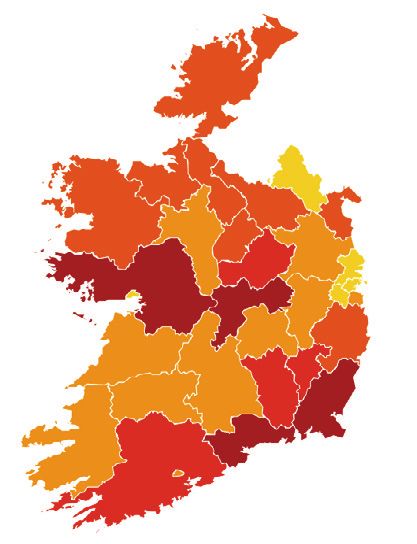
FIGURE 1. MAP OF RESULTS
This map presents each of the 31 local
authorities in Ireland, coloured according
to their scores in the index. The lightest
colours indicate better performance in the
ranking, while the darkest colours indicate
there is much room for improvement.
Low High
Score Score
0-9% 10-19% 20-29% 30-39% 40-49% 50-59% 60-69% 70-79% 80-89% 90-100%
National Integrity Index 2018 07TABLE 2. FULL RESULTS
COUNCIL OVERALL SCORE TOTAL POINTS
(% - total points out of 30) (out of 30)
Galway City Council 70% 21
Fingal County Council 63% 19
South Dublin County Council 63% 19
Dublin City Council 60% 18
Monaghan County Council 60% 18
Dún Laoghaire–Rathdown County Council 57% 17
Laois County Council 57% 17
Meath County Council 57% 17
Kerry County Council 53% 16
Kildare County Council 53% 16
Clare County Council 50% 15
Cork City Council 50% 15
Limerick City and County Council 50% 15
Roscommon County Council 50% 15
Tipperary County Council 50% 15
Leitrim County Council 47% 14
Donegal County Council 43% 13
Longford County Council 43% 13
Cavan County Council 40% 12
Louth County Council 40% 12
Mayo County Council 40% 12
Sligo County Council 40% 12
Wicklow County Council 40% 12
Cork County Council 37% 11
Kilkenny County Council 37% 11
Westmeath County Council 37% 11
Carlow County Council 33% 10
Offaly County Council 30% 9
Waterford City and County Council 30% 9
Wexford County Council 23% 7
Galway County Council 17% 5
08 Transparency International IrelandTRANSPARENCY TRANSPARENCY ACCOUNTABILITY ACCOUNTABILITY ETHICS ETHICS POINTS
SCORE Points (out of 12) SCORE Points (out of 10) SCORE Points (out of 8)
58% 7 90% 9 63% 5
58% 7 80% 8 50% 4
67% 8 80% 8 38% 3
67% 8 70% 7 38% 3
50% 6 90% 9 38% 3
58% 7 70% 7 38% 3
50% 6 80% 8 38% 3
58% 7 70% 7 38% 3
33% 4 90% 9 38% 3
42% 5 80% 8 38% 3
42% 5 60% 6 50% 4
58% 7 70% 7 13% 1
50% 6 80% 8 13% 1
50% 6 60% 6 38% 3
50% 6 60% 6 38% 3
50% 6 70% 7 13% 1
33% 4 60% 6 38% 3
42% 5 60% 6 25% 2
42% 5 60% 6 13% 1
33% 4 60% 6 25% 2
33% 4 60% 6 25% 2
42% 5 50% 5 25% 2
33% 4 60% 6 25% 2
42% 5 40% 4 25% 2
33% 4 40% 4 38% 3
33% 4 60% 6 13% 1
25% 3 50% 5 25% 2
42% 5 30% 3 13% 1
8% 1 50% 5 38% 3
17% 2 20% 2 38% 3
25% 3 20% 2 0% 0
National Integrity Index 2018 09RECOMMENDATIONS
Based on the findings from the research (see ‘Findings’ on page 13), TI Ireland has developed
the following set of recommendations.
LOCAL AUTHORITIES >> Develop and maintain up-to-date, comprehensive
webpages with ethics and governance information
>> Develop and maintain up-to-date, comprehensive (see the NII Toolkit for a webpage template).
Corruption and Fraud Prevention and Contingency
Plans. There should be a detailed strategy to >> Publish as much information as possible in
prevent corruption and fraud, and clear steps to machine-readable format, rather than in PDF form.
be followed when corruption or fraud is suspected. This should include procurement information,
These plans should adequately address Part 15 of regular council meeting minutes, strategic policy
the LGA 2001. They should clearly outline the roles committee meeting minutes, annual budgets,
and responsibilities of the Ethics Registrar, the reports on councillor payments and expenses, and
Chief Executive and the Cathaoirleach, and should annual ethics declarations.
have comprehensive investigation procedures that
are in line with Part 15 of the LGA 2001. These >> Ensure meaningful public engagement in the
plans need to be reviewed and updated on a preparation of City and/or County Development
periodic basis. Plans. Consider DPER’S ‘Three Consultation
Principles’5 and other guidelines from its
>> Ensure adequate handover between ethics ‘Consultation Principles & Guidance’.6
registrars (who rotate every two years). This
should include all applicable DHPLG circulars >> Publish information on Strategic Policy Committees
and guidance, an introduction to the relevant and Local Community Development Committees,
legislation, steps for ensuring complete including member names and affiliations, meeting
submissions of annual ethics returns, a full briefing minutes and the process for appointing members.
on any open ethics matters, and lessons learned >> Use publication checklists to ensure information is
from the previous ethics registrar. published in a timely and informative matter (see
>> Use one continuous email address for ethics the NII Toolkit for a checklist template).
registrar-related work that can be passed on to
subsequent ethics registrars, to ensure continuity
and proper electronic record keeping as the
position rotates. Meath County Council and
Waterford City and County Council said that The local authorities need to publish
they have a specific email address for the ethics much more information on their websites
registrar. Other authorities that have not yet taken
(such as meeting minutes, procurement
this step should consider doing so.
information, annual ethics declarations);
>> Ensure that all consultations that qualify as pre- they need to ensure they have up-to-date
planning consultations under Section 247 of the
Planning and Development Act 2000 (not just
corruption prevention and investigation
formally requested consultations) are adequately procedures; and they need to more
documented. Ensure that the corresponding proactively publish information on
reports are included in the online planning files for development plans and planning decisions.
the respective applications.
10 Transparency International IrelandDEPARTMENT OF HOUSING, PLANNING LOCAL GOVERNMENT MANAGEMENT
AND LOCAL GOVERNMENT AGENCY AND COUNTY AND CITY
>> Develop a training curriculum and deliver training
MANAGEMENT ASSOCIATION
to ethics registrars on their roles in the handling >> Publish agendas and minutes of LGMA and CCMA
of complaints. Since the two-year ethics registrar board meetings; provide more information on the
tenures begin and end at different times across the composition and activities of their committees; and
31 local authorities, an online training tool might provide more information on the LGMA website
be the most practical and cost-effective means to and its CCMA webpage, including updating of
carry out this task. This training should address the the FOI publication scheme.
role, responsibilities, authorities, and mechanisms
for pursuing and responding to complaints. >> Ensure clarity in the guidance provided to local
authorities on protected disclosures policies and
>> Provide guidance to the local authorities, towards procedures, with regard to the role of the ethics
the development of comprehensive plans for registrar. Suspected violations of Part 15 of the
investigating suspected wrongdoing, including LGA 2001 need to be reported to the ethics
contraventions of Part 15 of the LGA 2001, in registrar or chief executive (as applicable), as
line with the concerns raised by SIPO that these per Section 174 of the Act. Reporting suspected
investigations ‘may not be adequately investigated violations to the ethics registrar might qualify as a
due to the absence of proper procedures’.7 protected disclosure. The current template policies
and procedures instructs disclosers to only report
>> Introduce software to digitise the submission
to a ‘Designated Officer to Receive Disclosures’.
of declarations of interests. This will save time,
TI Ireland recommends providing a range of
reduce workloads, provide for automated tracking
individuals to whom disclosers can report.
of timely completion, provide greater automated
checks to ensure completion, and facilitate
easier year-to-year comparison. The Council
of Europe’s ‘Practitioner manual on processing LEGISLATORS, INCLUDING WITH REGARD
and analysing income and asset declarations of TO THE PUBLIC SECTOR STANDARDS
public officials’ notes that ‘unless under extreme BILL 2015
hardship, nowadays no country should stockpile
>> Ensure that SIPO or the proposed Public Sector
declarations just in paper format even if paper-
Standards Commissioner has the authority
based submission is allowed. Paper stockpiles are
to recommend the suspension or removal of
too impractical to handle and such system would
councillors or senior managers, should they be
be inevitably inefficient’.8 There is no compelling
found to have contravened provisions on ethics
reason for Irish local authorities to continue with
(whether in the LGA 2001 or in subsequent
an outdated and inefficient system to gather and
legislation replacting the LGA 2001). SIPO
publish this information.
produced seven investigation reports with regard
>> The Outside Appointments Board (OAB) for the to Part 15 contraventions since 2011. It found that
Local Government Sector should share more six individuals had committed contraventions that
information on its work with the public. It could were either ‘negligent to a high degree’, ‘reckless’
do this by launching a website or a page on the or ‘intentional’ and that those contraventions
DHPLG website with information on the Board, were ‘serious matters’.9 The only sanction
including an annual report on activity each year. imposed amounted to public reports detailing
TI Ireland understands the Board might be merged the contraventions of each official.
with another agency upon enactment of the Public
Sector Standards Bill 2015 - but the OAB should
nevertheless take this step in the meantime.
National Integrity Index 2018 11>> The Mahon Tribunal recommended that ‘the failure STANDARDS IN PUBLIC OFFICE
of a public official to make a disclosure required
under the Ethics Acts should be a criminal offence
COMMISSION/LOBBYING REGULATOR
as should the making of disclosure which is >> Provide more guidance and/or a webpage
false or misleading in a material respect’.10 The template for local authorities on what to post on
Public Sector Standards Bill 2015 calls for annual their websites with respect to the Regulation of
declarations to be submitted centrally, to the Office Lobbying Act. Many local authorities provide online
of the Public Sector Standards Commissioner. information on the Act; however they often only
This body should be authorised to systematically list senior management as DPOs (with no mention
check returns for accuracy, including checking of councillors) and fail to provide more helpful
them against business and property registers, so information to the public.
that the exercise of completing these declarations
is worthwhile. The Department of Environment >> Support the DHPLG on the development of
(now the DHPLG) advised that it is ‘not the role of procedures to investigate possible contraventions
the Ethics Registrar to systematically vet annual of Part 15 of the LGA 2001, in line with the
declarations’, adding that the ‘requirement to recommendation in SIPO’s 2012 annual report that
complete, properly, the annual declaration lies highlights the need for such procedures.13
wholly with the person concerned’.11 The DHPLG’s
advice is likely to mean that many declarations are
not independently checked and are inaccurate or OFFICE OF GOVERNMENT PROCUREMENT
misleading as a result.
>> Provide data in machine-readable format. Lists
>> Introduce a follow-up mechanism for complaints of contracts awarded by public sector bodies are
related to Part 15 of the LGA 2001. Currently, currently provided only in PDF format.14
when ethics registrars or chief executives (as
applicable) receive complaints, they must pass
them on to the chief executive or cathaoirleach
(as applicable) who considers what action needs
to be taken and ‘cause a report to be prepared’
and submits it to the ethics registrar or chief
executive (as applicable).12 There ought to be a
mechanism for following up and responding to
the complainant.
12 Transparency International IrelandFINDINGS
LOOKING AT THE DATA councils’ websites. There was a strong statistical
relationship with the councils’ scores, indicating
TI Ireland carried out various regression analyses that the higher proportion of women in senior
with the data it collected throughout the study and management roles was strongly linked to better
with other publicly available data. The councils’ final systems and practices to promote integrity.15 The
scores in the index were regressed on variables two local authorities with the highest proportion
such as the councils’ populations, their annual of women in senior management positions – Dun
expenditures, and their population densities, Laoghaire Rathdown, with seven out of nine (78%)
amongst many other variables. senior managers being women; and Galway City, with
three out of five being women (60%) – ranked sixth
Perhaps the most interesting finding is the relationship
and first, respectively. There was also some evidence
between the councils’ scores and their proportion of
of a similar relationship between the proportion of
women in senior management positions. TI Ireland
elected councillors who are women and the councils’
drew this conclusion by calculating the proportion
performance in the ranking, but to a lesser degree.16
of women listed as designated public officials on the
PLOT 1. NII SCORE VERSUS PERCENTAGE OF SENIOR MANAGEMENT POSITIONS HELD BY WOMEN
20
Council NII Scores
15
10
5
0 20 40 60 80
Percentage of Senior Management Positions Held by Women
National Integrity Index 2018 13The data analysis did not show any significant responding to FOI requests, updating corruption
relationship between the sizes (measured by the prevention plans, etc.). The plot below shows that
number of full-time equivalent employees) of the both smaller and larger councils perform well, and vice
councils and the councils’ performance in the index,17 versa. Similarly, we likewise did not find a statistically
thus undermining the argument that only those councils significant relationship between the councils’ annual
with more staff can meet the various integrity-related expenditures and their performance in the index.18
standards (such as publishing information online,
PLOT 2. COUNCILS’ NII SCORE VERSUS THEIR NUMBER OF FULL TIME EQUIVALENT EMPLOYEES
20
Council NII Scores
15
10
5
500 1000 1500 2000
Councils’ Number of Full Time Equivalent Employees
(with Dublin City Council removed - with over 5,000 staff it is an outlier)
Another key finding from the data analysis concerns associated with an average of about one million euro
the relationship between the councils’ performance more added to the council’s budget deficit. In other
and their budget deficits. It suggests that poor systems words, councils that performed better in the index
and practices for accountability and integrity may are likely to have much healthier budget balances,
have serious consequences for a council’s budget while those that do not promote accountability and
deficit. We found a highly significant relationship transparency are more likely to suffer budget deficits.
between these two variables.19 The regression analysis
showed that each point not received in the index was
14 Transparency International IrelandPLANNING found only three local authorities that clearly placed
the relevant meeting minutes or links to those meeting
The online ePlan platform used by most local minutes on their development plan webpages.24 The
authorities to upload and publish planning development plan webpages of Cork City Council25 and
documentation and decisions, which is provided South Dublin County Council26 might be referenced by
by the LGMA, is a valuable tool for promoting other local authorities in the preparation of subsequent
transparency in the planning process. city and/or county development plans.
However, TI Ireland researchers found a critical lack of
transparency in the pre-planning consultation process
across the local authorities. What takes place in these ETHICS
consultations can potentially have a significant impact The December 2015 RTÉ Investigates exposé on ethics
on the surrounding communities, thus underscoring found that ‘At council level, the under-declaration was
the need for transparency in this process. Section manifest with commercial interests and properties
247 of the Planning and Development Act 2000 regularly going undeclared in annual declarations’.27
highlights this need for transparency. It requires that Yet no local authority reported to TI Ireland researchers
planning authorities must keep a record in writing of that it takes steps to proactively confirm and verify
any such consultations. An independent review of six the content of the annual ethics declarations that
local authorities in July 201520 stated that the varying councillors and senior staff are required to submit (for
interpretation and application among authorities example checking the declarations against property
of Section 247 was a ‘systemic problem across registers and business registers). This is not surprising,
many planning authorities’.21 It also found that any since the law does not require the local authorities to
consultations between prospective applicants and the do so. In fact, a 2015 circular to the authorities from
council planners prior to submission of an application the then Department of Environment, Community and
should be documented ‘irrespective of whether the Local Government informed the authorities that ‘It is
prospective applicant requests a formal consultation‘.22 not the role of the Ethics Registrar to systematically
TI Ireland only found six local authorities that were vet annual declarations. The requirement to complete,
consistently including pre-planning consultation properly, the annual declaration lies wholly with the
reports in the online planning files for applications in person concerned’.28 With no verification of these
which such consultations took place. Though local declarations and next to no serious enforcement in
authorities can satisfy the law by providing these files cases of omission, there is very little deterrent for those
on request at their offices, there is no reason why they who might intentionally share misleading information.
should not also include them with the full application (See ‘Recommendations’).
documentation provided on their planning application
databases. Given the limitations placed on the ethics registrars,
whose duty it is collect the annual returns, TI Ireland
The Mahon Tribunal included a recommendation, asked each local authority if they took steps at least to
with respect to development plans, that ‘submissions confirm one-by-one that each return is fully completed.
and observations received in the context of public Fifteen local authorities reported that they took what
consultation should be published on the relevant steps they could, within the limitations imposed on
planning authority’s website as should the Manager’s them. This included reviewing each return against
Report drafted on the basis of any such submissions previous years, and reviewing each box one-by-one
or observations’.23 This is needed to promote to see if they had been completed, and reverting
transparency and effective public consultation in the back to those whose returns contained omissions
zoning process, and to prevent any undue influence in or inconsistencies.
the process. However, TI Ireland found only 10 local
authorities have done so with regard to their latest The local authorities were asked if they provide training
development plan. That same recommendation also to the ethics registrars. As stated in the LGA 2001,
noted that ‘motions submitted when making the draft ‘where the ethics registrar … becomes aware of a
development plan or the development plan should be possible contravention of this Part it is his or her duty to
published on the relevant planning authority’s website’ bring the matter to the attention of’ the chief executive
(this is with regard to councillor motions), and TI Ireland or the Cathaoirleach (as appropriate). Given that the
National Integrity Index 2018 15ethics registrars may receive sensitive complaints, Investigates programme of 2015 that exposed possible
it is important that they receive training on how to violations of the LGA included a detailed segment on
appropriately handle and channel these complaints. an elected member from the same council.30
However, no local authorities reported that they provide
formal training to the ethics registrars and some ethics Many authorities received points for having, at least,
registrars even mentioned that they received no training general fraud and corruption investigation procedures
or guidance at all, and are left only with the relevant included in their corruption and/or fraud contingency
legislation to guide their work. Given that it would plans. However, there is a need for these often vague
likely not be cost-effective for each individual local procedures to be clarified and strengthened. Although
authority to provide training for their ethics registrars, it many local authorities have investigation checklists
is important that the DHPLG and/or LGMA develop a in their corruption and/or fraud prevention and
training curricula and deliver training to ethics registrars contingency plans, there is a clear disconnect between
on their roles in the handling of complaints. At least these plans and the requirements of the LGA 2001. It
40 issues were brought to ethics registrars’ attention is concerning that many of the councils’ investigation
across the 31 local authorities between 2015 and procedures do not refer to ethics registrars, ethics
2017, so it is important that ethics registrars know how declarations or conflicts of interest. In other words,
to properly handle these complaints.29 they address suspected employee malfeasance
to an extent, but largely ignore possible Part 15
The LGA 2001 requires that the local authorities contraventions by elected members.
provide ethics returns to members of the public on
request in their offices. A number of local authorities
have published these returns online before, but many MEETING MINUTES
of their websites only show declarations from 2014
and/or 2015. Only four local authorities had published It was found that 20 local authorities provided their
the 2016 returns on their websites as of July 2017, monthly council meeting minutes online and within
and seven had published them on their websites by six weeks of the meeting taking place.31 However, it
November 2017. was noted that while a number of local authorities
publish meeting minutes that reference roll call votes,
some do not always list the names of councillors
INVESTIGATIONS who voted for, against or abstained from those votes.
This includes Dublin City Council and Galway City
When there are possible breaches of Part 15 of the Council. Citizens should know the voting records of
LGA (the Ethical Framework for the Local Government their elected representatives, which will inform their
Service), all local avenues must first be exhausted vote in upcoming elections. Local authorities are legally
and, failing resolution at the local level, complaints required to publish the full results of roll call votes in
can be forwarded to SIPO for investigation. In other their meeting minutes under Schedule 10 of the LGA
words, the local authorities are self-policing to a large 2001.32
extent. As such, it is of the highest importance that
local authorities have comprehensive investigation
procedures in place. It is concerning that local REVOLVING DOORS
authorities do not have adequate investigation
procedures in place or, where local authorities do have During preliminary interviews with local government
such procedures, that they are not being consistently experts and former local government staff, concerns
followed. As such, possible contraventions of Part 15 were raised regarding revolving door practices,
do not seem to be addressed in an open or clearly whereby individuals leave their positions in local
accountable manner. authorities and soon after take up similar work in
the private sector. For example, a planner might
For example, when each local authority was asked if leave a county or city council and take up a role in a
it had investigation procedures for contraventions of property development firm soon afterwards, bringing
Part 15, one authority responded that this ‘Problem fresh contacts, valuable information on the planning
hasn’t arisen to date,’ so it did not require any process and a direct line to former colleagues. This
such investigation procedures. However, the RTÉ risk is acknowledged in the Code of Conduct for
16 Transparency International IrelandEmployees, which states that ‘employees to whom The Lobbying Regulator’s Annual Report for 2016
Part 15 of the LGA 2001 (Ethical Framework for the reported very low numbers of registrations by lobbyists
Local Government Service) applies shall not, within in certain counties.38 For example, Leitrim only had two
twelve months of resignation or retirement, accept an lobbyists registered, while Monaghan only had six, and
offer of employment or consultancy engagement where Offaly and Longford had seven lobbyists registered
the nature and terms are such that the question of a as of January 2018.39 According to the Lobbying
conflict of interest could arise without obtaining the Regulator, ‘As DPOs include local authority members
approval of the appropriate authority’.33 However, no and senior staff as well as TDs, Senators and others, it
local authority reported any concrete, proactive steps is to be expected that all counties would have lobbying
to enforce this provision. activities taking place at a local level and a significantly
higher number of registrations’.40
Moreover, the same Code of Conduct states that
‘an employee at or above Director of Services level
(including County and City Managers) should apply
to the Outside Appointments Board for the Local
FREEDOM OF INFORMATION
Government Sector’, but no local authority mentioned TI Ireland submitted Freedom of Information (FOI)
the use of this mechanism to TI Ireland researchers requests to each of the 31 local authorities. Thirty out
nor is there any information available online about the of the 31 allowed for email submissions, while Cavan
activity of the Board (see Recommendations).34 The County Council was the only council that required that
Regulation of Lobbying Act 2015 contains provisions any FOI requests be sent by post.
that prohibit former Designated Public Officials (DPOs)
from taking on employment in or providing services Furthermore, the Freedom of Information Act 2014
to a person conducting lobbying activities. This might states that local authorities must confirm receipt of
be helpful in addressing some of the risks associated requests within 10 working days and must provide
with revolving doors.35 However, DPOs do not include a decision within 20 working days.41 Only 22 local
council planners. Furthermore, those DPOs that do authorities provided decisions within 20 working days.
move into the private sector only have to commit not
The local authorities confirm the date of receipt of the
to lobby their former employers. There is no restriction
FOI request and the date that their decision is due
on them providing advice or information on land-use or
when issuing letters confirming the FOI request. It
procurement that might assist their new employers.
is noteworthy that many of the councils set different
deadlines for decisions in the confirmation letters they
sent. TI Ireland submitted the requests on 3 January
LOBBYING 2018 – 20 working days from that date is 31 January
Section 6(4) of the Regulation of Lobbying Act 2015 2018.42 The range of deadlines claimed in those letters
requires that public service bodies, including local was as early as 29 January and as late as 2 February.
authorities, publish the names and brief descriptions Some local authorities, which received the FOI request
of their DPOs, which in the case of local authorities via email on the morning of 3 January, stated that they
includes their senior management and the elected received the request on 4 January (thus allowing more
councillors.36 SIPO further suggests that these bodies time for response). Galway County Council and Sligo
also publish a link to the Register of Lobbying, where County Council never provided any decision, nor any
further information can be found.37 communication following their confirmation letters.
Many local authorities publish clear lists of DPOs The Department of Public Expenditure and
and explicit explanations that councillors are also Reform’s (DPER) FOI Unit updated its Freedom
DPOs, and they take the additional step of including of Information Model Publication Scheme (along
comprehensive information on the Regulation of with its corresponding Guidance document) in July
Lobbying Act. At the same time, a number of local 2016.43 Section 8 of the Freedom of Information Act
authorities only provide the names of their Senior 2014 requires public bodies to prepare and publish
Management Team who are DPOs. Others just provide information, as outlined in the scheme. This includes
a link to a list of Councillors, without providing any financial information and procurement information,
context or any explanation that councillors are also amongst other items. This scheme is important for
DPOs. The lack of information on DPOs and the Act encouraging the proactive publication of information,
does not suggest that compliance with the Lobbying and for avoiding a larger volume of FOI requests from
Act is a priority among many local authorities. the public.
National Integrity Index 2018 17Multiple local authorities have simply posted the Some local authorities – including South Dublin County
template of the FOI model publication schemes on Council44 and Limerick City and County Council45 – had
their websites, without adapting it or adding in the links comprehensive and up-to-date information published
to the various items that the scheme advises them to via their FOI Publication Schemes. These schemes
publish (see the example below). might be used as a reference for other local authorities.
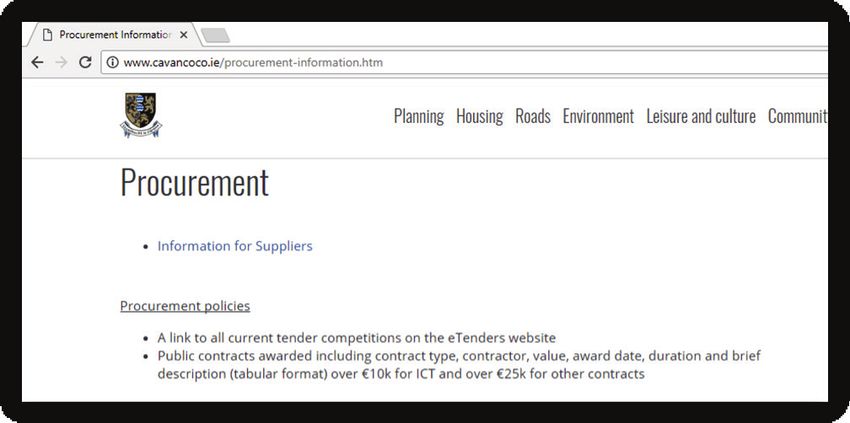
IMAGE 1. FOI PUBLICATION SCHEMES
Example of an FOI Publication Scheme still partially in template form
online so that those without intranet access, such
PROTECTED DISCLOSURES as contractors, have full access to the policies and
Section 22 of the Protected Disclosures Act (PDA), procedures.
2014, requires that every public body, including local
The LGMA’s Protected Disclosures Policies and
authorities, prepare and publish an annual report on the
Procedure template for the local authorities provides for
immediately preceding year, with information on ‘(a) the
a single individual to be designated as the ‘Designated
number of protected disclosures made to the public
Officer to Receive Disclosures’, to whom all disclosures
body, (b) the action (if any) taken in response to those
must be directed.47 This appears to be inconsistent
protected disclosures, and (c) such other information
with Section 174 of the LGA 2001, which requires
relating to those protected disclosures and the action
anyone who suspects a breach of Part 15 of the Act
taken as may be requested by the Minister from time to
to report it to the ethics registrar or chief executive
time’.46 The aim of the provision is to ensure that public
(as applicable). Sharing a concern with the ethics
bodies address protected disclosures in a timely and
registrar with regard to Part 15 might also qualify as a
accountable manner.
protected disclosure. The template does recognise that
Only 17 local authorities had published their latest disclosures can be made to individuals other than the
Section 22 reports online when they were reviewed in designated officer, but then states that ‘If a disclosure
August 2017. Furthermore, only nine local authorities is made to a line manager in the course of their duties,
had published a comprehensive protected disclosures the line manager is required to request the discloser to
policies and procedures on their websites. A number of make the disclosure directly to the Designated Officer
authorities still had interim plans from 2014 published to receive disclosures’.48 This can be problematic
on their websites. It is important that employees have particularly where the designated officer is implicated
access to information on the protected disclosures in potential wrongdoing or is considered to have a
process and the protections that they are afforded. conflict of interest in dealing with the disclosure (see
It is also important that such information be placed ‘Recommendations’).
18 Transparency International IrelandINTERNAL AUDIT LOCAL GOVERNMENT MANAGEMENT
Internal audit units play an important role in promoting AGENCY AND THE COUNTY AND CITY
accountability in local government. However, of the 31 MANAGEMENT ASSOCIATION
councils reviewed in 2015 (the most recent full year for The LGMA is an agency under the auspices of the
which all 31 reports are available), the LGAS Auditors DHPLG, which supports the functions of the city and
expressed concerns that the internal audit function county councils, in particular relating to service delivery.
in at least 15 local authorities was under-resourced.49 The board is composed of eight city and county council
Furthermore, TI Ireland found that 13 local authorities chief executives, two individuals from the DHPLG and
did not have reporting structures that are in line one nominee from the Minister of Housing, Planning and
with best practice. Specifically, their head of internal Local Government. The LGMA also provides support,
audit reports to a director of finance or a director of through its Office for Local Authority Management, to the
corporate services for functional and/or administrative CCMA. The CCMA is composed of the chief executives
purposes. The head of internal audit should report of each of the city and/or county councils and the
directly to the chief executive and the board, for both assistant chief executives of Dublin City Council.51
functional and administrative matters, to ensure the
free flow of information to them. The LGMA and CCMA boards do not publish agendas,
participants or minutes of their meetings. The LGMA’s
FOI Publication Scheme is partly still in template form,
FRAUD AND CORRUPTION PREVENTION with non-functioning hyperlinks.52 The CCMA is made
AND CONTINGENCY PLANS up of seven committees (including finance, water, and
housing and building) but there is no public information
It is important that local authorities proactively take provided on who sits on each of these committees, how
steps to prevent, detect and punish acts of fraud and often they meet, and what decisions they make (see
corruption. This can be achieved by developing a ‘Recommendations’).
corresponding, comprehensive corruption and fraud
prevention and contingency plan. As stated in the
‘Internal Audit in Local Authorities’ report, produced
by the Value for Money Unit of the then Department
of Environment and Local Government, any such plan
should set out ‘the authority’s strategy to prevent
fraud and/or corruption and the procedures to follow
in the event of fraud and/or corruption being uncovered
or suspected’.50
Only 21 local authorities reported that they have such
plans that are in date. Three local authorities have plans
that are more than 10 years old, with two of those
being more than 13 years old. Furthermore, two local
authorities reported that any such issues would be
covered by their general risk registers, rather than a
stand-alone fraud and corruption plan. This is likely to be
insufficient, given the multitude of corruption and fraud
risks and the corresponding need for a comprehensive
plan to prevent and respond to such risks. Given the
evolving nature of corruption and fraud risks, these plans
need to be reviewed and updated on a periodic basis.
National Integrity Index 2018 19CONCLUSION It is important to clarify that this study and its corresponding index are by no means a ranking of corruption in local authorities. Instead, the aim of this report and index is to help identify those local authorities with the best systems and practices aimed at promoting transparency, accountability and ethics. It is also important to note that there is no evidence to These systems should be designed to help prevent suggest that the majority of local authorities’ members future conflicts of interest and corruption. In doing so, and staff are anything other than honest and hard- they can build public trust and confidence among the working people – regardless of where their authority is communities they are duty-bound to serve. placed on the index. The purpose of this index is not to measure the individual integrity of people working in local authorities but the systems in which they operate. TI Ireland and the local authorities share a common goal. That is, to ensure that citizens and communities across Ireland are well served by local government. We hope, and are confident, that this project will help achieve that goal. 20 Transparency International Ireland
ANNEX – NATIONAL INTEGRITY
INDEX – LOCAL AUTHORITIES –
METHODOLOGICAL NOTE
Transparency International (TI) Ireland’s National Integrity Index on Local Authorities is composed
of a set of 30 indicators, measuring the systems and practices of Ireland’s 31 local authorities
to promote and ensure transparency, accountability and ethics. Each local authority is assessed
against each indicator, receiving one point where fulfilling the indicator, and zero points when not
fulfilling the indicator. The sum of points received is then converted to a percentage (points out of
30), rounded to the nearest whole number, and then used as the respective local authority’s score,
and to allocate its ranking in the index.

The Indicator Reference Sheet (provided on the              authorities, it would not have been possible to obtain
National Integrity Index webpage), explains the             an accurate unbiased snapshot of current practices.
importance and justification for including each             Furthermore, an aim of the study was to capture and
indicator, as well as the marking scheme, and the           understand the experience of typical citizens in seeking
source of the information (e.g. council websites,           information from their local authority. This would
emails to councils, phone calls to councils, and            not have been possible had the methodology and
freedom of information requests.)                           marking scheme been shared ahead of time. TI Ireland
                                                            informed local authorities that it was undertaking
                                                            research when gathering information by phone and
DEVELOPMENT OF THE METHODOLOGY                              email. However, little information was provided to
                                                            authorities on the methodology, to avoid any possible
TI Ireland developed the project based on similar           bias in their responses.
indices and similar methodologies carried out by TI
National Chapters in other European countries (in
particular Austria, Portugal, Slovakia and Ukraine).
                                                            STRUCTURE OF THE METHODOLOGY
In adapting the indicators to the local context and
to ensure they covered the issues relevant to local         TI Ireland understands the complexity in ranking local
government in Ireland, TI Ireland consulted with the        authorities based on various performance indicators,
Standards in Public Office Commission (SIPO), the           especially given the varying environments, sizes and
Local Government Audit Service (LGAS), the Office           contexts across the 31 authorities. As such, this
of the Information Commissioner, two academic               methodology is based on a simple binary system of
institutions, a former Director of Services in a local      yes-or-no questions, all of which TI Ireland expects
authority and a former County Manager in a local            local authorities should and can fulfil, regardless of
authority. This was to ensure a necessary balance of        budget, location or number of staff.
perspectives, namely academia, central government,
local government, as well as rural experience and           A number of possible indicators were considered when
urban experience.                                           developing the methodology, with multiple indicators
                                                            removed that were considered too demanding for
TI Ireland consulted on the methodology with                smaller authorities. When analysing the final data,
individuals formerly, but not currently, associated with    there was no statistical relationship between the size
local authorities, to avoid giving any local authority an   of a local authority (whether budget or number of staff)
advantage over its counterparts. If shared with all local   and its performance in the index.

                                                                                        National Integrity Index 2018   21
The National Oversight and Audit Commission’s Similarly, when calling and emailing local authorities, (NOAC) performance indicators for local government TI Ireland called and/or emailed each local authority were considered. Some loosely relate to accountability initially and, if not reaching them on the first attempt, but given that they are intended to measure provided at least two follow-up calls and/or emails. management rather than transparency, accountability Voicemails or messages were left with the officials’ and ethics, they are not directly relevant to this colleagues when calling, and follow-up emails were research. Much of the data published by NOAC is not sent when no voicemail response was received. appropriate for comparative purposes. Some of this Delivery receipts were used, to ensure emails were data was instead used for regression analysis with delivered. If there was no response from the authority the study’s final data. For example, some interesting after the third attempt, questions were not pursued insights were obtained when regressing the annual further and no points were given. A citizen should not budget deficit indicator on the local authorities’ have to call or email his or her local authority four times performances in the ranking (see ‘Findings’ section in order to obtain public information. in the report). It was not feasible to address every corruption and ethics-related risk in the list of indicators. Where additional risks arise, they could be included in future editions of the index. DATA COLLECTION TI Ireland took every reasonable step to obtain the data for each respective indicator. However, if there were obstacles to obtaining data or a local authority was not forthcoming with information, no points were awarded to those authorities. For example, while nearly all local authorities have easily accessible information online on planning applications, one local authority's page required advanced IT skills to access the information on the page. No points are merited in such cases. Likewise, an authority may maintain that certain information is published on its website. If TI Ireland’s team of researchers cannot find this information after an exhaustive search, then a typical citizen is unlikely to find this information, and hence no points can be awarded. 22 Transparency International Ireland
END NOTES
1.   Department of Housing, Planning and Local                     13. Standards in Public Office Commission, Annual
     Government, ‘Local Authority Budgets 2017’,                       Report 2012, available at http://www.sipo.ie/en/
     available at http://www.housing.gov.ie/sites/default/             Reports/Annual-Reports/2012-Annual-Report/
     files/publications/files/final_local_authority_budget_            annualreport2012/media/sipoc_ar_2012_english.pdf,
     publication_2017.pdf                                              page 29.

2.   Transparency International Ireland National Integrity         14. See http://ogp.gov.ie/contract-awards-for-standalone-
     Systems studies are available at https://transparency.ie/         mini-competitions/
     resources/NIS
                                                                   15. P-value of 0.0221
3.   As of 31 December 2016, in terms of the number of
                                                                   16. P-value of 0.0689
     full-time equivalent staff. This data is from the National
     Oversight and Audit Commission’s ‘Performance                 17. P-value of 0.192 when regressing the number of
     Indicators in Local Authorities 2016’, available at http://       full-time equivalent employees (as of 31 December
     noac.ie/wp-content/uploads/2018/01/2016-PI-Report.pdf             2016) on the councils’ scores. The p-value is 0.541
                                                                       when removing Dublin City Council which, with over
4.   This means in a type of file that can be easily read by a
                                                                       5,000 FTE, is an outlier in this regard. This data is
     computer (such as .csv, JSON), and allows for easier data
                                                                       from the National Oversight and Audit Commission’s
     processing and analysis.
                                                                       ‘Performance Indicators in Local Authorities
5.   Briefly summarising, these are (1) ensure genuine,                2016’, available at http://noac.ie/wp-content/
     meaningful, timely, balanced engagement, (2) ensure               uploads/2018/01/2016-PI-Report.pdf
     that consultations be targeted at and easily accessible
                                                                   18. P-value of 0.127, when regressing the councils’ 2017
     to those with a clear interest in the policy in question
                                                                       gross expenditures on the councils’ scores. The p-value
     and (3) make systematic efforts to ensure that
                                                                       is 0.299 when removing Dublin City Council which,
     interested and affected parties have the opportunity to
                                                                       with gross expenditures of 862 million euro in 2017,
     take part in open consultations at all stages.
                                                                       is an outlier. Gross expenditures for 2017 were taken
6.   Department of Public Expenditure and Reform,                      from estimates provided in the Department of Housing,
     Consultation Principles and Guidance, available at http://        Planning and Local Government’s ‘Local Authority
     www.per.gov.ie/en/consultation-guidelines/, page 6.               Budgets 2017’, available at http://www.housing.gov.ie/
                                                                       sites/default/files/publications/files/final_local_authority_
7.   Standards in Public Office Commission, Annual
                                                                       budget_publication_2017.pdf
     Report 2012, available at http://www.sipo.ie/en/
     Reports/Annual-Reports/2012-Annual-Report/                    19. P-value of 0.0114. 2016 budget balance data
     annualreport2012/media/sipoc_ar_2012_english.pdf,                 was taken from the National Oversight and Audit
     page 29.                                                          Commission’s ‘Performance Indicators in Local
                                                                       Authorities 2016’, available at http://noac.ie/wp-
8.   Council of Europe, Practitioner manual on processing
                                                                       content/uploads/2018/01/2016-PI-Report.pdf
     and analyzing, January 2014, available at https://
     rm.coe.int/16806db62d                                         20. ‘Independent Planning Review of The Performance of
                                                                       Planning Functions having regard to Specific Issues
9.   SIPO Investigation Reports are available at http://www.
                                                                       raised in respect of Six Planning Authorities’, July
     sipo.ie/en/Reports/Investigation-Reports/
                                                                       2015, available at http://www.housing.gov.ie/sites/
10. The Tribunal of Inquiry Into Certain Planning Matters              default/files/publications/files/planning_review_report_
    and Payments, available at https://planningtribunal.ie/            december_2015.pdf
    reports/the-final-report/, page 2606.
                                                                   21. Ibid.
11. Local Government Circular LG 2/2015, ‘Part 15 – Local
                                                                   22. Ibid.
    Government Act 2001, Revised Annual Declaration
    Forms’, Appendix 2.                                            23. The Tribunal of Inquiry Into Certain Planning Matters
                                                                       and Payments, available at https://planningtribunal.ie/
12. Section 174 of the Local Government Act 2001 is
                                                                       reports/the-final-report/, page 2544
    available at http://www.irishstatutebook.ie/eli/2001/
    act/37/section/174/enacted/en/html                             24. Ibid.

                                                                                                    National Integrity Index 2018   23
You can also read


