Noosa Shire Koala Conservation Plan 2016 - Noosa Shire Council
←
→
Page content transcription
If your browser does not render page correctly, please read the page content below
Noosa Shire Koala Conservation Plan 2016

Noosa Shire
Koala Conservation
Plan 2016
Noosa Shire Koala Conservation Plan 2016

     © Noosa Council 2016

     www.noosa.qld.gov.au
     General Enquiries: 8.15 am - 5.00 pm Monday to Friday (excluding public holidays)
     By telephone: (07) 5329 6500 (including After Hours emergencies)
     By email: mail@noosa.qld.gov.au
     Fax: (07) 5329 6501
     Street Address: 9 Pelican Street, TEWANTIN
     Postal address: PO Box 141, TEWANTIN QLD 4565

     April 2016

     Acknowledgements
     Council wishes to thank all interested stakeholders who have taken the time and energy to help guide
     the development of this plan.

     Disclaimer
     This document has been developed by Noosa Council’s Planning and Infrastructure Department.
     Information contained in this document is based on available information at the time of writing. All figures
     and diagrams are indicative only and should be referred to as such. This is a strategic document which
     deals with technical matters in a summary way only. Council or its officers accept no responsibility
     for any loss occasioned to any person acting or refraining from acting in reliance upon any material
     contained in this document.

Page 2 | Noosa Council
Noosa Shire Koala Conservation Plan 2016

Table of Contents

Executive Summary................................................................................. 4
1.       Introduction................................................................................... 5
1.1      Purpose of the Koala Conservation Plan..................................... 5
1.2      Objectives of the Koala Conservation Plan.................................. 5
1.2.1 Conserve koalas and habitat through statutory provisions.......... 6
1.2.2 Conserve koalas and habitat through non-statutory means...... 11
1.2.3 Improve understanding of koala needs and behaviours............ 15
1.2.4 Improved data collection and mapping
      of local koala populations........................................................... 16
1.2.5 Informed infrastructure decisions............................................... 20
1.2.6 Effective wild and domestic dog control..................................... 21
1.2.7 Implement translocation consistent with State policy................. 23
1.2.8 Increased community awareness and participation................... 24
2.       Koala Conservation Action Plan................................................. 25
3.       Appendix-Key Stakeholders....................................................... 32

                                                                                           Noosa Council | Page 3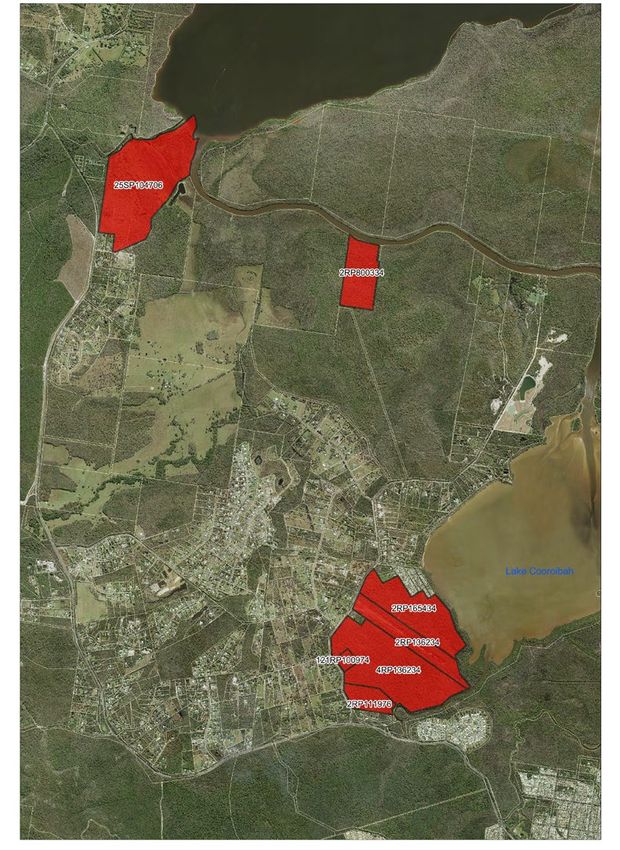
Noosa Shire Koala Conservation Plan 2016

     Executive Summary
     Koalas are of great significance to the Noosa community. Noosa Shire is recognised for
     its outstanding environmental attributes and was declared a Biosphere Reserve under
     UNESCO’s Man and the Biosphere Program in 2008. Vegetation networks that support koalas
     extend across rural and coastal landscapes on public and private land. Our koalas live in a
     diverse environment and visitors are often surprised to encounter koalas in close proximity to
     residential areas.

     Concerns have been expressed about the plight of koalas which are now listed as being
     ‘vulnerable’ in Queensland. In 2015 Noosa Council adopted a Koala Conservation Policy with
     the aim of developing a framework for the conservation and protection of this iconic species.

     One of the important outcomes of the Policy was to develop a shire-wide Koala Conservation
     Plan to deliver tangible on-ground actions. The Plan provides the mechanism to implement the
     Koala Policy with the aim of conserving our local koala populations in perpetuity. The Plan has
     been developed through extensive consultation with key stakeholders such as koala interest
     groups, research organisations, government agencies, and environmental and natural resource
     management groups. A public consultation process allows residents and visitors to have input
     into the Plan.

     The Koala Conservation Plan identifies a number of specific management objectives to help
     support koala conservation. These objectives cover statutory and non-statutory protection
     measures, improved data and mapping resourcing, guidance on minimising the impacts
     of infrastructure projects, management of domestic and wild dogs, koala health research
     initiatives and community engagement programs. A specific Action Plan describes the
     implementation measures to be employed over the next five years.

     Conserving Noosa Shire’s koala population is a challenging but essential goal. The Noosa
     Shire Koala Conservation Plan 2016 provides a framework to help achieve this objective.

Page 4 | Noosa Council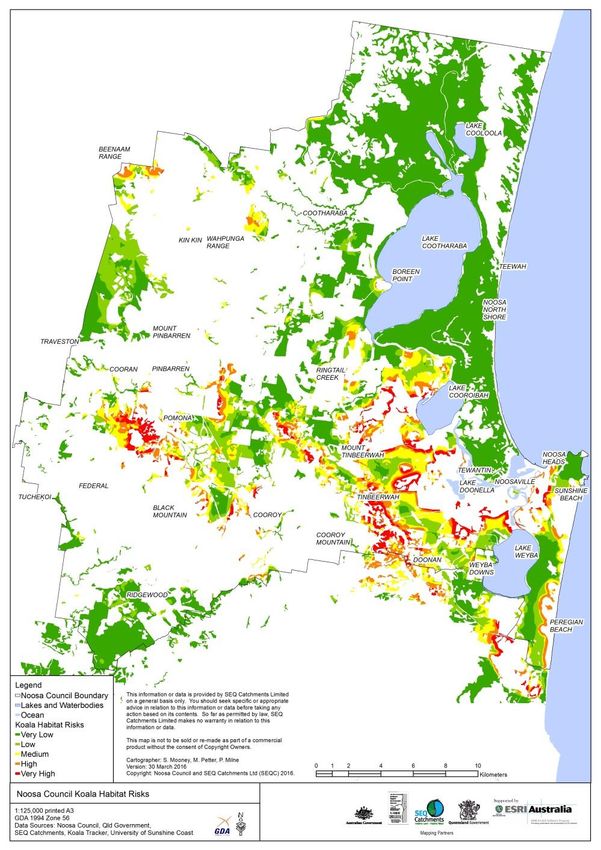
Noosa Shire Koala Conservation Plan 2016

1.         Introduction
Koalas (Phascolarctos cinereus) are of great interest to Noosa residents and visitors. They are
listed as ‘vulnerable’ by the Australian and Queensland Governments and there is concern that
the species may be in decline. The Koala Conservation Plan guides Council and community
efforts to help conserve and protect this iconic species. In addition, helping to conserve koalas
will provide mutual benefit to other native fauna and ecological communities in Noosa Shire.

Koalas, like many other native species, have suffered decline since European settlement.
Koalas used to have a bounty and between 1915 and 1919, over one million koalas were killed
in Queensland. Seabrook et al. (Seabrook et al, 2003, Landscape legacies: Koala habitat
change in Noosa Shire) describes Noosa generally having a low density of koalas, this being a
legacy of clearing native forests by early European settlers. Koala populations in Noosa Shire
have suffered a decline similar to other areas of
eastern Australia such as Port Stephens, Iluka,
Coffs Harbour and Logan.

However, koalas have still been found to occur in
various parts of Noosa Shire, from the hinterland to
the coast. It is unknown exactly how many koalas
there are, but records indicate koalas are known to
occur mostly in southern and western parts of the
Shire within the localities of Noosa, Eastern Beaches,
Tewantin, Cooroibah, Doonan, Cooroy, Ridgewood,
Federal and Cooran. Further research will help build
on our current knowledge of the distribution and
abundance of koalas across Noosa Shire.

1.1        Purpose of the Koala Conservation Plan
In 2015, Council adopted a Noosa Shire Koala Conservation Policy. The purpose of the policy
is to provide a coordinated and structured framework to help conserve and protect koala
populations and habitat within the Noosa Shire.

1.2        Objectives of the Koala Conservation Plan
The Noosa Koala Conservation Plan identifies eight objectives for each of the key policy areas
identified in the Koala Conservation Policy:
      •    Conserve koalas and habitat through statutory provisions
      •    Conserve koalas and habitat through non-statutory means
      •    Improved understanding of koala needs and behaviours
      •    Improved data collection and mapping of local koala populations
      •    Informed infrastructure decisions
      •    Effective wild dog and domestic dog control
      •    Implement translocation consistent with State policy
      •    Increased community awareness and participation

                                                                                Noosa Council | Page 5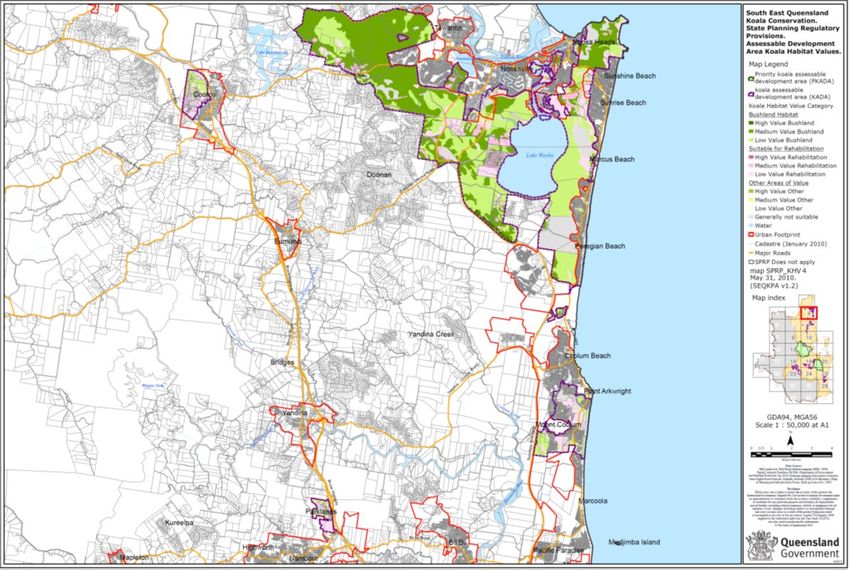
Noosa Shire Koala Conservation Plan 2016

     1.2.1      Conserve koalas and habitat through statutory provisions
     Noosa’s koalas are listed as ‘vulnerable’ at both National and State levels. Figure 1 below
     summarises the various legislation, policy, guidelines and plans that are aimed at conserving
     koalas.

                      Figure 1. Government legislation, policy, guidelines and plans

Page 6 | Noosa Council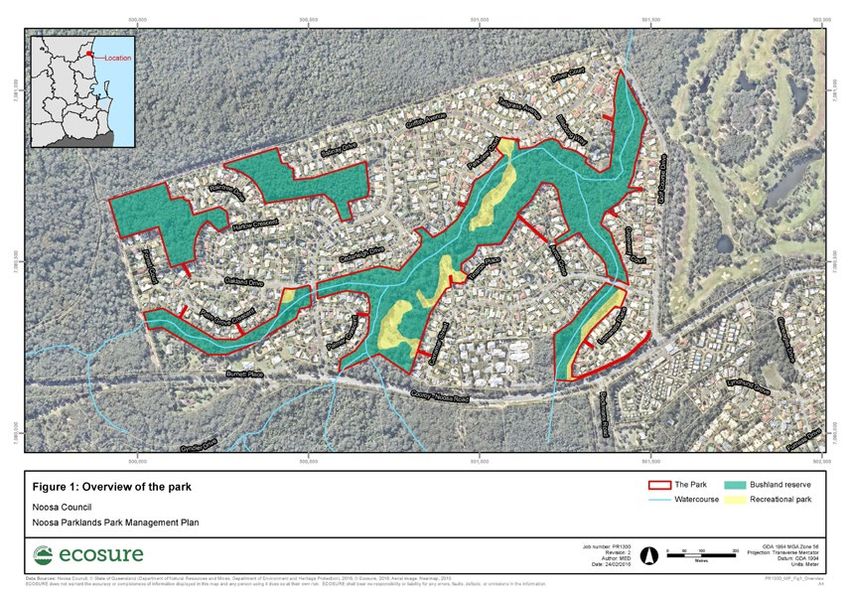
Noosa Shire Koala Conservation Plan 2016

National
The koala is listed as a ‘Vulnerable’ species under the Commonwealth Environment Protection
& Biodiversity Conservation Act 1999 (EPBC Act). Development that has a significant impact
on koalas requires referral to the Australian Government Minister for the Environment. Under
the EPBC Koala Referral Guidelines impacts on ‘habitat critical to the survival of the species’
and impacts that ‘substantially interfere with the recovery of the species’ are a ‘significant
impact’. For example the loss of twenty (20) hectares or more of high quality connected
habitat critical to the survival of koalas is likely to be a significant impact. Under the guidelines
a development in an urban area is unlikely to require referral because it will become highly
fragmented over time, there are substantial risks to koalas, and it is unlikely that populations
and habitat will recover over time.

A development that avoids or mitigates a significant impact also does not require referral.
The EPBC Koala Referral Guidelines provide guidance on how to mitigate significant impacts
covering:
     •      Dog control
     •      Vehicle strike
     •      Koala infection control
     •      Koala friendly infrastructure
     •      Maintaining ground water hydrology to support habitat

Under the EPBC Act Environment Offset Policy, any residual impact of an assessable
development will require an offset obligation.

In most cases the EPBC Act does not stop development, but provides measures to avoid,
mitigate, or offset the significant impacts of development on koalas.

State
Most regulatory control that affects koalas occurs at a State Government level. Under the
Nature Conservation Act 1992 koalas are listed as ‘Vulnerable’. Under the Queensland
Vegetation Management Act (VMA) 1999 clearing of vegetation is generally avoided if an
area is mapped as Essential Habitat. These are areas of potential habitat for Endangered,
Vulnerable, or Near Threatened species, including koalas. Development applications in
mapped Essential Habitat are assessed by the State.

The SEQ Regional Plan 2009 states the principle of koala conservation as ‘populations in the
region are enhanced through the protection, management and the achievement of a net gain
in bushland koala habitat and through managing conflict with urban development’. The key
planning instruments to achieve this are the State Planning Policy (SPP) 2014 and the South
East Queensland Koala Conservation State Planning Regulatory Provisions (SPRP). The
SPP is to be reflected in local planning instruments and aims to provide a net gain in koala
habitat. The SPRP identifies assessable development areas which are areas of highest risk
to koalas in SEQ. Development assessment in these areas is devolved to Council from the
State (see Map 1).

                                                                                    Noosa Council | Page 7
Noosa Shire Koala Conservation Plan 2016

                 Map 1. Extent of the State SPRP Koala Habitat Areas in Noosa Shire

     The SPRP provide measures to avoid/mitigate the impacts of development in SPRP mapped
     koala habitat areas and has similar provisions to the Commonwealth referral guidelines:
         •      avoiding, minimising or offsetting the clearing of non-juvenile koala habitat trees
         •	site design that provides safe koala movement opportunities appropriate to the
            development type and habitat connectivity values of the site
         •      construction phases that do not increase the risk of death or injury to koalas
         •      clearing of native vegetation, undertaken as sequential clearing
         •	clearing of koala habitat trees, undertaken in the presence of a koala spotter.

     The SPRP calls up the ‘Nature Conservation (Koala) Conservation Plan 2006 and
     Management Program 2006-2016’ and ‘Koala-sensitive Design Guideline: A guide to koala-
     sensitive design measures for planning and development activities’ to inform decision makers
     on development conditions.

     The Queensland Environment Offsets Policy 2014 has provisions for offsetting the residual
     impacts of unavoidable development on koala habitat. Again, this only applies to the mapped
     SPRP Koala Habitat Areas. Most koala habitat in Noosa occurs outside this mapped area.
     Koala offset plantings have been delivered in Girraween Nature Refuge, under the former
     Offsets for Net Gain in Koala Habitat in South East Queensland Policy (2010), which is now
     integrated into the Queensland Environment Offsets Policy 2014.

Page 8 | Noosa Council
Noosa Shire Koala Conservation Plan 2016

The State Government Supported Community Infrastructure Koala Conservation Policy (2014)
outlines how state public sector entities will consider koala conservation outcomes in the
planning and delivery of government supported community infrastructure such as roads and
buildings.

Similar to National legislation, in most cases State planning provisions do not stop
development, but provide measures to avoid/mitigate/offset impacts to koalas.

Local
The Noosa Plan 2006
The State Planning Policy (SPP) 2014 states that local government planning schemes are to
appropriately integrate State and National interests including biodiversity matters. The SPP
State interest-Biodiversity Parts 1-6 state that the planning scheme needs to consider matters
of national and state significance and facilitate a net gain in koala habitat.

At a local government level vegetation protection across the Noosa Shire is currently achieved
through the Noosa Plan Biodiversity Overlay Code which protects significant vegetation.
Development within these mapped areas requires assessment by Council and under the
Noosa Plan certain activities such as clearing for access, fencing and a dwelling house are
exempt. Landholders or contractors can be prosecuted for illegal clearing within the mapped
Biodiversity Overlay area and may be required to re-instate vegetation. Outside of the mapped
Biodiversity Overlay, protection provisions for all trees are included in the current round of
Noosa Plan planning scheme amendments.

In terms of Council infrastructure development projects such as roads, there are two Council
non-statutory adopted policies that apply to koalas and their habitat:

Noosa Koala Conservation Policy
This policy states that impacts on koalas and koala habitat from Council planned capital and
operational works are to be assessed through the following process:
    i)	In the first instance, investigate measures to avoid any impacts on koalas and koala
        habitat from planned works;
    ii)    Mitigate unavoidable impacts from works;
    iii)   Offset unavoidable impacts as close as possible to the impact site

Tree Management on Public Land Policy
This policy applies to all Council public land including parks, road reserves and other council-
owned land including community facilities. The policy states:
    i)     Trees are valuable assets and must be managed accordingly
    ii)	Council maintains a general commitment to the sustainable management of trees
         on public land and also the greening of open space
    iii)	Unavoidable removal of trees from public land may be offset with planting to ensure
          there is no net loss of trees on Council controlled land

In terms of Council’s infrastructure planning and design, it is the intent of this Koala
Conservation Plan that developments within Koala Habitat Areas (see Map 3, page 18) are
consistent with these policy provisions.

                                                                                 Noosa Council | Page 9
Noosa Shire Koala Conservation Plan 2016

     Noosa Shire Draft Biodiversity Plan
     Council is currently developing a Biodiversity Plan to inform the new Noosa Plan. The plan will
     identify important core and connecting habitat to consolidate Noosa Shire’s vegetation network.
     This will also help guide Council and community efforts towards koala conservation.

     Summary of Koala legislation and policy
     In summary, there are several layers of koala legislation and policy with the aim of protecting
     koalas. However, National, State and Local Government legislation and policy does not
     preclude development if a landholder has a right to develop their land or if exemptions apply.
     Under the Sustainable Planning Act 2009, removal of development rights can lead to a
     claim of injurious affection and compensation. Therefore, if development cannot be avoided,
     impacts are to be mitigated and residual impacts are offset. Based on historic evidence, koala
     populations in high risk areas (i.e. urban development areas), are unfortunately likely to decline
     over time.

     In 2010 the Queensland Department of Environment and Resource Management (DERM)
     published the Koala Coast-Koala Population Report covering Redlands, Logan and Brisbane
     City, all areas of significant urban expansion. Their research revealed that there has been
     significant decline (68%) in the koala population since 1996.

     Where legal mechanisms allow, Noosa Council will continue to apply development control,
     with the aim of avoiding and mitigating impacts on koalas. Improved understanding of the
                                                                   distribution and abundance
                                                                   of koalas will enable a more
                                                                   informed response when
                                                                   assessing developments.

Page 10 | Noosa Council
Noosa Shire Koala Conservation Plan 2016
1.2.2 Conserving koalas and habitat through non-statutory
means
There are a number of opportunities to further protect and enhance koala populations and
habitat through non-statutory measures. The focus of koala conservation activities will be:
• In areas identified as core habitat or within essential corridors between core habitat
areas, as shown in Map 3, page18.
• Prioritised in areas identified as low to medium risk (see Map 4, page 19), where
there is a greater chance of maintaining a viable population of koalas in the long
term.
The following programs may be used to support koala conservation measures:
Land for Wildlife (LFW) programs and Voluntary Conservation Agreement (VCA)
Landholders with suitable properties can apply to become part of the SEQ Catchments Land
for Wildlife (LFW) program. Currently there are 300 LFW landholders within Noosa Shire and it
is Council’s most popular voluntary private land conservation initiative. There is opportunity to
provide incentives to LFW landholders to re-instate koala habitat on their land. Once the Noosa
Plan Biodiversity Code-Vegetation Protection provisions are approved in the current round of
planning scheme amendments by the State, publicly funded vegetation works can be afforded
long term protection on private land.
The Voluntary Conservation Agreement (VCA) program encourages private landholders to
elect to have a portion of their land protected under covenant that remains on title. Council
provides a financial incentive to the landholder to fund environmental works and/or a rate
contribution. Many of the VCA property owners have started from the LFW program. An agreed
property management plan is developed with the landholder and this guides environmental
rehabilitation on the land.
Through the LFW and VCA programs there is opportunity to expand conservation efforts on
private land and reinstate koala
habitat and linkages through
revegetation projects.
Noosa Council | Page 11Noosa Shire Koala Conservation Plan 2016
Case study: Federal Voluntary Conservation Agreement (VCA) Cluster
In the western part of Noosa Shire, at the locality of Federal, three VCA landholders
have been active with efforts to conserve local koalas. The landholders have been
monitoring and recording koalas in the area and recently participated in a survey with
University of Sunshine Coast researchers and Maya, the koala detection dog. Most
evidence occurs in Spotted Gum (Corymbia citriodora) country along ridgelines. This
data has contributed to expanding the known range of koalas in the western part of
the Shire and has been included in the Noosa Shire Koala Habitat map.
Controlling weeds in koala habitat on VCA land
Photo: Joel Morris
Noosa and District Landcare Group (NDLG)
Noosa and District Landcare Group (NDLG) have been involved in habitat restoration projects
on both private and public land for many years. In 2013, NDLG were successful in gaining
$30,000 in grant funding for the ‘Noosa Hinterland Koala Habitat Restoration and Awareness
Project’ through the Everyone’s Environment Grant Program. The project involved extensive
consultation with private landholders and key stakeholders such as Council, Koala Care
Groups, Environment Groups, Natural Resource Management Groups and research agencies.
The project was promoted through the media, environmental networks and koala brochures
were distributed to landholders inviting them to be part of the initiative. Seven properties were
selected and two-thousand koala trees were planted. Workshops, school visits and community
events were held to promote the importance of koala conservation.
Page 12 | Noosa CouncilNoosa Shire Koala Conservation Plan 2016
Noosa Bushland Care Volunteer program
Noosa Shire has eighteen (18) Bushland Care Groups with approximately three hundred (300)
members. Some bushland groups specifically work in areas that make a significant contribution
to protecting and enhancing koala habitat.
Case study: Heritage Park Bushland Reserve
Heritage Park Bushland Reserve is a riparian corridor of remnant vegetation in Noosa
Parklands, Tewantin. It provides an important linkage with surrounding National Park
and is habitat for a number of threatened species including koalas, frogs and the
Richmond Birdwing Butterfly. Attractive pathways meander through the park providing
visitors with recreational and nature based experiences.
The Heritage Park Bushland Care Group has been actively involved in protecting
and enhancing the bushland reserve since 2003. The focus of the group has been
to restore the natural habitat of the site through weed control and revegetation.
Educational signage provides park visitors with information on the parks outstanding
natural values.
Environment Levy land acquisition program
Council’s Environment Levy program provides funding to purchase environmentally significant
land. Since 1996, 19 properties covering approximately 1700 ha have been purchased through
the levy. Most of these properties are mapped as koala habitat.
Between 2004 and 2015, Noosa Council purchased three parcels of land along the Noosa
River through the levy. Some of these purchases were co-funded with the Australian
Noosa Council | Page 13Noosa Shire Koala Conservation Plan 2016
Government National Reserve System Funding (NRS) and from State funding. Securing these
parcels of land helps to protect the riparian and wildlife corridor along the western side of
the Noosa River and consolidates koala habitat in the adjoining Cooloola National Park. The
parcels are mapped as koala habitat and koala ‘scats’ or droppings have been found on some
of the sites. Neighbouring residents report hearing koalas calling during the spring mating
season.
Map 2. Noosa River Environment Levy land acquisitions
Council is currently developing a Conservation Land Plan to identify environmentally significant
parcels of land for potential purchase or suitability for the Voluntary Conservation Agreement
(VCA) program in the future. Some of the identified parcels will be suitable for offset receiving
sites and can be planted in advance of future developments.
Page 14 | Noosa Councilon the northern side of the Park are probably related to the tw
females purposely released there in 1966. These 5 koalas wer
Noosa Shire Koala Conservation Plan 2016
forestry sites near Beerburrum.
As the1.2.3 Improve understanding
Queensland Nature (Koala) of koala needs and behaviours
Conservation Plan 2006 note
populations may result in inbreeding and thus a reduction in gene
Koalas are solitary animals and very territorial. They often act aggressively towards other
individuals. Males are more aggressive. The home range of an individual koala will depend on
turn can reduce
the habitat includingthe health
available potential
food trees. and
Within a socially stablelong-term viability
group, home ranges overlap of frag
at the edges, and that is where any social interaction takes place. Koalas are very fussy eaters.
KoalasThey are subject
consume foliage ofto a range
certain of diseases.
eucalypts, although Mostmaysignificant
some non-eucalypts contribute to the and com
(koala retro-virus) and Chlamydiosis, which causes urinary tract inf
diet. Females produce just one young per year.
sometimes death.
It is not known how many Koalas there are in the Noosa Shire area. Locally, koalas have been
sighted at Peregian Beach, Weyba, Sunshine Beach, Noosa National Park, Tewantin, Tewantin
National Park, Tinbeerwah, Cooroibah, Cootharaba, Doonan, Lake Macdonald, Ringtail
Creek, Yurol Forest, Pomona, Cooran, Kin Kin, Woondum National Park and elsewhere.
In 2015, Council engaged the University of the Sunshine Coast (US
Recently there have been verified reports of a koala on Noosa North Shore. Climate change is
anticipated to alter the distribution of koalas over time and drought can also threaten survival.
for Conservation, to conduct koala presence/absence surveys on
The current population of koalas in the Noosa Heads National Park Headland section on the
on Land forof the
northern side Wildlife (LFW)
Park are probably related toproperties.
the two males and threeThefemalessurvey
purposelyhelped t
knowledge of the distribution of koalas sourced from Wildnet, Mo
released there in 1966. These 5 koalas were translocated from forestry sites near Beerburrum.
Council
As therecords and(Koala)
Queensland Nature Koala Tracker.
Conservation Plan 2006 However, determining the p
notes, small fragmented
populations may result in inbreeding and thus a reduction in genetic variation. This in turn
koalas doesthe health
can reduce notpotential
provide information
and long-term viability of fragmentedon populations.
the long term sus
Koalas are
subject to a range of diseases. Most significant and commonplace is KoRV (koala retro-virus)
populations in different
and Chlamydiosis, which causeslocalities. Historic
urinary tract infection, infertility records
and sometimesindicate
death. that infe
KoRV) are the greatest cause of sickness and mortality in Noo
In 2015, Council engaged the University of the Sunshine Coast (USC), Detection Dogs for
theseConservation,
records have
to conduct been
koala gathered
presence/absence surveys on in areas
Council reservefrequented
and on Land for
Wildlife (LFW) properties. The survey helped to build on current knowledge of the distribution
by p
necessarily reflect
of koalas sourced the health
from Wildnet, of Hospital,
Moggill Koala koalas in records
Council the bush.
and KoalaUnderstanding
Tracker.
However, determining the presence/absence of koalas does not provide information on the
extentlongofterm
these diseases
sustainability in koala
of koala populations populations
in different localities. Historicwould allow Council
records indicate
to focus management actions where efforts will be most effective.
that infection (Clamydia and KoRV) are the greatest cause of sickness and mortality in Noosa
Shire. However, these records have been gathered in areas frequented by people, and do
not necessarily reflect the health of koalas in the bush. Understanding the distribution and
extent of these diseases in koala
populations would allow Council
and the community to focus
management actions where
efforts will be most effective.
There has been some suggestion
that Noosa Shire koalas could be
the first round of recipients for a
new Chlamydia vaccine.
Maya, the USC Koala ‘poo’ detection dog
Maya, the USC Koala ‘poo’ detection dog
Noosa Council | Page 15Noosa Shire Koala Conservation Plan 2016
The University of the Sunshine Coast (USC) is currently undertaking research into the long-
term sustainability of koalas through its post-graduate research program. USC has been
granted $65,000 from the Noosa Biosphere Foundation to progress this work and develop
koala health maps for the Shire. The research utilises non-invasive techniques of scat
analysis.
The University of the Sunshine Coast (USC) is currently undertaking research into the
long-term sustainability of koalas through its post-graduate research program. The
Inresearch
consultation with non-invasive
utilises Queensland Koala Crusaders,
techniques the Richard
of scat Branson
analysis. USC Koala Conservancy
has also applied to
was
Noosa Biosphere® Foundation and Commonwealth ARC funding body to The
recently launched to help raise funds for koala research and conservation. funding
progress will
this
support
work. a research collaboration between koala experts and USC researchers. GPS tracking
devices will be placed on local koalas to study home range movements and long term survival.
1.2.4 Improved data collection and mapping of local koala populations
1.2.4 Improved data collection and mapping of local koala
populations
Data collection
Data collection
Koala data informs koala habitat maps which are used for a number of purposes
including
Koala data development assessment,
informs koala habitat infrastructure
maps which are used forplanning
a number and identifying
of purposes areas for
including
investment in koala habitat restoration projects and land acquisition programs.
development assessment, infrastructure planning and identifying areas for investment in koala
Records
habitat of koalas
restoration are and
projects collected by incidental
land acquisition means
programs. (e.g. of
Records citizen
koalasscience, wildlife
are collected by
rescue, reports to Council) or through planned projects (e.g. koala surveys by
incidental means (e.g. citizen science, wildlife rescue, reports to Council) or through planned
consultants,
projects research
(e.g. koala surveys projects). Currently
by consultants, different
research organisations
projects). have organisations
Currently different their own
systems and processes for recording koala sightings:
have their own systems and processes for recording koala sightings:
• Qld Department of Environment & Heritage Protection (EHP): The
QldWildNet
Department
database of informs
Environment
the SPP&Wildlife
Heritage Protection
Habitat Map which(EHP):
is usedThefor WildNet
database informs the SPP Wildlife Habitat Map which is used for State
State Government development assessment purposes. Data must have
Government development
a certain level of confidenceassessment
attributed to purposes.
the record toData must have
be accepted in thea certain
level of confidence attributed to the record to be accepted in the database
database
Faunawatch:
• Faunawatch:This This association collectsfauna
association collects faunadatadata
fromfrom volunteers
volunteers and and also
data collected
also from Faunawatch
data collected from Faunawatchconsulting services
consulting services
Koala Tracker: A private ‘citizen science’ web-based facility
• Koala
Koala Tracker: A private ‘citizen science’ web-based facility
Diaries records
Hospital
• Hospitaland
andWildlife
Wildlife Rescue organisations:Moggill
Rescue organisations: Moggill Koala
Koala Hospital, Australia
Hospital,
Zoo, Koala Zoo,
Australia RescueKoalaand Wildlife
Rescue andRescue
Wildlifekeep theirkeep
Rescue owntheir
records of ‘in-patients’
own records
Noosa Council: Records are kept from public consultation processes,
of ‘in-patients’
consultant
• Noosa Council:reports on development
Records are kept fromapplications and engagement
public consultation processes, of koala
survey services
consultant suchonasdevelopment
reports the USC Koala Detection
applications andDogs for Conservation
engagement of
koala survey services such as the USC Koala Detection Dogs for
There areConservation
also some local residents who are ‘champions’ in monitoring local koalas
and who record their sightings and photos on Facebook.
Page 16 | Noosa Council
Whilst each organisation will continue to keep their own records, from Council’s
perspective, WildNet is considered the official database for record keeping as itNoosa Shire Koala Conservation Plan 2016
There are also some local residents who are ‘champions’ in monitoring local koalas and who
record their sightings and photos on Facebook.
Koala Tracker is a ‘citizen science’ web based facility and is a very useful database. Verifiable
data from this resource has been used to inform the Noosa koala habitat maps. Members of
the public can record their koala sightings online.
Each organisation will continue to keep their own records. Any koala records received by
Council can be entered onto the WildNet database for use in the State Essential Habitat
Mapping.
Koala Habitat Mapping
To help guide Council and community koala conservation actions it is important to accurately
identify koala habitat areas. There are currently several mapping resources available to
Council. Statutory maps are used for development assessment purposes. Local mapping
can provide more detail to State mapping and can be used as supporting material to inform
development assessment decisions.
Statutory koala habitat maps include the Queensland State Planning Policy (SPP) Wildlife
Habitat Mapping, State Planning Regulatory Planning Provisions (SPRP) mapping (see map
1, page 8) and Essential Habitat mapping for threatened species (including koalas)
Non-statutory koala habitat maps include the Australian Koala Foundation (AKF) Noosa
Koala Habitat Atlas and the South-east Queensland Catchments (SEQC) Noosa Koala
Habitat and Threat Mapping Project. These are discussed below.
In October 2000 the Australian Koala Foundation (AKF) provided Council with the Noosa
Koala Habitat Atlas. Suitable feed and shelter trees were identified that had koala ‘scats’
underneath. Vegetation types were attributed to the location data and shire-wide maps
developed. The maps identify primary, secondary and tertiary habitats based on the likely
density of koalas utilising that particular habitat type.
In 2015, Noosa Council engaged SEQ Catchments to develop local koala maps for Noosa
Shire. Similar to the AKF Koala Habitat Atlas, the SEQC Noosa Koala Habitat Mapping
Project has taken an evidence based approach to identifying habitat. This means that
land can only be mapped as koala habitat if there has been evidence of koalas using that
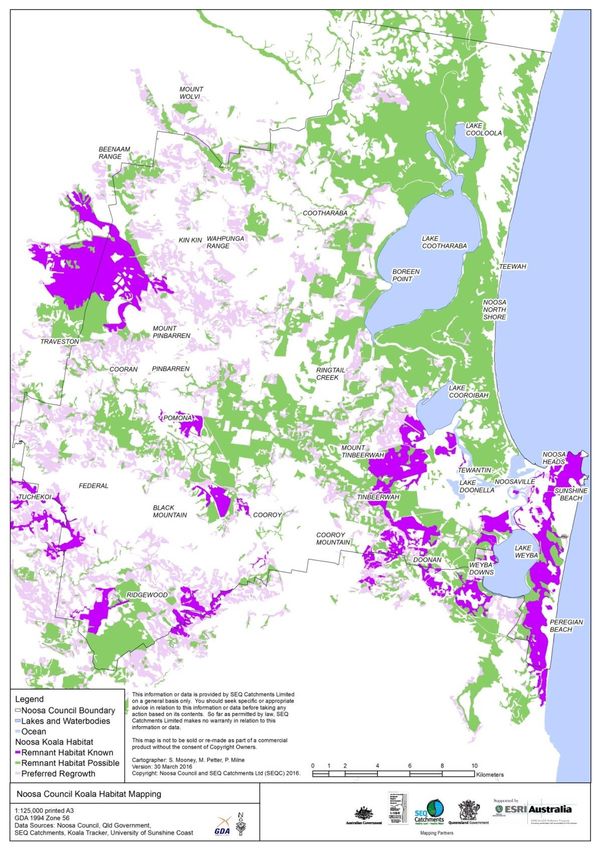
particular vegetation in Noosa Shire. Map 3 on page 18 shows the SEQC koala habitat
mapping. The SEQC koala habitat mapping is a verifiable mapping resource because it is
based on local evidence and also includes regrowth, which koalas often utilise. Fifty per cent
of koala records have been found to be outside remnant vegetation in regrowth and other
areas.
Koalas are recorded in National Park, State Forest, Council controlled land such as Bushland
Reserve and on private land. There are some important vegetation linkages that cross
jurisdictional boundaries and Noosa Council will work with Sunshine Coast Council and
Gympie Shire Council to help protect this habitat.
Noosa Council | Page 17Noosa Shire Koala Conservation Plan 2016
Map 3. Noosa Shire Koala Habitat Map.
Map 3. Noosa Shire Koala Habitat Map.
KoalaThreat
Koala ThreatMapping
Mapping(Mapis based
4, page upon
19) identifying
is based upon areas of development
identifying pressure which
areas of development
aggravates
pressure caraggravates
which strike, dogcarattack
strike,ordog
theattack
increased incidence incidence
or the increased of bushfire. There is no
of bushfire.
strongis scientific
There evidenceevidence
no strong scientific to suggest that development
to suggest that developmentaggravates
aggravatesdisease
diseasewithin
within
koalapopulations
koala populations as as some
some populations
populations in relatively
in relatively undisturbed
undisturbed areas alsoareas also have
have Chlamydia
(pers. comm.
Clamydia withcomm.
(pers. Dr Jon with
Hanger).
Dr Jon Hanger).
Page 18 | Noosa Council
16Noosa Shire Koala Conservation Plan 2016
Basedon
Based onthe
theKoala
Koala Threat
Threat Mapping,
Mapping, the Koala
the Koala Conservation
Conservation Plan places
Plan places a on
a priority priority on
protecting populations in low to medium risk areas where koalas have the best
protecting populations in low to medium risk areas where koalas have the best chance chance of
survival in the long term (see Map 4 below). The localities of Lake Weyba, Noosa
of survival in the long term (see Map 4 below). The localities of Lake Weyba, Noosa Hill/Noosa
Heads, Mt Tinbeerwah,
Hill/Noosa Heads, Mt Ridgewood,
Tinbeerwah,Woondum, Ringtail
Ridgewood, Creek andRingtail
Woondum, FederalCreek
West are andidentified
Como
as priority areas for koala conservation actions. Council is
are identified as priority areas for koala conservation actions.also developing a Biodiversity Plan
which will identify important linkages between core habitat areas.
Map 4. Koala Threat Map
Map 4. Koala Threat Map
Noosa Council | Page 19
17Noosa Shire Koala Conservation Plan 2016
1.2.5 Informed infrastructure decisions
National and State legislation, The Noosa Plan, and Council policy, guide Council infrastructure
decisions.
Best practice design and construction is to be applied to existing or planned infrastructure that
impacts on koalas in mapped Koala Habitat Areas. Measures to mitigate may include hard
infrastructure (exclusion and guiding fences, bridges, underpasses and culverts, koala ladders)
or soft measures (speed limit reductions, signs, road markings, improved street lighting).
Hard infrastructure
In 2008, the Australian Government conducted a study titled ‘Review of mitigation measures
used to deal with the issues of habitat fragmentation’. The researchers concluded that there
was strong evidence that mitigation structures such as wildlife crossings were effective for
individual fauna (koalas utilising bridge underpasses and culverts), but the long term impact of
the habitat fragmentation (e.g. construction of linear road through habitat) on fauna populations
is unclear.
In discussion with wildlife rescue organisations and based on koala threat mapping the
following Noosa Shire roads are identified as being highest risk:
• Eenie Creek Road, Noosa Heads
• Eumundi Road (Noosaville to Doonan)
• Noosa-Cooroy Road (Tewantin to Tinbeerwah)
• McKinnon Drive (Tewantin to Noosa Banks)
• Bruce Highway (Black Mountain)
• Yurol Forest Drive, Pomona
• Noosa Drive, Weyba Creek
• Jampot Creek Road, Pomona
• Beckmans Road, Tewantin
Page 20 | Noosa CouncilNoosa Shire Koala Conservation Plan 2016
Those roads that traverse known koala habitat areas (Map 3, page 18) are to be prioritised for
auditing of koala infrastructure. The process of identifying koala infrastructure needs for these
roads is as follows:
• Undertake an audit of existing wildlife structures in Known Koala Habitat Areas,
including their location and condition
• Identify areas where there are ‘gaps’ in koala infrastructure
• Develop a feasibility report including cost to deliver and maintain koala infrastructure
at priority sites during infrastructure upgrades
New koala infrastructure will be considered for major road projects located in proximity to
known koala habitat areas. Consultation with the Department of Transport and Main Roads will
be required on koala infrastructure needs identified on State Roads.
The Queensland Department of Transport and Main Roads (TMR) provide Fauna Sensitive
Road Design technical manuals for road infrastructure. TMR is also financially supporting koala
research and koala detection dogs.
Soft infrastructure
Car strike is one of the leading causes of death and injury for koalas in Noosa Shire in
developed areas (see Chart 1 next page). Between 1995-1999, the Queensland National Parks
and Wildlife Service, the Queensland Department of Main Roads and Redland City Council
undertook a trial of speed limit reductions from 80km/hr to 60km/hr between 7pm and 5am, in
August and December when koalas are most active. 1407 koalas were hit by cars during the
trial period and most died. Results indicated that there was no significant reduction in speed
by motorists, and no evidence that low speed zones cause a reduction in koalas being hit by
cars. QPWS suggested that speed limits would have to be reduced below 60 km to have any
affect. To implement a Noosa shire wide road speed reduction from 80-100km/hr to say 40km/
hr, similar to school zones, would require significant community support and substantial police
regulation. Efforts would be better directed to improved koala infrastructure to facilitate safe
road crossings or exclusion fencing at key sites.
Similarly the effectiveness of koala signs or markings along roads needs to be reviewed as
motorists often do not notice signs/markings and improved lighting will only assist in ‘go slow
zones’. Innovative signs and speed bumps may be an option in key koala crossing areas.
1.2.6 Effective wild and domestic dog control
Domestic and wild dogs can significantly impact on koala populations. Records indicate that
the greatest cause of injury and mortality to koalas in Noosa Shire is from disease and car
strike (see Chart 1). However, the majority of records come from areas that are actively used
by humans (roads and residential areas). Within the Noosa records there are a small number
of records of mortality from dog attack, but these are likely to be domestic dog.
Noosa Council | Page 21Noosa Shire Koala Conservation Plan 2016
Chart 1. Data on Koala in-patients at Australia Zoo
Domestic dogs
Domestic dogs are regulated under Noosa’s Animal Management Local Law No. 2. In public
spaces dogs must remain under control by the owner at all times and on private land, must be
confined to property boundaries. Local Law No. 2 also regulates the restraint of dogs in Koala
Habitat Areas. On occasion koalas wander onto private property, or dog owners fail to keep
control of their dogs in public spaces, and koalas are attacked.
Other Councils have declared through local laws, dog and cat free estates as a measure to
protect wildlife. Given the low proportion of attacks on koalas by domestic dogs in Noosa Shire
it is recommended that resources be directed to other areas such as wild dog control, disease
research and fauna sensitive road design. However, public education on dog control is still
important. Noosa Council has a ‘Responsible Dog Ownership’ program and education on dog
control and minimising attacks on native animals is to be part of this program.
Wild dogs
In one study of the Moreton Bay Rail Project at Amcor, one rogue dog was responsible for 8
cases of koala mortality in one month alone. However this was an unusual case and there is
no evidence to suggest that this is happening in Noosa Shire. Given the potential of wild dogs
to significantly impact on koala populations, it is recommended that Council’s current wild dog
control strategy continues and efforts be directed in and around the mapped priority Koala
Habitat Areas.
Page 22 | Noosa CouncilNoosa Shire Koala Conservation Plan 2016
1.2.7 Implement translocation consistent with State policy
1.2.7 Implement translocation consistent with State policy
TheNature
The NatureConservation
Conservation (Koala)
(Koala) Conservation
Conservation Plan Plan
2006 2006 and Management
and Management ProgramProgram
2006-
2006-2016
2016 sets
sets strict strict
policy policy to
in respect in koala
respect to koala State
translocation. translocation. State
approvals are approvals
required and are
required and
proponents need proponents needthat
to demonstrate to the
demonstrate that the re-introduction/re-stocking
re-introduction/re-stocking of koalas in an area will of
koalas in
actually an area
benefit local will
koalaactually benefit
populations. Any local koala
release populations.
requires Anymonitoring
a long-term release requires
programato
assess the success of the translocation. The risk of koala translocation is as follows: risk of
long-term monitoring program to assess the success of the translocation. The
koala translocation is as follows:
• Potential disease transmission to local populations
• Impacts on the social structure and range of existing koalas
Potential disease transmission to local populations
• Potentially
Impacts on theoutcompeting local koalas
social structure for food
and range of existing koalas
• Potentially
Alterationoutcompeting local koalas for food
of local gene pool
Alteration of local gene pool
• Introducing koalas that are not accustomed to local tree species
Introducing koalas that are not accustomed to local tree species
• Releasingkoalas
Releasing koalas in
in area
areawhere koalas
where have not
koalas beennot
have ablebeen
to survive
ablepreviously
to survive
previously
The advantages of translocation include:
The •advantages
Koalas of
can be relocatedinclude:
translocation from high risk, to low risk areas
• Koalas are an iconic species and are of great interest to tourists
• Koalas can bekoalas
Introduced relocated fromdiversify
may help high risk,
thetogene
low pool
risk areas
Koalas are an iconic species and are of great interest to tourists
• Koalas may have been hunted into local extinction previously. Re-introducing koalas
Introduced koalas may help diversify the gene pool
may be a viable option.
Koalas may have been hunted into local extinction previously. Re-introducing
koalas
Council may be may be a viable
supportive option.
of koala translocation but only if proponents have State permits and
comply with the State Nature Conservation (Koala) Conservation Plan 2006 and Management
Council 2006-2016.
Program may be supportive
The koalas ofwould
koalaneed
translocation but local
to be from the onlyvicinity
if proponents have20State
(i.e. less than
permits
kms from and comply
release with theand
site), healthy, State Nature
at risk Conservation
from unavoidable (Koala) Conservation
development. Proposals for Plan
2006 and Management
translocation to Council land Program 2006-2016.
will be considered The koalaswith
in consultation would need
State to be from
Government on an the
local
as vicinity
needs basis.(i.e.
Some less
koalathan 20 kms
experts from
maintain thatrelease site), healthy,
current translocation andis ineffective
policy at risk from and
unavoidable development. Proposals for translocation to Council land will be
needs review. Council will observe any new policy changes as they arise.
considered in consultation with State Government and on an as needs basis.
Noosa Council | Page 23
21Noosa Shire Koala Conservation Plan 2016
1.2.8 Increased community awareness and participation
Residents and visitors have a great interest in our local koalas. Involving residents, visitors and
community groups in koala conservation has a number of benefits:
• Encouraging landholders to plant koala food trees;
• Participating in the collection of data for research purposes;
• Raising awareness of threats from dogs, cars, fencing and pool drowning;
• Improved reporting measures for sick/injured/orphaned koalas;
• Capacity building with key stakeholders for koala habitat restoration projects.
Council will continue to support koala conservation through attendance at public events and
provision of education materials. Council also supports wildlife rescue through the community
grants program.
There are a number of active organisations involved with the conservation of koalas. Advocacy
groups include the Australian Koala Foundation, Queensland Koala Crusaders, Koala Tracker,
and Koala Diaries. In addition there are several wildlife care groups involved with saving koalas
such as Australia Zoo, Sunshine Coast Koala Rescue, Wilvos, Wildlife Rescue and Wildcare
Australia. Research organisations include the University of Sunshine Coast Detection Dogs for
Conservation and University of Queensland Koala Research Network. Environment groups,
natural resource management groups and government agencies are also key stakeholders in
koala conservation.
The identified stakeholder groups in Appendix 3 have been consulted on the Koala
Conservation Plan. Council will continue to work with these organisations during
implementation phases of the Plan.
Case study: Cooroy Lower Mill Site Project
In 2005, Noosa Council and the Noosa and District Landcare Group (NDLG) joined
forces to rehabilitate Cooroy Creek. The first stage was to remove environmental
weeds, particularly Camphor laurel (Cinnamomum camphora) which was dominating
the creek and shading out native vegetation. Following this, native plant species
including koala food trees, were planted to bring the creek back to a natural condition.
The success of this project led to further funding and restoration of Cooroy Creek.
Funding contributors included Council, NDLG, Burnett Mary Regional Group, Mary
River Catchment Coordinating Committee and SEQ Water. The Cooroy Lower Mill
Site Project has reaped multiple benefits including improved water quality, greater
public amenity, and even recent recorded sightings of koalas.
Page 24 | Noosa Council2. Koala Conservation Action Plan (To be reviewed on an annual basis)
Reference Action Success Indicator Responsibility Time frame Resources Status
Objective 1. Conserve koala populations and habitat through statutory provisions
1.1 Amend the Noosa Provisions are Strategic planning May 2016 Officer time Individual tree
Plan to include Shire- included which protection provisions
wide individual tree avoid/mitigate/offset have been included
protection provisions impacts on koala in the 2016
outside the mapped trees outside the planning scheme
Biodiversity Overlay mapped Biodiversity amendments
Overlay
1.2 Identify Koala Habitat Data is submitted for Environment August 2016 Officer time Koala Habitat
Areas based on local State review Services and Mapping completed
data and approach Strategic Planning April 2016.
State for inclusion in
SPP mapping Update mapping
every 5 years
1.3 Investigate harsher Harsher penalties Environment October 2016 Officer time Not started
penalties for illegal are applied and the Services
tree clearing incidence of illegal
tree clearing is
reduced
1.4 Deliver environment Offsets are delivered Environment Levy Subject to Officer time and Settlers Cove Koala
offsets as required on demand and Working Group developments offset funds Offsets delivered at
koalas utilise habitat that trigger offset Girraween Nature
provisions Refuge in 2015.
TMR Cooroy to
Curra offsets
Noosa Shire Koala Conservation Plan 2016
pending
Noosa Council | Page 25Reference Action Success Indicator Responsibility Time frame Resources Status
Objective 2. Conserve koala populations and habitat through non-statutory means
2.1 Secure koala Purchase of key Environment Levy Ongoing Officer time 100 ha purchased in
habitat through properties mapped Working Group 2015 on Noosa River
land acquisition and as koala habitat and Environment Levy and is mapped as
Page 26 | Noosa Council
rehabilitation koalas are recorded ‘possible’ koala habitat
onsite. Environment Levy
generates $1.8m
per annum
2.2 Fund koala tree Koala tree plantings Environment 2017-2022 Officer time Subject to 17/18
planting projects are delivered on key Services new initiative budget
targeting private properties and koalas Target budget approval and/or grant
landholders located occupy habitat of $20,000 per funding
Noosa Shire Koala Conservation Plan 2016
next to, or within, annum each year
Koala Habitat Areas for 5 years through
and in areas mapped operational or
as low to medium grant funding
threat.
2.3 Continue to support One major koala Environment Ongoing Officer time Ongoing
environment and grant to be delivered Services
natural resource every 3 years and State or National
management groups koalas are recorded grants
with applications onsite
for grant funding to
restore koala habitat
on public land
2.4 Focus Bushland Care One major koala tree Parks and Natural 2016-2021 Officer time Ongoing
weed control and planting (e.g. National Areas
tree planting projects Tree Day) project is
towards koala habitat completed each year
areas in key Koala Habitat
AreasReference Action Success Indicator Responsibility Time frame Resources Status
Objective 3. Improve understanding of koala needs and behaviour
3.1 Develop research Partnership is Environment 2016-2021 Officer time Council provides in-kind
partnerships with formalised and health Services support to USC post-
other Councils, status of Noosa’s Australian graduate koala health
State Government koala populations is Government ARC research program
Koala interest assessed funding
groups and research USC has been granted
Noosa $65,000 by the Noosa
organisations to Biosphere®
determine the health Biosphere (R) Reserve
funding Foundation for the Koala
and sustainability of
koala populations Health Mapping Project
Richard Branson
Conservancy and USC is applying for an
Queensland Koala ARC Research Project
Crusaders Grant to fund a comprehensive
funding study across SEQ and
Wide Bay Regions
Objective 4. Map and monitor local koala populations
4.1 Develop local koala Koala habitat maps Environment March 2016 $8500 for USC Maps finalised April
habitat and threat completed and used Services koala survey and 2016
mapping to inform development $8600 for SEQC
Update maps every 5
assessment and koala habitat/
years
Council operational threat mapping
works programs to
minimise impact on Update maps after
koalas 5 years $1000
4.2 Investigate latest Discussions are held Environment 2016 Officer time Ongoing
methods for efficient with USC and other Services
and effective ground research agencies USC
truthing of koala and efficiencies
UQ Koala
presence/absence improved
Research Network
Noosa Shire Koala Conservation Plan 2016
and health
Richard Branson
Conservancy
Noosa Council | Page 27Reference Action Success Indicator Responsibility Time frame Resources Status
4.3 Maintain database Data is entered quarterly Environment Ongoing Officer time Not started
with koala records on Wildnet and used to Services
inform State Essential
Habitat Mapping
Page 28 | Noosa Council
4.4 Explore opportunities Consultation completed Environment September 2016 Officer time Not started
to improve the rigour and all data verifiable for Services
of citizen science State mapping purposes
data records
4.5 Implement Noosa FMP is implemented and Environment Ongoing Officer time Started 2015
Bushland Reserve potential fire hazard to Services and
Fire Management koalas reduced Parks and natural FMP budget
Plan (FMP) with a Areas
Noosa Shire Koala Conservation Plan 2016
focus on ‘high’ to
‘very high’ fire hazard
areas
Objective 5. Informed infrastructure decisions
5.1 Include new Koala New layer is included GIS August 2016 Officer time New Koala mapping
Mapping in Council’s and used to inform finalised March 2016
internal GIS mapping Council capital and
system for capital operational works
and operational Environment Ongoing Officer time Commenced
Infrastructure works
works environmental Services and
including tree koala
assessment Parks and Natural
tree assessment
are reviewed by the Areas
Environment services
team and are consistent
with Koala Policy and
State/Federal legislation
5.2 Upload koala Intranet webpage is Environment August 2016 Officer time TMR technical
sensitive design developed and utilised Services guidelines for roads
guidelines on Intranet by Council capital and are available online
operational works. ITReference Action Success Indicator Responsibility Time frame Resources Status
5.3 Conduct audit of current Audit and Environment February 2017 Officer time Not started
koala infrastructure feasibility report on Services
including land bridges, development and Tablet for mobile Apply through IT
culverts, pipes, culverts, maintenance of koala data collection budget
road signs, climbing friendly infrastructure $4000
ladders, directional and is completed
exclusion fencing. Current GIS
bridge asset layer
5.4 Deliver koala hard Koala infrastructure Civil operations 2017-2022 Officer time Ongoing
infrastructure during is delivered and the
road renewals near incidence of koala car Include in capital
mapped koala habitat strike is reduced or works/operational
areas negated works budget
5.5 Consult with Qld Meet with State Environment August 2016 Officer time Not started
Department of Government Services
Transport and Main officers to gauge
Roads and USC on effectiveness of koala
koala infrastructure infrastructure
requirements for State
Roads
5.6 Monitor the effectiveness Monitoring is Environment Ongoing Officer time Started
of new technology trials undertaken and Services
such as road reflectors assessed for
to discourage koalas suitability to reduce
and other wildlife from car strike
crossing roads, koala
alert signs at crossing
points and improved
lighting
Noosa Shire Koala Conservation Plan 2016
Noosa Council | Page 29You can also read


