Professional Development Portfolio Guide - with Essential Practice Competencies - Commission on ...
←
→
Page content transcription
If your browser does not render page correctly, please read the page content below
Professional
Development
Portfolio Guide
with Essential Practice Competencies
Professional
                                                                             Development
                                                                             Portfolio
                                                                              with Essential Practice Competencies

Dear Dietetics and Nutrition Practitioner:
The Commission on Dietetic Registration (CDR), the credentialing agency for the Academy
of Nutrition and Dietetics, is committed to protecting the public through the enforcement
of validated certification standards and the Code of Ethics for the Profession of Dietetics
(www.eatrightpro.org/resources/career/code-of-ethics). In addition to rigorous credentialing
processes, the Commission is also dedicated to meeting the needs of nutrition and dietetics
practitioners with practical resources to enhance continual professional learning and growth.
The Professional Development Portfolio Guide now reflects Essential Practice Competencies
for CDR Credentialed Nutrition and Dietetics Practitioners. As a shift from the traditional
PDP learning need codes, practice competencies describe the knowledge, skills, judgment,
and attitudes for all credentialed practitioners throughout their careers, and across areas of
practice, and work settings.
To assist with the PDP transition to practice competencies, the Goal Wizard, an online,
interactive tool is available by logging into your “MyCDR” page on the CDR website
(www.cdrnet.org). The Goal Wizard asks a series of structured questions based upon practice
status, daily professional activities, and current and future learning needs, in order to assist
you in formulating and submitting your individual learning plan. The Goal Wizard promotes
professional self-reflection and learning needs assessment to help you complete your learning
plan by selecting competencies and performance indicators from your personalized Practice
Competency Profile.
The essential practice competencies and Goal Wizard have been incorporated into the PDP
process beginning June 2, 2015, for newly credentialed nutrition and dietetics practitioners, and
June 1, 2016, for recertifying credentialed nutrition and dietetics practitioners completing the
2016-2021 recertification cycle. All other practitioners will be transitioned into the new system
over the next five years.
These enhancements to the PDP process are exciting and also meet the needs of nutrition
and dietetics practitioners who are fully engaged in quality career-long learning and
professional growth. Please visit www.cdrnet.org/competencies for helpful resources about
the competency-based PDP process. If you have any questions, email CDR at cdr@eatright.org
or at competencies@eatright.org, or phone CDR at 1-877-1600 ext. 5500.
Sincerely,

Kevin Sauer, PhD, RD, LD
Chair
Commission on Dietetic Registration

                                               1
Professional
Development
Portfolio
with Essential Practice Competencies
Table of Contents
Professional Development Portfolio Guide
Professional Development Portfolio At A Glance................................................................2
Professional Development Portfolio Principles.....................................................................4
Step 1: Learning Plan Using The Goal Wizard Tool............................................................8
Step 2: Activity Log......................................................................................................................... 11
Step 3: Professional Development Evaluation...................................................................... 14
Approved Continuing Education Activity Types.............................................................. 15
Portfolio Audit Procedures......................................................................................................... 27
Definitions Of Terms..................................................................................................................... 28
Appendices
Please Note: All appendices are contained in the separate PDP Appendix PDF to
be found elsewhere on the CDR website.
A: Instructions for Online Entry of Learning Plan/Activity Log 2
B: Sponsored Independent Learning Contract..................................................................11
C: Approved Certification Program Information..............................................................13
D: Resources for PDP Process Development.......................................................................17
E: Visioning Report and Workforce Demand Study....................................................... 19
F: Independent Foreign Degree Evaluation Agencies..................................................... 21
Contacting CDR
The Commission on Dietetic Registration will always be the best resource
for information regarding the PDP process and its requirements. Feel free to
contact us in one of the following manners:
Phone: 1-800-877-1600 x 5500
Web: www.cdrnet.org
Email: cdr@eatright.org
Fax: 312-899-4772
Mail: Commission on Dietetic Registration
120 South Riverside Plaza, Suite 2000
Chicago, IL 60606-6995
1Professional
Development
Portfolio
with Essential Practice Competencies
Professional Development
Portfolio At A Glance
The Professional Development Portfolio (PDP) than March 17th of the last year of your
is constructed to help you through the 3 steps recertification cycle, you may rollover up to 15
CPEUs completed within the last 75 days of your
of the recertification process. The Steps will
cycle (i.e., CPE activities completed between
help you to: March 17th and May 31st). Please note that the
• Develop a Learning Plan by completing the Goal 120 day policy still applies. If your Activity Log
Wizard tool, which will help you reflect on and has been approved, you may enter your new
assess your current and future professional Learning Plan online as early as March 17th of
learning needs and goals in order to first develop the last year of your cycle.
a personalized Practice Competency Profile
that indicates competencies and performance Commonly used CPE Activity Types
indicators relevant to your practice.
• Record, document and evaluate learning
170: Lectures and Seminars
activities. • Any live program. This type of activity does not
• Evaluate progress made towards reaching your require prior approval.
goals. • 1 CPEU equals 1 contact hour.
• There is no CPEU maximum for this type of
Deadlines and requirements activity per 5 year recertification cycle.
• Your Learning plan is required to be submitted
within 120 days of completing your first CPE 150: Interactive Workshops
activity for your current recertification cycle. • Any live interactive program. This type of
• All CPE activities must be completed no later activity does not require prior approval.
than May 31st of the last day of your current • 1 CPEU equals 1 contact hour.
recertification cycle.
• There is no CPEU maximum for this type of
• Activities are to be logged and submitted no activity per 5 year recertification cycle.
later than June 30th of the last year of your
current recertification cycle. 200: Professional Reading
• Your CDR Maintenance fee is due 8/31 every year. • This activity entails reading peer-reviewed,
At the beginning of every new recertification dietetics-related articles from professional
cycle, you will have the option to pay yearly, or journals and professional newsletters
pay for five years in advance. • The article must be read within 5 years of the
CPEU Rollover and 120 day policy date the article was published
• You must include the journal reference/citation
• The 120 day policy states that your Learning
in the activity title description on your Step 4
Plan must be submitted before you engage in
Activity Log.
CPE activities or postmarked no later than 120
• RDNs or RDs can earn up to 15 CPEUS, and
days after completing your first continuing
NDTRs or DTRs can earn up to 10 CPEUs, for
professional education activity in the current
this type of activity.
recertification cycle (a 120 day chart is on CDR’s
website at www.cdrnet.org/calculator). • For those dietetics practitioners who can
document authoring a publication (journal
• If your Activity Log is submitted no later
2Professional
Development
Portfolio
with Essential Practice Competencies
article in a scientific peer-reviewed journal • Your learning plan will be automatically
or a chapter in a published dietetics related approved when you submit it at the end of the
textbook) within their current recertification Goal Wizard process.
cycle, the reading maximum can be increased
by 5 CPEUs per article or chapter, up to a Dream Wizard
maximum of 35 CPEUs if you have authored four • A demo version of the new PDP Goal Wizard
articles (or two chapters and two articles, etc.). tool that can be used to become more familiar
with the Step 1 Learning Plan process.
260-465: Consecutive Certifications
• The Dream Wizard will allow you will to create
• These specific certifications can be used to and print a final copy of your Learning Plan, but
recertify in repeated recertification periods this plan cannot be saved or submitted to CDR.
indefinitely for 75 CPEUs.
** Please note that you must access your
• CPEUs can be awarded for these qualifying
certifications earned during your current Professional Development Portfolio Guide
5-year recertification cycle and up to 6 months for a full description of PDP guidelines and
before your current recertification cycle. requirements.
700-740: Self-Study What Is Considered Continuing
• Self-study activ ities can be audio-based, Education?
computer-based, printed, video or DVD-based
or web-based.
In determ ining which CPE activ ities
receive credit under the PDP process, CDR’s
• These types of activities must be prior approved
by CDR, or approved through a CDR Accredited Competency Assurance Panel considers the
Provider. direction of information f low—whether it
• There is no CPEU maximum for this type of is toward or away from the practitioner. For
activity per 5 year recertification cycle. example, when attending a lecture/seminar,
information is f lowing from the presenter
Competencies and toward the practitioner; therefore, this
• Please review the Spheres, Competencies, and activity could be eligible for CPE. When it
Performance Indicators to better understand is the practitioner delivering a presentation,
the new competency-based process.
however, the information is flowing from the
• Link: http://www.cdrnet.org/competencies.
practitioner to the audience; therefore, being a
Goal Wizard presenter is not eligible for CPE. Presenters may
• The Goal Wizard tool will help you develop
possibly obtain CPEUs for certain preparation
and submit your Step 1 Learning Plan by activities within the approved CPE categories.
ref lecting on and assessing your current See the following pages 16–27 for a full list of
and future professional learning needs and approved CPE activity types.
goals in order to first develop a personalized
Practice Competency Profile that indicates The Online CPE Database can be found at:
competencies and performance indicators
http://www.cdrnet.org/go/and/cdr/cpe_search.cfm
relevant to your practice.
• The Goal Wizard allows you to work on your A complete listing of CDR's Accredited
learning plan and save it as you go. You do not Providers can be found at:
have to finish the Goal Wizard process and
submit your learning plan in one sitting. http://www.cdrnet.org/commission-on-dietetic-
registration-continuing-professional-education-
• Please keep in mind the 120 day policy still
applies. Your learning plan is not postmarked accredited-providers
or approved until your submit your learning
plan at the end of the Goal Wizard process.
3Professional
Development
Portfolio
with Essential Practice Competencies
Professional Development
Portfolio Principles
The underlying principle of the Professional “[t]he dietetics practitioner assumes a life-long
Development Portfolio (PDP) process is that responsibility for personal competence in
effective continuing professional education practice, consistent with accepted professional
(CPE) involves more than information transfer standards, continually striving to increase
alone. Research shows CPE is optimized when professional knowledge and skills and to
each practitioner identifies knowledge and apply them in practice.” RDNs, RDs, NDTRs,
skills needed for professional competence, and DTRs not complying with the Code of
uses appropriate educational methods, Ethics are subject to disciplinary actions,
and develops individualized strategies to including censure, probation, suspension
implement what has been learned by applying of registration, and revocation of credential
it to professional practice. (http://www.eatright.org/CODEOFETHICS/).
Bu i ld i n g upon t hese pr i nciples , t he To enhance accountability and assist
Commission on Dietetic Registration (CDR) practitioners with achieving their goals,
constructed a PDP process, which promotes CDR will employ a periodic audit process
lifelong learning and continuing professional whereby it will randomly select practitioners
competence while providing you with the tools and will require those individuals to submit
to achieve these aims. The tools will enable their CPE documentation. Only practitioners
you to analyze circumstances, requirements, who are audited will be required to submit
and essential practice competencies within CPE documentation. Specific “Required
your profession; create and carry out an Documentation” is outlined in the CPE Activities
individualized continuing education activity; (pages 16–27) under each activity type.
and evaluate the success of using CPE in your The three steps of the PDP process take time.
professional life. The value of the process is often proportionate
CDR embraces the Academy of Nutrition and to the effort expended in its completion.
Dietetics’ Standards of Professional Practice,
which hold the individual professional
Essential Practice Competencies
responsible for continuing competence. The The Essential Practice Competencies provides
Code of Ethics for the Profession of Dietetics, overarching validated standards for two
which applies to all registered dietitian credentials: the RDN or RD and the NDTR
nutritionists (RDNs), registered dietitians (RDs), or DTR. Practice competencies define the
nutrition and dietetics technicians, registered knowledge, skill, judgment, and attitude
(NDTRs), and dietetic technicians, registered requirements throughout a practitioner’s
(DTRs), also imposes an on-going obligation on career, across practice, and within focus areas.
these practitioners to maintain competence by Competencies provide a structured guide
increasing their professional knowledge and to help identify, evaluate, and develop the
skills. The Code of Ethics specifically states that, behaviors required for continuing competence.
4Professional
Development
Portfolio
with Essential Practice Competencies
Unlike entry-level competencies, which focus Fo r c o m p l e t e i n f o r m a t i o n o n t h e
on preparation and evaluation for minimum Essential Practice Competencies, v isit
competence upon completion of an academic http://www.cdrnet.org/competencies.
activity approved by ACEND (Accreditation
Council for Education in Nutrition and
CPE Definition and Philosophy
Dietetics), the essential practice competencies CPE, as defined in the CDR Dietetics Practice
are intended for use throughout a nutrition Audit (see Appendix D), is education beyond
and dietetics practitioner’s career. that required for entry into the profession. The
There is an expectation that competencies will dietetics professional participates in lifelong
be used by the dietetics professional to identify learning to maintain and improve knowledge
learning needs; guide continuing professional and skills for competent practice.
development and ongoing competence; CPE is the implementation of the Learning
assist in career progression and professional Plan of the PDP process. CPE activities must
development; and communicate the role and be selected based on your individual Learning
competence of the profession to stakeholders Plan that has been approved by CDR.
(e.g., employers, external accreditation bodies,
the public, etc.). Content Criteria and Requirements
Checklist for Continuing Professional
The competency-based PDP is intended to Education Activities That You Attend
assist practitioners with increasing their
to Maintain Registration
skills, knowledge, and competence while
also ensuring compliance with the Code of CPE encompasses activities or materials that
Ethics. The PDP process does not, however, you attend and that must have the following
warrant or guarantee competency, accuracy, characteristics:
or any particular treatment result, but, rather, 1. Faci l itate l ifelong lea rn ing by updating ,
participation in the process helps demonstrate enhancing, or assessing knowledge and skills
the practitioner’s commitment to providing outlined in the essential practice competencies
the highest quality dietetic services through 2. Help you implement an individual Learning Plan
continuous education and professional 3. Are dietetics related
development. Dietetics related means: The integration,
application, and communication of principles
The first group to use the essential practice
derived from food, nutrition, social, business,
competencies in the PDP will be new RDNs and basic sciences to achieve and maintain
or RDs and new NDTRs or DTRs who are optimal nutritional status of individuals
credentialed June 2, 2015-May 31, 2021 and through the development, provision, and
practitioners recertifying June 1, 2016-May 31, management of effective food and nutrition
2021. Annually thereafter, newly credentialed services in a variety of settings and as defined
by the essential practice competencies.
practitioners and those recertifying will begin
including essential practice competencies 4. Are targeted academically to beyond entry-level
dietetics professionals and provide learning
in the PDP. The last group to transition to
outcomes that apply to professional practice or
essential practice competencies will be new intended practice.
RDNs or RDs, and NDTRs or DTRs credentialed
5. Are developed by instructors or individuals who
June 2, 2019–May 31, 2025 and practitioners have appropriate academic training, certification,
recertifying June 1, 2020–May 31, 2025. or demonstrated expertise to present or develop
materials in a particular subject area.
5Professional
Development
Portfolio
with Essential Practice Competencies
6. Academic degrees should be relevant and completing the CPE activity in different editions
from a US regionally accredited institution. of the same publication, should not be repeated
Foreign academic degrees accredited by foreign
in the same 5-year recertification cycle.
equivalent institutions are accepted on the
condition that they have been verified by one of Be aware that failure to complete the PDP
the agencies listed on the Independent Foreign process will lead to the loss of your RDN or
Degree Evaluation Agencies list on pages 21 and 22 RD, or NDTR or DTR credential.
of the Appendix. Publications in scientific, peer-
reviewed professional journals or presentations CDR will continue to process prior approval
at scientific, peer-reviewed conferences may also of CPE and accreditation for CPE providers to
be used to help establish expertise. identify activities and providers that have met
7. Demonstrate that content, quality, and scientific CDR standards. You may attend activities that
integrity of the activities and materials are have not been prior-approved or presented by
maintained.
CDR-accredited providers (except for self-
8. Presentations and materials that are clinical
study activities), on the condition that they
in nature are evidence-based. A balanced
discussion of the topic, including risk versus
meet PDP process requirements.
benefit information where appropriate, is ensured.
Controversial or disputed issues are presented
as such and supported by documentation
from current and reputable, refereed, scientific
journals.
9. Disclose potential conflicts of interest, including
commercial bias
10. Are (typically) a minimum of one (1) contact hour
in length.
11. Exceptions include professional reading, poster
presentations and exhibits, and self-study
activities, which can be a minimum of 0.5 CPEUs.
You must complete CPE activities within your
5-year recertification period to be awarded
CPEUs. Your Learning Plan must be submitted
before you participate in CPE activities or
must be postmarked no later than 120 days
after completing your first CPE activity in your
current recertification cycle.
Only approved CPE Activity Types listed on
pages 16–27 will be awarded CPEUs by CDR.
RDNs or RDs must attain 75 CPEUs and NDTRS
or DTRs must attain 50 CPEUs during a 5-year
reporting period. CPE activities must be based
on the individual learning needs specified on
your Learning Plan that has been approved by
CDR. Some CPE activities have CPEU limits for
a 5-year reporting period; any limits are listed
in the description of each specific CPE activity.
The same learning activities, for example,
6Professional
Development
Portfolio
with Essential Practice Competencies
Required Ethics CPE Activity 4. The first CPEU to be transferred to the next
cycle must be attained at least one day after
RDNs or RDs, and NDTRS or DTRs, must the completion date of the last activity logged
complete a minimum of 1 CPEU of Continuing for the current cycle ending May 31.
Professional Education in Ethics (Ethics and 5. RDNs or RDs may transfer up to 15 CPEUs
Professionalism 1-1.6) during each 5-year and NDTRs or DTRs may transfer up to 10
recertif ication cycle. This requirement CPEUs earned during the last 75 days of their
recertification cycle toward their next cycle,
will be effective starting with the 5-year
which begins June 1.
recertification cycle that ends on May 31, 2017,
6. A new Step 1: Learning Plan for the new cycle
and will be phased in over a 5-year period for beginning June 1 needs to be submitted no
each recertification cycle. later than 120 days after the completion date
Accordingly: of the first activity to be transferred to the next
recertification cycle.
• Each Step 1: Learning Plan submitted for
7. All CPEUs from a given activity must be
recertification cycles ending May 31, 2017, will
transferred. CPEUs from one activity cannot be
be required to include a performance indicator
credited across multiple recertification cycles.
from Ethics and Professionalism 1.1-1.6.
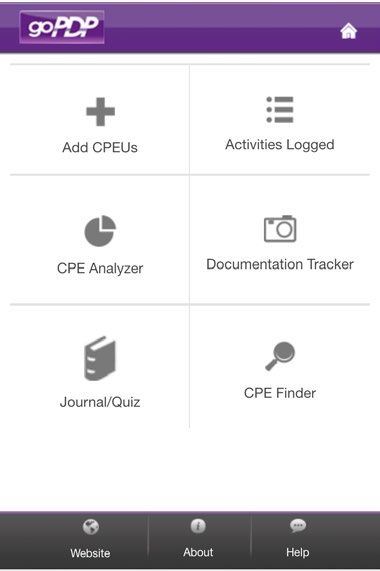
• Each Step 2: Activ ity Log submitted for PDP Activity Mobile Logging
recertification cycles ending May 31, 2017, must
include at least 1 Continuing Professional RDNs or RDs, and NDTRs or DTRs, are able
Education Unit (CPEU) with a performance to utilize an internet-enabled smartphone to
indicator from Ethics and Professionalism 1.1–1.6. track their CPEUs as they complete them. You
can download the goPDP app from the iTunes
CPEU Rollover
App and Google Play stores, or by visiting the
At its February 2011 meeting, CDR approved following website from any other smartphone:
a process for permitting rollover of up to 15 https://pdp.webauthor.com/
CPEUs (RDNs and RDs) or up to 10 CPEUs
(NDTRS and DTRs) in the last 75 days of a
practitioner’s current recertification cycle that
will count towards the next cycle. CPEUs to
be transferred must meet all of the following
requirements:
1. Practitioners must have successfully completed
the CPEUs required for their current cycle (75
CPEUs for RDNs or RDs or 50 CPEUs for NDTRs
or DTRs).
2. Practitioners must submit their completed
online Step 2: Activity Log for the current cycle
no later than March 17 of the last year of their
recertification cycle in order to be eligible for
CPEU to roll over to the next recertification
cycle.
3. The CPEUs to be transferred must be attained
du r ing the last 75 days of the cu r rent
recertification cycle (i.e., CPE activities must
be completed between March 17 and May 31).
7Professional
Development
Portfolio
with Essential Practice Competencies
1-2-3: Step by Step Through The
Professional Development Portfolio Process:
Step 1: Using The Goal
Wizard Tool To Complete
Learning Plan
Overview of the Goal Wizard: From which selected competencies you would like
Practice Competency Profile to Step to establish as learning goals and by choosing
1: Learning Plan which selected performance indicators you
will focus on for each learning goal. At the end
The Goal Wizard is an algorithmic tool that will of the Goal Wizard process, you will review
help you to first reflect on where your career is and submit your Step 1: Learning Plan to CDR.
now and where you would like your career to Approval is automatic upon receipt.
be in the future. This reflection is a critical first
step in planning for continuing professional Completing Step One Using the
development and career management. The Goal Wizard Tool
Goal Wizard will also help you to identify The Goal Wizard tool will ask you a series of
knowledge and skills that you need to develop questions to determine your practice status
or strengthen to reach your goals. Identifying and employment setting, your day-to-day work
learning needs helps you enhance competence, activities and specific skills, and knowledge
remain competitive, and take advantage of and judgments that need to be demonstrated
new opportunities in the marketplace. After in these activities, as well as which external
answering questions related to your current or factors or trends will affect your professional
future practice, the goal Wizard will generate practice. Based on your responses, the Goal
a personalized Practice Competency Profile. Wizard will generate a Practice Competency
This profile will list specific competencies Profile.
describing identifiable components of your
expected performance (knowledge, skill, In Step 1, the Goal Wizard uses your
judgment, and attitude) and particular personalized Practice Competency Profile to
performance indicators describing an develop your Learning Plan, which will serve
interrelated set of factors that define your as the basis for completing your Step 2:Activity
level of expected performance. Using the Log. The Goal Wizard will prompt you to select
customized Practice Competency Profile, you which competencies you want to save as goals
will create your Learning Plan by choosing (you must choose one competency related
8Professional
Development
Portfolio
with Essential Practice Competencies
to ethics); after selecting and prioritizing If Your Learning Plan Changes
your goals, you will be directed to choose
The Learning Plan can be rev ised to
at least one performance indicator for each
accommodate significant career changes or
goal from a customized list. You must have
life situations. If your learning needs and goals
at least one goal that is supported by at least
significantly change, you must submit a revised
one performance indicator, although you will
Step 1: Learning Plan to CDR for approval.
likely have multiple goals and performance
This resubmission is important because your
indicators. After you complete these steps, you
learning activities will be evaluated against
will be able to review and submit your Step 1:
the Learning Plans(s) that CDR has approved.
Learning Plan to CDR.
You will receive credit for your learning
Step 1: Learning Plan Process activities if they were consistent with the
Requirements approved Learning Plan on file with CDR at
the time of your CPE activity. Your revised Step
You must submit your Learning Plan within
1: Learning Plan must be submitted before
your current recertification cycle; however,
you participate in CPE activities or submitted
you may submit your Step 1: Learning Plan
within 120 days of completing your first CPE
as early as 75 days before your new 5-year
activity under your new Learning Plan.
recertification cycle begins. Note that neither
the 75-day rule nor the 120-day Learning Plan When revising your Learning Plan, you may
grace period can be used to transfer CPEU either start from the beginning of the Goal
credit for activities completed outside your Wizard process, or you may start from the
current recertification cycle. If this is not your point at which the Goal Wizard provides you
first recertification cycle, you must have an with a selected list of competencies based on
approved Step 2: Activity Log before you can your previous responses. Both options will
submit a new Step 1: Learning Plan. allow you to make the appropriate updates
to your Learning Plan before you submit your
It is recommended that you submit the Learning
revised plan to CDR.
Plan to CDR before your first CPE activity. Your
Learning Plan must be submitted before you Copying Your Step 1: Learning Plan
engage in CPE activities or postmarked no from a Previous Recertification Cycle
later than 120 days after completing your first in Your New 5-Year Recertification
continuing professional education activity in Cycle
the current recertification cycle (a 120 day
chart is on CDR’s website at www.cdrnet. If you have completed a PDP recertification
org/calculator). Only CPE activities that cycle before, there is a feature in CDR’s online
correspond to the performance indicators Learning Plan that will enable you to make a
specified on your verified Step 1: Learning Plan copy of your last Step 1: Learning Plan from
and that meet applicable CDR standards will your previous recertification cycle. Using the
receive credit for recertification. If you complete Goal Wizard, you can modify your plan as
a CPE activity that does not correspond to any needed before submitting it for review.
of your performance indicators, you will need Please note that even if you plan to use the
to revise your Learning Plan within 120 days same or a similar plan from the previous cycle,
of the CPE activity. you must still resubmit it at the start of your
new 5-year recertification cycle.
9Professional
Development
Portfolio
with Essential Practice Competencies
Instructions for Online Entry of Your competencies to your Practice Competency
Profile, select the competency and then click,
Step 1: Learning Plan “Select From List on Left and Click Here to Add
1. Go to www.cdrnet.org Competency to My Profile.” Repeat this for each
2. On the CDR homepage, click the “Login” link in competency you wish to add. Once you are
the right-hand corner of the page. finished, click “Next.”
3. Enter your registration number (as your Login 12. Review all the competencies on your Practice
Name) and your password. (If you do not know Competency Profile. If you wish to delete any
your password, click on the “Forgot Password” competencies, select the delete box to the left
button and enter your email address. The system of the competency. When you are finished, click
will send you an email to reset your password.) on “Show My Profile.”
4. The individual information page should now 13. You will now see the final version of your
appear. Click on the “PDP” tab on the blue toolbar. Practice Competency Profile. You may print out
5. Click on the green box that says, “Click here to your Practice Competency Profile at this point
access your PLAN.” if you wish; however, you may also print it at the
end of the Goal Wizard process. When you are
6. If this is not your first portfolio cycle, you will
done reviewing the final version of your Profile,
see multiple cycle dates. Click “Select” next to
click on “Create Your Learning Plan.”
your current 5-year recertification cycle.
14. Click “Next” to create your Learning Plan.
7. A separate window, “What’s New?” will appear.
Read the text, then click “Continue” near the 15. Select competencies from your Practice
bottom of the page. Competency Profile that will be added to your
Learning Plan as goals that reflect your current
8. Read the Introduction pa ge, then cl ick
or future learning needs. Click the green
“Let’s Get Started.”
arrow to the right of each competency to add
9. You will then be asked questions regarding the a competency to your Learning Plan. When you
following: are finished, click “Next.” You will now be able
a. Practice status to view your Learning Plan
b. Positions held in your previous or current 16. You will now be asked to choose performance
practice indicators for each goal. To choose Performance
c. Day-to-day activities Indicators, click on “Select Performance
Indicators” to the right of each goal. Once you
d. Skills, knowledge, and judgment needed for have selected all Performance Indicators, click
day-to-day activities “Update Learning Plan.” Repeat this process for
e. Interests and future work each goal. After you have selected Performance
f. Anticipated changes in current role or position Indicators for each goal, click “I Have Finished
Creating My Plan.”
g. Future roles or positions
17. Your completed Step 1: Learning Plan will
h. Mandatory learning now be displayed based on the goals and
i. Ethics and professionalism performance indicators you have chosen. At
this time, you may submit your plan or update
10. After you have answered all questions, you can
it and submit later. If you wish to submit your
view your personalized Practice Competency
plan, click “Yes, Submit My Plan.”
Profile that the Goal Wizard has generated for
you by clicking on “Display My Profile.” (After 18. Your Learning Plan is now approved and active
this step, if for any reason you are not able to in the system.
finish your Learning Plan in one sitting, you 19. It is recommended that you print a copy of your
may save the work you have completed and Step 1: Learning Plan for your records.
come back to it at a later time.)
11. Review the competencies not selected by the
Goal Wizard. If you would like to add any
10Professional
Development
Portfolio
with Essential Practice Competencies
Step 2: Activity Log
Purpose You will receive credit for all CPE activities
that correspond to performance indicators
This step provides a means to record, evaluate,
specified on your Step 1: Learning Plan and
and document the CPE activities that directly
that meet applicable CDR Standards.
relate to your identified performance indicators.
Learning activities completed during this step Note that the only CPE activities that must
should assist you in reaching your desired level receive prior approval from CDR (or that
of competency. Documenting these learning must be offered by CDR-approved program
activities can be useful not only to you, but prov iders) are Preapproved Self-Study
also to employers and outside accrediting activities (see activity type 700-740 on pages
organizations. Evaluating your learning 26–27).
activities can help you in making future Depending on the CPE activities you select, it
decisions about learning opportunities. may not require 5 years to complete your PDP
Step 2 Process Requirements requirements. CDR recommends that you
submit your Step 2: Activity Log to CDR as
The Step 2: Activity Log is central to the soon as you complete your PDP requirements
professional development process. You within your recertification cycle. You must
will log your CPEUs online; required CPE have a Step 1: Learning Plan completed and
documentation can be stored in an electronic verified by CDR before you can submit your
or paper filing system. Step 2: Activity Log. The total number of
The Step 2: Activity Log is designed to CPEUs submitted must be at least 75 for RDNs
document your participation in activities that or RDs and 50 for NDTRs or DTRs.
support your Step 1: Learning Plan. Update Logging vs. Submitting CPEUs
it on an ongoing basis and keep appropriate
documentation of the activities completed. Logging CPE activities means recording them
A listing of the documentation required for on your online Step 2: Activity Log. You have
different CPE activities is provided in this two chances to submit your CPE activities to
Guide on pages 16–27. CDR for review:
1. When RDNs or RDs have logged between 30
CDR has an online CPE database available to
and 74 CPEUs, or NDTRs or DTRs have logged
assist you in locating relevant, preapproved between 30 and 49 CPEUs, CDR will provide the
CPE activities. Online access is available at opportunity for a one-time, midpoint review of
www.cdrnet.org. You can search activities by your Step 2: Activity Log. You will be able to
topic, location, date, program provider, and see which activities were accepted and, if any,
practice competency performance indicator. which were denied. Once logged CPE activities
have been approved, they cannot be edited
You may also call, write, email, or fax CDR or deleted. In addition, the midpoint review
to request information about CPE activities. cannot be requested during the last 6 months of
Refer to the Table of Contents for CDR contact a recertification cycle (no later than December
information. 1 of the last year of the recertification cycle).
11Professional
Development
Portfolio
with Essential Practice Competencies
2. Once RDNs or RDs have logged 75 or more
CPEUs, or NDTRS or DTRs have logged 50 or
more CPEUs, it is time to submit them to CDR
for final review.
Your Step 2: Activity Log may be submitted
as soon as you complete your recertification
requirements. Remember that you must log at
least one CPE activity that relates to Ethics
and Professionalism. All CPE activities must
be completed by May 31 of the fifth year of the
recertification cycle, and your Step 2: Activity
Log must be submitted to CDR by June 30
of the fifth year. A Certification Statement
will appear when you submit your Step 2:
Activity Log to CDR for final review. You will
then answer a series of questions about your
Activity Log and click “Submit” to officially
submit your Step 2: Activity Log to CDR for
review.
You will receive notification from CDR within
6-8 weeks of receipt of your Step 2: Activity Log.
Retain required supporting documentation for
your CPE activities for at least 2 years beyond
the end of your recertification cycle. Do not
mail the CPE documentation to CDR unless
you are officially notified of an audit.
If you need to have a CPE report for state
licensure purposes, contact CDR for a state
licensure verification worksheet or visit
www.cdrnet.org/certifications/verification-
of-continuing-professional-education-hours-
for-licensure-purposes
You will use your Activity Log as the basis
for completing the Step 3: Professional
Development Evaluation worksheet.
12Professional
Development
Portfolio
with Essential Practice Competencies
Instructions for Online Entry of Your 8. Click the “Add Activity” button to track this
activity on your Step 2: Activity Log. If the
Step 2: Activity Log activity is not immediately added to your log,
1. Go to www.cdrnet.org (the latest releases of an error message will appear at the top of the
Microsoft Internet Explorer, Firefox, Google page.
Chrome or Safari work best). 9. Once the activity has been added to your log,
2. On the CDR home page, click on the “Login” link click “Add Activity” again to enter additional
in the right-hand corner of the page. activities.
3. Enter your registration number (as your Login 10. Should you need to edit an activity, you can do
Name) and your password (If you do not know so by clicking on the yellow pencil icon directly
your password, click the “Forgot Password” to the right of the activity entry. If you would
button and select one of the two reset options). like to delete an activity, click the red X next to
4. Your credential information box should now the pencil icon.
appear. If it does not, click MyCDR in the upper 11. After RDNs or RDs have entered at least 75
right-hand corner of the screen. Once on the CPEUs, or NDTRs or DTRs have logged 50
MyCDR page, click on the “PDP” tab in the blue CPEUs, click on the “Finish – Submit Log for
menu bar. Processing” button.
5. Click on the pink box that says, “Click here to • CDR now offers an optional midpoint review
access your Log." once within your 5-year recertification cycle.
6. If this is not your first portfolio cycle, you will When RDNs or RDs have entered between 30-
see multiple cycle dates. Click “Select” next to 74 CPEUs, or NDTRs or DTRs have entered
your current 5-year recertification cycle. 30-49 CPEUs, a button will appear that says
7. Click the “Add Activity” button to track an “Submit Log for Midpoint Review.” The
activity on your Log. deadline for the midpoint review is 6 months
before the end of your 5-year recertification
• This will open a new window. If you don't
cycle.
immediately see it, minimize your current
page and look for the window that says "PDP You will receive verification of your approved
Log—Add Activity." Activity Log within 6-8 weeks of submission.
• Select the 3-digit activity code of the activity If you have an email address on record, you
that you completed (e.g., #170 lecture/seminar,
will receive your Activity Log approval letter
#720 printed self-study, etc).
by email.
• Enter the date of completion in the MM/DD/
YYYY format or use the calendar icon to the If you do not have an email address on record,
right. your letter will be sent by mail.
• Choose your performance indicator from the
drop-down box (Note: The dropdown list will
populate only with the performance indicators
on your Learning Plan, relative to the date of
the activity).
• Enter the activity Title and CPE activity
provider name.
• Enter the number of CPEUs obtained.
• Briefly explain how you used or will use the
knowledge or skill acquired from this learning
activity.
13Professional
Development
Portfolio
with Essential Practice Competencies
Step 3: Professional
Development Evaluation
Purpose What Progress Did I Make Toward
The final step of the PDP process follows
Accomplishing My Professional
completion of the Step 2: Activity Log and Goals?
occurs at the end of the recertification cycle. On the Step 3: Professional Development
It is a self-evaluation to determine which goals Evaluation worksheet, refer to your Step 1:
and performance indicators you met on your Learning Plan and list your goals in the left-
Step 1: Learning Plan. The purpose of this step hand column. Ref lect on the progress you
is to evaluate your level of competence in what have made toward your goals and describe
you have learned and how you have applied this progress in the right-hand column. It
this learning. The outcome is the completed may be useful to consider the following while
evaluation of the effectiveness of your Learning completing this worksheet:
Plan and CPE activities.
– How has your level of knowledge or skill
You may wish to use this information to has changed as a result of your CPE activities?
answer the Goal Wizard questions based
– Which kinds of learning activity types
on professional self-reflection and learning
were more useful to you (do you have a
needs assessment for the next professional
preferred learning style)?
development cycle. In this way, the process
becomes continuous improvement. – Which CPE providers did you find
produced materials or activities that worked
Requirements best for you?
On your Step 2: Activity Log, you described – How would you evaluate the impact of
the application of learning that was derived your learning activities on your professional
from each of your CPE activities. On your practice?
Step 3: Professional Development Evaluation
worksheet, you will evaluate your Learning – Did you meet each goal? Do you wish to
Plan and your CPE activities related to your use some of the same goals in your next 5-year
Learning Plan and completed during this recertification cycle?
recertification cycle. The Step 3: Professional For the worksheet, please see the next page.
Development Evaluation worksheet is for your
use in evaluating your continuing education.
14Professional
Development
Portfolio
with Essential Practice Competencies
______________________________________ ______________________________________
______________________________________ ______________________________________
______________________________________ ______________________________________
______________________________________ ______________________________________
______________________________________ ______________________________________
______________________________________ ______________________________________
______________________________________ ______________________________________
______________________________________ ______________________________________
______________________________________ ______________________________________
______________________________________ ______________________________________
______________________________________ ______________________________________
______________________________________ ______________________________________
______________________________________ ______________________________________
______________________________________ ______________________________________
______________________________________ ______________________________________
______________________________________ ______________________________________
______________________________________ ______________________________________
______________________________________ ______________________________________
______________________________________ ______________________________________
______________________________________ ______________________________________
______________________________________ ______________________________________
______________________________________ ______________________________________
______________________________________ ______________________________________
______________________________________ ______________________________________
______________________________________ ______________________________________
______________________________________ ______________________________________
______________________________________ ______________________________________
______________________________________ ______________________________________
______________________________________ ______________________________________
______________________________________ ______________________________________
______________________________________ ______________________________________
______________________________________ ______________________________________
15Professional
Development
Portfolio
with Essential Practice Competencies
Approved Continuing
Professional Education
Activity Types
100. Academic Coursework
Maximum CPEUs per 5 Years
Dietetics-related academic coursework, including
distance learning, at a regionally accredited US college or No Maximum
university can be awarded CPEUs based on the following Description for Activity Log
list. Under the activity description in your Step 2: Activity Course Title
Log, indicate whether the coursework was taken during College or University
a semester, trimester, or quarter. Academic coursework Date Completed
that qualifies for CPE credit must be started after you Quarter, Semester or Trimester
have become an RDN or RD, or NDTR or DTR and must be Credits Earned/CPEUs Requested
completed in your current recertification cycle. The date of Documentation to Retain
completion of academic coursework can be either the date Official Transcript
of notification of successful course completion or the date of
the final examination required for course completion; note,
however, that the notification of successful completion of
coursework must be received by May 31 of the last year of
the recertification cycle.
CPEUs Approved Course taken Course
for Credit Audited
1 semester credit hour 15 CPEUs 8 CPEUs
1 trimester credit hour 14 CPEUs 7 CPEUs
1 quarter credit hour 10 CPEUs 5 CPEUs
101. Non-Academic Coursework: Recorded
Online Academic Lectures/Seminars
Maximum CPEUs per 5 Years
Recorded online lectures or seminars that are considered No Maximum
non-academic coursework, and that are offered by US
Description for Activity Log
regionally accredited colleges or universities, can be
Course Title
awarded CPEUs. You must have official verification of
College or University
your participation, such as a certificate of completion that
Date Completed
verifies that you have completed specified assignments,
Quarter, Semester or Trimester
participatory activities, and evaluation benchmarks.
Documentation to Retain
One CPEU is equivalent to 1 contact hour. Official Verification Of Participation
16Professional
Development
Portfolio
with Essential Practice Competencies
110. Case Presentations Maximum CPEUs per 5 Years
CPEUs may be awarded for attendance at dietetics-related No Maximum
case presentations. Examples may include but are not Description for Activity Log
limited to: Program Title, Provider, Date
Completed, CPEUs Requested
— Grand rounds
Documentation to Retain
— Patient case study
Certificate of Completion
One CPEU is equivalent to 1 contact hour. or agenda/timing outline
Provider Contact Information
120. Certificate Programs
A certificate program is an intensive training program with Maximum CPEUs per 5 Years
a component that assesses the participant’s performance. No Maximum
Upon completion of the program, participants receive a
Description for Activity Log
certificate attesting to the attainment of a new knowledge/
Program Title, Provider, Date
skill set (e.g., CDR’s Certificate of Training in Adult Weight Completed, CPEUs Requested
Management). Unlike a certification, participants do not Documentation to Retain
receive a professional designation (e.g.,CSSD). Certificate
Certificate of Completion
programs must: or agenda/timing outline
1. Be dietetics-related. Provider Contact Information
2. Have stated learning objectives upon which the course and
assessment content is based.
3. Include content expert instruction and interactive discussion
(which may occur face-to-face or by electronic delivery).
4. Include a post-course assessment that assesses the participant’s
completion of the program’s learning objectives.
5. Have all course materials reviewed by a minimum of three
professionals with demonstrated expertise in the content area
attesting to the number of hours needed to complete the program.
6. Be sponsored by the Commission on Dietetic Registration
(CDR) or a CDR-accredited provider.
If the program includes a self-study component, the
self-study must include an assessment based on stated
learning objectives wherein course participants must pass
the assessment to continue in the program and to receive
CPEUs for the self-study component.
Individuals completing a certificate program receive CPEUs
for training and assessment time regardless of whether they
pass the post-course assessment and receive the certificate.
Though you may receive certificates of completions for
lectures and seminars as well as for self-study activities,
these certificates do not signify completion of 120-level
certificate programs.
One CPEU is equivalent to 1 contact hour.
17Professional
Development
Portfolio
with Essential Practice Competencies
130. Exhibits
Maximum CPEUs per 5 Years
Learning obtained from dietetics-related exhibits such as
15 for RDNs or RDs, 10 for NDTRs or DTRs
those presented at the Academy of Nutrition and Dietetics
Food and Nutrition Conference and Expo can be awarded Description for Activity Log
CPEUs when properly documented. Event, Provider, Date Completed,
CPEUs Requested
You do not need to list exhibitors separately. You may record Documentation to Retain
several exhibits that relate to the same learning need code Certificate of Attendance/Completion
as one event on your Step 2: Activity Log. or Materials Describing Exhibits (Date,
Virtual, online exhibits may be awarded up to 1 CPEU, Timeline, Provider, Content)
provided the exhibit is organized around a single, dietetics-
related topic; provides a certificate of completion for
participants; and contains a minimum of 25 links or pages
of text for review.
One-half (0.5) CPEU is equivalent to a one-half contact
hour (30 minutes).
140. Experiential Skill Development
Guidelines for experiential skill development activities are: Maximum CPEUs per 5 Years
No Maximum
— Content must be dietetics-related
Description for Activity Log
— Program must include a didactic component
Program Title, Provider, Date
— Providers must be credentialed professionals in the subject
Completed, CPEUs Requested
area taught or must be an RDN or RD, or NDTR or DTR (for
culinary programs, an RDN or RD, or NDTR or DTR must be Documentation to Retain
involved in the planning or presentation) Certificate of Completion
or agenda/timing outline
Examples of experiential skill development activities
include culinary skills training (content must focus on food Provider Contact Information
composition, food chemistry, alternative nutrient sources,
cultural/social/economic influences, techniques to improve
acceptability or compliance), physical assessment training,
multi-skills training, and computer/technology training.
Any self-study experiential skill development activity must
meet requirements listed in the 700-740 Preapproved Self-
Study section.
One CPEU is equivalent to 1 contact hour. Maximum CPEUs per 5 Years
No Maximum
150. Interactive Workshops
Description for Activity Log
Workshop content is required to be dietetics related, and Program Title, Provider, Date
the workshop should include interactive discussion or Completed, CPEUs Requested
participation among attendees. Documentation to Retain
One CPEU is equivalent to 1 contact hour. Certificate of Completion
or agenda/timing outline
Provider Contact Information
18Professional
Development
Portfolio
with Essential Practice Competencies
160. Journal Clubs
Maximum CPEUs per 5 Years
The journal club must be preplanned, provide for group
participation, include three or more professionals and No Maximum
include in-depth discussion of a single dietetics-related Description for Activity Log
topic from pre-assigned articles/papers in professional, Program Title, Provider, Date
peer-reviewed journals (materials should not be older Completed, CPEUs Requested
than five years). Online journal clubs, in which interactive Documentation to Retain
posts by dietetics professionals are read by and responded Certificate of Completion
to by dietetics professionals, are also creditable. A system or agenda/timing outline
or program administrator should be able to provide Provider Contact Information
verification of participation in the event of an audit.
One CPEU is equivalent to 1 contact hour.
170. Lectures/Seminars/Webinars/Teleseminars
Maximum CPEUs per 5 Years
Lecture/seminar content must be dietetics related and
include participation by or discussion among attendees. No Maximum
Web or telephone conference seminars must occur in real Description for Activity Log
time and include a provision for discussion and interaction Program Title, Provider, Date
between the presenter and attendees. Completed, CPEUs Requested
Documentation to Retain
You may be requested to provide an itemized list of lectures Certificate of Completion
attended at annual meetings or conferences. or agenda/timing outline
Note that recorded webinars do not qualify under this Provider Contact Information
activity type (see 230 Study Groups and 700-740 Preapproved
Self-Study).
One CPEU is equivalent to 1 contact hour.
175. Recorded Preapproved CPE
Viewing or listening to a recording of a presentation can Maximum CPEUs per 5 Years
now be awarded CPE credit. In order for a recording to be 30 for RDNs or RDs, 20 for NDTRs or DTRs
eligible for credit, the recorded presentation must have been Description for Activity Log
either preapproved by CDR for credit when it was presented Program Title, Provider, Date
live or offered by one of CDR’s accredited CPE providers. In Completed, CPEUs Requested
addition, the recording must be listened to/viewed within Documentation to Retain
1 year of the original date of the live presentation (e.g., a Certificate of Completion
recording of a presentation given on September 15, 2014, or agenda/timing outline
could be viewed for credit through September 14, 2015.) Provider Contact Information
One CPEU is equivalent to 1 contact hour.
19You can also read


