PRINCIPLES AND PRACTICES OF FINANCIAL MANAGEMENT (PPFM) - Long Term Fund Excluding 'The Closed Funds' - Royal London
←
→
Page content transcription
If your browser does not render page correctly, please read the page content below
ly
                                         on
 PRINCIPLES AND PRACTICES

                                       n
 OF FINANCIAL
 MANAGEMENT (PPFM)
                                     io
                                  at
                          rm

 Long Term Fund
 Excluding ‘The Closed Funds’
                 fo

 December 2021
   r  in
Fo

                                   -1-
 Version 17.3   1 December 2021
Principles and Practices of Financial Management
Royal London Long Term Fund excluding ‘The Closed Funds’
The term The Closed Funds’ means: The PLAL With-Profits Sub-fund, the Royal Liver Sub-
Fund and the Royal London (CIS) Sub-Fund.
CONTENTS
ly
Page
1. Introduction…………………………………………………….…………… 3
on
1.1 About Royal London
1.2 What does this document include?
1.3 Structure of the Royal London Long Term Fund
1.4 Types of with profits contract
1.4.1 General description
n
1.4.2 Regular bonuses
1.4.3 Final bonuses
1.5
1.6
1.4.4 Amounts payable
io
With profits contracts included in this PPFM
What are Principles and Practices?
at
2. Principles and Practices of Financial Management…………… 9
2.1 Mutuality
rm
2.2 Guiding Principles
2.3 Management of the Estate
2.4 Business Activities
2.5 New Business Volumes
fo
2.6 Investment Strategy
2.7 Policy Benefits Payable
2.7.1 General Principles and Practices
in
2.7.2 Calculation of Asset Shares
2.7.3 Smoothing
2.7.4 Final Bonus and MVR Scales
2.7.5 Regular (or Annual) Bonus
r
Fo
Glossary……………………………………………………………………….……… 49
Appendix 1: Acquisitions of Royal London………………………………. 57
Appendix 2: Policies included in this PPFM…………………………….. 59
-2-
Version 17.3 1 December 20211 INTRODUCTION
1.1 About Royal London
Royal London consists of The Royal London Mutual Insurance Society Limited and
its subsidiaries. Royal London is the UK’s largest mutual life insurer. The Group’s
businesses offer pensions, life assurance, savings and investment products and
provide investment management. Products are distributed direct to policyholders
and through independent financial advisers.
ly
1.2 What does this document include?
on
This document sets out the Principles and Practices by which certain with profits
business within the Royal London Long Term Fund (RL LTF) will be managed.
Although this document has been written in straightforward language it contains
some technical language and terms. These have been included in a glossary and
n
these defined terms can be identified by a bold typeface. The aim of this document
is to explain and promote understanding of how the fund is managed and of the
io
potential risks and rewards from effecting a with profits policy with Royal London.
It covers those issues which Royal London reasonably foresees may have a
at
significant impact on the management of the fund. These issues include for example
the mutual status of Royal London, the management of the estate, the exposure to
rm
various types of business risk, the investment strategy of the fund, how we set the
amount payable under a with profits policy and the fair treatment of with profits
policyholders.
fo
The RL LTF consists of the RL Main Fund, the PLAL With-Profits Sub-Fund,
the Royal Liver Sub-Fund and the Royal London (CIS) Sub-Fund. This
in
document covers the operation of the RL Main Fund. The operations of the PLAL
With-Profits Sub-Fund, the Royal Liver Sub-Fund and the Royal London
(CIS) Sub-Fund, collectively known as The Closed Funds, are described in
r
separate documents.
Fo
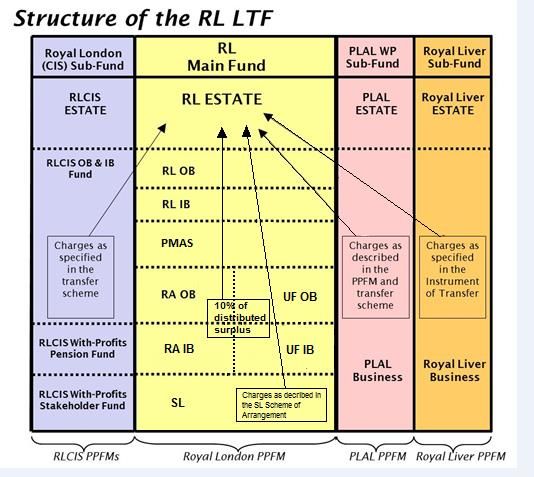
1.3 Structure of the Royal London Long Term Fund
The structure of the RL LTF is shown in outline below. Appendix 1 contains further
information on the acquisitions made by Royal London.
-3-
Version 17.3 1 December 2021ly
on
n
io
at
rm
1.4 Types of with profits and deposit administration contracts
1.4.1 General description
fo
This section provides a general description of the main types of with profits and
deposit administration policies and how they are structured. For any individual
in
contract the policy terms and conditions and any schedules attaching will determine
the operation of that contract. The main classes of business are conventional with
profits policies, unitised with profits policies, unit-linked with profits policies
and deposit administration policies.
r
Fo
Conventional with profits policies are contracts which provide a guaranteed sum
assured or a guaranteed pension to which bonuses are added. The guaranteed sum
assured is payable at the maturity date or on earlier death provided all premium
payments due under the policy are made. The guaranteed pension is normally
payable from the maturity date. A form of conventional with profits, accumulating
with profits, is one where a notional fund provides the guaranteed benefit. The
notional fund is increased as premiums are paid and as regular bonuses are added.
-4-
Version 17.3 1 December 2021Unitised with profits policies are contracts under which premiums paid purchase
units in a with profits fund. Units are allocated to policies as premiums are paid, and
depending on the policy type units may be cancelled to meet expense charges, the
cost of life cover or other benefits.
Unit-linked with profits policies are contracts under which premiums paid
ly
purchase units in one or more unit-linked funds. These policies differ from non-
profit unit-linked policies in that they are entitled to participate in the profits of
on
Royal London through the application of bonuses. Units are allocated to policies as
premiums are paid and units may be cancelled to meet expense charges, the cost of
life cover or other benefits. These policies are quite different to conventional and
unitised with profits policies in that the policyholder chooses which funds to invest
n
in and the asset share concept used to guide payouts on conventional and
unitised with profits policies does not apply. There is no smoothing applied to
io
payouts and there are no guaranteed maturity benefits as the policy value is
determined by the value and number of unit-linked units allocated to the policy.
at
Some policies may contain a mixture of conventional, unitised and unit-linked
with profits benefits. The PPFM wording applies to the relevant part of each policy
rm
as if they were separate contracts.
Bonuses are additions to the benefits payable on with profits policies and usually take
fo
two forms: regular bonuses which are added through the policy term; and final
bonuses which, if payable, are only added at the date of a claim.
in
Deposit administration policies are similar to accumulating with profits
policies. The investment returns achieved on the assets backing deposit
r
administration policies are distributed by way of bonus or interest additions each
Fo
year. Depending on the policy type the deposit administration fund for a policy
may be reduced to reflect explicit expense charges, the cost of life cover or other
benefits. These may alternatively be reflected in a reduced amount of annual bonus
or interest. No final bonus is payable on deposit administration policies.
1.4.2 Regular bonuses
-5-
Version 17.3 1 December 2021For conventional with profits policies and deposit administration policies,
regular bonuses are declared as percentages of the guaranteed sum assured or
guaranteed pension and in some cases as percentages of the attaching regular
bonuses, and are added yearly. For some classes of unitised with profits policies,
regular bonuses are declared in the form of increases in the price of units held in the
fund. For other classes of unitised with profits policies regular bonuses are
declared in the form of extra units being added to the policy yearly. Regular bonus
ly
additions increase the level of guaranteed amounts payable on specified events such
as death, maturity, or retirement.
on
For unit-linked with profits policies regular bonuses are declared in the form of
extra units in the chosen unit-linked funds being added to the policy yearly. Once
added these units are treated in the same way as units derived from contributions.
n
A further type of bonus, interim bonus, may also be added at the date of claim.
io
Interim bonus is a way of allowing for some regular bonus between bonus declaration
dates for conventional and unitised with profits policies.
at
1.4.3 Final bonuses
rm
Final bonuses may be added to the benefits when a claim is paid, depending on the
policy type. Any final bonus payable will be determined at the date the claim arises.
Final bonus for conventional with profits policies is usually expressed as a
percentage of the sum assured, notional fund or guaranteed pension benefit. For
fo
some policy types final bonus may also be expressed as a percentage of regular bonus
added at the date of claim. Normally specific rates of final bonus apply to all policies
in
entering within the same calendar year. Final bonus is not normally paid on the
surrender of a conventional with profits policy, although the surrender value paid
may make some allowance for final bonus.
r
Fo
Final bonus rates for unitised with profits policies are usually expressed as a
percentage of the unit value. Specific rates usually apply to units purchased in each
calendar year or quarter depending on the policy type.
Deposit administration policies do not receive any final bonus.
1.4.4 Amounts payable
-6-
Version 17.3 1 December 2021The amount payable at maturity or at the contractual retirement date in respect of
most classes of conventional with profits policies will be the sum of any guaranteed
amount (including regular bonuses added during the term of the contract) and any
interim and final bonus added at the date of claim. The amount payable at maturity
or at the contractual retirement date in respect of most classes of unitised with
profits policies will generally be the value of the units at the quoted bid price together
with any final bonus added at the date of claim. The amount payable at maturity or
ly
at the contractual retirement date in respect of deposit administration policies is
the face value of the account.
on
Some with profits policies do not have a maturity date and the benefits are payable
only on death or surrender. Amounts payable on death depend on the policy type but
will generally be the guaranteed benefits and attaching regular bonuses, or the value
n
of with profits units, and may also include interim and final bonus. Some policies pay
only a minimal death benefit, for example a return of premiums paid. The structure
io
of the death benefit of any policy can be determined from the policy document.
at
Amounts payable on surrender are not generally guaranteed in advance of an
application to surrender. For unitised policies a market value reduction (MVR)
may be applied to reduce the value of units available to policyholders who choose to
rm
surrender their units. For deposit administration policies an MVR may be
applied to reduce the value of benefits available to policyholders who choose to
surrender their benefits. An MVR would apply only where allowable, according to
fo
the policy terms and conditions.
in
1.5 With profits contracts included in this PPFM
For the purposes of this document, and to make finding a way around the
information contained in it as straightforward as possible, each policy has been
assigned to a particular group (as explained below). This document covers the PPFM
r
Fo
for:
Group A: Conventional with profits policies issued by RL before 1 January
2001. This covers IB and OB life business and OB accumulating with
profits pension business.
Group B: Unitised with profits policies issued by RL. This covers life and
pension business issued after 31 December 2000, all with profits ISA business
-7-
Version 17.3 1 December 2021and Royal London DAC German Bonds1 reinsured by Royal London
under the German Bond Reinsurance Agreement.
Group C: Royal London Funeral Investment Plan issued after 31 December
2014 and with profits benefits of Royal London Intermediary policies
issued after 30 June 2001, and with profits increments made after 30 June
2001 on Group I policies.
ly
Group D: Conventional OB and IB with profits policies issued by UF and
on
conventional IB with profits policies issued by RA.
Group E: Unitised with profits policies issued by RA before 1 January 2001.
This covers single premium bonds issued before 1 January 2001 and the
n
Personal Pension Plan issued between 1 October 1999 and 31 December 2000.
io
Group F: Conventional with profits policies issued by RA before 1 January
2001. This covers OB life and pension business.
at
Group G: Unit-linked with profits policies issued by RL after 30 June
rm
2001.
Group H: Conventional and Unitised with profits policies issued by
PMAS.
fo
Group I: Conventional and Unitised with profits policies and deposit
administration policies issued by SL before 1 July 2001.
in
A summary of the main products and policy types contained in each group is given in
Appendix 2.
r
Fo
1.6 What are Principles and Practices?
The Principles are high level statements of the standards Royal London will follow
in the management of the fund. These set out how Royal London intends to
manage the fund over the longer term and how Royal London expects to respond
1The Royal London DAC German Bonds are policies of Royal London DAC which is a subsidiary of
Royal London that are reinsured by Royal London under the German Bond Reinsurance Agreement.
Appendix 2 provides more detail about how the Principles and Practices apply to these policies.
-8-
Version 17.3 1 December 2021to longer term changes in the business, regulatory and economic environment. The
Principles are not expected to change often. However, changes may be made to the
Principles and three months’ advance written notice will usually be given to affected
with profits policyholders unless otherwise agreed with the Regulator. The advance
notice of changes to the Principles may be contained in annual statements we send to
policyholders. The Principles are identified in the text by this typeface.
ly
The Practices describe Royal London’s approach to managing the fund and to
responding to shorter term changes in the business, regulatory and economic
on
environment. In other words, the Practices describe how Royal London intends to
follow the Principles in the day-to-day management of the fund. Any of the Practices
may be changed and affected policyholders will be notified within a reasonable
timescale unless otherwise agreed with the Regulator. Such notice may be
n
contained in annual statements we send to policyholders and may also be published
on the website. The Practices are identified in the text by this typeface.
io
In order to enable a reader to understand this document it is necessary to include
at
certain background material which forms part of neither the Principles nor the
Practices. This text is shown by the same typeface as in this paragraph.
rm
The Directors are ultimately responsible for all aspects of the management of the
with profits and deposit administration business. The Directors have
established a With Profits Committee to provide independent advice on the way the
fo
fund is managed, to provide an independent view when they are considering the
interests of with profits and deposit administration policyholders and to monitor
in
compliance with the PPFM. Before making any changes to the Principles or the
Practices the Directors will obtain Actuarial Advice.
r
The Principles and the Practices will continue to evolve over time in response to
Fo
changing circumstances and changes in the business environment.
Management of the business is not a mechanistic process carried out strictly on the
basis of compliance with a detailed set of pre-determined criteria. Rather, many
judgements need to be made about the actions to take in aiming to meet the
objectives which are described in the Principles and Practices set out in the PPFM.
Those judgements are made with a view to achieving what the Directors believe is a
-9-
Version 17.3 1 December 2021fair balance between the different interests of individual policyholders and groups of
policyholders, and furthering the interests of policyholders as a whole.
A report to policyholders from the Directors on compliance with the PPFM is
published each year on the Royal London group website. The report for any year is
usually available at the end of June of the following year.
ly
As the PPFM is a technical document a series of policyholder friendly Guides to how
we manage our with profits fund is available on the Royal London group website.
on
2 PRINCIPLES AND PRACTICES OF FINANCIAL MANAGEMENT
2.1 Mutuality
n
Royal London is a mutual insurance company and has no shareholders. In
common with other mutual organisations Royal London is owned by its members.
io
Because the members are policyholders of the business, there is often a greater
common purpose between owners and policyholders than is found in other
at
organisations.
For a mutual company the primary source of capital to operate and develop its
rm
business for the benefit of its members is the estate, although other sources are
available. Other sources of capital used by Royal London include reassurance and
subordinated debt.
fo
This use of the estate by a mutual company to provide the capital requirements of
in
the business means that all the profits and losses remain in the business for the
benefit of policyholders and members rather than a share of the profits being paid
out to shareholders in the form of dividends.
r
Fo
Royal London remains committed to mutuality, which has served the company and
its policyholders well over the years. Only some policyholders are members however,
and the rules determining membership are set out in Royal London’s Articles of
Association as amended from time to time.
There are certain categories of with profits policy which do not confer membership
and these include, among others, policies taken out originally with RA, UF, SL,
PLAL, Royal Liver, CIS or PMAS.
- 10 -
Version 17.3 1 December 2021Generally, where a policy is taken out by Trustees any membership is conferred on
the Trustees who purchase the policy. The trust beneficiaries do not gain
membership and if the original Trustees change their membership may be lost. The
exceptions to this are personal pension and free-standing additional voluntary
contribution policies written under the trusts of The Royal London Personal Pension
Scheme (No 2) and The Royal London Free-Standing AVC Scheme (No 2). In these
ly
cases Counsel has advised that membership is conferred on the individual for whom
the policy is taken out.
on
Membership may lapse if changes in a policy which confers membership are made,
for example failing to maintain premium payments on a regular premium policy, or
the assignment of a policy.
n
2.2 Guiding Principles
io
Royal London applies some overall guiding principles when managing the fund
at
under the Principles and Practices set out in this document. Where there is conflict
between one or more Principles or Practices or between any of these and the overall
guiding principles, the fund will be managed so that the guiding principles are
rm
applied.
Guiding Principles
fo
Royal London will manage the fund in accordance with the legal and
regulatory requirements that apply to it from time to time. This will
in
include maintaining sufficient assets to satisfy ongoing Regulatory
Capital Resource Requirements applicable from time to time.
r
Royal London will manage the fund in compliance with the provisions of
Fo
any scheme of transfer of business into the fund and any scheme of
arrangement that relates to policies in the fund. If a conflict with a
principle or practice in this document arises then the provisions of the
relevant scheme of transfer or scheme of arrangement will take
precedence.
- 11 -
Version 17.3 1 December 2021Royal London will conduct its business in a sound and prudent manner
with due regard to the interests of its policyholders and with a view to
treating policyholders fairly.
Royal London will aim to manage the fund in order to ensure that all
guaranteed benefits can be paid as they fall due. This will include
observing all contractual terms set out in policy terms and conditions.
ly
2.3 Management of the Estate
on
The term ‘Estate’ in this document means the excess of the market value of assets
and value of in force business attributed to the fund over the value of the total of
technical provisions for business of the fund. Technical provisions comprise
aggregate asset shares and additional costs in respect of contractual guarantees,
n
options and smoothing. This approach is consistent with the Regulator’s
methodology for determining Capital Resources within the Regulatory Returns
io
and the assessment of the Regulatory Capital Resource Requirements.
at
The capital required to support the business activities of Royal London, such as
writing new long term business and developing the business in other ways for the
rm
benefit of members, is provided by the RL Estate.
fo
in
When the size of the PLAL With-Profits Sub-fund falls below a preset amount the
PLAL Scheme of Transfer permits it to be transferred as a whole to the RL Main
Fund. At the point the assets are transferred the residual PLAL Estate will be
r
allocated to the remaining PLAL with profits policyholders.
Fo
When the size of the Royal Liver Sub-Fund falls below a preset amount the Royal
Liver Instrument of Transfer permits it to be transferred as a whole to the RL
Main Fund. The residual Royal Liver Estate will be allocated as enhancements to
the remaining Royal Liver with profits policyholders as set out in the Royal Liver
Instrument of Transfer.
- 12 -
Version 17.3 1 December 2021When the size of the Royal London (CIS) Sub-Fund falls below a preset amount
the RLCIS Scheme of Transfer permits it to be transferred as a whole to the RL
Main Fund. At the point the assets are transferred the residual RL(CIS) Estate
will be allocated to the remaining qualifying Royal London (CIS) Sub-Fund with
profits policyholders.
PRINCIPLES - Management of the Estate
ly
The fund will be managed to ensure that it will be maintained at an
appropriate size in relation to the with profits liabilities calculated on a
on
realistic basis and having regard to the fair treatment of with profits
policyholders. The target size of the RL Estate will be determined by the
Directors upon receiving Actuarial Advice.
n
The RL Estate will be used to provide capital to write new non-
participating and with profits policies and to support other business
io
activities of Royal London. In return it will receive profits or losses
from writing the new business and from the business activities.
at
If, in the view of the Directors, the RL Estate is sufficiently in excess of
its target size and/or any amount required for the future management
rm
of the business, then it may be reduced by distribution to appropriate
policyholders, subject to approval from the Directors upon receiving
Actuarial Advice and after taking into account any constraints imposed
fo
by schemes of transfer of business into the fund and schemes of
arrangement relating to policies in the fund.
in
If the level of the RL Estate falls below the target level determined by the
Directors the amounts which may be distributed (if any) from the RL
r
Estate to policyholders may be reduced and appropriate charges to
Fo
asset shares may be introduced or increased from time to time.
The RL Estate may be used to meet exceptional costs which the
Directors, upon receiving Actuarial Advice, consider would not be
appropriate to be charged to with profits policyholders.
- 13 -
Version 17.3 1 December 2021The RL Estate may be required to support The Closed Funds. Any
shortfall covered by a payment from the RL Estate into The Closed
Funds will be refunded to the RL Estate, once the support is no longer
required, subject to any constraint from any scheme of transfer or
scheme of arrangement. Similarly, the Estates of The Closed Funds may,
in extreme circumstances, be required to support the fund, subject to
any constraint from any scheme of transfer or scheme of arrangement.
ly
Any shortfall covered by a payment from their Estate into the fund will
be refunded to them as soon as possible.
on
The RL Estate is managed in the expectation that no re-attribution
exercise will be undertaken.
n
PRACTICES - Management of the Estate
As a mutual RL uses its Estate to enable it to
io
meet the reasonable benefit expectations of existing policyholders
at
invest in a mix of assets designed to optimise long term returns to the fund
whilst ensuring solvency
rm
write new with profits and non-participating business
operate the smoothing and distribution policy
develop the business of RL
meet its Regulatory Capital Resource Requirements in all reasonably
fo
foreseeable circumstances.
in
The target level of the RL Estate is determined as a multiple of the Regulatory
Capital Requirements taking into account the uses of the RL Estate and the
Directors’ attitude to the risk of failing to meet its Regulatory Capital Resource
r
Requirements.
Fo
The level of the RL Estate is assessed and managed appropriately with the aim of
maintaining it, where possible, within an agreed range around the target level
determined by the Directors.
A single pool of profits arising from Royal London’s activities is determined by
the Directors as being available for distribution each year. The size of the pool is
at the Directors’ discretion and may be zero. This pool is distributed to different
- 14 -
Version 17.3 1 December 2021types of policy in different ways. For conventional and unitised with profits
business distributions are normally applied as enhancements to asset shares as
set out in section 2.7.2. For unit-linked with profits policies distributions are
normally applied as a regular bonus of additional units as set out in section 2.7.5.
The rate of enhancement for conventional and unitised with profits business
written prior to 31 December 2021 is expected to be around 8 times the rate applied
ly
to unit-linked with profits policies. The Directors have discretion to vary this
multiple to reflect circumstances at the time following Actuarial Advice.
on
However, should the proposed multiple be lower than 6 or higher than 10 then the
Directors must obtain Independent Actuarial Advice that supports such a
change. The Regulators would be informed in advance of any proposed change to
the long-term expected rate of 8 times on business written prior to 31 December
n
2021. For business written on or after 31 December 2021, including switches into
with profits on or after 31 December 2021, the Directors will have complete
io
discretion to set multiples having received Actuarial Advice.
at
The target level of the RL Estate will be reviewed by the Directors, normally
annually, and may be changed following Actuarial Advice to reflect for example
changes in economic conditions, changes in regulatory requirements or
rm
expectations and changes in the Directors’ risk appetite.
fo
Regular reports, normally monthly, are provided to the Capital and Investment
in
Management Committees and the Directors to enable them to monitor the level
of the RL Estate in relation to the target level, the range around the target and the
likelihood of the level of the RL Estate moving outside its range.
r
Fo
As a result of the information provided in the regular reports the Capital and
Investment Management Committees makes recommendations to the
Directors, with the agreement of the Group Chief Executive Officer, on any
investment-related action required to steer the level of the RL Estate towards the
agreed target.
The level of the RL Estate is managed appropriately by the Directors upon
receiving Actuarial Advice. If the size of the RL Estate is outside the range
- 15 -
Version 17.3 1 December 2021around the target level they may authorise an increase or reduction in the level of
the RL Estate by changing as necessary the investment strategy, bonus strategy,
payout strategy or smoothing strategy as described in the later sections in this
document in order to maintain fair treatment of policyholders. Any action which
the Directors may decide to take will depend on factors including the reasons for
and extent to which the RL Estate is above or below the target level, whether the
situation is expected to be temporary or longer lasting, and an assessment of the
ly
impact of a range of appropriate actions. The Directors will obtain Actuarial
Advice when assessing the range of potential actions.
on
In assessing the appropriate level of the RL Estate for the purpose of determining
whether there is any excess surplus which should be distributed, the Directors
will take into account that as a mutual the RL Estate is the primary source of
n
capital to support the business and their desire to provide sufficient investment
flexibility in order to maintain the investment strategy in line with expectations of
existing policyholders. io
at
The RL Estate is meeting or being credited with the differences between
the expenses of administering with profits, deposit administration and
rm
non-participating policies and the administration charges passed on to
such policies
the cost of risk benefits and the charges for risk benefits passed on to with
fo
profits, deposit administration and non-participating policies
the cost of guarantees on with profits, deposit administration and non-
participating policies and the charges made for those guarantees
in
the cost of smoothing for with profits and deposit administration policies
and charges made to with profits and deposit administration policies for
the smoothing
r
Fo
The RL Estate is being used to meet
the expenses of management of certain classes of with profits policy where
the expense levels are higher than those charged to policyholders.
the cost of those annuity guarantees which are not charged to policyholders
the cost of redress or guarantees on mortgage endowment policies
- 16 -
Version 17.3 1 December 2021The RL Estate is being used to provide capital to write new with profits and non-
participating business.
The RL Estate is being credited with one-ninth of distributed surplus each year on
certain transferred with profits policies from UAG. This transfer is the same
transfer that was previously made to shareholders of UAG. The right to this
transfer was purchased by Royal London when it acquired the shares of UAG
ly
and was set out in the UAG Scheme of Transfer.
on
The RL Estate may be used to meet any shortfall arising out of transferred
business in The Closed Funds. The UF OB policies transferred from UAG
are entitled to receive distributions of miscellaneous surplus from the RL
Estate in accordance with the terms of the UAG Scheme of Transfer. Currently
n
there are no shortfalls requiring support.
io
Within the RL Estate the Notional Account is held in relation to PMAS policies.
The Notional Account tracks the movements in the value of PMAS assets and
at
liabilities not attributable to day-to-day operations, as set out in the PMAS
Instrument of Transfer.
rm
If the absolute value of the Notional Account exceeds £5m then actions will be
taken to reduce the absolute value of the Notional Account to £5m. The value of
the Notional Account and the associated actions taken will be reviewed at least
fo
annually and may be reviewed more frequently if needed.
in
The actions taken may include one or more of the following:
changes to guarantee charges applied to PMAS asset shares
changes to the asset mix of PMAS asset shares
r
one-off charges to reduce PMAS asset shares
Fo
one-off enhancements to increase PMAS asset shares
During the PMAS initial period the value of any change in the Notional
Account as a result of these actions will be split between PMAS asset shares and
the RL Estate as specified in the PMAS Instrument of Transfer.
- 17 -
Version 17.3 1 December 2021The investment strategy of the RL Estate is generally different from that of the
rest of the fund. The RL Estate contains strategic investments which are identified
in the later section in this document under Investment Strategy.
2.4 Business Activities
PRINCIPLES - Business Activities
ly
Any business activities entered into by the fund must be approved by the
Directors, upon receiving suitable professional advice where
on
appropriate and in accordance with agreed guidelines on the level and
type of risk that may be undertaken.
The underlying objective of entering into any activity with an
n
associated business risk would be to provide long term value to with
profits policyholders who share in the RL Estate. This does not preclude
io
the possibility that losses may occur. In such circumstances any losses
or compensation costs would initially be borne by the RL Estate.
at
The Directors will take action to mitigate and manage any new business
risks that are taken on and will aim to control the level of exposure to all
rm
existing business risks within the fund.
fo
PRACTICES – Business Activities
Royal London operates a risk framework for the identification, prioritisation,
in
management and reporting through the year of the key risks by business area.
Royal London’s risk framework has three key interlinked elements, which are the
Governance Structure, the Risk Appetite and a range of risk policies. This
r
framework is reviewed regularly by the Directors and amended accordingly.
Fo
Local Executive and senior management are responsible for risk management
throughout their areas and for ensuring all staff understand their responsibilities
with respect to risk management. They are also responsible for ensuring that their
business structures, processes, systems and controls are adequate to manage risk in
line with the group risk policies.
- 18 -
Version 17.3 1 December 2021Royal London continuously seeks to obtain independent assurance through Group
Risk & Compliance and Group Internal Audit that its systems of risk management
and internal control are operating effectively. In addition Group Internal Audit
provides an independent opinion on the effectiveness of the key systems and
controls throughout the organisation. This includes evaluating the effectiveness of,
and the adequacy of, the risk management processes and ensuring compliance with
policies and procedure. The effectiveness of internal control and the risk
ly
management infrastructure is also specifically considered by our external auditors
in the context of their review of our financial statements.
on
Examples of some business risks in relation to the fund are set out below, along
with mitigating actions that may apply.
n
Risk
Exposures arising from guarantees associated with with profits policies including
io
guaranteed annuity rates or other contractual guarantees.
Mitigation
at
Limits made to the exposure of the fund to guarantees by adoption of asset/
liability matching, hedging or other techniques as deemed appropriate.
rm
Risk
Variances in the profitability of non-participating business within the fund, in
particular as a result of the exposure to investment, expense, mortality, morbidity,
fo
lapse and other risks associated with this business.
Mitigation
in
Processes and limits are applied for product pricing and underwriting, and
reinsurance and asset/liability matching techniques are used as appropriate.
r
Risk
Fo
Breach of regulatory requirements.
Mitigation
Continual close monitoring of regulatory requirements, ensuring appropriate
action is taken as required.
Risk
Exposure to risks arising from the development of new business units such as our
‘Direct to Consumer’ business.
- 19 -
Version 17.3 1 December 2021Mitigation
Detailed financial planning, budgeting and monitoring processes are maintained.
Risk
For some classes of business an implicit allowance is made for additional expenses
through the charges that are applied to the product. The risk is that these charges
are insufficient to meet the actual additional expenses incurred.
ly
Mitigation
Reviews of charges taken versus expenses incurred and monitoring the effect on the
on
RL Estate. Appropriate action is taken when required.
Risk
The fees negotiated between Royal London and the service company responsible
n
for administering the policies may be inadequate to cover the actual expenses
incurred by the service company. Any losses in any service company within Royal
io
London are ultimately borne by the RL Estate as the owner of the service
company and may therefore affect policy benefits payable.
at
Mitigation
Annual reviews of charges taken versus expenses incurred and monitoring the effect
on the RL Estate.
rm
Risk
Transactional risks for example process risks relating to incorrect investment
fo
pricing, or policy administration transactions.
Mitigation
in
These are controlled using laid down procedures that seek to minimise the risk of
error and fraud.
r
Risk
Fo
Financial support may be required to meet any shortfalls in any of The Closed
Funds. This may reduce any distribution from the RL Estate which could
otherwise have been made to asset shares.
Mitigation
Monitoring the size of and managing The Closed Funds to minimise the risk of a
shortfall arising.
- 20 -
Version 17.3 1 December 2021Other risks, for example those associated with investment, expenses and taxation,
are mitigated by monitoring processes.
Monitoring processes and actions undertaken in relation to the risks associated
with acquiring and maintaining new with profits and non-participating policies
are covered in the section below on New Business Volumes, along with limits
imposed on the volume of new business.
ly
Limits in relation to other business risks that may be borne by the fund will be
on
determined in accordance with the risk framework.
The rewards or losses from business risks are credited or charged to the RL Estate,
and there is no specific limit on the amount that is credited or charged. There is no
n
direct impact on policy benefits payable however:
io
Policies in Groups A, B, C, E, F, G and UF OB policies in Group D may
benefit from these rewards or losses credited to the RL Estate as a result of
at
distribution from the RL Estate or the need to increase the level of the RL
Estate.
rm
IB Policies in Group D do not participate in the rewards or losses credited to
the RL Estate as they instead participated in the distribution of their
relevant Additional Account including a one-off final distribution when
fo
their Additional Account was distributed fully and the policies were
consolidated into the RL Main Fund.
in
Policies in Group H may only participate in rewards or losses arising in the
Notional Account during the PMAS initial period. They do not
r
participate in the rewards or losses credited to the wider RL Estate.
Fo
With Profits Policies in Group I may participate in the rewards or losses
credited to the RL Estate from 1 January 2022. Prior to this they
participated in the distribution of the SL Estate including a one-off final
distribution when the SL Estate was distributed fully and the policies were
consolidated into the RL Main Fund.
- 21 -
Version 17.3 1 December 2021No business risk should arise from the issue of capital instruments by Royal
London or its subsidiaries which have the benefit of a subordinated guarantee
from Royal London provided, as is intended, the fund is managed (and such
capital instruments are structured) so that discretionary benefits under with profits
contracts are calculated and paid disregarding (insofar as it is necessary for
policyholders to be treated fairly) any liability the firm may have to make
payments under the capital instruments.
ly
2.5 New Business volumes
on
PRINCIPLES - New Business Volumes
Royal London expects to remain open to new business. If it is decided
that the fund should be closed to new with profits business then
n
appropriate changes to the principles would be notified to policyholders
as part of a wide-ranging process. If the fund is closed to new with
io
profits business part of the RL Estate would need to be retained to write
new non participating business. If the fund is closed to all new business
at
one possibility is that the fund would be run off over the future lifetime
of the business in force at the date of closure to new business, with an
appropriate distribution of the RL Estate.
rm
There is no specific limit to the volume of new with profits business and
new non participating business allowed to be written in the fund.
fo
However, the volume of business written will be such that it is unlikely
to threaten the benefit expectations of policyholders.
in
In the event of closure to significant amounts of new business, Royal
London would review its investment policy, smoothing practices and
management of the RL Estate in an appropriate manner, so as to ensure
r
Fo
the continuing fair treatment of remaining with profits policyholders.
PRACTICES - New Business Volumes
The volume of new business written in the fund may be constrained to ensure that
the level of the RL Estate does not fall below the minimum required to satisfy
Regulatory Capital Resource Requirements.
- 22 -
Version 17.3 1 December 2021Royal London operates a comprehensive business planning process from which
the Directors receive regular reports and financial projections.
A business plan is produced annually, setting out the planned volumes of new
business for each policy class for the following year. The planned new business
volume is set following assessment of the impact on the level of the RL Estate after
modelling different levels of new business and mix of policy classes and taking into
ly
account the risks associated with writing the different policy types. The planned
new business volume and mix is arrived at such that it does not materially affect the
on
appropriate size of the RL Estate. The business plan will take into account the
results of any financial modelling carried out during the year including for example
different economic scenarios, or the assessment of any capital requirements.
n
The planned new business volume is then approved by the Directors, upon
receiving Actuarial Advice and after taking into account all aspects of the
io
proposal that may affect policyholders. The principal areas the Directors consider
are the level of capital required to write the planned new business volume, the risks
at
associated with the planned new business volume (assessed in accordance with the
risk framework) and any requirements that the previous schemes of transfer may
impose on RL in respect of existing business.
rm
A formal mechanism for the review and approval of the pricing of proposed new
products is in place to ensure that minimum profitability criteria agreed from time
fo
to time by the Directors are likely to be achieved. A Product Pricing and
Approval Committee currently carries out this function for products
in
manufactured by Royal London.
2.6 Investment Strategy
r
Fo
PRINCIPLES - Investment Strategy
The aim of the investment strategy is to optimise the long term return
on investments for with profits and deposit administration
policyholders whilst recognising the need for the fund to meet its
guaranteed liabilities and commitments to policyholders and
maintaining the RL Estate at the target size.
- 23 -
Version 17.3 1 December 2021The Directors upon receiving Actuarial Advice may group the liabilities
of the fund into separate pools and the investment strategy for each
such pool may be determined separately.
The fund invests in a wide range of assets. In determining the mix of
assets between different asset classes, the investment strategy will take
into account the size of the RL Estate, the fund’s ability to meet its
ly
ongoing Regulatory Capital Resource Requirements in all reasonably
foreseeable circumstances, the long term expected return available from
on
each asset category and the observed and expected market volatility of
each asset class.
The non-participating business in the fund is backed either by cash and
n
fixed interest holdings of an appropriate term or (in the case of unit
linked business) by appropriate matching linked assets. Royal London
io
aims to invest a significant portion of the rest of the fund in equities and
property but the proportions held in fixed interest and deposits will be
at
varied to protect the RL Estate and maintain it at the target size.
In considering the range of assets in which to invest, derivatives and
rm
other financial instruments may be used within the limits determined
from time to time by the Directors for efficient portfolio management or
for hedging purposes to protect the RL Estate. In order to reduce the
fo
risk of loss resulting from the failure of a third party the Directors set
limits for exposure to various counterparties, taking into account their
in
credit rating and any other contracts Royal London has with them.
There are no restrictions on the fund holding assets that are not
r
normally traded provided that the fund also holds sufficient liquid
Fo
assets to meet its requirements. Such assets might include for example,
the office buildings occupied by Royal London employees or investments
in Royal London companies. Any such holdings are reviewed on a
regular basis to ensure that they continue to be required to support the
operation of the business and that they form an appropriate portion of
the fund.
- 24 -
Version 17.3 1 December 2021The fund may invest in non-quoted Royal London companies provided
that there is a realistic prospect of a reasonable return on the amount
invested.
In determining the investment strategy of the fund no reliance is placed
on assets held within The Closed Funds. As a mutual there are no other
assets held outside the fund.
ly
on
PRACTICES - Investment Strategy
Until late 2009 the fund was managed as one pool of assets. From 1 January 2010
the fund was managed as four hypothecated pools of assets backing four liability
n
pools (UF IB, RA IB, UF OB and the remainder of the business in the fund), each
of which may have had a different investment strategy appropriate for the business
io
in that pool as described below. On 30 June 2021 RA IB policies were consolidated
into the RL Main Fund and now shares its investment strategy. On 31 December
at
2021 UF IB, UF OB and SL policies were consolidated into the RL Main Fund
and now share its investment strategy. Currently the fund is managed as one pool
of assets designed to optimise the returns to the fund subject to the mix of policies
rm
and after taking into account the size of the RL Estate :
The unit linked business (including unit-linked with profits business) is backed
fo
by appropriate matching linked assets. Other non-participating business and the
asset shares of specified classes of with profits policies with significant guarantees
in
are backed solely by cash and fixed interest assets of appropriate term. The asset
mix underlying the asset shares of the remaining with profits policies is set with
reference to the type of policies within the fund. The asset mix for the RL Estate is
r
determined after consideration of the value of the RL Estate relative to its target
Fo
size and to the Regulatory Capital Resource Requirements.
The Directors set benchmarks for the asset allocations within the fund. Currently
the strategy and the asset mix are reviewed quarterly by the Directors but these
may be changed more frequently or at any time in order to reflect changes in
circumstances. The investment mix is monitored by the Capital and Investment
Management Committees, which normally meets every month or more
- 25 -
Version 17.3 1 December 2021frequently if market conditions dictate. Changes to the benchmark asset allocations
are recommended to the Group Chief Executive Officer by the Capital and
Investment Management Committees upon receiving Actuarial Advice.
Significant changes to the benchmark allocations require approval by the
Directors upon receiving Actuarial Advice.
The Directors set guidelines for the proportion of assets that may be invested in
ly
particular asset classes or in individual securities or companies. Investment may be
made only in permitted asset classes. Details of permitted counterparties and
on
limitations on exposure and minimum credit quality for investments are
maintained.
Investment in any new asset class is only permitted after following the approval
n
processes in force. The investment management agreement is revised as
appropriate to include such new investments.
io
The fund currently holds assets which would not normally be traded including its
at
principal administration offices, investments in Royal London undertakings and
the Present Value of In Force long term business resulting from the
acquisitions of UAG, SL and other businesses. Such holdings are monitored to
rm
ensure that they form an appropriate part of the fund and do not constrain the
investment freedom of the fund.
fo
The fund currently holds certain quoted investments which are regarded by the
Directors as strategic and may not be traded by RLAM without obtaining the
in
consent of the Group Chief Executive Officer.
The fund may invest in commodities, infrastructure financing or insurance related
r
investments to provide credit diversification within the fund. Investment in any of
Fo
these classes is only permitted after following the approval process in force.
The fund may invest in a range of unit trusts and OEICS managed by RLAM
within guidelines issued by the Capital and Investment Management
Committees.
The fund may hold derivative instruments, including options and interest rate
swaps and swaptions to provide a close match with the guaranteed annuity option
- 26 -
Version 17.3 1 December 2021liabilities within the fund and to provide backing for other guaranteed benefits and
for efficient portfolio management.
The Directors set performance benchmarks against which the returns achieved on
the individual asset categories are measured. The performance benchmarks for
those assets invested in bonds are set such that the durations of the benchmarks are
consistent with the duration of policy benefits and expenses which the bonds are to
ly
meet by comparing the expected future contributions and cash flows from bonds
held to support non-participating and with profits business, after adjustments for
on
the risk of default with the expected amounts payable in respect of policy benefits
and expenses year by year.
The fund is managed by a wholly owned subsidiary, RLAM, which invests the
n
assets within guidelines set out in an investment management agreement. The
io
Directors meet quarterly to monitor the performance achieved by RLAM against
the agreed asset allocation benchmarks, to monitor the performance achieved by
RLAM of the investments in each asset category against agreed performance
at
benchmarks and to monitor adherence to the investment management agreement.
rm
Royal London publishes the asset mix at 31 December each year in respect of
conventional and unitised with profits business in the fund. Such information
may be provided in the annual report and accounts or it may be published on the
fo
website. Such information is also provided to policyholders by other means, for
example in literature accompanying annual statements or bonus notices.
Information on the approximate asset mix is also normally available quarterly.
in
Each unit-linked fund has its own investment aim and benchmark.
r
2.7 Policy Benefits Payable
Fo
This section describes how Royal London determines the benefits payable to with
profits and deposit administration policyholders. The first two parts describe the
general Principles and Practices Royal London uses to determine the policy
benefits payable and explain in detail the calculation of asset shares in this process.
The final parts describe the smoothing policy adopted by the fund, how final bonus
and market value reduction (MVR) scales are determined and how regular (or
annual) bonuses are set.
- 27 -
Version 17.3 1 December 2021The benefits payable on unit-linked with profits policies are determined by the
number and value of unit-linked units allocated to the policies. The concept of asset
share does not apply to these policies, nor does smoothing.
2.7.1 General Principles and Practices
ly
PRINCIPLES - Policy Benefits Payable
When determining the amounts payable Royal London will aim to meet
on
the reasonable benefit expectations of all policyholders, treating
different classes and generations of policyholders fairly.
One aspect of fairness is the need to ensure that the interests of
n
remaining policyholders are safeguarded against the impact of
policyholders voluntarily exiting the fund. Voluntary exits are those
io
arising where policyholders do not complete the full terms and
conditions of their policies. This might be for example by ceasing to pay
at
premiums, by altering the policy or by surrendering benefits. Royal
London aims to meet the reasonable expectations of these policyholders,
rm
but will also seek to ensure that the appropriate credit is made to the RL
Estate in order to safeguard the benefits of continuing policyholders.
fo
For conventional and deposit administration business Royal London
aims to smooth payouts in order to ensure that on average over the
in
longer term the amount paid on maturity and death claims is the asset
share subject to a minimum of the guaranteed benefit. For unitised
business Royal London aims to ensure that on average over the longer
r
term the amount paid on maturity and death claims is the asset share of
Fo
the policy subject to smoothing. For both types of business maturity
payouts and death claims will be calculated by adding a final bonus,
which may be zero or positive, to guaranteed benefits. In order to meet
reasonable benefit expectations of certain classes of existing
policyholder Royal London may pay greater than asset share.
For unit-linked with profits business claim values reflect the number
and value of units held in each policy. The number of units will include
- 28 -
Version 17.3 1 December 2021those bonus units added to provide a share of the profits earned in the
RL Main Fund.
Payments on voluntary exit may reflect a charge for any unrecouped
expenses and other charges, including a charge for the use of capital. In
addition, for unitised business, payments on surrender or part
surrender will reflect the application of a market value reduction (MVR)
ly
as appropriate.
on
The method of determining payouts may be changed in the future but in
the event of any such change a formal process will be followed requiring
the decision of the Directors upon receiving Actuarial Advice.
n
The fees to be charged against with profits and deposit administration
policies in the calculation of benefits are agreed annually through
io
negotiation with the service company responsible for administering the
policies and are determined on bases which are judged to be
at
appropriate to all policyholders taking into account the expenses
incurred for each category of business.
rm
Historical assumptions or parameters may not be changed unless the
Directors upon receiving Actuarial Advice consider changes are required
to correct errors, to reflect new information or to maintain fairness
fo
between policyholders and the effect of the change on asset shares
would be material.
in
Some approximations in calculating payouts are made, including
adoption of a common bonus series for altered and unaltered policies,
r
for endowment and whole life policies in some policy classes and for
Fo
policies of different sizes. For classes of policy where asset shares are
not calculated the payout may be determined by methods which provide
an approximation to asset share. All methods used, assumptions made
and parameters used lead to approximations in calculating payouts as
a result of pooling of experience over the fund and over policy classes.
PRACTICES - Policy Benefits Payable
- 29 -
Version 17.3 1 December 2021The benefits payable on unit-linked with profits policies depend on the number
and value of units held and the concept of asset share does not apply. The
maturity amounts payable under conventional and unitised with profits policies
are currently determined by the use of asset shares as a guide to setting payout
levels.
Documentation setting out the methods, procedures and assumptions used in the
ly
calculation of policy values is maintained.
on
The asset shares used when determining maturity payouts may be bare asset
shares, enhanced asset shares or smoothed asset shares depending on the
type of business being considered. Further details on the enhancements applied are
included in the section below on asset shares.
n
Target maturity payouts are 100% of enhanced asset share for policies in the
following Groups io
A (conventional with profits policies issued by RL before 1 January 2001)
at
C (Royal London Funeral Investment Plan issued after 31 December 2014
and with profits benefits of Royal London Intermediary policies issued
after 30 June 2001)
rm
D (conventional OB and IB policies issued by UF and conventional IB
policies issued by RA)
F (conventional with profits policies issued by RA before 1 January 2001)
fo
H (conventional and unitised with profit policies issued by PMAS)
I (conventional and unitised with profit policies and deposit
in
administration policies issued by SL)
Target maturity payouts are 100% of enhanced asset share for policies in Group
r
B (unitised with profits policies issued by RL) and Group E (unitised with profits
Fo
policies issued by RA before 1 January 2001) other than the Personal Pension Plan
for which the target is 100% of bare asset share.
For some groups of business asset shares are calculated using individual policies.
For other groups of business asset shares are calculated using specimen average
contracts representative of policies expected to mature or becoming claims in the
- 30 -
Version 17.3 1 December 2021You can also read


