NATIONAL RURAL HEALTH MISSION - DISTRICT LAKHISARAI DISTRICT HEALTH ACTION PLAN ( 2010-2011) - State Health Society, Bihar
←
→
Page content transcription
If your browser does not render page correctly, please read the page content below
NATIONAL RURAL HEALTH MISSION

    DISTRICT LAKHISARAI
  DISTRICT HEALTH ACTION PLAN

          ( 2010-2011)

                                Page | 0
GOVERNMENT OF BIHAR

                                       Preface

       It is our pleasure to present the Lakhisarai District Health Action Plan for the year
2010-11. The District Health Action Plan seeks to set goals and objective for the district
health system and delineate implementing processes in the present context of gaps and
opportunities for the Lakhisarai district health team.

        National Rural Health Mission was introduced to undertake architectural corrections
in the public Health System of India. District health action plan is an integral aspect of
National Rural Health Mission. District Health Action Plans are critical for achieving
decentralisation, interdepartmental convergence, capacity building of health system and
most importantly facilitating people’s participation in the health system’s programmes.
District health Action planning provides opportunity and space to creatively design and
utilise various NRHM initiatives such as flexi–financing, Rogi Kalyan Samiti, Village Health
and Sanitation Committee to achieve our goals in the socio-cultural context of Lakhisarai.

        I am very glad to share that all the BHMs and MOIC of the district along with key
district level functionaries participated in the planning process. The plan is a result of
collective knowledge and insights of each of the district health system functionary. We are
sure that the plan will set a definite direction and give us an impetus to embark on our
mission.

                                                                  C.S. cum Secrectary

                                                               District Health Society

                                                                              Lakhisarai

                                                                                    Page | 1
Table of Contents
1 Introduction ................................................................................................................ 3
2 Profile of lakhisarai District...................................................................................... 4
3 Summary of DHAP process in lakhisarai .................................................................. 8
4 Health profile of lakhisarai District........................................................................... 9
5 Human Resources for Health in lakhisarai ............................................................. 10
6 Situation Analysis of Health Facilities ................................................................... 11
7 Situation Analysis: Health Sub centre level Infrastructure................................... 12
8 Situation Analysis: APHC level infrastructure and Human Resource (Detailed).. 14
9 Situation Analysis: APHC Human Resource ........................................................... 16
10 Situation Analysis: Support Services at PHCs: ..................................................... 23
11 Situation Analysis: Sub Divisional Hospital (SDH) and Referral Hospitals (RH) . 25
12 Situation Analysis: District Hospital lakhisarai .................................................... 26
13 Situation Analysis: Service Delivery ...................................................................... 26
14 Situation Analysis: ASHA Training ......................................................................... 34
15 Strengthening Health Facilities in lakhisarai District .......................................... 35
16 Reproductive and Child Health............................................................................... 53
17 National Vector Borne Disease Control ProgrammesError! Bookmark not defined.
18 Community Participation ........................................................................................ 65
19 Capacity Building and Training .................................. Error! Bookmark not defined.
Page | 2Introduction
The National Rural Health Mission (NRHM) is a comprehensive health programme
launched by Government of India to bring about architectural corrections in the health care
delivery systems of India. The NRHM seeks to address existing gaps in the national public
health system by introducing innovation, community orientation and decentralisation. The
mission aims to provide quality health care services to all sections of society, especially for
those residing in rural areas, women and children, by increasing the resources available
for the public health system, optimising and synergising human resources, reducing
regional imbalances in the health infrastructure, decentralisation and district level
management of the health programmes and community participation as well as ownership
of the health initiatives. The mission in its approach links various determinants such as
nutrition, water and sanitation to improve health outcomes of rural India.
The NRHM regards district level health planning as a significant step towards achieving a
decentralised, pro-poor and efficient public health system. District level health planning
and management facilitate improvement of health systems by 1) addressing the local
needs and specificities 2) enabling decentralisation and public participation and 3)
facilitating interdepartmental convergence at the district level. Rather than funds
being allocated to the States for implementation of the programmes developed at the
central government level, NRHM advises states to prepare their perspective and annual
plans based on the district health plans developed by each district.
The concept of DHAP recognises the wide variety and diversity of health needs and
interventions across the districts. Thus it internalises structural and social diversities such
as degree of urbanisation, endemic diseases, cropping patterns, seasonal migration
trends, and the presence of private health sector in the planning and management of
public health systems. One area requiring major reforms is the coordination between
various departments and vertical programmes affecting determinants of health. DHAP
seeks to achieve pooling of financial and human resources allotted through various central
and state programmes by bringing in a convergent and comprehensive action plan at the
district level.
Page | 3Profile of lakhisarai District
Geography
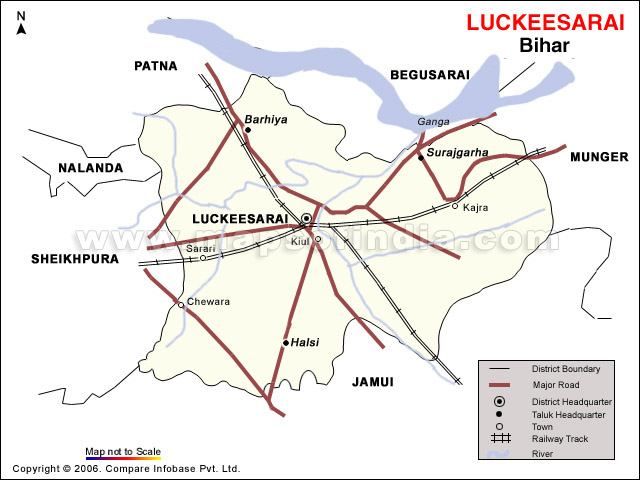
Lakhisarai was formed as a District on 03rd july, 1994 as a result of its separation from Munger. It is located
at 25o to 25o 20’ north Latitude and 85o 55’ to 86o 25’ east longitude.
Boundary- East Munger district, west Shekhpura district, North west Nalanda district and patna district,
north begusarai district west south to south covered by Jamui district.
Area- Lakhisarai occupies a total of 1228 sq. km.
Population- As per 2001 Census (provisional) statistics, total population of Lakhisarai is 8,02,225 out of
which the male population is of 4,17,672 and that of the female is 384553. At present 2009 it is about
9,41,277 approx. out of which the male population is of 4,90,076 and that of the female is 4,51,201.
Page | 4Density- From the 2001 census statics, it is approximately 653 people per sq.km.
Literacy- The average literacy figures for Lakhisarai stands at 48% (Male-60.7%, Female- 34%)
Administrative Units
1. No. of Police District :1
2. No. of Sub-Divisions :1
3. No. of Blocks : 07
4. No. of PHC : 05
5. No. of Circles : 07
6. No. of Police Stations :09
7. No. of Panchayats : 80
8. No. of Villages : 494
History
Lakhisarai was an established administrative and religious centre during the golden period of Pal bansh.
This region of Lakhisarai was identified in old times as a place of rocks, mountains and statues of different
Hindu and Bhuddhist gods and goddesses. Even in Buddha literature this place had been mentioned
as "Anguttri" meaning thereby a district status. This beautiful place, naming Lakhisarai came into existence,
as a new district from Munger . Hence this place in the ancient period also can be identified with the name
of Munger or Ang Pradesh. Lakhisarai region during Pal administration was the capital of Pals for some
period. Other evidences found in the district under the Pal Dharampal.
Noted Historian Dr. D.C. Sarkar during his visit, found some more evidences on the basis of which, he also
confirmed that this place was very important "Krimila" Subject during Pal administration. Monument of
Madan Pal of period 1161-1162 was found in Balgudar consist Narayana statue as Krimila Subject. Chinese
traveler Huen Tsang described this place having 10 Buddha mathas and more than four hundred Buddhists
resided here. Most of the Buddhists living here were Heenyanis. There were 10 temples also of Hindus and
people lived here with peace and harmony. People of that time used to live in a very planned manner. Also,
according to historian Sri Radha Krishna Chaudhary all the Buddha mathas were situated in southern side of
Ganga and the king of Pal Bans was also a Buddhist. This region of Lakhisarai was ruled over in seventh
century to eleventh century by the administrator of Pal Bans. Sen family also ruled this region for some
period in 11th century. Acharya Hawaldar Triapthi mentioned this region of Lakhisarai on the basis of
"Mritika Mudra" kept in Nalanda. It means that Krimila was very important and Caval Gram was very
important. The people believe that Krimila of that period is now Kiul Basti, which is situated in Southern
side of Lakhisarai Railways station. Krimila was a center of Buddhist religion. Lord Buddha also stayed
here for three years on Chaliya Mountain and Jantugram was nearby Chliya mountain and was situated on
bank of river Krimikala, where Lord Buddha with his followers used to visit and deliver speech. It is
convincing that Krimikala is now in Kiul river and Chaliya mountain is nothing but Jainagar mountain.
Page | 5History indicates also that Md. Bin Bakhtiyar attacked this region in 11th century. Shershah also
ruled this region in the 15th century. Surrajgarha witnessed great war of Shershah and Mugal emperor
Humayu in 1534. Also in 1953 a fight occurred in Fatehpurnear Surajgarha between Miya Suleman and
Adlshah in which Adilshah was killed.
In religious context, Surajgarha was also an important place for Shaiva sect. One beautiful Shiv Mandir was
there and large number of people gathered there for worship of Lord Shiva with religious devotion.
There are some other places in this district, which are significant or were known for its significance in
ancient period, either in Historical, archaeological or in religious context.
Page | 6Table 1: Lakhisarai District at a Glance
Total Area 1228 sqkm.
Population in thousands 941277
Rural Population 802909 (85.3 %)
Urban Population 138368 ( 14.7 %)
Population density 653 per sq km
Number of sub-divisions 1
Number of blocks 07
Total no. of Panchayats 80
Number of villages 494
Sex Ratio 880
Percent of urban population 14.7
Percent of SC population 15.8 (148722)
Percent of ST population 0.7 (6589)
Female literacy 34
Male literacy 60.74
Total literacy 48
No. of Medical College 0
No. of Government of India Hospitals (military, 0
railways, ESI, CGHS)
NGO Hospitals and centres undertaking RI with 0
government vaccines
Total ICDS projects 07
Total Number of Anganwadi centres 802
Page | 7Summary of DHAP process in lakhisarai
The District Health Action Plan of lakhisarai has been prepared under the guidance of the
Chief Medical Officer, Additional Chief Medical Officer and District Immunization officer of
Lakhisarai with a joint effort of the Block health managers and various M.O - PHCs as well as other
concerned departments under a participatory process. The field staff of the department has also
played a significant role. Public Health Resource Network has provided technical assistance in
estimation and drafting of various components of this plan.
Summary Of The Planning Process
Training of district team for preparation of DHAP
Preliminary meeting with CMO, ACMO and DIO along with other concerned officials
Data Collection for Situational Analysis - MOIC and BHM meeting chaired by DM and
CMO/CS
Block level consultations with MOICs and BHMs
Writing of situation analysis
District Planning workshop to review situation analysis and prepare outline of district
health plan- the meeting was chaired by CMO and facilitated by ACMO. The workshop
was attended by MOICs, BHMs and other key health functionaries at the district level.
District Consultations for preparation of 1st Draft
Preliminary appraisal of Draft
Final Appraisal
Final DHAP: Submission to DHS and State
Printing and Dissemination
Page | 8Health profile of Lakhisarai District
Table 2 : Lakhisarai Health Profile
Key Infant Mortality rate 56
population Maternal mortality rate 450
indicators Crude birth rate 30
Death rate 5.0
DLHS 3 DLHS 2 Bihar
District Level Household & Facility Survey
(08-09) (02-04) DLHS 3
Pregnant women who registered in the
21.7 %
first trimester
Pregnant women with 3 + ANC 25.3 % 20 26.4
Pregnant women receive at least 1 TT 50.4
46.5 34.9
injections
Delivery assisted by a skilled attendant 5.9 %
6.3 4.3
at home
Institutional births 32.5 22.9 27.7
Children with full immunization 36 23.5 41.4
Children with Diarrhoea treated within 62.5 89.9 73.7
last two weeks who received treatment
Children with Acute Respiratory 73.4
infections in the last two weeks who 76 -
were given treatment
Children who had check up within 24 21
hours after delivery
Children who had check up within 10 21.2
days of delivery
Communicable Kala Azar prevalence -
diseases
TB incidence -
(percent)
HIV prevalence among STD clinics -
HIV prevalence among ANC clinics -
Page | 9Human Resources for Health in lakhisarai
Lakhisarai currently has 58 doctors sanctioned out of which 42 are present. Similarly 30
contractual positions are sanctioned for doctors against which only 13 are posted. So the total
number of doctors present in the district is 55 against the total sanction of 88.
Table 3: Details of Existing Human Resource
Specialisation
Regular Contract
MD Physician 4 0
Surgery 3 1
Gynaecologist 4 1
Paediatrician 4 0
Orthopaedics 2 0
Ophthalmologists 2 0
Pathology 0 0
ENT 0 0
Radiologist 0 0
Bio-chemistry 0 0
Physiology 2 0
Anaesthetist 2 0
Total 23 02
Staff Nurses, Lady Health Visitors (LHVs) and Auxiliary Nurse Midwives (ANMs)
The total number of positions sanctioned under this category is 10 In addition to this, Eight
regular Grade A nurses are posted, 61 Contractual post of A-Grade Nurse is sanctioned out which
16 are in position and selection process for rest is in progress.
22 positions for LHVs are sanctioned out of which 08 are in position and 14 are vacant. For
regular ANMs 132 positions are sanctioned and 132 are in position. No posts of ANMs are vacant
in the district. 102 positions for contractual ANMs are sanctioned and 72 are currently posted. All
the contractual ANMs are posted at the Sub centre level.
Page | 10Situation Analysis of Health Facilities
The three tiers of the Indian public health system, namely village level Sub centre, Additional
Primary Health Centre and Primary Health Centres were closely studied for the district of
lakhisarai on the basis of three crucial parameters:
1) Infrastructure
2) Human resources and
3) Services offered at each health facility of the district.
The Indian Public Health System (IPHS) norms define that a Village Health Sub centre should
be present at the level of 5000 population in the plain regions and at 2500-3000 population in the
hilly and tribal regions. The district can be divided into three parts viz. (i) Hilly area (ii) Flood hit area and
(ii) Plain area. the norm of Sub centre population is expected to be diagnostically followed. A sub
centre is supposed to have its own building with a small OPD area and an exam room.. Sub
centres are served by an ANM, Lady Health Volunteer and Male Multipurpose Health Worker and
supported by the Medical Officer at the APHC. Sub centres primarily provide community based
outreach services such as immunisation, antenatal care services (ANC), prenatal and post natal
care, management of mal nutrition, common childhood diseases and family planning. It provides
drugs for minor ailments such as ARI, diarrhoea, fever, worm infection etc. The Sub centre
building is expected to have provisions for a labour room, a clinic room, an examination room,
waiting area and toilet. It is expected to be furnished with essential equipment and drugs for
conducting normal deliveries and providing immunisation and contraceptive services. In addition
equipment for first aid and emergency care, water quality testing and blood smear collection is also
expected to be available.
The Primary Health Centre (PHC) is required to be present at the level of 30,000 populations
in the plain terrain and at the level of 20,000 populations in the hilly region. A PHC is a six bedded
hospital with an operation room, labour room and an area for outpatient services. The PHC
provides a wide range of preventive, promotive and clinical services. The essential services
provided by the PHC include attending to outpatients, reproductive and child health services
including ANC check-ups, laboratory testing during pregnancy, conducting normal deliveries,
nutrition and health counselling, identification and management of high risk pregnancies and
providing essential newborn care such as neonatal resuscitation and management of neonatal
hypothermia and jaundice. It provides routine immunisation services and tends to other common
childhood diseases. It also provides 24 hour emergency services, referral and inpatient services.
The PHC is headed by an MOIC and served by two doctors. According to the IPHS norms every
24 *7 PHC is supposed to have three full time nurses accompanied by 1 lady health worker and 1
male multipurpose worker. NRHM stipulates that PHCs should have a block health manager,
accountant, storekeeper and a pharmacist/dresser to support the core staff.
According to the IPHS norms, a Community Health Centre (CHC) is based at one lakh twenty
thousand population in the plain areas and at eighty thousand populations for the hilly and tribal
regions. The Community Health Centre is a 30 bedded health facility providing specialised care in
medicine, obstetrics & gynaecology, surgery, anaesthesia and paediatrics. IPHS envisage CHC as
an institution providing expert and emergency medical care to the community.
In Bihar, CHCs are absent and PHCs serve at the population of one lakh while APHCs are
formed to serve at the population level of 30,000. The absence of CHC and the specialised health
care it offers has put a heavy toll on PHCs as well as district and sub district hospitals. Moreover
various emergency and expert services provided by CHC cannot be performed by PHC due to non
Page | 11availability of specialised services and human resources. This situation has led to negative
outcomes for the overall health situation of the state.
1. Situation Analysis: Health Sub centre level Infrastructure
Table 4: Sub centre Data
Sr. Name of PHC Name of Total Total PRESENT ALREADY Further
No. block Population requirement (functional) Sanctioned requiremen
as per t based on
District District
Database Database
Lakhisarai 114333 23 7 4 12
Ramgarh
1 Lakhisarai Chawk 56832 11 9 0 2
Chanan 100330 20 10 4 6
Pipariya 38582 8 2 4 2
2 Surajgarha
Surajgarha 318331 64 35 4 25
3 Halsi (
Halsi ( Ramgarh Chauk
Ramgarh
inc. ) 163320 33 21 4 8
Chauk )
4
Barhaiya
Barhaiya 149549 30 18 4 8
941277 189 102 24 63
Table No. 4 presents the additional requirements of Sub centers as per population norms
mandated by IPHS as well as according to the database available with District Health Society
Lakhisarai. As per IPHS norms, Lakhisarai district requires a total of 189 Sub centers of which 102
are present in the district. 24 more have currently become functional and 63 are proposed in
Lakhisarai .
Page | 12Situation Analysis: Health Sub centre level Infrastructure and Human Resource
(Detailed)
Table 5.1 Sub centre Details
3.
1. Sadar 2. 4
Halsi (Ramgarh
phc lakhisarai Surajgarha Barhaiya
chauk incl.)
Total Number of Sub centres
28 35 21 18
ANMs regular 28 35 21 18
ANMs contract 20 34 11 09
ANM (Regular) Required 12 4 4 4
ANM ® Required 12 4 4 4
ANM residing at HSC Nil nil Nil Nil
Residential facility for ANM
40 39 25 22
required
HSC in Govt building
HSC in Panchayat building
HSC in rented
Building
SC building under
construction
Building required
Running water supply
available
NA NA NA NA
Water supply required 40 39 25 22
Cont. power Supply NA NA NA NA
Power supply required 40 39 25 22
Untied Funds
Page | 132. Situation Analysis: APHC level Infrastructure
The gaps in the availability of PHC are calculated as per the IPHS norms of one APHC at the level
of 30,000 populations. However in Bihar, the current state practice is one PHC at one lakh
population level. Since the APHCs function at the level of 30,000 populations at present in Bihar,
the number of present and proposed APHCs is taken into account for the purpose of calculating
the overall requirement of PHCs. The matrix also estimates requirement of CHCs in each block.
Like Sub centres, the district has also proposed APHCs.
Table 6: APHC Infrastructure
Name of Block APHC PRESENT PROPOSED Further
Total REQUIRED
required after including
PHC
1. SADAR PHC LAKHISARAI 12 1 3 8
2. Surajgarha 11 5 1 5
3. Halsi 6 4 1 1
4. Barhaiya 5 2 1 2
Total 34 12 6 16
3. Situation Analysis: APHC level infrastructure and Human Resource
(Detailed)
In Bihar Additional PHCs operate at the population of 30,000. The APHC is the cornerstone of the
public health system since it serves as a first contact point for preventive, curative and promotive
health services. It is the first part of the public health system with a full time doctor and provision
for inpatient services. There are 32 functional APHCs in Lakhisarai. In general the APHCs in
Lakhisarai suffer from:
1) Lack of facilities including availability of building
2) Constant power and water shortages
3) Unavailability of doctors
4) Doctors not residing at the facility
5) Insufficient quantities of drugs and equipment
6) Lack of capacity to use untied funds.
The level of facilities at the APHCs is expected to be similar to that of a PHC. A summarized
version of the state of infrastructure facilities is as follows:
Page | 14Table 7: APHC Infrastructure
P.H.C.LAKHISA
SURAJGARHA
BARHAIYA
SADAR
HALSI
RAI
Name of facility Total
Total No. of APHC 1 5 4 2 12
APHC with Government
1 4 2 1 8
Building
APHC in rented building 0 1 1 0 2
Building APHC in Panchayat
0 0 0 0 0
Building
APHC in PVT building 0 0 1 1 2
APHC Under
0 1 1 1 3
construction
APHC with assured
Water supply 0 0 0 0 0
water supply
Continuous Power
0 0 0 0 0
Supply
Power supply Interminantly available
0 0 0 0 0
power supply
No power supply 0 0 0 0 0
Toilets With Toilets 0 0 0 0 0
With Labour room in
0 0 0 0 0
Labour room good condition
No Labour Room 0 0 0 0 0
APHC with residential
0 0 0 0 0
facilities
Residential facilities APHC with no
0 0 0 0 0
residential facilities
MO residing at APHC 0 0 0 0 0
Furniture Furniture Available 0 0 0 0 0
Ambulance Ambulance NA NA NA NA NA
Page | 15B uilding s tatus of AP HC s
No Building
25%
Pvt Building
13% Govt Building
49%
Rented
Building
13%
Figure 1 : APHC Infrastructure
As per Table 7, 12 APHCs suffer from unavailability of as per norms buildings and facilities such as
water and power supply, unavailability of functional labour and operation theatre and toilets. Any
one APHC have not running water supply and no APHC has continuous power supply available.
Considering that APHCs are expected to provide laboratory services, maintain the cold chain
involving equipment such as deep freezers and ILR, 24 hour emergency services and inpatient
services, lack of running water and a continuous power supply is a significant constraint.
4. Situation Analysis: APHC Human Resource
The APHC is expected to be staffed by 2 medical officers; preferably at least one woman, 1
pharmacist, 3 staff nurses, 1 Health worker, 2 health assistants,1 clerk ,2 lab technicians, 1 health
educator, 1 driver and other Grade 4 staff. In lakhisarai all 12 APHCs have posts sanctioned for 2
doctors but only 8 APHCs, 1 from Lakhisarai block, 3 from Surajgarha, 2 from Halsi and 2 from
Barhaiya have 2 doctors in position. 4 APHCs have one doctor in position.
Page | 16Availability of Doctors in APHCs
APHCs with 0
doctor in
position
0%
APHCs with 1
doctor in
position
33%
APHCs with 2
doctors in
Figure: 2 APHC Human Resources
Page | 17Table 8: APHC Human Resource
P.H.C.LAKHISAR
SURAJGARHA
BARHAIYA
SADAR
HALSI
Total
AI
Total No. of APHC 1 5 4 2 12
Doctors Doctors
2 10 8 4 24
Sanctioned
Doc in Position 2 8 6 4 20
Doc in Regular 2 8 6 4 20
Doc in Contract 1 0 2 1 10
ANM
2 ANMs Sanction 2 10 8 8 28
2 ANM in position 2 10 7 8 27
1 in position 0 0 1 0 1
0 in position 0 0 0 0 0
Laboratory Technician
Sanctioned 1 5 4 2 12
in Position 0 1 0 0 1
Pharmacist/Dresser
Sanction 1 5 4 2 12
in Position 0 3 1 2 6
Nurses Grade (A)
2 Sanctioned 0 0 0 0 0
2 in Position 0 0 0 0 0
1 in position 0 0 0 0 0
Page | 18P.H.C.LAKHISAR
SURAJGARHA
BARHAIYA
SADAR
HALSI
Total
AI
Total No. of APHC 1 5 4 2 12
Accountant
In position 1 1 1 2 5
Peon
In position 0 0 2 0 2
Sweeper
In position 0 1 0 0 1
Specialist
0 0 3 0 3
Situation Analysis: PHC Infrastructure
PHCs fare well in terms of infrastructure as compared to APHC and Health Sub centres. All the
PHCs in the district are based out of government buildings. In 4 functional PHCs, 4 have functional
OT and 3 have functional labour rooms. Yet the condition of the operation theatres and labour
rooms needs to be improved in nearly all the PHCs. PHCs such as Halsi, Surajgarha and Barhaiya
require major repair work to make their Labour Rooms fully operational. Toilets are not available
any PHCs. Out of 4 PHCs, no PHC has running water supply and only 3 PHC has continuous
availability of power. In present of one Referral and one Sub divisional hospital, both hospitals
have continuous power supply access without running water supply.
The status of infrastructure in all the PHCs in the district is presented in the following chart:
Infrastructure facilities at PHC level
Available Not Available
With Continuous power supply 3 1
With Assured Running Water Supply 1 3
With Toilets 1 3
With Functional Labour Room 3 1
With Functional OT 4
With Government buildings 4
Figure: 3 Infrastructure at PHC
Page | 19A detailed version of status of infrastructure at all the PHCs is as follows:
Table 9.1: PHC Infrastructure
1. sadar 2. 3. 4
lakhisarai SURAJGARHA HALSI BARHAIYA
Building Govt Govt Govt Govt
Building Condition Poor , insufficient Poor , insufficient Poor , insufficient Poor , insufficient
NA NA NA NA
Running Water Supply
Power Supply A A NA A
Toilets NA NA NA NA
Functional Labour Room A A NA A
Condition of Labour Room Require new building Require new building Require new building Require new building
Functional OT A A A A
Condition of OT Inadequate Inadequate Inadequate Inadequate
Condition of ward Very poor Very poor Very poor Very poor
A - Available; NA- Not available
5. Situation Analysis: PHC Human Resources
Barhaiya and Halsi served by three doctor, Surajgarha and Lakhisarai PHCs have 2 doctors in
position. Availability of specialists is still a major constraint for the district. The situation regarding
number of ANMs at PHC level is satisfactory since the gap between sanctioned and in position is
either absent or very narrow for most of the PHCs. Pharmacists are sanctioned in all the PHCs but
are in position only 5 of them. All other PHCs don’t yet have nurses sanctioned or in position.
District’s human resources availability across all the PHCs can be summarised as follows:
Page | 20Table 20: Human Resources at PHC
Number of PHCs
Doctors Number of PHCs with 4 and more sanctioned doctors 0
Number of PHCs with 4 and more doctors in position 0
Number of PHCs with 3 doctors sanctioned 3
Number of PHCs with 3 doctors in position 3
Number of PHCs with 2 or less than 2 doctors sanctioned 1
Number of PHCs with 2 or less than 2 doctors in position 1
Total number of doctors 11
Regular Doctors 11
Contractual Doctors 0
Specialists PHCs with 2 specialist 0
ANMs PHCs with 7 or more than 7 ANMs 0
PHC with less than 7 04
PHC with sanctioned position more than in position 6
PHCs with in position ANMs more than sanctioned 0
Nurses PHCs with Nurses 0
Lab tech PHCs with lab tech sanctioned 4
PHCs with lab tech in position 0
Pharmacist PHCs with at least 1 pharmacist sanctioned 4
PHCs with at least 1 pharmacist in position 4
Store keepers PHCs with storekeepers 0
Availability of Human resources in each PHC can be studied in detail from the following matrix:
Page | 21Table 11: Human Resource at PHC
P.H.C.LAKHISARAI
SURAJGARHA
Sub divisional
Staff Positions BARHAIYA
Hospital
HALSI
Ref PHC
Doctors 4
Sanctioned 4 4 4 4
4
In position 2 3 3 3
ANMs 0
Sanctioned 2 2 2 2
0
in Position 2 2 2 1
Laboratory Technician 1
Sanction 1 1 1 1
in Position 0
0 0 0 0
Pharmacist/Dresser 3
Sanctioned 2 2 2 4
1
in Position 0 1 1 2
Nurses 4
Sanctioned 0 0 0 0
4
in position 0 0 0 0
Storekeeper 0
in position 0 0 0 0
Specialist 0
in position 0 3 0 0
Page | 226. Situation Analysis: Support Services at PHCs:
Table 12: Support Services at PHC
PHC Services at a Glance
Total number of PHCs 4
Availability of Ambulance 3
Generator 4
X – Ray 0
Laboratory Services (Pathology) 0
Laboratory Services (Malaria/Kalazaar) 0
Laboratory Services (T.B) 4
Canteen 0
Housekeeping 4
Rogi Kalyan Samiti set up 3
Untied funds received 4
Untied funds utilised 0
Efficiency of PHC apart from infrastructure facilities and human resources depends on
various other factors such as availability of transport facilities, x ray services, generator etc. PHC
as an in-patient facility also needs to acquire canteen and housekeeping services. PHC provides
basic pathological lab services along with lab services for TB, Malaria and kala azar. A detailed
analysis of the services available at each PHC of Lakhisarai is given alongside.
Page | 23Table 13: Support Services for PHCs (Detail)
P.H.C.LAKHISAR
SURAJGARHA
BARHAIYA
SADAR
HALSI
AI
Ambulance A A A A
Generator A A A A
X – Ray NA NA NA NA
Laboratory Services (Pathology) NA NA NA NA
Laboratory Services
NA NA NA NA
(Malaria/Kalazaar)
Laboratory Services (T.B) A A A A
Canteen NA NA NA NA
Housekeeping A A A A
RKS Funds amount available
NA 4 Lac 0.762207 LAC. 3.5 LAC.
(in Rs. lakhs)
RKS Funds amount Utilised
A .8 Lac 0.762207 LAC 1 lac
(in Rs. lakhs)
Untied funds received
1.5 Lac 1.25 LAC 0.75 LAC.
(in Rs. lakhs)
Untied funds used
1.5 Lac 1.25 Lac 0
(in Rs. lakhs)
Page | 247. Situation Analysis: Distyrict Hospital (DH) and Referral Hospitals (RH)
Table 14 : Human Resource at DH and RH
Dist. Hosp.
Referral Barhaiya
LAKHISARAI
Sanctioned 16 4
Doctors
In position 7 4
Sanctioned 0 0
ANMs
In Position 0 0
Sanction 2 1
Laboratory Technician
in Position 1 0
Sanctioned 3 3
Pharmacist/Dresser
in Position 1 1
Sanctioned 28 4
Nurses
in position 4 4
in position 1 1
Storekeeper
in position 0 0
Specialist
Page | 258. Situation Analysis: District Hospital Lakhisarai
The District Health System is the fundamental basis for implementing various health policies,
ensuring delivery of healthcare, and management of health services for a defined geographic area.
The District hospital is an essential component of the district health system and functions as a
secondary level of health care which provides curative, preventive and promotive healthcare
services to the community in the district.
According to IPHS norms districts such as Lakhisarai with a population of more than 10 lakhs need
a 300 bedded district hospital to perform efficiently all the roles described above. Yet the district
hospital in Lakhisarai has only 30 beds functional and 100 bedded building is under construction.
Huge resource investment is required to upgrade the facility to 300 bed levels. Sadar hospital
Lakhisarai is situated in a spacious and clean building at Lakhisarai district, which is the District
head quarter. The building is in average condition and the hospital has approx. all the basic
facilities needed, such as running water supply, power supply, X-ray and pathological services.
Sadar hospital is served by 5 doctors and 4 nurses. The hospital currently does have only one lab
technician and has only one pharmacist/dresser and one Clerks without store keeper. The facility
has functional ambulance, generator and X ray machine and pathology lab.
9. Situation Analysis: Service Delivery
The infrastructure, human resources and support services available for the PHCs need to be
compared with the work burden of each PHCs. Primary data for outpatient services given in the
table below indicates significant work pressure on all the PHCs in the district.
Table 15: Treatment of OPD Patients in PHCs
Name of PHCs Jan Feb Mar Apr May June July
SADAR
4696 4344 4049 4023 5547 6157 7206
LAKHISARAI
SURAJGARHA 1902 2196 2737 2628 3043 2952 3371
HALSI 2941 2836 2698 2592 3964 4505 6530
BARHAIYA 3533 3464 4533 4418 5188 5095 6300
Average 3268 3210 3504 3415 4435 4677 5852
Total 13072 12840 14017 13661 17742 18709 23407
Page | 26Table 36: Treatment of OPD patients in PHCs
Name of PHC Aug Sept Oct Nov Dec Average for Total for
year 2008 year 2008
SADAR LAKHISARAI 7909 7570 5925 5802 5738 5747 68966
SURAJGARHA 3160 2814 2170 2235 1797 2584 31005
HALSI 4877 5592 4297 3999 4968 4150 49799
BARHAIYA 3945 4719 4617 5188 4641 4637 55641
Average 4973 5174 4252 4306 4286 4279 51352
Total 19891 20695 17009 17224 17144 17118 205411
According to the available data, on an average, only Surajgarha PHC in lakhisarai attends 2584
patients in a month. PHCs like Halsi, Barhaiya on an average receive 4150 and 4637 patients in a
month respectively. Sadar Lakhisarai.receives the highest number of patients with the number of
OPD patients. This is certainly huge number in terms of work burden. Total patients attended by all
the PHCs in year 2008 are two lakh five thousand four hundred eleven.
Graphical representation of number of OPD services offered by all the PHCs in the district over the
period of Jan 2008 to Dec 2008 highlights the seasonal variations in patient’s numbers.
9000
8000
7000
6000 Sadar Hospital
5000 Surajgarha
4000 Halsi
3000 Barhaiya
2000
1000
0
jan feb mar apr may june july aug sep oct nov dec
Figure 4: OutPatients Treated
Increase in the work burden in the monsoon months of June to September in both the years is
quite evident from the graph. The number of outpatients rocketed to 23407 in july 2008. This fact
highlights the need to integrate flood preparations and emergency planning in the district health
plans in terms of increased availability of drugs, equipments, services and human resources.
Page | 2710. Situation Analysis: Reproductive and child health
Salient RCH statistics for the district are given in the district profile section of this document.
Mentioned below are the performance figures of PHCs across the district.
Table 17: Reproductive and Child Health
Sl.No. Name of PHC TT Vaccination Measles Institutional Family
Vaccine Delivery Planning
1 Sub Div. Hospital 3742 246
LAKHISARAI
2 SURAJGARHA 4254 789
3 HALSI 968 0
4 BARHAIYA 2763 840
Total 11727 1875
Table 18: Revised National Tuberculosis Control Programme
Name of TU Total no. Annualised Number of Annualised Cure rate for Annulaised Current
of total case new NSP case cases NSP case rate
patients of detection smear detection detected in detection
put on rate positive rate (2008) last 4 rate (2009)
treatment case put corresponding
on quarter (NSP)
treatment
Sub Div.
Hospital
LAKHISARAI
SURAJGARH
A
HALSI
BARHAIYA
Total
Page | 2811. Situation Analysis: Leprosy Control Programme
Table 19: Leprosy in Lakhisarai District
Current prevalence rate (per 10,000) 1.92
Current detection rate 1.92
Current number of patients 198
New cases detected in last year 217
Percentage of children in new cases 0.53
Percentage of disabled in new cases 0.03
% of SC in new cases 0.90
Percentage of ST in new cases 0
Total number of cured patients 316
Page | 2912. Situation Analysis : Filaria Control Programme
Status of Filaria in the district is as follows:
Table 21: District level data on Filaria Cases
Total No. of
Indicators
Cases in 2008
No. of Cases Reported 0
No. of Night Blood Sample Collected 0
No. of Hydrocele Operation done 0
Page | 3013. Situation Analysis: Malaria Control Programme
Even though the number of malaria cases reported in Lakhisarai is not significant, Lakhisarai is a
malaria endemic district.
Table 22: Malaria Data
PROGRESSIVE TOTAL
Name of the B.S. B.S. Positive Pf. Deaths
PHC Coll. Exam Cases
R.T Given
Suspect
Confirm
Female
Female
Total
Total
Male
Male
M F M F
Lakhisarai 2007 - - - - - - - - - - -
2008 - - - - - - - - - - -
Surajgarha 2007 - - - - - - - - - - -
2008 - - - - - -
Barhaiya 2007 - - - - - - - - - -
2008 - - - - - - - - - -
Halsi 2007 - - - - - - - - - - -
2008 - - - - - -
Total 2007 - - - - - -
2008 - - -
Malaria 2007
Clinic
2008
Page | 3114. Situation Analysis: National Blindness Control Programme
This programme is carried out at the facilities available at Sadar Hospital, Lakhisarai and also
through various school health camps. Salient information from the National Blindness Control
Programme is given in the matrix below:
Table 23: National Blindness Control P Data
CATARACT QUARTER – I QUARTER – II QUARTER - III QUARTER - IV TOTAL
PERFORMANCE
APR MAY JUN JUL AUG SEP OCT NOV DEC JAN FEB MAR
DIST
HOSPITAL - - - - - - - - 1004 0 - 0 1004
(through NGO)
P.H.C ( Private)
- - - - - - - - - - - 0 0
OTHERS
0 0 0 0 0 0 0 0 0 0 0 0 0
TOTAL
- - - - - - - - 1004 0 0 0 1004
Page | 3215. Situation Analysis: Utilisation of RKS Funds
Under the aegis of NRHM, several innovative initiatives for better performance of facilities at the
level of PHCs and above have been launched. Untied funds for the PHC and Rogi Kalyan Samiti
are two key initiatives to provide better financial flow and management support to the facility. Rogi
Kalayn Samiti play a crucial role in managing the affairs of the hospital. It consists of members
from local Panchayati Raj Institutions (PRIs), NGOs, local elected representatives and officials
from the Government sector who are responsible for the proper functioning and management of
the facility. RKS generates, allocates, and spends the funds allotted to it to ensure well functioning,
quality services. In Lakhisarai RKS have been set up in all of the PHCs except Sadar PHC
Lakhisarai. Most of the PHCs have been using the RKS funds towards various services such as
ambulance, X ray machines and generators
Table 24: Utilisation of RKS Funds
Name of Block RKS Funds - RKS Funds Untied Untied funds used
amount -amount funds
available Utilised received
Sub Div Hospital
LAKHISARAI
SURAJGARHA 482000 2000
HALSI
BARHAIYA
Page | 3316. Situation Analysis : ASHA Training
Accredited Social Health Activist (ASHA) is a key strategy of the NRHM to link the community with
the health systems. ASHA works with the community to raise awareness about various health
programmes, provide basic health knowledge, and provide information on health practices thus
generating demand for health services. She also helps and supports the community to access
health services. Proper selection and training of ASHAs is a crucial step for the success of NRHM.
In Lakhisarai. ASHAs have been selected in all the blocks. In most of the blocks ASHAs have
completed four rounds of training. Salient information related to ASHAs in the district can be
found in the matrix below:
Table 25: Selection and Training of ASHA
Target (Total no. of ASHA to be selected)= 802
Total No. of ASHA selected(till date)= 637
Sl.No. Name of PHC Total Total Total No. of Total Total
Target No. of ASHA ASHA not No. of No. of ASHA
selected selected ASHA Untrained
Trained (amoung selected)
1 SADAR PHC 308 202 106 184 18
LAKHISARAI
2 SURAJGARHA 239 234 05 184 50
3 HALSI 132 88 44 83 5
4 BARHAIYA 123 113 10 100 13
Total 802 637 165 561 86
Table 26: Aanganwadi workers in PHCs
Name of PHC No. of AWW
Sanction Present
SADAR PHC LAKHISARAI 308 252
SURAJGARHA 235 192
HALSI 132 123
BARHAIYA 123 121
Total 802 688
The District Health Action Plan provides the opportunity to identify gaps, innovate and invest in the
public health system. The above situation analysis presents a detailed review of the status of
infrastructure, human resources and services in the district. This analysis can be used as a
baseline from which to design new strategies and approaches to achieve the goals of the National
Rural Health Mission in lakhisarai.
Page | 34Strengthening Health Facilities in Lakhisarai District
Goal: To ensure that all health facilities have required infrastructure, human resources, supplies
and equipment according to IPHS for effective functioning.
1. Sub centres
Objectives:
1. To ensure that Lakhisarai has 100% functioning Sub centres as required by population norm
2. To ensure that all Sub centres have the facilities to provide a comprehensive range of services
3. To strengthen the Sub centre as the provider of primary outreach services
Infrastructure
Situation analysis: As per the norm, 189 HSCs are required. Out of the total 189 subcentres
requirement, 102 HSCs already exist and 24 already Sanctioned Of the existing 102 HSCs, 76 are
in Government building, 3 are in rented building and 23 In Pvt building.
Strategies Activities Budget
Construction of 24 newly For new construction New construction
Sanctioned HSC + 26 HSC in Pvt Meeting with BD0/CO to 24 HSC newly
building identify availability of land for sancationed + 26
Ensuring that the 12 Sub centres setting up the priority HSCs in running in Pvt building *
currently being constructed are the selected villages. 650000 = 3,25,00,000/-
constructed according to IPHS Follow up the responses to
norms the advertisement given by
Requisition for sanctioning of 63 Bihar Govt for donation of
HSCs land for setting up of HSCs.
One blocks Surajgarha required Village meetings to identify
HSC is more than 25-90% more accessible locations for
than the existing Sub centres. setting up of HSCs
Prioritizing setting up of total 63 Finding locations for new
new HSCs in these blocks. HSCs on the basis of hard to
Ensuring that the 76 Sub centres reach areas and population.
currently located in Government Distance between two Reconstruction
buildings in which 54 are already facilities should also be 22 HSC running in govt
currently being renovated and 22 considered. building * 216000 =
are needed reconstruction Requesting allotment for 4752000
according to IPHS norms construction of new HSCs to
Ensuring that the 54 sub centers State Health Society
currently being renovated Requesting state government
according to IPHS norms to revise the rent rates for HC
building and make the grant
for payment of the rent.
Page | 35 Revising rent rates for the sub Ensuring construction of HSC Rent for 24 newly
centres operating from rented building as per IPHS norm sanctioned + 26 in Pvt
houses and for any further along with residence for ANM building = 50*
rentals in order to get adequate and other health staff. Rs.500.0*12
space and facilities for HSC For review of ongoing months=Rs.300,000.0
functioning. renovation/construction
Furniture Required for all HSC Meeting of DHS in presence Furniture for sub-
of SE, Building Division, for centers
review of ongoing 102+24 *
constructions for IPHS norms 10,000=Rs.12,60,000.0
INTERIM ARRANGEMENT
Meeting local bodies to (One time payment for 2
identify temporary building for chairs, one table, one
1) the HSCs without a almirah, one bench)
building located in the
identified priority blocks 2) for
26 HSCs operating without a
building 3) 35 HSCs working
from rented building
Page | 36Human Resources
Situation analysis: All 74 HSCs have one regular and one contractual ANM posted at the Sub
centre and 28 HSC have one regular ANM only. The contracts of the contractual ANMs renewed for
three years. 24 newly sanctioned HSCs need to be sanctioned and appointed posts of regular and
contractual ANMs.
Strategies Activities Budget
Renewing the contracts of the Appointment of ANMs for new Salaries for
ANMs on contract HSCs contractual ANMs
Appointment of regular and Submission of proposal for 24 new sactioned + 28 (
contractual ANMs for the newly the appointment of regular under Process) + 74 =
sanctioned HSCs and contractual ANMs for the 126*Rs.6000.0*12=
newly sanctioned HSCs Rs. 90,72,000.0
Holding interviews and
issuing appointment letters Salaries for regular
ANMs (from treasury
route)
126* ( Treasury info req.
)*12=…?
Equipment
Situation analysis: Most HSCs do not have equipment as per the IPHS norms
Strategies Activities Budget
Assessing the equipment needs Identifying a local repairing For currently
of all currently sanctioned HSCs agency functional HSCs
and identifying equipment Training for the ANM and 102* Rs.2000.0*2 (half
requiring repair and equipment other health staff at the HSC yearly) = Rs.408,000/-
that needs to be requisitioned in handling the equipment
Acquiring permission from the and conducting minor For newly Sanctioned
state government to appoint repairs. HSCs
district level agency for repair and Setting up of a district level 24*Rs10,000.0=
maintenance. equipment replacement unit Rs.2,40,000.0
Ensuring timely supply of the
equipment
Ensuring timely repair of the
equipment by the local agency
Ensuring quick replacement of
non-functional equipment
Drugs
Situation analysis: Most HSCs do not have the drugs required as per IPHS norms
Strategies Activities Budget
Ensuring timely replenishment of Weekly reporting of the General purchase
essential drugs prescribed under drugs status: availability, 102+24=
IPHS standards requirement, expiry status 126 * Rs.1000.0*4
Ensuring management of adverse Setting up a block level drug (quarterly)=Rs
drug reactions replacement unit 5,04,000.0
Ensuring proper storage of the Utilization of untied funds for
drugs. purchase of essential drugs Local purchase ( if
Page | 37locally stock is limited at district
Providing basic training for level)
management of drug 102+24=
reactions. 126 *Rs.500.0*4
(quarterly)=
Rs.2,52,000/-
Untied Funds
Situation analysis: No HSCs received any untied funds because of problems in the opening of
bank accounts
Strategies Activities Budget
Ensuring that HSCs receive Opening Bank Accounts 102+24 =
untied funds. Ensuring timely release of 126*Rs.10,000/- =
funds to HSCs Rs.12,60,000/-
Page | 382. Additional Primary Health Centres
Objectives:
1. To ensure that lakhisarai has 100% of functional APHCs as required by population norms
2. To upgrade all APHCs as per PHC level IPHS norms and to name all APHCs as PHCs
3. To operate 25% of APHCs on a 24*7 basis
Infrastructure
Situation analysis: As per the norm of 1 APHC (now termed as PHC) for every 30,000
population, lakhisarai requires a total of 32 APHCs (PHCs), of these 12 APHCs already exist and
are functional. A total of 20 new APHCs (PHCs) are required in which 6 have been Sanctioned are 6
proposed. Of the existing 12 APHCs, 8 work in Government buildings, 4 working in Pvt buildings.
Only 2 APHCs report power supply any APHC have not running water supply and 10 report no
power supply. Any APHC have not toilets, labour room, residential facilities for MOs.
Strategies Activities Budget
6 APHCs to be newly established Construction of buildings for For construction
and 12 APHCs should be set up existing & proposed APHCs (including MO and staff
to meet the PHC level IPHS quarters)
norms. Meeting with BDO/CO to 6 APHC newly
Prioritising the setting up of identify available land for sanctioned +
APHCs in blocks such as Halsi setting up the priority APHCs 12 APHCs renovation:
which do not have any APHCs (PHCs) in the selected 6+12= 18 *
currently in south west region villages Rs.1,500,000.0=
where Matasi Sanctioned as Follow up the responses to Rs.27,000,000.0
APHC and also in blocks where the advertisement given by
the gaps are more than 50% Bihar Govt for donation of For rent (including MO
namely, Chanan, Ramgarh land for setting up of APHCs and staff quarters)
Chauk, Pipariya. A total of 20 HSCs. 12 existing APHCs + 6
APHCs need to be set up in Village meetings to identify new =18
these all the blocks as accessible locations for APHCs*Rs.2000.0*12 =
requirements. setting up of APHCs Rs.432000/-
Construction of buildings for the Finding locations for new
existing 12 APHCs working in APHCs on the basis of hard For Electrification
Govt or Pvt buildings or without to reach areas and Rs.100,000.0
any building as per PHC level population. Distance between
IPHS norms. two facilities should also be For power backup
Ensuring the availability of labour considered. 18 APHCs* Rs72.0/hr*
room facilities, maternity wards Requesting state government 8hrs/day*20
and toilets, ensuring running to revise the rent rates for days/month*12
water supply and drinking water APHC (PHC) building and months=Rs.248,8320.0
supply in all existing APHCs make the grant for payment
Ensuring power supply and of the rent. For running water
power back up for all existing Ensuring construction of supply
APHCs APHC (PHC) building as per 18
Building residential facilities for IPHS norm along with APHCs*Rs.200,000.0/uni
doctors and other staff at 12 residence for MOs, ANM and t=
APHCs functional and 6 newly other health staff. Rs.36,00,000.0
Page | 39sanctioned Ensuring power supply to all
APHCs
Ensuring running water
supply for 12 APHCs
functional, 6 newly
sanctioned and construction
is being initiated for only 6 of
the 20 new APHCs being
operationalised this year.
Human Resources
Situation Analysis: While posts of 2 MOs have been sanctioned for 12 APHCs, 6 newly
sancation APHC require MO post sanctioning; only 5 APHCs function with 2 doctors in position while
7 APHCs have only 1 MO in position.
All 18 APHCs have 2 Grade A Staff Nurse positions sanctioned, 32 Grade A Staff Nurses are under
selection process. All 18 APHCs have 2 ANMs sanctioned and 12 functional APHCs have 2 ANMs in
position whereas 6 newly APHCs have none in position. Laboratory technicians are sanctioned in all
APHCs but in position in only 1. Pharmacists are sanctioned in all APHCs but in position in only 7.
Accountants are in position in 8 APHCs.
Strategies Activities Budget
Doctors For Rationalization of Doctors
Rationalization of doctors across across facilities Medical Officers
block facilities to ensure filling of Reviewing current postings 12 functional + 6 newly
basic minimum positions Preparing a rationalization sanction * 2
If any APHC (PHCs) after plan MO/APHC=36 MOs
rationalization is in need of more Introducing rationalization
doctors then additional doctors plan in DHS meeting agenda 36 MOs*Rs.20,000.0*12
can be deputed from PHC to run to consider and approve the months=
at least one day OPD. This rationalization plan Rs.8640,000/-
should be considered as an Additional charge as interim
interim arrangement. arrangement Nurse
Filling vacancies by hiring Preparation of the roster for 19*2=38 Nurses
doctors on contract or appointing deputation of Doctors at the
regular doctors APHC (PHC) where no 38
Grade A Nurses doctor is available. Nurses*Rs.7,500.0*12
Renewal of contract of Nurses for Informing community about months=Rs3420000/-
3 years based on performance the 1 day per week OPD
Filling all vacancies services at APHCs (PHCs) MPWs (M/F)
Recruitment of Nurses for newly Hiring of vehicles for the 18*2=36 MPWs
sanctioned 6 APHCs movement of doctors for fixed
ANMs OPD days. 36 MPWs*
Filling 12 ANM vacancies Filling vacancies Rs.7,000.0*12
(Recruitment of two ANMs for Requisition to state health months=3024,000/-
each of the newly established 6 department for recruitment of
APHCs) permanent doctor and ANMs
MPWs requisition to State Health 6*2=12
Society for hiring of 12 ANMs*Rs.6000.0*12
Appointment of 2 MPWs (M/F)
contractual doctors. months =Rs.8,64,000/-
Page | 40for all 18 APHCs Requisition to state health
Laboratory technicians department for recruitment of Lab tech
Filling up of vacancies of permanent nurses and 12+6= 18-1=17
Laboratory technicians in all requisition to State Health
APHCs (PHCs) Society for hiring of 17 LabTech*Rs.7,000.0*
Pharmacists contractual nurses. 12
Filling up of vacancies of Appointment of 2 MPWs months=Rs14,28,000/-
Pharmacists in all APHCs (M/F) at each APHC
(PHCs) Hiring Laboratory technicians Pharmacist
Accountant and pharmacists (permanent 18-7 = 11
Filling up of vacancies of positions)
Accountants Hiring of clerks/accountants 11 Pharmas*Rs.7,000.0*
Contract Renewal 12 months=Rs9,24,000.0
Renewal of contractual Post
for the next three years or as Accountant
per need based on 12+6 = 18*8000*12=
performance. Rs.17,28,000.00/-
Equipment
Situation Analysis: Most APHCs do not have all equipment as per IPHS norms
Strategies Activities Budget
A detailed assessment of the Monthly reporting of the Existing APHCs
status of functional equipment in equipment status, 12 APHCs*Rs.5,000.0*4
all APHCs as per IPHS norms functional/non-functional quarters=Rs240,000.0
Rational fulfilling of the Purchase of essential
equipment required equipment locally by utilizing Operationalizing 6
Repair/replacement of the the funds or through RKS APHCs
damaged equipment funds 6 APHCs*Rs20,000.0=
Identification of a local repair Rs120,000.0
shop for minor repairs
Training of health worker for
handling of the equipment.
Drugs
Situation Analysis: Most APHCs do not have a regular supply of drugs and do not have all drugs
as per IPHS norms
Strategies Activities Budget
Ensuring timely replenishment of Block level drug replacement Existing APHCs
essential drugs prescribed under unit by providing fortnightly 12 APHCs* Rs.5000/-*4
IPHS standards status of the drug quarters= Rs. 2,40,000/-
Ensuring management of availability/expiry in the store
adverse drug reactions Utilization of RKS funds for Operationalisation of 6
Ensuring proper storage of the purchase of essential drugs APHCs
drugs locally 6 APHCs* Rs.30,000/-=
Providing basic training for 1,80,000/-
management of drug
reactions for health workers
mainly Staff Nurse and
refresher course for Doctors
Separate provision of drugs
mainly for camps.
Rationalizing the collection of
Page | 41user fees on drugs and
utilization of these funds for
purchase of
essential/emergency drugs
Utilization of PMGY funds
allotted for drugs purchase at
the local level.
Untied funds
Situation Analysis: Currently since APHCs have not been upgraded to PHC level they do not
receive any untied funds
Strategies Activities Budget
Ensuring that all Ensuring that all APHCs receive untied 18 APHCs*Rs.25,000.0=
APHCs receive untied funds as per the NRHM guidelines Rs.4,50,000/-
funds as per the
NRHM guidelines
Operating 100% of APHCs on a 24*7 basis
Strategies Activities Budget
Operationlising all For Upgradation of Infrastructure Upgradation of
APHC and on priority Meeting of DHS to plan upgradation of infrastructure
basis 8 APHCs which existing all APHCs in which 8 have their 12 APHCs *
have their own building own building on priority. Rs.700,000/-=
on a 24*7 basis and Request to Building division to review, Rs.14,00,000/-
upgrading them to the prepare layout, plan and make overall
PHC level. budget for upgradation of 12 APHCs Setting up
Upgradation of (PHCs as per IPHS norms) with their Pathological labs
infrastructure as per own building 12 APHCs
PHC level IPHS norms For power supply *Rs150,000.0=
Ensuring continuous Ensuring power supply (PHCs) Rs. 1800,000.0
power supply and Ensuring power back up by hiring a
power back up in these generator Power back up
12 APHCs. For Ambulance services 12 APHCs*
Hiring Ambulance Hiring ambulance services provided by Rs.72/hr*24hr*30days*1
services for these 12 an appropriate NGO 2 months=Rs.7464,960/-
APHCs. For outsourcing housekeeping &
Outsourcing canteen services Ambulance
housekeeping and Issuing a call for tenders for 12 APHCs*
canteen services for housekeeping services Rs.15,000.0/month*12
these 12 APHCs Selection and awarding contract month=Rs. 21,60,000/-
(PHCs). Canteen services to be provided by
Sanctioning the post of Electrification
local SHGs
an additional Staff 12
Selection of SHGs through a call for
Nurse at these 12 APHCs*Rs.100,000.0=
proposals and selection of lowest bidder
APHCs taking the total Filling Vacancies Rs.1,200,000.0
number of Staff Nurses Requisition to state health department
posted at each APHC Water supply
for recruitment of permanent doctor and 12 APHCs*Rs200,000.0
to 3. requisition to State Health Society for
Filling vacancies of =Rs.2400,000.0
hiring of contractual doctors.
Staff Nurses and Requisition to state health department
ANMs in APHCs Canteen funds- 12
for recruitment of permanent Grade A APHCs*Rs.60 per
(PHCs) on a priority and requisition to State Health Society
basis. person*6
for hiring of contractual Grade A nurses.
Page | 42You can also read


