National Stalking Awareness Month 2022 - Know it. Name it. Stop It. #NSAM2022 #NSAMcle - Journey Center for ...
←
→
Page content transcription
If your browser does not render page correctly, please read the page content below
National Stalking Awareness Month 2022
                  Know it. Name it. Stop It.
                         #NSAM2022    #NSAMcle

                                 JourneyCenterNEO

                                 JourneyCenterNEO

                                 Journey_NEO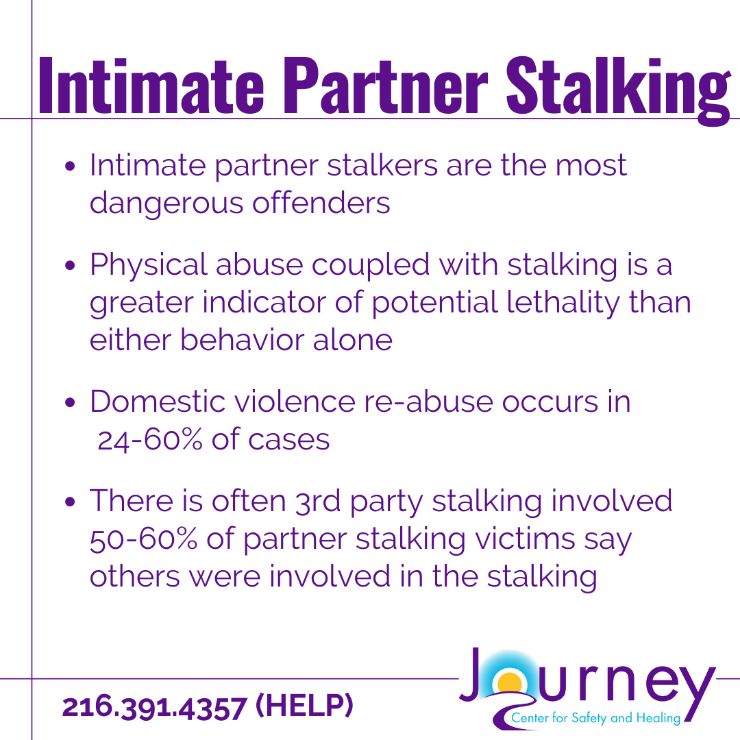
A Note from Journey Center

As we begin the New Year Journey Center wants to recognize the increased stress and dangers faced by our community and those impacted by
stalking, domestic violence, and child abuse. While nearly 15,000 people in Cuyahoga County were touched by Journey’s services in 2021, it was a
challenging year of providing critical services to children and adults experiencing abuse.

COVID-19 reinforced our critical mission as victims were often isolated with their abuser. Journey has seen a significant increase in need for
services. Journey has maintained essential services throughout the pandemic. Helpline has been operating continually. The Shelter has remained
open and staff continue to serve on the frontline. Advocates and therapists are working with survivors via remote technology but also in person
when necessary.

January is National Stalking Awareness Month (NSAM), a month dedicated to recognizing and responding to the serious crime of stalking. Journey
Center is committed to bringing increased awareness to this important issue and we hope that you will join us in advocating for safe, healthy
relationships for everyone in our community and talking a stand against stalking. Journey’s programs help break the cycle of abuse and transform
generations and we are excited and energized to continue to work towards safety, healing, and breaking cycles in 2022 and beyond.

Who is Journey Center?

Journey Center for Safety and Healing- formerly known as Domestic Violence & Child Advocacy Center- provides an array of prevention and
intervention services that foster safety and healing for those affected by child abuse and domestic violence. We prevent abuse through education,
advocacy and systemic change. We are Cuyahoga County’s most comprehensive domestic violence agency, with nearly 45 years of leadership and
innovation in helping break the cycle of violence. The center operates a 24-hour Helpline to assist with resources, referrals, crisis intervention and
safety planning. Individuals can call or text: 216.391.4357 (HELP) or live chat at Journeyneo.org.

Journey Center values Empowerment, Resiliency, Safety, Inclusion, Integrity, and Connectedness. We envision a community where safety and well-
being are achieved by empowering people to find a path toward healthy, thriving relationships.

                                                                                                                      #NSAM2022 #NSAMcle
                                                                                                         216.391.4357 (HELP) Journeyneo.org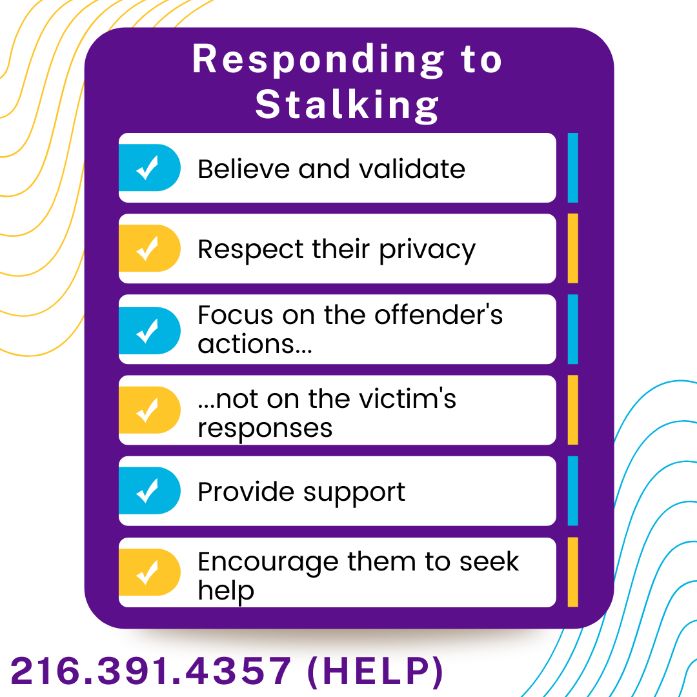
What is Stalking?
Stalking is defined as a pattern of behavior directed at a specific person that would Statistics to Know
cause a reasonable person to feel fear. In Ohio, a pattern is considered two or more
incidents closely related in time. 81% of women who were stalked by a
current or former husband or cohabiting
Stalking is typically directed at a specific person. Most victims of stalking are stalked partner were also physically assaulted by
by someone they know- a current or former intimate partner, acquaintance, or that partner.
family member. Intimate partner stalkers are the most dangerous offenders. The average duration of intimate partner
stalking is 2 years.
While the definition of stalking states that a reasonable person would feel fear, it is Intimate partner stalkers are more likely
important to note that fear is often masked by other emotions such as: anger, to physically approach the victim, use
frustration, hopelessness, or despair. weapons, escalate behaviors quickly,
follow through on threats, and re-offend.
Fear is contextual. What’s scary to one person may not be scary to another. In Stalking often precedes intimate partner
stalking cases, many of the behaviors are only scary to a victim because of their homicide- in 85% of completed and 75%
relationship with the stalker. Many stalkers’ behaviors seem innocuous or even of attempted femicides, there was at
desirable to outsiders – for example, sending expensive gifts. The stalker’s actions least one episode of stalking the year
may not seem scary to others and are, therefore, hard to explain. prior.
Stalking and Domestic Violence
Intimate partner stalking is the largest category of all stalking cases. Stalking often co-occurs with domestic violence and can be an indicator
of other forms of violence. Many abusers use stalking to intimidate and control their victims.
Stalking does not just occur when a person leaves the relationship. Victims are stalked while still in the relationship with a controlling partner,
making separation very difficult. 21% of the time stalking occurs during the relationship, 36% of the time it happens both during and after the
relationship, and 43% of stalking occurs after the relationship has ended. The average duration of intimate partner stalking is two years.
#NSAM2022 #NSAMcle
216.391.4357 (HELP) Journeyneo.org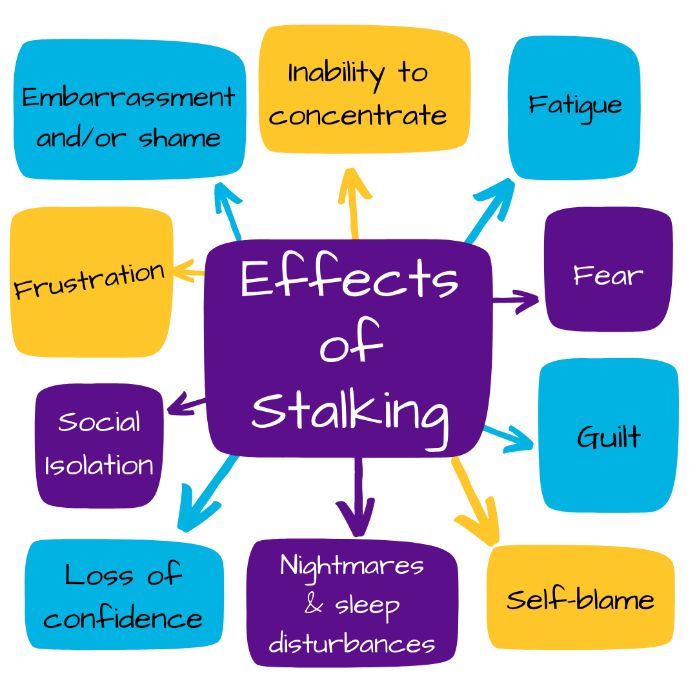
Stalking Behaviors and Tactics Impact of Stalking
While many stalking behaviors are not criminal as a single occurrence, Stalking victimization can impact every aspect of a victim’s life.
but when viewed as a pattern of behavior that causes a victim fear Stalking behavior is often persistent and unpredictable, and can take
and to change their behaviors- they add up to stalking. place over a long period of time causing repeated trauma. Stalking
can affect a victim’s physical and emotional health, their relationships
Common behaviors can include: with family and friends, financial stability, and their job.
Repeated phone calls, voicemails, emails, or text messages Common effects of stalking can include:
Monitoring a victim’s phone activity or computer use
Sending unwanted gifts, letters, or cards Abuse of drugs or alcohol
Posting information or spreading rumors about the victim on Inability to concentrate and/or accomplish daily tasks
social media sites, in public places, or by word of mouth Anger and Irritability
Using technology, such as hidden cameras, to watch the victim Anxiety, Depression, and PTSD
Driving by, waiting at, or showing up at the victim’s home, Loss of confidence
school, or work Confusion
Following the victim, either in person or via the use of Loss of relationships
technology (e.g., GPS or location-based apps) Minimization
Using a third party to contact or stalk the victim (i.e., proxy Economic losses
stalking) Nightmares and Sleep disturbances
Committing identity theft or financial fraud against the victim, Flashbacks
such as opening, closing, or taking money from accounts Embarrassment and shame
Using children to harass or monitor the victim Emotional numbness
Vandalizing or destroying a victim’s property, car, or home Self-blame
Threatening to hurt the victim or their family, friends, or pets Fatigue
Threatening to kill the victim or others, self, or pets Sexual dysfunction
Searching for information about the victim by conducting Fear
public records or online searches, hiring private investigators, Shock
digging through the victim’s garbage, or contacting the Frustration
victim’s friends, family, neighbors, or co-workers Social isolation
Guilt
The average duration of stalking is approximately two years, Suicidal ideation
although intimate partner stalking tends to last longer than Hypervigilance
non-intimate partner stalking.
Weight changesHow Can You Help Someone Experiencing Stalking?
Stalking Safety Tips
Those experiencing stalking are facing added and unique barriers during
Trust your instincts
this time. They may have limited options for accessing support services and
networks and may feel uncertain about what the future holds. We can all Your safety plan should evolve, change, and adapt as
the stalking situation changes.
do our part to help those we care about.
As much as possible, don’t only plan around what has
Believe and Validate already happened – also think about what might
happen next
o Don’t question or minimize what they tell you
Cease any further communication with the stalker
Focus on the offender’s actions, not the victim’s responses
o Many stalkers misinterpret any contact (even
o Don’t ask questions such as “why did you respond to that
negative contact) as encouragement
text message?”
Keep a log of every stalking incident
o Nothing the victim did justifies the stalker’s behavior
o Save voicemails, text messages and e-mails
Support them and encourage them to seek help o Photograph evidence of property damage
o Thank them for trusting you enough to have the o Take screenshots of all text or internet
conversation communications with the stalker
o Help the victim think through options Consider or try to anticipate how the stalker may react
o Respect their choices to any changes you may make, so you can further plan
Respect their privacy for your safety
o Do not share any information about the victim with the Vary your daily routine
stalker, or anyone else without the victim’s approval Have a someone walk you to your car/ transportation
Encourage them to document the stalking Identify escape routes out of your house
Check in Pack a bag with important items in case you need to
o Stalking cases can last a long time, and your loved one’s leave quickly
reactions, wants, needs, and feelings might change over Do an internet search for your name to make sure
time none of your personal information is posted by others
o Continue to check in and be a source of support Tell your friends, family, and neighbors what is
Refer to Journey Center occurring – tell them what they should do if they are
contacted or see something
o Give a picture of the stalker to security and
Thank you for friends at work and school.
I believe you telling me. Call Journey Center to create a specific, detailed safety
plan
This is not
your faultJourney Center Programs and Services
24-Hour Helpline
o Answered 24-hours a day, 7 days a week. Advocates can assist callers with resources, referrals, and general information;
crisis intervention and safety planning, legal information and/or options, intakes for services; and offer assistance to those
experiencing abuse as well as friends/family.
Emergency Domestic Violence Shelter
o Confidentially located, the shelter operates as a safe haven for individuals and families at high risk for
re-victimization and stalking.
Justice System Advocacy
o Court advocacy for domestic violence victims involved in criminal and civil proceedings throughout Cuyahoga County.
Latina Domestic Violence Project
o Culturally relevant advocacy and support services for Latina victims of domestic violence.
Safe & Sound Visitation Center
o The only one of its kind in Cuyahoga County helping high-risk, high-conflict families in need of safe, supervised visits
and/or safe exchanges.
Trauma Services
o Therapy services for children, adolescents and adults who have experienced trauma, grief, and loss related to child abuse,
teen dating violence, domestic violence and/or stalking.
Support Groups
o Support groups are available for individuals who have experienced abusive relationships.
o These free, weekly, facilitated groups offer a confidential setting for discussion, support, and more.
Domestic Violence Education Classes
o This 7-week program provides education on the dynamics of domestic violence to help those affected by abuse make
informed life decisions.
Training and Community Education
o Training provided for professionals and individuals/groups working with those who may be experiencing abuse.
Topics include: child abuse, teen dating violence, domestic violence, and other related issues.
#NSAM2022 #NSAMcle
216.391.4357 (HELP) Journeyneo.orgStalking Awareness Images
NSAM Banners: Facebook, Twitter, LinkedIn
Zoom Background
Sample Social Media Posts
Everyone deserves to feel safe on their Journey to safety and healing. You are not alone. #NSAMcle #NSAM2022
More than 1 in 6 women and 1 in 17 men will experience stalking in their lifetime. #NSAMcle #NSAM2022
I can support survivors stalking by spreading awareness of Journey Center for Safety and Healing services so others may reach out for help.
#NSAMcle #NSAM2022
January is National Stalking Awareness Month. I’m joining Journey Center and others across the nation to take a stand against stalking.
#NSAMcle #NSAM2022
#NSAM2022 #NSAMcle
216.391.4357 (HELP) Journeyneo.orgThe Intersections of Stalking
Stalking frequently co-occurs with other types of victimization and criminal behavior, including domestic violence.
One study found that 81% of victims who were stalked by a current or former intimate partner had been physically assaulted by that partner
and the research is clear: when physical abuse and stalking co-occur, the victim is at greater risk of violence.
Establishing a connection between stalking and domestic violence serves an important purpose, including: supporting the victim’s emotional
recovery, minimizing the victim’s self-blame, and demonstrating intentional contact on the part of the stalker.
Stalking Resources
Other crimes that may be a part of stalking might include:
National Resources
Assault NNEDV’s Tech Safety
Burglary and home invasion Stalking Prevention and Resource Center
Criminal mischief (SPARC)
Forgery and fraud Stalking Resource Center
Harassment Victim Connect Resource Center
Identity and/or mail theft
Kidnapping Survivor Stories
Protective order violations OutrageUs Stalking Mini-Documentary Series
Robbery and theft Strictly Stalking Podcast
Sexual assault Real Fear, Real Crime: The Peggy Clinke Story
Threats Resilience is Futile, The Life and Death and
Trespass Life of Julie S Lalonde, by Julie Lalonde
Vandalism
Vehicle tampering and theft Media
Voyeurism YOU, Season 1 Discussion Guide
YOU, Season 2 Discussion Guide
YOU, Season 3 Discussion Guide
Wanna Talk About it? - Netflix
#NSAM2022 #NSAMcle
216.391.4357 (HELP) Journeyneo.orgAdvocate
Support Safe, Healthy Relationships
Use the social media hashtags: #NSAM2022, #NSAMcle
Like, follow, and share Journey Center’s posts and videos
o Facebook: JourneyCenterNEO Twitter: Journey_NEO Instagram: JourneyCenterNEO
Download and share Journey’s NSAM graphics
Join and share Journey Center’s newsletter with your friends and family
Call or text our 24-Hour Helpline if you or someone you know is in an unsafe or abusive relationship:
216.391.4357 (HELP) or live chat: Journeyneo.org
Talk with people in your community to learn what steps they can take to promote healthy relationships and take a
stand against stalking
Take the NSAM 2022 Community Pledge
Learn
Join Journey Center for a 1 hour Intimate Partner Stalking webinar where we will talk about the connection between
stalking and domestic violence
o Friday, January 21: 12-1p
Let’s Talk Tuesday
o Join Journey Center on Instagram every Tuesday in January as we will talk about different aspects of stalking
and the impact it has on our community
Read and share our NSAM Toolkit, social media posts, and website
Donate
Make a donation to support those impacted by stalking, domestic violence, and child abuse
Host a Facebook fundraiser to support Journey Center
Use Amazon Smile when you make an Amazon purchase
o (choose Domestic Violence & Child Advocacy Center when making your purchase)
Organize a collection of items from Journey Center’s Wish List
Hold a cell phone drive to collect old phones for Journey Center
Create a safe, social distanced third-party event with your community
#NSAM2022 #NSAMcle
216.391.4357 (HELP) Journeyneo.orgEveryone deserves a safe, healthy
relationship. Call or Text
216.391.4357 (HELP)
Reach out for help.
Live Chat
You are not alone.
Journeyneo.org
Safety. Healing. Breaking cycles.
JourneyCenterNEO
JourneyCenterNEO
Journey_NEO
#NSAM2022 #NSAMcle
216.391.4357 (HELP) Journeyneo.orgYou can also read


