NEW GENERAL CO-MANAGER AT - THE CENTRE! - EU-Japan Centre
←
→
Page content transcription
If your browser does not render page correctly, please read the page content below

EU-JAPAN NEWS
                                                                                                                                    JUNE 2018 I 2 VOL 16

                                                 NEW GENERAL CO-MANAGER AT
                                                 THE CENTRE!
                                                 Since April this year, the EU-Japan Centre has a new General co-Manager
                                                 (EU-side), Philippe de Taxis du Poët. And, at the same time, he will act
                                                 as Minister Counsellor at the Delegation of the European Union to Japan.
                                                 Prior to this, Philippe was in the European Commission DG GROW in
                                                 the International Affairs Unit responsible for EU economic diplomacy,
                                                 internationalisation of European businesses and access to finance. Below is
                                                 his statement for the future of the Centre.

                                                 A NEW ERA OF COOPERATION BETWEEN THE
                                                 EU AND JAPAN
First of all, one should keep in mind that we do not start ex nihilo - far from it - as last year was the 30th anniversary
of the Centre. Set up in 1987, this pioneer joint initiative by the Commission and METI has gained a rich experience,
and it delivered multiple outcomes. These “30 years together” has also generated trust - an intangible although
crucial dimension. This is a solid foundation on which we should build further.

For the Centre, the challenge ahead concerns in particular the EU-Japan Economic Partnership Agreement (EPA).
Its economic value is considerable. The EPA should be now fully implemented. Its benefits should be fully utilised
by businesses. SMEs from both the EU and Japan should be aware of the very existence of the EPA, and be able to
understand and benefit from its provisions. Raising awareness, disseminating relevant information, stimulating, and
guiding businesses, in particular SMEs, will be essential to delivering a new level of EU-Japan Cooperation.

The Centre will need to focus its activities and resources in Tokyo and in Brussels to maximise our added value and
impact regarding the industry, trade, innovation and investment cooperation between the EU and Japan.
Our mind-set should be more than ever a cooperative one aiming at mutual benefits.
In a global context where geopolitical uncertainties are increasing, the Centre can be instrumental for the EU and
Japan to join forces, act and stand together for sustainable cooperation, team up to preserve the benefits of open-
ness, and ensure level-playing field.

                                                 IN THIS ISSUE
日欧産業協力センターでは、季刊英文ニュース                            > CENTRE’S NEWS                              ................................................................................................1-12
レター「EU-Japan News」を通じて、さまざま
な日・EU関係の情報を発信しています。                              > EU NEWS .................................................................................................................. 13-19
欧州連合日本政府代表部/欧州委員会より
                                                 > JAPAN NEWS ....................................................................................................20-22
• News from Japan....................... 20-22
                                                 > EU-JAPAN NEWS                               .......................................................................................... 23-32
• News from the EU...................... 13-19
• 日・EU関係イベント案内................ 23-32             > EEN & PARTNERING OPPORTUNITIES .................................33-34
日・EU中小企業間のパートナーシップ促進支                            > CALENDAR...................................................................................................................35
援エンタープライズ・ヨーロッパ・ネットワーク
より
• ビジネスパートナー募集情報、他....... 33-34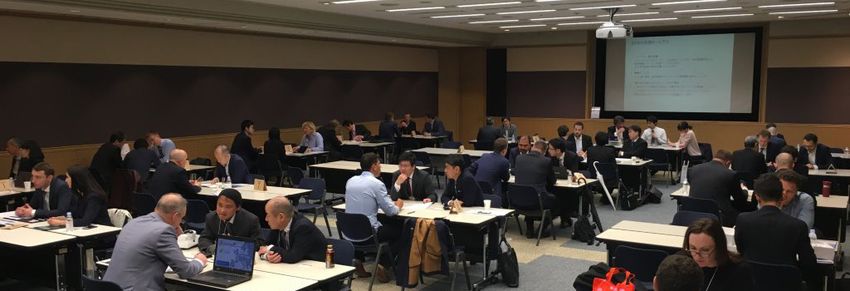
CENTRE’S NEWS EU-JAPAN NEWS I JUNE 2018 I 2 VOL 16 I PAGE 2
EU AND JAPAN – CHAMPIONS
OF GLOBAL FREE TRADE
The 20th annual meeting of the EU-Japan Business Round
Table took place at the Conrad Tokyo on Friday, 20 April
2018 and brought together senior representatives of leading
European and Japanese companies and industry federations
to discuss issues of common concern.
The first part of the meeting was devoted to private-sector
discussions on four topics affecting business: The EU- The BRT’s Joint Session with the EU and Japanese Authorities
Japan Economic Partnership Agreement; Digital and Data
Economy, Cybersecurity and Blockchain; the UN Sustainable The BRT exists to foster
Development Goals (SDGs) and Regulatory Cooperation. communication between
The second part of the meeting consisted of discussions Japanese and European
between the BRT and senior representatives of the Japanese industries and to submit
and EU Authorities. The topics for discussion included regula- recommendations to the
tory cooperation, the BRT’s 2018 recommendations and Japanese and European
other issues of mutual interest. Hiroshige Seko, Minister for Authorities to help de-
Economy, Trade and Industry addressed the drinks reception velop trade and investment
Minister Seko addresses the BRT
that followed the discussions. Lowri Evans, Director-General between the EU and Japan,
for Internal Market, Industry, Entrepreneurship and SMEs and and to encourage industrial
Viorel Isticioaia Budura, Ambassador of the European Union cooperation in fields of common interest such as innovation,
to Japan were the senior EU Authority participants. climate change, or industrial standards. The EU-Japan Centre
acts as the BRT’s Secretariat.
https://www.eu-japan-brt.eu/annual-meeting-2018
PM ABE RECEIVES THE BRT’S 2018
RECOMMENDATIONS
On 16 May, Kazuo Tsukuda (the BRT’s out-going Japan-side Chairman) and Danny
Risberg (representing the BRT’s out-going EU-side Chairman, Eric Schulz) formally
submitted the BRT’s 2018 Recommendations to PM Abe in a ceremony at Kantei
(the Prime Minister’s official residence). Their brief discussion addressed the EPA, the
SDGs, regulatory cooperation and other issues.
Mr Tsukuda is Senior Executive Adviser at Mitsubishi Heavy Industries, Ltd. and Mr
Risberg is the Chairman of the European Business Council in Japan. The BRT will
Photo taken from the Official Website of
submit its recommendations to European Council President Tusk and European the Prime Minister of Japan and His Cabinet
Commission President Juncker in due course.
http://www.mofa.go.jp/ecm/ie/page4e_000819.html http://www.kantei.go.jp/jp/98_abe/actions/201805/16jpeuteigen.html
APRIL 2018 JAPANESE INDUSTRY AND POLICY NEWS
Topics covered in the April issue:
LEGISLATION & POLICY NEWS COMPANY NEWS
• METI compiles future policy for automobile industry • Hitachi Zosen Inova to build and operate a special plant in
• METI study group released a report on the introduction of Sweden to turn organic waste into vehicle fuel
digital technologies into lifestyle products • NYK to issue green bonds
SURVEY AND BUSINESS DATA ADDITIONAL TOPICS
• Operating profits and net income of Japanese overseas • NEDO creates a new Department for Advanced Battery
affiliates reached a record-high level and Hydrogen Technology
• 2018 White papers on SMEs and Small Enterprises in Japan • Thermally stable, efficient and ultra-flexible OPV
released developed
https://www.eu-japan.eu/publications/april-2018-japanese-industry-and-policy-news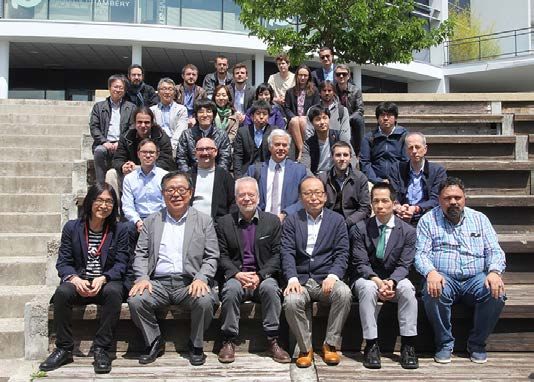
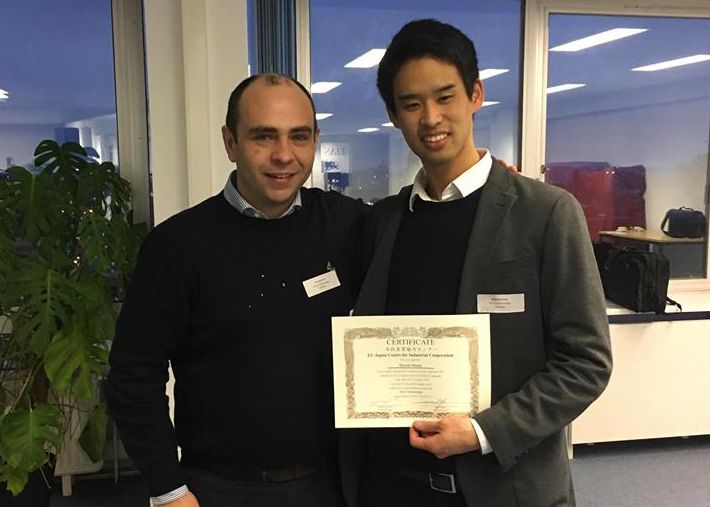
CENTRE’S NEWS EU-JAPAN NEWS I JUNE 2018 I 2 VOL 16 I PAGE 3 SEMINAR ON INTERNET OF THINGS (IOT) AND 3D PRINTING IN IP: A EUROPEAN/JAPANESE COMPARATIVE ANALYSIS The EU-Japan Centre for Industrial Cooperation and the EU-Japan Technology Transfer Helpdesk co-organised a seminar on how cutting edge technologies as Internet of Things (IoT) and 3D printing are being positioned in the current intellectual property systems, together with Sonoda & Kobayashi Intellectual Property Law and Murgitroyd Munich Office on 1 March 2018 in Tokyo. The seminar attracted an audience of approximately 90. The key points of discussion were as follows: a) The current status of IoT and 3D printing from the point of view of intellectual property. Exploring further, the common- alities and differences in the examination process of Japan and Europe through reviewing most recent IoT and 3D printing related patent applications and inventions. b) The scope and limit of the international framework of Intellectual Property reviewed with emphasis on Europe and Japan, to serve businesses in IoT and 3D printing. c) Impacts on businesses were discussed in light of IoT and 3D printing stimulating new discussions in the IP sphere. The report of the seminar and the speakers’ presentations are available online both in English and Japanese. https://www.eu-japan.eu/events/seminar-internet-things-iot-and-3d-printing-ip-europeanjapanese-comparative-analysis https://www.eu-japan.eu/ja/seminar-internet-things-iot-and-3d-printing-ip-europeanjapanese-comparative-analysis EEN JAPAN JOINS THE JAPAN CHALLENGE IOT START-UP PITCH AWARD 2017 The Japan Challenge IoT Award 2017, a pitching contest in the field of IoT for Japanese start-ups and new business ideas, held its final competition on 2 March 2018 in Tokyo, following a series of previous events where 31 regional winners were selected. The 2017 contest was organised by the The EU-Japan Centre chose team SPALO Japan Telecom Services Association to receive the Europe prize, a start-up (TELESA) and co-organised by the EU- focused on introducing Japan’s first Japan Centre for Industrial Cooperation. voice-controlled AI chat bot application. It was supported by the Cabinet Office The Prize offered team SPALO a coach- of Japan, the Ministry of Internal Affairs ing package for partner search sup- The EU-Japan Centre officially handed and Communication, the Ministry of port in the EU, as well as the pitching the Europe prize to team SPALO at the Economy, Trade and Industry, and opportunity to connect to 20 European end of the pitching event, and offered Ryukyufrogs. start-ups in AI, IoT, M2M and fintech closing remarks highlighting the need Regional winners presented their new coming to Japan in May 2018 as part of for start-ups to partner internationally concepts, technologies and business the EEN Japan Cluster Support Mission. in order to succeed. models ranging from new software https://www.eu-japan.eu/events/ solutions to AI concepts. ict-cluster-sme-mission. http://ict.telesa.or.jp/archives/3253
CENTRE’S NEWS EU-JAPAN NEWS I JUNE 2018 I 2 VOL 16 I PAGE 4
BROKERAGE EVENT IN BIOTECH AND PHARMA SECTORS
9 OCTOBER 2018, OSAKA, JAPAN
In cooperation with Osaka Prefectural Government, the EU-Japan Centre for Industrial Cooperation as the partner of
Enterprise Europe Network in Japan is organising a Brokerage Event in Biotech and Pharma sectors, which will take
place on 9 October 2018 in Osaka, Japan.
Being Japan’s second largest city, Osaka During the event, business repre- after (from 9:20 PM to 4:00 PM).
is a major economic centre for Biotech sentatives of EU companies will have The business matching event is re-
and Pharma industry in Japan and hosts an opportunity to attend pre-arranged served only to European Union (includ-
several biotech clusters. Historically, B2B meetings with Japanese compa- ing COSME) companies and to local
a large number of pharmaceutical nies from the Kansai region. The event Japanese companies.
companies have been concentrated in serves a perfect platform to meet repre- The following EU organisations will be
Osaka. Nowadays, bio-related pharma- sentatives of Japanese companies and supporting the event: bioXclusters+,
ceutical companies, food manufactur- accelerate opportunities for potential BioM, Business France, Advantage
ers and their surrounding companies, business partnerships between EU and Austria, Berlin Health Capital, and
including chemical and medical Japanese companies. The event will kick Helsinki Business Hub.
equipment companies are accumulated off with an opening speech at 9 AM and
around Osaka and forming clusters. the B2B meetings will take place shortly Registration are open at below link.
https://bio-pharma-osaka-2018.b2match.io
FOOD & DRINKS MISSION IN JAPAN
The EU-Japan Centre for Industrial Cooperation organised a mission on food & drinks in March, and participated in Asia’s
largest exhibition dedicated to food and drink with 8 EU state member companies (all SMEs) from 6-9 March 2018.
The first day of the mission, on 5 March, the EU-
Japan Centre invited 4 experts on organic sector
and provided lectures for the mission’s partici-
pants. Participants could learn organic market in
Japan from many different perspectives thanks
to the lecturers and had a better understanding
before the exhibition started.
The EU-Japan Centre’s booth was located in the
organic and wellness area, which is separate
apart from the European area. However, partici-
pants were very satisfied with the location which
made them stand out more than having a booth
at in the European area with companies having
similar products.
The average number of meetings was over 35
during the trade fair and some of them were very positive leads according to the feedback from the participants. EEN team in
Japan is now following up the B2B meetings which were held during the mission based on the participants’ request.
By MARTA SANNA, Export Manager, Smartimport srl, 2018 Food Mission participant
http://www.sardegna-mia.it
“The Mission has been very helpful in order to test the potential of our products in the
Japanese market. Being in a group of other European companies, similar in size, stage of
development and strategy, has been also very important to measure our strengths and
weaknesses, get advice and share ideas. Booth presence in the organic hall as a European
group has been very valuable, as it empowered our single/small presence. We were all
well briefed and prepared for the mission and the support and dedication from the EU-Japan Centre and
interpreters has been really outstanding. We found several good contacts with Japanese importers and I hope
to conclude business with some of them within the next 6 months.”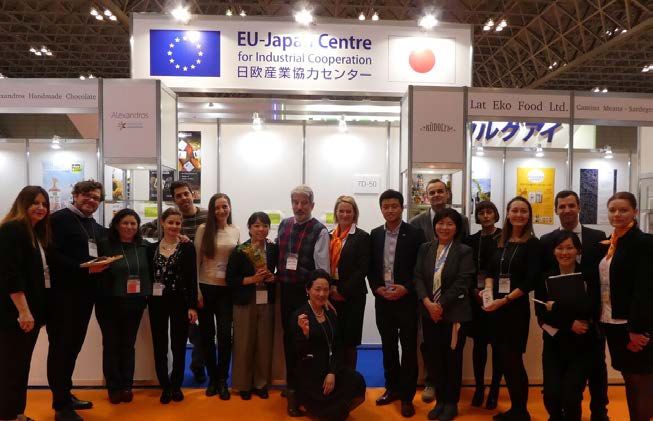
CENTRE’S NEWS EU-JAPAN NEWS I JUNE 2018 I 2 VOL 16 I PAGE 5
SUCCESSFUL LAUNCH OF THE
ICT CLUSTER SME SUPPORT
MISSION TO JAPAN
From 7 to 11 May 2018, the EU-Japan Centre for Industrial
Cooperation organised a Cluster / SME Support Mission to Japan
in the field of information and communication technologies (ICT).
17 SMEs and 3 Clusters from 11 member states had been selected
3 months in advance, with the goal to establish business contacts
in Japan and open up opportunities for cooperation.
The Mission consisted of a get-together
reception, a one-day matchmaking
event and a 3-day joint exhibit at the IT
Week Exhibition Spring Edition in Tokyo.
The get-together for participants took
place in the premises of the Centre on
the evening of 7 May. Two pitches by
invited Japanese companies were organ-
ised as a test case for coming events.
On 8 May, the 20 Mission participants,
11 additional organisations from From 9 to 11 May, Mission participants Organisation and follow-up of the
member states national delegations presented themselves at a joint exhi- Mission is done in the framework of the
and 27 Japanese companies were bition stand organised by the Centre Enterprise Europe Network (EEN) by the
brought together for a Matchmaking in the IoT /M2M area of the IT Week Centre‘s offices in Tokyo and Brussels
event in downtown Tokyo organised by Exhibition, one of Japan’s leading trade and in coordination with local EEN part-
Enterprise Europe Network Japan. 151 fairs in the ICT field with more than ners in Europe.
meetings, pre-scheduled through an 100.000 visitors. Posters and promo-
online platform (https://ict-tokyo2018. tion material in Japanese had been • 7 May, Evening get-together at the EU-
b2match.io), led to promising talks prepared by the Centre and interpreters Japan Centre Tokyo
between Japanese and European were available at the stand to support • 8 May, One-day Matchmaking event
participants. For the promotion of this communication with visitors. with 63 companies from 12 member
event, the Centre had gained the sup- Participants especially valued the states + Japan, 151 meetings
port of local partners such as the IOT mixture of different opportunities dur- • 9-11 May, Joint exhibition at IoT/M2M
Acceleration Consortium, JETRO and ing the Mission and the good overall Exhibition / Japan IT Week
the Tokyo Metropolitan Government. organisation of the programme.
http://d.japan-it.jp/en/Exhibitors/4079410/EU-JAPAN-CENTRE-FOR-INDUSTRIAL-COOPERATION
By SASHA HOW-CHOONG, Head of ASEAN Market, GEOCONCEPT Group, 2017 ICT mission participant
http://www.geoconcept.com
“It is my second time attending the Japan IT week in Tokyo and I found it beyond expectation
just like last time. Despite the fact that our company already had business experiences through
local partners in Japan for years, we still benefited significantly in this mission in terms of the
new insight and the opportunities it brought. Especially in the B2B meeting conducted one day
before the ICT week, we had the opportunity to meet a variety of potential partners/clients from
Japan or from the other side of Europe.
Thanks to the well-designed online platform and to the clear offers/requirements written by each of the
participants, we could make the most of the resources and thus to conduct the discussion efficiently within each
of the short meeting slot. In the end, we indeed found one ideal potential partner who is very much interested in
promoting our products in the Japanese market.
The coming IT week also gave us a better exposure in front of many local users. The staff in the EU-Japan is
very helpful all the time with posters, translations, guidance and everything else. I’m really thankful to have been
selected for this mission and will not hesitate to apply again.”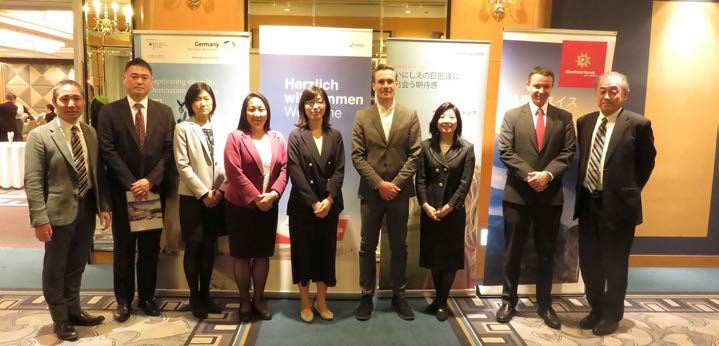
CENTRE’S NEWS EU-JAPAN NEWS I JUNE 2018 I 2 VOL 16 I PAGE 6
BUSINESS INFORMATION ABOUT
JAPAN
Do not miss the opportunity to get access to practical business information
“About Japan”
The Centre published on the website a wide variety of webpages, expert reports
and e-learning resources, and regularly organises 2-3 webinars per month covering
Japan-related operational matters, industrial sectors and cultural aspects to assist
EU companies in seizing opportunities in the Japanese market.
Feel free to register on https://www.eubusinessinjapan.eu/user/register
NEXT “ABOUT JAPAN” WEBINARS
Each month the EU-Japan Centre is organising webinars designed to improve EU companies’ knowledge of conducting business in Japan.
• 19 June 2018 | 10:00 - 11:00 CET: Market Entry to Japan via Ecommerce
https://www.eubusinessinjapan.eu/library/event/webinar-120-market-entry-to-japan-via-ecommerce
• 26 June 2018 | 10:30 - 11:30 CET: Japan’s Fintech Sector - Strategy and Trends
https://www.eubusinessinjapan.eu/library/event/webinar-121-japan-fintech-sector-strategy-and-trends
During the webinars (members access only), participants will have the opportunity to listen to selected experts who have
agreed to share their knowledge and expertise. http://www.eubusinessinjapan.eu/events
“ABOUT JAPAN” LATEST REPORTS RELEASED
The pharmaceuticals industry in The Japanese Furniture and Home The Cheese Market in Japan
Japan Fashion Market
The report is presents an overview of the
This report provides detailed information This report provides an analysis of the cheese market in Japan, elaborating on its
concerning the business environment of the Japanese furniture and home fashion mar- size, its main players, and the current regula-
pharmaceuticals industry, notably through ket, including key industry players, current tions and standards. In addition to providing
different aspects such as political, legal, and market trends and future direction of the information about the current trends of this
technical factors. In addition, this report market. Furthermore, it discusses the distri- market, this report discusses the future im-
discusses the major barriers to market entry bution channels on the Japanese market and pact that the EU-Japan EPA will have on the
and proposes concrete recommendations gives practical guidance on how to evaluate cheese market, and the resulting opportuni-
through the expertise of professionals in the the different market entry options. Finally, ties for Europeans in Japan. Lastly, it presents
Japanese pharmaceuticals industry. Finally, this report presents new ways to rethink various recommendations to EU companies
it presents relevant case studies of EU SMEs strategy and market entry on the Japanese for a successful market entry.
having succeeded in entering the Japanese furniture and interior market through differ-
https://www.eubusinessinjapan.eu/
pharmaceuticals market. ent case studies. library/publication/report-the-cheese-mar-
https://www.eubusinessinjapan.eu/ https://www.eubusinessinjapan.eu/ ket-in-japan
library/publication/report-the-pharmaceuti- library/publication/report-the-japanese-fur-
cals-industry-in-japan niture-and-home-fashion-market
CALLS FOR EXPERT PROPOSALS
ECONOMIC PARTNERSHIP AGREEMENT HELPDESK
The EU-Japan Centre is currently calling for expert proposals to deliver fact sheets and step by step guidelines for its EPA help-
desk for EU SMEs seeking to benefit from the EU-Japan Economic Partnership Agreement (EPA).
The deadline for submitting proposals is Monday, 25 June 2018, at 12 PM Brussels time.
https://www.eu-japan.eu/news/call-expert-proposals-epa-helpdesk
JAPANESE BUSINESS CULTURE WORKSHOPS IN THE EU
The EU-Japan Centre is currently calling for expert proposals for its “About Japan” workshops organised in the EU
The deadline for submitting proposals is Monday, 2 July 2018.
https://www.eu-japan.eu/news/call-expert-proposals-japanese-business-culture-events
“ABOUT JAPAN” - MARKET ENTRY REPORTS
The EU-Japan Centre is currently calling for expert report proposals for its “About Japan” information website (www.eubusi-
nessinjapan.eu).
The deadline for submitting proposals is Monday, 18 June 2018
https://www.eu-japan.eu/news/call-expert-report-proposals-may-2018
CENTRE’S NEWS EU-JAPAN NEWS I JUNE 2018 I 2 VOL 16 I PAGE 7
SUCCESS STORY: CYBERNETICA AS
Cybernetica is an Estonian R&D company in the field of ICT.
The SME develops and manufactures hardware and software systems, a system integrator and information security compe-
tence centre. The SME is seeking for strategic partnerships.
Based o the interview ade with Mr Oliver Vaartnou, CEO, CYBERNETICA AS www.cyber.ee
https://cyber.ee/en/news/cybernetica-pilots-secure-identity-management-tool-ngts-with-eltes-in-japan/
ACTIVITIES: Mission Critical Software Solutions for Governments and Corporations.
KEY PRODUCTS AND COMPETENCES: Interoperability and Secure Data Exchange (UXP and X-Road), Digital Identity (SplitKey), Confidential Data
Analysis (Sharemind), Cybersecurity and radio communications solutions.
HISTORY: Founded in 1997 as an independent company, successor of the Institute of Cybernetics (Estonian Academy of Sciences) founded in 1960.
SIZE: ca 150 employees - INTEREST IN JAPAN: Strategic Partnerships
WHY JAPAN? the existing references and contacts during RECOMMENDATION
Cybernetica AS has a strong interest in the Centre’s Programme in Japan. This When it comes to Japan, the CEO explained
establishing itself in the Japanese market. As greatly helped in strengthening the existing that European companies have to take
Mr Oliver Vaartnou explained, Japan is a very contacts and developing the right strategy business step-by-step “you have to get to
advanced country with a very high IT infra- to enter the Japanese market. After their know your partner first and the partner
structure which could bring good market participation in HRTP, Cybernetica AS started needs to gain trust in you”.
opportunities for their company. In addi- discussing more serious terms of coopera- After a couple of months of negotiations and
tion, because of Japan’s interest in Estonia’s tion opportunities with Japanese entities a few visits from the Japanese companies,
development of e-services, and numerous they have now delivered two small-scale
CHALLENGES
Japanese companies’ visits in Estonia, they pilot projects in Japan and they are
“Japanese business culture is very different to
already had a few contacts in mind and expecting to go into a stronger and larger
the European one. That is not to say that it is
wanted to see what further opportunities cooperation with both of those projects
bad or good, just that it differs a lot to what
and possibilities they had to succeed in the they are developing in Japan.
we’re used to”, says Mr Vaartnou. Therefore,
Japanese market.
he suggests that European companies need WHAT’S NEXT
STEPS TAKEN to gain insights into the peculiarities of the In the future, they would like to have a few
Before participating in the EU-Japan Centre’s Japanese business culture first, before being big projects in Japan, so their technologies
Human Resources Training Programme able to do business in Japan. For them, the would be present on the Japanese market
(HRTP) in 2016 (now redesigned as Get Ready most challenging part was to find the time for the long-term. Hopefully, based on these
for Japan https://www.eu-japan.eu/events/ and to devote it to the Japanese market, couple of successful projects, they can build
get-ready-for-japan-training-programme), as it is not an easy market, it takes time to a more significant and successful footprint in
the Estonian company did not have any develop, to get to know the people, and Japan.
official partners in Japan. However, they to gain the trust of your counterparts. Mr
https://www.eubusinessinjapan.eu/
visited Japan before and also met with quite Vaartnou believes that European companies library/publication/success-story-cy-
need to have patience if they want to enter bernetica-hrtp-get-ready-for-ja-
a few Japanese companies in Estonia. Since
pan-successful-cooperation
they already had a few contacts in place, Mr the Japanese market, as the market is very
Vaartnou took the opportunity to validate competitive and it takes time to establish a
strong position in the long-term market.
“STEP IN JAPAN”: YOUR FREE OFFICE SPACE IN TOKYO…
AND MUCH MORE
Are you an EU or Cosme SMEs planning to go to Japan? Then don’t miss out on this
opportunity. The EU-Japan Centre offers FREE logistical support and business assistance
at our Tokyo office, for up to one month.
WHAT CAN YOU ASK FOR?
• Office facilities in Tokyo on the Centre’s premises , including an internet connection and telephone
• Full access to meeting and seminar facilities in the Centre’s premises;
• Free access to sector specific reports and webinars and to a thorough intercultural crash-course;
• Assistance in using the Enterprise Europe Network partnering support service while in Japan;
• A help desk for all information inquiries about business in Japan.
Any SME wishing to benefit from this support should contact: StepInJapan@eu-japan.gr.jp
http://www.eu-japan.eu/logistical-support-step-japan
CENTRE’S NEWS EU-JAPAN NEWS I JUNE 2018 I 2 VOL 16 I PAGE 8
NEW FEATURES FOR THE EU-JAPAN TECHNOLOGY
TRANSFER HELPDESK
The EU-Japan Technology Transfer Helpdesk has recently
updated its website, adding to it new features such as the
“Request for Proposals” section.
This section allows users to easily and quickly browse the
current opportunities for working with various companies
or organisations in a wide range of fields. The proposals
feature detailed descriptions of what type of collaboration is
proposed, in a concise format which enables the technology pull from those interested. For example, a detailed description
might also include information on out-licensing and even possible funding.
The creation of a request for proposal is also very simple.
All that needs to be done is to contact the Helpdesk, and
together with the team, discuss the important aspects
of the potential partnership. The request is then formally
presented on the Helpdesk’s website. The requests for
proposals are updated regularly, with interests currently
ranging from pharmaceutical to manufacturing compa-
nies. The initial contact is done through the team of the
Technology Transfer Helpdesk, which provides help to
both sides. For further information, contact the Helpdesk
team at: techtransferhelpdesk@eu-japan.gr.jp, or visit the “Request for Proposals” section at the link below.
http://www.eu-jp-tthelpdesk.eu/category/library/requests-for-proposals
ENTERPRISE EXCELLENCE IRELAND 2018
On 23 May more than 900 people took part in the ‘Enterprise Excellence Ireland 2018’ lean management conference.
Ichiro Tsujino from Osaka Prefectural Government
Peter Schlagbauer (Kostwein Maschinenbau GmbH) Armin Schwab (Bosch Thermotechnology) and
Richard Kenworthy (Toyota Motor Europe) listen to Richard Keegan (Enterprise Ireland; Trinity College, Dublin and lean
advisor to the EU-Japan Centre) during the Enterprise Excellence Ireland plenary discussion on ‘driving improvement and
competitiveness in a digital age’ organised in conjunction with the EU-Japan Centre.
Photographs by Russell Taylor Photography
The event featured two panel discus- The event was hosted by Lean Business to give some of the best practice case
sions, 32 case studies, a workshop and Ireland and supported by IDA Ireland, studies; and arranged for Ichiro Tsujino
networking opportunities. It brought Lean Business Ireland, Enterprise from Osaka Prefectural Government’s
together participants from finance, Ireland and Dell EMC. The EU-Japan Monozukuri (Manufacturing) Support
technology, retail, manufacturing, Centre organised the afternoon plenary Unit to give a presentation on how
construction, automotive, public and discussion on Driving improvement his Prefecture is helping local SMEs to
the services sector to learn and share and competitiveness in a digital age; embrace digitalisation.
together to spread understanding of invited some former participants in https://www.eu-japan.eu/events/
Lean and Enterprise Excellence. its WCM and Lean in Europe activities enterprise-excellence-ireland-2018
CENTRE’S NEWS EU-JAPAN NEWS I JUNE 2018 I 2 VOL 16 I PAGE 9
RECENT LEAN IN EUROPE VISITS
The EU-Japan Centre recently organised three visits to showcase how leading European companies use lean ‘tools’ in
their relentless drive to be competitive. These best practice visits are designed to inspire the participants along their
companies' lean journeys and can also provide valuable feedback to the host companies.
The 17th Lean in Europe visit took place near Vienna and fo-
cused on how Schaeffler GmbH uses Customer-to-Customer,
Supplier Integration, Flow Production, TPM, Lean Coaching,
Digitalization at Logistics, SMED and Shop floor Management
to drive its activities. 27 participants from 17 different coun-
tries joined the visit on 27 March.
https://www.eu-japan.eu/events/lean-europe-visit-17-schaeffler
The 18th visit was to Rosderra Irish Meats near Dublin. Rosderra
is Ireland’s largest pork processing company and the visit
focussed on its use of a PIT process based on the improvement
through PERFORMANCE, ISSUES and TARGETS and its devel-
opment through the PM system. 20 people from 9 countries
(including Japan) joined this visit on 24 May.
https://www.eu-japan.eu/events/lean-europe-visit-19-rosderra-iri-
sh-meats
The 19th Lean in Europe visit was to TRUMPF, near Stuttgart. This
visit focussed on TRUMPF’s production system, digital transfor-
mation, Industry 4.0 and digitalisation of order-to cash process.
31 people from 13 countries joined this visit on 25 May.
https://www.eu-japan.eu/events/lean-europe-visit-20-trumpf
Future visits are currently being arranged. Information about
them will be available at:
https://www.eu-japan.eu/events/lean-visits-europe
By STEFAN SCHMIDT, Process and Quality Management, BMW
https://www.bmwgroup.com/en
Programme/mission attended: visits to Trumpf (Germany), Schaeffler (Austria), Rolls Royce (United
Kingdom), Rational AG (Germany), Lean conference in Dublin 2006 and 2015
“I have been on several lean visits organised by the EU-Japan Centre to world class European
plants. These best practice visits have been excellently prepared and executed. I really appreciate
this programme as well as the people from the EU-Japan Centre and the participants from countries across Europe.
OEM’s very often deal only with themselves. These visits are an exceptional opportunity to see and learn from
companies outside one’s own industry about their path to lean and the implemented principles. This inspires
thinking outside the box and gives fresh ideas for the enhancement of lean in the own organisation.”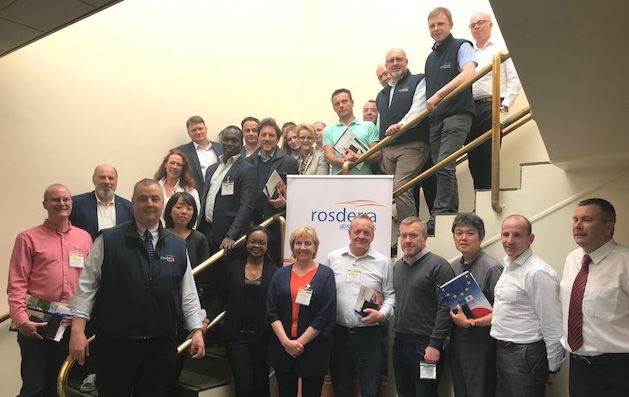
CENTRE’S NEWS EU-JAPAN NEWS I JUNE 2018 I 2 VOL 16 I PAGE 10
CALL FOR APPLICATIONS - MINERVA 20TH TECHNOLOGY
FELLOWSHIP TRANSFER WEBINAR
PATENTS: UTILITY
MODELS – OVERVIEW
OF REQUIREMENTS,
PROCEDURES AND TACTICAL
USE IN EUROPE AND JAPAN
29-06-18 | 10:00 - 11:00 AM
DEADLINE FOR APPLICATION: 22 JUNE 2018
The 1st 2018 slot of the “Minerva” EU-Japan fellowship programme successfully
1. What are Utility Models and how can
I best implement them in company`s IP
started. Three research fellowships were awarded to one Dutch and two
strategy?
Spanish nationals. The fellowship (consisting of 2000 EUR per month) covers a
What are the procedures and require-
period of six months and is offered twice a year, from April to September and
ment to register file utility model rights
from October to March. in some European countries includ-
The Research Fellows are expected to produce a policy report on topics that are ing Germany, France, Italy and Spain
relevant to the EU-Japan Centre, as well as supporting the daily analytical activities as well as in Japan? What aspects are
of the Centre. examined and what is not examined?
Applications are currently open for the 2nd 2018 “Minerva” edition (October How long does it take to get the utility
2018-March 2019 period). Should you be interested in applying, please submit your model right granted and how long
application documents (CV, cover letter, research topic plan). is it valid? What kind of inventions or
For more information and priority topics see link below. subject matter is exempt registration as
utility model rights?
http://www.eu-japan.eu/events/minerva-fellowship-programme
2. Is it possible to enforce a utility
MINERVA REPORTS AND PODCASTS model right? What re the limitations
and risks?
• Opportunities in nine digital technology areas 3. When and how can a utility model
The report has the purpose to show a map of opportunities for venture firms, right be converted to a patent right?
universities and research institutes in the EU to conduct knowledge transfer with Can a utility model and a patent appli-
Japanese counterparts in nine digital technology areas: automated driving tech- cation be filed for the same invention?
nology, cybersecurity, fintech (financial technology), blockchain technology, ed- 4. What is the best way to include util-
tech (education technology), martech (marketing technology), game, IT for fashion ity models in a company`s IP strategy?
business, and IT for art and music business.
Podcast available online by end of July. In this webinar, we will amongst
https://www.eu-japan.eu/publications/opportunities-venture-firms-universities-and-re- other topics cover the following:
search-institutes-eu-conduct-knowledge
• Basics about filing utility model
• Japan Bioventures Landscape applications at the different na-
Japan is one of the major countries that European biotech companies target in tional patent offices (procedure, time
their expansion when it comes to internationalisation. This report intends to be a frame, requirements, costs etc)
useful source of information for European SMEs and clusters considering potential • How Utility Rights can be used in
cooperation with Japan. Enforcement
https://www.eu-japan.eu/publications/opportunities-cooperation-between-eu-and-ja- • How to reduce costs by a tacti-
pan-biotechnology-healthcare-japan cal Use of Utility Models in your
• Photonics for life science and industrial manufacturing, business and co- company`s IP Strategy (Japan)
operation opportunities in Japan • Possibility to branch off a utility
Japan is still a very relevant market for photonics with a 30% global market share model from a pending patent ap-
(2015) including overseas’ production. This reports aims at giving EU SMEs the mar- plication (e.g. Germany)
ket intelligence to make better-informed decisions when entering the Japanese
https://www.eu-japan.eu/events/
market. It includes overviews on several topics, among which: the photonics technology-transfer-webinar-20-pa-
market, its distributors and associations, research funding and public procurement tents-utility-models-overview-require-
ments-procedures-and
opportunities, and relevant events in Japan.
Podcast available online by mid-June
https://www.eu-japan.eu/publications/photonics-life-science-and-industrial-manufactu-
ring-business-and-cooperationCENTRE’S NEWS EU-JAPAN NEWS I JUNE 2018 I 2 VOL 16 I PAGE 11
CALL FOR APPLICATIONS – VULCANUS IN EUROPE
BOOST YOUR R&D TEAM THROUGH HOSTING A JAPANESE STUDENT IN ENGINEERING
The EU-Japan Centre is inviting applications from EU companies and research centres to host Japanese trainees for an
8-month internship in the EU from August 2019 to March 2020.
The trainees come from leading Japanese universities and are
students in engineering or other scientific/high–tech fields. By JORGE PINHO, Bosh Termotecnologia (Portugal),
Following a 4-month intensive language course, the train- Vulcanus in Europe 2017/18 supervisor
ees will be able to communicate in the EU company’s local
language. “My name is Jorge Pinho and I am R&D Engineer at
Bosch Termotecnologia in Aveiro, Portugal. Our group
By welcoming a trainee, the main benefits for the Host
is responsible for the development of new gas water
Company will be a valuable addition to its R&D workforce heaters technologies worldwide.
and an insight into Japanese culture, which is extremely use-
ful for conducting successful business with Japan. We have hosted the student Mizuki Okada in the
framework of Vulcanus in Europe Programme 2017/2018.
The application deadline is 23 September 2018 Mizuki has performed very important work in the
http://www.eu-japan.eu/events/vulcanus-europe implementation of optical techniques such as
Particle Image Velocimetry and Flow visualisation to
characterise and understand complex combustion flows.
These experimental results were then used to validate
numerical models which are used on daily basis by our
engineers’ team. Since the beginning of his traineeship,
Mizuki has shown impressive skills, not only thanks to
his technical background, but also on the collaborative
and cooperation aspect. His high education level and
ability to solve complex engineering problems was
very appreciated by all our colleagues, along with the
opportunity of interaction with the Japanese culture.
This was the first time our company participated in the
Vulcanus in Europe Programme, but we are definitely
looking forward to extend this collaboration in the near
future. Our plan is to keep participating to the Vulcanus
in Europe Programme, and promote collaboration
among European and Japanese cultures.”
CALL FOR APPLICATIONS TO BENEFIT FROM
KEYS TO JAPAN
ARE YOU CONSIDERING MARKETING A PRODUCT OR SERVICE IN JAPAN?
DO YOU NEED A PROFESSIONAL MARKET ENTRY PLAN?
“Keys to Japan” is a European Commission-funded initiative, managed by the EU-Japan
Centre to help a selected European SME considering marketing a product or service in
Japan by developing a detailed and personalised market entry plan for it.
The plan is worth €10,000; 7,000 of which are covered by the EU-Japan Centre, and 3,000 by the
company. The plan will be prepared by the Japan Market Expansion Competition (JMEC) (www.jmec.gr.jp/).
Who is eligible to apply?
Must be citizens of an EU Member-State or COSME Third Country (http://ec.europa.eu/DocsRoom/documents/21365) working
in a management position for a SME applicants (http://ec.europa.eu/growth/smes/business-friendly-environment/sme-defini-
tion) headquartered in the EU or in a COSME Third Country. Applicants must be at least 20 years of age at the date of submis-
sion of the application form. Deadline for application: 31 July 2018.
https://www.eu-japan.eu/market-entry-business-plan-support-keys-japanCENTRE’S NEWS EU-JAPAN NEWS I JUNE 2018 I 2 VOL 16 I PAGE 12
WORKSHOPS ON JAPANESE BUSINESS CULTURE
IN COOPERATION WITH ENTERPRISE EUROPE NETWORK PARTNERS WITHIN
THE EU.
The EU-Japan Centre in collaboration with partners
of Enterprise Europe Network (EEN) is co-organising
numerous cross-cultural workshops all over Europe.
The aim of these workshops is not only to inform local
SMEs on the Japanese business culture and of the available support services, but
also to follow up on recent trends, including the potential benefits of the EU-Japan
Economic Partnership Agreement (EPA) once fully entered into force.
Riga, Latvia
EU-JAPAN EPA AWARENESS ACTIONS
Taking the opportunity of these events, the EU-Japan Centre briefly introduces
information about the potential benefits for EU SMEs of the future EU-Japan
Economic Partnership Agreement and the European Commission’s Market Access
Database (http://madb.europa.eu/madb/indexPubli.htm).
http://ec.europa.eu/trade/policy/in-focus/eu-japan-economic-partnership-agreement/
In the last couple of months, 7 new workshops took place in numerous locations.
On 29 March, a cross-cultural workshop was organised in Riga, Latvia thanks to
Copenhagen, Denmark Investment and Development Agency of Latvia.
On 4 April, a cross-cultural workshop took place in Copenhagen, Denmark in coop-
eration with Vaeksthus Hovedstadsregionen.
Followed by 2 cross-cultural workshops in France, Toulouse and Montpellier on
10-11 April respectively.
Shortly after, in cooperation with National Hungarian Trading House, another
workshop took place in Budapest on 19 April.
On 3 May, the Centre had a pleasure to conduct a cultural session and present its
support services to numerous participants in Bordeaux thanks to ALPHA RLH:
Finally, more useful tips on how to communicate with Japanese were shared dur-
Toulouse, France ing the workshop in Gothenburg on 31 May in partnership with Business Region
Göteborg AB.
To this date, more than several hundred SMEs from various European cities ben-
efited from the cross-cultural sessions, led by expert consultants, and are evidently
more and more up-to-date with Japanese business realities. With the increasing
demand of such initiatives from both Enterprise Europe Network partners and
SMEs in their respective regions, several new workshops will be organised in
Coimbra, Lisbon, Tallinn, Lublin, Brussels and other cities in the near future and
each time in strong cooperation and support of the local EEN partners.
Montpellier, France
https://www.eu-japan.eu/cross-cultural-workshops
Bordeaux, France Budapest, Hungary Gothenburg, SwedenCENTRE’
FROM EUS NEWS EU-JAPAN NEWS I JUNE 2018 I 2 VOL 16 I PAGE 13
KEY ELEMENTS OF THE EU-JAPAN ECONOMIC
PARTNERSHIP AGREEMENT
The negotiations for the EU-Japan Economic Partnership
Agreement were launched in 2013. This Economic
Partnership Agreement will boost trade in goods and
services as well as create opportunities for investment.
The agreement will further improve the position of EU exporters and investors on Japan’s large market, while including strong
guarantees for the protection of EU standards and values. It will help cement Europe’s leadership in setting global trade rules
and send a powerful signal that cooperation, not protectionism, is the way to tackle global challenges.
Following the breakthrough announced at the EU-Japan Summit held in Brussels on 6 July 2017, the negotiators finalised their
work on 8 December 2017. On 18 April 2018, the text of the agreement was presented by the Commission to the Council. This
step marks the beginning of the ratification process at the EU level. This is the first step towards the signature and conclusion
of the agreement.
Once approved by the Council, the agreement will be sent to the European Parliament, aiming for the entry into force before
the end of the current mandate of the European Commission in 2019.
At the same time, negotiations with Japan continue on investment protection standards and investment protection dispute
resolution. The firm commitment on both sides is to move towards an agreement in the investment protection negotiations
as soon as possible, in light of the shared commitment to a stable and secure investment environment in Europe and Japan.
More details about main changes by industrial sectors are available on below link.
http://europa.eu/rapid/press-release_MEMO-18-3326_en.htm
MORE INFORMATION
On the European Commission website, there are already plenty of relevant
information for EU SMEs to better prepare them to take advantage of the EPA
when it will enter into force, such as:
• The EU-Japan Economic Partnership Agreement in 60 seconds
• Factsheets about the agreement
• Negociation reports, impact assessments
• Current trade relations with Japan
• Main chapters in the agreement
• Exporters’ stories
http://ec.europa.eu/trade/policy/in-focus/eu-japan-econo-
mic-partnership-agreement/
YOUR OPINION IS VERY IMPORTANT!
This message is addressed to EU exporters (to the people in the companies who deal with the export transactions), to
shipping companies handling import documentation and procedures in third countries and to EU economic operators
with affiliates in third countries with whom we have FTAs.
RULES OF ORIGIN QUESTIONNAIRE AND TEST VERSION OF AN ONLINE TOOL
The European Commission is committed to ensure effective implementation of Free Trade Agreements (FTAs) concluded by
the EU and to facilitate that EU economic operators, in particular SMEs, take advantage of EU FTAs.
To help EU companies use the FTAs, the European Commission (DG Trade) is launching a pilot project on “Rules of Origin tool”.
This tool is integrated in the Market Access Database (http://madb.europa.eu/madb/indexPubli.htm) and has now been put
online for testing.
Key stakeholders are invited to test it and to comment on whether the on-line tool would be helpful for their understanding
of the applicable rules of origin and to receive comments on how the tool could be improved.
If the outcome of this pilot project would be positive, the tool will be provided on a permanent basis.
The link to the test: http://madb.europa.eu/madb/indexPubli.htm
The link will be publicly available until 31 July 2018.CENTRE’
FROM EUS NEWS EU-JAPAN NEWS I JUNE 2018 I 2 VOL 16 I PAGE 14
EU AND JAPAN CONCLUDE NEGOTIATIONS FOR
STRATEGIC PARTNERSHIP AGREEMENT
The EU and Japan have concluded negotiations on a Strategic Partnership Agreement. Complementing the new
economic deal agreed in December liberalising trade, the political deal aims to facilitate common solutions to common
challenges, such as climate change, energy supply and threats to security. It will help the EU and Japan to jointly
promote peace, stability and prosperity globally, as well as an open international system.
The EU and Japan will further strengthen their already very close relationship thanks to a new Strategic Partnership
Agreement (SPA), negotiations on which were concluded on 25 April 2018. EU High Representative, Federica Mogherini and
her counterpart, the Foreign Minister of Japan, Taro Kono, marked the occasion in a bilateral meeting in the margins of the
Second Brussels conference on supporting the future of Syria and the region.
This agreement, together with the new Economic Partnership Agreement, will take the European Union's long-standing part-
nership with Japan to a new strategic level, triggering considerable benefits to citizens in both countries.
The EU already cooperates with Japan in a wide range of areas. Once in force, the SPA will provide a legally binding frame-
work for this cooperation giving to it strategic direction and coherence. The SPA covers a broad range of areas of mutual
interest, which can help find solutions to the many similar challenges faced by the EU and Japan both regionally and globally
(cyber-crime, disaster management, energy security, climate change, ageing population, etc.).
It will help the EU and Japan to jointly promote peace, stability and prosperity globally, as well as an open international sys-
tem and shared values like human rights, democracy and the rule of law. The SPA will facilitate aligning positions in multilat-
eral organisations or to solve bilateral problems.
The EU and Japan will now complete their respective internal procedures before the signing of the Strategic Partnership
Agreement together with the Economic Partnership Agreement.
Source: European Union External Action
https://eeas.europa.eu/headquarters/headquarters-homepage/43526/eu-and-japan-conclude-negotiations-strategic-partnership-agreement_en
EU AND JAPAN INTENSIFY BILATERAL COOPERATION ON
DIGITAL ECONOMY ISSUES
The European Union (EU) and Japan this week continued their intense cooperation in the area of digital economy,
with representatives of the European Commission and the EU Delegation to Japan holding a series of meetings with
Japanese interlocutors from government as well as with the European and Japanese business communities.
The Commission services involved digital strategies aimed at making a wider context of the new opportunities
were the Directorate-General for success of the transformation of our for regulatory dialogue and cooperation
Communications Networks, Content, respective economies for the digital that will be offered by the Economic
the Directorate-General for Trade, the age. In particular, participants from Partnership Agreement agreed between
Directorate-General for Justice and public authorities and industry looked the EU and Japan last year.
Consumers. On the Japanese side, gov- into ways of working even more closely
ernment ministries and bodies repre- together in areas such as 5G, connected Both sides proposed to organise
sented included; the Ministry of Internal and automated driving, AI and robot- follow-up activities with a workshop on
Affairs and Communications (MIC), the ics, electronic authentication, research standardisation; explore participation in
Ministry of Economy, Trade and Industry and development in digital technolo- research, development and innovation
(METI), the Japan Patent Office, Japan gies, platform regulation, and the data programmes for the digital economy
Fair Trade Commission and the Personal economy and markets, data protection by the EU and Japan; deepen discus-
Information Protection Commission. and privacy, as well as the standardisa- sions on AI; and to focus the next 8th
tion of digital products and services. ICT strategies workshop notably on
The meetings included in particular the cybersecurity, blockchain and the data
7th EU-Japan ICT Strategies Workshop This intense and regular cooperation economy. These activities will report to
on 17 and 18 April, which allowed the between the EU and Japan on the the next EU-Japan Dialogues with MIC
different partners to exchange views digital economy aims at achieving closer and METI that should be held towards
and experiences on their respective cooperation and must be seen in the the end of 2018 in Brussels.
Source: Delegation of the European Union to Japan
https://eeas.europa.eu/delegations/japan/43252/eu-and-japan-intensify-bilateral-cooperation-digital-economy-issues_enCENTRE’
FROM EUS NEWS EU-JAPAN NEWS I JUNE 2018 I 2 VOL 16 I PAGE 15
HOW HORIZON EUROPE IS BEING DESIGNED
The Commission is working on its proposal for Horizon Europe, the framework programme that will succeed Horizon 2020.
This is done on the basis of various building blocks including the interim evaluation of Horizon 2020, the Lab-Fab-App report
(informally the Lamy report), foresight studies and various other reports.
The proposal is being made as part of the EU's proposal for the next EU long-term budget, the multiannual financial frame-
work (MFF). Horizon Europe, with a budget of €97.9 billion, is the biggest ever research and innovation funding programme.
Source: European Commission
https://ec.europa.eu/info/designing-next-research-and-innovation-framework-programme/what-shapes-next-framework-programme_en
HIGH-LEVEL CONFERENCE ON "SCIENCE AND INNOVATION
– OPEN TO THE WORLD: STRENGTHENING COOPERATION
BETWEEN THE STS FORUM AND THE EU THROUGH THE
NEXT FRAMEWORK PROGRAMME "HORIZON EUROPE"
On 17 May, a high-level conference on "Science and Moedas, Director Russo (DG RTD, International Cooperation)
Innovation – Open to the World: Strengthening coopera- and ERC President Bourguignon on the EU side, and Mr Ito,
tion between the STS forum and the EU through the next Deputy Minister of MEXT, Mr Sato, Deputy Director-General,
Framework Programme "Horizon Europe" took place in the Industrial Science and Technology Policy and Environment
European Parliament, co-chaired by Mr Rübig, MEP and 1st Bureau, METI, Mr Irino, Executive Vice President of JETRO,
Vice-Chair of STOA, Mr Buzek, MEP and Chair of the ITRE Mr Chubachi, President of AIST, and Mr Kotani, Executive
Committee, and Mr Omi, Founder and Chairman of the STS Director of RIKEN on the Japanese side. The conference was
forum (Japan), who provided introductory and closing re- organised by the ITRE Committee and STOA of the European
marks. The EU and Japanese speakers included Commissioner Parliament, and the STS forum and JETRO (Japan).
Source: European Commission http://www.europarl.europa.eu/stoa/cms/home/workshops/FPIX
GRANTS IN PRACTICE 2018
The most comprehensive MSCA IF and ERC grant proposal writing workshop to ever take place in Japan, 9-10 July
Tokyo, 11-12 July Osaka, limited seats.
The Grants In Practice event series brings in professional train- WHERE AND WHEN?
ers from Europe to provide in Japan training on grant proposal • 9 July, EU Delegation Tokyo: MSCA IF training
writing. In 2018 the focus will exclusively be on the two main • 10 July, EU Delegation Tokyo: ERC training
EU grant schemes for individual researcher mobility: • 11 July, KANDAI MeRISE Osaka: MSCA IF training
• MSCA IF: for young or experienced researchers, 1-2 years • 12 July, KANDAI MeRise Osaka: ERC training
research stays in Europe; and WHO CAN ATTEND?
• ERC: for excellent reserchers looking for generous funding
Students and researchers of any nationality, seniority
to setup their own team in Europe.
level and discipline; or research managers/administrators.
Participation is 100% free, but organisers ask that all par-
Source: EURAXESS ticipants engage themselves as actively aspossible in the
https://euraxess.ec.europa.eu/worldwide/japan/grants-prac- process of applying to one of the two grants schemes, as the
tice-2018-four-days-grant-writing-training-tokyo-and-osaka training will include interactive exercises.CENTRE’
FROM EUS NEWS EU-JAPAN NEWS I JUNE 2018 I 2 VOL 16 I PAGE 16
EU-JAPAN WORKING GROUP ON ROBOTS
Within the framework of the 21st European Commission DG GROW-METI Industrial Policy Dialogue, the 3rd meeting of
the Robotics Working Group took place on 17 April 2018 in Tokyo. Both sides have exchanged information about the
recent robotics policies in the EU and Japan, including regulatory framework and safety standards.
On the Japanese side, METI has provided interesting informa- They will also continue to collaborate on standards develop-
tion on the progress of Japan’s New Robot Strategy, including ment for robots and will remain open to discuss safety issues
collaborative robots. On the EU side, DG GROW presented pertaining to Artificial Intelligent robots.
the overview on the EU strategy for artificial intelligence and The existing regulatory frameworks were not designed with
robotics. They also gave policy updates on the EU regula- new technologies in mind, such as autonomous artificial
tory safety framework for robots, specifically the Machinery intelligent robots. Both sides have therefore recognised the
Directive and the Radio Equipment Directive. necessity for carefully following cases of practical use of arti-
ficial intelligence in various industrial sectors. This would help
DG GROW and METI have agreed to expand the scope of the in assessing whether there is any need to update the respec-
Robot Working Group to include exchanges on safety issues tive regulatory frameworks.
related to human-robot collaboration in shared workspaces.
The working group acknowledged that collaborative robots EU and Japan look forward to continuing the good collabo-
will contribute to solving the various global issues such as ration they had so far and harvesting positive outcomes for
support for ageing society or lack of labour force. This is an common regulatory approaches.
area where EU and Japan will continue to exchange views
and seek regulatory convergence. Source: European Commission Directorate General GROWTH
https://ec.europa.eu/digital-single-market/en/news/communication-artificial-intelligence-europe
WHY AND HOW? SHOWCASE YOUR INSTITUTION AS
“PARTNER ORGANISATION” TO HOST AN MSCA-IF-GLOBAL
FELLOWSHIP ON THE EURAXESS PORTAL
Japanese universities, research institutes and other organisations may offer to host a European based researcher for up to 24
months as part of a MarieSklodowska Curie Actions Individual Fellowship-Global Fellowship (MSCA-IF-GF) proposal.
MSCA-IF-GF call is for experienced (post-PhD) researchers based in Europe (nationals or long term residents of a Member State
or Associated Country) wishing to spend 12 to 24 months in a Partner country, such as Japan, and an additional (compulsory)
year back in Europe. Any research performing institution in the world can be a host for Global Fellowships. At the proposal
stage, a letter of intent must be produced, showing the capacity of your institution to host the researcher and to provide to
the needs of the project (the researcher received a salary and research grant from the European Union and thus does not
necessarily need to be under a contract with your institution).
The call closes on 12 September 2018
For more about the MSCA-Individual Fellowships se below links.
Source: EURAXESS
https://euraxess.ec.europa.eu/worldwide/india/msca-if-2018-call-open-12-april-2018
https://euraxess.ec.europa.eu/worldwide/japan/why-and-how-showcase-your-institution-partner-organisation-host-msca-if-global
EURAXESS JAPAN TOUR 2018 @ NAGOYA UNIVERSITY
20 JUNE 2018, NAGOYA, JAPAN
The third edition of our EURAXESS Japan Tour seminars in 2018 will take place at ITbM, Nagoya University. It will provide in
half a day a complete overview of opportunities for research cooperation and mobility projects between Japan and Europe,
with a particular focus on funding schemes within the EU’s flagship research and innovation Framework Programme, Horizon
2020.
Source: EURAXESS
https://euraxess.ec.europa.eu/worldwide/japan/euraxess-japan-tour-2018-nagoya-universityYou can also read


