New Hope in Nepal Curing canines in Kathmandu
←
→
Page content transcription
If your browser does not render page correctly, please read the page content below
New
 Hope
in Nepal
Curing canines in Kathmandu
Story and photographs by Matthew Kruchak

38 moderndog   FALL 2009
I
                                 t’s midday and the sun shines hot over Kathmandu. There’s no movement in the
                                 trash-filled lot that separates a Tibetan Buddhist monastery and the back end of a
                                 Nepalese restaurant. You can’t see them, but the stray dogs are out there, lumps of
                                 filthy fur lying in the beating sun or hiding in slivers of shade. Andrea Bringmann is
                                 about to wake them.
                           Bringmann is the founder of Street Dogs Care Camp, a non-profit organization based in
                        Boudhanath, a Tibetan community resting on the rough edge of Kathmandu. With a team
                        of volunteers and a pair of veterinarians, Bringmann has been caring for the area’s suffering
                        street dogs since February of 2008.
                           Normally, the Care Camp team sets up a field clinic every Saturday to treat sick and
                        injured canines at Boudha Stupa, a large bell-shaped Buddhist shrine that’s circumambu-
                        lated by practitioners. Since they began their rescue and rehabilitation efforts, Bringmann
                        and her colleagues have, on average, treated 15 dogs every Saturday and have intensively
                        cared for almost 50 so far.
                           But today is the Buddha’s 2,553rd birthday and thousands of followers have flooded the
                        area. Instead of bringing the dogs to the stupa, Bringmann decides to visit them on their
                        turf.
                           Bringmann leads the way through the Nepalese restaurant and out onto the patio, calling
                        for Mummy, a blind dog the colour of the golden monk shirts that hang in the sun to dry,
                        but not nearly as clean. Following closely behind her is Franziska Oertle, a Swiss volunteer,
                        and the pair of Nepalese veterinarians, Susmitha Gautan and Suraj Dhakal. From a spot in
                        the shade, Mummy follows Bringmann’s German accent into her outstretched arms.
                           “You’re very lucky,” Bringmann says. Mummy growls.
                           According to the Kathmandu Animal Treatment (KAT) Centre, there are over 35,000
                        street dogs in the Kathmandu Valley and Mummy is definitely one of the lucky ones. She
                        had a softball-sized growth on her back caused by a canine transmissible venereal tumour,
(above)                 a sexually transmitted disease that affects the reproductive tract. With the help of Street
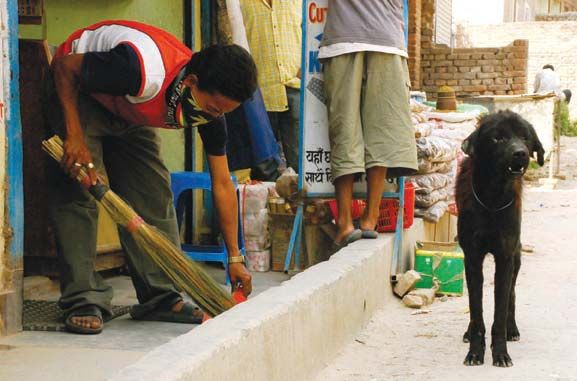
A Boudhanath area
shopkeeper sweeps       Dogs Care Camp, Mummy’s tumour was removed. But the majority of stray dogs in the
the dusty sidewalk,
                        area still suffer from abuse, malnutrition, and disease.
as a street dog
stands nearby.             “They suffer so much and I suffer with them,” Bringmann says. “If there’s a possibility
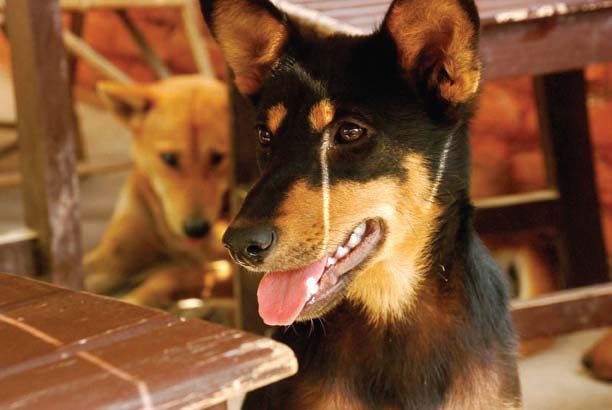
(facing page) A pair
                        to help them, then why not do it?”
of street dogs lounge      And she does.
in the shade under
a table on a restau-       Born in Germany, Bringmann worked for 10 years in Italy’s advertising industry. She had
rant’s patio.           a steady income and nice home, but wasn’t satisfied with her career. She felt she was lying

                                                                                                        moderndogmagazine.com   39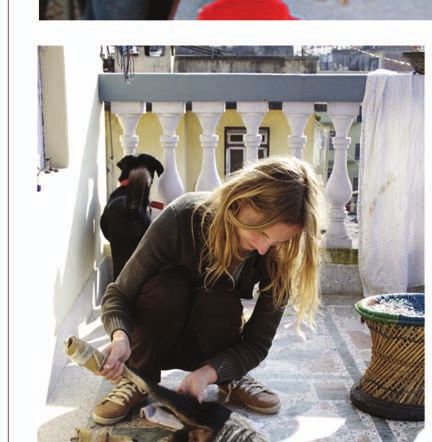
“Dogs and people are just the same,
                             That’s why I feed them. Religious
                            practice is not just being a monk.”
                           to the people she was pitching products to and it wasn’t worth the stress. So a
                           year ago, Bringmann packed her bags and headed around the world, making
                           stops in Europe, North America, South America, and South Asia before landing
                           in Kathmandu. She planned to move on to Australia, but never left Nepal.
                               “I cancelled my flight because of the dogs,” she says, with a wide grin.
                               Every day, Bringmann saw distressed dogs on the streets of Kathmandu—
                           skinny, forlorn and infected with mange, a skin disease caused by parasitic
                           mites that produces hair loss and the formation of scabs and lesions. And
                           every day, she felt the need to help.
                               Bringmann began by feeding the dogs rice and meat. Friends visiting from
                           Germany saw the work she was doing and wanted to help. They donated
                           money for dog food but Bringmann thought the cash could be put to better use,
                           so she developed the idea of a weekly clinic to treat the sick and injured dogs.
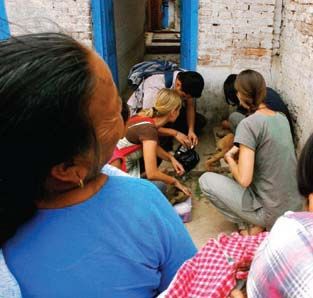
                                                         The first canine clinic at Boudha Stupa drew a
                           (clockwise from top left)  large crowd of curious observers. With prayer beads
                           A crowd gathers as         clenched in their hands, Buddhists broke from circling
                           Andrea Bringmann,
                           Suraj Dhakal, Susmitha     the stupa to watch Bringmann’s team soap up the
                           Gautan, and Franziska      street dogs. The locals had never before seen strays
                           Oertle examine ticks in
                           Little Wamo’s ears.        being washed and given vaccinations. The resident
                                                      reactions were mostly positive but some thought
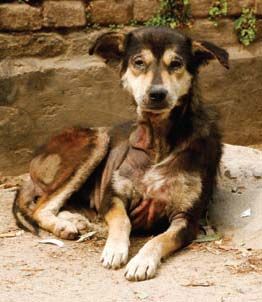
                           Chiny relaxes at the
                           side of a dusty street in  Bringmann and her team were crazy. Many still think
                           Boudhanath.
                                                      they are.
                            Andrea Bringmann             There’s a fear of street dogs in Nepal, Bringmann
                           comforts Pasang as
                           veterinarian Susmitha      says. They’re seen as dirty and diseased. According to
                           Gautan holds the dog’s     the KAT Centre, about 200 people die every year in
                           front left leg while col-
                           league Suraj Dhakal        Nepal after being bitten by rabid dogs.
                           sutures the wound.            People step around stray dogs on the street. They
                            A mangy street dog in     step over them, too. And if dogs get in the way,
                           Bhaktapur, Nepal.          they’re kicked. But never loved.

40 moderndog   FALL 2009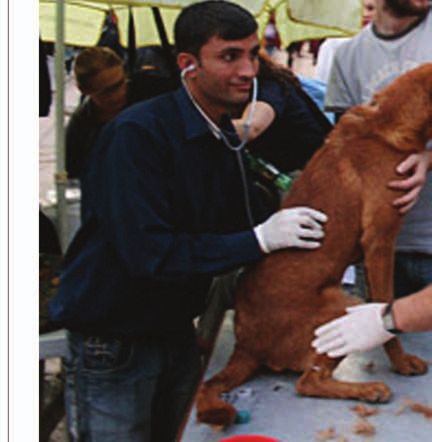
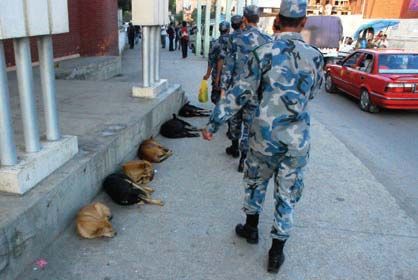
(clockwise from top left)
                                                                                                             Members of the Armed Police Force walk
                                                                                                             past sleeping street dogs at the front
                                                                                                             gates of the former royal palace, which is
                                                                                                             now a museum.

                                                                                                             Veterinarian Susmitha Gautan holds Oro
                                                                                                             in place as her colleague Suraj Dhakal
                                                                                                             examines the cast they put on the pup-
                                                                                                             py’s broken leg a couple weeks earlier.

                                                                                                             Andrea Bringmann shakes Strubel’s
                                                                                                             paw at Boudha Stupa.

                                                                                                             “They suffer
                                                                                                             so much and
                                                                                                             I suffer
                                                                                                             with them.
                                                                                                             If there’s a
                                                                                                             possibility
                                                                                                             to help them,
                                                                                                             then why not
                                                                                                             do it?”

in Boudhanath so it’s just a precaution, Bringmann says.                 to examine the dog; she has a puppy of her own and doesn’t
   She’s developing a street dog education program to take               want to pass the disease on to her dog.
around to local schools and hands out informational brochures on            The vets examine the dog and give the caregivers some medi-
Saturdays. The Care Camp doesn’t focus only on street dog care,          cine. The team bids the puppy farewell. They will see it again.
however. They’re also educating people on how to keep canines as         Without the Care Camp the dog would surely die.
pets. Street dogs often live better lives than canines kept by Tibetan      After just a few months, it’s exciting to see how much healthier
and Nepalese families, Bringmann says. They tend to keep house           and happier the street dogs are, Bringmann says; it’s the people
dogs on metre-long leashes or locked up in small cages.                  who will be tougher to train.
   One palm-sized black and white puppy (this time the white                “I would like to teach people that if they respect the ani-
is actually white), luckier than many pet dogs, is held in loving        mals and give love, they will also get love from the animals,”
hands as he waits for treatment. A Tibetan family rescued the            Bringmann says.
sick puppy from the nearby stupa. This puppy is last on the list            This can be seen when the group walks down the street.
for treatment today and for an unfortunate reason. The pup has           Normally, stray dogs won’t approach people like a loving house
canine distemper virus, a highly contagious disease that affects         pet, but this is the reaction the group has been receiving from the
the respiratory, gastrointestinal, and central nervous system.           street dogs they’ve met today. They’ve shown the dogs some love
Bringmann stays on the ground floor as the team heads upstairs           and it’s returned with licks and paw shakes. ■

42 moderndog          FALL 2009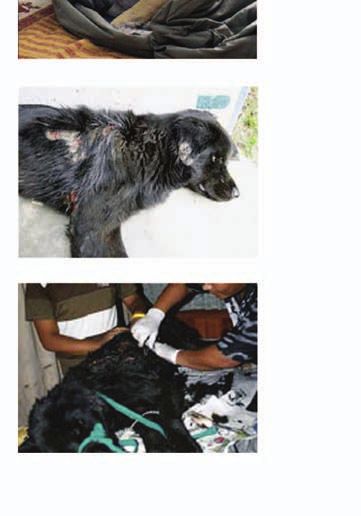
You can also read


