News and Political Information Consumption in Sweden: Mapping the 2018 Swedish General Election on Twitter
←
→
Page content transcription
If your browser does not render page correctly, please read the page content below
News and Political Information Consumption in Sweden:
                           Mapping the 2018 Swedish General Election on Twitter

                             COMPROP DATA MEMO 2018.3/ SEPTEMBER 6, 2018
                                        comprop@oii.ox.ac.uk

          Freja Hedman                 Fabian Sivnert            Bence Kollanyi          Vidya Narayanan
         Lund University              Oxford University         Oxford University        Oxford University
          @frejahedman                 @fabiansivnert            @bencekollanyi          @vidunarayanan

                                     Lisa-Maria Neudert         Philip N. Howard
                                     Oxford University          Oxford University
                                        @lmneudert                @pnhoward

ABSTRACT
In Sweden, concerns over misinformation and computational propaganda and their effect on the democratic
process are on the rise. In this data memo, we analyse political news and information shared over Twitter in the
period leading up to the 2018 Swedish General Election. We find that (1) Swedish political discourse on social
media is about broad public issues rather than specific candidates and parties, (2) Swedish social media users
are sharing more junk news — one for every three URLs being shared with political hashtags—the largest
proportion of all the European elections we have studied, and (3) most of this junk news is home grown, with
eight of the top ten junk news sources being of Swedish origin.

INTRODUCTION                                                refused to cooperate with them and as a result,
                                                                                                       3
Social media networks have become a key platform            Sweden has had a minority government. Recent
for citizens to share news and political information.       polls suggest that the Sweden Democrats will
The news and information voters are exposed to on           increase their support in the upcoming General
social media platforms ranges from professional             Election on September 9, 2018. According to such
news content to emotionally-driven and polarizing           polls, if other parties remain reluctant to cooperate
news content. Sources spreading deceptive or false          with the Sweden Democrats, another minority
information can often mimic established news                                          4
                                                            government is expected.
reporting, with actors across the political spectrum                  Similar to other European countries,
leveraging misinformation to capture attention.             Sweden has a public media system which includes
During times of heightened public interest, social          television and radio programmes. A 2015 study
media algorithms repeatedly promote conspiracy              produced by the SOM- Institute for Media Studies
                                     1
content over accurate information. This has raised          showed that the majority of all Swedish citizens
concerns about the manipulation of public opinion,          have a high confidence in the media; interestingly,
especially in politically sensitive moments such as         the confidence level was lowest when addressing
                            2
elections and referenda. In Sweden, there is                immigration. According to the same study 54% of
increasing debate about the impact of                       all participants answered that they either agreed or
misinformation, or of full-scale influence operations       agreed partially with the claim that the Swedish
undertaken by foreign powers. This study examines           media do not produce accurate articles on issues
high-frequency tweeting and sharing of news                 surrounding immigration. Only 27% disagreed or
sources on Swedish Twitter between August 8 and             partially disagreed with the statement. Additionally,
August 17, 2018. In this context, our research              an individual’s confidence in media appears to be
questions are: (1) Which political parties lead the         politically influenced, where Left/Green voters trust
conversation over Twitter? (2) What types of                the media more compared to Centre/Centre-Right
content do voters share over Twitter?                       voters, while the lowest confidence levels were
                                                                                                         5
                                                            found among the Sweden Democrat voters.
THE GENERAL ELECTION AND MEDIA
Sweden has a proportional representation system,            COMPUTATIONAL PROPAGANDA AND
where the party landscape consists of multiple              JUNK NEWS IN SWEDEN
smaller parties and larger coalitions. Since 2010,          Computational propaganda has emerged as a
eight parties have been represented parliament: the         prominent issue among policymakers in Sweden,
Left Party, the Social Democrats, the Green Party,          especially in light of the upcoming election. The
the Moderate Party, the Centre Party, the Liberals,         Swedish government launched several initiatives in
the Christian Democrats, and the Sweden                     2017 specifically aimed at preventing and
Democrats. Interestingly, since the Sweden                  combatting the influence of computational
Democrats — a radical right party — entered                 propaganda. In response, the government founded a
parliament in 2010, the remaining parties have              new public authority tasked with countering

                                                                                                               1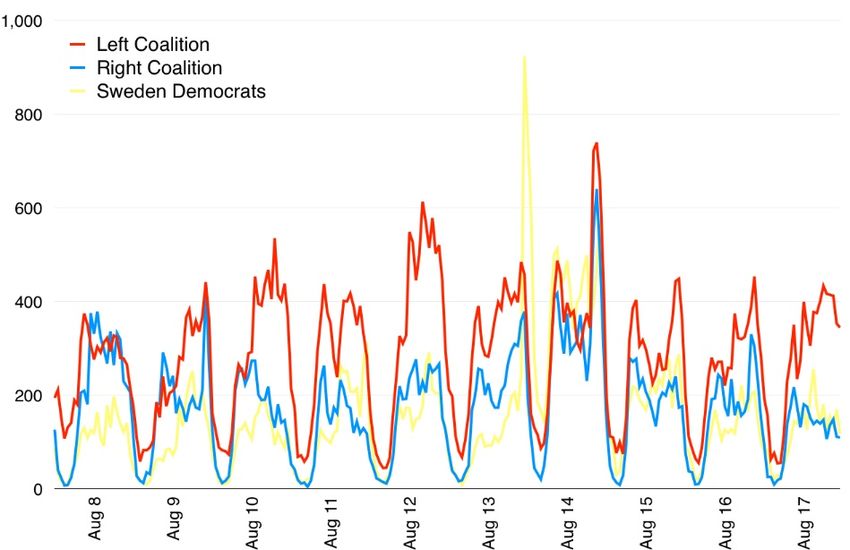
misinformation and boosting the population’s              same tweet contained hashtags or mentions for
resilience in the face of possible influence              different parties, it was credited to each of the
operations.6 The Swedish government has also              relevant parties. If a tweet included more than one
raised questions about foreign interference               relevant hashtags or mentions for the same party, it
campaigns. At the People and Defence conference           was still counted only once per party. The final
2018, the Swedish Prime Minister claimed that             dataset contains links to news sources shared five
Russia were responsible for several influence             times or more on Twitter; it also includes links to
operations.7 In a larger political context, Russia has    content on YouTube and Facebook. Links pointing
a history of being one of the biggest intelligence        to Twitter itself were excluded from our sample.
threats towards Sweden.8 Furthermore, the                 This approach resulted in 94% coverage, meaning
Totalförsvarets Forskningsinstitut (the Swedish           the team coded 94% of the all URLs shared. The
Defence Research Agency) recently released a              process of classifying the base URLs, accounts,
report on interference campaigns which found that         channels, and pages, based on the evaluation of the
automated bots share URLs of known junk news              sources, was done according to a rigorous and
sites like Samhällsnytt and Fria Tider more               iterative coding process using a typology that has
frequently than regular accounts; and that the            been developed and refined through the project’s
majority of automated accounts that have either been      previous studies of six elections in four Western
suspended or removed by Twitter expresses                 democracies and several countries in Latin
                                                   9                11,12
traditional authoritarian and nationalistic views.        America.        To ensure a high inter-coder reliability
                                                          we calculated the Krippendorff’s alpha which was
SAMPLING AND METHODS                                      0.81. The existing literature concludes that this
                                                                                                 13
The Twitter dataset contains 274,953 tweets posted        provides a high level of reliability. The typology
by 41,389 unique Twitter users, collected between         explaining our content classification follows below:
August 8 and August 17, 2018, using a combination
of relevant political party hashtags, election-specific   Professional News Content
hashtags, and handles for the individual parties,         •    Major News Brands. This is political news and information
                                                               by major newspapers, broadcasting or radio outlets, as well
party leaders, and their youth organisations. It is            as news agencies.
important to note that we have only included parties      •    Local News. This content comes from local and regional
who are currently in parliament. Although there are            newspapers, broadcasting and radio outlets, or local
several other smaller parties competing for                    affiliates of major news brands.
parliamentary seats – including the Feminist Party        •    New Media and Start-ups. This content comes from new
                                                               media and digitally native publishers, news brands and
and the Alternative for Sweden – they have been                start-ups.
excluded from this study. The list of hashtags            •    Tabloids. This news reporting focuses on sex, crime,
associated with the Swedish election was compiled              astrology and celebrities, and includes yellow press
by a team of two trained coders who are native                 publications.
Swedish speakers and very familiar with Swedish           Professional Political Content
politics. Prior to launching the data collection, the     •    Government. These links are to websites of branches of
set of hashtags was refined in a trial run consisting          government or public agencies.
of a two-day test data collection. The trial run          •    Experts. This content takes the form of white papers, policy
revealed the most frequently used hashtags, and the            papers or scholarship from researchers based at universities,
                                                               think tanks or other research organizations.
list was revised accordingly.                             •    Political Party or Candidate. These links are to official
          Twitter’s Streaming API was used to                  content produced by a political party or candidate
collect publicly available tweets. The platform’s              campaign, as well as the parties’ political committees.
precise sampling method is not disclosed, however
                                                          Polarizing and Conspiracy Content
Twitter reports that data available through the           •     Junk News and Information. These sources deliberately
Streaming API is, at most, 1% of the overall global             publish misleading, deceptive or incorrect information
                                             10
public traffic on Twitter at any given time. Tweets             purporting to be real news about politics, economics or
were collected if they: (1) contained at least one of           culture. This content includes various forms of propaganda
                                                                and ideologically extreme, hyper-partisan or conspiratorial
the relevant hashtags or at least one Twitter handle            news and information. To be classified as Junk News and
of the political parties or political leader; (2)               Information, the source must fulfill at least three of these
contained the hashtag in the URL shared, or the title           five criteria:
of its webpage; (3) were a retweet of a message that           o      Professionalism: These outlets do not employ
                                                                      standards and best practices of professional
contained a relevant hashtag or mention in the                        journalism. They refrain from providing clear
original message; or (4) were a quoted tweet                          information about real authors, editors, publishers and
referring to a tweet with a relevant hashtag or                       owners. They lack transparency and accountability,
                                                                      and do not publish corrections on debunked
mention.
                                                                      information.
          During the analysis of the party-related            o       Style: These outlets use emotionally driven language
Twitter traffic, every tweet was counted once if it                   with emotive expressions, hyperbole, ad hominem
contained at least one of the hashtags or the                         attacks,     misleading      headlines,       excessive
mentions associated with a political party. If the                    capitalization, unsafe generalizations and logical

                                                                                                                           2
fallacies, moving images, and lots of pictures and Table 1: Twitter Conversation and High Frequency
mobilizing memes. Tweeting about the Swedish Election
o Credibility: These outlets rely on false information Political party or N % of N of high % of high
and conspiracy theories, which they often employ general traffic total frequency frequency
strategically. They report without consulting multiple tweets* tweets
sources and do not fact-check. Sources are often General 143,697 47 10,826 57
untrustworthy and standards of production lack
Social Democrats 47,044 16 2,046 11
reliability.
o Bias: Reporting in these outlets is highly biased, Sweden Democrats 36,930 12 2,554 14
ideologically skewed or hyper-partisan, and news Moderate Party 19,398 6 942 5
reporting frequently includes strongly opinionated Green Party 15,098 5 687 4
commentary. Left Party 11,812 4 605 3
o Counterfeit: These sources mimic established news Christian Democrats 10,600 4 311 2
reporting. They counterfeit fonts, branding and
stylistic content strategies. Commentary and junk Liberal Party 10,192 3 437 2
content is stylistically disguised as news, with Centre Party 8,456 3 418 2
references to news agencies and credible sources, and Total** 303,227 100 18,826 100
headlines written in a news tone with date, time and Source: Authors’ calculations from data sampled 08/08/18–
location stamps. 17/08/18.
• Russia. This content is produced by known Russian sources Note: * Refers to the number of tweets from high frequency-
of political news and information. tweeting accounts. ** A tweet counted multiple times if it
contained hashtags or mentions for more than one party or
Other Political News and Information candidate.
• Political Commentary Blogs. Political blogs that employ Hashtags include: #svpol, #val2018, #valet2018,
standards of professional content production such as copy- #miljopartiet, #klimatval2018, #GronUngdom, #v2018,
editing, as well as employ writers and editorial staff. These #vansterpartiet, #ungvanster, #centerpartiet, #cuf,
blogs typically focus on news commentary rather than #liberalerna, #LUFswe, #mufswe, #moderaterna,
neutral news reporting on a news cycle and are often #nya_moderaterna, #kdriks, #KDUSverige, #sd2018,
opinionated or partisan. #Ungsvenskarna, #sverigedemokraterna; Twitter
• Citizen, Civil Society and Civic Content. These are links to handles include: @jimmieakesson, @miljopartiet,
content produced by independent citizen, civic groups, civil @buchebba, @vansterpartiet, @annieloof,
society organizations, watchdog organizations, fact- @socialdemokrat, @stefanlofven, @centerpartiet,
checkers, interest groups and lobby groups representing @IsabellaLovin, @liberalerna, @jsjostedt,
specific political interests or agendas. This includes blogs @nya_moderaterna, @bjorklundjan, @kdriks,
and websites dedicated to citizen journalism, personal @ulfkristersson, @sdriks.
activism, and other forms of civic expression that display
originality and creation that goes beyond curation or
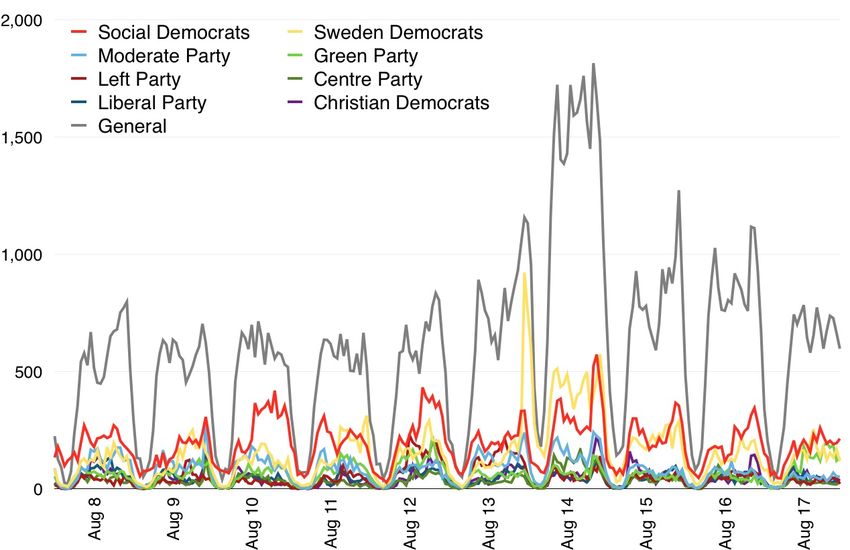
aggregation. This category includes Medium, Blogger and According to Figure 1 and Table 1 the hourly
WordPress, unless a specific source hosted on either of Twitter activity was consistently highest among the
these pages can be identified. Social Democrats, the Sweden Democrats, and the
Moderates. These parties are also the three largest
FINDINGS AND ANALYSIS based on the 2014 election result. The Sweden
For our analysis of Twitter data, we examined the Democrats accounted for 14% of the hourly Twitter
volume of tweets, the degree of high frequency conversation whereas the Social Democrats
tweeting and the type of news content shared on accounted for 11% and the Moderates for 5%.
Twitter during the Swedish General Election. Noteworthy is that 47% of the Twitter
conversations was general content, as opposed to
Figure 1: Hourly Tweets about the Swedish General party specific content. It is a high amount in
Election Based on Hashtags and Mentions
comparison to the project’s previous studies in
European democracies. In the German
Parliamentary Election and the French Presidential
Election, general content was shared at 29% and
14,15
26% respectively. This suggests that when
talking about politics, Swedish users often refrain
from sharing partisan affiliations and opinions, but
rather remain neutral.
Source: Author’s calculations from data sampled between
08/08/18 – 17/08/18.
3Figure 2: Hourly Twitter Conversation about the Swedish Table 3: Types of News and Information Shares on
General Election Based on Hashtag and Mention Use Twitter
(Possible Coalitions) Type of Source N %
Professional News and Information
Professional News Brands* 9,344 50.3
Tabloids 247 1.3
Subtotal 9,591 51.6
Polarizing and Conspiratorial Content
Junk News and Information 4,104 22.1
Russian Content 36 0.2
Subtotal 4,140 22.3
Professional Political Content
Political Party or Candidate 458 2.5
Experts 44 0.2
Government 40 0.2
Source: Author’s calculations from data sampled between Subtotal 542 2.9
08/08/18 – 17/08/18.
Other News & Information
Video/Image Sharing 1,192 6.4
Table 2: Twitter Conversation and High Frequency
Citizen or Civil Society 1,047 5.6
Tweeting about the Swedish Election
Portals, SEs, Aggregators 791 4.3
Coalition or N % of N of high % of high Political Commentary Blogs 290 1.6
political party total frequency frequency Remaining categories** 125 0.7
tweets* tweets
Subtotal 3,445 18.5
Left coalition 67,907 47 3,030 42
Right coalition 40,871 28 1,672 23 Other
Sweden Democrats 36,930 25 2,554 35 Social Media Platforms 525 2.8
Total** 145,708 100 7,256 100 Shopping, Services & Apps 186 1.0
Source: Authors’ calculations from data sampled 08/08/18– Not Available 50 0.3
17/08/18. Other Non-Political 45 0.2
Note: For the complete list of hashtags and mentions used to Language 38 0.2
collect our data, see Table 1. * Refers to the number of tweets Link Shorteners 22 0.1
from high frequency-tweeting accounts. ** A tweet counted Subtotal 866 4.7
multiple times if it contained hashtags or mentions for more Total 18,584 100
than one party or candidate. Source: Authors’ calculations from data sampled 08/08/18–
17/08/18.
Note: * Major News Brand, Local News, New Media and
Figure 2 shows the hourly Twitter conversation Start-ups were collapsed into this category for this table and
when parties are clustered based on possible subsequent tables. ** Cloud Services, Fundraising &
coalitions post-election. These two coalitions are Petitions, Other Political, Political Humor, Religion were
based on longstanding relationships between collapsed for this table as constituted low percentage.
specific parties in parliament. The Right coalition
was introduced during the 2004 Swedish General Apart from the hourly Twitter conversation analysis
Election and the Left coalition was introduced we also extracted URLs from the Twitter data
in 2008.
16,17
The analysis includes all parties that sample and then classified them according to the
18 typology. Table 2 reveals that the content classified
will enter parliament, according to recent polls.
as Other Non-Political was very low (0.2%), which
When clustering parties based on possible
therefore confirms that the handles and hashtags
coalitions, the Left coalition (the Left Party, the
used to capture political conversations were
Green Party, and the Social Democratic Party) have
successful. Content labelled as Polarizing and
67,907 tweets with relevant mentions and hashtags
Conspiracy comprised of 22% of the sample. Junk
whereas the most likely Right coalition (the Centre
news thereby constituted the second largest
Party, the Moderate Party, the Liberal Party, and the
category, only exceeded by Professional News
Christian Democratic Party) only have 40,871
Content, which constituted 52%. The ratio of
tweets. In other words, the Left coalition dominates
professional news to junk news shared over social
the Twitter conversation with roughly 47% of all
media was roughly 2:1. Comparing across other
tweets associated with the parties whereas the Right
countries, junk news consumption is as high as
coalition only had 28%.
during the US election, but significantly lower than
in the UK, Germany, and France. Germany had the
ratio of 4:1 and UK and France had 5:1 and 7:1
19
respectively. Junk news therefore contributed
substantially to the conversation around the Swedish
General Election.
An in-depth analysis of the junk news
sources revealed that out of the top-ten most shared
4junk news sources eight were Swedish, and only we foresee a need to conduct further research into
0.2% content of all junk had Russian origin. the effect of junk news on individual voters.
The most frequently shared junk news sites —
Samhällsnytt, Nyheteridag, and Fria Tider — ABOUT THE PROJECT
accounted for 86% of all junk news shares. All three The Project on Computational Propaganda
outlets mimic the look and journalistic language of (COMPROP) based at the Oxford Internet Institute
professional news content sites, therefore increasing is an interdisciplinary team of social and
the likelihood of being interpreted as legitimate information scientists researching how political
sources of news. These findings are also consistent actors manipulate public opinion over social
with the independent report recently released by networks. This work includes analysing the
Totalförsvarets Forskningsinstitut (the Swedish interaction of algorithms, automation, politics and
Defence Research Agency) which also analysed the social media to amplify or repress political content,
impact of computational propaganda on the Swedish disinformation, hate speech and junk news. Data
General Election and found that automated bots memos are designed to present quick snapshots of
share URLs of known junk news sites like analysis on current events in a short format, and
Samhällsnytt and Fria Tider more frequently than although they reflect methodological experience and
regular accounts. Content labelled as Professional considered analysis, they have not been peer-
Political Content, such as official party content, reviewed. Working papers present deeper analysis
constituted 3% of the data sample. This is a small and extended arguments that have been collegially
share in comparison to the project’s previous studies reviewed and engage with public issues.
of France with 12%, Germany with 11% and the UK COMPROP’s articles, book chapters and books are
with 10%. significant manuscripts that have been through peer
review and formally published.
CONCLUSION
Our main conclusions are that (1) on Twitter, the ACKNOWLEDGEMENTS.AND
political discourse in Sweden is about broad public DISCLOSURES
issues as opposed to specific candidates and parties, The authors gratefully acknowledge the support of
(2) for every two links of professional news content the European Research Council, “Computational
shared Swedish users shared one junk news story– Propaganda: Investigating the Impact of Algorithms
with 22% of all URLs shared, this was the largest and Bots on Political Discourse in Europe,”
proportion of junk news across all the European Proposal 648311, 2015-2020, Philip N. Howard,
elections we have studied, and (3) most of the junk Principal Investigator. Project activities were
news originates from Swedish outlets, with eight of approved by University of Oxford’s Research Ethics
the top ten junk news sources coming from home Committee, CUREC OII C1A 15-044. For
grown sources. We further observe that the Twitter supporting our Election Observatory and our
conversation was dominated by the three largest research in Europe we are grateful to the Adessium
parties and when clustering parties based on Foundation, Microsoft Research, and Omidyar
possible coalitions, the Left coalition generates Network. Any opinions, findings, and conclusions
more traffic than the Right coalition. Users shared or recommendations expressed in this material are
only 3% of content that came from official parties or those of the authors and do not necessarily reflect
candidates. This is in line with our findings that the views of the University of Oxford or the
close to half of the tweets generated on the elections European Research Council, Adessium Foundation,
were about general issues. As compared to the Microsoft Research, or Omidyar Network.
project’s previous studies of European democracies,
these categories had a unique distribution in REFERENCES
Sweden. The ratio of junk news to professionally [1] P. N. Howard, S. Woolley, and R. Calo,
produced news was the same as in the US election. “Algorithms, bots, and political
However, significantly more junk news was shared communication in the US 2016 election: The
in Sweden than in the other European democracies challenge of automated political
we studied. The content shared on parties and communication for election law and
candidates was significantly less in Sweden administration,” J. Inf. Technol. Polit., pp. 1–
compared to Germany, France and UK. 13, Apr. 2018.
Our results indicate that Swedish voters [2] G. Bolsover and P. Howard, “Chinese
have shared a substantial amount of junk news in the computational propaganda: automation,
run up to the 2018 Swedish General Election. Our algorithms and the manipulation of
analysis suggests that countries like Sweden still information about Chinese politics on Twitter
have a high volume of junk news – despite recent and Weibo,” Information, Communication &
efforts to prevent and combat the influence of Society, pp. 1–18, May 2018.
computational propaganda. In light of our findings [3] A. Hellström, T. Nilsson, and P. Stoltz,
“Nationalism vs. Nationalism: The Challenge
5of the Sweden Democrats in the Swedish Parliamentary Election: What are German
Public Debate,” Gov. Oppos., vol. 47, no. 2, Voters Sharing over Twitter?,” Project on
pp. 186–205, Apr. 2012. Computational Propaganda, Oxford Internet
[4] Novus, “2018 - Novus,” Novus - från åsikt till Institute, Oxford University, Oxford, United
insikt, 2018. [Online]. Available: Kingdom, Data Memo, 2017.7.
https://novus.se/valjaropinionen/svtnovus- [15] C. Desigaud, P. N. Howard, S. Bradshaw, B.
valjarbarometer/2018-2/. Kollanyi, and G. Bolsolver, “Junk News and
[5] SOM Institute for media studies, “Misstron Bots during the French Presidential Election
mot medier”. [Online]. Available: (Round II),” Project on Computational
http://mediestudier.se/publikationer/misstron- Propaganda, Oxford Internet Institute, Oxford
mot-medier/, 2015. University, Oxford, United Kingdom, Data
[6] R. och Regeringskansliet, “En ny myndighet Memo, 2017.4.
för psykologiskt försvar,” Regeringskansliet, [16] Alliansen, “Hem - Alliansen”. [Online].
16-Aug-2018. [Online]. Available: Available: http://www.alliansen.se/.
https://www.regeringen.se/rattsliga- [17] “Vänsterpartiet - Ett rödgrönt samarbete för
dokument/kommittedirektiv/2018/08/dir.- framtiden,” 10-Dec-2008. [Online]. Available:
201880/. https://web.archive.org/web/20081210144837
[7] R. och Regeringskansliet, “Sveriges säkerhet i /http://www.vansterpartiet.se/content/view/19
en ny värld,” Regeringskansliet, 14-Jan-2018. 01/275/.
[Online]. Available: [18] Sveriges Television, Novus, “SVT/Novus
https://www.regeringen.se/tal/2018/01/sverige väljarbarometer – Novus,” Novus - från åsikt
s-sakerhet-i-en-ny-varld/. till insikt. [Online]. Available:
[8] Säkerhetspolisen, “Ryska olagliga https://novus.se/valjaropinionen/svtnovus-
underrättelseoperationer - Säkerhetspolisen”. valjarbarometer/.
[Online]. Available: [19] M. Kaminska, J. D. Gallacher, B. Kollanyi, T.
http://www.sakerhetspolisen.se/publikationer/ Yasseri, and P. N. Howard, “Social Media
fallstudier-och-artiklar-fran- and News Sources during the 2017 UK
arsbocker/spionage/ryska-olagliga- General Election,” Project on Computational
underrattelseoperationer.html. Propaganda, Oxford Internet Institute, Oxford
[9] J. Fernquist, L. Kaati, N. Akrami, K. Asplund University, Oxford, United Kingdom, Data
Cohen, R. Schroeder, “Botar och det svenska Memo, 2017.6.
valet. Automatiserade konton, deras budskap
och omfattning,” 2018. [Online]. Available:
https://www.foi.se/vara-tjanster/fois-
rapporter--
publikationer/sammanfattning.html.
[10] F. Morstatter, J. Pfeffer, H. Liu, and K. M.
Carley, “Is the Sample Good Enough?
Comparing Data from Twitter’s Streaming
API with Twitter’s Firehose,” ArXiv13065204
Phys., Jun. 2013.
[11] V. Narayanan, V. Barash, J. Kelly, B.
Kollanyi, L. M. Neudert, and P. N. Howard,
“Polarization, Partisanship and Junk News
Consumption over Social Media in the US,”
Project on Computational Propaganda, Oxford
Internet Institute, Oxford University, Oxford,
United Kingdom, Data Memo, 2018.1.
[12] P. N. Howard, B. Kollanyi, S. Bradshaw, L. M.
Neudert, “Social Media, News and Political
Information during the US Election: Was
Polarizing Content Concentrated in Swing
States?,” Project on Computational
Propaganda, Oxford Internet Institute, Oxford
University, Oxford, United Kingdom, Data
Memo, 2017.8.
[13] K. Krippendorff, Content analysis: An
introduction to its methodology. Sage, 2012.
[14] L. M. Neudert, B. Kollanyi and P. N. Howard,
“Junk News and Bots during the German
6You can also read


