Noninvasive Ventilation in Patients With COVID-19-Related Acute Hypoxemic Respiratory Failure: A Retrospective Cohort Study
←
→
Page content transcription
If your browser does not render page correctly, please read the page content below
BRIEF RESEARCH REPORT
                                                                                                                                                  published: 24 May 2021
                                                                                                                                         doi: 10.3389/fmed.2021.638201

                                              Noninvasive Ventilation in Patients
                                              With COVID-19-Related Acute
                                              Hypoxemic Respiratory Failure: A
                                              Retrospective Cohort Study
                                              Yingyun Fu 1† , Lili Guan 1† , Weibo Wu 2† , Jing Yuan 2† , Shanshan Zha 1† , Junmin Wen 3 ,
                                              Zhenghao Lin 2 , Chen Qiu 1*, Rongchang Chen 1* and Lei Liu 2*
                             Edited by:
                                              1
                         Reza Lashgari,        Shenzhen Institute of Respiratory Diseases, Shenzhen People’s Hospital (The Second Clinical Medical College, Jinan
 Institute for Research in Fundamental        University; The First Affiliated Hospital, South University of Science and Technology), Shenzhen, China, 2 National Clinical
                          Sciences, Iran      Research Center for Infectious Disease, The Third People’s Hospital of Shenzhen, The Second Affiliated Hospital of Southern
                                              University of Science and Technology, Shenzhen, China, 3 Fuwai Hospital Chinese Academy of Medical Sciences, Shenzhen,
                         Reviewed by:
                                              China
                  Eduardo Luis De Vito,
 University of Buenos Aires, Argentina
                          Shima Moein,        Introduction: Noninvasive ventilation (NIV) has been used to alleviate hypoxemia and
 Institute for Research in Fundamental
                   Sciences (IPM), Iran       dyspnea, but there is no consensus on the application of NIV in patients with coronavirus
                   *Correspondence:           disease 2019 (COVID-19). Some staff use NIV as the rescue therapy which might lead to
                                Lei Liu       the adverse outcomes. This study was to identify early factors associated with intubation
                liulei3322@aliyun.com
                      Rongchang Chen
                                              to help the medical staff select appropriate patients for receiving NIV treatment.
                  chenrc@vip.163.com          Methods: Patients with laboratory-confirmed COVID-19 who were treated with NIV
                            Chen Qiu
            qiuchen@email.jnu.edu.cn          in emergency department or ICU of the Third People’s Hospital (the only designated
     † These authors have contributed
                                              hospital for treating COVID-19 in Shenzhen) between January 1 and August 31, 2020,
    equally to this work and share first      were retrospectively analyzed.
                            authorship
                                              Results: Thirty-nine patients with COVID-19 treated with NIV were included; of them,
                    Specialty section:
                                              16 (41%) received endotracheal intubation and 3 (8%) died. Significant differences
          This article was submitted to       were observed between intubated and non-intubated patients in PaO2 /FiO2 before NIV
                   Pulmonary Medicine,
                                              initiation, hospitalization duration, NIV as the rescue therapy, and PaO2 /FiO2 of ≤200
                a section of the journal
                   Frontiers in Medicine      mmHg after 1–2 h of NIV initiation. Notably, 1–2 h after NIV initiation, a PaO2 /FiO2 of ≤200
       Received: 05 December 2020             mmHg (odds ratio [OR], 9.35; 95% confidence interval [CI], 1.84–47.62; P = 0.007) and
           Accepted: 28 April 2021            NIV as the rescue therapy (OR, 5.43; 95% CI, 1.09–27.12; P = 0.039) were the risk
           Published: 24 May 2021
                                              factors for intubation.
                            Citation:
 Fu Y, Guan L, Wu W, Yuan J, Zha S,           Conclusions: In patients with COVID-19-related acute hypoxemic respiratory failure
Wen J, Lin Z, Qiu C, Chen R and Liu L         receiving NIV, close attention should be paid to PaO2 /FiO2 after 1–2 h of NIV initiation.
     (2021) Noninvasive Ventilation in
    Patients With COVID-19-Related            Also, using NIV as rescue therapy should draw our awareness that it might delay
Acute Hypoxemic Respiratory Failure:          escalation of respiratory support and lead to adverse outcomes.
       A Retrospective Cohort Study.
               Front. Med. 8:638201.          Keywords: coronavirus disease 2019, noninvasive ventilation, rescue therapy, delayed intubation, acute hypoxemic
    doi: 10.3389/fmed.2021.638201             respiratory failure

Frontiers in Medicine | www.frontiersin.org                                          1                                              May 2021 | Volume 8 | Article 638201
Fu et al.                                                                                                               NIV in Patients With COVID-19-Related AHRF

INTRODUCTION                                                                         METHODS
Since the identification of an initial cluster of patients in                        In this retrospective cohort study, patients with laboratory-
December 2019, the coronavirus disease 2019 (COVID-19)                               confirmed COVID-19 in the emergency department or ICU
pandemic has continued to wreak global havoc. So far, ∼20%                           of the Third People’s Hospital which is the only designated
of patients have been categorized as severely or critically ill,                     hospital for treating COVID-19 in Shenzhen, a megacity with
presenting with acute hypoxemic respiratory failure (AHRF) (1).                      a population of more than 10 million, between January 1 and
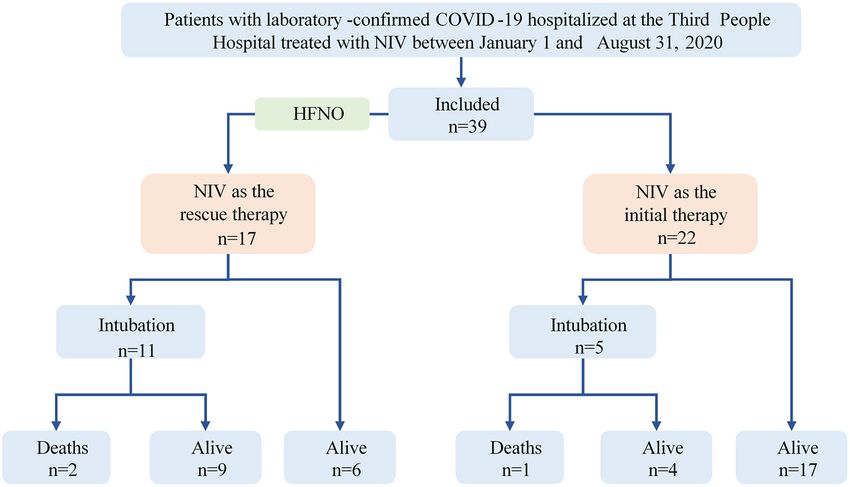
Medical resources have been in short supply owing to the vast                        August 31, 2020, were included (Figure 1). All patients who
number of patients. Moreover, early intubation has inevitably led                    were treated with NIV during their hospital stay and were
to some complications in these patients (2).                                         identified from electronic medical records, were included. The
   Using noninvasive respiratory support to treat patients                           treatment regimen was in accordance with the Chinese COVID-
without intubation can save medical resources and reduce                             2019 treatment guidelines (12), and all patients have already been
the incidence of pain and complications (3–5). Noninvasive                           discharged from the hospital, except three deaths.
ventilation (NIV) has been used to alleviate hypoxemia and                               Demographic and clinical data and information on ventilatory
dyspnea in patients with COVID-19 during the pandemic                                settings and arterial blood gas samples were collected before
(6). However, using NIV to treat AHRF remains showing                                and 1–2 h after NIV initiation. Two clinicians independently
some discrepancies, probably due to the patient selection                            gathered demographic and clinical data from electronic medical
and NIV parameter settings (7, 8). For now, there is no                              records using standardized data collection forms; any variances
unified consensus on the application of NIV in patients                              or discrepancies were discussed, and a third clinician moderated
with COVID-19-related AHRF; most of the consensus are                                and adjudicated the validity of disputed data.
based on previous experience in the treatment of viral                                   NIV as the initial treatment was defined as using NIV as the
pneumonia (9, 10). Medical staff tend to base their choice                           first choice to correct hypoxemia after using conventional oxygen
on personal preference or experience because there is no                             therapy. NIV as the rescue therapy was defined as using NIV to
evidence-based recommendation for the NIV selection                                  treat patients with AHRF in whom treatment with HFNO had
(6, 11). In addition, some staff tend to use NIV as the                              failed. The criteria for intubation included the signs of persisting
rescue therapy after conventional oxygen therapy or high-                            or worsening respiratory failure, hemodynamic instability, or
flow nasal oxygen therapy (HFNO) had failed, which might                             consciousness deterioration (12). The primary outcome of the
delay the escalation of respiratory support and lead to the                          study was to identify early factors associated with intubation,
adverse outcomes.                                                                    whereas secondary outcomes included hospitalization duration
   Therefore, in this retrospective cohort study, we aimed to                        and all-cause mortality during hospitalization.
identify early factors associated with intubation to help the                            SPSS version 19.0 (IBM SPSS Statistics, Armonk, NY,
medical staff select appropriate patients for receiving NIV                          USA) was used for data analysis. Data were presented as
treatment and avoid delayed intubation.                                              median (interquartile range [IQR]), or number (percentage)

  FIGURE 1 | Flowchart of the study. COVID-19, coronavirus disease 2019; NIV, noninvasive ventilation; HFNO, high-flow nasal oxygen therapy.

Frontiers in Medicine | www.frontiersin.org                                      2                                              May 2021 | Volume 8 | Article 638201
Fu et al.                                                                                                                            NIV in Patients With COVID-19-Related AHRF

as appropriate. For continuous variables, comparisons were                                     < 0.05 was considered significant. The ethics committee of the
performed using Student’s t-test for normally distributed data                                 Third People’s Hospital approved this study, and the trial was
and nonparametric test for non-normally distributed data. For                                  registered with www.chictr.org.cn (ChiCTR2000039567).
categorical variables, Pearson’s chi-square test or Fisher’s exact
test was used. Factors associated with intubation were assessed via
backward multivariate logistic regression analyses. The Kaplan–                                RESULTS
Meier method was used to evaluate the 28th day intubation rate
from hospital admission and symptom onset, and between-group                                   In total, among 423 hospitalized patients with COVID-19 in
differences were estimated using the log-rank test. A two-tailed P                             Shenzhen, 39 patients with COVID-19 (9%) who were treated

TABLE 1 | Comparison of baseline clinical characteristics, NIV therapy, and clinical outcomes in patients who required intubation or not intubation.

                                               Intubation (n = 16)         Nonintubation (n = 23)          Unadjusted p-value              OR (95% CI)            Adjusted p-value

Baseline clinical characteristics
Age, years                                       65.0 (58.5–69.0)              62.0 (59.5–65.0)                     0.343
Male, n (%)                                          11 (68.8)                     15 (65.2)                        0.818
BMI, kg/m2                                       24.6 (21.7–26.2)              25.4 (22.8–27.1)                     0.394
White blood cell count, × 109 /L                   5.5 (4.1–6.9)                 4.3 (3.5–5.1)                      0.112
Lymphocyte count, × 109 /L                         1.0 (0.9–1.3)                 1.1 (0.8–1.4)                      0.746
Procalcitonin, ng/ml                             0.08 (0.06–0.11)              0.07 (0.05–0.10)                     0.563
D-dimer, µg/ml                                     0.7 (0.5–1.2)                 0.6 (0.4–0.8)                      0.107
Comorbidities
Chronic respiratory disease, n (%)                   2 (12.5)                        1 (4.3)                        0.557
Hypertension, n (%)                                  7 (43.8)                       7 (30.4)                        0.503
Chronic cardiovascular disease, n (%)                 3 (3.3)                        5 (4.7)                        0.820
Chronic kidney disease, n (%)                          0 (0)                         1 (4.3)                        0.398
Chronic hepatic disease, n (%)                        1 (6.3)                        1 (4.3)                        0.791
Diabetes, n (%)                                      3 (18.8)                       4 (17.4)                        0.913
Cancer, n (%)                                         1 (6.3)                        1 (4.3)                        0.791
Clinical data before NIV therapy
Respiratory rate, breaths/min                    25.0 (24.8–26.5)              23.0 (22.0–28.5)                     0.159
Heart rate, breaths/min                          83.0 (77.0–88.0)              81.0 (74.0–89.0)                     0.938
pH                                               7.46 (7.45–7.48)              7.45 (7.43–7.47)                     0.534
PaO2 , mmHg                                      72.1 (64.6–78.8)              72.2 (63.5–80.5)                     0.855
PaO2 /FiO2 , mmHg                              144.1 (126.0–169.5)           180.0 (151.4–226.5)                    0.016
The time interval from symptom onset             10.5 (5.8–13.5)                11.0 (9.0–13.5)                     0.489
to initiating NIV, days
NIV as the rescue therapy, n (%)                     11 (68.8)                      6 (26.1)                        0.011                5.43 (1.09–27.12)               0.039
APACHE II                                        12.0 (10.8–13.5)               10.0 (8.5–12.0)                     0.094
Clinical data after 1–2 h NIV therapy
Respiratory rate, breaths/min                    24.0 (21.5–28.5)              22.0 (20.0–23.5)                     0.143
Heart rate, breaths/min                          78.0 (73.5–85.5)              78.0 (71.0–86.0)                     0.935
Pressure support, cmH2 O                           6.0 (6.0–6.3)                 7.0 (6.0–7.0)                      0.046
EPAP, cmH2 O                                       6.0 (6.0–6.3)                 6.0 (6.0–7.0)                      0.703
PaO2 , mmHg                                      87.2 (77.6–92.8)             110.0 (99.5–125.6)
Fu et al. NIV in Patients With COVID-19-Related AHRF
with NIV were included in the study; of them, 16 (41%) received (HFNO or NIV), the time interval from symptom onset to
endotracheal intubation, and 3 (8%) died. All patients received initiating noninvasive respiratory support (initial therapy: 10.0
bilevel ventilation. The median initial inspiratory positive airway [IQR, 8.3–13.0] days vs. rescue therapy: 10.0 [IQR, 5.0–11.0]
pressure and expiratory positive airway pressure were 13.0 (IQR, days, P = 0.307) and the in-hospital mortality (initial therapy:
12.0–14.0) cmH2 O and 6.0 (IQR, 6.0–6.5) cmH2 O, respectively, 4.5% vs. rescue therapy: 11.8%, P = 0.570) between patients who
with a median fractional inspired oxygen (FiO2 ) of 0.5 received NIV as initial therapy and those who received NIV as
(IQR, 0.4–0.5). rescue therapy; however, PaO2 /FiO2 was observed to be lower
There is no significant difference between intubated and non- before initiating NIV in the latter (144.2 [IQR, 119.6–175.5]
intubated patients in the baseline demographic, comorbidities, mmHg vs. 174.4 [IQR, 158.0–208.7] mmHg; P = 0.034) (Table 2).
severity blood markers (white blood cell count, lymphocyte
count, procalcitonin, d-dimer) and severity scores (APACHE II
score) (Table 1). Patients who required intubation had lower DISCUSSION
arterial oxygen partial pressure (PaO2 ) to FiO2 ratio (PaO2 /FiO2 )
before receiving NIV, higher proportion of using NIV as the Our findings indicate that in patients with COVID-19-related
rescue therapy, and longer hospitalization duration (Table 1). AHRF receiving NIV, a PaO2 /FiO2 of ≤200 mmHg after 1–2 h of
Significant differences were observed between intubated and NIV initiation and using NIV as the rescue therapy are associated
non-intubated patients in PaO2 /FiO2 before NIV initiation with a higher risk of intubation.
(144.1 [IQR, 126.0–169.5] mmHg vs. 180.0 [IQR, 151.4–226.5] Recently, Franco et al. (13) performed a multicentered,
mmHg; P = 0.016), hospitalization duration (46.0 [IQR, 35.0– retrospective study to analyze the feasibility and efficacy of using
52.5] days vs. 34.0 [IQR, 28.0–40.0] days; P = 0.007), NIV as noninvasive respiratory support in patients with COVID-19-
the rescue therapy (68.8 vs. 26.1%; P = 0.011), PaO2 /FiO2 of related AHRF outside ICU. All patients only used one form of
≤200 mmHg after 1–2 h of NIV initiation (68.8 vs. 17.4%; P = noninvasive respiratory support (NIV/CPAP or HFNO) during
0.002), and the pressure support level (6.0 [IQR, 6.0–6.3] cmH2 O the hospitalization. The results found that the 30-day mortality,
vs. 7.0 [IQR, 6.0–7.0] cmH2 O; P = 0.046). Furthermore, a trend intubation rate and length of hospitalization were similar among
of higher in-hospital mortality was observed in the intubated different noninvasive respiratory support methods, but HFNO
patients (18.8 vs. 0%; P = 0.061). Multivariate logistic regression was usually used for patients with mild COVID-19 in their
analysis showed that 1–2 h after NIV initiation, a PaO2 /FiO2 of clinical practice. Similar to Franco’s study, we also tended to use
≤200 mmHg (odds ratio [OR], 9.35; 95% confidence interval HFNO in mild patients, but patients in our study would receive
[CI], 1.84–47.62; P = 0.007) and NIV as the rescue therapy (OR, NIV as the rescue therapy when HFNO failed to improve the
5.43; 95% CI, 1.09–27.12; P = 0.039) were the risk factors for clinical status of patients. Actually, some medical staff in China
intubation (Table 1). and some consensus tended to choose HFNO as the first choice,
In the subgroup analysis of NIV as the rescue therapy, the especially during the early pandemic, because it is easy to use
medium time of using HFNO before NIV was 2 (IQR, 0.4–3.0) and has good tolerance (14). In cases where severe respiratory
days, and the intubation rate at day 28 from hospital admission distress or hypoxemia could not be relieved via HFNO, NIV
was much higher when comparing with NIV as the initial therapy was used as the rescue therapy. Subsequently, the treatment
(64.7 vs. 22.7%; P = 0.007; Figure 2), as well as the intubation failure may be related to the delayed use of NIV when using
rate from symptom onset (P = 0.005; Table 2). Furthermore, it as the rescue therapy, leading to a low PaO2 /FiO2 before
hospitalization duration was longer when NIV was used as the NIV initiation (Table 2). The rate of NIV treatment failure in
rescue therapy (42.0 [IQR, 31.5–52.5] days vs. 34.5 [IQR, 26.6– our study population was comparable to those reported in two
42.4] days; P = 0.005). There was no difference in clinical previous observational studies (41.0 vs. 44.6 vs. 49.3%) (13, 15).
characteristics before initiating noninvasive respiratory support However, on excluding the patients using NIV as the rescue
therapy in our study, the failure rate would be much lower (rescue
therapy: 64.7% vs. initial therapy: 22.7%). It might imply that
when using HFNO as the initial treatment for mild COVID-
19 patients, patients should be closely monitored in order to
avoid the delayed escalation of respiratory support. In addition,
our team proposed that when considering treatment rationale,
adjustable pressure, oxygen consumption, and tolerance, NIV
should be considered as the first-line therapy to treat patients
with mild acute respiratory distress syndrome (ARDS) (6).
Furthermore, in line with Frat’s findings that 1 h after NIV
initiation, a PaO2 /FiO2 of ≤200 mmHg and a tidal volume
of >9 mL/kg of predicted body weight are the independent
predictors of intubation among patients with AHRF, we found
that after initiating NIV therapy, a PaO2 /FiO2 of ≤200 mmHg
FIGURE 2 | Kaplan–Meier survival curve of the intubation rate at day 28 after
is an essential predictor of intubation in patients (16). We
admission. NIV, noninvasive ventilation.
could not record the expired tidal volume because of the
Frontiers in Medicine | www.frontiersin.org 4 May 2021 | Volume 8 | Article 638201Fu et al. NIV in Patients With COVID-19-Related AHRF
TABLE 2 | Comparison of baseline clinical characteristics and outcomes in patients who used NIV as initial or rescue therapy.
NIV as initial therapy NIV as rescue therapy p-value
(n = 22) (n = 17)
Age, years 62.5 (59.3–69.0) 62.0 (59.0–66.0) 0.944
Male, n (%) 12 (54.5) 14 (82.4) 0.093
BMI, kg/m2 24.8 (22.0–27.4) 24.8 (22.9–26.6) 0.726
The time interval from symptom onset to initiating noninvasive respiratory support, days 10.0 (8.3–13.0) 10.0 (5.0–11.0) 0.307
The time interval from initiating HFNO to using NIV therapy, days – 2 (0.4–3.0) N.A.
Comorbidities
Chronic respiratory disease, n (%) 0 (0) 3 (17.6) 0.074
Hypertension, n (%) 7 (31.8) 7 (41.2) 0.738
Chronic cardiovascular disease, n (%) 4 (18.2) 4 (23.5) 0.709
Chronic kidney disease, n (%) 0 (0) 1 (5.9) 0.436
Chronic hepatic disease, n (%) 1 (4.5) 1 (5.9) 0.851
Diabetes, n (%) 4 (18.2) 3 (17.6) 0.966
Cancer, n (%) 1 (4.5) 1 (5.9) 0.851
Clinical data before noninvasive respiratory support*
Respiratory rate, breaths/min 24.5 (23.0–27.5) 22.0 (20.0–25.0) 0.076
Heart rate, breaths/min 85.0 (75.3–88.8) 82.0 (80.0–89.0) 0.893
pH 7.46 (7.43–7.48) 7.46 (7.45–7.47) 0.928
PaO2 , mmHg 72.3 (61.1–79.2) 73.0 (61.5–73.8) 0.872
PaO2 /FiO2 , mmHg 174.4 (158.0–208.7) 179.27 (165.9–224.1) 0.468
Clinical data before NIV therapy
Respiratory rate, breaths/min 24.5 (23.0–27.5) 25.0 (23.0–29.0) 0.410
Heart rate, breaths/min 85.0 (75.3–88.8) 78.0 (74.0–87.0) 0.319
pH 7.46 (7.43–7.48) 7.45 (7.43–7.47) 0.317
PaO2 , mmHg 72.3 (61.1–79.2) 72.0 (65.3–81.0) 0.664
PaO2 /FiO2 , mmHg 174.4 (158.0–208.7) 144.2 (119.6–175.5) 0.034
Clinical outcomes
Intubation, n (%) 5 (22.7) 11 (64.7) 0.007+
0.005#
Hospitalization duration, days 35.0 (29.0–41.0) 42.0 (33.0–52.0) 0.005
In-hospital mortality, n (%) 1 (4.5) 2 (11.8) 0.570
Data represent as median (interquartile range) or n (%); HFNO, high-flow nasal oxygen therapy; NIV, noninvasive ventilation; PaO2 , arterial oxygen partial pressure; FiO2 , fractional
inspired oxygen; N.A., Not applicable.
*Noninvasive respiratory support refers to the HFNO or NIV; + intubation rate from hospital admission; # intubation rate from symptom onset.
emergency situation during the pandemic and the retrospective noninvasive respiratory support (20). However, there is no
nature of the study. However, studies have pointed that the direct evidence indicating an increased risk of infection
pathophysiological characteristics of some patients with COVID- among medical workers while using NIV, and none of the
19 who are diagnosed with ARDS according to the Berlin medical staff was infected during NIV procedures performed
definition are not entirely consistent with those of patients with under adequate protection in our study (20, 21). In future
typical ARDS, presenting with the mismatch of severe hypoxia studies, further exploration will be needed regarding (1)
and relatively good respiratory compliance (17). Therefore, the relationship between the use of NIV and the amount
whether the targeted tidal volume of patients with COVID- of virus dissemination and (2) the relationship between
19-related early ARDS receiving NIV may be higher, especially viral pathogenicity and the dilution effect of the increased
among those with hypercapnia, would need more evidence in ventilation volume.
further studies (18). The prone position could improve oxygenation by recruiting
Whether NIV treatment would increase the risk of the collapsed region of the dorsal lung and promoting drainage of
viral transmission among medical staff has always been a airway secretions in AHRF patients (22, 23). Recently, researchers
matter of concern and debate over the past few years (19). applied prone position NIV in patients with COVID-19-related
Previous studies have shown that the maximum distance AHRF and found that it could reduce respiratory rate, improve
of exhaled air dissemination will be increased when using oxygenation and comfort of patients (24). More evidence on
Frontiers in Medicine | www.frontiersin.org 5 May 2021 | Volume 8 | Article 638201Fu et al. NIV in Patients With COVID-19-Related AHRF
the benefits of the prone position NIV should be investigated DATA AVAILABILITY STATEMENT
by comparing with standard NIV and selecting the appropriate
patients are needed in the future. The raw data supporting the conclusions of this article will be
Obviously, our study has some limitations. First, some made available by the authors, without undue reservation.
clinical variables or ventilator parameters could not be analyzed
due to the retrospective study design. Moreover, this was a ETHICS STATEMENT
single center study with a small sample size, which could not
get adequate power to draw definitive conclusions. However, The studies involving human participants were reviewed and
this study included all patients with COVID-19-related AHRF approved by the ethics committee of the Third People’s Hospital.
receiving NIV in the city of Shenzhen (with 423 laboratory- Written informed consent for participation was not required for
confirmed cases on August 31, 2020), and these results this study in accordance with the national legislation and the
could provide some help for the medical staff to select institutional requirements.
appropriate patients receiving NIV treatment. In future, large-
scale prospective randomized control studies are warranted AUTHOR CONTRIBUTIONS
to give us more evidence for the use of NIV and further
studies should also explore the treatment effect of different LL, CQ, and RC contributed to determining the outline and
NIV modalities or interface in patients with COVID-19- content of the study. YF, LG, WW, and SZ contributed to
related AHRF. retrieving literature and writing a draft of this manuscript. JY, JW,
In conclusion, close attention should be paid to PaO2 /FiO2 ZL, and SZ contributed to the data acquisition, the interpretation
after 1–2 h of NIV initiation in patients with COVID-19-related of outcomes, and data analysis. All authors contributed to
AHRF receiving NIV. In addition, using NIV as rescue therapy revising the draft critically for important intellectual content,
should draw our awareness that it might delay escalation of providing final confirmation of the revised version, and being
respiratory support and lead to adverse outcomes. responsible for all aspects of the work.
REFERENCES 10. Winck JC, Ambrosino N. COVID-19 pandemic and non invasive respiratory
management: every Goliath needs a David. An evidence based evaluation of
1. Wang D, Hu B, Hu C, Zhu F, Liu X, Zhang J, et al. Clinical characteristics of problems. Pulmonology. (2020) 26:213–20. doi: 10.1016/j.pulmoe.2020.04.013
138 hospitalized patients with 2019 novel coronavirus-infected pneumonia in 11. Rochwerg B, Brochard L, Elliott MW, Hess D, Hill NS, Nava S,
Wuhan, China. Jama. (2020) 323:1061–9. doi: 10.1001/jama.2020.1585 et al. Official ERS/ATS clinical practice guidelines: noninvasive
2. Tobin MJ, Laghi F, Jubran A. Caution about early intubation and ventilation for acute respiratory failure. Eur Respir J. (2017)
mechanical ventilation in COVID-19. Ann Intensive Care. (2020) 50:1602426. doi: 10.1183/13993003.02426-2016
10:78. doi: 10.1186/s13613-020-00692-6 12. National Health Commission of the People’s Republic of China. Diagnosis
3. Crummy F, Naughton MT. Non-invasive positive pressure ventilation for and Treatment Guideline of COVID-2019, 8th edn. Available online at: http://
acute respiratory failure: justified or just hot air? Intern Med J. (2007) 37:112– www.nhc.gov.cn/yzygj/s7653p/202008/0a7bdf12bd4b46e5bd28ca7f9a7f5e5a.
8. doi: 10.1111/j.1445-5994.2007.01268.x shtml (accessed November 10, 2020).
4. Nicolini A, Stieglitz S, Bou-Khalil P, Esquinas A. Cost-utility of non- 13. Franco C, Facciolongo N, Tonelli R, Dongilli R, Vianello A, Pisani L,
invasive mechanical ventilation: analysis and implications in acute et al. Feasibility and clinical impact of out-of-ICU noninvasive respiratory
respiratory failure. A brief narrative review. Respir Investig. (2018) support in patients with COVID-19-related pneumonia. Eur Respir J. (2020)
56:207–13. doi: 10.1016/j.resinv.2017.12.011 56:2002130. doi: 10.1183/13993003.02130-2020
5. Jahagirdar D, Picheca L. Heated Humidified High Flow Oxygen for Respiratory 14. Frat JP, Coudroy R, Thille AW. Non-invasive ventilation or high-flow oxygen
Support: A Review of Clinical Effectiveness, Cost-Effectiveness, and Guidelines. therapy: when to choose one over the other? Respirology. (2019) 24:724–
CADTH Rapid Response Reports, Ottawa, ON (2019). 31. doi: 10.1111/resp.13435
6. Guan L, Zhou L, Le Grange JM, Zheng Z, Chen R. Non-invasive 15. Aliberti S, Radovanovic D, Billi F, Sotgiu G, Costanzo M, Pilocane
ventilation in the treatment of early hypoxemic respiratory failure caused T, et al. Helmet CPAP treatment in patients with COVID-19
by COVID-19: considering nasal CPAP as the first choice. Crit Care. (2020) pneumonia: a multicentre cohort study. Eur Respir J. (2020)
24:333. doi: 10.1186/s13054-020-03054-7 56:2001935. doi: 10.1183/13993003.01935-2020
7. Ferreyro BL, Angriman F, Munshi L, Del Sorbo L, Ferguson ND, 16. Frat JP, Ragot S, Coudroy R, Constantin JM, Girault C, Prat G, et al. Predictors
Rochwerg B, et al. Association of noninvasive oxygenation strategies of intubation in patients with acute hypoxemic respiratory failure treated
with all-cause mortality in adults with acute hypoxemic respiratory with a noninvasive oxygenation strategy. Crit Care Med. (2018) 46:208–
failure: a systematic review and meta-analysis. JAMA. (2020) 324:57– 15. doi: 10.1097/CCM.0000000000002818
67. doi: 10.1001/jama.2020.9524 17. Chiumello D, Busana M, Coppola S, Romitti F, Formenti P, Bonifazi M,
8. Ni YN, Luo J, Yu H, Liu D, Ni Z, Cheng J, et al. Can high-flow nasal et al. Physiological and quantitative CT-scan characterization of COVID-
cannula reduce the rate of endotracheal intubation in adult patients with 19 and typical ARDS: a matched cohort study. Intensive Care Med. (2020)
acute respiratory failure compared with conventional oxygen therapy and 46:2187–96. doi: 10.1007/s00134-020-06281-2
noninvasive positive pressure ventilation?: a systematic review and meta- 18. Gattinoni L, Chiumello D, Caironi P, Busana M, Romitti F,
analysis. Chest. (2017) 151:764–75. doi: 10.1016/j.chest.2017.01.004 Brazzi L, et al. COVID-19 pneumonia: different respiratory
9. Raoof S, Nava S, Carpati C, Hill NS. High-flow, noninvasive treatments for different phenotypes? Intensive Care Med. (2020)
ventilation and awake (nonintubation) proning in patients with 46:1099–102. doi: 10.1007/s00134-020-06033-2
coronavirus disease 2019 with respiratory failure. Chest. (2020) 19. Guan L, Zhou L, Zhang J, Peng W, Chen R. More awareness is needed for
158:1992–2002. doi: 10.1016/j.chest.2020.07.013 severe acute respiratory syndrome coronavirus 2019 transmission through
Frontiers in Medicine | www.frontiersin.org 6 May 2021 | Volume 8 | Article 638201Fu et al. NIV in Patients With COVID-19-Related AHRF
exhaled air during non-invasive respiratory support: experience from China. 24. Sartini C, Tresoldi M, Scarpellini P, Tettamanti A, Carco F, Landoni
Eur Respir J. (2020) 55:2000352. doi: 10.1183/13993003.00352-2020 G, et al. Respiratory parameters in patients with COVID-19 after
20. Ferioli M, Cisternino C, Leo V, Pisani L, Palange P, Nava S. Protecting using noninvasive ventilation in the prone position outside the
healthcare workers from SARS-CoV-2 infection: practical indications. Eur intensive care unit. JAMA. (2020) 323:2338–40. doi: 10.1001/jama.
Respir Rev. (2020) 29:200068. doi: 10.1183/16000617.0068-2020 2020.7861
21. Esquinas AM, Egbert Pravinkumar S, Scala R, Gay P, Soroksky
A, Girault C, et al. Noninvasive mechanical ventilation in high- Conflict of Interest: The authors declare that the research was conducted in the
risk pulmonary infections: a clinical review. Eur Respir Rev. (2014) absence of any commercial or financial relationships that could be construed as a
23:427–38. doi: 10.1183/09059180.00009413 potential conflict of interest.
22. Guerin C, Reignier J, Richard JC, Beuret P, Gacouin A, Boulain T, et al. Prone
positioning in severe acute respiratory distress syndrome. N Engl J Med. (2013) Copyright © 2021 Fu, Guan, Wu, Yuan, Zha, Wen, Lin, Qiu, Chen and Liu. This
368:2159–68. doi: 10.1056/NEJMoa1214103 is an open-access article distributed under the terms of the Creative Commons
23. Coppo A, Bellani G, Winterton D, Di Pierro M, Soria A, Faverio Attribution License (CC BY). The use, distribution or reproduction in other forums
P, et al. Feasibility and physiological effects of prone positioning in is permitted, provided the original author(s) and the copyright owner(s) are credited
non-intubated patients with acute respiratory failure due to COVID-19 and that the original publication in this journal is cited, in accordance with accepted
(PRON-COVID): a prospective cohort study. Lancet Respir Med. (2020) academic practice. No use, distribution or reproduction is permitted which does not
8:765–74. doi: 10.1016/S2213-2600(20)30268-X comply with these terms.
Frontiers in Medicine | www.frontiersin.org 7 May 2021 | Volume 8 | Article 638201You can also read


