Nursing Strategy 2017-2020 - HEALTH PEI - Government of ...
←
→
Page content transcription
If your browser does not render page correctly, please read the page content below

HEALTH PEI

Nursing Strategy
                  2017-2020
Nurses Transforming Health Care
Prepared by:                                           Telephone:
Nursing, Allied Health and Patient Experience       (902) 368-6130

Published by:                                                  Fax:
Health PEI                                          (902) 368-4969
PO Box 2000
Charlottetown, PE                                             Mail:
Canada C1A 7N8                                           Health PEI
                                                 16 Garfield Street
April 2017                                            PO Box 2000
                                                 Charlottetown, PE
Printing:                                                 C1A 7N8
Document Publishing Centre
                                                            Email:
Available online at:                            healthpei@gov.pe.ca
www.healthpei.ca
                                                            Web:
Printed in Prince Edward Island                   www.healthpei.ca

                                                          Twitter:
                                                       @Health_PEI
HEALTH PEI

                 Nursing Strategy
                                                              2017-2020

		CONTENTS
 1    Message from the Chief of Nursing, Allied Health and Patient Experience

 2    Introduction

 4    Nursing Strategy Framework

 5    Pillar 1 – Workforce Capacity

 7    Pillar 2 – Engagement and Leadership in Nursing

 8    Pillar 3 – Professional Practice

 10   Pillar 4 – Innovation

 11   Definition of Terms

 13   References

 15   Appendices
		        Appendix A – Nursing Strategy Steering Committee Members and Stakeholder Groups
		        Appendix B – Nursing Strategy Strategic Priorities and Objectives: Timeline
Message from the Chief
                                       of Nursing, Allied Health and
                                       Patient Experience
                                       Nurses form the largest workforce within our health care system and, as such, play an
                                       instrumental role in defining the care and services provided to Islanders every day. It
                                       is my pleasure to introduce the inaugural multi-year nursing strategy for Health PEI.

                                       Health PEI Nursing Strategy: 2017-2020 is the result of a significant collaborative effort
                                       among nursing leadership from different organizations across our province, including
                                       valuable input from front line nursing staff and other key stakeholders. More impor-
                                       tantly, it represents an opportunity to transform the health care system, together.

                                       This three-year nursing strategy will enable and enhance the contribution of nursing
                                       as Health PEI continues to focus on improving the overall care of Islanders. The
                                       strategy will ensure nurses are delivering the right care, in the right place, by the right
                                       provider, while taking into consideration current nursing positions and the future
     Marion Dowling, RN, MScN          direction of the profession. Finally, the strategy builds upon the ways in which nurses
    Chief of Nursing, Allied Health    are committed to achieving an improved patient and family/caregiver experience by
       and Patient Experience          seeking their input and providing quality patient care that is safe, effective and
                                       efficient.

                                       It is an exciting and challenging time to be part of the caring professions in our
                                       province. Nurses play an essential role in contributing to the patient and family/care-
                                       giver journey and are central to the services Health PEI offers. This strategy supports
                                       the approach identified in Health PEI’s Human Resource Strategic Plan (2016-19). It also
                                       reflects nursing’s commitment, passion and pride to continually improve the care for
                                       patients using evidence and knowledge to change practice.

                                       My predecessor and former Chief Nursing Officer for Health PEI, Brenda Worth,
                                       initiated the development of the nursing strategy. I wish to thank her for all her
                                       dedication and hard work that has led to this final product. As nurses, we have all
                                       benefitted from her leadership and direction as we focused our efforts on creating a
                                       meaningful and impactful nursing strategy for Health PEI.

                                       I am pleased to present this strategy and look forward to seeing the impact on
                                       outcomes for patients, their families and caregivers, as well as on nurses and the
                                       health care teams they work as part of and lead.

                                       Marion Dowling, RN, MScN
                                       Chief of Nursing, Allied Health and Patient Experience

1      H E A LT H P E I N u r s i n g S t r a t e g y 2 0 1 7 - 2 0 2 0
Introduction
The Health PEI Nursing Strategy: 2017-2020 outlines the direction for nursing within Prince Edward Island’s
publically-funded health care system. This multi-year document will serve as a guide post for maintaining and
advancing the nursing profession now and for years to come, ensuring a strong, dedicated workforce to serve the
population of PEI.

The vision for the nursing strategy is “Nurses Transforming Health Care”. Guiding the work to be undertaken in the
strategy is the philosophy of person-centered, interprofessional and evidence-based care. Four strategic pillars with
corresponding priorities and objectives form the core of the strategy (Figure 1).

FIGURE 1 | FOUR STRATEGIC PILLARS

Over the next three years, the nursing strategy will be overseen through the work of the Provincial Nursing
Leadership Committee. The committee will collaborate with nursing leaders, other health care providers, patients,
family/caregiver representatives, professional organizations, unions, educational institutions and members of
Health PEI’s Senior Management Group to achieve the priorities and objectives outlined in this nursing strategy.
Details of the strategic pillars are provided in Appendix B.

                                                             nurse
                                                             For the purpose of this document the term nurse refers
                                                             to regulated nurses:
                                                             Nurse Practitioner (NP), Registered Nurse (RN) and
                                                             Licensed Practical Nurse (LPN).

                                                            H E A LT H P E I N u r s i n g S t r a t e g y 2 0 1 7 - 2 0 2 0   2
STRATEGY DEVELOPMENT
    In December 2015, the Nursing Strategy Steering Committee was formed to oversee the development of a multi-
    year nursing strategy for Health PEI. A broad, yet focused, effort was undertaken to hear from nurses, other health
    care providers and stakeholders to inform the committee developing the nursing strategy. The steering committee
    developed an electronic nursing survey that was distributed to all Health PEI nurses.

    Nursing Strategy Steering Committee members also met with internal and external stakeholder groups to receive
    input on the future direction for nursing (See Appendix A). Information from the stakeholder groups and the
    nursing survey was analysed, grouped by themes and incorporated into the priorities and objectives for the Nursing
    Strategy. The number of survey participants ensured the overall results of the survey were representative of the
    nursing population as a whole. (See Appendix A for the Nursing Strategy Steering Committee Members and
    Nursing Strategy Stakeholder Groups.) A literature review was completed to support the priorities identified.

    In presenting this nursing strategy, the Nursing Strategy Steering Committee reported to the Provincial Nursing
    Leadership Committee and obtained approval from Health PEI Senior Management Group, as well as the
    Department of Health and Wellness.

3      H E A LT H P E I N u r s i n g S t r a t e g y 2 0 1 7 - 2 0 2 0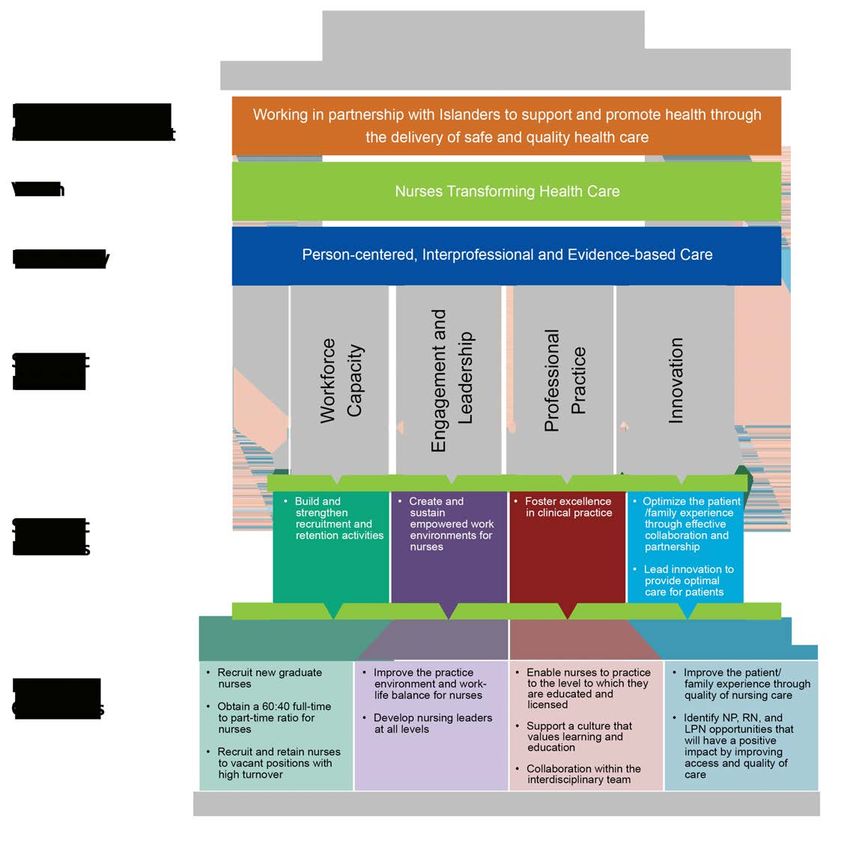
Nursing Strategy Framework
FIGURE 2 | HEALTH PEI NURSING STRATEGY FRAMEWORK

                                               H E A LT H P E I N u r s i n g S t r a t e g y 2 0 1 7 - 2 0 2 0   4
Pillar 1 | Workforce Capacity
The focus of this pillar is to build and strengthen recruitment and retention activities. In order to maintain and
provide optimal patient care to Islanders, it is important to have an adequate number and mix of nurses.
HEALTH PEI NURSING PROFILE
18 1,353 528
NPs RNs LPNs
Recruitment and retention of new graduate nurses and nurses to
vacant and high turnover positions
• Retention challenges have been documented such that the percentage of
Strategic Priority 1 new graduates who leave nursing after one year ranges from 33 to 61%
Build and strengthen retention and (Boychuk Duchscher, 2009).
recruitment activities
• To support new graduates, several studies have found that effective
Objectives mentorship programs enhance recruitment and retention of graduate nurses
Recruit new graduate and facilitate the transition from student to professional nurse (Boychuk
nurses Duchscher, 2009; DeSilva, 2009; Dyess, 2009; Ferguson, 2010; Fox, 2010).
Obtain a 60:40 full-time to
part-time ratio for nurses • A 2015 survey of University of Prince Edward Island 4th year nursing students
indicated that 75% of respondents prefer to have full-time employment upon
Recruit and retain graduation (Gilman, 2015).
nurses to vacant
positions and positions with • In 2014, the number of regulated nurses leaving the profession was greater
high turnover
than those entering, however recent data indicates that this trend had
Nurses can improve patient care reversed in 2015 (CIHI, 2015, 2016).
by collaborating with other members
of the health care team, and working • PEI data indicates that retirement, for both registered nurses and licensed
together
practical nurses was the main reason for nurses leaving the workforce in 2014
– nursing survey respondent (Gilman, 2015). The same study predicts attrition rates for nursing by 2019 of
>10% for RNs and >7% for LPNs.
• High turnover rates are associated with decreased job satisfaction and an
increase in overtime hours.
5 H E A LT H P E I N u r s i n g S t r a t e g y 2 0 1 7 - 2 0 2 0
Key Actions
      •   Recruiting and retaining nurses will be achieved by continuing to partner with the Department of Health
          and Wellness on the evaluation and design of current and new recruitment and retention activities.

      •   Health PEI will also continue to collaborate with PEI’s educational institutions to ensure there is an
          adequate supply of nurses graduating each year.

      •   The monitoring and promotion of the new Graduate Mentorship Program, designed to support new
          graduates in their successful transition to practice, is one of the initiatives in this nursing strategy.

      •   A new Nurse Graduate Employment Guarantee Program has been developed as a result of student feedback
          and existing challenges with staffing. This program will be implemented and monitored. There is also
          continuing support for the current Baccalaureate in Nursing Sponsorship Program.

      •   Nursing turnover rates will continue to be monitored as ongoing planning and evaluations are being
          conducted for the future nursing workforce.

      •   Strategies and practices will be identified to retain present staff through collaboration with unions,
          educational institutions, and various other stakeholders.

Full-time to part-time ratio
  •   Increasing the percentage of full-time to part-time nursing ratio is believed to improve continuity of care
      for patients and patient outcomes (Registered Nurses Association of Ontario, (RNAO), 2005).

  •   Excessive use of part-time and casual employment for RNs is associated with decreased morale,
      disengagement among nurses (RNAO, 2013) and an unstable workforce where nurses move to other
      jurisdictions to find full-time work (Hall et al., 2009).

  Key Action
      •   The Nursing Strategy will seek opportunities to increase the percentage of full-time to part-time
          nursing positions to a ratio of 60:40 from the current 51:49.

                                                            H E A LT H P E I N u r s i n g S t r a t e g y 2 0 1 7 - 2 0 2 0   6
Pillar 2 | Engagement and
Leadership in Nursing
The focus of this pillar is to create and sustain an empowered work environment for nurses.
Improve the practice environment and work-life balance for nurses
• Practice environments where nurses feel empowered and supported by strong nursing leadership provide
quality patient care with improved outcomes, and experience improved job satisfaction resulting in lower
vacancy and turnover rate. (Cook, Hiroz, & Mildon, 2006 and American Nurses Credentialing Centre, 2016).
• Stakeholder feedback provided for this nursing strategy emphasized the importance of work-life balance
for nurses. Nurse satisfaction, patient outcomes and system outcomes improve when nurses rate their work
environment positively (Aiken et al., 2011).
Key Actions
• Research and develop strategies aimed at improving a healthy work environment and implementing
nurse-led work place improvements.
• Research, design and implement opportunities to improve work-life balance and communication in
partnership with nursing unions.
Develop nursing leaders at all levels
• Positive nursing work environments that allow nurses to provide leadership
Strategic Priority 2 at the point-of-care have been linked to increased nurse retention, safer
Create and sustain empowered work patient care and increased job satisfaction (RNAO, 2013).
environments for nurses
• Effective nursing leadership is linked to positive patient outcomes (RNAO,
Objectives 2013).
Improve the practice
environment and Key Actions
work-life balance for nurses
• Leadership education, incorporation of the LEADS framework into
Develop nursing leaders at all performance development plans, nursing leadership education, and
levels continued partnerships with our professional nursing associations will
assist in the cultivation of nursing leaders.
Nurses can improve patient care
by providing and developing leadership • Development and implementation of a front line nursing leadership
capacity at all levels of nursing
course in partnership between Health PEI and the Faculty of Nursing at
– nursing survey respondent
the University of Prince Edward Island. The commitment to nursing
leadership education and development is an integral and ongoing
component of our nursing strategy.
7 H E A LT H P E I N u r s i n g S t r a t e g y 2 0 1 7 - 2 0 2 0Pillar 3 | Professional Practice
The focus of this pillar is to foster excellence in clinical practice, with a focus on enabling nurses to practice to the
level to which they are educated and licensed.
Enable nurses to practice at the level to which they are educated and
licensed
• Nurses have the skills, knowledge, education and competency to deliver Strategic Priority 3
a wide variety of health care services. Health PEI nurses are committed to
providing high quality evidenced based nursing care to improve patient Foster excellence in clinical practice
outcomes and the patient, family/caregiver experience. Objectives
• Implementing best practice guidelines not only benefits patients and Enable nurses to practice at
the level to which they are
families, their adoption and implementation also provides quality patient educated and licensed
care and support interdisciplinary collaboration (Canadian Nurses
Association, 2011). Support a culture that values
learning and education
Key Actions Collaboration within the
• Opportunities for further implementation of best practices and interdisciplinary team
evidence based practices will be sought throughout the health care Nurses can improve patient care
system. by ensuring everyone works to full
scope with interdisciplinary and
• To move nursing services forward progressively, a legislative and policy leadership support
action plan will be initiated, including the identification of policy,
legislative and regulatory barriers. – nursing survey respondent
Support a culture that values learning and education
• Continuing education for nurses is essential in an ever-changing work environment and with advancements
in health care. Many nurses responding to the nursing survey indicated a need for additional education in
mental health to support the care that they provide throughout our health care system.
Key Action
• Supporting a culture of learning and education for nursing will be achieved by working with internal
and external partners to provide ongoing education.
H E A LT H P E I N u r s i n g S t r a t e g y 2 0 1 7 - 2 0 2 0 8Collaboration within the interdisciplinary team
• Nurses work as part of an interdisciplinary team when providing care to Islanders. Excellence in clinical
practice is achieved through successful collaboration with other health care providers as well as a work
environment that supports excellence (RNAO, 2004).
Key Actions
• Supporting and promoting initiatives to strengthen interdisciplinary team work through education and
orientation.
• Developing and delivering education programs for health care providers by streamlining partnerships
with interdisciplinary staff and Island educational institutions.
9 H E A LT H P E I N u r s i n g S t r a t e g y 2 0 1 7 - 2 0 2 0Pillar 4 | Innovation
The focus of the fourth and final pillar is to optimize the patient and family/caregiver experience through effective
collaboration and partnership and to lead innovations for optimal care of patients. Innovative approaches to care
can yield positive impacts for both patients and the health care system. Nurses are ideal health care providers to
care for the aging population and to continue to support the population with chronic diseases.
Improve patient, family/caregiver experience
• The nursing strategy promotes the adoption of Health PEI’s Patient and
Strategic Priority 4
Family Steering Committee vision “partnering with patients and families, we
are better together”. The Canadian Foundation for Healthcare Improvement Optimize the patient/family
(n.d.) states that “hearing the voices of patients, families and caregivers is experience through effective
essential to transforming health care”. collaboration and partnership
Objective
Key Action Improve the patient/family
• Optimizing the patient and family/caregiver experience will be achieved experience through quality
by promoting, supporting and leading quality initiatives, and through of nursing care
pursuing the inclusion of patients, families/caregivers when developing
or renewing initiatives directly impacting them in all areas of care.
Strategic Priority 5
Lead innovation to provide optimal care for Lead innovation to provide optimal
patients care for patients
Objective
• The implementation of expanded/advanced roles for nursing in Canada and
Identify NP, RN and LPN
globally is resulting in better care to the populations they serve. opportunities that will have a
positive impact by improving
• The percentage of seniors (aged 65 and over) in PEI was 16.3% compared to access and quality of care
14.8% nationally (Statistics Canada, 2011). Healthy aging and the
management of chronic disease aligns with the knowledge and practice of Nurses can improve patient care
nurses (National Expert Commission, 2012). by focusing on health promotion and
illness/disease prevention; and
improving communication with the
Key Action patient and their family in
• Working in collaboration with health care leaders, the nursing collaboration with other patient
community will seek innovative strategies for optimizing care (e.g., team members
improve access to care for key population groups, considering the social
determinants of health). – nursing survey respondent
H E A LT H P E I N u r s i n g S t r a t e g y 2 0 1 7 - 2 0 2 0 10Definition of Terms
Advanced Nursing Practice Magnet Recognition
An umbrella term describing an advanced level of An international organizational credential that
clinical nursing practice that maximizes the use of recognizes nursing excellence in health care
graduate educational preparation, in-depth nursing organizations. The Magnet Recognition Program is
knowledge and expertise in meeting the health needs based on research that demonstrates that creating a
of individuals, families, groups, communities and positive professional practice environment for nurses
populations. It involves analyzing and synthesizing leads to improved outcomes – for staff and for patients.
knowledge; understanding, interpreting and applying (American Nurses Credentialing Centre, 2016).
nursing theory and research; and developing and
advancing nursing knowledge and the profession as a Nurse
whole” (Canadian Nurses Association (CNA), 2008). The term nurse in this document refers to regulated
nurses: Nurse Practitioner (NP), Registered Nurse (RN)
Evidence-based care and Licensed Practical Nurse (LPN).
Involves applying the best available research results
(evidence) when making decisions about health care. Part-time
Care providers who apply an evidence-based approach Refers to regularly scheduled and working less than full
use research evidence along with clinical expertise and time hours as specified in the employment contract
patient preferences (Jacobs, Jones, Gabella, Spring, & (Registered Nurses of Ontario (RNAO), 2005, p.35).
Brownson, 2012).
Patient
Full-time A generic term used to describe any person receiving
Refers to regularly scheduled and working full-time health care services from Health PEI, and includes
hours as defined by the employment contract (e.g. 37.5 persons referred to as clients or residents (Health PEI,
hours per week) (Registered Nurses of Ontario (RNAO), 2015).
2005, p.35).
Person- and family-centered care
LEADS Framework Refers to care that meets the specific needs of the
A national leadership framework representing the key individual and their family, giving them the best
leadership competencies and capabilities that benefit a opportunity to lead the life that they want. A person-
leader’s capacity to lead at all levels of the organization. and family-centered approach recognizes that the
The acronym LEADS represents the five key domains of person is an equal partner in planning their care, and
leadership including; Leads self, Engage others, Achieve their choices are respected and personal values
results, Develop coalitions, and Systems transformation. recognized. Family can include anyone who provides
care and support (World Health Organization, 2016).
11 H E A LT H P E I N u r s i n g S t r a t e g y 2 0 1 7 - 2 0 2 0Provincial Nursing Leadership Committee Turnover
The purpose of the Provincial Nursing Leadership Defined as the process whereby nursing staff leave or
Committee (PNLC) is to provide strategic and transfer within the hospital environment (O’Brien-Pallas
operational direction and leadership to nursing and et al as cited by Kovner, Brewer, & Fatehi, 2014). For the
nursing services within Health PEI. The goal of the purpose of the Nursing Strategy, it is the process
PNLC is to standardize and advance the professional whereby nursing staff leave or transfer within health
practice of nursing in all practice contexts to enable care service areas.
quality nursing services to be delivered to the clients/
patients/residents of Prince Edward Island.
The scope of this committee relates to NPs, RNs, LPNs
and all other members of the nursing care team within
Health PEI.
Committee Membership
CHAIR
Chief of Nursing, Allied Health and Patient Experience
ACUTE CARE
2 Representatives (East and West, larger centre and
smaller centre represented)
LONG-TERM CARE
2 Representatives (East and West, larger centre and
smaller centre represented)
PRIMARY CARE
1 Representative
HOME CARE
1 Representative
PUBLIC HEALTH
1 Representative
MENTAL HEALTH AND ADDICTIONS
2 Representatives (inpatient and outpatient services)
AMBULATORY CARE, DIALYSIS AND CANCER CARE
1 Representative
DEPARTMENT OF HEALTH AND WELLNESS
Nursing Policy Analyst
The main committee resource is the Health PEI Nursing
Research Lead and one Administrative Assistant.
H E A LT H P E I N u r s i n g S t r a t e g y 2 0 1 7 - 2 0 2 0 12References
Aiken, L.H., Sloane, D.M., Clarke, S., Poghosyan, L., Cho, Canadian Nurses Association. (2011). Interprofessional
E., You, L., Finlayson, M., Kanai-Pak, M., & Aungsuroch, Y. collaboration statement. Retrieved from:
(2011). Importance of work environments on hospital https://www.cna-aiic.ca/~/media/cna/page-content/
outcomes in nine countries. International Journal for pdf-en/interproffessional-collaboration_position-
Quality in Health Care, 23(4), 359-364. statement.pdf?la=en
American Nurses Credentialing Centre. (2016). Cook, J., Hiroz, J., & Mildon, B. (2006). Strategies and
Magnet Recognition Program ® Overview. Retrieved outcomes associated with Magnet Hospitals Fact Sheet ll
from: http://www.nursecredentialing.org/Magnet/ of ll. Nursing Health Services Research Unit, a
International/MagnetProgOverview.Overview collaborative project of the University of Toronto faculty
of Nursing and McMaster University School of Nursing.
Boychuk Duchscher, J. (2009). Transition shock: the initial Retrieved from: http://www.nhsru.com/wp-content/
stage of role adaptation for newly graduated Registered uploads/2010/11/Magnet-factsheet-Part-II-of-II-
Nurses. Journal of Advanced Nursing. 65(5). 1103–1113. Strategies.FINAL1_.pdf
doi: 10.1111/j.1365-2648.2008.04898.x
DeSilva, B. (2009). Mentoring program enhances CM
Canadian Foundation for Healthcare Improvement. (n.d.) training. Health Care Benchmarks and Quality
Ingredients for successful patient engagement: Ready, Improvement. 16(9), 99-102. Retrieved from:
set, engage: Preparing for engagement. Retrieved from: http://www.henryfordconnect.com/documents/Sladen
http://www.cfhi-fcass.ca/Libraries/Collaborations/PEP_ Library/HBQI-September2009.pdf
Brief_Readiness_EN.sflb.ashx.
Duchscher, J. E. B. (2009). Transition shock: the initial
Canadian Institute for Health Information. (2015). stage of role adaptation for newly graduated Registered
Regulated Nurses Report, 2014. Retrieved from: Nurses, Journal of Advanced Nursing, 65 (5) 1103–1113.
https://secure.cihi.ca/estore/productFamily.htm?
locale=en&pf=PFC2898&lang=en Dyess, S. (2009). The first year of practice: new
graduate nurses’ transition and learning needs. The
Canadian Institute for Health Information. (2016). Journal of Continuing Education, 40 (9), 403-410.
Regulated Nurses Report, 2015. Retrieved from: doi:10.3928/00220124-20090824-03.
https://secure.cihi.ca/estore/productFamily.htm?
locale=en&pf=PFC3152 Ferguson, L.M. (2010).From the perspective of new
nurses: What do effective mentors look like in practice?
Canadian Nurses Association. (2008). Advanced Nursing Nurse Education in Practice, 11, 119-123. doi:1016/j.
Practice: A National Framework. Retrieved from: nepr.2010.11.003.
https://www.cna-aiic.ca/~/media/cna/page-content/
pdf-en/anp_national_framework_e.pdf Fox, K.C. (2010). Mentor program boosts new
nurses’ satisfaction and lowers turnover rate. The
Canadian Nurses Association (2009). Fact Sheet. Nurses Journal of Continuing Education in Nursing, 4(1), 311-316.
Offer Solutions for Cost-effective Health Care. Retrieved 10.3928/00220124-20100401-04.
from: https://www.cna-aiic.ca/~/media/cna/page-
content/pdf-en/roi_solutions_cost_fs_e.pdf?la=en
13 H E A LT H P E I N u r s i n g S t r a t e g y 2 0 1 7 - 2 0 2 0Gilman, J.G. (2015). Recruitment and Retention Registered Nurses Association of Ontario. (2005). The
Secretariat Presentation. PEI Department of Health and 70 per cent solution: A progress report on increasing
Wellness. Gilman, J.G. (2015). Results Nursing Students’ full-time employment for Ontario RNs. Retrieved from:
Survey. Recruitment and Retention Secretariat. PEI http://rnao.ca/sites/rnao-ca/files/1146_70_Percent_
Department of Health and Wellness. Solution.pdf
Hall, L., Pink, G., Jones, C., Leatt, P., Gates, M., & Registered Nurses Association of Ontario. (2013-
Peterson, J. (2009). Is the grass any greener? Canada to January) Nursing Care: RNAO’s Policy Platform
United States of America nurse migration. International Backgrounder. Retrieved from http://rnao.ca/sites/
Nursing Review, 56(2), 198-205. doi:10.1111/j.1466- rnao-ca/files/Nursing_Care_RNAO_2013.pdf
7657.2008.00706.x
Registered Nurses Association of Ontario. (2013-July).
Health PEI. 2015. Guide for Common Language Use: Developing and Sustaining Nursing Leadership Best
Definitions. Practice Guideline, Second Edition.
Jacobs, J., Jones, E., Gabella, B., Spring, B., & Brownson, Statistics Canada (2011). Statistics Canada, censuses of
R. (2012). Tools for implementing an evidence-based population, 2006 and 2011. Retrieved from:
approach in public health practice. Preventing Chronic https://www12.statcan.gc.ca/census-recensement/2011/
Disease, 12(9). as-sa/98-311-x/2011001/fig/fig7-eng.cfm
Kovner. T., Brewer, C. S., Fatehi, F., & Jun, J. (2014). What World Health Organisation. (2016). Framework on
does nurse turnover rate mean and what is the rate?. integrated, people-centred health services: report by
Policy, Politics, & Nursing Practice, 15(3-4), 64-71. doi: the Secretariat. Retrieved from: http://www.who.int/
10.1177/1527154414547953. servicedeliverysafety/areas/people-centred-care/
ipchs-what/en/
National Expert Commission. (2012). A nursing call to
action. The health of our nation, the future of our health
system. Retrieved from: https://www.cna-aiic.ca/~/
media/cna/files/en/nec_report_e.pdf?la=en
H E A LT H P E I N u r s i n g S t r a t e g y 2 0 1 7 - 2 0 2 0 14Appendix A
NURSING STRATEGY STEERING COMMITTEE MEMBERS
MARION DOWLING DR. JO-ANN MACDONALD
Chief of Nursing, Allied Health & Patient Experience, Associate Professor, UPEI School of Nursing
Health PEI – Chair
MARNEY MACKINNON
BRENDA WORTH Recruitment & Retention Secretariat, Department of
Chief Nursing Officer & Executive Director of Laboratory Health and Wellness
Services, Health PEI – Past Chair
DAWN RIX-MOORE
MARILYN BARRETT Acting Executive Director, PEI Licensed Practical Nurses
Director of Primary Care Networks & Chronic Disease, Registration Board
Health PEI
DENISE PROUD
CYNTHIA BRYANTON Learning Manager, Holland College Practical Nursing
President, Association of Registered Nurses of PEI Program
SHAUNA CHISHOLM HEATHER RIX
Nursing Strategy Steering Committee Lead Resource Nursing Policy Analyst/Advisor, Department of Health
and Wellness
DOROTHY DEWAR
Nursing Research Lead, Health PEI CATHY SINCLAIR
Recruitment & Retention Secretariat, Department of
DR. GULROSE JIWANI
Health and Wellness
Dean, UPEI School of Nursing
TANYA TYNSKI
SHELLEY MACCALLUM
Executive Director of Human Resources, Health PEI
Health PEI Long Term Care-Gerontological Clinical Nurse
Consultant
NURSING STRATEGY STAKEHOLDER GROUPS
Acute Care, Mental Health and Addictions Leadership Holland College – LPN Program (4 reps) Licensed
Team Practical Nurses Board
Acute Care Directors of Nursing Long Term Care Leadership Team
Allied Health Representatives HEALTH PEI Nursing Groups East and West – Health PEI
Association of Registered Nurses of PEI Council PEI Nurses Union Board
Collège de l’Île Provincial Medical Advisory Committee
Community Health Leadership Team Provincial Nursing Advisory Committee
Department of Health and Wellness – Retention and Provincial Nursing Leadership Committee
Recruitment Secretariat UPEI – School of Nursing
Executive Leadership Team – Health PEI
Union of Public Sector Employees Board
15 H E A LT H P E I N u r s i n g S t r a t e g y 2 0 1 7 - 2 0 2 0Appendix B
NURSING STRATEGY STRATEGIC PRIORITIES, OBJECTIVES
AND ACTIONS
1. Build and strengthen recruitment and retention activities.
A) Recruit new graduate Continue to work with the Department of Health and Wellness on
Actions
Objectives
nurses. active recruitment.
Work with educational institutions to ensure an adequate supply of
nurses.
Promote the mentorship program for Health PEI among nursing staff.
Implement and monitor the new Nurse Graduate Employment
Guarantee Program.
Continue to monitor nursing employment programs: Bachelor of
Nursing Sponsorship, Nursing Student Summer Employment
Program.
Explore additional opportunities with educational institutions to
ensure clinical nursing instructors capacity for successful learning
experience of students.
B) Obtain a 60:40 full-time Develop a plan to increase the number of full time positions to
to part-time ratio for achieve $ 60:40 proportions.
nurses.
Explore options to amalgamate positions that are less than 0.4 full
time equivalents in consultation with unions.
C) Recruit and retain Research recruitment best practice initiatives.
nurses to vacant
positions and positions Explore opportunities to retain existing nurses in collaboration with
with high turnover. unions and educational institutions (eg. special projects, dedicated
educational units, etc.).
Support recruitment and retention efforts for experienced nurses and
the recruitment, integration and retention of internationally educated
nurses.
Identify strategies to improve nursing workforce capacity (e.g. exit
rates, exit interviews, nursing projections data, etc.).
Identify strategies to plan, recruit and retain nurses in specialty areas.
H E A LT H P E I N u r s i n g S t r a t e g y 2 0 1 7 - 2 0 2 0 162. Create and sustain empowered work environments for nurses.
A) Improve the practice Actions Research and develop strategies aimed at improving healthy work
Objectives
environment and work- environments (eg. could include adoption of Registered Nurses
life balance for nurses. Association of Ontario Best Practice Guidelines on Leadership or
Developing and Sustaining Effective Staffing and Workload Practices).
Provide opportunities for nurses to be actively involved in various
Health PEI committees, working groups and with professional
associations and educational institutions.
Identify and research models of shared governance structures such as
nursing practice councils or staff councils.
Develop a standardized process which supports prioritization of
requests for time off, respecting collective agreements.
Investigate and implement nurse-led workplace improvement
strategies.
B) Develop nursing Develop a succession plan for nursing leadership.
leaders at all levels.
Continue to partner with UPEI School of Nursing in providing the
Nursing Leadership Education Program.
Advocate for senior nursing leadership positions that have
accountability for nursing practice, policy and governance.
Educate and encourage the use of the LEADS framework for
leadership development.
Incorporate the LEADS framework into performance
development plans.
Continue to partner with the Association of Registered Nurses of PEI
and nursing leaders interested in adopting point-of-care leadership
best practice guidelines to optimize nurses’ ability to make decisions
at the point-of-care.
17 H E A LT H P E I N u r s i n g S t r a t e g y 2 0 1 7 - 2 0 2 03. Foster excellence in clinical practice.
A) Enable nurses to Actions Determine and address barriers that prevent nurses from doing the
Objectives
practice to the level to work they are educated and licensed to do.
which they are
educated and licensed. Collaborate with the Association of Registered Nurses of PEI and PEI
Licensed Practical Nurses Registration Board to develop a more
formalized process that supports continuing professional
competence.
Continue to partner with professional associations to provide scope
and standards of practice education to nurses including the
accountability frameworks and code of ethics.
Continue to review policies and practices and standardize within a
best practice/evidence based framework.
Incorporate entry-to-practice competencies and professional nursing
standards into the orientation processes.
Propose changes to legislation and regulations aimed at improving
and enhancing collaborative practice for NPs.
B) Support a culture that Work with internal and external partners to provide education in high
values learning and priority areas and specialty nursing services which require significant
education. additional education and orientation (e.g. critical care, dialysis, etc.).
Strengthen and standardize process for return-in-service agreements
for significant employer provided education and training.
Explore opportunities, internal/external resources required to provide
continuing education for nurses as identified in nursing survey (e.g
mental health services).
Identify professional development opportunities currently provided
by employer and provide this resource list to nurses (e.g. online
education calendar).
Investigate processes which support prioritizing educational
opportunities for nurses, including time off.
C) Collaboration within Explore opportunities to promote and support initiatives which
the interdisciplinary strengthen interdisciplinary practice through education and work
team. within interdisciplinary teams to enhance collaborative practice.
H E A LT H P E I N u r s i n g S t r a t e g y 2 0 1 7 - 2 0 2 0 184. Optimize the patient/family experience through effective collaboration and partnership.
A) Improve the Actions Promote, support and lead the implementation of quality initiatives
Objectives
patient/family aimed at enhancing the patient/family experience.
experience through
quality of nursing care. Support educational opportunities for nurses on patient centered
care.
Promote the adoption of Health PEI’s vision of the Patient and Family
Centered Care Steering Committee “Partnering with patients and
families, we do better together” in all aspects.
Work with nursing leaders to encourage the adoption of quality
nursing practices which optimize the patient/family experience (e.g.
bedside hand-off reporting, 4 P Rounding, senior friendly initiatives in
acute care).
Promote and support nursing services and resources for the
Francophone population.
5. Lead innovation to provide optimal care for patients.
A) Identify NP, RN and LPN Research evidence-based opportunities for nurses that can positively
Actions
Objectives
opportunities that will influence the health of Islanders.
have a positive impact
by improving access Work with health care leaders to identify opportunities and
and quality of care. strengthen nursing (NPs, RNs and LPNs) presence and roles across
identified priority areas (eg. Primary Care, Long-Term Care, and
Mental Health and Addictions).
Determine and report how nursing patient care information will be
collected and used to measure performance, inform practice
improvement and maximize patient outcomes.
Demonstrate, evaluate and report on the impact of nursing care on
patient health outcomes.
Identify and support opportunities for nursing research partnerships.
19 H E A LT H P E I N u r s i n g S t r a t e g y 2 0 1 7 - 2 0 2 0Prepared by: Telephone:
Nursing, Allied Health and Patient Experience (902) 368-6130
Published by: Fax:
Health PEI (902) 368-4969
PO Box 2000
Charlottetown, PE Mail:
Canada C1A 7N8 Health PEI
16 Garfield Street
April 2017 PO Box 2000
Charlottetown, PE
Printing: C1A 7N8
Document Publishing Centre
Email:
Available online at: healthpei@gov.pe.ca
www.healthpei.ca
Web:
Printed in Prince Edward Island www.healthpei.ca
Twitter:
@Health_PEIHEALTH PEI
Nursing Strategy
2017-2020
Nurses Transforming Health CareYou can also read


