Online-Safety Policy Template for Schools - St Thomas of Canterbury School
←
→
Page content transcription
If your browser does not render page correctly, please read the page content below
Online-Safety Policy
                            Template for Schools

Introduction
Key people / dates

                                                   Designated Safeguarding Lauretta Morris
                                                   Lead (DSL) team

                                                   Online-safety lead                          Lauretta Morris
                                                   (if different)
                                                   Online-safety                           / Jeannie Walls
                                                   safeguarding
                                                   link governor
                                                   PSHE/RSHE lead                              Sanna Mahmood

                                                   Network manager / other Donna Townsend & Jennifer
                                                   technical support       Newton
                                                   Date this policy was October 2020 by M Tucker &
                                                   reviewed and by whom L Morris
                                                   Date of next review and by November 2021
                                                   whom

What is this policy?

Online safety is an integral part of safeguarding and requires a whole school, cross-curricular approach
and collaboration between key school leads. Accordingly, this policy is written in line with ‘Keeping
Children Safe in Education’ 2020 (KCSIE), ‘Teaching Online Safety in Schools’ 2019, statutory RSHE
guidance 2019 and other statutory documents. It complements existing and forthcoming subjects
including Health, Relationships and Sex Education, Citizenship and Computing; it is designed to sit
alongside your school’s statutory Safeguarding Policy. Any issues and concerns with online safety must
follow the school’s safeguarding and child protection procedures.

Who is it for; when is it reviewed?

This policy should be a living document, subject to full annual review but also amended where
necessary during the year in response to developments in the school and local area. We recommend
you read the DfE Covid Safeguarding Guidance at safepolicies.lgfl.net before reissuing your school
policies for online safety, safeguarding and AUPs to see what needs changing in the light of potential
closure, remote learning and alternative arrangements at school. Although many aspects will be
informed by legislation and regulations, you should involve staff, governors, pupils and parents in
               Updated: August 2020 © LGfL – DigiSafe is an LGfL brand – view this document & more at safepolicies.lgfl.net
                                                                    1
Online-Safety Policy
Template for Schools
writing and reviewing the policy (KCSIE stresses making use of teachers’ day-to-day experience on the
ground). This will help ensure all stakeholders understand the rules that are in place and why, and that
the policy affects day-to-day practice. Pupils could help to design a version in language their peers
understand or help you to audit compliance. Acceptable Use Policies (see appendices) for different
stakeholders help with this – ensure these are reviewed alongside this overarching policy. Any changes
to this policy should be immediately disseminated to all the above stakeholders.
Who is in charge of online safety?
You may have a named online-safety lead at your school (see above); this person may or may not be
the designated safeguarding lead (DSL), but KCSIE makes clear that “the designated safeguarding lead
should take lead responsibility for safeguarding and child protection (including online safety).”
What are the main online safety risks today?
Online-safety risks are traditionally categorised as one of the 3 Cs: Content, Contact or Conduct
(identified by Professor Tanya Byron’s 2008 report “Safer children in a digital world”). These three
areas remain a helpful way to understand the risks and potential school response, whether
technological or educational. They do not stand in isolation, however, and it is important to understand
the interplay between all three.
Many of these new risks are mentioned in KCSIE 2020, e.g. extra-familial harms where children are at
risk of abuse or exploitation to multiple harms in situations outside their families including sexual
exploitation, criminal exploitation, serious youth violence, upskirting and sticky design.
In past and potential future remote learning and lockdowns, there is a greater risk for grooming and
exploitation (CSE, CCE and radicalisation) as children spend more time at home and on devices. There is
a real risk that some of your pupils may have missed opportunities to disclose such abuse during the
first lockdown. The quick audit safesummer2020.lgfl.net or quiz at digisafedigest.lgfl.net (available
from mid-August as a compilation of the best questions from the DD worksheets) may help to surface
some of these issues.
Ways we can help you stay up to date with the latest news, risks, opportunities, best-practice and
trends include the LGfL DigiSafe blog, newsletter and our Twitter/Facebook channels.
How will this policy be communicated?
This policy can only impact upon practice if it is a (regularly updated) living document. It must be
accessible to and understood by all stakeholders. It will be communicated in the following ways:
Posted on the school website
Updated: August 2020 © LGfL – DigiSafe is an LGfL brand – view this document & more at safepolicies.lgfl.net
2Online-Safety Policy
Template for Schools
Available on the internal staff network/drive
Available in paper format in the staffroom
Part of school induction pack for all new staff (including temporary, supply and non-classroom-
based staff)
Integral to safeguarding updates and training for all staff (especially in September refreshers)
Clearly reflected in the Acceptable Use Policies (AUPs) for staff, volunteers, contractors,
governors, pupils and parents/carers (which must be in accessible language appropriate to
these groups).
AUPs issued to whole school community, on entry to the school, with annual reminders of
where to find them if unchanged, and reissued if updated after annual review
Reviews of this online-safety policy will include input from staff, pupils and other stakeholders,
helping to ensure further engagement
Updated: August 2020 © LGfL – DigiSafe is an LGfL brand – view this document & more at safepolicies.lgfl.net
3Online-Safety Policy
Template for Schools
Contents
NB – don’t edit the names or otherwise update this page; edit the titles in the relevant section. This
table will then automatically update when you save/exit; if not, click on the table below and press F9.
Introduction .................................................................................................................................................1
Key people / dates ...................................................................................................................................1
What is this policy? ..................................................................................................................................1
Who is it for; when is it reviewed? ..........................................................................................................1
Who is in charge of online safety? ...........................................................................................................2
What are the main online safety risks today? ......................................................................................... 2
How will this policy be communicated? ..................................................................................................2
Contents .......................................................................................................................................................4
Overview ......................................................................................................................................................6
Aims .......................................................................................................................................................... 6
Further Help and Support ........................................................................................................................6
Scope ........................................................................................................................................................7
Roles and responsibilities ............................................................................................................................ 7
Headteacher Marie Tucker ...........................................................................................................7
Designated Safeguarding Lead / Online Safety Lead – Lauretta Morris .................................................8
Governing Body, led by Online Safety / Safeguarding Link Governor – Jeannie Walls ........................ 10
All staff ...................................................................................................................................................11
PSHE / RSHE Lead/s – Sanna Mahmood ............................................................................................... 12
Computing Lead – Charlotte Rose .........................................................................................................13
Subject / aspect leaders ......................................................................................................................... 13
Network Manager/technician – Donna Townsend................................................................................13
Data Protection Officer (DPO) –Derek Crabtree ....................................................................................14
LGfL TRUSTnet Nominated contacts – Derek Crabtree .........................................................................15
Volunteers and contractors ...................................................................................................................15
Pupils ......................................................................................................................................................16
Parents/carers ........................................................................................................................................16
External groups including parent associations – ...................................................................................17
Education and curriculum .......................................................................................................................... 17
Updated: August 2020 © LGfL – DigiSafe is an LGfL brand – view this document & more at safepolicies.lgfl.net
4Online-Safety Policy
Template for Schools
Handling online-safety concerns and incidents ......................................................................................... 18
Actions where there are concerns about a child ...................................................................................19
Sexting ....................................................................................................................................................21
Upskirting ...............................................................................................................................................22
Bullying ...................................................................................................................................................22
Sexual violence and harassment ............................................................................................................22
Misuse of school technology (devices, systems, networks or platforms) .............................................22
Social media incidents ............................................................................................................................ 23
Data protection and data security .............................................................................................................24
Appropriate filtering and monitoring ........................................................................................................25
Electronic communications ....................................................................................................................... 26
Email ....................................................................................................................................................... 26
School website ...........................................................................................................................................27
Cloud platforms .........................................................................................................................................27
Digital images and video ............................................................................................................................ 28
Social media ...............................................................................................................................................29
St Thomas of Cantebury RC Primary School’s SM presence ..................................................................29
Staff, pupils’ and parents’ SM presence ................................................................................................ 30
Device usage ..............................................................................................................................................31
Personal devices including wearable technology and bring your own device (BYOD).......................... 32
Network / internet access on school devices ........................................................................................ 32
Trips / events away from school ............................................................... Error! Bookmark not defined.
Searching and confiscation ....................................................................................................................33
Appendices.................................................................................................................................................34
Updated: August 2020 © LGfL – DigiSafe is an LGfL brand – view this document & more at safepolicies.lgfl.net
5Online-Safety Policy
Template for Schools
Overview
Aims
This policy aims to:
Set out expectations for all St Thomas of Canterbury RC Primary School community members’
online behaviour, attitudes and activities and use of digital technology (including when devices
are offline)
Help all stakeholders to recognise that online/digital behaviour standards (including social
media activity) must be upheld beyond the confines of the school gates and school day, and
regardless of device or platform
Facilitate the safe, responsible and respectful use of technology to support teaching & learning,
increase attainment and prepare children and young people for the risks and opportunities of
today’s and tomorrow’s digital world, to survive and thrive online
Help school staff working with children to understand their roles and responsibilities to work
safely and responsibly with technology and the online world:
o for the protection and benefit of the children and young people in their care, and
o for their own protection, minimising misplaced or malicious allegations and to better
understand their own standards and practice
o for the benefit of the school, supporting the school ethos, aims and objectives, and
protecting the reputation of the school and profession
Establish clear structures by which online misdemeanours will be treated, and procedures to
follow where there are doubts or concerns (with reference to other school policies such as
Behaviour Policy or Anti-Bullying Policy)
Further Help and Support
Internal school channels should always be followed first for reporting and support, as documented in
school policy documents, especially in response to incidents, which should be reported in line with
your Safeguarding Policy. The DSL will handle referrals to local authority multi-agency safeguarding
hubs (MASH) and normally the headteacher will handle referrals to the LA designated officer (LADO).
The local authority, academy trust or third-party support organisations you work with may also have
advisors to offer general support.
Beyond this, reporting.lgfl.net has a list of curated links to external support and helplines for both
pupils and staff, including the Professionals’ Online-Safety Helpline from the UK Safer Internet Centre
and the NSPCC Whistleblowing Helpline, as well as hotlines for hate crime, terrorism and fraud which
might be useful to share with parents, and anonymous support for children and young people.
Updated: August 2020 © LGfL – DigiSafe is an LGfL brand – view this document & more at safepolicies.lgfl.net
6Online-Safety Policy
Template for Schools
Scope
This policy applies to all members of the St Thomas of Canterbury RC Primary School community
(including teaching and support staff, supply teachers and tutors engaged under the DfE National
Tutoring Programme, governors, volunteers, contractors, students/pupils, parents/carers, visitors and
community users) who have access to our digital technology, networks and systems, whether on-site
or remotely, and at any time, or who use technology in their school role.
Roles and responsibilities
This school is a community and all members have a duty to behave respectfully online and offline, to
use technology for teaching and learning and to prepare for life after school, and to immediately report
any concerns or inappropriate behaviour, to protect staff, pupils, families and the reputation of the
school. We learn together, make honest mistakes together and support each other in a world that is
online and offline at the same time.
Headteacher/Principal – Marie Tucker
Key responsibilities:
Support safeguarding leads and technical staff as they review protections for pupils in the
home and remote-learning procedures, rules and safeguards (see
coronavirus.lgfl.net/safeguarding for an addendum to policies and an infographic overview of
safeguarding considerations for remote teaching technology.
Foster a culture of safeguarding where online safety is fully integrated into whole-school
safeguarding
Oversee the activities of the designated safeguarding lead and ensure that the DSL
responsibilities listed in the section below are being followed and fully supported
Ensure that policies and procedures are followed by all staff
Undertake training in offline and online safeguarding, in accordance with statutory guidance
and relevant Local Safeguarding Partnerships
Liaise with the designated safeguarding lead on all online-safety issues which might arise and
receive regular updates on school issues and broader policy and practice information
Take overall responsibility for data management and information security ensuring the school’s
provision follows best practice in information handling; work with the DPO, DSL and governors
to ensure a GDPR-compliant framework for storing data, but helping to ensure that child
protection is always put first and data-protection processes support careful and legal sharing of
information
Updated: August 2020 © LGfL – DigiSafe is an LGfL brand – view this document & more at safepolicies.lgfl.net
7Online-Safety Policy
Template for Schools
Ensure the school implements and makes effective use of appropriate ICT systems and services
including school-safe filtering and monitoring, protected email systems and that all technology
including cloud systems are implemented according to child-safety first principles
Be responsible for ensuring that all staff receive suitable training to carry out their safeguarding
and online safety roles
Understand and make all staff aware of procedures to be followed in the event of a serious
online safeguarding incident
Ensure suitable risk assessments are undertaken so the curriculum meets needs of pupils,
including risk of children being radicalised
Ensure that there is a system in place to monitor and support staff (e.g. network manager) who
carry out internal technical online-safety procedures
Ensure governors are regularly updated on the nature and effectiveness of the school’s
arrangements for online safety
Ensure the school website meets statutory requirements (see appendices for website audit
document)
Designated Safeguarding Lead / Online Safety Lead – Lauretta Morris/Charlotte Rose
Key responsibilities (remember the DSL can delegate certain online safety duties, e.g. to the online-
safety coordinator, but not the overall responsibility; this assertion and all quotes below are from
Keeping Children Safe in Education 2020):
“The designated safeguarding lead should take lead responsibility for safeguarding and child
protection [including online safety] … this lead responsibility should not be delegated”
Work with the HT and technical staff to review protections for pupils in the home [e.g. DfE
Umbrella scheme or LGfL HomeProtect filtering for the home] and remote-learning procedures,
rules and safeguards (see coronavirus.lgfl.net/safeguarding for an addendum to policies and an
infographic overview of safeguarding considerations for remote teaching technology.
Where the online-safety coordinator is not the named DSL or deputy DSL, ensure there is
regular review and open communication between these roles and that the DSL’s clear
overarching responsibility for online safety is not compromised
Ensure “An effective approach to online safety [that] empowers a school or college to protect
and educate the whole school or college community in their use of technology and establishes
mechanisms to identify, intervene in and escalate any incident where appropriate.”
“Liaise with staff (especially pastoral support staff, school nurses, IT Technicians, and SENCOs,
or the named person with oversight for SEN in a college and Senior Mental Health Leads) on
matters of safety and safeguarding (including online and digital safety) and when deciding
whether to make a referral by liaising with relevant agencies.”
Take day-to-day responsibility for online safety issues and be aware of the potential for serious
child protection concerns
Updated: August 2020 © LGfL – DigiSafe is an LGfL brand – view this document & more at safepolicies.lgfl.net
8Online-Safety Policy
Template for Schools
Remind staff of safeguarding considerations as part of a review of remote learning procedures
and technology, including that the same principles of online safety and behaviour apply
Work with the headteacher, DPO and governors to ensure a GDPR-compliant framework for
storing data, but helping to ensure that child protection is always put first and data-protection
processes support careful and legal sharing of information
Stay up to date with the latest trends in online safeguarding and “undertake Prevent awareness
training.” – see safetraining.lgfl.net and prevent.lgfl.net
Review and update this policy, other online safety documents (e.g. Acceptable Use Policies) and
the strategy on which they are based (in harmony with policies for behaviour, safeguarding,
Prevent and others) and submit for review to the governors/trustees.
Receive regular updates in online safety issues and legislation, be aware of local and school
trends – see safeblog.lgfl.net for examples or sign up to the LGfL safeguarding newsletter
Ensure that online safety education is embedded across the curriculum in line with the
statutory RSHE guidance (e.g. by use of the updated UKCIS framework ‘Education for a
Connected World – 2020 edition’) and beyond, in wider school life
Promote an awareness of and commitment to online safety throughout the school community,
with a strong focus on parents, who are often appreciative of school support in this area, but
also including hard-to-reach parents – materials at parentsafe.lgfl.net
Communicate regularly with SLT and the designated safeguarding and online safety
governor/committee to discuss current issues (anonymised), review incident logs and
filtering/change control logs and discuss how filtering and monitoring work and have been
functioning/helping.
Ensure all staff are aware of the procedures that need to be followed in the event of an online
safety incident, and that these are logged in the same way as any other safeguarding incident.
Ensure adequate provision for staff to flag issues when not in school and for pupils to disclose
issues when off site, especially when in isolation/quarantine/lockdown, e.g. a safe, simple,
online form on the school home page about ‘something that worrying me’ that gets mailed
securely to the DSL inbox/
Oversee and discuss ‘appropriate filtering and monitoring’ with governors (is it physical or
technical?) and ensure staff are aware (Ofsted inspectors have asked classroom teachers about
this). If you use LGfL filtering, view the appropriate filtering statement here
Ensure the 2018 DfE guidance on sexual violence and harassment is followed throughout the
school and that staff adopt a zero-tolerance approach to this, as well as to bullying
Facilitate training and advice for all staff, including supply teachers:
o all staff must read KCSIE Part 1 and all those working with children Annex A
o it would also be advisable for all staff to be aware of Annex C (online safety)
o cascade knowledge of risks and opportunities throughout the organisation
o cpd.lgfl.net has helpful CPD materials including PowerPoints, videos and more
Pay particular attention to online tutors this year, both those engaged by the school as part of
the DfE scheme who can be asked to sign the contractor AUP, and those hired by parents.
Updated: August 2020 © LGfL – DigiSafe is an LGfL brand – view this document & more at safepolicies.lgfl.net
9Online-Safety Policy
Template for Schools
Governing Body, led by Online Safety / Safeguarding Link Governor – Jeannie Walls
Key responsibilities (quotes are taken from Keeping Children Safe in Education 2020)
Approve this policy and strategy and subsequently review its effectiveness, e.g. by asking the
questions in the helpful document from the UK Council for Child Internet Safety (UKCIS) Online
safety in schools and colleges: Questions from the Governing Board
Ask about how the school has reviewed protections for pupils in the home (including when
with online tutors) and remote-learning procedures, rules and safeguards (see
coronavirus.lgfl.net/safeguarding for an addendum to policies and an infographic overview of
safeguarding considerations for remote teaching technology.
“Ensure an appropriate senior member of staff, from the school or college leadership team, is
appointed to the role of DSL [with] lead responsibility for safeguarding and child protection
(including online safety) [with] the appropriate status and authority [and] time, funding,
training, resources and support…”
Support the school in encouraging parents and the wider community to become engaged in
online safety activities
Have regular strategic reviews with the online-safety co-ordinator / DSL and incorporate online
safety into standing discussions of safeguarding at governor meetings
Where the online-safety coordinator is not the named DSL or deputy DSL, ensure that there is
regular review and open communication between these roles and that the DSL’s clear
overarching responsibility for online safety is not compromised
Work with the DPO, DSL and headteacher to ensure a GDPR-compliant framework for storing
data, but helping to ensure that child protection is always put first and data-protection
processes support careful and legal sharing of information
Check all school staff have read Part 1 of KCSIE; SLT and all working directly with children have
read Annex A; check that Annex C on Online Safety reflects practice in your school
“Ensure that all staff undergo safeguarding and child protection training (including online
safety) at induction. The training should be regularly updated […] in line with advice from the
local three safeguarding partners […] integrated, aligned and considered as part of the
overarching safeguarding approach.” There is further support for this at cpd.lgfl.net
“Ensure appropriate filters and appropriate monitoring systems are in place [but…] be careful
that ‘overblocking’ does not lead to unreasonable restrictions as to what children can be taught
with regard to online teaching and safeguarding”. LGfL’s appropriate filtering submission is here
“Ensure that children are taught about safeguarding, including online safety […] as part of
providing a broad and balanced curriculum […] Consider a whole school or college approach to
online safety [with] a clear policy on the use of mobile technology.” NB – you may wish to refer
to ‘Teaching Online Safety in Schools 2019’ and investigate/adopt the UKCIS cross-curricular
framework ‘Education for a Connected World – 2020 edition’ to support a whole-school
approach
Updated: August 2020 © LGfL – DigiSafe is an LGfL brand – view this document & more at safepolicies.lgfl.net
10Online-Safety Policy
Template for Schools
All staff
Key responsibilities:
In 2020 pay particular attention to safeguarding provisions for home-learning and remote-
teaching technologies (see coronavirus.lgfl.net/safeguarding for an infographic overview of
safeguarding considerations for remote teaching technology. There are further details in the
staff AUP.
Recognise that RSHE will be introduced in this academic year and that it is a whole-school
subject requiring the support of all staff; online safety has become core to this new subject
Understand that online safety is a core part of safeguarding; as such it is part of everyone’s job
– never think that someone else will pick it up
Know who the Designated Safeguarding Lead (DSL) and Online Safety Lead (OSL) are Lauretta
Morris
Read Part 1, Annex A and Annex C of Keeping Children Safe in Education (whilst Part 1 is
statutory for all staff, Annex A for SLT and those working directly with children, it is good
practice for all staff to read all three sections).
Read and follow this policy in conjunction with the school’s main safeguarding policy
Record online-safety incidents in the same way as any safeguarding incident and report in
accordance with school procedures.
Understand that safeguarding is often referred to as a jigsaw puzzle – you may have discovered
the missing piece so do not keep anything to yourself
Sign and follow the staff acceptable use policy and code of conduct/handbook
Notify the DSL/OSL if policy does not reflect practice in your school and follow escalation
procedures if concerns are not promptly acted upon
Identify opportunities to thread online safety through all school activities as part of a whole
school approach in line with the RSHE curriculum, both outside the classroom and within the
curriculum, supporting curriculum/stage/subject leads, and making the most of unexpected
learning opportunities as they arise (which have a unique value for pupils)
Whenever overseeing the use of technology in school or for homework or remote teaching,
encourage and talk about appropriate behaviour and how to get help and consider potential
risks and the age-appropriateness of websites (find out what appropriate filtering and
monitoring systems are in place)
When supporting pupils remotely, be mindful of additional safeguarding considerations – refer
to the 20 Safeguarding Principles for Remote Lessons infographic which applies to all online
learning
Carefully supervise and guide pupils when engaged in learning activities involving online
technology, supporting them with search skills, critical thinking, age appropriate materials and
signposting, and legal issues such as copyright and GDPR.
Updated: August 2020 © LGfL – DigiSafe is an LGfL brand – view this document & more at safepolicies.lgfl.net
11Online-Safety Policy
Template for Schools
Be aware of security best-practice at all times, including password hygiene and phishing
strategies.
Prepare and check all online source and resources before using
Encourage pupils/students to follow their acceptable use policy at home as well as at school,
remind them about it and enforce school sanctions.
Notify the DSL/OSL of new trends and issues before they become a problem
Take a zero-tolerance approach to bullying and low-level sexual harassment (your DSL will
disseminate relevant information from the new DfE document on this)
Be aware that you are often most likely to see or overhear online-safety issues (particularly
relating to bullying and sexual harassment and violence) in the playground, corridors, toilets
and other communal areas outside the classroom – let the DSL/OSL know
Receive regular updates from the DSL/OSL and have a healthy curiosity for online safeguarding
issues
Model safe, responsible and professional behaviours in their own use of technology. This
includes outside the school hours and site, and on social media, in all aspects upholding the
reputation of the school and of the professional reputation of all staff. More guidance on this
point can be found in this Online Reputation guidance for schools.
PSHE / RSHE Lead/s – Sanna Mahmood
Key responsibilities:
As listed in the ‘all staff’ section, plus:
Embed consent, mental wellbeing, healthy relationships and staying safe online into the PSHE /
Relationships education, relationships and sex education (RSE) and health education
curriculum. “This will include being taught what positive, healthy and respectful online
relationships look like, the effects of their online actions on others and knowing how to
recognise and display respectful behaviour online. Throughout these subjects, teachers will
address online safety and appropriate behaviour in an age appropriate way that is relevant to
their pupils’ lives.”
This will complement the computing curriculum, which covers the principles of online safety at
all key stages, with progression in the content to reflect the different and escalating risks that
pupils face. This includes how to use technology safely, responsibly, respectfully and securely,
and where to go for help and support when they have concerns about content or contact on
the internet or other online technologies.
Work closely with the DSL/OSL and all other staff to ensure an understanding of the issues,
approaches and messaging within PSHE / RSHE.
Note that an RSHE policy should now be included on the school website.
Work closely with the Computing lead to avoid overlap but ensure a complementary whole-
school approach, and with all other lead staff to embed the same whole-school approach
Updated: August 2020 © LGfL – DigiSafe is an LGfL brand – view this document & more at safepolicies.lgfl.net
12Online-Safety Policy
Template for Schools
Computing Lead – Charlotte Rose
Key responsibilities:
As listed in the ‘all staff’ section, plus:
Oversee the delivery of the online safety element of the Computing curriculum in accordance
with the national curriculum
Work closely with the RSHE lead to avoid overlap but ensure a complementary whole-school
approach
Work closely with the DSL/OSL and all other staff to ensure an understanding of the issues,
approaches and messaging within Computing
Collaborate with technical staff and others responsible for ICT use in school to ensure a
common and consistent approach, in line with acceptable-use agreements
Subject / aspect leaders
Key responsibilities:
As listed in the ‘all staff’ section, plus:
Look for opportunities to embed online safety in your subject or aspect, especially as part of the
new RSHE curriculum, and model positive attitudes and approaches to staff and pupils alike
Consider how the UKCIS framework Education for a Connected World and Teaching Online
Safety in Schools can be applied in your context
Work closely with the DSL/OSL and all other staff to ensure an understanding of the issues,
approaches and messaging within Computing
Ensure subject specific action plans also have an online-safety element
Network Manager/technician – Donna Townsend
Key responsibilities:
As listed in the ‘all staff’ section, plus:
Support the HT and DSL team as they review protections for pupils in the home [e.g. DfE
Umbrella scheme or LGfL HomeProtect filtering for the home] and remote-learning procedures,
rules and safeguards (see coronavirus.lgfl.net/safeguarding for an addendum to policies and an
infographic overview of safeguarding considerations for remote teaching technology.
Keep up to date with the school’s online safety policy and technical information in order to
effectively carry out their online safety role and to inform and update others as relevant
Updated: August 2020 © LGfL – DigiSafe is an LGfL brand – view this document & more at safepolicies.lgfl.net
13Online-Safety Policy
Template for Schools
Meet the RSHE lead to see how the online-safety curriculum delivered through this new subject
can complement the school IT system and vice versa, and ensure no conflicts between
educational messages and practice.
Work closely with the designated safeguarding lead / online safety lead / data protection officer
/ LGfL nominated contact to ensure that school systems and networks reflect school policy
Ensure the above stakeholders understand the consequences of existing services and of any
changes to these systems (especially in terms of access to personal and sensitive records / data
and to systems such as YouTube mode, web filtering settings, sharing permissions for files on
cloud platforms etc
Support and advise on the implementation of ‘appropriate filtering and monitoring’ as decided
by the DSL and senior leadership team
Maintain up-to-date documentation of the school’s online security and technical procedures
To report online-safety related issues that come to their attention in line with school policy
Manage the school’s systems, networks and devices, according to a strict password policy, with
systems in place for detection of misuse and malicious attack, with adequate protection,
encryption and backup for data, including disaster recovery plans, and auditable access controls
Network managers/technicians at LGfL schools may want to ensure that you take advantage of
the following solutions which are part of your package: Sophos Anti-Virus, Sophos Anti-Phish,
Sophos InterceptX, Sophos Server Advance, Malware Bytes, Egress, Meraki Mobile Device
Management and CloudReady/NeverWare. These solutions which are part of your package will
help protect the network and users on it
Monitor the use of school technology, online platforms and social media presence and that any
misuse/attempted misuse is identified and reported in line with school policy
Work with the Headteacher to ensure the school website meets statutory DfE requirements
(see RAG-audit for *MAINTAINED*, *FREE SCHOOL & ACADEMY* websites at
safepolicies.lgfl.net.)
Data Protection Officer (DPO) – Derek Crabtree
Key responsibilities:
NB – this document is not for general data-protection guidance; GDPR information on the
relationship between the school and LGfL can be found at gdpr.lgfl.net; there is an LGfL
document on the general role and responsibilities of a DPO in the ‘Resources for Schools’
section of that page
Be aware that of references to the relationship between data protection and safeguarding in
key Department for Education documents ‘Keeping Children Safe in Education’ and ‘Data
protection: a toolkit for schools’ (August 2018), especially this quote from the latter document:
“GDPR does not prevent, or limit, the sharing of information for the purposes of keeping
children safe. Lawful and secure information sharing between schools, Children’s Social Care,
Updated: August 2020 © LGfL – DigiSafe is an LGfL brand – view this document & more at safepolicies.lgfl.net
14Online-Safety Policy
Template for Schools
and other local agencies, is essential for keeping children safe and ensuring they get the
support they need. The Data Protection Act 2018 introduced ‘safeguarding’ as a reason to be
able to process sensitive, personal information, even without consent (DPA, Part 2,18;
Schedule 8, 4) When Designated Safeguarding Leads in schools are considering whether, or not,
to share safeguarding information (especially with other agencies) it is considered best practice
for them to record who they are sharing that information with and for what reason. If they have
taken a decision not to seek consent from the data subject and/or parent/carer that should also
be recorded within the safeguarding file. All relevant information can be shared without
consent if to gain consent would place a child at risk. Fears about sharing information must not
be allowed to stand in the way of promoting the welfare and protecting the safety of children.”
The same document states that the retention schedule for safeguarding records may be required to be
set as ‘Very long term need (until pupil is aged 25 or older)’. However, some local authorities require
record retention until 25 for all pupil records. An example of an LA safeguarding record retention policy
can be read at safepolicies.lgfl.net, but you should check the rules in your area.
Work with the DSL, headteacher and governors to ensure frameworks are in place for the
protection of data and of safeguarding information sharing as outlined above. You may be
interested in the discounts for LGfL schools for three market-leading GDPR compliance
solutions at gdpr.lgfl.net
Ensure that all access to safeguarding data is limited as appropriate, and also monitored and
audited
LGfL TRUSTnet Nominated contacts – Derek Crabtree
Key responsibilities:
To ensure all LGfL services are managed on behalf of the school in line with school policies,
following data handling procedures as relevant
Work closely with the DSL and DPO to ensure they understand who the nominated contacts are
and what they can do / what data access they have, as well as the implications of all existing
services and changes to settings that you might request – e.g. for YouTube restricted mode,
internet filtering settings, firewall port changes, pupil email settings, and sharing settings for
any cloud services such as Microsoft Office 365 and Google G Suite.
Ensure the DPO is aware of the GDPR information on the relationship between the school and
LGfL at gdpr.lgfl.net
Volunteers and contractors (including tutor)
Key responsibilities:
Updated: August 2020 © LGfL – DigiSafe is an LGfL brand – view this document & more at safepolicies.lgfl.net
15Online-Safety Policy
Template for Schools
Read, understand, sign and adhere to an acceptable use policy (AUP)
Report any concerns, no matter how small, to the designated safety lead / online safety
coordinator as named in the AUP
Maintain an awareness of current online safety issues and guidance
Model safe, responsible and professional behaviours in their own use of technology at school
and as part of remote teaching or any online communications
Note that as per AUP agreement a contractor will never attempt to arrange any meeting,
including tutoring session, without the full prior knowledge and approval of the school, and will
never do so directly with a pupil. The same applies to any private/direct communication with a
pupil.
Pupils
Key responsibilities:
Read, understand, sign and adhere to the student/pupil acceptable use policy and review this
annually
Treat home learning during any isolation/quarantine or bubble/school lockdown in the same
way as regular learning in school and behave as if a teacher or parent were watching the screen
Avoid any private communication or use of personal logins/systems to communicate with or
arrange meetings with school staff or tutors
Understand the importance of reporting abuse, misuse or access to inappropriate materials,
including any concerns about a member of school staff or supply teacher or online tutor
Know what action to take if they or someone they know feels worried or vulnerable when using
online technology, at school, home or anywhere else.
To understand the importance of adopting safe and responsible behaviours and good online
safety practice when using digital technologies outside of school and realise that the school’s
acceptable use policies cover actions out of school, including on social media
Remember the rules on the misuse of school technology – devices and logins used at home
should be used just like if they were in full view of a teacher.
Understand the benefits/opportunities and risks/dangers of the online world and know who to
talk to at school or outside school if there are problems
Parents/carers
Key responsibilities:
Read, sign and promote the school’s parental acceptable use policy (AUP) and read the pupil
AUP and encourage their children to follow it
Updated: August 2020 © LGfL – DigiSafe is an LGfL brand – view this document & more at safepolicies.lgfl.net
16Online-Safety Policy
Template for Schools
Consult with the school if they have any concerns about their children’s and others’ use of
technology
Promote positive online safety and model safe, responsible and positive behaviours in their
own use of technology, including on social media: not sharing other’s images or details without
permission and refraining from posting negative, threatening or violent comments about
others, including the school staff, volunteers, governors, contractors, pupils or other
parents/carers.
Encourage children to engage fully in home-learning during any period of isolation/quarantine
or bubble/school closure and flag any concerns
Support the child during remote learning to avoid video calls in a bedroom if possible and if not,
to ensure the child is fully dressed and not in bed, with the camera pointing away from
beds/bedding/personal information etc. and the background blurred or changes where
possible.
If organising private online tuition, remain in the room if possible, ensure the child knows tutors
should not arrange new sessions directly with the child or attempt to communicate privately.
External groups including parent associations –
Key responsibilities:
Any external individual/organisation will sign an acceptable use policy prior to using technology
or the internet within school
Support the school in promoting online safety and data protection
Model safe, responsible, respectful and positive behaviours in their own use of technology,
including on social media: not sharing other’s images or details without permission and
refraining from posting negative, threatening or violent comments about others, including the
school staff, volunteers, governors, contractors, pupils or other parents/carers
Education and curriculum
The following subjects have the clearest online safety links (see the relevant role descriptors above for
more information):
Relationships education, relationships and sex education (RSE) and health (also known as RSHE
or PSHE)
Computing
Citizenship
However, as stated in the role descriptors above, it is the role of all staff to identify opportunities to
thread online safety through all school activities, both outside the classroom and within the curriculum,
supporting curriculum/stage/subject leads, and making the most of unexpected learning opportunities
as they arise (which have a unique value for pupils)
Updated: August 2020 © LGfL – DigiSafe is an LGfL brand – view this document & more at safepolicies.lgfl.net
17Online-Safety Policy
Template for Schools
Whenever overseeing the use of technology (devices, the internet, new technology such as augmented
reality, etc) in school or setting as homework tasks, all staff should encourage sensible use, monitor
what pupils/students are doing and consider potential dangers and the age appropriateness of
websites (ask your DSL what appropriate filtering and monitoring policies are in place).
Equally, all staff should carefully supervise and guide pupils when engaged in learning activities
involving online technology (including, extra-curricular, extended school activities if relevant and
remote teaching), supporting them with search skills, critical thinking (e.g. fake news), age appropriate
materials and signposting, and legal issues such as copyright and data law. saferesources.lgfl.net has
regularly updated theme-based resources, materials and signposting for teachers and parents.
At St Thomas of Canterbury RC Primary School we recognise that online safety and broader digital
resilience must be thread throughout the curriculum and that is why we are working to adopt the
cross-curricular framework ‘Education for a Connected World – 2020 edition’ from UKCIS (the UK
Council for Internet Safety).
Annual reviews of curriculum plans / schemes of work (including for SEND pupils) are used as an
opportunity to follow this framework more closely in its key areas of Self-image and Identity, Online
relationships, Online reputation, Online bullying, Managing online information, Health, Wellbeing and
lifestyle, Privacy and security, and Copyright and ownership.
Handling online-safety concerns and incidents
It is vital that all staff recognise that online-safety is a part of safeguarding (as well as being a
curriculum strand of Computing, PSHE/RSHE and Citizenship.
General concerns must be handled in the same way as any other safeguarding concern; safeguarding is
often referred to as a jigsaw puzzle, so all stakeholders should err on the side of talking to the online-
safety lead / designated safeguarding lead to contribute to the overall picture or highlight what might
not yet be a problem.
Support staff will often have a unique insight and opportunity to find out about issues first in the
playground, corridors, toilets and other communal areas outside the classroom (particularly relating to
bullying and sexual harassment and violence).
School procedures for dealing with online-safety will be mostly detailed in the following policies
(primarily in the first key document):
Safeguarding and Child Protection Policy
Behaviour Policy (including school sanctions)
Acceptable Use Policies
Prevent Risk Assessment / Policy
Updated: August 2020 © LGfL – DigiSafe is an LGfL brand – view this document & more at safepolicies.lgfl.net
18Online-Safety Policy
Template for Schools
Data Protection Policy, agreements and other documentation (e.g. privacy statement and
consent forms for data sharing, image use etc)
This school commits to take all reasonable precautions to ensure online safety, but recognises that
incidents will occur both inside school and outside school (and that those from outside school will
continue to impact on pupils when they come into school or during extended periods away from
school. All members of the school are encouraged to report issues swiftly to allow us to deal with them
quickly and sensitively through the school’s escalation processes.
Any suspected online risk or infringement should be reported to the online safety lead / designated
safeguarding lead on the same day – where clearly urgent, it will be made by the end of the lesson.
Any concern/allegation about staff misuse is always referred directly to the Headteacher, unless the
concern is about the Headteacher in which case the compliant is referred to the Chair of Governors and
the LADO (Local Authority’s Designated Officer). Staff may also use the NSPCC Whistleblowing Helpline
(you may want to display a poster with details of this / other helplines in the staff room – see
posters.lgfl.net and reporting.lgfl.net).
The school will actively seek support from other agencies as needed (i.e. the local authority, LGfL, UK
Safer Internet Centre’s Professionals’ Online Safety Helpline, NCA CEOP, Prevent Officer, Police, IWF).
We will inform parents/carers of online-safety incidents involving their children, and the Police where
staff or pupils engage in or are subject to behaviour which we consider is particularly disturbing or
breaks the law (particular procedures are in place for sexting and upskirting; see section below).
The school should evaluate whether reporting procedures are adequate for any future
closures/lockdowns/isolation etc and make alternative provisions in advance where these might be
needed.
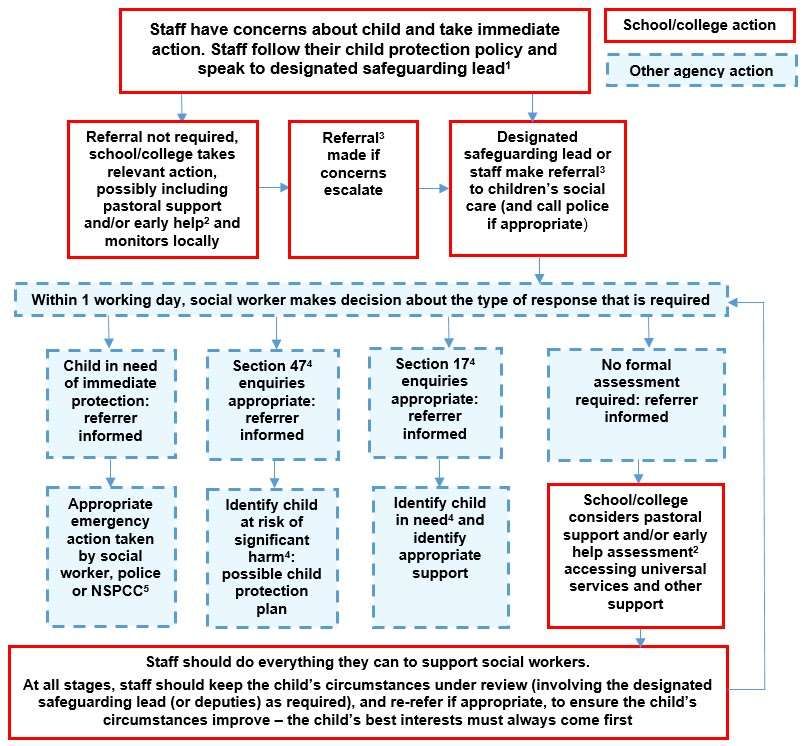
Actions where there are concerns about a child
The following flow chart (it cannot be edited) is taken from page 13 of Keeping Children Safe in
Education 2020 as the key education safeguarding document. As outlined previously, online safety
concerns are no different to any other safeguarding concern.
Updated: August 2020 © LGfL – DigiSafe is an LGfL brand – view this document & more at safepolicies.lgfl.net
19Online-Safety Policy
Template for Schools
Updated: August 2020 © LGfL – DigiSafe is an LGfL brand – view this document & more at safepolicies.lgfl.net
20Online-Safety Policy
Template for Schools
Sexting
All schools (regardless of phase) should refer to the UK Council for Internet Safety (UKCIS) guidance on
sexting (also referred to as ‘youth produced sexual imagery’) in schools. NB - where one of the parties
is over 18, this is no longer sexting but child sexual abuse.
There is a one-page overview called Sexting; how to respond to an incident for all staff (not just
classroom-based staff) to read, in recognition of the fact that it is mostly someone other than the
designated safeguarding lead (DSL) or online safety lead to first become aware of an incident, and it is
vital that the correct steps are taken. Staff other than the DSL must not attempt to view, share or
delete the image or ask anyone else to do so, but to go straight to the DSL.
The school DSL will in turn use the full guidance document, Sexting in Schools and Colleges to decide
next steps and whether other agencies need to be involved.
It is important that everyone understands that whilst sexting is illegal, pupils/students can come and
talk to members of staff if they have made a mistake or had a problem in this area.
The documents referenced above and materials to support teaching about sexting can be found at
sexting.lgfl.net
Updated: August 2020 © LGfL – DigiSafe is an LGfL brand – view this document & more at safepolicies.lgfl.net
21Online-Safety Policy
Template for Schools
Upskirting
It is important that everyone understands that upskirting (taking a photo of someone under their
clothing, not necessarily a skirt) is now a criminal offence, as highlighted in Keeping Children Safe in
Education and that pupils/students can come and talk to members of staff if they have made a mistake
or had a problem in this area.
Bullying
Online bullying should be treated like any other form of bullying and the school bullying policy should
be followed for online bullying, which may also be referred to as cyberbullying, including issues arising
from banter.
Materials to support teaching about bullying and useful Department for Education guidance and case
studies are at bullying.lgfl.net
Sexual violence and harassment
DfE guidance on sexual violence and harassment is referenced in Keeping Children Safe in Education
and also a document in its own right. It would be useful for all staff to be aware of this guidance:
paragraphs 45-49 cover the immediate response to a report and confidentiality which is highly relevant
for all staff; the case studies section provides a helpful overview of some of the issues which may arise.
Any incident of sexual harassment or violence (online or offline) should be reported to the DSL who will
follow the full guidance. Staff should work to foster a zero-tolerance culture. The guidance stresses
that schools must take all forms of sexual violence and harassment seriously, explaining how it exists
on a continuum and that behaviours incorrectly viewed as ‘low level’ are treated seriously and not
allowed to perpetuate. The document makes specific reference to behaviours such as bra-strap flicking
and the careless use of language.
Misuse of school technology (devices, systems, networks or platforms)
Clear and well communicated rules and procedures are essential to govern pupil and adult use of
school networks, connections, internet connectivity and devices, cloud platforms and social media
(both when on school site and outside of school).
These are defined in the relevant Acceptable Use Policy as well as in this document, for example in the
sections relating to the professional and personal use of school platforms/networks/clouds, devices
and other technology, as well as to BYOD (bring your own device) policy.
Where pupils contravene these rules, the school behaviour policy will be applied; where staff
contravene these rules, action will be taken as outlined in the staff code of conduct/handbook.
Updated: August 2020 © LGfL – DigiSafe is an LGfL brand – view this document & more at safepolicies.lgfl.net
22You can also read


