Ontario Priorities Housing Initiative (OPHI) - PROGRAM GUIDELINES FOR ONTARIO ABORIGINAL HOUSING SERVICES - Ontario Aboriginal ...
←
→
Page content transcription
If your browser does not render page correctly, please read the page content below
Schedule 1 – Program Guidelines

Ontario Priorities
Housing Initiative (OPHI)
PROGRAM GUIDELINES FOR
ONTARIO ABORIGINAL HOUSING
SERVICES
Program Guidelines Summary

Introduction
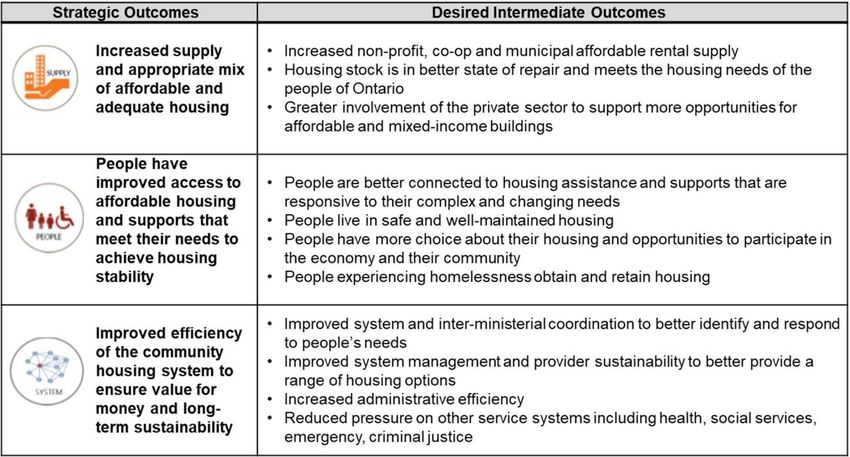
Ontario’s Community Housing Renewal Strategy is a multi-year plan to stabilize and
grow Ontario’s community housing sector, with the aim of achieving the following
outcomes and measures of success:

Over time, the Community Housing Renewal Strategy will help Ontarians be more
connected to housing assistance and supports that better meet their needs, live in safer
and well-maintained buildings, find housing more easily, and have more opportunities to
participate in the economy and their community.

The Community Housing Renewal Strategy is complemented by the Housing Supply
Action Plan, which is focused on enhancing housing affordability in the broader housing
market. Creating more housing, of the types and sizes people need, will help make
home ownership and renting more affordable and give people more choice.

Together, Ontario’s Community Housing Renewal Strategy and the Housing Supply
Action Plan demonstrate the government’s commitment to supporting the creation of
housing that responds to all Ontarians’ needs, across all incomes.

On April 30, 2018, Ontario and the Canada Mortgage and Housing Corporation signed a
nine-year Bilateral Agreement regarding the National Housing Strategy. This agreement
is important to achieving the goals and objectives of Ontario’s Community Housing

                                                                                      1
Renewal Strategy by providing an opportunity to align federal funds with Ontario’s
Community Housing Renewal Strategy priorities.
Consistent with the Community Housing Renewal Strategy, the nine-year National
Housing Strategy investments will be delivered in three three-year funding periods:
• Phase I - (2019-20 through to 2021-22)
• Phase II - (2022-23 through to 2024-25)
• Phase III - (2025-26 through to 2027-28)
These guidelines set out the parameters for Phase I of the National Housing Strategy’s
Ontario Priorities Housing Initiative (OPHI) for Indigenous Program Administrators. This
initiative addresses local housing priorities, including affordability, repair and
construction.
There will be an opportunity to review program priorities and desired outcomes prior to
the second and third funding periods. The Ministry intends to undertake a review of the
early experience with program take-up and release updated/revised guidelines in 2021
to align planning for implementation beginning in April 2022.
2Rental Housing Component
The Rental Housing component will:
• Increase the supply of community rental housing for off-reserve Indigenous
households on, or eligible to be on, social housing waiting lists.
• Ensure that safe, adequate and affordable rental housing is available to Ontario
households.
Eligibility Criteria - Projects
Eligible projects must be non-profit/municipal/co-operative developments or
partnerships, and be one of the following:
• New construction, including additions and extensions;
• Acquisition and, where required, rehabilitation of existing residential buildings to
maintain or increase the affordable rental housing stock; or,
• Conversion of non-residential buildings or units to purpose-built rental
buildings/units
Projects that are not eligible include:
• Projects proposed by private sector proponents without non-profit/municipal/co-
operative partnership*
• Secondary suites in owner-occupied housing (eligible under the Ontario
Renovates component)
• Nursing and retirement homes
• Shelters and crisis care facilities
• Owner-occupied housing
• Student residences
*Canada Mortgage and Housing Corporation has made available other programs – for
example, the National Housing Co-Investment Fund – to support the development of
affordable units by private developers. The Ministry is interested in focusing OPHI
funding on the development of community housing that will provide longer-term public
benefit.
Eligibility Criteria – Units
Units must be modest in size and amenities relative to other housing in the community.
Units are expected to be self-contained. Proponents who wish to develop congregate
living buildings (rooms with shared living spaces) for supportive housing may be eligible
for program funding and should provide a rationale in order to receive funding.
The following provincial minimum and average size requirements must be used as a
guideline for new construction projects.
3Bachelor 1 Bedroom 2 Bedroom 3 Bedroom 4 Bedroom
Minimum 40.0 m2 48.7 m2 60.4 m2 83.6 m2 102.2 m2
Average 41.8 m2 55.0 m2 67.4 m2 92.9 m2 109.2 m2
Up to 30% of the total available space may be used for non-residential purposes,
including common areas and services used directly with the residential accommodation
such as office space for support services providers.
Project Submission Process
Indigenous Program Administrators will solicit proposals and select Rental Housing
projects to recommend to the Ministry for funding approval.
Indigenous Program Administrators will submit recommended projects for the Ministry’s
consideration within the allocation set out in their Investment Plans.
Recommended projects shall:
• Be approved by the Board of Directors based on board procurement practices.
• Be able to sign a Contribution Agreement no later than December 31 of each
program year.
• Be able to start construction within 120 days after signing a Contribution
Agreement and be completed within four years.
• Be financially viable from a construction and operating cost perspective – based
on Indigenous Program Administrator confirmation.
• Meet the current Ontario Building Code and Canadian Environment Assessment
Act, 2012 requirements.
• Have rents that on average for the project are at or below 80% of the Canada
Mortgage and Housing Corporation Average Market Rent for the community or
as approved by the Ministry for a minimum of 20 years (see “Affordability Criteria
and Rents” on page 18 for additional details).
• Provide the required equity, if applicable – 4% for partnerships between private
sector and non-profit organizations; 0% for non-profit organizations.
• Are projected to maximize achievable reductions in energy consumption and
greenhouse gas emissions relative to minimum requirements (i.e. meet or
exceed the current National Energy Code and Ontario Building Code
requirements for new construction; for renovations/repairs, maximize the
achievable energy savings where possible when planning work or retrofits).
• Have an occupancy plan in place to ensure that units will be occupied in a timely
manner.
Further, Indigenous Program Administrators are encouraged to give priority
consideration to projects that:
• Have Contributions by Others, including the local municipality, and proponent –
to be used in partnership with OPHI Rental Housing funding.
• Include family-sized (multi-bedroom) units.
4• Are fully accessible and/or have units that are accessible to persons with
disabilities.
• Provide community employment benefits including:
o Work contracts for small and medium-sized businesses
o Job creation for apprentices, Indigenous Peoples, women in
construction, veterans and newcomers to Canada
• Have support service funding in place, if applicable.
Recommended projects for commitment should be submitted to the Ministry up to
November 30 of each program year. All projects must be submitted through the
Transfer Payment Hub System along with additional project background information.
Project Approval Process
Project approval will be based on construction readiness, ability to meet the program’s
eligibility criteria, and alignment with the Investment Plan.
Indigenous Program Administrators are required to create and submit Project
Information Forms through the Transfer Payment Hub System. Once approved, a
project will receive a Conditional Letter of Commitment from the Ministry, which
confirms Ministry approval and outlines the steps to take prior to signing a
Contribution Agreement.
The Contribution Agreement shall describe legal obligations and reporting requirements
for the project. All Indigenous Program Administrators are required to enter into
Contribution Agreements directly with proponents. If Indigenous Program Administrators
are delivering projects directly (i.e., the Indigenous Program Administrator is the project
proponent), they are required to enter into project-specific Transfer Payment
Agreements with the Ministry.
As funding allocations must be committed for each year of the program, the deadline to
execute Contribution Agreements (or project-specific Transfer Payment Agreements in
the case of projects delivered directly) is December 31 of each program year to allow
time for re-allocation of funds if necessary. Indigenous Program Administrators that
have not signed a Contribution Agreement (or project-specific Transfer Payment
Agreements) or have not begun construction by the required dates may have their
funding re-allocated.
Funding
Indigenous Program Administrator funding for the Rental Housing component is
provided as a forgivable capital loan.
The OPHI Rental Housing component will fund up to 75% of the pro-rated share of the
capital costs of the affordable units. Total capital costs include land, financing, hard
(construction) and soft costs but less any HST rebates.
5To encourage the development of family-sized units, and in recognition of the variance
in costs across the province, per unit funding caps have been eliminated under the
OPHI Rental Housing component. Indigenous Program Administrators are encouraged
to consider factors such as unit bedroom size, unit type (e.g. low-rise apartment, high-
rise apartment, townhouse), or geographic location of the project when determining
project funding amounts. The Ministry, however, will only approve projects that are
determined to provide value for money and are modest relative to other housing in the
community.
Indigenous Program Administrators are required to perform their due diligence to
ensure that a project is financially viable from a construction cost and on-going
operating context, costs per unit are accurate and the program expenditures represent a
prudent and best value use of public dollars.
The Ministry, at its discretion, may require an independent analysis to confirm project
financial viability.
Payment Process
The Ministry will advance funding directly to Indigenous Program Administrators, who
will be responsible for making project payments to housing proponents. Indigenous
Program Administrators will advance funds to proponents based on the completion of
construction milestones and compliance with the program requirements.
Funding will be advanced to Indigenous Program Administrators based on the following
instalments:
• 50% at signing of the Contribution Agreement and confirmation of registration of
security, or project-level Transfer Payment Agreement and construction
agreement (containing a development schedule and standard construction
payment schedule)
• 40% at confirmation of structural framing for new construction or 50% completion
for acquisition and rehabilitation projects
• 10% at confirmation of occupancy, submission of Initial Occupancy Report
including an updated capital cost statement in a form acceptable to the Ministry
The Ministry may consider accelerated payments for projects sponsored by non-profit
proponents or acquisition/rehabilitation projects on a case-by-case basis.
All final payments are required to be made within four years of signing the Contribution
Agreement, and not later than March 31, 2026. Indigenous Program Administrators are
required to ensure that all projects are completed and request the final payment prior to
this deadline.
Income Verification
6Indigenous Program Administrators are required to establish maximum income levels
for OPHI-funded Rental Housing units at the time of initial tenancy; however, all
households must be on, or eligible to be on, the waiting list for social housing.
Indigenous Program Administrators must establish an approach for income verification
to ensure that households in need are targeted. Annual income verification is at the
Indigenous Program Administrator’s discretion.
Affordability Criteria and Rents
Projects approved under the Rental Housing component must remain affordable for a
minimum period of 20 years. Affordability is defined as having rents for the project that
are at or below 80% of Canada Mortgage and Housing Corporation Average Market
Rent at the time of occupancy. Average rent is calculated using actual rents paid by
tenants and includes any rent supplements.
While individual unit rents may be set above or below the 80% threshold, in no instance
shall an OPHI-funded Rental Housing unit have a rent that is greater than the Canada
Mortgage and Housing Corporation Average Market Rent for the area.
If Canada Mortgage and Housing Corporation Average Market Rents are not available
for certain communities, an Indigenous Program Administrator should contact the
Ministry at HousingProgramsDelivery@ontario.ca to determine whether an alternate
average market rent has been approved for the area. If an alternate has not been
approved, the Indigenous Program Administrator may request an alternate average
market rent by submitting a business case including a local market rent survey for the
Ministry’s consideration.
Projects may include both OPHI Rental Housing and market units, but only units with
rents that meet affordability requirements will receive OPHI funding.
If rent supplements are used for OPHI-funded units to provide deeper affordability for
tenants, the Indigenous Program Administrator shall ensure total rent received by a
Proponent, including rent from the tenant and any rental supplements from the
Indigenous Program Administrator or other party shall not exceed 100% of Canada
Mortgage and Housing Corporation Average Market Rent. In addition, the total of the
rent paid by the tenant and any federal and/or provincially funded rent supplements paid
to the proponent must be used to calculate the weighted average rent in a project.
Rent increases after initial occupancy must be made in accordance with rules
established in the Residential Tenancies Act, 2006. New rental buildings (no part of
which was occupied for residential purposes on or before November 15, 2018) are
technically exempt from Residential Tenancies Act rent increase guidelines but are
subject to terms and conditions in the Transfer Payment Agreement. The Transfer
Payment Agreement states that rent increases follow the Residential Tenancies Act rent
increase guidelines but must still remain at or below 100% of Canada Mortgage and
7Housing Corporation Average Market Rent and that average rents for the project must
not exceed 80% of Canada Mortgage and Housing Corporation Average Market Rent.
The Ministry updates Average Market Rent information on its website annually at
www.mah.gov.on.ca.
General Requirements
The following general program requirements apply to projects approved under the
Rental Housing component:
Construction
• Projects must start construction within 120 days of signing a Contribution
Agreement, or equivalent.
• Projects that do not start construction within 120 days of signing a Contribution
Agreement or equivalent may, at the Ministry’s discretion, have program funding
withdrawn and re-allocated to another Indigenous Program Administrator or
Service Manager.
• Written confirmation of construction start must be provided to the Ministry.
• Site inspections will be conducted at the discretion of the Ministry.
• Projects must complete construction within four years of signing a Contribution
Agreement or equivalent.
Equity
• Minimum four percent equity must be provided for projects sponsored by
partnerships between private companies and non-profit organizations.
• No equity contribution is required for projects sponsored by non-profit or co-
operative housing organizations to encourage participation by these groups in
the program.
• Please note that private lenders may have additional equity requirements.
Indemnification and Repayment
There are obligations for all OPHI parties with regard to the indemnification and
recovery of government funding. Specific obligations and provisions are included in the
Transfer Payment Agreement.
The Ministry has developed the Affordable Housing Program and Investment in
Affordable Housing Risk Mitigation Strategies Guide (2012) that provides best practices
and clarification on preventing and resolving issues with affordable housing projects that
may experience difficulties. The Guide can be found at:
http://www.mah.gov.on.ca/Asset9886.aspx.
8In cases where an OPHI Rental Housing project encounters difficulties, the risk
mitigation strategies outlined in the Guide may assist proponents and Indigenous
Program Administrators.
9Housing Support Services Component
Support services are beneficial to tenants who may need extra support – either
temporary or permanent – to achieve housing stability. Housing stability results in
improved health outcomes, less reliance on other emergency services, while promoting
social inclusion.
The objective of the Housing Support Services component is to ensure housing
retention, greater self-reliance and social inclusion for tenants.
Indigenous Program Administrators may not exceed five percent of the funding
allocation for the Housing Support Services component.
Eligibility Criteria
Housing Support Services component funding can only be used to provide housing
support services to eligible tenants in existing social housing, affordable housing units
created under previous programs, as well as to those tenants in units established
through OPHI.
Indigenous Program Administrators may provide a variety of support services (see
Appendix “D” for a sample list of eligible services) to recipients either directly, or through
partnerships with external community agencies. Supports funded should help ensure
housing retention, greater self-reliance, and social inclusion for tenants. Indigenous
Program Administrators are encouraged to work with providers that have familiarity with
the addiction and mental health system, Indigenous organizations and, where
appropriate, with Ministry of Children, Community and Social Services regional offices,
the Ministry of Health and Long-Term Care and local community agencies that provide
supportive housing and homelessness-related services.
10Appendix A – List of Designated Areas under the French Language
Services Act
Service Manager Designated Area(s)
City of Toronto All
Central Region
Regional Municipality of Peel City of Mississauga; City of Brampton
Regional Municipality of York City of Markham
County of Simcoe Town of Penetanguishene; Townships of Tiny and Essa
Eastern Region
City of Cornwall County of Glengarry; Township of Winchester; County of
Stormont
City of Kingston City of Kingston
City of Ottawa All
United Counties of Prescott and Russell County of Prescott; County of Russell
County of Renfrew City of Pembroke; Townships of Stafford and Westmeath
Western Region
Municipality of Chatham-Kent Town of Tilbury; Townships of Dover and Tilbury East
City of Hamilton All of the City of Hamilton as it exists on December 31,
2000
City of London City of London
Regional Municipality of Niagara City of Port Colborne; City of Welland
City of Windsor City of Windsor; Towns of Belle River and Tecumseh;
Townships of Anderdon, Colchester North, Maidstone,
Sandwich South, Sandwich West, Tilbury North, Tilbury
West and Rochester
Northeast Region
Algoma District Services Administration Board District of Algoma
Cochrane District Social Services Administration All
Board
City of Greater Sudbury All
Manitoulin-Sudbury District Services Board District of Sudbury
District of Nipissing Social Services Administration District of Nipissing
Board
District of Parry Sound Social Services Administration Municipality of Callander
Board
District of Sault Ste. Marie Social Services The part of the District of Algoma that is part of the district
Administration Board for the District of Sault Ste. Marie Social Services
Administration Board
District of Timiskaming Social Services Administration All
Board
Northwest Region
Kenora District Services Board Township of Ignace
District of Thunder Bay Social Services Administration Towns of Geraldton, Longlac and Marathon; Townships of
Board Manitouwadge, Beardmore, Nakina and Terrace Bay
11Appendix B: Canadian Environmental Assessment Act (CEAA)
Pre-screening Guidelines
The Canadian Environmental Assessment Act, 2012 (the “CEAA 2012”) has replaced
the Canadian Environmental Assessment Act, 1992. Under CEAA 2012, housing-
related activities do not currently constitute physical activities as described in the
Regulations Designating Physical Activities. Accordingly, the Pre-Screening Guideline
(the “Guideline”) has been simplified and updated to reflect the provisions of the CEAA
2012 and replaces all previous versions of the Guideline.
Indigenous Program Administrators are required to consider this checklist when
recommending project proposals to the Ministry for funding approval. Indigenous
Program Administrators must confirm to the Ministry that the proposed project complies
with the CEAA 2012, as per Canada Mortgage and Housing Corporation requirements.
The answers to the two questions must be “NO” for the CEAA 2012 to be complied with.
• Is the project carried out on federal lands*?
• Has the project been specifically identified by the Minister of the Environment
in an Order Designating Physical Activities?
*NOTE: “federal lands” includes lands that belong to, or that may be disposed of by, Her
Majesty in right of Canada, but does not include lands under the administration and
control of the Commissioner of Yukon, the Northwest Territories, or Nunavut.
12Appendix C: Maximum Household Income Level, 2019*
Service Managers Income at 60th Percentile
Greater Toronto Area** $96,000
City of Toronto
Regional Municipality of Durham
Regional Municipality of Halton
Regional Municipality of Peel
Regional Municipality of York
City of Brantford $88,400
City of Cornwall $77,200
City of Greater Sudbury $93,800
City of Hamilton $90,300
City of Kawartha Lakes $82,000
City of Kingston $89,200
City of London $84,500
City of Ottawa** $96,000
City of Peterborough $82,900
City of St. Thomas $83,600
City of Stratford $88,400
City of Windsor $86,600
County of Bruce $93,100
County of Dufferin** $96,000
County of Grey $80,200
County of Hastings $77,400
County of Huron $84,200
County of Lambton $91,600
County of Lanark $91,400
County of Lennox & Addington $87,400
County of Norfolk $89,500
County of Northumberland $88,700
County of Oxford $91,100
County of Renfrew $85,200
County of Simcoe** $96,000
County of Wellington** $96,000
District Municipality of Muskoka $86,600
Municipality of Chatham Kent $75,500
Regional Municipality of Waterloo** $96,000
Regional Municipality of Niagara $83,800
United Counties of Leeds & Grenville $86,800
United Counties of Prescott & Russell** $96,000
Algoma DSSAB $72,800
Cochrane DSSAB $91,100
Kenora DSSAB** $96,000
Manitoulin-Sudbury DSSAB $81,800
Nipissing DSSAB $79,200
Parry Sound DSSAB $77,800
Rainy River DSSAB $85,700
Sault Ste. Marie DSSAB $80,900
Thunder Bay DSSAB $89,200
Timiskaming DSSAB $78,600
ONTARIO** $96,000
* Based on Statistics Canada, 2016 Census of Population, indexed to 2018 based on CPI.
** In areas where 60th income percentile is greater than the provincial level, the provincial level 60th
income percentile is used.
13Appendix D: Examples of Eligible Support Services
The types of support services that are eligible to be funded include, but are not limited
to, the following:
• Counselling, case management, crisis prevention, harm reduction, and
intervention services.
• Support with physical and cognitive disabilities.
• Household set-up assistance, including: obtaining personal identification; moving;
transportation; basic furnishings; and rent / utility deposits.
• Development of support service plans, to document recipients’ goals, activities,
and levels of support to be provided.
• Assistance with maintaining rental tenancy, including information about: rights
and responsibilities; tenant-landlord relations and orientations; and information
about how to be a good neighbor and crisis intervention / eviction prevention.
• Assistance with basic needs, including: personal care (e.g., bathing, hygiene,
and dressing); exercise; shopping; purchasing food and meal preparation; house
cleaning; laundry; money management (e.g., budgeting, banking, financial
goals); dispensing medication; and conflict resolution.
• Assistance with referrals to gain access to services including: income support;
employment, job placements, vocational counselling, education, and skills
training; parenting courses and child care; legal services; and recreational
activities.
• Assistance with the coordination of opportunities for social engagement and
inclusion in community life, including: volunteer experiences; participation in
social clubs, organizations, and sports; and transportation to events.
• Support to connect with peers and strengthen positive relationships with family
members and friends.
• Recruitment and / or employment of staff members and peer support workers to
deliver support services to recipients, either on-site or through external
community agencies.
• Community relationship worker who connects people experiencing difficulty to
the right community-based supports.
14• Provision of traditional healing and wellness practices to help clients remain
housed.
15You can also read


