Operational Models for Supply Chain Management
←
→
Page content transcription
If your browser does not render page correctly, please read the page content below
Operational Models for Supply Chain Management
                                       OSCM 4375         Spring 2021

Instructor:   Mr. Michael S, Garcia MSPM
E-mail:       msgarcia4@utep.edu
Office: COBA 204             Phone: (915) 747-8631                 Fax: (915) 747-5348

Class Hours: 100% online, asynchronous
Office Hours: TWR 8:00-10:15 a.m. or by appointment

Required Textbook:
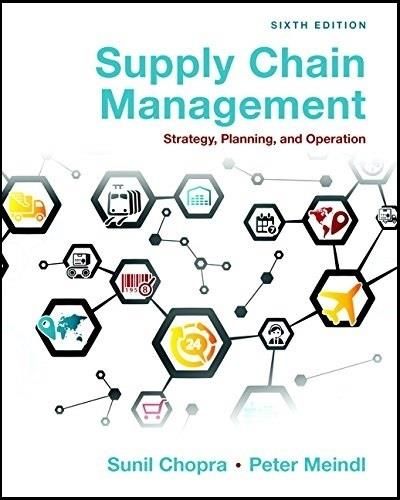
Supply Chain Management: Strategy, Planning, and Operations, by Sunil
Chopra and Peter Meindl, Prentice Hall, 6th edition
ISBN: 9780133800203

Welcome to the undergraduate Operational Models for Supply Chain
Management Course. Official information for OSCM 4375, including grades,
will be posted on Blackboard. You are responsible for reading and responding
to Blackboard “Announcements”, “Assignments”, “Assessments”, and any
other information concerning this course - check your Blackboard account daily!

Course description (From Goldmine)
An examination of some of the major operational concepts and issues relating to the flow of materials,
goods, services, and information through a company's supply chain-the network of organizations that
supply and transform materials and distribute final products to customers. The course seeks to provide an
understanding of the importance of individual components (suppliers, manufacturers, distributors, and
customers) in the operation of the supply chain. It will emphasize inventory-service level tradeoffs, risk
pooling, and other operational concerns. Some of the more recent approaches designed for the effective
and efficient operation of the supply chain will be discussed.
Prerequisites: OSCM 3321, QMB 3301 and CIS 3345.

Objectives:
At the completion of this course students will be able to:
        1. Identify the global trends in Supply Chain Models.
        2. Define the individual components in the operations of the supply chain.
        3. Explain the inventory-service level tradeoffs.
        4. Describe how to manage risk pooling.
        5. Explain the implementation issues associated with supply chain modeling.
        6. Define the key design issues associated with supply chain modeling.
        7. Define the key factors for assessing supply chain models.
        8. Describe the analysis and assessment of supply chain models.

Lectures
Important material from the textbook, reference books, case studies, multimedia sources, and homework
problem examples will be covered in class lectures. This class is 100% online, so class lectures will be
delivered through short 10-15 minute lecture videos posted on Blackboard in the Lecture Videos content
area. The detailed class outline, at the end of this syllabus, shows you exactly what activity and book
chapters will be covered during each week of the entire semester session. I strongly recommend that you
view and understand the lecture videos associated with each day in the outline, on that particular day, to
stay on top of all the material that you will need to master for each exam. You should plan to read a lot and
take careful lecture notes. Discussion and engagement with your classmates is strongly encouraged about
the topics being covered, through regular discussion board assignments. Please make sure that your
computer can run a recent version of Microsoft Excel – this will be required for homework!
Operational Models for Supply Chain Management
OSCM 4375 Spring 2021
Regular Exams
There will be three regular, non-comprehensive exams that cover class materials and chapters in the
textbook and other materials, taught up to the date of the last class before the exam. Exams will generally
be available for 24 hours, beginning on the date specified in the class outline. You may take an exam
anytime during that 24-hour period. You must use Respondus Lockdown Browser to take exams, and have
a working webcam and microphone on the computer you are using. Respondus Monitor will be enabled
and will be recording everything you do and say during your exam session. You will have 90 minutes to
take exams. You can save and exit the exam if you have some kind of issue or technology problem, but
the 90-minute timer will keep running. Even if you have some kind of problem with your computer or
Internet connection, your answers will be saved, and you'll have plenty of time to restart and reenter the
exam. You must complete the exam within 90 minutes of the time you started it, including any
interruptions. There are no make-up exams.
How we will Communicate:
I will communicate with you through Blackboard announcements, global emails sent to the whole class and
virtual office hours via Blackboard Collaborate. I may reach out to you via a voice call for something
urgent. Your best way to communicate directly with me is via email to msgarcia4@utep.edu. I teach many
classes and have many students, so please identify your course number and a message topic clearly in the
Subject line of your email. A good example email Subject line would be:
Subject: OSCM 4375 – Question about Exam 1 Grades
If you do not include this information in the Subject line of your message, it may significantly delay my
response. I will do my best get back to you within 1 business day.
Netiquette Guidelines:
Netiquette is a set of rules for behaving properly online. We must establish and maintain a safe online
learning environment. All opinions and experiences, no matter how different or controversial they may be
perceived, must be respected in a tolerant spirit of academic discourse. You are encouraged to comment,
question, or critique an idea but you are not to dismiss or attack any individual. Working as a community
of learners, we will build a polite and respectful course community.
The following netiquette tips will enhance the learning experience for everyone in this course:
Do not dominate any discussion.
Give other students the opportunity to join in the discussion.
Do not use offensive language. Present ideas appropriately and professionally.
Be cautious in using Internet language. For example, do not capitalize all letters since this suggests
shouting. Popular emoticons, such as ☺, can be helpful to convey your tone but do not overdo or
overuse them.
Avoid using vernacular or slang language. This could possibly lead to misinterpretation.
Never make fun of someone’s ability to read or write.
Share tips with other students.
Keep an “open-mind” and be willing to express even your minority opinion. Minority opinions will
be respected.
Think, pause, and edit before you push the “Send” button.
Do not hesitate to ask for feedback.
Be careful using humor – your perception of what is funny may be very different from someone
else’s.Operational Models for Supply Chain Management
OSCM 4375 Spring 2021
Grading Policy:
10 % First Regular Exam A = numerical grade ≥ 90
15 % Second Regular Exam B= 80 ≤ numerical grade < 90
15 % Third Regular Exam C = 70 ≤ numerical grade < 80
15 % Final Exam D = 60 ≤ numerical grade < 70
10 % Attendance and Punctuality F= numerical grade < 60
35 % Homework, Quizzes and other Assignments
COURSE POLICIES
1. Electronic Devices
All electronic devices (cell phones, tablets, camera containing devices, etc.) should be completely turned
off during exams and should not be in the hands of students at any time during an exam. There will be
absolutely no texting, phone calls, or social media interaction during exams. Such activity will be
captured and recorded by Respondus Monitor and will constitute grounds for disqualifying an exam
attempt, resulting in a grade of zero.
2. Academic Integrity
Cheating is unethical and unacceptable. Using information or original wording in a paper, assignment or
discussion board without giving credit to the source of that information or wording is plagiarism, and is
absolutely unacceptable. Do not submit work under your name that you did not do yourself. You may not
submit work for this class that you did for another class. If you are found to be cheating or plagiarizing,
you will be subject to disciplinary action, per UTEP catalog policy. Refer to
https://www.utep.edu/student-affairs/osccr/student-conduct/academic-integrity.html for further
information.
3. Participation and Engagement
Just as it would be in a face-to-face class setting, your personal participation and engagement in class
activities is essential to your success in this class, and will be worth 10% of your overall grade. Your
level of participation and engagement will be determined by:
• Completion of all class assignments
• Completion and level of engagement demonstrated in class discussion board posts
• Viewing of lecture video series as determined by “Lecture Keys.”
In each video lecture series (one associated with each text chapter), I will embed or mention a Lecture
Key – a word, phrase or number, that is unique to that lecture series, at some random point in the lecture.
I will post assignments calling for those lecture keys, as part of your participation and engagement score.
4. Homework
There will generally be one homework assignment for each text chapter, taken from material previously
covered in class. Please note that you should complete and turn in homework exclusively through
Blackboard. Homework will not be accepted via hardcopy, email, or text messages and cannot be turned
in after its due date. If you expect to be out-of-pocket, make sure you will be able to do the homework
before its due date. No late assignments will be accepted. Unless specifically stated otherwise in a
homework assignment, all homework is a strictly individual, non-group, non-collaborative task.Operational Models for Supply Chain Management
OSCM 4375 Spring 2021
5. Quizzes
There will generally be one short reading quiz for each text chapter, taken form material that will be
covered in the days to follow. These reading quizzes are structured to compel and reward you for reading
ahead in the text in preparation for upcoming lectures. Reading quizzes will be administered through
Blackboard.
6. Need for Assistance
If you have a disability and need classroom accommodations, please contact The Center for
Accommodations and Support Services (CASS) at 747-5148, or by email to cass@utep.edu, or visit their
office located in UTEP Union East, Room 106. For additional information, please visit the Center for
Accommodations and Support Service (CASS) website at https://www.utep.edu/student-affairs/cass/
7. Other Student Services
University Writing Center: http://uwc.utep.edu/index.php
Sexual Harassment Guide for students: https://www.utep.edu/titleix/Filing-a-Complaint.html
University Counseling Center: https://www.utep.edu/student-affairs/counsel/, 747-5302, 202 Union
West; walk-ins encouraged.
Student Health and Wellness Center: https://www.utep.edu/chs/shc/, 747-5624. Many services free to
students paid for through student health fee.
Student Engagement and Leadership Center: https://www.utep.edu/student-affairs/selc/, 106 Union West,
747-5670. Includes study space with workstations; family friendly room with lactation space.
University Career Center: https://www.utep.edu/student-affairs/careers/, 103 Union West, 747-5640.
Mine Tracker: https://minetracker.utep.edu/. Events, news and organizations.
8. Campus Carry:
Persons who hold a Concealed Handgun License can lawfully carry their gun into a UTEP classroom as
long as it remains concealed. Open carry remains prohibited on campus. Should you feel someone is
intentionally displaying a gun (or any other weapon for that matter), do not hesitate to call Campus Police
(ext. 5611) or 911. For information on campus concealed carry, see https://www.utep.edu/campuscarry/.
For more information on overall campus safety, see:
https://www.utep.edu/student-affairs/dean-of-students-office/student-emergency/index.html
Please note that the GBC is a designated Campus Carry Exclusion Zone – a property leased by the
University which has existing tenant leases prohibiting weapons. For more on Exclusion Zones see:
https://www.utep.edu/campuscarry/exclusion-zones/index.html
9. Student Responsibility
Individual students must operate with integrity in their dealings with faculty and other students; engage
learning materials with appropriate attention and dedication; maintain engagement when challenged by
difficult learning activities; contribute to the learning of others; and perform to standards set by the faculty.Operational Models for Supply Chain Management
OSCM 4375 Spring 2021
Please see detailed class outline, beginning on the following page. It is a good idea to print this outline,
double-sided, on a single page, and carry it with you at all times so you’ll know what we are going to be
doing on a particular day in class. Please note that all the exams are pre-scheduled on very specific dates
that cannot change – so plan your personal activity accordingly and well in advance, as there are no
makeup exams, and late work is not accepted.
COVID-19 Precautions and Requirements:
This class is 100% online, asynchronous and remote and you are not currently required be on campus
for anything related to this course. However, you may have the occasion to come to campus for some
reason (e.g. to visit the library), so you must be aware of UTEP’s COVID-19 policies and requirements. It
is also possible that conditions and restrictions may change over the course of the semester, and we all need
to be prepared for the time when on-campus operations and activity may begin to resume.
You must STAY AT HOME and REPORT if you (1) have been diagnosed with COVID19, (2) are
experiencing COVID-19 symptoms, or (3) have had recent contact with a person who has received a
positive coronavirus test. Reports should be made at https://adminapps.utep.edu/screening/Home/Launch.
If you know anyone who should report any of these three criteria, encourage them to report. If the individual
cannot report, you can report on their behalf by sending an email to COVIDaction@utep.edu.
For each day that you are on campus—for any reason—you must complete the questions on the UTEP
screening website (https://adminapps.utep.edu/screening/Home/Launch) prior to arriving on campus. The
website will verify if you are permitted to come to campus. Under no circumstances should anyone come
to campus when feeling ill or exhibiting any known COVID-19 symptoms. Students are advised to
minimize the number of encounters with others to avoid infection.
If you are on campus, wear face coverings when in common areas of campus or when others are present.
You must wear a face covering over your nose and mouth at all times if you are inside of campus buildings
or facilities. If you cannot wear a face mask for medical reasons, please contact the Center for
Accommodations and Support Services (CASS) to discuss temporary accommodations for on-campus
courses and activities. If you choose not to wear a face covering, you will not be able to enter campus
facilities. If you remove your face covering, you will be asked to put it on or leave the facility. Students
who refuse to wear a face covering and follow preventive COVID-19 guidelines while on campus will be
dismissed from campus activities and will be subject to disciplinary action according to Section 1.2.3
Health and Safety and Section 1.2.2.5 Disruptions in the UTEP Handbook of Operating Procedures.Operational Models for Supply Chain Management
OSCM 4375 Spring 2021
Class Hours: 100% online, asynchronous
Detailed Course Outline:
Week Day Date Subject Discussion Comment
Mon Jan 18 No Class Martin Luther King Holiday
1
Wed Jan 20 Introduction Class Introduction and Expectations
Reading Quiz 1 Chapter 1 on Blackboard
Mon Jan 25 Chapter 1 Understanding the Supply Chain
2 Reading Quiz 2 Chapter 2 on Blackboard
Wed Jan 27 Chapter 2 Supply Chain Performance
Mon Feb 1 Chapter 3 Supply Chain Drivers and Metrics
3 Reading Quiz 3 Chapter 3 on Blackboard
Wed Feb 3 Chapter 4 Designing Distribution Networks
Mon Feb 8 Chapter 4 Designing Distribution Networks
4 Reading Quiz 4 Chapter 4 on Blackboard
One hour exam, covers Take anytime from
Wed Feb 10 Exam #1
Noon, Feb 10 to
Chopra Chapters 1-4
Noon, Feb 11
Mon Feb 15 Activity OSCM Leadership Learning Activity
5 Reading Quiz 5 Chapter 5 on Blackboard
Wed Feb 17 Chapter 5 Network Design in the Supply Chain
Mon Feb 22 Chapter 5 Network Design in the Supply Chain
6 Reading Quiz 6 Chapter 6 on Blackboard
Wed Feb 24 Chapter 6 Global Supply Chain Networks
Mon Mar 1 Chapter 6 Global Supply Chain Networks
7 Reading Quiz 7 Chapter 9 on Blackboard
Wed Mar 3 Chapter 9 Sales and Operations Planning
Mon Mar 8 Chapter 9 Sales and Operations Planning
8 Reading Quiz 8 Chapter 10 on Blackboard
Wed Mar 10 Chapter 9 Sales and Operations Planning
Mon Mar 15 No Class Spring Break
9
Wed Mar 17 No Class Spring Break
Mon Mar 22 Chapter 10 Coordination in a Supply Chain
10 Reading Quiz 9 Chapter 14 on Blackboard
Exam #2 One hour exam, covers Take anytime from
Wed Mar 24
Noon, Mar 24 to
Chopra Chapters 5, 6, and 9
Noon, Mar 25
Mon Mar 29 Chapter 10 Coordination in a Supply Chain
11 Reading Quiz 10 Chapter 15 on Blackboard
Wed Mar 31 Chapter 14 Transportation in a Supply ChainOperational Models for Supply Chain Management
OSCM 4375 Spring 2021
Mon Apr 5 Chapter 14 Transportation in a Supply Chain
12 Reading Quiz 11 Chapter 16 on Blackboard
Wed Apr 7 Chapter 15 Sourcing Decisions in a Supply Chain
Mon Apr 12 Chapter 15 Sourcing Decisions in a Supply Chain
13
Exam #3 90 minute Exam, covers Take anytime from
Wed Apr 14
Noon, Apr 14 to
Copra Chapters 10, 14 and 15
Noon, Apr 15
Mon Apr 19 Chapter 16 Pricing and Revenue Management
Reading Quiz 12 Chapter 17 on Blackboard
14
Wed Apr 21 Chapter 16 Pricing and Revenue Management
Mon Apr 26 Chapter 17 Sustainability and the Supply Chain
15
Wed Apr 28 Chapter 17 Sustainability and the Supply Chain
Mon May 3 Class Wrap-up Last Day of Class!
16 Take anytime from
90 minute Exam, covers
Wed May 5 Final Exam Copra Chapters 16, 17 + selected Noon, May 5 to
Noon, May 6
comprehensive questions.
Note: This is a tentative syllabus and the Professor reserves the right to make changes at any time.Operational Models for Supply Chain Management
OSCM 4375 Spring 2021
Spring 2021 Academic Calendar:
Oct 26th Spring Registration Begins
Jan 7th Last Day to Clear Students on Suspension/Probation as well as those with
Insufficient Prerequisites
Jan 8th Drops for Students with Unsatisfactory Academic Standing, Insufficient
Prerequisites, and Prior Grades of C in the Course
Jan 11th Financial Aid is Disbursed
Jan 18th Dr. Martin Luther King, Jr. Holiday – University Closed
Jan 19th Spring classes begin
Jan 19th–22nd Late Registration (Fees are incurred)
Feb 3rd Spring Census Day
Note: This is the last day to register for classes. If payment is not received
by this day, students will be dropped.
Feb 15th 20th Class Day
Note: Students who were given a payment deadline extension will be
dropped at 5:00 pm if payment arrangements have not been made.
Feb 19th Graduation application deadline for degree conferral
Mar 21st Midterm Spring 2021 Grades Due
Mar 15-19th Spring Break
Mar 26th Cesar Chavez Holiday – no classes
Apr 1st Spring Drop/Withdrawal Deadline
Note: Student-initiated drops are permitted after this date, but the student is
not guaranteed a grade of W. The faculty member of record will issue a
grade of either W or F.
Apr 2nd Spring Study Day
Apr 16th Deadline to submit candidates’ names for degree conferral
May 6th Spring – Last day of classes
May 7th Dead day
May 10-14th Spring Final Exams
May 15-16th Spring Commencement
May 19th Grades are Due
May 20th Grades are posted to student records; students are notified of grades and
academic standing
Payment For more information on payment deadlines, visit the Student Business
Deadlines Services WebsiteYou can also read


