Origin Live Resolution IV/Illustrious Turntable Review
←
→
Page content transcription
If your browser does not render page correctly, please read the page content below

Origin Live Resolution IV/Illustrious
      Turntable Review
      Posted on 14th April, 2021
      https://www.stereonet.co.uk/reviews/origin-live-resolution-iv-illustrious-turntable-review

      Jimmy Hughes takes an affordable British superdeck for a spin…

      Origin Live
      Resolution IV Turntable & Illustrious Tonearm

      £5,570

© StereoNET International 2021
Origin Live was launched in the late nineteen eighties by naval architect
      Mark Baker. The company has since carved out a distinct niche for itself,
      manufacturing a range of quirky yet highly capable turntables and
      tonearms. The £3,600 Resolution you see here is at the more affordable
      end of the Southampton company's five-strong vinyl spinner range and
      comes tested with the £1,970 Illustrious, one of four tonearms sold by OL.
      This combination costs £5,570, and I think it is worth every penny.

      CLOSE UP

      The Resolution IV has some interesting original design innovations – a few
      are obvious, but most are not, while some of its secrets are hidden in plain
      sight. The design itself is elegant and efficient. Much thought has gone
      into the materials chosen and every aspect of fabrication. It features a
      skeletal metal chassis on a support base. If architects Norman Foster
      ever made a turntable, I imagine it would look something close to this.

© StereoNET International 2021
The low friction main bearing runs in an oil bath for smooth results. With
      the belt removed, the time taken for the platter to stop turning from
      33.3rpm was 1 minute, 42 seconds. That's really impressive. By way of
      comparison, despite its massive 12kg platter, Acoustic Solid's MPX
      turntable took 1 minute 20 seconds, and my reference Musical Fidelity
      MF-1 lasted less than 30.

© StereoNET International 2021
The 25mm thick platter is made from acrylic and weighs about 1.5kg. The
      platter is driven from a Swiss-made DC300 DC motor via a flat belt having
      a textured surface, and the drive is strong and solid. Motor speed is
      governed electronically, using LED sensors on the motor housing, which
      check and regulate speed via a foil strip on the underside of the platter.
      Once the deck is correctly adjusted for height, a blue LED illuminates the
      platter from below.

      Pitch stability seems excellent; the company's specially developed
      electronics monitor speed, ironing out motor fluctuations for a secure and

© StereoNET International 2021
constant rate of knots. My platter had Origin Live's Multi Layer update,
      which adds about £650 to the price and acts as a vertical shock absorber
      to enhance bass performance. I found it made a significant improvement,
      bringing a more natural tonal quality and reducing the midrange emphasis
      that acrylic platters can be prone to.

      The Illustrious tonearm is a 10-inch design featuring a tube made from five
      different materials to improve energy dispersion. Ultra low friction dual-
      pivot floating vertical bearings decouple the armtube from the deck to
      reduce colouration. The higher mass yoke than OL's cheaper Encounter
      arm – the model below Illustrious – is claimed to give better definition,
      particularly in the bass. The headshell is made from aerospace alloy and
      features a very nice high angled finger lift. The bearings feel smooth and
      silky but are not overly delicate. Two transit bolts are provided to protect
      them from damage during transportation. The arm has a removable cable
      terminated in RCA phono plugs.

      Although this turntable/tonearm package benefits from care taken over
      setting-up and alignment, it's not a sensitive pernickety design. Once
      installed and adjusted, you shouldn't need to keep fettling it, and it should
      run for several years before needing attention. As with all the turntables I
      review, to reduce the effects of footfall, I mounted it on a 25mm thick
      hardwood board supported by five decoupled feet.

© StereoNET International 2021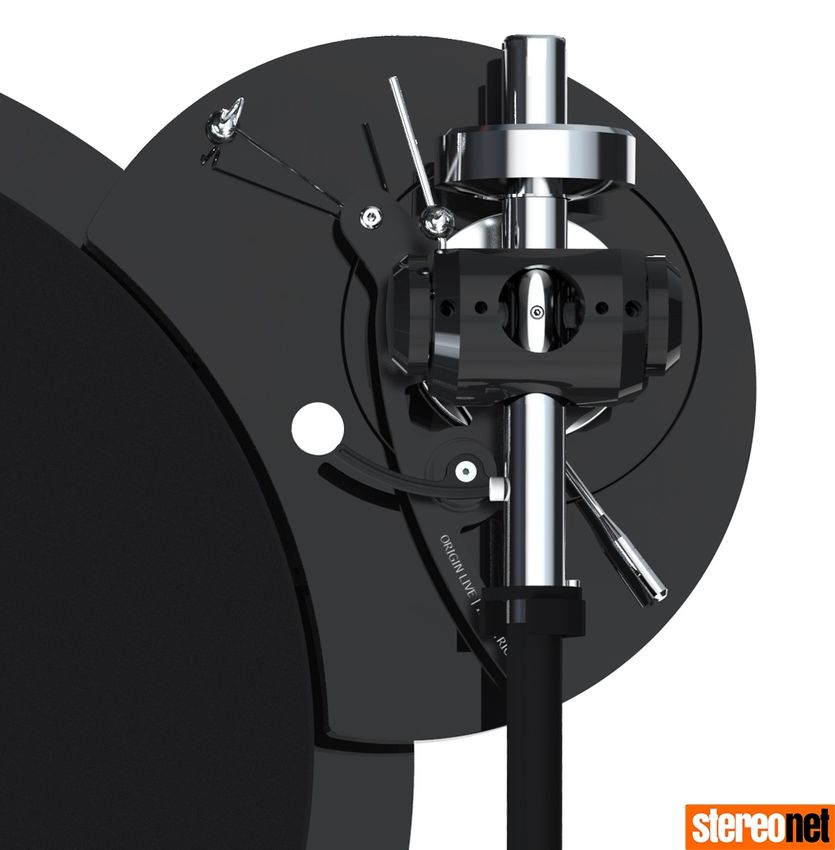
THE LISTENING

      Sonically, the Resolution/Illustrious offers comparable precision and focus
      to the big, heavy-go-round behemoths out there. But being lighter and
      less heavily damped, it reproduces music with superior fluidity and flow,
      plus greater subtlety and finer tonal gradations than many I have heard.
      Indeed at its best, it hardly sounds like a turntable at all. Instead, you get
      the impression you're listening to a master tape, such is its effortless
      poise and precision. Fast and responsive, it seems able to reproduce a
      broader range of tonal colours and microdynamics than most.

      The first long-player that I spun up was a Philips recording of Mozart's
      Adagio and Rondo for Glass Harmonica – a strange instrument whose
      sound suggests ghosts and the supernatural. I'd just played it on my
      Musical Fidelity MF-1 turntable, and it sounded great, or so I thought. Via
      the Origin Live, the glass harmonica exhibited even more other-worldly
      depth and shimmer, with slinky subtle halftones. It sounded significantly
      better than my reference deck. Breathy overtones filled the room;
      suddenly, bell-like notes could be heard as the glasses were tapped.

      Playing Miles Davis's Kind of Blue and the sheer tactile presence of
      trumpet and sax was impressive. Yet what really caught my ear were those
      quiet atmospheric piano chords played by Bill Evans, which seemed to
      cut through the mix with incredible ease. A few days earlier, I'd listened to

© StereoNET International 2021
this album on SACD, compared it to the CD and noticed something similar
      with Evans's piano. SACD focused it more clearly than CD. Vinyl went
      further, delivering even greater clarity and depth while sounding
      effortlessly natural and tonally more open.

      My Transfiguration Temper W cartridge now sounded a wee bit crisper
      and sharper in the Origin Live, compared to my Musical Fidelity. The
      enhanced transient attack made the music more immediate. Bass was
      deep and full, yet nimble. The decay of quiet notes as they slowly faded
      was more apparent. Solo voices and instruments did not dominate quieter
      ones. Everything was reproduced democratically. At the same time, the
      sound had a nice, flowing, lyrical sort of quality; it was crisp but not hard
      or coldly abrupt.

      JJ Cale's album Grasshopper really highlighted this. It's simple music, but
      each track sounds very individual – it was actually recorded in four
      different studios/venues, and no fewer than five engineers are credited.
      The producers didn't aim for a consistent, uniform sound, and the
      Resolution/Illustrious brought out all the myriad variations. I don't think I'd

© StereoNET International 2021
ever heard the individual differences between tracks revealed so clearly
      before. This album is also a good test for pace and timing too.

      On classic music recordings, I liked the way the Resolution/Illustrious
      revealed the ambience of the hall where the performance took place,
      maintaining clarity even when things grew loud. Playing Eugene
      Ormandy's pioneering reading of Rachmaninov's First Symphony proved
      fascinating. This old CBS recording from the early nineteen sixties is
      somewhat bright and forwardly balanced. Yet because all the low-level
      detail was reproduced so exquisitely, I really sensed the placement of the
      orchestra in the hall, regardless of dynamic extremes.

      Impressive projection, holographic soundstaging – all this and more on a
      mediocre recording that previously had always sounded thin, flat, and
      unrefined! Only intending to sample a few minutes, I ended up listening to
      the whole LP, thoroughly enjoying the experience. I found the impression
      of depth and space was really enhanced by the optional multilayer platter.
      Then, playing a seventies Beach Boys compilation LP, I was amazed to

© StereoNET International 2021
hear holographic reproduction – even on tracks that weren't that well
      transferred. Indeed some cuts were original mono, reprocessed for fake
      stereo.

      Despite this, voices and instruments sounded impressively dimensional,
      more so than they had any right to. It was a convincing demonstration of
      how good vinyl transcends the limits of average recordings, delivering
      results that instantly put a smile on your face. Seasoned analogue addicts
      will know what I mean.

      The noise floor of this turntable package proved extremely low, both in
      terms of rumble and general background mush and/or vinyl roar. On a
      well-pressed LP, background noise proved to be virtually absent. The
      Transfiguration cartridge helped here, too, as its stylus profile always
      seems to find the quiet part of the groove!

© StereoNET International 2021
Many of the records I played during the audition period had been cleaned
      ultrasonically using a Degritter. The surfaces weren't dirty as such, but
      this type of cleaning ensured that all the precision, clarity and fine detail
      present on a great LP can be heard when played on a turntable such as
      this. It made the music sound effortlessly real; for example, Live in
      Concert with Barbara Thompson's Paraphernalia really impressed me.

      This double album, recorded in 1980, ends with a track called Aliyah. It
      takes the whole of side four and features a standout extended drum solo
      from the late Jon Hiseman. Sonically, it has always pleased, but the Origin
      Live elevated it from very good to absolutely great. I'd never heard it

© StereoNET International 2021
sound so vivid and holographic before. Hiseman's solo is a tour de force,
and his drums and cymbals were reproduced with scintillating clarity and
attack.
THE VERDICT
While I enjoy CDs, SACDs and digital streaming, I am gratified by the way
that analogue keeps getting better and better – setting new standards
that challenge even the finest digital sources. There's no question about it
– on a deck such as this, the LP format sounds very engaging. There's a
relaxed freshness with good vinyl that digital still finds hard to emulate.
Origin Live's Resolution/Illustrious demonstrates how natural and
transparent LPs can sound and is a great combination.
© StereoNET International 2021You can also read


