Outcomes, Insights and Best Practices from IIC Testbeds: Smart Factory Web Testbed - Industrial Internet Consortium
←
→
Page content transcription
If your browser does not render page correctly, please read the page content below
Outcomes, Insights and Best Practices from IIC
                Testbeds: Smart Factory Web Testbed

Interviewee:

Dr. Kym Watson
Principal Scientist
Deputy Head of Department Information Management and Production Control
Fraunhofer IOSB
Fraunhofer IOSB is a member of the "Fraunhofer Center for Machine Learning"
kym.watson@iosb.fraunhofer.de

Interviewer:

Joseph Fontaine
VP Testbed Programs
Industrial Internet Consortium
fontaine@iiconsortium.org

IIC Journal of Innovation                  -1-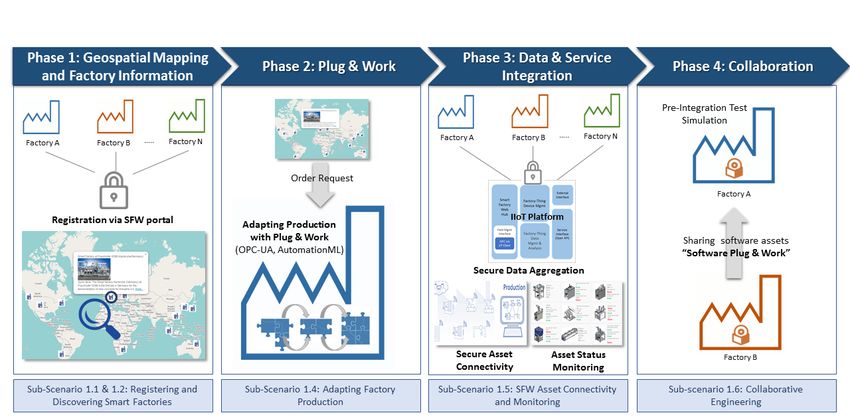
Outcomes, Insights and Best Practices from IIC Testbeds: Smart Factory Web Testbed

INTRODUCTION
In order to extend the usefulness of the published Testbeds in the Testbed Program of the
Industrial Internet Consortium (IIC), the Testbed Working Group has developed an initiative to
interview the contributors of selected testbeds to showcase more insights about the testbed,
including the lessons learned through the testbed development process. This initiative enables
the IIC to share more insights and inspire more members to engage in the Testbed Program.
This article highlights the Smart Factory Web Testbed. The information and insights described in
the following article were captured through an interview conducted by Mr. Joseph Fontaine, Vice
President of Testbed Programs at IIC, with Dr. Kym Watson, Principal Scientist and Deputy Head
of Department Information Management and Production Control at Fraunhofer IOSB. Kym is an
active member in the IIC where he has been serving as co-lead of the Smart Factory Web Testbed
and is a key contributor to the Testbed Working Group. Kym co-chairs the IIC Distributed Data
and Interoperability Management Task Group. In May 2018, Kym was recognized by his peers
and bestowed the IIC Testbed Award for his leadership and contribution to the Smart Factory
Web Testbed. His nomination indicated the importance of improving manufacturing order
fulfillment and cited Kym’s technical expertise, support and advancement of the smart
manufacturing activities within the IIC.

SMART FACTORY WEB TESTBED – FROM CONCEPT TO REALITY
The Smart Factory Web Testbed aims to set               This requires up-to-date information about
up a web-based platform to allow factories              the capabilities and status of assets in the
to offer production capabilities and share              factory. The characteristics of the
resources to improve order fulfillment in a             products—availability, quality, price and so
much more flexible way than is currently                on—provides a basis for possible negotiation
possible with available technology. It seeks            between competing offers.
to provide the technical basis for new
                                                        For this application to work, international
business models, especially for small lot
                                                        standards such as OPC Unified Architecture
sizes, with flexible assignment of production
                                                        (OPC UA) and AutomationML are needed to
resources across factory locations. This
                                                        link factories into the Smart Factory Web in
testbed is designed, in particular, to be a
                                                        order to provide information about the
step towards establishing a marketplace for
                                                        factories in a standardized way. This
manufacturing where one can look for
                                                        innovation enables production facilities to
factories with specific capabilities and assets
                                                        offer their services in a global market
to meet production requirements. Factories
                                                        business and adapt their production in a very
offering those capabilities can then register
                                                        efficient way. The Smart Factory Web
to be located and participate in the
                                                        Testbed enables cross-site usage scenarios
marketplace.
                                                        with secure Plug & Work functions and data

                                                  -2-                                   March 2019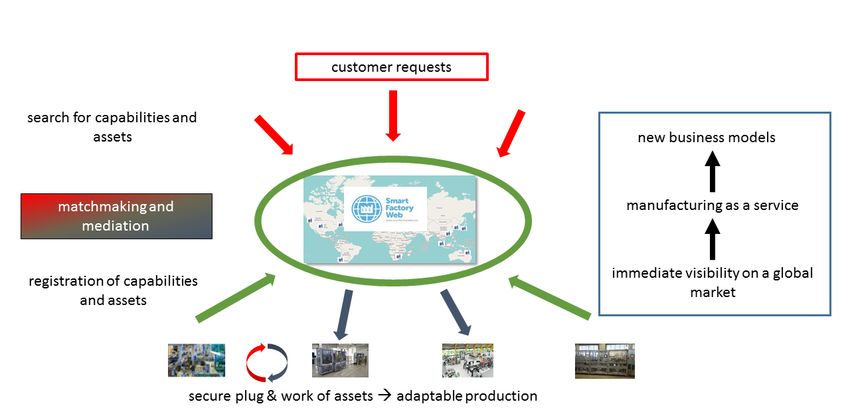
Outcomes, Insights and Best Practices from IIC Testbeds: Smart Factory Web Testbed

analytics. It reduces Information Technology               to describe the capabilities of factory assets
(IT) system integration and installation costs,            in a standardized way, to find assets with the
allowing for faster engineering and ramp-up                necessary capabilities and to access status
time of components, machines, plants and IT                data about these assets so that they may be
systems—improving upon the utilization of                  included in the overall order management.
equipment, as well. The core functionality is

                        Figure 1: Smart Factory Web as a Marketplace for Manufacturing
                                                           & Work assets in a factory, flexible
The Testbed is directed mainly towards
                                                           engineering, configuration of factory
small-lot size environments rather than large
                                                           integration into Smart Factory Web and the
manufacturers because companies working
                                                           Microsoft© Azure® platform, and the
with larger line orders usually have their own
                                                           description of assets in AutomationML.
supply chain management system and do
not need to be as flexible and responsive due              The Testbed’s primary use cases involve
to the size of the orders. For smaller scale               manufacturers who seek to find a factory to
production, there are many more examples                   produce certain parts. The manufacturer
of where a moderate or smaller number of a                 accesses the Smart Factory Web to find a
particular part is to be produced, and                     factory with the right capabilities, and a
machine capabilities need to be configured                 potential target factory is identified. After
for this particular order.                                 negotiating with the target factory about
                                                           delivery route, schedules, price and so on, an
To accomplish its goal, there are several
                                                           order can be placed. The target factory may
areas of experimentation in the Smart
                                                           need to adapt its production to meet the
Factory Web Testbed, including the
                                                           requested product specifications, and it
engineering of automation systems for Plug

IIC Journal of Innovation                           -3-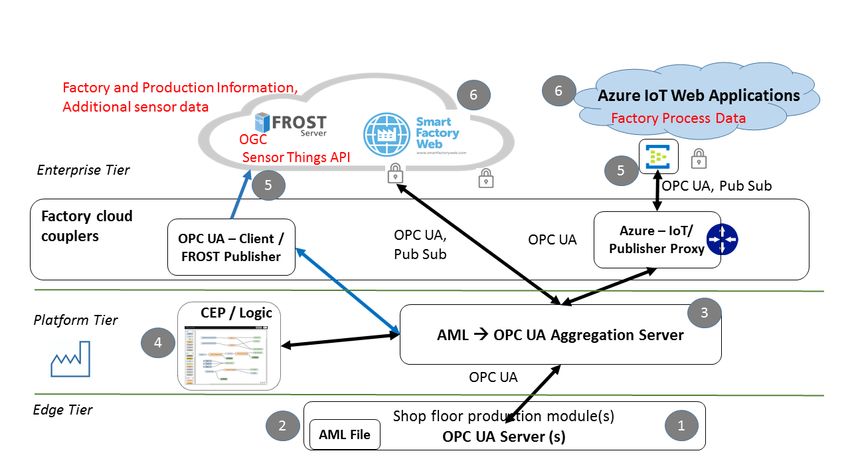
Outcomes, Insights and Best Practices from IIC Testbeds: Smart Factory Web Testbed

wants to do this as efficiently as possible.                    but they are not part of experimentation in
Once the production order is finished, the                      this    testbed.     A     proof-of-concept
factory provides the finished or partial                        implementation in the Smart Factory Web
product to the original manufacturer or to                      Testbed will handle the ordering workflows
another element in the overall supply chain.                    and modeling of supply chains. The
                                                                proposed     IIC   testbed     “Negotiation
This usage scenario, Order Driven Adaptive
                                                                Automation Platform” led by NEC© will
Production, is a combination of the
                                                                extend the concepts of the Smart Factory
application scenarios “order controlled
                                                                Web and take up this sub-scenario.
production” and “adaptable factory” as
defined by Plattform Industrie 4.0 (PI4.0)1. In                 Sub-Scenario 1.4 Adapt: Adapting the
further detail, this scenario is split into the                 Factory Production
following sub-scenarios:
                                                                Realized in Phase 2: “Plug & Work” to flexibly
Sub-Scenario 1.1 Publish: Registration of                       and efficiently adapt a production facility to
Smart Factories                                                 meet order requirements.
Realized in Phase 1: “Geospatial Mapping                        Sub-Scenario 1.5 Bind: Smart Factory Web
and Factory Information” with the help of                       Asset Connectivity and Monitoring
AutomationML        to   describe factory
                                                                Realized in Phase 3: “Data & Service
capabilities and assets.
                                                                Integration” to provide current information
Sub-scenario 1.2 Find: Discovering Smart                        on product and asset status (including
Factories                                                       availability of free capacity) for exploitation
                                                                in the Smart Factory Web, especially to
Realized in Phase 1: “Geospatial Mapping
                                                                support the discovery process and linking of
and Factory Information” to find smart
                                                                supply chains through secure data exchange.
factories registered in the Smart Factory
                                                                The Smart Factory Web information model
Web with the desired capabilities best
                                                                will be updated dynamically.
matching the order requirements.
                                                                Sub-Scenario 1.6 Collaborate:
Sub-scenario 1.3 Order: Management and
                                                                Collaborative Engineering
Execution of Orders in Smart Factory Web
                                                                To be realized in Phase 4: “Collaboration” to
The workflows to broker, orchestrate and
                                                                enhance the efficient adaptation of factory
process production orders in the Smart
                                                                production with shared engineering
Factory Web constitute this sub-scenario,
                                                                workflows and software Plug & Work.

11https://www.plattform-i40.de/I40/Redaktion/EN/Downloads/Publikation/aspects-of-the-research-
roadmap.pdf?__blob=publicationFile&v=10

                                                         -4-                                      March 2019
Outcomes, Insights and Best Practices from IIC Testbeds: Smart Factory Web Testbed
Figure 2: Phases of the Smart Factory Web Testbed
its information model as interfaces. That
There are three primary technologies
asset must then be integrated into the
involved in the testbed. The first is the OPC
information flow of a factory, the Smart
UA, used to implement data communication
Factory Web, and potentially cloud
between factories in the Smart Factory Web.
platforms such as Microsoft Azure. The
Second, the standard AutomationML is used
testbed’s core challenge lies in the software
to describe the necessary information
engineering processes, in an effort to make
models—the semantics of the data transport
a factory adaptable. Other considerations
from the factory to the Smart Factory Web.
include the electrical and mechanical
The other fundamental technology is the
interchangeability of a new device.
Smart Factory Web portal, a web-based
information management system and The testbed is deployed in model factories
application development environment located in Karlsruhe and Lemgo, Germany
which provides full support for access rights, and Ansan and Pangyo, South Korea. The
work flows and ontology-based information model factories in Germany are operated by
models. Fraunhofer IOSB and those in South Korea by
the Korea Electronics Technology Institute
The primary experimentation for the testbed
(KETI). The two factories in Karlsruhe and
is working out an effective way of describing
Pangyo deal with handling, filling and
assets and capabilities and developing very
transport. Both factories involve filling small
efficient ways of achieving the overall
bottles with either pellets or fluid,
software engineering where a new asset can
transporting these bottles with a small
be introduced. An asset can be described in
conveyor belt, and emptying the bottles—
terms of its capabilities but also in terms of
IIC Journal of Innovation -5-Outcomes, Insights and Best Practices from IIC Testbeds: Smart Factory Web Testbed
with a few quality inspections. The Karlsruhe by providing feedback to the relevant
factory will look at implementing the (PI4.0) standards bodies—OPC UA, AutomationML,
Asset Administration Shell for a number of and also standards work within the IIC and
assets in the next few months to validate the PI4.0. While other organizations are working
concepts of PI4.0. The model factory in in the area of asset administration, the
Lemgo in northern Germany also involves Smart Factory Web Testbed strives to play a
handling and filling but on a larger scale forerunner role in this area by tackling the
including assembly within a versatile whole combination of technologies
production facility. involved.
Ansan’s model factory is a large facility with
real production equipment to accomplish
TESTBED PLANNING
tasks including the visual inspection of The IIC ecosystem has played a significant
pistons from a local vehicle manufacturer’s role in the planning of the testbed. Regular
factory. The model factory in Ansan features presentations of the Smart Factory Web
a fully implemented digital twin of the Testbed and resulting discussions with IIC
manufacturer’s production. There is a real members at quarterly meetings and special
production line where various parts are IIC events were important mechanisms
transported and inspected. A floor which allowed for continuous discussions
simulation model of the robot motions of and constructive feedback about the
the conveyor belt show how the engineering Testbed’s purpose and function.
process is actually conducted. Therefore, if a Participating in the IIC Member Pavilion at
change to the line would be needed, it can events such as IoT Solutions World Congress
be done in the simulation environment (the in Barcelona and Hannover Messe has led to
digital twin) before going live, which would high visibility of Testbed activities and a
otherwise be a high risk. The Smart Factory better understanding of the requirements
Web Testbed strives to work closely with and potential applications.
manufacturing and automation companies
and eventually transfer its technology into In establishing alliances for various
real productive environments. extensions to the Smart Factory Web
Testbed, the IIC ecosystem played an
To date, the main deliverables of the testbed instrumental role. The IIC’s collaboration
are documents describing the key concepts, with PI4.0 is enabling the realization of the
standards application and implementation I4.0 component concept for selected assets
architecture of the Smart Factory Web. in the Smart Factory Web Testbed. An I4.0
These concepts can then be adapted and component comprises an Asset
adopted for use by a company. Another Administration Shell (a digital
planned output of the testbed is the representation) and the respective asset.
experience of how to describe asset Working with IIC member, Microsoft, the
capabilities, efficiently integrating assets integration of factories into the Microsoft
into an overall software architecture. Azure platform led to visualizing factory
Additionally, the testbed is driving standards
-6- March 2019Outcomes, Insights and Best Practices from IIC Testbeds: Smart Factory Web Testbed
process data. A new IIC testbed for the security, including the application of OPC UA
brokering of production and logistic services and AutomationML standards.
was proposed in conjunction with IIC
In choosing partners, it was important that
member NEC’s, the Negotiation Automation
the prospective organization was a leading
Platform. An alliance with IIC liaison,
innovator in IIoT in the manufacturing
International Data Spaces Association
domain and a strong promoter of open
(IDSA), brought the implementation of an
standards. In addition, expertise with the
IDS connector for trustworthy data exchange
standards used in the Testbed was required
between factories and the Smart Factory
to participate.
Web portal. Furthermore, the IIC ecosystem
fostered collaboration between PI4.0 and
the IIC, facilitated the international
IIC INTERACTIONS
dissemination of the benefits of standards in The 3-tier architecture of the Industrial
a testbed, and promoted work on the Internet Reference Architecture (IIRA) was
description of assets of IIC members. applied in two places within the testbed: 1)
There have also been benefits for the in each model factory and 2) in the Smart
companies operating the model factories— Factory Web with gateways to the factories
Fraunhofer IOSB and KETI. Both in the edge tier. The testbed has also
organizations perform applied research and adopted the general terminology used in the
development for industry. Through the IIRA, a crucial step to facilitate clear
Smart Factory Web Testbed, they aim to messaging to the rest of the industry.
improve and better market their own The activities of the Smart Factory Web
offerings in the field of IIoT and automation. Testbed have contributed to several aspects
In addition, the Smart Factory Web Testbed of the IIC. The Smart Factory Web Testbed is
is a showcase for products and technologies a candidate vehicle for an IIC-PI4.0
of participating companies, enhancing their collaboration aiming to trial the PI4.0
market opportunities. The network of specification Details of the Asset
companies taking part will form an Administration Shell which defines how data
‘innovation community’ supported by KETI exchange shall happen between Industrie
and Fraunhofer IOSB to identify and fill 4.0 components based upon international
technology gaps by linking the knowledge standards. In addition, Fraunhofer IOSB is
and requirements of users, companies and using testbed results and its own experience
research organizations. KETI and Fraunhofer to contribute to the whitepaper “Digital
IOSB advise companies on technology Twin and Asset Administration Shell,
assessment and development of technology Concepts and Application”, of the IIC-PI4.0
roadmaps. Furthermore, the Smart Factory Joint Task Group. The IIC DDIM TG
Web Testbed has been integrated into (Distributed Data Interoperability and
training programs offered by Fraunhofer Mananagement Task Group) is working on a
IOSB and KETI on industrial automation and whitepaper to be published in 2019 dealing
with IoT information models for semantic
IIC Journal of Innovation -7-Outcomes, Insights and Best Practices from IIC Testbeds: Smart Factory Web Testbed
interoperability and the characteristics of within a factory, between different factories
these models with the aim of proposing a and between the factory and the Smart
meta-model. The information models and Factory Web Testbed. The standards work in
standards used in the Smart Factory Web OPC UA is supported by the Open Source
Testbed have been contributions to the project open62541 where Fraunhofer IOSB
DDIM TG work. NEC submitted a research has made major contributions, see
and development proposal related to the https://open62541.org . KETI will also be
Smart Factory Web Testbed for the Japanese contributing to open62541 in 2019. In
government which has been accepted. As addition, Fraunhofer IOSB has developed the
part of this large national project, NEC has Fraunhofer Open Source SensorThings API
proposed the IIC testbed Negotiation Server (FROST). Both open62541 and FROST
Automation Platform which extends the are deployed in the testbed, and these Open
concepts of the Smart Factory Web Testbed Source projects contribute to the maturity
platform and includes information models to and onward development of the respective
describe assets and supply chains as well as standards.
AI methods for negotiation. The work of
IEC 62714 standard AutomationML is used to
Fraunhofer IOSB will be carried out within
describe the semantics of the data, which
the Fraunhofer Cluster of Excellence
data will be integrated into the Smart
“Cognitive Internet Technologies”.
Factory Web, and how that data is going to
Standards be visualized. The Smart Factory Web
Testbed uses AutomationML to provide the
The Smart Factory Web Testbed employs a
basis for the automatic generation of OPC
plethora of noteworthy standards. When
UA servers, following the standard
possible adaptions to a standard are
Companion Specification OPC UA for
identified, the testbed reports to the
AutomationML. Experience gained in the
relevant standards body. This report may
Smart Factory Web Testbed is fed back into
involve submitting a change request or
the onward development of the Companion
undertaking an accommodating process,
Specification.
depending on the standards organization.
Regarding Open Source projects for One recent activity involved implementing
example, the Open Source communities can OPC UA over an OPC UA publisher subscriber
process comments submitted and (pub sub) and running it over a Time
incorporate changes into the latest releases Sensitive Network (TSN). The OPC UA pub
of the software. The Smart Factory Web sub is a relatively new aspect of OPC UA, and
Testbed supports standards with Open this implementation executed in conjunction
Source Development as a way of trialing a with an IIC member helped to mature the
standard and receiving practical feedback specification of this OPC UA pub sub.
about the specification.
Certain areas of relevant standardization are
IEC 62541 standard OPC UA is used for the not yet fleshed out in the industry but are
data transfer between automation devices needed to fulfill the overall use cases, such
-8- March 2019Outcomes, Insights and Best Practices from IIC Testbeds: Smart Factory Web Testbed
as the area of geospatial data, e.g., to describe reference architectures for service
consider environmental aspects as part of a architectures.
smart factory. The Open Geospatial
More work is also needed in the
Consortium has standards in this area, but
specification of the Asset Administration
they are not yet fully integrated into the
Shell from PI4.0, a digital representation of
standards typically used in the
an asset by which modular and
manufacturing automation domains, i.e.,
interoperable digital twins may be built
OPC UA and AutomationML. Another gap
according to the Industrie 4.0 concepts. The
lies in the information models available for
Smart Factory Web Testbed hopes to
IIoT. While there is progress in the
provide support to this standardization
companion standards being worked on for
work. Additionally, semantic descriptions of
OPC UA, the development process is
asset capabilities are an important aspect of
ongoing.
standardization still needed in the industry,
A standard of Open Geospatial Consortium but there is further work to be done in this
called SensorThings API is becoming popular area.
in the IIoT domain: The Smart Factory Web
Testbed uses this standard to easily TESTBED RESULTS
integrate additional sources of data,
particularly sensor data, into a Factory Web. There are four phases in the Smart Factory
The oneM2M standard is being used by KETI, Web Testbed:
though it is not central for the overall Smart Phase 1: Geospatial Mapping and
Factory Web concept. This standard can be Factory Information
added into the Smart Factory Web if devices Phase 2: Plug & Work
within factories support oneM2m. There are Phase 3: Data & Service Integration
standards used from the PI4.0 area which Phase 4: Collaboration
Figure 3: Timeline of the Smart Factory Web Testbed
IIC Journal of Innovation -9-Outcomes, Insights and Best Practices from IIC Testbeds: Smart Factory Web Testbed
engineering phase is ongoing—intensifying
The Testbed’s architecture and experiences
the work on the Asset Administration Shell,
gained in the testbed over all phases will be
on the extension of the Smart Factory Web
documented in a technical design report to
platform for other testbeds, and for the
be published as a whitepaper in 2019. The
work with IDSA.
Testbed team plans to extend the report to
describe the work being done in the Digital The technical report highlights the
Twin/PI4.0 Component Testbed, a project description of assets in AutomationML,
under the IIC-PI4.0 Joint Task Group and on covering:
the IDS connector.
Their capabilities based on an
Functionally, the first three phases have ontology (to discover and integrate
been completed up through the Data & them as resources in a factory or
Service Integration. Phase 4 involves the supply chain),
collaborative software engineering of these The definition of data to be sent to
systems. There will be more work on the Smart Factory Web and Microsoft
overall system architecture to include new Azure through OPC UA or
developments with the Asset Administration SensorThings API utilizing the
Shell, as well as extensions of the Smart automatic generation of OPC UA
Factory Web Testbed to support the aggregation and FROST servers and
Negotiation Automation Platform from NEC. The visualization of asset data in
Though this work has started, the Smart Factory Web and Microsoft
specifications are still a work in progress. Azure.
Currently, the collaborative software
Figure 4: 3 Tier Architecture for Factory Integration. Abbreviations AML: AutomationML, CEP: Complex Event Processing, OGC:
Open Geospatial Consortium, FROST: Fraunhofer Open Source SensorThings API Server
- 10 - March 2019Outcomes, Insights and Best Practices from IIC Testbeds: Smart Factory Web Testbed
knowledge to KETI, who are now conducting
The results of Phase 3 are also summarized
similar training sessions for Korean
in the paper Cloud-based Plug and Work
companies. Another example of customer
Architecture of IIC Testbed Smart Factory
engagement is consultancy work on how to
Web from the 2019 IEEE 23rd International
design factories of the future and how to set
Conference on Emerging Technologies and
them up to include new emerging
Factory Automation (EFTA)2.
technologies.
Because the focus for Phase 4 is on
This area represents a challenge because
collaborating to achieve the necessary
there are so many new technologies arising,
software engineering to integrate factories
and it is difficult for anyone to assess
together, the engineers of the various
whether these technologies will have a real
factories and assets in the factories are
impact and can be relied upon for the next
needed to provide data and semantics of
fifteen years. In addition, the testbed must
their assets in a way that can be integrated
be able to transfer these technologies to
into a cloud—Smart Factory Web or Azure.
client applications, help set up the necessary
There has been a notable level of interest in software environments and concepts, and
the Smart Factory Web Testbed coming from take a multitude of steps to implement the
the industry, resulting in several types of Smart Factory Web or aspects of the Smart
customer engagement. Fraunhofer is Factory Web in the clients’ own workflows.
currently working to form advanced, It is crucial to increase the level of
leading-edge models and move them into understanding and skills about certain
the industry. To enable this entrance into the technologies—trust in those technologies
field, the Smart Factory Web Testbed has needs to be established so that there is a
had ongoing discussions with industrial sufficient level of proven experimentation
companies to transfer research and and best practices on how to apply the
development results from the experimental technologies. This level of trust is necessary
environment. This would entail setting up a before using these technologies in critical
type of Smart Factory Web for the manufacturing applications where large
production environment. production costs, and employee well-being,
is at stake.
In addition, Fraunhofer is transferring
general knowledge and training as part of its One of the major lessons learned from the
mission, and the Testbed has already Testbed is that open interfaces based on
conducted a number of training exercises on standards are essential to realizing a system
OPC UA and AutomationML for the industry. architecture that can be adapted to changing
The Testbed has also transferred this requirements and technologies with a
22Heymann, S.; Stojanovic, L.; Watson, K.; Nam, S.; Song, B.; Gschossmann, H.; Schriegel, S.: "Cloud-based Plug and Work
architecture of IIC Testbed Smart Factory Web". Proceedings of 2018 IEEE 23rd International Conference on Emerging
Technologies and Factory Automation (ETFA), Torino, Italy, September 4th to 7th, 2018
IIC Journal of Innovation - 11 -Outcomes, Insights and Best Practices from IIC Testbeds: Smart Factory Web Testbed
reasonable effort. The new version of the demonstrate new technologies as
technical design report will contain best easily as possible.
practices and how to set up the overall 3) Ensure that there are sufficient
system architecture. It will be a blueprint accompanying projects to maintain
comprised of advice on how to accomplish synergy, funding and stakeholder
this integration in a sustainable way. commitment—this will bring the
testbed from concept to reality and
EXPERIENCE help maintain it over a period of
several years.
The Smart Factory Web Testbed derives
different forms of business value from CLOSING
participating in the IIC Testbed Program. The
testbed has been able to procure new Having been through this testbed process
projects in the IIoT domain based on the and coming to the end of Phase 4, the Smart
experiences gained, as well as the marketing Factory Web Testbed team finds that they
support given by the IIC. Visibility and the did not encounter many major surprises in
number of clients in major IIC regions— the technical area, but were surprised by
Europe, North America and Asia—have their findings in the area of marketing. The
noticeably grown. From the perspective of level of interest in Smart Factory Web for
the IIC member companies, it is hoped that various application scenarios involving cross-
there will be value for new clients to be able facility collaboration is much more prolific
to apply some of the key technologies from than originally expected. There are many
the testbed more efficiently and with a different ideas and opportunities to
higher degree of confidence. transport these ideas to different
applications, especially where some form of
The Smart Factory Web Testbed would offer
cross-organization or cross-facility
three pieces of advice to other testbeds and
collaboration is needed.
companies considering an IIoT
implementation: The Smart Factory Web Testbed embraces
the spirit of why the IIC offers its testbed
1) Follow open standards as far as
program. The level of effort put into the
possible—this is a prerequisite to the
Testbed correlates with the high level of
second piece of advice.
output and discovery, and the Testbed
2) Develop a sustainable, robust and
continues to be a model example of
flexible implementation architecture
innovation in the IIoT domain.
where one can make adaptations and
- 12 - March 2019Outcomes, Insights and Best Practices from IIC Testbeds: Smart Factory Web Testbed
Return to IIC Journal of Innovation landing page for more articles and past editions
The views expressed in the IIC Journal of Innovation are the contributing authors’ views and do
not necessarily represent the views of their respective employers nor those of the Industrial
Internet Consortium.
© 2019 The Industrial Internet Consortium and OpenFog logos are registered trademarks of
Object Management Group®. Other logos, products and company names referenced in this
publication are property of their respective companies.
IIC Journal of Innovation - 13 -You can also read


