Outlook of Cassava Brown Streak Disease Assessment: Perspectives of the Screening Methods of Breeders and Pathologists
←
→
Page content transcription
If your browser does not render page correctly, please read the page content below
ORIGINAL RESEARCH
                                                                                                                                              published: 05 July 2021
                                                                                                                                      doi: 10.3389/fpls.2021.648436

                                             Outlook of Cassava Brown Streak
                                             Disease Assessment: Perspectives of
                                             the Screening Methods of Breeders
                                             and Pathologists
                                             Alfred A. Ozimati 1*, Williams Esuma 1 , Titus Alicai 1 , Jean-Luc Jannink 2 , Chiedozie Egesi 2
                                             and Robert Kawuki 1
                                             1
                                              Root Crops Program, National Crops Resources Research Institute (NaCRRI), Kampala, Uganda, 2 College of Agriculture
                                             and Life Sciences, Cornell University, Ithaca, NY, United States

                                             Cassava production and productivity in Eastern, Central, and Southern Africa are ravaged
                                             by cassava brown streak disease (CBSD), causing yield losses of up to 100% when
                                             susceptible varieties are grown. Efforts to develop CBSD-resistant clones are underway.
                           Edited by:
                                             However, the methods for screening CBSD resistance currently vary between breeders
               Valerio Hoyos-Villegas,
             McGill University, Canada       and pathologists, with the limited empirical data to support their choices. In this study,
                        Reviewed by:         we used the empirical CBSD foliar and root necrosis data from two breeding populations,
           Francis Chuks Ogbonnaya,          termed cycle zero (C0 ) and cycle one (C1 ), to assess and compare the effectiveness of the
   Grains Research and Development
                Corporation, Australia
                                             CBSD screening methods of breeders vs. pathologists. On the one hand, the estimates of
                              Jiao Liu,      broad-sense heritability (H2 ) for the CBSD root necrosis assessment of breeder ranged
        Chinese Academy of Tropical
                                             from 0.15 to 0.87, while for the assessment method of pathologists, H2 varied from
          Agricultural Sciences, China
                                             0.00 to 0.71 in C0 clones. On the other hand, the marker-based heritability estimates
                  *Correspondence:
                      Alfred A. Ozimati      (h2 ) for C0 ranged from 0.00 to 0.70 for the assessment method of breeders and from
              ozimatialfred@gmail.com        0.00 to 0.63 for the assessment method of pathologists. For cycle one (C1 ) population,
                                             where both foliar and root necrosis data were analyzed for clones assessed at clonal
                    Specialty section:
          This article was submitted to      evaluation trials (CETs) and advanced yield trials (AYTs), H2 varied from 0.10 to 0.59
                        Plant Breeding,      for the assessment method of breeders, while the H2 values ranged from 0.09 to 0.35
                a section of the journal
             Frontiers in Plant Science
                                             for the CBSD computation method of pathologists. In general, higher correlations were
                                             recorded for foliar severity from the assessment method of breeders (r = 0.4, p ≤ 0.01 for
       Received: 31 December 2020
           Accepted: 31 May 2021             CBSD3s and r = 0.37, p ≤ 0.01 for CBSD6s) in C1 clones evaluated at both clonal and
           Published: 05 July 2021           advanced breeding stages than from the approach of pathologists. Ranking of top 10 C1
                             Citation:       clones by their indexed best linear unbiased predictors (BLUPs) for CBSD foliar and root
       Ozimati AA, Esuma W, Alicai T,
   Jannink J-L, Egesi C and Kawuki R         necrosis showed four overlapping clones between clonal and advanced selection stages
    (2021) Outlook of Cassava Brown          for the method of breeders; meanwhile, only a clone featured in both clonal and advanced
         Streak Disease Assessment:
                                             selection stages from the CBSD assessment method of pathologists. Overall, the CBSD
        Perspectives of the Screening
            Methods of Breeders and          assessment method of breeders was more effective than the assessment method of
                         Pathologists.       pathologists, and thus, it justifies its continued use in CBSD resistance breeding.
         Front. Plant Sci. 12:648436.
      doi: 10.3389/fpls.2021.648436          Keywords: cassava, resistance, breeder’s, pathologist’s, cassava brown streak disease

Frontiers in Plant Science | www.frontiersin.org                                  1                                            July 2021 | Volume 12 | Article 648436
Ozimati et al. Cassava Brown Streak Disease Assessment
INTRODUCTION assessments of pathologists or breeders are the different traits
used for decision support.
The human population in the next 30 years is projected to In our efforts to optimize the cassava breeding operations
increase by 25%, from the current world population of ∼7.5 tailored toward increased genetic gains, there is a need to assess
billion to 10 billion people. The highest rate of this growth is the precision and relationship between the CBSD assessment
expected to arise from sub-Saharan Africa (SSA; Hickey et al., methods. A key metric used to assess trait reliability is heritability,
2017). Consequently, there is an urgent need to match this rapid which measures the ratio of genetic variance to phenotypic
growth in the human population with a concomitant increase in variance (broad-sense heritability) or the ratio of additive genetic
food production. Cassava (Manihot esculenta Crantz), a climate- variance to phenotypic variance (narrow-sense heritability)
resilient food staple in SSA, is a suitable crop to meet the (Bernardo, 2003). Accordingly, the data sets presented in this
projected calorie demand since more than half of the global study aimed at answering the following research questions: (a)
production is in Africa (FAOSTAT, 2019). What proportion of total genetic and additive genetic variances
Unfortunately, the average on-farm yield of cassava in are captured by the CBSD assessment methods of breeders and
Africa is low, stagnating at 12 tons/ha compared with 20 pathologists? and (b) To what extent do the CBSD assessment
tons/ha estimated for Asian and Latin American countries methods of breeders and pathologists select and advance the
(Malik et al., 2020). The biotic factors, such as cassava brown same clones?
streak disease (CBSD), cassava mosaic disease (CMD), cassava
bacterial blight, and whitefly vector, are the key obstacles
to optimal cassava production and productivity in Africa
MATERIALS AND METHODS
(Maruthi et al., 2005; Mware et al., 2009; Patil and Fauquet, Test Clones and CBSD Field Evaluations
2009; Patil et al., 2015). In the case of East Africa, the The clones used in this study comprised genomic selection cycle
CBSD is currently the most devastating constraint for cassava zero (C0 ) and cycle one (C1 ) populations developed by the
production, causing yield losses of up to 100% in highly cassava breeding program of National Crops Resources Research
susceptible varieties (Alicai et al., 2007; Legg et al., 2011; Institute (NaCRRI). The data for C0 clones presented in this
Hillocks and Maruthi, 2015). Typical cassava plants infected study were collected from clonal evaluation trials (CETs), while
with CBSD present characteristic yellowing along the veins, C1 clones were evaluated in both CETs and advanced yield
compromising the photosynthetic capacity of leaves, brown trials (AYTs). The first set of CETs from C0 , herein referred
streaks on stems, and corky necrosis in the edible root to as CETs-1, were evaluated at seven sites during first (April–
parenchyma, and rendering the roots unusable for food or feed May) and second (September–October) planting seasons in 2015.
(Hillocks, 2004; Patil et al., 2015; Hillocks et al., 2016). The first and second plantings generally depict the onset of
The severity and incidence of foliar and root CBSD symptoms rains. In Uganda, our first and second rains typically appear
form the basis of CBSD resistance screening. Currently, a scale of in February–March and September–October, respectively. The
1–5 is used to independently assess CBSD severity on foliar and trial sites represent some of the key cassava production and
roots; these assessments are commonly performed at 3 (CBSD3s) consumption zones in Uganda. In these multilocational trials,
and 6 (CBSD6s) months for foliar and at 12 (CBSDRs) months a total of 155 C0 clones from a genomic selection training
at harvest for root necrosis (Hillocks, 2004; Kaweesi et al., 2014; population of 427 genotypes were evaluated (Ozimati et al.,
Okul et al., 2018). The scores for the foliar severity assessment 2018). Each trial was established in an augmented design with
are as follows: 1 = no symptom, 2 = slight foliar chlorotic leaf five checks (i.e., UG110008, UG110014, UG110015, UG110016,
mottle with no stem lesions, 3 = foliar chlorotic leaf mottle and and UG110017) and replicated —five to six times in single-
blotches with mild stem lesions, 4 = foliar chlorotic leaf mottle row plots of 10 plants spaced at 1 × 1 m between and
and blotches with well-pronounced stem lesions, but no dieback, within rows.
and 5 = defoliation with stem lesions and dieback. The scores for On the other hand, the C1 population presented in this study
the root necrosis assessment are as follows: 1 = no necrosis, 2 = was generated from crosses made among 100 progenitors, a
mild necrotic lesions (1–10%), 3 = pronounced necrotic lesions subset of the 155 C0 clones. In 2015–2016, we started with a
(11–25%), 4 = severe necrotic lesion (26–50%), and 5 = very seedling evaluation of ∼5,000 genotypes for C1 , from which 735
severe necrotic lesions (>50%). clones were evaluated in CET (2016–2017), herein referred to
Although the CBSD symptom expressions are common to as CETs-2 at two locations (i.e., Namulonge and Serere). The
both breeders and pathologists, there is an apparent discrepancy CETs-2 were also planted in an augmented design with three
in the data processing for decision support. For example, checks, namely, UG110015, UG110017, and UG110134 in single-
pathologists compute plot scores by averaging all severity scores row plots of 10 plants spaced at 1 × 1 m between and within rows.
≥2, i.e., they exclude the CBSD severity scores of 1 when deriving During harvest in August 2017, a subset of 50 C1 clones were
plot mean for foliar and root symptoms (Ogwok et al., 2012; selected, based on the yield performance and response to CBSD
Odipio et al., 2014; Wagaba et al., 2017). On the other hand, as well as CMD from the CETs-2, and established in AYTs at three
breeders compute the averages of CBSD foliar and root severity locations (i.e., Arua, Serere, and Namulonge). At each location,
using all the recorded observations, i.e., they do not exclude the trials were established in randomized complete block design,
the CBSD scores of 1 (Kawuki et al., 2016, 2019; Okul et al., with a plot size of 6 × 6 m, replicated twice. For all trials, the plots
2018). Essentially, the average values obtained from the CBSD were separated by 2-m alleys.
Frontiers in Plant Science | www.frontiersin.org 2 July 2021 | Volume 12 | Article 648436Ozimati et al. Cassava Brown Streak Disease Assessment
Since the plant-based foliar CBSD data collected at 3 estimates for root necrosis for the two CBSD assessment methods
(CBSD3s) and 6 (CBSD6s) months after planting (MAP) were across 14 CETs-1 (i.e., location–season combinations) were then
only available for C1 clones assessed at CETs-2 and AYTs, we computed as follows:
derived the mean foliar CBSD values for the assessment methods
of breeders and pathologists for this population. To compute σc2
H2 =
the plot means for foliar CBSD severity for the two disease (σ2c + σb2 + σe2 )
assessment methods, plant-based diseases scored on a scale of 1–5
were used. In this case, score 1 = no foliar symptom expressions, where σc2 was the clone variance, σb2 was the variance due to
2 = mild symptoms (1–10%), 3 = pronounced chlorotic mottle
blocks, and σe2 was the model residual variance.
and mild stem lesions (11–25%), 4 = foliar chlorotic leaf mottle
To obtain the genomic estimated breeding values and the
and blotches with pronounced stem lesions (26–50%), and 5 =
additive genetic variance for the two methods from CETs-1,
defoliation with stem lesions and dieback (>50%) (Hillocks and
we fitted a single-step genomic best linear unbiased predictor
Thresh, 2000).
(G-BLUP) model as follows:
At harvest, which coincided with 12 MAP for both C0 and C1
populations, all plants per plot were uprooted, and roots were yijk = µ + wi + gj + eijk Model 2
also assessed individually for CBSD necrosis using the scale of
1–5, where 1 = no necrosis, 2 = mild necrotic lesions (1–10%), where yijk was the response of jth genotype in the ith block
3 = pronounced necrotic lesions (11–25%), 4 = severe necrotic recorded for kth plot, µ and w were the fixed grand mean and
lesions (26–50%) with mild root constrictions, and 5 = very block effects, respectively, gj represented the random genotype
severe necrotic lesions (>50%) with severe root constrictions effect, assuming gj ∼ N(0, Gσg2 ) with σg2 representing the variance
(Hillocks and Thresh, 2000; Kaweesi et al., 2014). We further due to genotypic effects while G represented the covariance
processed the root necrosis data to match the mean CBSD structure among clones based on the marker data, and e was
severity computation methods of breeders and plant pathologists, the random model residual effect, assumed to be normally
i.e., all root severity scores were averaged for the assessment distributed as εIID 2 2
ijk ∼ N (0, σe ) with σe as the residual variance.
method of breeders, while only the root severity scores ≥2 were
We extracted the variance components from the G-BLUP model
averaged for the CBSD assessment method of pathologists.
and estimated the narrow-sense heritability (h2 SNP-heritability)
using the formula as follows:
Genotyping of the Clones
DNA was extracted from ∼100 mg of fresh young leaves from
σg2
each of the 155 C0 clones. DNA extractions were performed using h2 =
QIAGEN DNeasy, Texas, USA extraction kits and quantified (σ2g + σe2 )
using Picogreen R to ensure that the required concentrations
for sequencing were obtained. Consequently, DNA samples where σg2 was the additive genetic variance and σe2 was the model
were genotyped using the genotyping-by-sequencing method as residual variance.
described by Elshire et al. (2011). Removing the single nucleotide Furthermore, we examined how many top 10 ranked clones
polymorphic (SNP) markers by filtering and imputation methods at CETs-2 were featured among the best 10 clones at AYTs for
has been described in an earlier study (Hamblin and Rabbi, 2014; the two CBSD assessment methods from C1 population. To do
Wolfe et al., 2016, 2017). Ultimately, we had a total of 25,383 SNP this, the data sets from each of the two trial stages (i.e., CETs-
markers, which were filtered at minor allele frequency (MAF) 2 and AYTs) were combined across sites, followed by fitting a
≥0.01 for the estimation of SNP-based heritability for each of the multilocational linear mixed model as described below for each
C0 clones. trial stage. For the CETs-2, we fitted a multilocational model
described as follows:
Statistical Analyses
To estimate the broad-sense heritability for each CBSD yijkl = µ + li + gj + b/lk(i) + glij + εijkl Model 3
assessment method, i.e., breeders vs. pathologists for C0 clones,
we fitted the linear mixed model for each trial using the lme4 where the grand mean µ and the main effect of the ith
package for the R statistical computing software (R Development environment (l) were considered fixed, while the jth genotype
Core Team, 2008) as follows: (g), the kth block (b) nested within the ith environment (l),
the interaction of the jth genotype (g) by ith environment (gl),
yijk = µ + ci + bj + eijk Model 1 and the residual term (ε) were considered random. The variance
components were extracted for the estimation of broad-sense
where yijk was the response of ith clone from jth block in the kth heritability, using the formula described above for CETs-1.
plot, µ represented the fixed trial mean, b and c represented a Similarly, we fitted a multilocational linear mixed model for
vector of random block and clone effects, respectively, and e was C1 AYTs, where the grand mean and location were considered
the random residual term. The variance components to compute fixed, while clones, replicates nested within trial, genotype-by-
the broad-sense heritability (H 2 ) were extracted from the environment interactions, and residual terms were considered
model described earlier. The plot-based broad-sense heritability random. Accordingly, the variance components were extracted
Frontiers in Plant Science | www.frontiersin.org 3 July 2021 | Volume 12 | Article 648436Ozimati et al. Cassava Brown Streak Disease Assessment
to compute the plot-based broad-sense heritability estimates for with the estimates of 0.41 and 0.09 recorded for the computations
foliar and root necrosis for the two CBSD assessment methods. of pathologists for CBSD3s and CBSD6s, respectively (Figure 1).
The raw phenotypic means and BLUP values for foliar CBSD
severity as well as root necrosis of C1 clones were extracted Relationship Between BLUP Values of the
for both CETs-2 and AYTs from the models fitted and used 50 Clones Evaluated at CETs-2 and AYTs
to compute Pearson’s correlation coefficients for 50 C1 clones for Mean CBSD Assessment Methods
that featured in both CETs-2 and AYTs for each of the CBSD In general, we recorded higher Pearson’s correlation coefficients
assessment methods. Furthermore, we computed selection index from the foliar CBSD assessment method of breeders than
(SI) from BLUPs and raw phenotypic means of the three traits the approach of pathologists, using both BLUP estimates and
across sites, with the traits having equal economic weights raw phenotypic means across locations (Table 2). On the one
as follows: hand, the highest correlation coefficient value (r = 0.40, p ≤
0.01) was observed for CBSD3s from the assessment method of
SI = −1(CBSD3s) + −1(CBSD6s) + −1(CBSDRs) breeders. On the other hand, low and statistically nonsignificant
correlation coefficients were recorded for root necrosis and
where CBSD3s, CBSD6s, and CBSDRs were the CBSD severities indexed trait values for both the CBSD assessment methods
assessed at 3, 6, and 12 MAP, respectively. (Table 2). The correlation values for root necrosis and indexed
Finally, we used the indexed BLUP values of the three traits for trait values varied from 0.02 to 0.21. Overall, for all three disease
the 50 clones that appeared at both CETs-2 and AYTs for ranking traits and their indexed values, the CBSD computation method
the top 10 clones at each trial stage. The purpose of ranking was to of breeders had higher correlation coefficients than the approach
compare the number of 10 top clones that overlapped at CETs-2 of the CBSD assessment of pathologists (Table 2).
and AYTs for each of the CBSD averaging methods.
Ranking of 50 Clones in CETs-2 and AYTs
Using Indexed BLUPs Values for the Two
RESULTS
CBSD Averaging Methods
Broad-Sense and SNP-Heritability We ranked the 50 clones from C1 , CETs-2, and AYTs by
Estimates their indexed BLUP values of CBSD3s, CBSD6s, and CBSDRs
The broad-sense heritability (H 2 ) estimates for the CBSD root for the two CBSD assessment methods (Table 3). Based on
severity assessment method of breeders ranged from 0.15 in ranking of the top 10 clones, four clones (i.e., UG15F190P001,
Arua 2015A trial to 0.87 in Namulonge 2015A trial (Table 1). UG15F170P507, UG15F079P011, and UG15F176P502)
On the other hand, H 2 estimates for the assessment method evaluated in CETs-2 and AYTs overlapped among the top
of pathologists ranged from 0.00 in Arua 2015A trial to 0.71 10 ranked clones for the mean CBSD assessment method of
in Namulonge 2015A and B trials (Table 1). Meanwhile, the breeders, whereas only one clone (UG15F190P001), overlapped
narrow-sense heritability (h2 ) estimates, also referred to as SNP- between CETs-2 and AYTs evaluated among the top 10 ranked
based heritability, for the assessment method of breeders ranged clones (Table 3).
from 0.00 in Arua 2015A trial to 0.72 in Namulonge 2015A trial
(Table 1). Similarly, h2 for the assessment method of pathologists DISCUSSION
varied from 0.00 in Arua 2015A trial to 0.63 in Serere 2015A trial.
Overall, the average broad-sense and narrow-sense heritability On recognizing the CBSD epidemic in Uganda in the early
estimates across trials were higher for the CBSD assessment 2000s, concerted research efforts were initiated to understand
method of breeders (H 2 = 0.56 and h2 = 0.36) than for the the diversity of viruses causing CBSD (Mbanzibwa et al., 2011;
CBSD assessment approach of pathologists (H 2 = 0.49 and Alicai et al., 2016; Ateka et al., 2017; Mbewe et al., 2017), their
h2 = 0.25) (Table 1). transmission by the whitefly vector, Bemisia tabaci (Maruthi
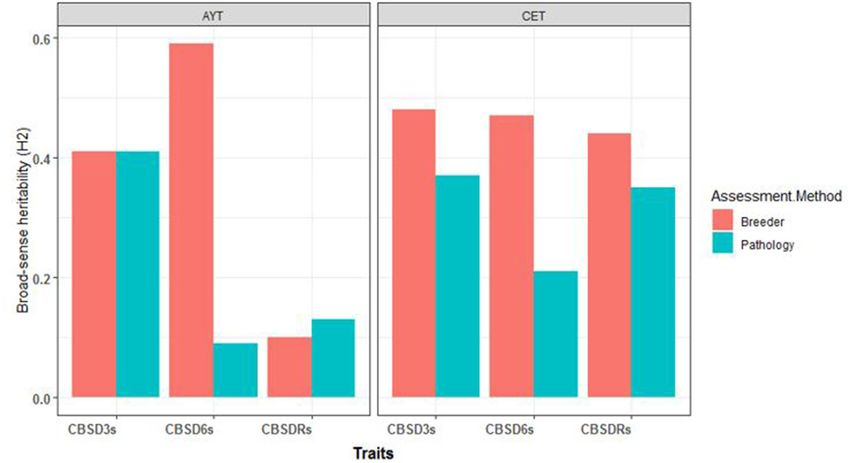
For C1 population, the broad-sense heritability estimates et al., 2005; Omongo et al., 2012; Mugerwa et al., 2018; Ally
for foliar and root necrosis from both CETs-2 and AYTs are et al., 2019), and sourcing for resistant genetic materials for
presented in Figure 1. We also observed higher H 2 values breeding (Kanju et al., 2007; Kawuki et al., 2016). More recently,
for the CBSD assessment method of breeders compared with transgenic approaches have also been explored to combat CBSD,
the CBSD assessment method of pathologists for both CET but with no officially released genetically transformed plant
and AYT evaluation stages. For example, at CET, H 2 at 3 under cultivation in Uganda to date (Patil et al., 2011; Yadav
months was 0.48 for the method of breeders and 0.38 for the et al., 2011; Wagaba et al., 2017). Collectively, these research
method of pathologists. At 6 months, H 2 was 0.47 for the interventions have contributed to our increased understanding
method of breeders and 0.21 for the computation of pathologists. and management of CBSD.
Based on the root necrosis data at harvest, the broad-sense A discrepancy remains in the methodologies of CBSD
heritability values were 0.44 and 0.35 for the methods of breeders resistance screening, which continues to be refined (Kawuki
and pathologists, respectively. Similarly, the higher broad-sense et al., 2019). In general, in screening for CBSD resistance,
heritability estimates of 0.42 and 0.56 were recorded for the plant pathologists assess clone performance based on average
combined data from AYTs for the method of breeders compared foliar infected plants and/or roots, i.e., exclude scores of 1
Frontiers in Plant Science | www.frontiersin.org 4 July 2021 | Volume 12 | Article 648436Ozimati et al. Cassava Brown Streak Disease Assessment
TABLE 1 | Broad and narrow-sense heritability estimates associated with breeder’s and pathologist’s CBSD root severity assessment methods.
Trial location Seasons C0 clones Broad-sense heritability Narrow-sense heritability
Breeder’s Pathologist’s Breeder’s Pathologist’s
Mityana 2015A 115 0.39 0.51 0.10 0.04
Mityana 2015B 105 0.62 0.64 0.49 0.22
Arua 2015A 149 0.15 0.00 0.00 0.00
Arua 2015B 111 0.64 0.47 0.39 0.34
Kasese 2015A 116 0.26 0.06 0.21 0.06
Kasese 2015B 138 0.54 0.57 0.51 0.34
Kigumba 2015A 147 0.49 0.61 0.25 0.09
Kigumba 2015B 116 0.56 0.54 0.13 0.05
Namulonge 2015A 150 0.87 0.71 0.72 0.31
Namulonge 2015B 113 0.79 0.71 0.55 0.45
Serere 2015A 123 0.68 0.64 0.64 0.63
Serere 2015B 112 0.71 0.58 0.70 0.56
Lira 2015A 149 0.47 0.44 0.25 0.22
Lira 2015B 108 0.67 0.48 0.54 0.27
Mean Heritability 0.56 0.49 0.39 0.25
2015A and 2015B, refers to the first (April-May) and second (Aug-Sept) planting seasons.
FIGURE 1 | The broad-sense heritability estimates (H2 ) for the three disease traits (cassava brown streak disease severity assessed at 3-months after planting
[CBSD3s], cassava brown streak disease severity assessed at 6-months after planting [CBSD6s], cassava brown streak disease root severity assessed at 12-months
after planting [CBSDRs]) for clonal evaluation trials (CETs-2) and advanced yield trials (AYTs) for the two mean CBSD computation methods.
(Ogwok et al., 2012; Odipio et al., 2014). On the other hand, the methods have varying sampling sizes, hence introducing
breeders assess clone performance based on average foliar sampling errors or biases. This study aimed at comparing the
infected plants and/or roots without excluding the severity scores two CBSD severity assessment methods based on the heritability
of 1, i.e., no data are excluded (Kanju et al., 2007; Okul et al., estimates and the relative ranking of clones at different
2018; Kawuki et al., 2019; Ozimati et al., 2019). Certainly, trial stages.
Frontiers in Plant Science | www.frontiersin.org 5 July 2021 | Volume 12 | Article 648436Ozimati et al. Cassava Brown Streak Disease Assessment
TABLE 2 | Pearson correlation coefficients of the 50 clones evaluated at CETs-2 no necrosis). In the same study by Kawuki et al. (2019), the
and AYTs. lowest standard error from five CBSD root necrosis assessment
BLUPs Raw phenotype methods were associated with trials at Namulonge, supporting
early studies qualifying Namulonge as a hot spot for CBSD
Traits Breeder’s Pathologist’s Breeder’s Pathologist’s
screening (Kaweesi et al., 2014; Okul et al., 2018). It is not
CBSD3s 0.40** 0.29** 0.37** 0.19ns
surprising that Namulonge presented the highest heritability
CBSD6s 0.37** 0.20ns 0.36** 0.26*
estimates in this study, supporting it as a hot spot for CBSD
screening. Efforts are currently in place to improve the CBSD
CBSDRs 0.02ns 0.03ns 0.05ns 0.11ns
phenotyping at the hot spot in Namulonge by the use of
S.I 0.20ns 0.06ns 0.21ns 0.09ns
imaging technology, which is considered a robust and less
*, **Significant correlation at p ≤ 0.05 and 0.01, respectively. subjective screening method. As stated by Bernardo (2003),
ns, non-significant correlations coefficients; CBSD3s, cassava brown streak disease heritability is an important function in the genetic study of
severity scored 3 months after planting; CBSD6s, cassava brown streak disease severity
scored 6 months after planting; CBSDRs, cassava brown streak disease root severity
metric character, because it reflects the predictive accuracy and
scored at 12-months harvest; S.I, selection index values for the three cassava brown reliability of the phenotypic values. Thus, the highest heritability
streak traits; BLUPs, best linear unbiased predictors for clones. estimates (i.e., broad sense and narrow sense) for both foliar
and CBSD root necrosis recorded from the computation of
breeders support the use of this method for efficient selection of
TABLE 3 | Ranking of top 10 C1 clones by their indexed BLUPs values for the two
CBSDs.
CBSD-resistant clones.
Breeder’s Pathologist’s
Comparing Pearson’s Correlation
CETs-2 AYTs CETs-2 AYTs
Coefficients for BLUP Estimates of Clone
UG15F190P001* UG15F190P001 UG15F262P513 UG15F265P001 in CETs-2 and AYTs for the Two CBSD
UG15F262P513 UG15F079P011 UG15F190P001* UG15F312P003 Assessments Methods
UG15F170P507* UG15F140P003 UG15F017P003 UG15F190P001 The best linear unbiased predictor (BLUP) pioneered by C.R.
UG15F176P004 UG15F196P004 UG15F177P016 UG15F249P007 Henderson (Piepho et al., 2008) as a procedure for genetic
UG15F201P517 UG15F176P502 UG15F170P507 UG15F047P010 estimation was first used for practical dairy breeding. The BLUP
UG15F079P011* UG15F177P016 UG15F306P028 UG15F044P009 procedure allows for a more accurate estimation of genetic
UG15F176P502* UG15F044P009 UG15F176P004 UG15F169P507 merit of traits in the unbalanced data while accounting for the
UG15F017P003 UG15F170P507 UG15F222P038 UG15F158P005 differences in the amount of data available for each genotype
UG15F209P001 UG15F222P038 UG15F361P510 UG15F140P001 (Bernardo, 2003). In general, the correlation coefficients of
UG15F302P513 UG15F312P003 UG15F154P005 UG15F196P004 BLUP values for CBSD traits of clones that were filtered from
CETs-2 (C1 ) to AYTs (C1 ) were low to moderate (r = 0.02–
CETs-2, clonal evaluation trial (C1); AYTs, advanced yield trials.
0.40). However, these correlation coefficients were higher and
*Overlapping clones at CET and AYT.
significant (p ≤ 0.01) for the mean foliar CBSD computation of
breeders than the method of pathologists for clones that made it
Heritability Estimates of CBSD Foliar and from CETs-2 to AYTs. Ozimati et al. (2019) previously reported
a high genetic correlation of 0.70 for root necrosis between
Root Necrosis for the Two Assessment measurements at seedling vs. at clonal evaluations. In this study,
Methods the low correlation observed between BLUPs values at CETs-
According to Bernardo (2003), the broad- and narrow-sense 2 and AYTs for root necrosis could be due to degeneration.
heritability estimates are critical for selection decisions. The Recycling the clones for more than three planting seasons has
comparison of heritability estimates across CETs-1 revealed been reported to cause resistance degeneration due to the buildup
higher heritability estimates for the method of breeders for of the virus population (Shirima et al., 2017). In fact, to date,
CBSD root severity assessment than that for the method of no clones have been reported to be immune in the conventional
pathologists, with the highest plot-based broad-sense (H 2 = 0.87) breeding pipeline, except for the recent sources of immunity
and narrow-sense (h2 = 0.72) heritability estimates recorded reported from Latin American germplasm (Sheat et al., 2019).
for Namulonge trial in 2015A. In a recent study by Kawuki One approach of selecting and advancing clones in face of
et al. (2019), a minimum number of 30 roots per plot were degeneration due to the virus buildup would be to complement
recommended to obtain the meaningful assessment of CBSD the symptom-based screening with the measurements of virus
root necrosis. A notable difference between the CBSD assessment titer, especially when advancing clones from the mid-to-late
methods of breeders and pathologists is that the former uses stages of selection, i.e., from CET stage onward. However, the
sample sizes larger (i.e., includes all roots to obtain plot mean) high cost per assay is a major limitation to the use of quantitative
than the latter (i.e., excludes roots with a severity score of 1). PCR (q-PCR) for virus screening of a large number of clones, as at
Averaging all root scores per plot possibly explains the higher CET (i.e., over 600 genotypes; Ogwok et al., 2012; Kaweesi et al.,
precision and heritability estimates observed for the CBSD 2014; Okul et al., 2018). Through international collaboration
assessment of breeders compared with that for the approach with Plant Virus Department, Leibniz Institute DSMZ-German
of pathologists with the exclusion of roots scores of 1 (i.e., Collection of Microorganism and Cell Culture, Braunschweig,
Frontiers in Plant Science | www.frontiersin.org 6 July 2021 | Volume 12 | Article 648436Ozimati et al. Cassava Brown Streak Disease Assessment
Germany, a cheap and rapid assay is being developed to enable compared with cases where roots with severity scores of
the screening of large entries. Nonetheless, the higher correlation 1 were excluded.
coefficients observed between the BLUP values of clones in
CETs-2 and AYTs for mean CBSD computation of breeders DATA AVAILABILITY STATEMENT
than for the approach of pathologists support the use of the
assessment methods of breeders for a more effective selection of The original contributions presented in the study are included
resistant clones. in the article/Supplementary Material, further inquiries can be
directed to the corresponding author/s.
Ranking of Clones by Their Indexed BLUPs
for the Two CBSD Averaging Methods AUTHOR CONTRIBUTIONS
In a recent study by Kawuki et al. (2019), to evaluate the
alternative methods for assessing CBSD root necrosis, 256 AO conceived the original manuscript idea, analyzed the data,
clones were ranked using their BLUPs for five CBSD assessment and wrote the manuscript. RK, TA, WE, J-LJ, and CE reviewed the
methods. The comparison of the top 15 resistant clones ranked manuscript. All authors contributed to the article and approved
across the CBSD assessment methods showed one overlapping the submitted version.
clone for all the five CBSD root necrosis assessment methods
(Kawuki et al., 2019). In this study, ranking of the top 10 resistant FUNDING
clones from CETs-2 and AYTs revealed four clones featuring
at both evaluation stages for the CBSD assessment method of This work was supported by Next Generation Cassava Breeding
breeders compared with only a single clone that overlapped Project (INV-007637) through funding from Bill and Melinda
for the approach of pathologists. Four clones overlapping Gates Foundation and by the International Department of the
at CETs-2 and AYTs for breeders mean CBSD computation United Kingdom.
relative to a single clone for pathologists assessment method,
further supports the use of breeders-derived phenotypes to guide ACKNOWLEDGMENTS
selection decisions.
We thank NaCRRI field and laboratory technical staff for their
CONCLUSION support during data collection and sampling of leaves for DNA
extraction, respectively.
This study provides insights into CBSD necrosis assessment as
performed by the methods of breeders and pathologists that SUPPLEMENTARY MATERIAL
remarkably differ in how the mean severities are computed.
Based on the heritability estimates and the number of clones The Supplementary Material for this article can be found
that were filtered, it was evident that computing mean CBSD online at: https://www.frontiersin.org/articles/10.3389/fpls.2021.
for the entire number of roots from a plot was more reliable 648436/full#supplementary-material
REFERENCES Hamblin, M. T., and Rabbi, I. Y. (2014). The effects of restriction-enzyme choice on
properties of genotyping-by-sequencing libraries: a study in Cassava (Manihot
Alicai, T., Ndunguru, J., Sseruwagi, P., Tairo, F., Okao-Okuja, G., Nanvubya, esculenta). Crop Sci. 54, 2603–2608. doi: 10.2135/cropsci2014.02.0160
R., et al. (2016). Cassava brown streak virus has a rapidly evolving genome: Hickey, L. T., Hafeez, A. N., Robinson, H., Jackson, S. A., Leal-bertioli, S. C. M.,
implications for virus speciation, variability, diagnosis and host resistance. Sci. Tester, M., et al. (2017). Breeding crops to feed 10 billion. Nat. Biotechnol. 37,
Rep. 6:36164. doi: 10.1038/srep36164 744–754. doi: 10.1038/s41587-019-0152-9
Alicai, T., Omongo, C. A., Maruthi, M. N., Hillocks, R. J., Baguma,Y., Kawuki, R., Hillocks, R. (2004). Research Protocols for Cassava Brown Streak Virus.
et al. (2007). Re-emergence of cassava brown streak disease in Uganda. Plant Fao.Org, 1–7.
Dis. 91, 24–29. doi: 10.1094/PD-91-0024 Hillocks, R., Maruthi, M., Kulembeka, H., Jeremiah, S., Alacho, F., Masinde,
Ally, H. M., El Hamss, H., Simiand, C., Maruthi, M. N., Colvin, J., Omongo, C. E., et al. (2016). Disparity between leaf and root symptoms and crop losses
A., et al. (2019). What has changed in the outbreaking populations of the associated with cassava brown streak disease in four countries in Eastern Africa.
severe crop pest whitefly species in cassava in two decades. Sci. Rep. 9, 1–13. J. Phytopathol. 164, 86–93. doi: 10.1111/jph.12430
doi: 10.1038/s41598-019-50259-0 Hillocks, R. J., and Maruthi, M. N. (2015). Post-harvest impact of cassava brown
Ateka, E., Alicai, T., Ndunguru, J., Tairo, F., Sseruwagi, P., Kiarie, S., et al. streak disease in four countries in eastern Africa. Food Chain 5, 116–122.
(2017). Unusual occurrence of a DAG motif in the Ipomovirus Cassava brown doi: 10.3362/2046-1887.2015.008
streak virus and implications for its vector transmission. PLoS ONE 12:187883. Hillocks, R. J., and Thresh, J. M. (2000). Cassava mosaic and cassava brown streak
doi: 10.1371/journal.pone.0187883 virus diseases in Africa. Root 7, 1–8.
Bernardo, R. (2003). Breeding for Quantitative Traits in Plants. (Woodbury, MN: Kanju, E. E., Masumba, E., Masawe, M., Tollano, S., Mulli, B., Mahungu., N., et al.
Stemma Press). (2007). Breeding cassava for brown streak resistance: regional cassava variety
Elshire, R. J., Glaubitz, J. C., Sun, Q., Poland, J. A., Kawamoto, K., Buckler, E. S., development strategy based on farmer and consumer preferences. Proc. 13th
et al. (2011). A robust, simple genotyping-by-sequencing (GBS) approach for ISTRC Symp. 2007, 95–101.
high diversity species. PLoS ONE 6, 1–10. doi: 10.1371/journal.pone.0019379 Kaweesi, T., Kawuki, K., Kyaligonza, V., Baguma, Y., Tusiime, G., and Ferguson,
FAOSTAT (2019). Food and Agriculture organization of the United Nations, 2010. M. E., et al. (2014). Field evaluation of selected cassava genotypes for
Available online at: http://www.fao.org/faostat/en/#home (accessed October 15, cassava brown streak disease based on symptom expression and virus load
2020). Field evaluation of selected cassava genotypes for cassava brown streak
Frontiers in Plant Science | www.frontiersin.org 7 July 2021 | Volume 12 | Article 648436Ozimati et al. Cassava Brown Streak Disease Assessment disease based on symptom expression and virus load. Virol. J. 2, 11–216. Cassava breeding population for genomic selection. Crop Sci. 59, 460–473. doi: 10.1186/s12985-014-0216-x doi: 10.2135/cropsci2018.01.0060 Kawuki, R. S., Esuma, W., Ozimati, A., Kayondo, I. S., Nandudu, L., and Patil, B. L., and Fauquet, C. M. (2009). Cassava mosaic geminiviruses: Wolfe, M., et al. (2019). Alternative approaches for assessing cassava brown actual knowledge and perspectives. Mol. Plant Pathol. 10, 685–701. streak root necrosis to guide resistance breeding and selection. 10, 1–13. doi: 10.1111/j.1364-3703.2009.00559.x doi: 10.3389/fpls.2019.01461 Patil, B. L., Legg, J. P., Kanju, E., and Fauquet, C. M. (2015). Cassava brown Kawuki, R. S., Kaweesi, T., Esuma, W., Pariyo, A., Kayondo, I. S., Ozimati, streak disease: a threat to food security in Africa. J. Gen. Virol. 96, 956–968. A., et al. (2016). Eleven years of breeding efforts to combat cassava doi: 10.1099/jgv.0.000014 brown streak disease. Breed. Sci. 66, 560–571. doi: 10.1270/jsbbs. Patil, B. L., Ogwok, E., Wagaba, H., Mohammed, I. U., Yadav, J. S., Bagewadi, B., 16005 et al. (2011). RNAi-mediated resistance to diverse isolates belonging to two Legg, J. P., Jeremiah, S. C., Obiero, H. M., Maruthi, M. N., Ndyetabula, I., Okao- virus species involved in Cassava brown streak disease. Mol. Plant Pathol. 12, Okuja, G., et al. (2011). Comparing the regional epidemiology of the cassava 31–41. doi: 10.1111/j.1364-3703.2010.00650.x mosaic and cassava brown streak virus pandemics in Africa. Virus Res. 159, Piepho, H. P., Möhring, J., Melchinger, A. E., and Büchse, A. (2008). BLUP for 161–170. doi: 10.1016/j.virusres.2011.04.018 phenotypic selection in plant breeding and variety testing. Euphytica 161, Malik, A. I., Kongsil, P., Ou, W., Srean, P., Utsumi, Y., Lu, C., et al. (2020). Cassava 209–228. doi: 10.1007/s10681-007-9449-8 breeding and agronomy in Asia: 50 years of history and future directions. Breed R Development Core Team (2008). R: A language and environment for statistical Sci. 70, 145–166. doi: 10.1270/jsbbs.18180 computing. R Foundation for Statistical Computing, Vienna, Austria. (ISBN Maruthi, M. N., Hillocks, R. J., Mtunda, K., Raya, M. D., Muhanna, 3-900051-07-0): 900051. Vienna: R Found. Stat. Comput. M., Kiozia, H., et al. (2005). Transmission of Cassava brown streak Sheat, S., Fuerholzner, B., Stein, B., and Winter, S. (2019). Resistance virus by Bemisia tabaci (Gennadius). J. Phytopathol. 153, 307–312. against cassava brown streak viruses from Africa in cassava germplasm doi: 10.1111/j.1439-0434.2005.00974.x from South America. Front. Plant Sci. 10:567. doi: 10.3389/fpls.201 Mbanzibwa, D. R., Tian, Y. P., Tugume, A. K., Patil, B. L., Yadav, J. S., Bagewadi, 9.00567 B., et al. (2011). Evolution of cassava brown streak disease-associated viruses. J. Shirima, R., Maeda, D., Kanju, E., Ceasar, G., Tibazarwa, F., and Legg, J. Gen. Virol. 92, 974–987. doi: 10.1099/vir.0.026922-0 (2017). Absolute quantification of cassava brown streak virus mRNA by Mbewe, W., Tairo, F., Sseruwagi, P., Ndunguru, J., Duffy, S., Mukasa, S., et al. real-time qPCR. J. Virol. Methods 245, 5–13. doi: 10.1016/j.jviromet.2017. (2017). Variability in P1 gene redefines phylogenetic relationships among 03.003 cassava brown streak viruses. Virol. J. 14, 1–7. doi: 10.1186/s12985-017-0790-9 Wagaba, H., Beyene, G., Aleu, J., Odipio, J., Okao-Okuja, G., Chauhan, R. Mugerwa, H., Seal, S., Wang, H. L., Patel, M. V., Kabaalu, R., Omongo, C. A., D., et al. (2017). Field level RNAi-mediated resistance to cassava brown et al. (2018). African ancestry of New World, Bemisia tabaci-whitefly species. streak disease across multiple cropping cycles and diverse East African Sci. Rep. 8, 1–11. doi: 10.1038/s41598-018-20956-3 agro-ecological locations. Front. Plant Sci. 7:2060. doi: 10.3389/fpls.2016. Mware, B., Ateka, E., Songa, J., Narla, R. D., Olubaya, F., and Amata, R. (2009). 02060 Transmission and distribution of cassava brown streak virus disease in cassava Wolfe, M. D., Del Carpio, D. P., Alabi, O., Ezenwaka, L. C., Ikeogu, U. N., Kayondo, growing areas of Kenya. J. Appl. 16:864–870. I. S., et al. (2017). Prospects for genomic selection in cassava breeding. Plant Odipio, J., Ogwok, E., Taylor, N. J., Halsey, M., Bua, A., Fauquet, C. M., Genome 10, 1–19. doi: 10.3835/plantgenome2017.03.0015 et al. (2014). RNAi-derived field resistance to Cassava brown streak disease Wolfe, M. D., Rabbi, I. Y., Egesi, C., Hamblin, M., Kawuki, R., Kulakow, persists across the vegetative cropping cycle. GM Crops Food 5, 16–19. P., et al. (2016). Genome-wide association and prediction reveals genetic doi: 10.4161/gmcr.26408 architecture of cassava mosaic disease resistance and prospects for rapid genetic Ogwok, E., Odipio, J., Halsey, J., Gaitán-Solís, E., Bua, A., Taylor, N. J., improvement. Plant Genome 9, 342–356. doi: 10.3835/plantgenome2015.11. et al. (2012). Transgenic RNA interference (RNAi)-derived field resistance 0118 to cassava brown streak disease. Mol. Plant Pathol. 13, 1019–1031. Yadav, J. S., Ogwok, E., Wagaba, H., Patil, B. L., Bagewadi, B., Alicai, T., et al. (2011). doi: 10.1111/j.1364-3703.2012.00812.x RNAi-mediated resistance to Cassava brown streak Uganda virus in transgenic Okul, A., Ochwo-Ssemakula, M., Kaweesi, T., Ozimati, A., Mrema, E., Mwale, E. cassava. Mol. Plant Pathol. 12, 677–687. doi: 10.1111/j.1364-3703.2010.0 S., et al. (2018). Plot based heritability estimates and categorization of cassava 0700.x genotype response to cassava brown streak disease. Crop Prot. 108, 39–46. doi: 10.1016/j.cropro.2018.02.008 Conflict of Interest: The authors declare that the research was conducted in the Omongo, C. A., Kawuki, R., Bellotti, A. C., Alicai, T., Baguma, Y., Maruthi, absence of any commercial or financial relationships that could be construed as a M. N., et al. (2012). African cassava whitefly, Bemisia tabaci, resistance in potential conflict of interest. African and South American Cassava genotypes. J. Integr. Agric. 11, 327–336. doi: 10.1016/S2095-3119(12)60017-3 Copyright © 2021 Ozimati, Esuma, Alicai, Jannink, Egesi and Kawuki. This is an Ozimati, A., Kawuki, R., Esuma, W., Kayondo, I. S., Wolfe, W., Lozano, R., open-access article distributed under the terms of the Creative Commons Attribution et al. (2018). Training population optimization for prediction of cassava brown License (CC BY). The use, distribution or reproduction in other forums is permitted, streak disease resistance in West African Clones. Genes Genomes Genet. 8, provided the original author(s) and the copyright owner(s) are credited and that the 3903–3913. doi: 10.1534/g3.118.200710 original publication in this journal is cited, in accordance with accepted academic Ozimati, A., Kawuki, R., Esuma, W., Kayondo, S. I., Pariyo, A., Wolfe, M., practice. No use, distribution or reproduction is permitted which does not comply et al. (2019). Genetic variation and trait correlations in an East African with these terms. Frontiers in Plant Science | www.frontiersin.org 8 July 2021 | Volume 12 | Article 648436
You can also read


