Oval Court, Burlington Housing Impact Statement - April 29, 2021 - City of Burlington
←
→
Page content transcription
If your browser does not render page correctly, please read the page content below
Oval Court, Burlington
Housing Impact Statement

                           April 29, 2021
Oval Court, Burlington
Housing Impact Statement
Prepared for:
Branthaven Homes
Prepared by:
Altus Group Economic Consulting
33 Yonge Street Toronto Ontario M5E 1G4
Phone: (416) 641‐9500 Fax: (416) 641‐9501
economics@altusgroup.com
altusgroup.com
April 29, 2021April 29, 2021
EXECUTIVE SUMMARY
Altus Group Economic Consulting was retained by Branthaven Homes to
prepare a Housing Impact Statement for the proposed development at Oval
Court in the City of Burlington.
Overview of Subject Site and Proposed Development
The subject site, which covers numerous sites fronting onto Oval Court, is
located in the City of Burlington, immediately east of the Appleby GO
Station, and west of Sherwood Forest Park. The site is located on the south
side of the Lakeshore West GO rail corridor. Also located on the south side of
the rail corridor are various residential uses along Fairview Street.
The site is currently occupied by several non‐residential buildings containing
a mix of office and industrial users. In total, the buildings on the parcels
comprising the subject site include 192,379 square feet of industrial/office
uses.
The proposed development consists of multiple mixed‐use buildings that
will have residential, retail, office and institutional uses. The plan includes
1,996 residential apartment units (including 190 assisted living units), and
approximately 134,700 square feet of non‐residential development, which
includes office space (69,224 sf), retail space (25,163 sf), day‐care space
(10,757 sf), and a library (29,576 sf).
Affordable Housing Definition and Delivery
Halton’s 2019 State of Housing report states that the affordable threshold for
maximum purchase prices is $393,400 and the maximum monthly rent is
$2,060. Over the 2017‐2019 period, approximately 26% of new housing sales
in the Region met the Region’s definition of affordable, including 45% of new
housing units constructed in Burlington (or 102 new affordable units in the
City over the 2017‐2019 period).
Achieving Housing and Density Targets Within Appleby GO MTSA
The proposed development would contribute towards the achievement of the
Region’s intensification targets generally within the City as well as the
density targets within the Appleby GO Major Transit Station Area (MTSA):
Oval Court, Burlington Altus Group Economic Consulting
Housing Impact Statement Page iApril 29, 2021
Halton ROPA 48 proposes an alternative density target for the
Appleby GO MTSA of 120 persons & jobs per hectare. The land area
within the Appleby GO MTSA is 166.26 hectares;
The site size of the subject site is 4.5 hectares, or approximately 2.7%
of the site area within the Appleby GO MTSA;
At the proposed minimum density target of 120 persons and jobs per
hectare, the required persons and jobs needed to achieve the density
target is 19,951 persons and jobs (120 persons & jobs x 166.26
hectares);
Based on planned persons and jobs within the MTSA, the Appleby
GO would require 11,970 jobs and 7,980 persons to achieve the 19,951
persons and jobs required to meet the minimum density target of 120
persons and jobs per hectare;
The total number of persons and jobs generated in the subject
development (3,124 persons and jobs) would equate to under 16% of
the minimum number of persons and jobs required within the
Appleby GO MTSA, at the proposed minimum density target of 120
persons & jobs per hectare.
If the Region decides to limit residential uses in the employment lands to the
north of the GO rail corridor, it will place additional emphasis on ensuring
that the lands to the south of the rail corridor maximize the residential
densities needed to bring the overall MTSA density up to the planned
minimum density targets, and provide a mix of persons and jobs to the
transit station area and to optimize the investments made to transit capacity
in the station area.
Affordable Housing Proposed Within Oval Court Development
Branthaven proposes to provide 5% of the housing units within the
development as affordable housing, to be provided proportionately
throughout the housing development as each development phase progresses.
The proposed affordable units will be provided based on the Region’s
quantified definition of affordable housing price/rent thresholds, as they
stand as of the date of application.
The roughly 100 units of affordable housing units proposed to be provided
within the Oval Court development matches the number of affordable
Oval Court, Burlington Altus Group Economic Consulting
Housing Impact Statement Page iiApril 29, 2021
housing units provided in total, City‐wide over the 2017‐2019 period, as
reported in the Region’s annual State of Housing reports.
Branthaven is in the process of engaging affordable housing providers,
including Habitat for Humanity and Options for Homes. Discussions to
develop an affordable housing strategy are on‐going.
In addition to the affordable residential units to be provided, Branthaven
intends to include approximately 190 assisted living/long‐term care units
within the development (or 9.5% of proposed units).
Response to Required Elements in Housing Impact Statement
The City’s requirements for a Housing Impact Statement requires several
elements and considerations be addressed. The table below sets out the
considerations and how they are addressed within this report and the
development proposal itself.
Figure ES‐ 1 Required Element Analysis
How the proposal The proposal would directly contribute to the achievement of the
contributes to achieving Region’s affordable housing targets by providing 5% of the proposed
the Region’s housing housing units (or approximately 100 units) as affordable units, as well
targets, including as 200 assisted living/long‐term care units.
identification of any
The number of affordable housing units proposed to be provided
proposed new
(approximately 100 units) would be roughly equal to the total amount
affordable or assisted
of new affordable housing created in the City over the three‐year
housing units.
period from 2017 to 2019.
The proposal would also contribute a significant proportion of the
required amount of apartment units within the City’s built‐up area,
helping the City and Region achieve the population and housing
forecasts in their respective Official Plans.
The development would also indirectly contribute to housing
affordability more broadly by making available approximately 4.5 to
5.5 years of apartment supply to the City, based on historic levels of
apartment unit completions in the City.
How the estimated rents Beyond the 5% of units to be provided as affordable units, the other
and/or initial sales units are not expected to meet the Region’s definition of affordable
Oval Court, Burlington Altus Group Economic Consulting
Housing Impact Statement Page iiiApril 29, 2021 prices of the housing, given the anticipated larger unit sizes to be provided within development are at or the development, and costs associated with housing development. below the affordable housing thresholds by type. Where construction of It is expected that the affordable housing units to be provided will be the units is expected to constructed proportionately to ‘market’ units throughout each phase of occur in phases, the development, with 5% of the units in each development phase information regarding being affordable housing units. the number of affordable housing units to be provided per phase, where applicable. The proposed legal It is assumed that the City and/or Region would support, through and/or financial funding, incentives and/or other mechanisms, the delivery of mechanisms to ensure affordable housing where applicable and that Branthaven can further the delivery of any clarify how City, Regional, Provincial and Federal programs can be proposed new leveraged to facilitate this policy. Policies reflective of such intention affordable housing should also be considered and included. commitments, and mechanisms to retain the long‐term affordability of units, where applicable Oval Court, Burlington Altus Group Economic Consulting Housing Impact Statement Page iv
April 29, 2021

TABLE OF CONTENTS
                                                                                                                                                         Page

                  EXECUTIVE SUMMARY ................................................................................. i

                  1     INTRODUCTION ...................................................................................... 1
                        1.1 Subject Site ....................................................................................................................... 1
                        1.2 Approach ......................................................................................................................... 2

                  2     POLICY CONTEXT .................................................................................... 3
                        2.1 Provincial Policy Statement........................................................................................... 3
                        2.2 Growth Plan for the Greater Golden Horseshoe ........................................................ 4
                        2.3 Region of Halton Official Plan ...................................................................................... 6
                        2.4 City of Burlington Official Plan .................................................................................... 8
                        2.5 Region of Halton 2019 State of Housing Report ......................................................... 9

                  3     OVERVIEW OF PROPOSED DEVELOPMENT................................. 11
                        3.1 Overview of Development ...........................................................................................11
                        3.2 How Proposal Contributes to Achievement of Region Housing Targets ...............12
                        3.3 Affordable Housing Units to be Provided .................................................................16
                        3.4 Assisted Housing ...........................................................................................................18

                  4     MECHANISM TO DELIVER AFFORDABLE HOUSING ............... 20
                        4.1 Delivery of Affordable Housing ..................................................................................20
                        4.2 Emerging Mechanisms to Deliver Affordable Housing ...........................................20

                  5     CONCLUSIONS ....................................................................................... 22

Oval Court, Burlington                                                                                         Altus Group Economic Consulting
Housing Impact Statement                                                                                                               Page v
April 29, 2021
1 INTRODUCTION
Altus Group Economic Consulting was retained by Branthaven Homes to
prepare a Housing Impact Statement for the proposed development at Oval
Court in the City of Burlington.
1.1 SUBJECT SITE
The subject site, which covers numerous sites fronting onto Oval Court, is
located in the City of Burlington, immediately east of the Appleby GO
Station, and west of Sherwood Forest Park. The location of the subject is
shown in Figure 1 below. The site is located on the south side of the
Lakeshore West GO rail corridor. Also located on the south side of the rail
corridor are various residential uses along Fairview Street.
Figure 1 Context Map of Oval Court, City of Burlington
Lakeshore West GO Line
Subject Site
Appleby GO
Station
Fairview Street
Source: Altus Group Economic Consulting
The site is currently occupied by several non‐residential buildings containing
a mix of office and industrial users:
720 Oval Court – improved with a 17,538 square foot light
industrial/office:
Oval Court, Burlington Altus Group Economic Consulting
Housing Impact Statement Page 1April 29, 2021
740 Oval Court – improved with a 53,768 square foot industrial
building with ancillary office space:
735‐737 Oval Court – improved with an 88,073 square foot
industrial/office building:
711 Oval Court/5155 Fairview Street – improved with a 24,000 square
foot light industrial/office building; and
5135 Fairview Street – improved with a 9,000 square feet industrial
building.
In total, the buildings on the parcels comprising the subject site include
192,379 square feet of industrial/office uses.
The proposed development consists of multiple mixed‐use buildings that
will have residential, retail, office and institutional uses. The plan includes
1,996 residential apartment units (including 190 assisted living units), and
approximately 134,700 square feet of non‐residential development, which
includes office space (69,224 sf), retail space (25,163 sf), day‐care space
(10,757 sf), and a library (29,576 sf).
1.2 APPROACH
The City of Burlington Official Plan requires the submission of a housing
impact statement when more than 100 units are included in a development
proposal. Section 3.1.1(2)h identifies the following requirements:
i. how the proposal contributes to achieving the Region’s housing
targets, including identification of any proposed new affordable or
assisted housing units;
ii. how the estimated rents and/or initial sales prices of the development
are at or below the affordable housing thresholds by type;
iii. where construction of the units is expected to occur in phases,
information regarding the number of affordable housing units to be
provided per phase, where applicable; and
iv. the proposed legal and/or financial mechanisms to ensure the
delivery of any proposed new affordable housing commitments, and
mechanisms to retain the long‐term affordability of units, where
applicable
Oval Court, Burlington Altus Group Economic Consulting
Housing Impact Statement Page 2April 29, 2021
2 POLICY CONTEXT
This section of the report provides insight into the policies regarding
affordable housing in both provincial and municipal planning policies, as
well as the various definitions of affordable and/or assisted housing in each
document.
2.1 PROVINCIAL POLICY STATEMENT
Section 1.1.1b) of the Provincial Policy Statement discusses affordable
housing:
1.1.1 Healthy, liveable and safe communities are sustained by:
b) accommodating an appropriate affordable and market-based range
and mix of residential types (including single-detached, additional
residential units, multi-unit housing, affordable housing and housing
for older persons), employment (including industrial and commercial),
institutional (including places of worship, cemeteries and long-term
care homes), recreation, parks and open space, and other uses to meet
long-term needs.
Policy 1.4.3 states that:
1.4.3 Planning authorities shall provide for an appropriate range and
mix of housing options and densities to meet projected market-based
and affordable housing needs of current and future residents of the
regional market area by:
a) establishing and implementing minimum targets for the provision of
housing which is affordable to low and moderate income households
and which aligns with applicable housing and homelessness plans.
However, where planning is conducted by an upper-tier municipality,
the upper-tier municipality in consultation with the lower-tier
municipalities may identify a higher target(s) which shall represent the
minimum target(s) for these lower-tier municipalities
The definition of affordable in the PPS is as follows:
Affordable: means
i. In the case of ownership housing, the least expensive of:
i. Housing for which the purchase price results in annual
accommodation costs which do not exceed 30 percent of
gross annual household income for low and moderate
income households; or
Oval Court, Burlington Altus Group Economic Consulting
Housing Impact Statement Page 3April 29, 2021
ii. Housing for which the purchase price is at least 10
percent below the average purchase price of a resale unit
in the regional market area;
ii. In the case of rental housing, the least expensive of:
1. A unit for which the rent does not exceed 30 percent of
gross annual household income for low and moderate
income households; or
2. A unit for which the rent is at or below the average market
rent of a unit in the regional market area.
The PPS defines low and moderate incomes as follows:
Low and moderate income households: means
a) In the case of ownership housing, households with incomes in the
lowest 60 percent of the income distribution for the regional
market area; or
b) In the case of rental housing, households with incomes in the
lowest 60 percent of the income distribution for renter households
for the regional market area;
2.2 GROWTH PLAN FOR THE GREATER GOLDEN HORSESHOE
One of policies in the Growth Plan regarding the achievement of complete
communities is as follows:
4. Applying the policies of this Plan will support the achievement of
complete communities that:
c) provide a diverse range and mix of housing options, including
additional residential units and affordable housing, to accommodate
people at all stages of life, and to accommodate the needs of all
household sizes and incomes.
d) expand convenient access to: i. a range of transportation options,
including options for the safe, comfortable and convenient use of active
transportation …
Policy 2.2.4.9 and 2.2.4.10 of the Growth Plan states that:
9. Within all major transit station areas, development will be supported,
where appropriate, by:
a) planning for a diverse mix of uses, including additional residential
units and affordable housing, to support existing and planned transit
service levels. …
Oval Court, Burlington Altus Group Economic Consulting
Housing Impact Statement Page 4April 29, 2021
10. Lands adjacent to or near to existing and planned frequent transit
should be planned to be transit-supportive and supportive of active
transportation and a range and mix of uses and activities.
Policy 2.2.6.1 of the Growth Plan states that:
1. Upper- and single-tier municipalities, in consultation with lower-tier
municipalities, the Province and other appropriate stakeholders, will:
a) support housing choice through the achievement of the minimum
intensification and density targets in this Plan, as well as the other
policies of this Plan by:
i. identifying a diverse range and mix of housing options and
densities, including additional residential units and affordable
housing to meet projected needs of current and future
residents; and
ii. establishing targets for affordable ownership housing and
rental housing.
The definition of affordable in the Growth Plan is as follows:
Affordable: means
a) In the case of ownership housing, the least expensive of:
i. Housing for which the purchase price results in annual
accommodation costs which do not exceed 30 percent of
gross annual household income for low and moderate
income households; or
ii. Housing for which the purchase price is at least 10
percent below the average purchase price of a resale unit
in the regional market area;
b) In the case of rental housing, the least expensive of:
i. A unit for which the rent does not exceed 30 percent of
gross annual household income for low and moderate
income households; or
ii. A unit for which the rent is at or below the average market
rent of a unit in the regional market area.
The Growth Plan defines low and moderate incomes as follows:
Low and moderate income households: means
c) In the case of ownership housing, households with incomes in the
lowest 60 percent of the income distribution for the regional
market area; or
Oval Court, Burlington Altus Group Economic Consulting
Housing Impact Statement Page 5April 29, 2021
d) In the case of rental housing, households with incomes in the
lowest 60 percent of the income distribution for renter households
for the regional market area;
2.3 REGION OF HALTON OFFICIAL PLAN
Map 1 of the Halton Region OP identifies Appleby GO as a Major Transit
Station Area.
Policy 78(11) of the Halton Region OP states that the objectives of major
transit station areas are as follows:
For Major Transit Station Areas and Intensification Corridors:
a) To achieve increased residential and employment densities in order
to ensure the viability of existing and planned transit infrastructure and
service.
b) To achieve a mix of residential, office, institutional and commercial
development, where appropriate.
c) For Major Transit Station Areas, to provide access from various
transportation modes to the transit facility, including consideration of,
but not limited to, pedestrians, bicycle routes and bicycle parking,
commuter pick-up/drop-off areas, carpool parking, car share vehicles,
and parking/recharging stations for electric vehicles. …
Policy 80 of the Region OP states that:
Intensification Areas are parts of the Urban Area and consist of: …
Major Transit Station Areas (including Metrolinx-designated Mobility
Hubs) as identified on Map 1 and Map 3 and/or in Local Official Plans,
which generally consist of areas within 500 m of the Major Transit
Station,
Policy 81 states that it is the policy of the Region to direct development with
higher densities and mixed uses to intensification areas, and to require
municipalities to prescribe minimum densities for lands within the
intensification areas:
It is the policy of the Region to:
(1) Direct development with higher densities and mixed uses to
Intensification Areas.
(2) Require Local Official Plans to identify Intensification Areas with
detailed boundaries in accordance with the objectives and policies of
this Plan.
(7) Require the Local Municipalities to:
Oval Court, Burlington Altus Group Economic Consulting
Housing Impact Statement Page 6April 29, 2021
a) include Official Plan policies and adopt Zoning By-laws to meet
intensification and mixed-use objectives for Intensification Areas;
b) prescribe in Official Plans and Zoning By-laws minimum
development densities for lands within Intensification Areas;
c) prohibit site-specific Official Plan or Zoning By-law amendments to
reduce development density within an Intensification Area unless it is
part of a municipal comprehensive review of the Official Plan or a
review of the Area-Specific Plan for the Intensification Area; and
d) promote development densities that will support existing and
planned transit services.
Policy 86 deals with the delivery of housing within the Region:
86. It is the policy of the Region to:
(2) Define Affordable Housing for the Halton and local municipal
markets based on its definition under Section 214.
(6) Adopt the following housing targets: a) that at least 50 per cent of
new housing units produced annually in Halton be in the form of
townhouses or multi-storey buildings; and b) that at least 30 per cent of
new housing units produced annually in Halton be Affordable or
Assisted Housing.
(6.1) Establish, in conjunction with the Local Municipalities, annual
targets for the production of housing units by density type and
affordability for each Local Municipality, based on the Regional targets
under Section 86(6).
(7) Provide annually a State of Housing report to Council that contains
among other things:
a) an update of the definitions of Assisted Housing and
Affordable Housing;
b) a review of housing supply, demand and need in Halton
during the past year, covering the various housing segments of
Assisted Housing, Affordable Housing, Market Housing,
Special Needs Housing and housing with universal physical
access;
c) identification of the gaps between supply and demand of
Assisted Housing and Affordable Housing;
d) state of homelessness in Halton; and e) performance of the
housing market towards meeting the housing targets under
Sections 86(6) and 86(6.1).
Halton Region defines Major Transit Station Area as follows:
Oval Court, Burlington Altus Group Economic Consulting
Housing Impact Statement Page 7April 29, 2021
MAJOR TRANSIT STATION AREA means the area including and
around any existing or planned higher order transit station within the
Urban Area; or the area including and around a major bus depot in an
urban core. Station areas generally are defined as the area within an
approximate 500m radius of a transit station, representing about a 10-
minute walk.
Halton Region defines affordable housing as follows:
AFFORDABLE HOUSING means housing with a market price or rent
that is affordable to households of low and moderate income spending
no more than 30 percent of their gross household income.
Affordable rental housing should meet the demand of households at the
low end, as described in Halton’s annual State of Housing Report,
pursuant to Section 86(7). Such households would be able to afford at
least three out of ten rental units on the markets
Affordable ownership housing should meet the demand of households
at the high end, as identified in Halton’s annual State of Housing
Report pursuant to Section 86(7). Such households would have
sufficient income left, after housing expenses, to sustain the basic
standard of living.
Halton Region defines assisted housing as follows:
ASSISTED HOUSING means housing that is available to low and
moderate income households for rent or purchase where part of the
housing cost is subsidized through a government program.
Halton Region defines Low and Moderate Income Households as follows:
LOW AND MODERATE INCOME HOUSEHOLDS mean: those
households defined through Halton’s annual State of Housing Report,
pursuant to Section 86(7), and in accordance with definitions of
Affordable and Assisted Housing under Section 214 and 218. The
income thresholds for low and moderate income households should not
be more than those as defined in the Provincial Policy Statement.
2.4 CITY OF BURLINGTON OFFICIAL PLAN
The City of Burlington Official Plan defines affordable housing as follows:
Affordable Housing - Housing with a market price or rent that is
affordable to households of low and moderate income spending 30
percent of their gross household income without government subsidies.
Such households would be able to afford, at the low end, at least three
out of ten rental properties on the market, and, at the high end,
ownership housing with sufficient income left, after housing expenses,
to sustain a basic standard of living.
Oval Court, Burlington Altus Group Economic Consulting
Housing Impact Statement Page 8April 29, 2021
The City of Burlington Official Plan defines assisted housing as follows:
Assisted Housing – Housing that is available to low and moderate
income households for rent or purchase where part of the housing cost
is subsidized through a government program.
The Official Plan defines low and moderate income households as follows:
Those households defined through the Region of Halton’s annual State
of Housing Report, pursuant to the Region of Halton Official Plan, and
in accordance with the definitions of Affordable and Assisted Housing
under the Region of Halton Official Plan. The income thresholds for
low and moderate income households should not be more than those as
defined in the Provincial Policy Statement.
2.5 REGION OF HALTON 2019 STATE OF HOUSING REPORT
Halton’s 2019 State of Housing report states that the affordable threshold for
maximum purchase prices is $393,400 and the maximum monthly rent is
$2,060. These values are roughly consistent with our estimates of affordable
ownership price and affordable rent thresholds as calculated under the
definitions of affordable housing under the PPS and Growth Plan.
The Region’s State of Housing reports over the 2017‐2019 period found that
approximately 26% of new housing sales in the Region met the Region’s
definition of affordable. Over the 2017‐2019 period, over 45% of new housing
units constructed in Burlington met the Region’s definition of affordable,
however this amounts to just 102 new affordable units in the City over a
three‐year period.
Oval Court, Burlington Altus Group Economic Consulting
Housing Impact Statement Page 9April 29, 2021
Figure 2 New Affordable Housing Sales by Municipality, Halton Region, 2017-
2019
Units Sold
Below Units Above Affordable
Affordable Affordable Units as %
Threshold Threshold Total of Total
2017 Units Percent
Single-Detached - 638 638 0.0%
Semi-Detached - 22 22 0.0%
Tow nhouse 483 321 804 60.1%
Apartment 576 117 693 83.1%
Total Region 1,059 1,098 2,157 49.1%
Burlington 72 43 115 62.6%
Halton Hills - 112 112 0.0%
Milton 428 414 842 50.8%
Oakville 559 529 1,088 51.4%
2018 Units Percent
Single-Detached - 805 805 0.0%
Semi-Detached - 219 219 0.0%
Tow nhouse 75 609 684 11.0%
Apartment 332 255 587 56.6%
Total Region 407 1,888 2,295 17.7%
Burlington 21 56 77 27.3%
Halton Hills - 107 107 0.0%
Milton 162 819 981 16.5%
Oakville 224 906 1,130 19.8%
2019 Units Percent
Single-Detached - 730 730 0.0%
Semi-Detached - 62 62 0.0%
Tow nhouse 85 761 846 10.0%
Apartment 65 25 90 72.2%
Total Region 150 1,578 1,728 8.7%
Burlington 9 24 33 27.3%
Halton Hills 1 132 133 0.8%
Milton 139 937 1,076 12.9%
Oakville 1 485 486 0.2%
Total 2017-2019 Units Percent
Single-Detached - 2,173 2,173 0.0%
Semi-Detached - 303 303 0.0%
Tow nhouse 643 1,691 2,334 27.5%
Apartment 973 397 1,370 71.0%
Total Region 1,616 4,564 6,180 26.1%
Burlington 102 123 225 45.3%
Halton Hills 1 351 352 0.3%
Milton 729 2,170 2,899 25.1%
Oakville 784 1,920 2,704 29.0%
Source: Halton Region, State of Housing Reports - 2017, 2018 & 2019
Oval Court, Burlington Altus Group Economic Consulting
Housing Impact Statement Page 10April 29, 2021
3 OVERVIEW OF PROPOSED DEVELOPMENT
3.1 OVERVIEW OF DEVELOPMENT
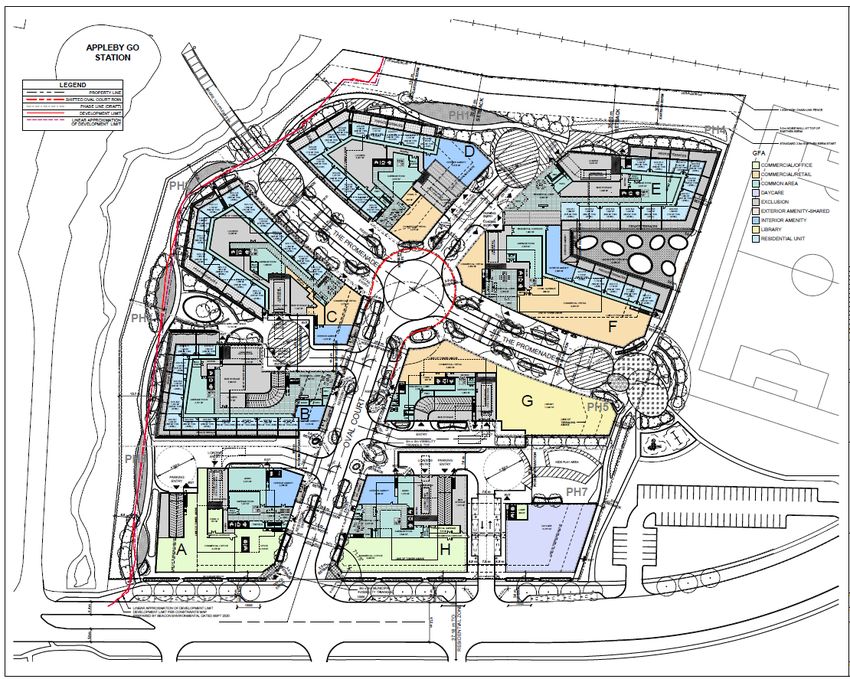
The proposed development consists of multiple mixed‐use buildings that
will have residential, retail, office and institutional uses. Figure 3 depicts the
site plan depicting how the project will look upon completion.
Figure 3
Figure 4 summarizes the project statistics for the subject site. In total, the plan
includes 1,996 residential apartment units, and approximately 134,700 square
feet of non‐residential development.
The residential units include nearly 500 units with 2‐or‐more bedrooms, with
large average unit sizes, ranging from an average of 822 square feet for 2‐
bedroom units, an average of 1,203 square feet for 2‐bedroom + den units,
and an average of 1,355 square feet for 3‐bedroom units.
Oval Court, Burlington Altus Group Economic Consulting
Housing Impact Statement Page 11April 29, 2021
Project Statistics: Oval Court, City of Burlington
Figure 4
Residential Share of Average
Units Units Size
Unit Type Units Percent Square Feet
1 Bedroom 499 25% 551
1 Bedroom + Den 998 50% 656
2 Bedroom 299 15% 822
2 Bedroom + Den 20 1% 1,203
3 Bedroom 180 9% 1,355
Total/Average 1,996 100% 723
GFA
Square Feet
Residential 1,838,349
Non-Residential 134,719
Total 1,973,068
Source: Altus Group Economic Consulting
The non‐residential space includes office space (69,224 sf), retail space (25,163
sf), daycare space (10,757 sf), and a library (29,576 sf).
3.2 HOW PROPOSAL CONTRIBUTES TO ACHIEVEMENT OF REGION
HOUSING TARGETS
3.2.1 Intensification Targets – Halton Region Official Plan
Table 2 of the Halton Region Official Plan sets out the minimum number of
new housing units to be added to the built‐up area of the various lower‐tier
municipalities over the 2015‐2031 period. The City of Burlington’s minimum
amount is 8,300 housing units.
Figure 5 Units Inside Built‐ Units Units per Year
Boundary
2012‐2016 2,525 505
2017‐2021 2,758 552
2022‐2026 2,669 534
2027‐2031 2,659 532
Total 2012‐2031 10,611 531
Oval Court, Burlington Altus Group Economic Consulting
Housing Impact Statement Page 12April 29, 2021
Table 2A provides a breakdown of the minimum intensification amounts
over the five‐year periods between 2012 and 2051, which is reproduced as
Figure 5.
3.2.2 Estimated Intensification Potential – Appleby GO MTSA
The Halton IGMS Report states that the intensification potential within the
Appleby GO MTSA is 7,885 units, including 394 rows, and 7,491 apartments.
The subject proposal would consist of 1,996 residential units, or just over 25%
of the potential development around Appleby GO.
3.2.3 Appleby GO MTSA Study / ROPA 48
Halton Region is proposing a density target for the Appleby GO MTSA in the
proposed Regional Official Plan Amendment 48 (ROPA 48) of 120 persons
and jobs per hectare, with ROPA 48 also containing minimums proportions
of jobs for the area, with 60% of the density achieved through jobs, and the
other 40% achieved through population in residential dwellings.
The total land area to the north of the rail corridor is 106.08 hectares, while
the land area to the south of the rail corridor is 60.18 hectares, for a total of
166.26 hectares. The site size of the subject site is 4.5 hectares, or
approximately 2.7% of the site area within the Appleby GO MTSA.
The Growth Plan, in section 5.2.5.4 states that density targets are to be
measured across all lands within the MTSA boundary.
Except as provided in policy 2.2.7.31, the minimum intensification and
density targets in this plan will be measured across all lands within the
relevant area, including any lands that are subject to more than one
target.
At the proposed minimum density target of 120 persons and jobs per hectare,
the required persons and jobs needed to achieve the density target is 19,951
persons and jobs (120 persons & jobs x 166.26 hectares). Using the proposed
split of jobs (60%) and residents (40%), and the requested alternative density
target (which is subject to Minister approval) the Appleby GO would require
11,970 jobs and 7,980 persons to achieve the 19,951 persons and jobs required
to meet the minimum density target of 120 persons and jobs per hectare.
1
Policy 2.2.7.3 relates to density targets within designated greenfield areas and lists exclusions for the
land base in the denominator of the calculated density per hectare.
Oval Court, Burlington Altus Group Economic Consulting
Housing Impact Statement Page 13April 29, 2021
Figure 6
Boundaries of Appleby GO MTSA
Subject Site
Source: Region of Halton, City of Burlington
It is noted that while ROPA 48 includes proposed minimum proportions of
jobs in the Appleby GO MTSA, the Growth Plan makes no distinction
between the proportions of persons and jobs that each MTSA should
generate, but contains a policy (2.2.4.9) stating that MTSAs should support
development by planning for a mix of uses, “including additional residential
units and affordable housing to support existing and planned transit service
levels.”
It is estimated that, based on person per unit and floor space per worker
factors from the City’s 2019 Development Charges Background Study2, that
the Oval Court development would generate 2,787 persons and 359 jobs, or a
total of 3,147 persons and jobs, or an increase of 2,864 persons from the
current estimated jobs on site of 283 jobs.
2
Watson & Associates, City of Burlington Development Charges Background Study, (March 18, 2019)
Oval Court, Burlington Altus Group Economic Consulting
Housing Impact Statement Page 14April 29, 2021
Figure 7 Oval Court Development Contribution Towards Meeting Proposed
Minimum Density Target at Appleby GO MTSA
Average
Residential Household Population
Units Size Estimates
Residential by Unit Type Units Persons/Unit Square Feet
1 Bedroom 499 1.282 640
1 Bedroom + Den 998 1.282 1,279
2 Bedroom 299 1.740 520
2 Bedroom + Den 20 1.740 35
3 Bedroom 180 1.740 313
Total 1,996 2,787
Job
GFA FSW Factors Estimates
Non-Residential Space Square Feet Sq. Ft. / Job Jobs
Off ice 69,224 360 192
Retail 25,163 560 44
Property Management 24
Daycare 10,757 400 26
Library 29,576 400 73
Total 134,720 359
Total Persons & Jobs - Oval Court 3,147
Less: Existing Persons & Jobs on Subject Sites 283
Equals Net New Persons & Jobs - Oval Court 2,864
Appleby MTSA - Area (ha) 166.26
Appleby MTSA - Minimum Persons & Jobs (@ 120 p&j/ha) 19,951
Oval Court - Persons & Jobs as % of Appleby GO MTSA Requirements 15.8%
Note: Property management estimate based on 1 job per 75,000 sf of residential
space
Source: Altus Group Economic Consulting
The total number of persons and jobs generated in the subject development
(3,124 persons and jobs) would equate to under 16% of the minimum number
of persons and jobs required within the Appleby GO MTSA, at the proposed
minimum density target of 120 persons & jobs per hectare. As a proportion of
the proposed composition of the density in the MTSA (40% population, 60%
jobs), the development proposal would consist of 2.7% of the land area
within the MTSA, just under 35% of the planned population, and 3.0% of the
jobs.
Oval Court, Burlington Altus Group Economic Consulting
Housing Impact Statement Page 15April 29, 2021
Figure 8 Oval Court Appleby GO MTSA Development Proposal
Development Proposal (ROPA 48) as % of ROPA 48 Targets
Population 2,787 persons 7,980 persons 34.9%
Jobs 359 jobs 11,970 jobs 3.0%
If the Region decides to limit the amount of residential uses in the
employment lands to the north of the GO rail corridor, it will place
additional emphasis on ensuring that the lands to the south of the rail
corridor maximize the residential densities needed to bring the overall MTSA
area up to the planned minimum density targets, and provide a mix of
persons and jobs to the transit station area and to optimize the investments
made to transit capacity in the station area.
3.3 AFFORDABLE HOUSING UNITS TO BE PROVIDED
3.3.1 Proposed Affordable Housing Units
Branthaven proposes to provide 5% of housing units as affordable housing,
which equates to approximately 100 units out of the proposed 1,996
residential apartment units.
The proposed affordable units will be provided based on the Region’s
quantified definition of affordable housing price/rent thresholds, as they
stand as of the date of application. When last outlined in the 2019 State of
Housing Report, these thresholds were pricing of less than $393,400 for
affordable ownership, or a rent of less than $2,060 per month for affordable
rental housing.
The roughly 100 units of affordable housing units proposed to be provided
within the Oval Court development matches the number of affordable
housing units provided in total, City‐wide over the 2017‐2019 period, as
reported in the Region’s annual State of Housing reports.
Branthaven is in the process of engaging affordable housing providers,
including Habitat for Humanity and Options for Homes. Discussions to
develop an affordable housing strategy are on‐going.
Given significant costs of construction and the limited inclusion of smaller‐
sized apartment units in the development, it is unlikely that many of the
Oval Court, Burlington Altus Group Economic Consulting
Housing Impact Statement Page 16April 29, 2021
other apartment units provided will be able to be constructed and sold at a
price below the Region’s definition of affordable ownership housing ‐ the
proposal does not include any bachelor/studio units which are the most
likely to be able to meet the Region’s affordable housing thresholds.
However, the ultimate sales price of the remaining units will depend on the
market’s demand for units within the development, so the amount of
affordable housing provided may end up being greater than the 5%
proposed to be set aside, provided and maintained by the affordable housing
providers.
In addition to the affordable residential units to be provided, Branthaven
intends to include approximately 190 assisted living/long‐term care units
within the development (or 9.5% of proposed units).
More broadly, beyond the provision of the proposed affordable housing
units within the development, the introduction of a large supply of
apartment units to the City and Region’s housing market will indirectly help
with housing affordability by ensuring that the demand for apartment
housing in the City and Region is sufficiently met with available supply,
minimizing upward pressure on pricing that can occur when supply is
significantly short of demand. For example, as an indication of the amount of
supply that the proposed development would bring to the City and Region:
The nearly 2,000 residential apartment units represents
approximately four‐years of the City’s 20‐year requirement for new
housing units within the intensification area by 2031.
The City has averaged 365 apartment unit completions per year over
the last ten years (2011‐2020), and 425 apartment unit completions
per year over the last five years (2016‐2020). The development
proposal would bring 4.5 to 5.5 years worth of available apartment
supply to the City’s housing market.
Oval Court, Burlington Altus Group Economic Consulting
Housing Impact Statement Page 17April 29, 2021
Figure 9 Annual Apartment Unit Completions, City of Burlington, 2001-2020
900
800 779
700
600
515
500
488 479
440
400 382 379
360
311 312 328
303
300 264
238
205 188
200
150
100 68
0 0
0
2001 2002 2003 2004 2005 2006 2007 2008 2009 2010 2011 2012 2013 2014 2015 2016 2017 2018 2019 2020
Source: CMHC
3.3.2 Affordable Housing Units by Phase
It is expected that the affordable housing units to be provided would be
provided proportionately throughout the housing development as each
development phase progresses, or 5% of the housing units provided within
each development phase. The 190 units of assisted living/long‐term care units
would be provided within Tower B.
3.4 ASSISTED HOUSING
Given the definitions of assisted housing in the Region of Halton and City of
Burlington Official Plans, additional affordable housing in the form of
assisted housing may be provided, should government programs be
available to convert a certain number of ‘market’ apartment units into
assisted housing units.
One such program offered by the Region of Halton is offered directly to
homebuyers or renters – the Region provides assistance to households
unable to afford the cost of maintaining their rental home, in the form of rent‐
geared‐to‐income assistance, through rent supplements provided to reduce
the cost of housing for qualified individuals and families. Landlords of rental
properties sign agreements to provide units to the program, and Halton
Region places eligible applicants in available units. The housing subsidy
Oval Court, Burlington Altus Group Economic Consulting
Housing Impact Statement Page 18April 29, 2021
provided through the program is paid directly to the landlord. Tenants then
pay their portion of their rent (based on their household income) directly to
the landlord. Households living in assisted housing pay a rent based on 30%
of their household income (before taxes).3 As of the end of 2019, there were
716 households in Halton Region receiving rent supplements.4
3
Halton Region Assisted Housing, https://www.halton.ca/For‐Residents/Housing‐Supports‐and‐
Services/Assisted‐Housing
4
Halton Region, 2019 State of Housing Report
Oval Court, Burlington Altus Group Economic Consulting
Housing Impact Statement Page 19April 29, 2021
4 MECHANISM TO DELIVER AFFORDABLE HOUSING
4.1 DELIVERY OF AFFORDABLE HOUSING
It is assumed that the City and/or Region would support, through funding,
incentives and/or other mechanisms, the delivery of affordable housing
where applicable and that Branthaven can further clarify how City, Regional,
Provincial and Federal programs can be leveraged to facilitate this policy.
Policies reflective of such intention should also be considered and included.
4.2 EMERGING MECHANISMS TO DELIVER AFFORDABLE HOUSING
4.2.1 Inclusionary Zoning
Section 3.1.1(2) of the City of Burlington Official Plan states that the City may
soon implement an inclusionary zoning policy:
…the City will develop a city-wide housing strategy that will support
the Region’s Comprehensive Housing Strategy and will:
vii. research and develop, in association with the Region and
local municipal partners, an inclusionary zoning by-law as
part of either a Region-wide program, or as a city-wide
program.
The City of Burlington has recently released an RFP for Phase 1 of the
Housing Study and are looking consultant to commence the study. Phase 1 of
the study will include an inclusionary zoning municipal assessment report.
As the subject development may be subject to inclusionary zoning, the
ultimate amount of affordable housing to be provided within the
development cannot be known at this time, however the amount being
proposed (5% of residential units) would at minimum act as a ‘credit’
towards an requirement under the City’s potential inclusionary zoning
program should it be applicable to the subject development.
4.2.2 Community Benefits Charge
As of September 2022, many municipalities will have adopted Community
Benefits Charges by‐laws (under a revised section 37 of the Planning Act),
which allows for the recovery of up to 4% of land value of high‐density
developments (5‐or‐more storeys and 10‐or‐more units) based on the value of
land the day before building permit issuance.
Oval Court, Burlington Altus Group Economic Consulting
Housing Impact Statement Page 20April 29, 2021
Assuming that the City of Burlington adopts a CBC by‐law, Section 37(6) of
the Planning Act allows a municipality that has passed a Community Benefits
Charge by‐law to allow an owner of land to provide in‐kind contributions to
a municipality.
The allowance for in‐kind contributions would appear to allow for the
provision of affordable housing as an in‐kind CBC contribution, with the
agreed‐upon value of the affordable housing provided deducted from the
amount of CBCs otherwise payable.
Oval Court, Burlington Altus Group Economic Consulting
Housing Impact Statement Page 21April 29, 2021
5 CONCLUSIONS
Based on the analysis presented and the required elements of a Housing
Impact Statement, the table below summarizes how each of the criteria for a
Housing Impact Statement have been addressed.
Figure 10 Required Element Analysis
How the proposal The proposal would directly contribute to the achievement of the
contributes to achieving Region’s affordable housing targets by providing 5% of the proposed
the Region’s housing housing units (or approximately 100 units) as affordable units, as well
targets, including as 200 assisted living/long‐term care units.
identification of any
The number of affordable housing units proposed to be provided
proposed new
(approximately 100 units) would be roughly equal to the total amount
affordable or assisted
of new affordable housing created in the City over the three‐year
housing units.
period from 2017 to 2019.
The proposal would also contribute a significant proportion of the
required amount of apartment units within the City’s built‐up area,
helping the City and Region achieve the population and housing
forecasts in their respective Official Plans.
The development would also indirectly contribute to housing
affordability more broadly by making available approximately 4.5 to
5.5 years of apartment supply to the City, based on historic levels of
apartment unit completions in the City.
How the estimated rents Beyond the 5% of units to be provided as affordable units, the other
and/or initial sales units are not expected to meet the Region’s definition of affordable
prices of the housing, given the anticipated larger unit sizes to be provided within
development are at or the development, and costs associated with housing development.
below the affordable
housing thresholds by
type.
Where construction of It is expected that the affordable housing units to be provided will be
the units is expected to constructed proportionately to ‘market’ units throughout each phase of
occur in phases,
information regarding
Oval Court, Burlington Altus Group Economic Consulting
Housing Impact Statement Page 22April 29, 2021 the number of the development, with 5% of the units in each development phase affordable housing units being affordable housing units. to be provided per phase, where applicable. The proposed legal It is assumed that the City and/or Region would support, through and/or financial funding, incentives and/or other mechanisms, the delivery of mechanisms to ensure affordable housing where applicable and that Branthaven can further the delivery of any clarify how City, Regional, Provincial and Federal programs can be proposed new leveraged to facilitate this policy. Policies reflective of such intention affordable housing should also be considered and included. commitments, and mechanisms to retain the long‐term affordability of units, where applicable Oval Court, Burlington Altus Group Economic Consulting Housing Impact Statement Page 23
You can also read


