Proposed Waikato District Plan - Stage 2 Chapter 15 Land Stability and Liquefaction Specialist Input Review - NET
←
→
Page content transcription
If your browser does not render page correctly, please read the page content below
Job No: 1016545
                                                                                                          29 March 2021
Waikato District Council
Private Bag 544
Ngaruawahia

Attention: Will Gauntlett, Clive Morgan

Dear Will/Clive

                               Proposed Waikato District Plan - Stage 2
                              Chapter 15 Land Stability and Liquefaction
                                       Specialist Input Review

1            Introduction and Purpose of Report
Waikato District Council publicly notified Stage 2 (Natural Hazards) of the Proposed Waikato District
Plan on the 30 November 2020, and further submissions closed on 14 December 2020.
Waikato District Council have engaged Tonkin & Taylor Limited (T+T) to undertake a technical review
of the submissions received as per the contract dated the 20th of January 2021 (reference
PSP000185).
This letter report supports the s42A report prepared by Grant Eccles of T+T, and it is prepared by Eric
Bird, Senior Engineering Geologist of T+T.
Mr Bird has reviewed the submissions and identified the submissions that require expert input in
Appendix A: Land Stability Submissions and Appendix B: Liquefaction. This letter report responds
to the submissions in those appendices.
In preparing this report, Mr Bird has not undertaken an assessment of the hazards of land stability,
subsidence and liquefaction in the District.
Qualifications and Experience
I have an MSc in Engineering Geology and have experience in natural hazards and natural disaster
recovery. I am currently employed as a Senior Engineering Geologist with Tonkin and Taylor. Prior to
this I was employed as the Technical Director of the $4Bn Southern Response earthquake recovery
project in Christchurch, a role I held from 2010 until 2019. In that role I was responsible for
managing all engineering and regulatory aspects of the project, which involved the rebuild and
repair of thousands of houses throughout Canterbury.
I have direct experience in implementing regulatory changes to zoning, consenting and construction
on hazard prone land; having worked closely with MBIE, the Selwyn, Waimakariri and Christchurch
City Councils, contractors, planning consultants and consulting engineers, and MBIE’s Engineering
Advisory Group throughout many zoning and regulatory changes in Canterbury. I have also been
involved in review and changes to legislation as a result of the Canterbury earthquakes including the

Tonkin & Taylor Ltd | Norris Ward McKinnon House, Level 5, 711 Victoria Street, Hamilton 3240, New Zealand
PO Box 9544, Hamilton 3240 | P +64-7-834 7320 F +64-9-307 0265 E ham@tonkintaylor.co.nz
2
New Zealand Building Code, the Canterbury Property Boundaries Act, the EQC Act, as well as review
and feedback into many of MBIE’s guidance documents.
2 Land Stability Submissions and Further Submissions Addressed
2.1 Stormwater Management in Areas Subject to Risk of Land Instability or
Subsidence
The following three submissions were received requesting amendments to the land stability
provisions to address coastal hazard risk:
• 2102 (2102.47) – Miffy Foley – Waikato Regional Council
• 2128 (2128.5) – Chris & Sue Harris
• 2133 (2133.4) – Adam Marsh – Raglan Collective – Adam Marsh & Carol McColl
These submissions request amendments to the policy to address stormwater management in areas
subject to the risk of land instability or subsidence (Policy 15.2.1.21).
Refer to Appendix A for the submission summaries. The submissions all focus on the discharge of
stormwater to ground as a contributor to inundation, particularly in coastal areas.
Policy 15.2.1.21 ensures that stormwater discharge directly to ground is avoided in areas at risk of
land instability or subsidence. This is because discharging stormwater directly to ground can result in
groundwater fluctuations in these areas, and therefore may cause or exacerbate subsidence or
instability.
It is noted by Waikato Regional Council (WRC) in their submission that in many cases it is coastal
areas that are prone to instability, and that these are often areas also subject to other hazards. The
other two submitters indicate a similar concern; that stormwater discharge may exacerbate
flooding. They submit that Policy 15.2.1.21 should be broadened to also require consideration of the
effects of stormwater discharge on flooding.
I agree that the effects of stormwater discharge to ground should be considered in terms of how it
may affect other hazards such as flooding, and that the plan provisions should adequately address
this concern. However, I leave any commentary how this might appropriately be achieved within the
planning provisions themselves to the s42A author.
3 Liquefaction Submissions and Further Submissions Addressed
3.1 Approach and Methodology to Managing Liquefaction Risk
The following submissions were received requesting amendments to the liquefaction provisions:
• 2105.2 Aaron Collier for Collier Consultants Ltd on behalf of Perry Group Ltd
• FS3031.115 Miffy Foley on behalf of Waikato Regional Council (WRC)
• 2147.2, 3 Pokeno Village Holdings Limited
• 2094.15, 16, 50, 51, 52, 53, 89 Kainga Ora Homes and Communities
• 2101.10, 22, 23, 24 Transpower New Zealand Ltd
• 2102.43, 44, 45 Miffy Foley on behalf of Waikato Regional Council
• 2146.8 Will Gauntlett for Waikato District Council on behalf of Gavin Ion
• FS3033.4 Transpower New Zealand Ltd
• FS3033.5 Kainga Ora Homes and Communities
Tonkin & Taylor Ltd 29 March 2021
Proposed Waikato District Plan - Stage 2 Job No: 1016545
Chapter 15 Land Stability and Liquefaction
Specialist Input Review
Waikato District Council3
• FS3027.38, 49, 54 Horticulture New Zealand
• FS3003.7 Transpower New Zealand Ltd
These submissions raise the following issues:
- A district wide liquefaction map for screening purposes, vs every applicant assessing the
potential for liquefaction
- Activities covered by the proposed rules
- Other issues such as:
o Clarifying the intent of liquefaction assessment,
o How permitted activities such as retaining structures are managed,
o Timing of liquefaction assessment
I have summarised the key points from each submission below. Refer to Appendix B for detailed
submission summaries.
Transpower: Transpower’s submission requests clarity in 15.12.1 to specify activity types for which
liquefaction assessment is required. They submit that it should apply to subdivision, multi-unit and
comprehensive development activities, rather than all resource consents.
They observe that the liquefaction hazard within the district is not mapped and oppose the approach
of requiring applicants to assess liquefaction on the basis that it is overly onerous as it imposes all
costs on the applicant.
Waikato Regional Council: WRC question how WDC can consider that land can be identified as
potentially having liquefaction hazard by plan users without the need for expert assessment.
They question “… how risks are to be managed where an activity may be otherwise permitted,
particularly in relation to retaining structures.” [#7.9 of their submission dated 22 Sept 2020].
They suggest some wording changes for consistency (liquefaction “susceptible” rather than “prone”,
among other things).
Waikato District Council: WDC submits that the proposed plan wording makes clearer that the
purpose of liquefaction assessment is to confirm that the land is suitable for development.
Pokeno Village Holdings: Notes that only parts of the Waikato District are likely to have a
liquefaction hazard and observes that requiring liquefaction assessment in all areas is onerous on
any applicant seeking resource consent. They submit that WDC should carry out a high-level study to
identify areas of liquefaction hazard, and that within these areas of liquefaction hazard, detailed
investigations should then be required from the applicant for proposed development.
They submit that liquefaction hazard areas are shown within a non-statutory overlay map, as it
allows WDC to make regular updates to hazard maps as new information is made available.
Kainga Ora: Kainga Ora broadly supports controlling subdivision use and development on land
susceptible to liquefaction. (agrees with 15.2.1.23)
Kainga Ora opposes the applicant having to carry out the assessment in all cases on the basis that it
places the full onus for undertaking the work to identify areas of liquefaction hazard on the
applicant. They submit that the council should be funding a district-wide assessment of land
susceptible to liquefaction. They submit that this would enable ‘liquefaction management areas’ to
be mapped, which would then only require geotechnical assessments in locations known to be likely
to subject to liquefaction. They observe that their proposed approach is consistent with the
approach taken for other natural hazards in the proposed plan change. (p11 of 34, p24)
Tonkin & Taylor Ltd 29 March 2021
Proposed Waikato District Plan - Stage 2 Job No: 1016545
Chapter 15 Land Stability and Liquefaction
Specialist Input Review
Waikato District Council4
They submit that ‘liquefaction management areas’ are produced as non-statutory maps.
They submit that WDC delete the current proposed rules and review the approach to liquefaction
hazard.
Perry Group: Perry Group submit to remove the wording “new zonings” from 15.1 (14) on the basis
“… that liquefaction assessment should be considered at the time of subdivision development
through detailed geotechnical and ground engineering analysis. The nature of the development and
impacts of liquefaction on different types of development and layouts may not necessarily be known
or able to be assessed at the time of rezoning.” [paragraph 9 of their submission]
4 Discussion
4.1 District-wide liquefaction assessment
The key issue identified in a number of submissions (Transpower, Pokeno Village Holdings, Kainga
Ora) is that currently district-wide liquefaction mapping has not been undertaken, and in the view of
these submitters, should be undertaken by WDC. They submit that high-level mapping should be
carried out so that the areas potentially subject to liquefaction are identified, and the areas not
subject to liquefaction can be removed from the requirement to assess liquefaction. Further work
can then be carried out by applicants in areas which are identified as being subject to liquefaction.
The process identified by these submitters represents the best practice industry approach for
dealing with liquefaction for planning purposes. In general, a district or regional council carries out a
high-level regional liquefaction assessment, identifying areas where liquefaction is unlikely, and
where it is possible. In some areas, insufficient information may be available so the assessment
results in a classification of liquefaction hazard that is ‘undetermined’. For areas where liquefaction
is unlikely (such as areas of elevated topography or certain geology where liquefaction cannot
occur), no further liquefaction assessment requirements apply. For areas where liquefaction is
possible (or ‘undetermined’), further investigations are required at a more detailed level for any
proposed activities in these areas.
This approach is covered in some detail in the guidance document Planning and engineering
guidance for potentially liquefaction-prone land – Resource Management Act and Building Act
aspects, issued by MBIE and MfE in September 2017 (referred to as MBIE/MfE (2017)). This
document was developed to provide guidance on a risk-based process to address liquefaction in land
use planning and development, primarily to satisfy Resource Management Act requirements. It also
includes some brief guidance on Building Act requirements.
It is intended to provide a framework that allows for liquefaction assessment studies to be sufficient
(but not excessive) for their intended purpose and allow for liquefaction categorisation to be
progressively refined over time as more information becomes available, and as more detailed
studies are conducted.
It specifies differing levels of detail in the investigation and assessment of liquefaction, depending on
the information required for a specific purpose (such as developing a regional or district plan, or
carrying out a site-specific assessment for Building Consent). These levels of detail are briefly
outlined below:
− Level A: Basic Desktop Assessment
− Level B: Calibrated Desktop Assessment
− Level C: Detailed Area-wide Assessment
− Level D: Site-Specific Assessment
Tonkin & Taylor Ltd 29 March 2021
Proposed Waikato District Plan - Stage 2 Job No: 1016545
Chapter 15 Land Stability and Liquefaction
Specialist Input Review
Waikato District Council5
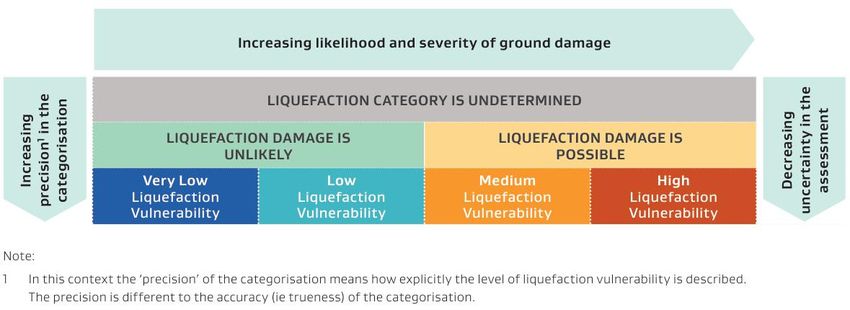
The results of these assessments determine the liquefaction vulnerability category (Figure i), with
increasing levels of precision available as more detailed assessment work is carried out.
Figure i: Liquefaction vulnerability categories for use in planning and consenting processes (adapted from Table
4.1, MBIE/MfE (2017))
For regional and district plan change purposes it is envisaged that a basic level of assessment is
carried out, at a Level A or B1. This level of assessment would generally identify where liquefaction is
likely, unlikely, or undetermined (shown by the red dotted box in Figure i). A higher level of detail
would then be required for subdivision or land use change, and a higher level again for Building
Consent application.
Approaching the hazard of liquefaction in this manner is consistent with the approach adopted by
numerous councils throughout New Zealand. It is also consistent with the manner in which other
hazards are approached by WDC, by mapping certain areas subject to specific hazards and requiring
further assessment by applicants within these areas.
The requirement for high-level liquefaction mapping also exists for a Building Consent Authority:
Recent changes to B1/AS1 of the New Zealand Building Code2 require specific consideration of
liquefaction during the Building Consent process, and so will require a Building Consent Authority to
have some means of identifying land subject to liquefaction. Generally, this requires Level A or B
mapping being carried out by the territorial authority.
Two parties (Pokeno Village Holdings and Kainga Ora) submit that the high-level liquefaction map
should be produced as a non-statutory overlay map, as it allows WDC to make regular updates to the
liquefaction hazard map as new information is made available. This is a sensible approach,
particularly as it allows for refinement of liquefaction hazard areas as more detailed assessments are
carried out by applicants, and it avoids the need to go through the formal plan change process to
make changes to the map.
4.2 Other issues
4.2.1 Extent of consideration of Liquefaction
Transpower submitted that the requirement to assess and address liquefaction (15.12.1) should
apply to specific activity types: they submit that it should apply to subdivision, multi-unit and
1MBIE/MfE guidance (2017), Table 3.5
2https://www.building.govt.nz/building-code-compliance/annual-building-code-updates/november-2019-building-code-
update/
Tonkin & Taylor Ltd 29 March 2021
Proposed Waikato District Plan - Stage 2 Job No: 1016545
Chapter 15 Land Stability and Liquefaction
Specialist Input Review
Waikato District Council6
comprehensive development activities, rather than all resource consents. Horticulture NZ support
this submission, echoing a concern that the requirement for liquefaction assessment may in some
cases apply to minor activities such as constructing farm buildings.
Fundamentally, it is important to ensure that in areas susceptible to liquefaction, all structures
including infrastructure are appropriately designed to accommodate the effects of liquefaction. I
leave the assessment of whether the Proposed Waikato District Plan provisions achieve this
appropriately or not to the s42A author.
4.2.2 Liquefaction consideration in Zoning decisions
The proposed plan, in the introduction 15.1 (14) states “While liquefaction areas have not been
identified on the planning maps, provisions in the district plan require this seismically-induced natural
hazard to be assessed before new zonings or subdivision and development are undertaken.” Perry
Group Limited submitted that the wording “new zonings” be removed on the basis that the impacts
of liquefaction on different types of development and layouts may not necessarily be known or able
to be assessed at the time of rezoning.
This is correct; there will be cases where at the time of land rezoning, the implications of liquefaction
on the final land development will not necessarily be fully known. However, it is important that
liquefaction is considered when land use decisions are being made. Under the proposed plan, WDC
has discretion to consider whether liquefaction assessment is relevant for a proposed activity
(15.12.1). Additionally, as discussed in 4.1 of this letter, the MBIE/MfE (2017) guidance document
provides a framework that allows for differing levels of detail in the investigation and assessment of
liquefaction, depending on the information required for a specific purpose.
4.2.3 Liquefaction and Permitted Activities
Waikato Regional Council asked, for liquefaction hazard areas “… how risks are to be managed
where an activity may be otherwise permitted, particularly in relation to retaining structures.”
The proposed rules for liquefaction apply to restricted discretionary activities. Where activities are
permitted and are building work (such as the construction of retaining structures), the work is
subject to the Building Act and is required to comply with the Building Code. As such, the Building
Consent Authority should consider liquefaction when processing Building Consents in areas subject
to a liquefaction hazard to ensure that the building work takes appropriate account of liquefaction.
5 Conclusions and Recommendations
For stormwater management in areas subject to the risk of land instability or subsidence:
• the effects of stormwater discharge to ground should be considered in terms of how it may
affect other hazards such as flooding. WDC should ensure that the provisions of the plan
adequately address this concern.
For liquefaction:
• the WDC should adopt the current industry best practice approach for managing liquefaction
hazards and carry out a high-level assessment of the Waikato district, to identify areas where
liquefaction is possible. In areas where liquefaction is possible (or where liquefaction hazard is
undetermined), appropriate rules should be developed, requiring applicants to carry out
further liquefaction assessment as relevant for the proposed activity. In other areas where
liquefaction is unlikely no further requirements should apply.
• this map should be produced as non-statutory map to enable the WDC with the flexibility to
alter it as necessary.
Tonkin & Taylor Ltd 29 March 2021
Proposed Waikato District Plan - Stage 2 Job No: 1016545
Chapter 15 Land Stability and Liquefaction
Specialist Input Review
Waikato District Council7 6 Applicability This report has been prepared for the exclusive use of our client Waikato District Council, with respect to the particular brief given to us and it may not be relied upon in other contexts or for any other purpose, or by any person other than our client, without our prior written agreement. We understand and agree that this report will be used by Waikato District Council in undertaking its regulatory functions in connection with the Proposed Waikato District Plan. Tonkin & Taylor Ltd Environmental and Engineering Consultants Report prepared by: Authorised for Tonkin & Taylor Ltd by: .......................................................... ...........................….......…............... Eric Bird Glen Nicholson Senior Engineering Geologist Project Director \\ttgroup.local\corporate\hamilton\projects\1016545\issueddocuments\210329 land stability and liquefaction letter report.docx Tonkin & Taylor Ltd 29 March 2021 Proposed Waikato District Plan - Stage 2 Job No: 1016545 Chapter 15 Land Stability and Liquefaction Specialist Input Review Waikato District Council
Appendix A: Land Stability Submissions
No. Submitter_Name Organisation On Behalf OS Point FS Point Submission SupportOppose Decision Sought Reason Primary Hearing topic Secondary Plan Plan
Of No. No. number Hearing Provision Section
topic (if
applicable)
2102 Miffy Foley on Waikato OS 2102.47 OS 2102.47 Support Amend Policy 15.2.1.21 - The submitter supports the consideration Land Stability 0 15.2.1.21 15
behalf of Waikato Regional Stormwater management in of the effects of on site (or reticulated)
Regional Council Council areas subject to risk of land servicing on where there is identified land
instability or subsidence - to instability, noting this is also applicable in
include areas subject to many instances to coastal areas which are
coastal flooding. prone to instability.
The amendments to the policy and
inclusion of a new rule ensures the activity
is not undertaken in areas subject to high-
risk natural hazards without assessment of
the impact of the activity. · This policy is
given effect to by the rules controlling
utilities in the high-risk coastal hazard
areas.
2128 Chris & Sue Harris OS 2128.5 OS 2128.5 Oppose Amend policy 15.2.1.21 - Storm water often magnifies the major Land Stability 0 15.2.1.21 15
Storm management in areas risk of flooding in some coastal areas.
of land instability or
subsidence to include
impacts of stormwater
magnifying risk of flooding in
coastal.
2133 Adam Marsh for Raglan Adam OS 2133.4 OS 2133.4 Oppose Amend Policy 15.2.1.21 - Stormwater often magnifies major risk of Land Stability 0 15.2.1.21 15
Raglan Collective Collective Marsh & Stormwater management in flooding in some coastal areas.
on behalf of Adam Carol areas subject to risk of land
Marsh & Carol McColl instability or subsidence - to
McColl include areas subject to
coastal flooding.
2107 Carolyn McAlley on Heritage OS 2107.13 OS 2107.13 Support Amend Policy 15.2.1.19 - Amendments ensure that when Land Stability 0
behalf of Heritage New Development on land subject subdivision, use and development occurs,
New Zealand Zealand to instability or subsidence. the risk to historic heritage and sites and
Pouhere Taonga Pouhere areas of significance to Maaori are
Taonga minimised. Amendment recognises that
historic heritage and sites and areas of
significance to Maaori can be located on
unstable land and on land immediately
adjacent to unstable land. There is
potential for subdivision, use and
development to adversely impact historic
heritage and sites and areas of significance
to Maaori when avoiding the risk of
instability. The proposed amendment
will help to give effect to RMA s6(e) and
(f).
Tonkin & Taylor Ltd 29 March 2021
Proposed Waikato District Plan - Stage 2 Job No: 1016545
Chapter 15 Land Stability and Liquefaction
Specialist Input Review
Waikato District CouncilAppendix B: Liquefaction Vulnerability Submissions
No. Submitter Name Organisation On Behalf OS Point FS Point No. Submission Support / Decision Sought Reason Primary Secondary Plan Plan Section
Of No. point number Oppose Hearing Hearing topic Provision
topic (if applicable)
2105 Aaron Collier for Collier Perry Group OS 2105.2 OS 2105.2 Support Amend Section 15.1 (14) - • Liquefaction assessment should be Liquefaction 0 15.1 15
Collier Consultants Limited Introduction as follows: considered at the time of subdivision
Consultants Ltd Ltd (14) While liquefaction areas have development through detailed
on behalf of not been identified on the planning geotechnical and ground engineering
Perry Group maps, provision in the District Plan analysis. • The nature of development and
Limited require this seismically induced the impacts of liquefaction on different
natural hazard to be assessed before types of development and layouts may not
new zonings or subdivision and deve necessarily be known or be able to be
lopment are undertaken. assessed at the time of rezoning.
3031 Miffy Foley on Waikato OS 2105.2 FS3031.115 FS3031.115 Oppose Oppose OS 2105.2 RPS implementation method 6.1.8(e) Liquefaction 0 15.1 15
behalf of Regional requires that district plan zoning for new
Waikato Council urban development supported by
Regional Council information which identifies potential
natural hazards and how the related risks
will be managed.
2147 Pokeno Village OS 2147.3 OS 2147.3 Support Amend Chapter 15.12 Liquefaction Based on advice from submitters Liquefaction 0 15.12 15
Holdings Limited approach to assessing effects of geotechnical engineer, it is understood
liquefaction to that there are very few places within the
(a) Provide a high-level study to Waikato District that would have the
identify areas of likely liquefaction potential for liquefaction. Requiring a
risk and that these are shown within liquefaction risk assessment despite low
a non-statutory overlay; and risk of geotechnical instability resulting
(b) Required detailed investigations from liquefaction will be onerous for any
into liquefaction risks for any applicant seeking resource consent.
proposed development within these
identified areas.
2094 Kainga Ora OS 2094.50 OS 2094.50 Oppose Delete Section 15.12.1 Overview of •Broadly supports the approach to manage Liquefaction 0 15.12.1 15
Homes and method regarding liquefaction. liquefaction risk but opposes the
Communities requirement for a geotechnical assessment
in all cases where a restricted discretionary
consent is required. •A Council-funded
district-wide assessment of broad areas
that are potentially prone to liquefaction
should be undertaken to save coasts of
geotechnical assessment in every
case. •The explanation within section
15.12.1 refers to Geotechnical
Assessments required “where the site and
proposed development is considered
vulnerable to liquefaction based on site-
specific characteristics”. This appears to
assume a form of initial assessment yet
without an explicit framework as the
basis. •The best practice is that the council
should introduce a mapped ‘Liquefaction
Management Area’ or similar alongside a
suite of provisions relevant to subdivision
and development, constituting the most
efficient and effective means of managing
liquefaction risk.
Tonkin & Taylor Ltd 29 March 2021
Proposed Waikato District Plan - Stage 2 Job No: 1016545
Chapter 15 Land Stability and Liquefaction
Specialist Input Review
Waikato District CouncilNo. Submitter Name Organisation On Behalf OS Point FS Point No. Submission Support / Decision Sought Reason Primary Secondary Plan Plan Section
Of No. point number Oppose Hearing Hearing topic Provision
topic (if applicable)
2101 Transpower New OS 2101.22 OS 2101.22 Neutral Amend Section 15.12.1 - · For clarity and certainty, the proposed Liquefaction 0 15.12.1 15
Zealand Ltd Liquefaction – Overview of methods approach should be clarified in the
to clarify that the requirement to introductory ‘overview of the method’
assess and address liquefaction risk statement provided in 15.12.1, to ensure
does not apply to all resource that liquefaction risk does not apply to all
consents only to specifically resource consents only specifically
identified subdivision, multi-unit, identified activities. · If the approach has a
and comprehensive development wider application (i.e., applies to a wider
activities. range of resource consent activities) then
the submitter would oppose the approach
on the basis it is overly onerous.
2094 Kainga Ora OS 2094.51 OS 2094.51 Support Retain Rule 15.12.2, provided •Broadly supports the approach to Liquefaction 0 15.12.2 15
Homes and Council identifies areas susceptible manage liquefaction risk but opposes the
Communities to liquefaction. requirement for a geotechnical assessment
in all cases where a restricted discretionary
consent is required. •A Council-funded
district-wide assessment of broad areas
that are potentially prone to liquefaction
should be undertaken to save costs of
geotechnical assessment in every
case. •The explanation within section
15.12.1 refers to Geotechnical
Assessments required “where the site and
proposed development is considered
vulnerable to liquefaction based on site-
specific characteristics”. This appears to
assume a form of initial assessment yet
without an explicit framework as the
basis. •The best practice is that the council
should introduce a mapped ‘Liquefaction
Management Area’ or similar alongside a
suite of provisions relevant to subdivision
and development, constituting the most
efficient and effective means of managing
liquefaction risk.
2101 Transpower New OS 2101.23 OS 2101.23 Neutral Amend rule 15.12.2 by adding · See reasons above for amendments to Liquefaction 0 15.12.2 15
Zealand Ltd matters of restricted discretion to 15.12.1, submission point # 2101.22.
clarify that the requirement to
assess and address liquefaction risk
does not apply to all resource
consents only to specifically
identified subdivision, multi-unit,
and comprehensive development
activities.
3033 Craig Sharman Beca Limited Kainga Ora - OS 2101.23 FS3033.4 FS3033.4 Oppose Oppose OS 2101.23 Kainga Ora opposes this submission. Liquefaction 0 15.12.2 15
for Beca Limited Homes and [Please refer to the rationale provided in
on behalf of Communitie response to submission 2102.22 above].
Kainga Ora - s
Homes and
Communities
Tonkin & Taylor Ltd 29 March 2021
Proposed Waikato District Plan - Stage 2 Job No: 1016545
Chapter 15 Land Stability and Liquefaction
Specialist Input Review
Waikato District CouncilNo. Submitter Name Organisation On Behalf OS Point FS Point No. Submission Support / Decision Sought Reason Primary Secondary Plan Plan Section
Of No. point number Oppose Hearing Hearing topic Provision
topic (if applicable)
2094 Kainga Ora OS 2094.52 OS 2094.52 Oppose Delete Rule 15.12.3. •Broadly supports the approach to manage Liquefaction 0 15.12.3 15
Homes and liquefaction risk but opposes the
Communities requirement for a geotechnical assessment
in all cases where a restricted discretionary
consent is required. •A Council-funded
district-wide assessment of broad areas
that are potentially prone to liquefaction
should be undertaken to save coasts of
geotechnical assessment in every
case. •The explanation within section
15.12.1 refers to Geotechnical
Assessments required “where the site and
proposed development is considered
vulnerable to liquefaction based on site-
specific characteristics”. This appears to
assume a form of initial assessment yet
without an explicit framework as the
basis. •The best practice is that the council
should introduce a mapped ‘Liquefaction
Management Area’ or similar alongside a
suite of provisions relevant to subdivision
and development, constituting the most
efficient and effective means of managing
liquefaction risk.
2101 Transpower New OS 2101.24 OS 2101.24 Neutral Amend rule 15.12.3 by adding · See reasons above for amendments to Liquefaction 0 15.12.3 15
Zealand Ltd matters of restricted discretion to 15.12.1, submission point # 2101.22.
clarify that the requirement to
assess and address liquefaction risk
does not apply to all resource
consents only to specifically
identified subdivision, multi-unit,
and comprehensive development
activities.
3033 Craig Sharman Beca Limited Kainga Ora - OS 2101.24 FS3033.5 FS3033.5 Oppose Oppose OS 2101.24 Kainga Ora opposes this submission. Liquefaction 0 15.12.3 15
for Beca Limited Homes and [Please refer to the rationale provided in
on behalf of Communitie response to submission 2102.22 above].
Kainga Ora - s
Homes and
Communities
3027 Lucy Deverall on Horticulture OS 2101.24 FS3027.49 FS3027.49 Support Support OS 2101.24 Support clarification that this should not Liquefaction 0 15.12.3 15
behalf of New apply to equally to all applications.
Horticulture New Zealand
Zealand
2094 Kainga Ora OS 2094.53 OS 2094.53 Oppose Delete Section 15.13.2 Liquefaction •The proposed approach to liquefaction Liquefaction 0 15.13.2 15
Homes and potential. places the onus of identifying areas subject
Communities to liquefaction risk onto the
applicants. •It is considered more
appropriate for Council to initially
undertake the identification of areas
subject to Liquefaction risk. •Delete the
current liquefaction rules and review the
approach.
Tonkin & Taylor Ltd 29 March 2021
Proposed Waikato District Plan - Stage 2 Job No: 1016545
Chapter 15 Land Stability and Liquefaction
Specialist Input Review
Waikato District CouncilNo. Submitter Name Organisation On Behalf OS Point FS Point No. Submission Support / Decision Sought Reason Primary Secondary Plan Plan Section
Of No. point number Oppose Hearing Hearing topic Provision
topic (if applicable)
3027 Lucy Deverall on Horticulture OS 2094.53 FS3027.54 FS3027.54 Support Support OS 2094.53 HortNZ shares the concerns that the Liquefaction 0 15.13.4 15
behalf of New requirements place a large onus on
Horticulture New Zealand applicants (for what may in some cases be
Zealand minor activities - particularly if HortNZ's
submission points regarding farm buildings
are not accepted).
2102 Miffy Foley on Waikato OS 2102.43 OS 2102.43 Support Amend Chapter 15.14 - Definitions · The submitter supports the need to Liquefaction 0 15.14.15.1 15
behalf of Regional to confirm how liquefaction risk may consider land instability and liquefaction
Waikato Regional Council be identified by plan users without risk and accepts that these areas are
Council the need for expert assessment. challenging to define. · The plan needs to
OR confirm how land can be identified as
Amend Section 15.1 (6) - prone or susceptible to liquefaction by plan
Introduction to confirm how users, without the need for expert
liquefaction risk may be identified assessment, and what process is proposed
by plan users without the need for to be followed in practice by applicants and
expert assessment. the council. · The submitter notes the
development of the New Zealand
Geotechnical Society (NZGS) and Ministry
of Business Innovation & Employment
(MBIE) Earthquake Geotechnical
Engineering Practice in New Zealand
guidelines and considers that the 2019
update may be relevant to consider in
further defining the approach to
liquefaction risk in the plan.
3027 Lucy Deverall on Horticulture OS 2102.43 FS3027.38 FS3027.38 Support Support OS 2102.43 Support the intent of submission, to make it Liquefaction 0 15.14.15.1 15
behalf of New clearer how a plan user would identify
Horticulture New Zealand liquification without expert assessment.
Zealand
2094 Kainga Ora OS 2094.15 OS 2094.15 Oppose Delete Policy 15.2.1.22 - • The proposed approach places the onus Liquefaction 0 15.2.1.22 15
Homes and Liquefaction-Prone Risk Assessment of identifying areas subject to liquefaction
Communities risk onto applicants. • Submitter opposes
applicants having to prepare a supporting
geotechnical assessment prior to new
subdivision use or development taking
place, given the uncertainty and risk
associated for this party. • The council
should fund a district-wide assessment of
land susceptible to liquefaction-induced
ground damage. • Policy 15.2.1.23 is the
appropriate policy.
2101 Transpower New OS 2101.10 OS 2101.10 Support Amend Policy 15.2.1.22(a) as · Supports the mapping of areas potentially Liquefaction 0 15.2.1.22 15
Zealand Ltd follows: prone to liquefaction as the identification
(a) On land identified as potentially of these areas would assist plan users and
prone to liquefaction, ensure that: provide significant increased clarity as to
(i) … the application of the related policies and
OR rules. · To increase the clarity of the scope
Amend Policy 15.2.1.22(a) as and application, wording should include
follows: reference to land that has been identified
(a) On land assessed as potentially as potentially prone to liquefaction.
prone to liquefaction...
Tonkin & Taylor Ltd 29 March 2021
Proposed Waikato District Plan - Stage 2 Job No: 1016545
Chapter 15 Land Stability and Liquefaction
Specialist Input Review
Waikato District CouncilNo. Submitter Name Organisation On Behalf OS Point FS Point No. Submission Support / Decision Sought Reason Primary Secondary Plan Plan Section
Of No. point number Oppose Hearing Hearing topic Provision
topic (if applicable)
2102 Miffy Foley on Waikato OS 2102.44 OS 2102.44 Support Amend Policy 15.2.1.22 - · The submitter supports the inclusion of Liquefaction 0 15.2.1.22 15
behalf of Regional Liquefaction-prone land risk policy direction and matters of discretion
Waikato Regional Council assessment as follows: where resource consent is required but
Council Policy 15.2.1.22 - Liquefaction- questions how risks are to be managed
prone susceptible land risk assessme where an activity may otherwise be
nt permitted, particularly in relation to
(a) On land potentially retaining structures. · Amendments are
prone susceptible to liquefaction, en proposed to ensure consistency of
sure that: terminology. · The submitter supports the
(i) an assessment by a geotechnical additional matters identified in 15.12 for
specialist occurs before new liquefaction and land instability where
subdivision, use or development subdivision, use and developments,
takes place is provided for; and including multi-unit developments are
[…] proposed.
2146 Will Gauntlett for Waikato Gavin Ion OS 2146.8 OS 2146.8 Support Add to Policy 15.2.1.22(a) - Sub-section (iii) makes it clear that the Liquefaction 0 15.2.1.22 15
Waikato District District Liquefaction-prone land risk ultimate purpose of the assessment is to
Council on behalf Council assessment a sub- section to read as confirm that the land is suitable for the
of Gavin Ion follows: proposed development.
(iii) the assessment confirms that th
e land is suitable for the proposed
development,
AND
Amend Policy 15.2.1.22(a)(i) and (ii)
- Liquefaction-prone land risk
assessment to read:
(i) an assessment by a geotechnical
specialist occurs before new
subdivision, use or development
takes places; and
(ii) the level of assessment reflects
the type and scale of the
subdivision, use or development and
the overall vulnerability of the
activity to the effects of
liquefactions., and,
AND
Any consequential amendments as
required, AND
Any other change necessary to give
effect to the intent of this relief
sought and to achieve the purpose
of the Resource Management Act
1991.
2094 Kainga Ora OS 2094.16 OS 2094.16 Support Amend Policy 15.2.1.23 as follows: Supports the intent of the Policy. Seeks to Liquefaction 0 15.2.1.23 15
Homes and Control subdivision, use and amend wording to better control
Communities development on land subdivision land use and development on
assessed identified as being suscepti land susceptible to liquefaction-induced
ble to liquefaction- ground damage. (Refer to submission on
induced ground damage... Policy 15.2.1.22.)
Tonkin & Taylor Ltd 29 March 2021
Proposed Waikato District Plan - Stage 2 Job No: 1016545
Chapter 15 Land Stability and Liquefaction
Specialist Input Review
Waikato District CouncilNo. Submitter Name Organisation On Behalf OS Point FS Point No. Submission Support / Decision Sought Reason Primary Secondary Plan Plan Section
Of No. point number Oppose Hearing Hearing topic Provision
topic (if applicable)
3003 Transpower New OS 2094.16 FS3003.7 FS3003.7 Support Support OS 2094.16 In its submission Transpower supported Liquefaction 0 15.2.1.23 15
Zealand Ltd Policy 15.2.1.23 on the basis the policy has
a management directive as opposed to
avoidance. Transpower supports the
submission point seeking amendment of
the policy to replace the word ‘assessed’
with ‘identified’ as the replacement
wording would provide greater clarity to
the policy. The amendment would also
reflect the relief sought in Transpower
submission point on Policy 15.2.1.23.
2102 Miffy Foley on Waikato OS 2102.45 OS 2102.45 Support Amend Policy 15.2.1.23 – Control · The submitter supports the inclusion of Liquefaction 0 15.2.1.23 15
behalf of Regional activities on land susceptible to policy direction and matters of discretion
Waikato Regional Council damage from liquefaction as where resource consent is required but
Council follows: questions how risks are to be managed
Policy 15.2.1.23 – Control activities where an activity may otherwise be
on land susceptible to permitted, particularly in relation to
damage from liquefaction retaining structures. · Amendments are
(a) Control subdivision, use and proposed to ensure consistency of
development on land assessed as terminology. · The submitter supports the
being susceptible to liquefaction- additional matters identified in 15.12 for
induced ground damage, liquefaction and land instability where
to ensure that where appropriate av subdivision, use and developments,
oidance, remediation or mitigation i including multi-unit developments are
s provided so that the level of risk to proposed.
people, property, infrastructure an
d the environment is acceptable.
2094 Kainga Ora OS 2094.89 OS 2094.89 Support Amend the approach to liquefaction The proposed approach to liquefaction, as Liquefaction 0 Multiple 15
Homes and by Council identifying areas subject drafted, places the onus of identifying provisions
Communities to liquefaction risk and providing a areas subject to liquefaction risk onto the
framework to appropriately manage applicants.
the risk to people's safety, wellbeing
and property.
2147 Pokeno Village OS 2147.2 OS 2147.2 Support Amend all rules within the zone Throughout the PWDP, "geotechnical Liquefaction 0 Multiple V2
Holdings Limited chapters that state … “including suitability including liquefaction risk (refer provisions
liquefaction risk (refer to Chapter to Chapter 15)" is referenced as a matter of
15)”, as follows: discretion for restricted discretionary
… including liquefaction risk (refer activities. Rule 15.12 of the PWDP outlines
Rule 15.12 Liquefaction the matters to be addressed as part of a
to Chapter 15 ) liquefaction risk assessment. The provision
refers to Chapter 15 in its entirety. Chapter
15 is not solely related to liquefaction risk.
Specific reference to Rule 15.12 is required
for the purposes of avoiding doubt and
providing greater clarity to future resource
consent applicants.
Tonkin & Taylor Ltd 29 March 2021
Proposed Waikato District Plan - Stage 2 Job No: 1016545
Chapter 15 Land Stability and Liquefaction
Specialist Input Review
Waikato District CouncilYou can also read


