Overview Hamas "explains" not firing rockets during the Flag March
←
→
Page content transcription
If your browser does not render page correctly, please read the page content below
Hamas "explains" not firing rockets
                                     during the Flag March
June 12, 2022

                                                      Overview
                  On May 29, 2022, Israel held its traditional Flag March, marking the unification of
                Jerusalem after the Six Day War. By government decision, its route passed through east
                Jerusalem and the Damascus Gate. On the eve of the march, Hamas and the other terrorist
                organizations threatened they would attack, including from the Gaza Strip. In reality, the
                march was held without particular incident, despite the threats and warnings, and there was
                no response from the Gaza Strip.
                  The Palestinian public was disappointed, and many criticized Hamas for not carrying out
                its threats. Initially, senior Hamas figures responded to the criticism by saying that the
                events in Jerusalem crossed red lines and necessitated a response, but it would come at a
                time and in a way Hamas deemed appropriate.
                  In the meantime Hamas claimed a propaganda-security victory, claiming its threats on the
                eve of the Flag March had exhausted Israel politically, militarily and security-wise, and
                forced it to change the route of the march. Hamas also claimed Israel had been forced to ask
                the mediators to appeal to Hamas not to respond, but that the pressure exerted had not
                influenced Hamas' decision not to respond.
                  As time passed and criticism continued, Hamas became increasingly apologetic. Senior
                Hamas figures and affiliated political commentators provided reasons "justifying" Hamas'
                lack of response, among them that Israel was on high alert because the IDF was holding a
                military exercise, the threats had cost them the element of surprise, Hamas did not want
                another war in the Gaza Strip, etc.
                  Today, a year after Operation Guardian of the Walls, Hamas wants to avoid another
                military campaign waged inside the Gaza Strip. Despite the litany of threats issued by senior
                Hamas figures on the eve of the Flag March, Hamas' lack of response was dictated by
                practical considerations. The ongoing criticism forced Hamas to "explain" its motives.
                Apparently Hamas, which has positioned itself as "the defender of Jerusalem and the sites
                holy to Islam," will continue to foment unrest in Jerusalem, Judea and Samaria,

                                                                                                        909-22
undermining security in the Palestinian Authority (PA) territories. However, in the meantime
it will preserve quiet in the Gaza Strip.

                                  The Flag March
  On May 29, 2022, Israel held its traditional annual Flag March, whose route according to a
government decision, passed through east Jerusalem and the Damascus Gate. That led to a
wave of Palestinian reactions, and the tensions increased when Jewish groups declared
their intention to enter the Temple Mount compound on Jerusalem Day and a magistrate's
court allowed Jews to hold prayers at the site. The Palestinian terrorist organizations issued
threats and warned of the consequences of holding the march and of Jews entering the
Temple Mount.
  Hamas claimed the march would cross red lines, and that holding it along its proposed
route was "escalation." The terrorist organizations called on the Palestinian public to
"rebel," including with guns. They also hinted rockets would be fired, as they had been
during the Flag March in May 2021, and that there might be another round of fighting
("Sword of Jerusalem 2.0"). However, most of the calls to "rebel" went unheeded and the
propaganda to rise up and take action was aimed at Israeli Arabs and east Jerusalem, while
relative calm was maintained in the Gaza Strip.
  On May 28, 2022, the eve of the Flag March, eight test rockets were fired from the
southern Gaza Strip towards the sea. Reportedly, the rockets were developed to improve the
capabilities of the "resistance" [i.e., the terrorist organizations]. The organizations in the
Gaza Strip warned Israel not to let settlers "storm al-Aqsa mosque" during the march (al-
Risalah, May 28, 2022).

      Hamas video of test rockets fired towards the sea (Filastin Bin Idak, May 30, 2022).

  According to reports, the threats made Israel inform Hamas through the mediators that it
had no intention of causing a provocation. The Flag March would use the same route it had

                                                                                             909-22
in past years, passing through the Damascus Gate without reaching al-Aqsa mosque. Israel
    also warned the organizations not to fire rockets, which would lead to an Israeli response
    against the Gaza Strip (al-Mayadeen, May 25, 2022).
      The Flag March was relatively calm, with the exception of local clashes between
    Palestinians and Israeli security forces. Despite the threats and warnings, there was no
    response from the Gaza Strip during the march.

                           Hamas Answers Criticism
      Given Hamas' lack of action during the Flag March, the Palestinian public began
    expressing criticism and disappointment because Hamas and the other terrorist
    organizations had not carried out their threats. Criticism on the social networks and in op-ed
    columns written by Palestinian political commentators claimed the threats raised
    expectations that had not been met.
      They mentioned the militant speech given by Yahya al-Sinwar, head of the Hamas
    political bureau in the Gaza Strip, a month before the march, when he called on the
    Palestinians to prepare for a "great battle to defend al-Aqsa mosque," specifically saying
    that a barrage of 1,111 rockets would be fired [commemorating Yasser Arafat, who died on
    11.11] (Hamas Telegram channel, April 30, 2022). Al-Hayat al-Jadeeda, the official PA
    newspaper, accused Hamas of lying (al-Hayat al-Jadeeda, May 31, 2022). The Hezbollah-
    affiliated Lebanese newspaper al-Akhbar printed a column about disappointment with the
    Gaza Strip and Palestinian anger with Hamas, which did not respond the way it had
    promised (al-Akhbar, May 31, 2022).
      Hamas praised the Palestinians who went to confront the Israeli security forces in east
    Jerusalem, while at the same time trying to answer the criticism and explain why the military
    wings of the organizations in the Gaza Strip, led by Hamas' Izz al-Din Qassam Brigades, had
    not responded to the events with rocket fire.
      Senior Hamas figures did not deny that events in Jerusalem demanded a response, but
    they claimed it would come at a time and in a way Hamas deemed appropriate.1 They made
    it clear that the pressure exerted on Hamas by the mediators and Arab states had not
    influenced Hamas' decision not to respond. For example, a "source in the resistance" was

                                                                  ��������������������
                                                                            ����
1
 In the meantime, routine daily life has returned to the Gaza Strip, after during the days before the
march the alert level in Gaza was raised and steps were taken on the ground because of concern of an
"escalation."

                                                                                                909-22
quoted as denying reports that the "resistance" had yielded to pressure from Egypt and
Qatar. The source confirmed that there was in fact pressure from Arab states but it would be
inaccurate to say the "resistance" had yielded to it (Ra'i al-Yawm, June 4, 2022).
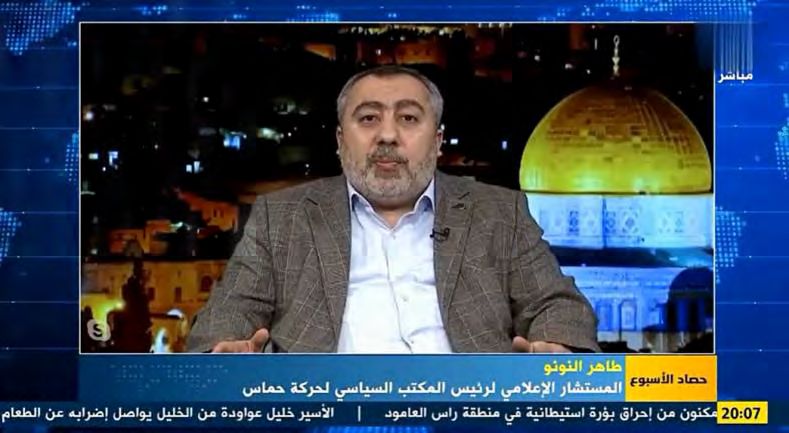
Taher al-Nunu, Isma'il Haniyeh's media advisor, justified Hamas' lack of response by
claiming that the "resistance's" leadership had acted prudently. He called the confrontation
with Israel "open and strategic," saying it had to escalate, not only in the Gaza Strip but in all
the Palestinian territories (al-Aqsa TV, June 3, 2022).
Taher al-Nunu interviewed on the Hamas-affiliated al-Aqsa TV station (YouTube, June 3, 2022).
Hamas claimed credit for not getting involved in "an unwise battle" with Israel at a time
when the IDF wanted one and was on high alert. Hamas also noted that only the Gaza Strip
paid the price during Operation Guardian of the Walls, while Jerusalem belonged to all
Palestinians and everyone had to help bear the burden (al-Risalah, May 30, 2022). Hamas-
affiliated cartoonist Omaya Joha said the Gaza Strip could live securely as long as it was
protected by "a prudent resistance." She said the Gaza Strip had experienced four wars in
less that 13 years, and deserved to rest (Omaya Joha's Twitter account, May 30 2022).
Claims were made that the threats made on the eve of the Flag March deterred Israel and
made it change the march's route, which stopped in front of the Damascus Gate and did not
enter the Muslim Quarter of the Old City as planned (Felesteen, June 1, 2022). There were
also claims that the threats had forced Israel to contact Hamas through the mediators and
ask it not to respond. Mahmoud al-Zahar, a member of Hamas' political bureau, said
Hamas had not responded to the Flag March because there was no need, Israel had "already
surrendered" to all its conditions (Awda TV Twitter account, June 3, 2022).
Hamas spokesman Fawzi Barhoum said Hamas' threats had limited the route of the
march and caused Israel to make many changes. He claimed the "organizations" had
exhausted Israel politically, militarily and security-wise, and forced Israel to face Palestinians
909-22who had gone into the streets to express their rage (al-Ghad, May 31, 2022). Ibrahim al-
Madhoun, a Hamas activist from the Gaza Strip who currently resides in Istanbul, issued
a video in which he boasts about the IDF's high alert and the pressure exerted by the Flag
March, which he claimed cost Israel a fortune (Ibrahim al-Madhoun's Twitter account, May
30, 2022).
Hamas issued a video claiming "victory" in its propaganda war against the Flag March,
forcing Israel into the trap set by Hamas' psychological warfare. The video showed how
Hamas "successfully put the IDF on high alert" before Jerusalem Day, which included
deploying 3,000 policemen in Jerusalem. Isma'il Haniyeh, head of Hamas' political
bureau, appeared in the video, declaring that without the shadow of a doubt they would
"resist" with all the means at their disposal. The video also mentioned the test rockets fired
from the southern Gaza Strip towards the sea on the eve of the march, to show the threats
had to be taken seriously (Filastin Bin Idak, May 30, 2022).
Hamas video after the Flag March boasting it had put the IDF on high alert (Filastin Bin Idak, May
30, 2022).
Later, as criticism continued and embarrassed the Hamas leadership, they, their affiliated
media outlets and other commentators provided a list of excuses for Hamas' not have
employed a military response. They included:
Pressure exerted from states and mediators who "implored" them not to cause the
situation to deteriorate. Taher al-Nunu, Isma'il Haniyeh's media advisor, provided a list
of people who had contacted Haniyeh asking him to contain the situation and prevent
further deterioration (al-Risalah, May 29, 2022). Hamas spokesman Fawzi Barhoum
claimed many mediators had appealed to Hamas, asking for a promise the situation
would not deteriorate to the point of war with Israel (al-Ghad, May 31, 2022).
The timing was inconvenient, because the IDF was on high alert because of its "war
exercise." Haroun Nasser al-Din, a member of Hamas' political bureau, said the only thing
909-22that prevented them from responding was that they did not want Israel to determine the
circumstances of the combat, especially in light of the fact that the Israeli army expected it
and had deployed, in addition to the military exercise being conducted at the time
(Felesteen, June 1, 2022).
The threats before the Flag March had cost them the element of surprise. Khader
Habib, a senior Palestinian Islamic Jihad (PIJ), claimed the "resistance" wanted to
surprise Israel, but the IDF was on high alert and prepared for a confrontation, so
attacking would not have significant results. He added that they would wait until Israel
was not prepared (Sabaq24, May 30, 2022).
The organizations had decided to avoid an "escalation" only a year after the
previous confrontation. Despite the fact that they were deployed and ready, the
leadership of Hamas and the other organizations decided to forego an "escalation" that
would lead the Gaza Strip into another round of combat for which it was not prepared
only a year after Operation Guardian of the Walls (al-Quds, May 30, 2022).
Israel wanted to solve its internal problems with a military campaign [against the
Gaza Strip]. Haroun Nasser al-Din claimed the government of Israel was in the throes of
an internal crisis and wanted to resolve it with an external campaign, and the "resistance"
in the Gaza Strip had no intention of falling prey to an Israeli plot (Felesteen, June 1, 2022).
Opinions from political commentators
Similar arguments were proposed by Hamas-affiliated political commentators, who said
the fact that Hamas had decided not to respond despite public pressure "proved" the
leadership took all factors into consideration and acted rationally.
Hamas-affiliated political commentator Husam al-Dajani said the lack of response
from the Gaza Strip was the result of a combination of an analysis of the situation in the
Gaza Strip and of the strategic circumstances of both sides. However, the lack of response
did not indicate the subject was closed. The "resistance" was an "ongoing project" and the
military wings of the organizations and the joint operations room would decide on the
time and place to respond. He said that if there had been extensive clashes in Judea,
Samaria and Jerusalem, "without a doubt" the position of the "resistance" would have
been different. However, since the clashes were "limited" they decided on "moderation"
so that Israel's response would not focus on the Gaza Strip, especially since only a year
had gone by since the most recent combat (al-Jazeera, May 30, 2022).
909-22Yusuf Fares, Gaza correspondent for the Hezbollah-affiliated Lebanese
newspaper al-Akhbar, summed up the issue in an op-ed piece entitled, "Considerations
that prevent an explosion." He claimed the lack of action from the "resistance" enabled
Israel to win one round in the propaganda war and make a symbolic achievement in
"realizing sovereignty." However, he said, the "resistance" had logical reasons to avoid
"escalation," the most important of which was Israel's "unprecedented" alert, in which
case starting a war would have been suicide. He gave a series of additional tactical
considerations which caused the "resistance" not to respond, among them the presence
of Israeli aircraft in the skies above the Gaza Strip before the march and the IDF's attempts
to drag the organizations into shooting at fake targets along the border (al-Akhbar, May
30, 2022).
The Hamas magazine al-Risalah reported that the "resistance" leadership had
decided not to respond to the Flag March for a variety of reasons. After an assessment of
the situation on the ground, the leadership realized that the current time was
inappropriate and would serve the interests of Israel, which was prepared for a
confrontation. The magazine emphasized that the leadership had shown prudence and its
considerations were far-sighted, because "everyone knew" the "resistance" could fire
rockets and spoil the celebration of the Flag March, as it had the previous year. The
"resistance" intended, according to al-Risalah, to respond, but not when Israel was
prepared (al-Risalah, May 31, 2022).
909-22You can also read


