Oxygen concentrator helps meet surge in demand - SHJ ...
←
→
Page content transcription
If your browser does not render page correctly, please read the page content below
MEDICAL GAS PIPELINE SYSTEMS

Oxygen concentrator helps
meet surge in demand
Like many large acute hospitals, London’s Charing Cross Hospital in west London has seen increased
oxygen demand over the past six months, and in March, with the coronavirus pandemic beginning to
ramp up, its Estates team found the site’s existing oxygen VIE (Vacuum Insulated Evaporator) was already
beginning to struggle to meet demand, and would not be capable of meeting the predicted COVID-19
surge demand. As HEJ reports, when two already overstretched oxygen suppliers were unable to help
upgrade the VIE, Imperial College Healthcare NHS Trust’s long-standing medical gas pipeline supplier,
SHJ Medical Gas Specialists, stepped in to help with an oxygen concentrator-based solution.

In March this year – when the effects of
the COVID-19 pandemic were beginning to
hit the UK – the Estates Department at
Charing Cross Hospital (part of the Imperial

                                                                                                                                                                                                                                  ©Estates and Facilities Management Dept,
College Healthcare NHS Trust) started to

                                                                                                                                                                                                                                  Imperial College Healthcare NHS Trust
prepare for the first influx of patients. While
the oxygen infrastructure pipework at the
hospital was good, the site’s Vacuum
Insulated Evaporator (VIE) was struggling
to supply the predicted surge requirements.
Although technically capable of delivering
3,000 litres per minute, the vaporisers
created a pinch point, bringing the supply
down to just 1,833 L/min. The Trust
contacted two major oxygen suppliers to                                                                                            The oxygen concentrator connection and distribution manifold,
request assistance with upgrading the VIE,                                                                                         and emergency standby manifold, arrangement.
or providing additional VIE plant, but, with
their resources stretched nationwide, and                                                                                          Unit, Day Surgery Ward, theatres, and           The engineering challenges
directed primarily to new field hospitals,                                                                                         Recovery, and in which new COVID beds           Plant space
neither was able to help. Charing Cross                                                                                            had hurriedly been placed. Pipework was         As at most hospitals, space is at a
Hospital was then facing the prospect of                                                                                           laid to enable the concentrator to supply       premium, and there are not many
having to turn patients away.                                                                                                      the block independently, while retaining        plant rooms lying empty waiting to
                                                                                                                                   the connection to the main VIE to allow         accommodate an oxygen concentrator.
Oxygen concentrator solution                                                                                                       maximum flexibility. It also allowed            Charing Cross Hospital is no different,
The Trust’s long-standing medical gas                                                                                              generated oxygen to be supplied to the          and so to overcome the problem, SHJ
pipeline supplier, SHJ Medical Gas Specialists,                                                                                    entire hospital site via a ring main in the     suggested a technique it had used before
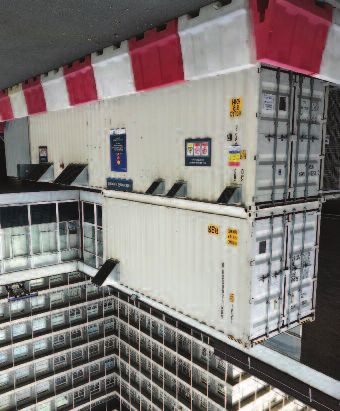
suggested using an oxygen concentrator.                                                                                            event of total failure of the VIE.              – housing the concentrators in two 40 ft
Although common overseas, concentrators                                                                                                                                            metal shipping containers installed in the
had rarely been used in a UK mainland                                                                                                                                              hospital car park. In an ideal world, the
                                                  ©Estates and Facilities Management Dept, Imperial College Healthcare NHS Trust

hospital before, where the ‘tradition’ has                                                                                                                                         containers would have been pre-fitted out
generally been to rely on liquid oxygen                                                                                                                                            and placed in position already up and
stored in a Vacuum Insulated Evaporator.                                                                                                                                           running. In this instance, however, given
Rather than relying on stored liquid oxygen,                                                                                                                                       the urgency, the empty containers were
a concentrator uses a compressor and a                                                                                                                                             craned into position and fitted out on site.
refrigerant dryer on the ambient air to                                                                                                                                            Figure 1 shows the layout of the
generate a tank of air compressed to                                                                                                                                               concentrator plant within the container:
7.5 bar. This air is then filtered and passed                                                                                                                                      In addition to the new plant, an external
through a PSA (Pressure Swing Adsorber),                                                                                                                                           wraparound ring main was created to
which sieves and retains the oxygen, while                                                                                                                                         increase oxygen carrying capacity to key
discharging the waste nitrogen. The oxygen                                                                                                                                         wards. Figure 2 shows the configuration
is stored in a buffer vessel and then used                                                                                                                                         of the new plant within the hospital.
as normal. The concentrator supplied to
Charing Cross had a theoretical maximum                                                                                                                                            Oxygen purity
oxygen flow of 850 L/min.                                                                                                                                                          While oxygen from a VIE will produce a
   The hospital decided to allocate the                                                                                                                                            nominal 99.6% purity, an oxygen
concentrator to one of its blocks, the                                                                                                                                             concentrator produces at 93% +/–3%
Riverside Wing, which houses the                                                                                                                                                   (i.e. the purity will range from 90% to
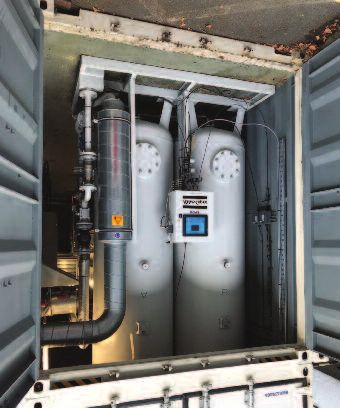
hospital’s Acute Medical Admissions                                                                                                Oxygen generator vessels.                       96%). With a lighter load a high purity is

                                                                                                                                                                                    October 2020 Health Estate Journal 39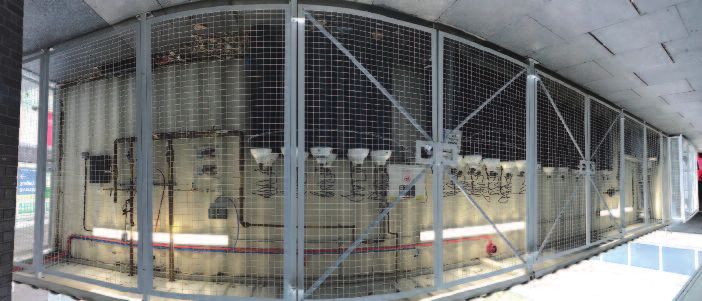
MEDICAL GAS PIPELINE SYSTEMS
easier to obtain, but as the load increases, than a larger one, which would also offer
©Estates and Facilities Management Dept, Imperial College Healthcare NHS Trust
the generator has to work harder, and greater resilience. I would recommend
lower purity is a consequence. This is going for the highest specification
acceptable for patient use, as the available, as the units are not always able
impurities are not significant. In fact the to run at 100% capacity. Equally, since
new plant’s installation resulted in Charing concentrators can have issues at extremes
Cross Hospital having two different of ambient temperature, they are ideally
oxygen products conforming to two better installed within the hospital building
separate European Pharmacopiea if possible. If not, then a containerised
Monographs. Having taken advice from its solution can work well, but the insulation
Chief Pharmacist, The Trust was happy to and ventilation need to be carefully
accept these constraints, and understood considered. It is also vital to ensure that
that, while switching between the two the works are completed and certified
products was acceptable, mixing the in accordance with the requirements of
two was not an option. HTM 02-01.”
As no 93% back-up cylinders were
available, other options had to be The future
considered. An automatic manifold was SHJ added: “Oxygen concentrators are
fitted with two banks of 10 cylinders of ideal for field use where delivery of liquid
99%. In addition, a new 54 mm main was The container-sized plant room solution oxygen is not a practical option. Due to
installed to link the 99% supply in the strategically located adjacent to the the amount of wasted nitrogen and the
event of an extreme emergency. This was oxygen load. electricity required, however, they are
double valved and double locked off. expensive to run, although they don’t
were able to begin Quality Control attract the costs and emissions associated
Medical gas alarms pharmaceutical testing less than four with bringing oxygen on site. They offer
The oxygen concentrator plant and the weeks later. The plant was operated under resilience during a situation of disaster or
emergency standby cylinder manifold trial load conditions for three days prior to threat, although their reliance on electricity
systems were both connected to plant being connected to the hospital’s medical presents a single point of failure in
and local alarms. The plant alarms were gas pipeline system. On the last day of locations with infrastructure challenges.
repeated at the 24-hour manned security April, final QC testing verified that oxygen “Nevertheless, they certainly provide a
base, Marjory Warren Ward, and SHJ’s production met the requirements of the viable emergency back-up solution to
K’nect portal. The units are monitored European Pharmacopeia Monograph 2455 crises such as the one that faced Charing
remotely by SHJ, where a predetermined and ISO 10083 for Oxygen 93 (oxygen Cross Hospital in March. There has been
response has been set up to automatically purity of 93% +/- 3%). The new system considerable interest in this project from
despatch a service engineer to site in the went into service at 4 pm that day. other UK hospitals as the NHS considers
event of a problem. how best to prepare for a potential
Recommendations ‘second wave’ of COVID-19 later in 2020
Successful outcome SHJ Medical Gas Specialists said: “The and into 2021.”
A team including engineers from the Charing Cross oxygen concentrator
Trust, SHJ, project managers, ETA project was an astonishing engineering Firm’s first ever customer
Projects, and supplier, Atlas Copco, feat given the constraints and the By way of background, Stafford Scopes,
began sourcing all the plant, pipelines, timescales. As one team member put it, managing director of SHJ Medical Gas
and electrical supplies required at the ‘We completed two years of infrastructure Specialists, whose father, Ronald, founded
beginning of April. Working around work in two months’.” the business in 1967, explained that one of
the clock, seven days a week, engineers Shane King, head of Estates Operations the Imperial College Healthcare NHS
at Imperial College Healthcare NHS Trust, Trust’s other hospitals, Hammersmith
says that he would advise anyone in Hospital was, in fact, the company’s first
similar circumstances to consider carefully ever customer, and that SHJ had provided
the type of concentrator they choose. medical gas pipeline services to the Trust
He said: “Depending on the plant ever since. He said: “In those days Imperial
space available, it may be was not a five hospital Trust;
better to choose two Hammersmith Hospital thus joined us
smaller oxygen as a customer as a single hospital, and
concentrator thereafter St Mary’s, Charing Cross, Queen
units rather Charlotte’s, and the Western Eye Hospitals
became clients, and then of course,
the Trust was formed. We provide the
majority of the Trust's medical gas pipeline
services, including regular planned
preventative maintenance visits,
installation work, and servicing of its plant.
The Trust also uses our Evolution medical
1 Air compressors gas alarm system, and our K’nect portal,
2 Refrigerant air dryers for its medical gas records and data.”
3 Carbon bag filters Moving to how the oxygen concentrator
4 Compressed air receiver project came about, Stafford Scopes said
5 Oxygen concentrator/ he visited the Charing Cross Hospital site
Pressure swing adsorber towers
in early March to talk through how to
6 Oxygen receiver
address a major increase in oxygen
Figure 1: The layout of the concentrator plant within the container. demand. He said: “At the time, SHJ was so
40 Health Estate Journal October 2020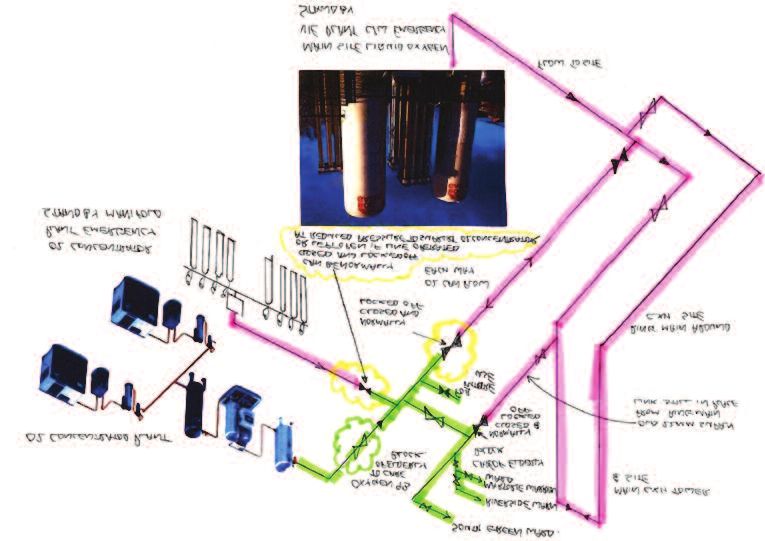
MEDICAL GAS PIPELINE SYSTEMS

                                                                                                    a team of about 10, who on some days
                                                                                                    worked an 18-hour shift in tandem with
                                                                                                    the Trust’s Estates team to get the
                                                                                                    scheme completed promptly.

                                                                                                    Two compressors for
                                                                                                    added resilience
                                                                                                    “An oxygen concentrator uses a
                                                                                                    compressor to manufacture air, and the
                                                                                                    air is then sieved for the oxygen, “Stafford
                                                                                                    Scopes explained. “To produce this air,
                                                                                                    you need an air compressor, and a
                                                                                                    refrigerant dryer to cool the air. However,
                                                                                                    there was only enough power – a 100 A
                                                                                                    supply – on site to run one air compressor.
                                                                                                    We wanted two compressors available,
                                                                                                    so that in the event of one failing, the
                                                                                                    system would switch to the other. We
                                                                                                    thus adapted our existing Empower
                                                                                                    control panel to be able to change duty
                                                                                                    between two machines to ensure that one
                                                                                                    compressor is powered down before
                                                                                                    the other one starts up.”
                                                                                                       Stafford Scopes explained that the
                                                                                                    project team also had to deal with a
Figure 2: A sketch plan of the configuration of the new plant within the hospital.                  significant unexpected obstacle when the
                                                                                                    shipping containers and concentrator
busy that we decided we were only going             a limit to what a VIE and the vaporisers        arrived. He said: “On examining the
to support our existing clients. Shane              can supply, and, keen not to exceed the         concentrator, we soon realised that the
King, the Trust’s head of Estates                   limit, Shane asked us what we could             measurements we had for it gave the
Operations – with whom we have a long-              suggest. Our ‘out-of-the-box’ thinking          height when it was lying horizontal, rather
standing relationship – needed a lot of             was to supply an oxygen concentrator.”          than vertical. To address this, we cut an
medical gas infrastructure reinforcement               Normally, largely because the                aperture into the roof of the first container,
to ensure adequate oxygen flow rates                performance of large oxygen concentrators       craned the oxygen concentrator in
and pressure at newly designated ICU                is impacted by ambient temperature,             through the roof, and then located the
beds, and SHJ just didn’t have the                  standard practice would be to install such      second container onto the top, to
resources to do it. Shane’s response was            plant in a hospital plant room. However,        weatherproof it all.”
that we should go out and get them,                 at Charing Cross Hospital, a lack of space
so we did – harnessing the services of              made this impractical. “In fact,” Stafford      Four weeks from start to finish
sub-contractors, who, under our                     Scopes explained, “as there was no such         To ensure that the system would be
Competent Person guidance, supported                space available here, we obtained two           resilient, SHJ ran a new medical gas main
SHJ with the installation of the plant and          40 foot shipping containers from a              from the existing VIE to the generator
pipework.”                                          company that can adapt them,                    – a distance of about 100 metres – and
                                                    Adaptainer, who Shane suggested.”               installed a cylinder manifold, so that if the
An enthusiastic project lead                           With the local roads quiet in late March,    supply from the concentrator failed, the
Stafford Scopes was keen to highlight               not long after the national lockdown,           hospital could run on cylinders. From
how enthusiastically Shane King had led             getting the plant, and indeed the specially     agreement on the plan to the completion
what proved a complex engineering                   fabricated containers that house them,          of all the works took only four weeks,
project right from the start. He said: “It          onto site, using cranes, did not prove too      Stafford Scopes explained, necessitating
was Shane who asked: ‘We don’t have                 much of a challenge. Stafford Scopes            some very long days on site for some
enough oxygen; how are we going to                  explained: “We undertook what proved a          personnel. He said: “The team was
address the issue?’ There is, of course,            quite demanding project ourselves, using        absolutely excellent in terms of its

                                         IQ Key         IQ Storage        IQ Safe
                                       Management      Management      Cabinet Series
                                                                                           KEY & ASSET MANAGEMENT SYSTEMS
                                                                                                   Plug & Play – Secure

                                                                                              Delivered within one week*

                            HIRE - LEASE - BUY                            +44 (0) 161 627 7947 | www.safelocking.co.uk
                 *subject to requirements

                                                                                                     October 2020 Health Estate Journal 41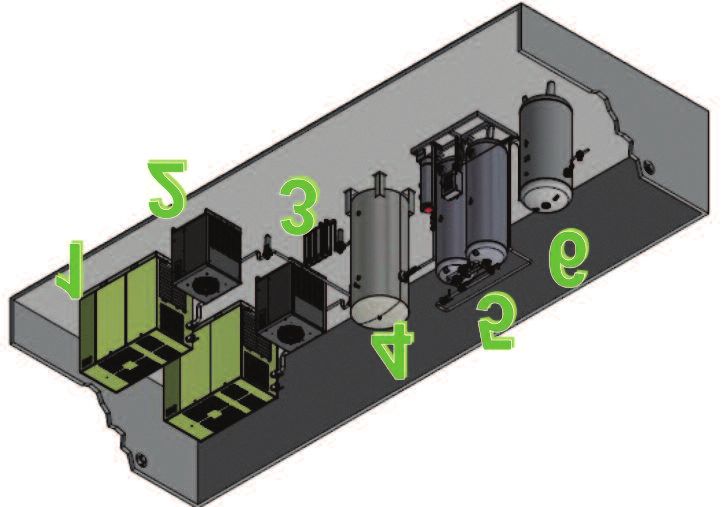
MEDICAL GAS PIPELINE SYSTEMS
attitude and commitment.” The oxygen Upgrading pipework
concentrator system is all linked up to The shipping containers from Adaptainer
SHJ’s K’nect portal, so that, from its were delivered in the first week of April,
offices in Chesham, its can see all the with the installation of all the plant
temperatures, via 10 different temperature completed, and the concentrator tested,
sensors, as well as the ampage it is completed, and operational, by the end
running at. Stafford Scopes added: of that month. Shane King added: “In
“We know the cost of electricity per addition, the work included upgrading
©Estates and Facilities Management Department, Imperial College Healthcare NHS Trust
amp/hour, so we can tell the Trust exactly the oxygen pipework within the wards to
how many litres of air are being produced get the required flow rates to the beds,
per minute, and the costs entailed. All the and installing both an emergency standby
data is collected by our Empower system, manifold, and an emergency link to the
which sends it to us here, and we then VIE. All of this work was undertaken by
host it and present it on our K’nect portal, our Estates Management team, SHJ, and
which the Trust’s Estates Department can CBRE. The scheme involved a lot of
access any time.” detailed design and calculations.”
He went on to explain that the He added: “Clearly there was a
concentrator at Charing Cross Hospital is significant increase in oxygen demand
currently supplying oxygen at a rate of up flow rates across the site and the building.
to 850 litres/min exclusively to COVID-19 Some of the wards we were working on
wards at the site, supplying all the wards had COVID-19 patients on them, so we
and theatres in the Riverside Wing, had to devise ways to upgrade the
equating to about one-third of the site’s pipework in the wards concerned, while
overall oxygen capacity. He added: “The minimising risk to patients and staff.
project, of which I am very proud, entailed We did this by creating local ring mains
completing an amazing amount of work in in the wards, downstream of the AVSUs.
a short time. It’s great to have a team of We also undertook some significant
engineers who will respond with the reinforcement and upgrading of the
commitment and enthusiasm that those The compact plant layout in a standard medical gas ring main – the main
from SHJ demonstrated on this project.” high-roof shipping container. distribution infrastructure – to enable it
to carry the oxygen with acceptable
Asked to ‘ramp up’ ICU capacity beds up on the eleventh floor of the pressure drops.
Shane King said: “In early March the Trust hospital’s main tower block. However, “SHJ was extremely helpful – especially
was asked to ramp up its ICU capacity, once it became clear there was not in the very flexible way its team
and, based on the numbers required enough VIE-piped oxygen, SHJ came in approached the work, including via
across the area, we didn’t have sufficient and began discussing how the additional extended hours working, and its staff
oxygen capacity from the VIE at Charing oxygen capacity could be optimally being prepared to work within COVID-19
Cross. BOC was unable to upgrade the provided – whether via additional standby designated areas. We all did some very
VIE, or to provide us with any additional manifolds, or temporary VIEs. He said: long days. Pleasingly, it all came together
temporary capacity. Had we – working “That is when SHJ suggested that the only and proved well worthwhile, and we
with our hard FM provider, CBRE, and other practical option would be to install managed to stay ahead of the capacity
SHJ – not come up with a solution, we an oxygen concentrator. While such requirements, which were changing
might not have been able to safely concentrators are always mentioned on daily.”
provide the Level III emergency care beds medical gas training,” he added, “I had
at Charing Cross. As soon as we became never worked with one operationally Praise from the Trust’s Chair
aware of the increase in patient numbers before. We were fortunate that this The Trust’s Chair, Paula Vennells, also
requiring oxygen therapy, we began particular concentrator had become praised SHJ’s work; in a letter of thanks
looking at our oxygen distribution available, and although several Trusts to Stafford Scopes, she said: “When I
network, to try to balance where the were interested in it, we were able to thanked the Imperial Estates team for
clinicians wanted to put the additional obtain the funds to purchase it. Between their work, they told me how grateful
beds with our oxygen and medical air purchasing it, and installing and they were for the support from SHJ.
infrastructure. Once numbers were firmed connecting it, however, we had some They were especially appreciative for
up, and the clinicians had identified which deliberations about how we could use this your supporting the Estates teams across
wards might be suitable for stepping up Oxygen 93, and whether it could be used all sites in the detailed assessment of
to critical care units, we reviewed all the with our pure oxygen, or used separately. existing piped medical gas system
infrastructure, and did a lot of work on It was agreed that it should be used capacity to meet increased ICU ventilator
upgrading the hospital’s ring main to separately, to supply the Riverside Wing.” requirements. They also thanked SHJ
enable us to move oxygen around the Once this has been decided, the Wing’s for its work on the redesign of systems
site. When we were looking at the oxygen supply was disconnected from and installation of new pipework
calculations for Charing Cross, we were the main medical gas ring main, and the infrastructure to provide adequate
significantly short. The VIE had an output whole building and another adjacent area oxygen and medical air flow capacity to
capacity of 1,833 litres, but we were were then supplied from the oxygen designated points of use, as well as for
looking for a requirement somewhere concentrator. “At Charing Cross Hospital,” the turnkey solution in supplying and
close to 3,050 litres in total.” Shane King explained, “even where installing the innovative oxygen
COVID-positive patients didn’t occupy a concentrator plant – increasing site
Close adjacencies sought whole ward, they occupied part of it. The oxygen capacity by 850 L/min when
Shane King explained that he and the concentrator ended up serving three conventional liquid oxygen supplies were
Estates Management team were looking wards, and has the potential to serve all unable to meet estimated demand, often
to put the additional intensive care beds day theatres and ‘Recovery’ in the working in close adjacency to COVID-19
in close adjacency to the existing ICU Riverside Wing and the adjacent area.” positive patients.” hej
42 Health Estate Journal October 2020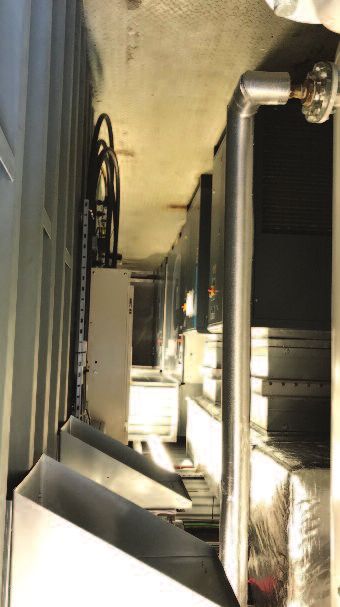
You can also read


