Packaging and Printed Paper (PPP) Program Plan 2017-2021 - March 2017
←
→
Page content transcription
If your browser does not render page correctly, please read the page content below
Packaging and Printed Paper (PPP)
          Program Plan
           2017-2021

          March 2017
List of Acronyms ......................................................................................................................... 5

 Introduction ............................................................................................................................... 6
 1.1            Multi-Material Stewardship Manitoba Inc................................................................... 6
 1.2            Regulatory Context ..................................................................................................... 6
 1.3            Background ................................................................................................................ 6
 1.4            Program Goals and Objectives .................................................................................... 6
 1.5            MMSM Vision and Mission ......................................................................................... 6

 2              Designated Materials ................................................................................................. 6

 3              Steward Responsibilities ............................................................................................ 7
 3.1            Obligated Stewards ....................................................................................................... 7
 3.2            Voluntary Stewards .................................................................................................... 8
 3.3         Rules for Stewards ...................................................................................................... 8
       3.3.1 Online Data Management System ............................................................................... 8
       3.3.2 Data Reporting Requirements ..................................................................................... 9
       3.3.3 Audit Provisions .......................................................................................................... 9
 3.4            Enforcement Procedures............................................................................................. 9

 4              Program Delivery ..................................................................................................... 10
 4.1            Overview .................................................................................................................. 10
 4.2            Municipal Collaboration in Establishing Program Context ......................................... 10
 4.3            Municipal Services Agreement.................................................................................. 11
 4.4         Recycling Program Data ............................................................................................ 12
       4.4.1 Data Reporting Requirements and Verification ......................................................... 12
 4.5            Calculation of Municipal Payments ........................................................................... 13
       4.5.1    Approach.................................................................................................................. 13
       4.5.2    Eligible Administration Costs .................................................................................... 14
       4.5.3    Eligible Net Costs ...................................................................................................... 15
       4.5.4    Payments to Municipalities....................................................................................... 16

 5              First Nation and Northern Communities .................................................................. 17

 6              Plastic Bag Reduction Program ................................................................................. 17
 6.1            Strategy .................................................................................................................... 18
 6.2            Measurement........................................................................................................... 19
 6.3            Education and Promotion ......................................................................................... 19

Page | 2
6.4            Reporting and Monitoring ......................................................................................... 19

 7              Promotion and Education ........................................................................................ 19
 7.1            Communication Strategy ........................................................................................... 20
 7.2            Operational Communications ................................................................................... 20
 7.3            Consumer P&E.......................................................................................................... 20
 7.4            P&E Activities ........................................................................................................... 20
 7.5            Research Support ..................................................................................................... 21

 8              Program Costs and Cost Recovery............................................................................ 21
 8.1            Annual Fee Setting .................................................................................................... 21
 8.2            5-Year Cost Projections ............................................................................................. 21
 8.3            Interest and Penalties ............................................................................................... 22

 9              Program Performance Measurement and Reporting ............................................... 22
 9.1            Recovery Rate Measurement .................................................................................... 23
 9.2            Environmental and Economic Sustainability .............................................................. 23
 9.3            Annual Report .......................................................................................................... 23

 10             Stakeholder and Public Consultation ....................................................................... 23
 10.1           Program Plan Renewal.............................................................................................. 23
 10.2           Ongoing.................................................................................................................... 23

 11             Governance Model .................................................................................................. 24
 11.1           MMSM Board of Directors ........................................................................................ 24

 Appendix A: Material list with examples ................................................................................. 25

 Appendix B – Eligible Cost and Revenue Categories ................................................................. 27
 Eligible Administration Costs ..................................................................................................... 27
 Eligible Service Delivery Costs.................................................................................................... 27
 Eligible Promotion and Education Costs..................................................................................... 27
 Eligible Capital Costs ................................................................................................................. 27
 Gross Revenue .......................................................................................................................... 27

 Appendix C: List of Municipalities, Parks, First Nations ............................................................ 28

 Appendix D: Consultation Communications Distributed March 7, 2016 ................................... 31

 Appendix E: Summary of Comments Received ......................................................................... 33

Page | 3
Appendix F: Comments Received and MMSM Responses ........................................................ 35

Page | 4
List of Acronyms

 AMM       Association of Manitoba Municipalities
 CBCRA     Canadian Beverage Container Recycling Association
 DPPP      Designated PPP
 MOU       Memorandum of Understanding
 MMSM      Multi-Material Stewardship Manitoba
 MIPC      Municipal Industry Program Committee
 PPP       Packaging and Printed Paper
 P&E       Promotion and Education
 SWAT      Solid Waste Advisory Team
 WRAP      Waste Reduction and Prevention Act

Page | 5
Introduction

1.1     Multi-Material Stewardship Manitoba Inc.

    Multi-Material Stewardship Manitoba Inc. (MMSM) is a not-for-profit industry-funded
    organization that was formed by representatives of obligated stewards to develop, implement
    and operate a diversion program for designated packaging and printed paper in the Province of
    Manitoba, on behalf of its members.

1.2     Regulatory Context

    The Packaging and Printed Paper Regulation 195/2008 (“the Regulation”), enacted in
    December 2008 under the Waste Reduction and Prevention (WRAP) Act (“the Act”),
    established requirements for a stewardship program for packaging and printed paper
    (PPP) made from paper, plastic, metal or glass, and supplied for use in the Province of
    Manitoba. An accompanying Guideline for Packaging and Printed Paper Stewardship sets out
    components to be addressed in a program plan.

1.3     Background

    The MMSM Packaging and Printed Paper Program Plan (“the PPP Program Plan” or “the
    Plan”`) was developed in response to the Regulation and was approved by the Minister in
    September 2009 for a five (5) year term. The MMSM Program launched on April 1, 2010.

    In October 2010, MMSM signed a Memorandum of Understanding (MOU) with Canadian
    Beverage Container Recycling Association (CBCRA). This MOU transferred responsibility of the
    75% beverage container recovery target from MMSM to CBCRA.

    In October 2014, MMSM requested and received approval for a one (1) year extension on the
    original MMSM PPP Program five (5) year term. This approval expires November 16, 2016.

1.4     Program Goals and Objectives

    The primary goals of the MMSM PPP Program are to promote the reduction, reuse and recycling
    of designated packaging and printed paper in the province of Manitoba and to sustainably
    increase recovery and recycling rates of the designated material.

1.5     MMSM Vision and Mission

    MMSM’s vision is to be a leader in responsible product stewardship in Manitoba.

    MMSM’s mission is to ensure that its members are fulfilling their stewardship requirements
    under the WRAP Act in a cost effective way.

2      Designated Materials

    Section 1 of the Regulation defines the designated materials as follows:

            “packaging means any package or container, or any part of a package or container,
            that is comprised of glass, metal, paper or plastic, or any combination of any of
Page | 6
those materials and includes, but is not limited to, service packaging”; and

            “printed paper means paper that is not packaging, but is printed with text or graphics
            as a medium for communicating information, and includes telephone directories, but
            does not include: (a) other types of bound reference books; (b) bound literary
            books; or (c) bound text books”.

    The Regulation identifies two categories of packaging:

            “pre-packaged goods means goods that are in the packaging in which they would
            ordinarily be supplied for consumption”; and

            “service packaging means packaging that is filled or applied at the point of sale to
            enable or facilitate the delivery of goods by a retail seller or a food service industry or
            other service industry outlet”.

    As these definitions are broad in scope, the PPP Program Plan further defines packaging and
    printed papers for purposes of steward reporting and determining eligible program
    costs. A complete list of packaging and printed paper categories and subcategories is
    available at www.stewardshipmanitoba.org and is appended to the Rules for Stewards. The
    complete list can be found in Appendix A.

    Packaging that is covered under another stewardship plan is excluded from MMSM’s PPP
    Stewardship Plan. This packaging is not to be reported by stewards to MMSM. Collection and
    management costs associated with this packaging are not eligible under MMSM’s PPP
    Stewardship Plan.

3      Steward Responsibilities

3.1     Obligated Stewards

    For the purpose of the PPP Program Plan and determining which person shall be the obligated
    steward for a particular category of Designated PPP (DPPP), the following provisions shall apply,
    in the order in which they are set out. For greater certainty, if two or more persons are
    obligated pursuant to the following categories, the provision which is first in this list shall
    prevail1:

        a) A Brand Owner is the obligated Steward with respect to all DPPP and the Packaging of all
           goods, for which it has a Commercial Connection in the Data Year;
        b) A Franchisor is the obligated Steward with respect to all DPPP and the Packaging of all
           goods, Supplied within the relevant Franchise System in the Data Year;
        c) In the event that there is no Brand Owner or Franchisor, a First Importer is the obligated
           Steward with respect to all DPPP and the Packaging of all goods for which it is the First
           Importer in the Data Year;
        d) In the event there is more than one Brand Owner for the same DPPP, the Brand Owner
           or First Importer more directly connected to the production of the DPPP shall be the
           obligated Steward, provided that in the case of a Franchisor who is Resident in
           Manitoba, the Franchisor shall be the obligated Steward;

1
 Definitions for the capitalized words in a) to h) are in the Steward Rules posted on MMSM’s website at
www.stewardshipmanitoba.org.
Page | 7
e) In the event that consumer products containing two or more independent brands are
           packaged together for sale in Manitoba, then the Brand Owner more closely associated
           to the joint packaging shall be the obligated Steward for such joint packaging;
        f) In the event there is not an identifiable brand for a particular DPPP and if the
           manufacturer of the good is resident in Manitoba, the manufacturer of such good shall
           be the obligated Steward for such DPPP, otherwise the First Importer shall be the
           obligated Steward for such DPPP;
        g) Any person who supplies service packaging to consumers in Manitoba in the Data Year;
           and
        h) Any person who is a voluntary steward in the Data Year.

 This description of the obligated steward is subject to revision for clarity and continuous
 improvement.

3.2     Voluntary Stewards
 MMSM has implemented a Voluntary Steward Policy, harmonized with other provinces, that
 provides reporting flexibility by allowing a company to report and pay fees on behalf of an
 otherwise obligated steward. The purpose of the process is to provide an opportunity for
 another company to accept reporting responsibilities and make payments on behalf of a
 company that would otherwise be the steward in order to reduce the administrative burden
 on the other steward. A copy of the Voluntary Steward policy is available on our website
 at www.stewardshipmanitoba.org

3.3     Rules for Stewards

 MMSM has developed Rules for Stewards setting out the requirements for reporting and the
 amount of fees to be paid by participating stewards and/or prescribing methods for
 determining the amount of the fees. MMSM Rules for Stewards outline the following:

        ·    Definition of stewards;
        ·    Definition of packaging and printed paper;
        ·    Fees for packaging and printed paper;
        ·    Reporting and payment requirements;
        ·    Penalties for late reporting and late payment;
        ·    Allowance for a company to report and pay fees on behalf of an otherwise obligated
             steward;
        ·    Record retention and audit provisions;
        ·    Steward exemptions; and
        ·    Dispute resolution process.

 The Board of MMSM reviews the Rules as required on an annual basis. Notification of all
 proposed changes to the Rules will be sent to registered stewards and posted on the MMSM
 website. A notice period of no less than 30 days will be allowed for comment on the proposed
 changes. Following review of comments received, the Board of Directors of MMSM will vote on
 proposed changes as per the bylaws of the corporation. Following review and approval by the
 MMSM Board of Directors, MMSM will communicate to stewards the rule changes to
 be implemented and the date they will take effect. The current steward rules are available at
 www.stewardshipmanitoba.org

3.3.1       Online Data Management System

Page | 8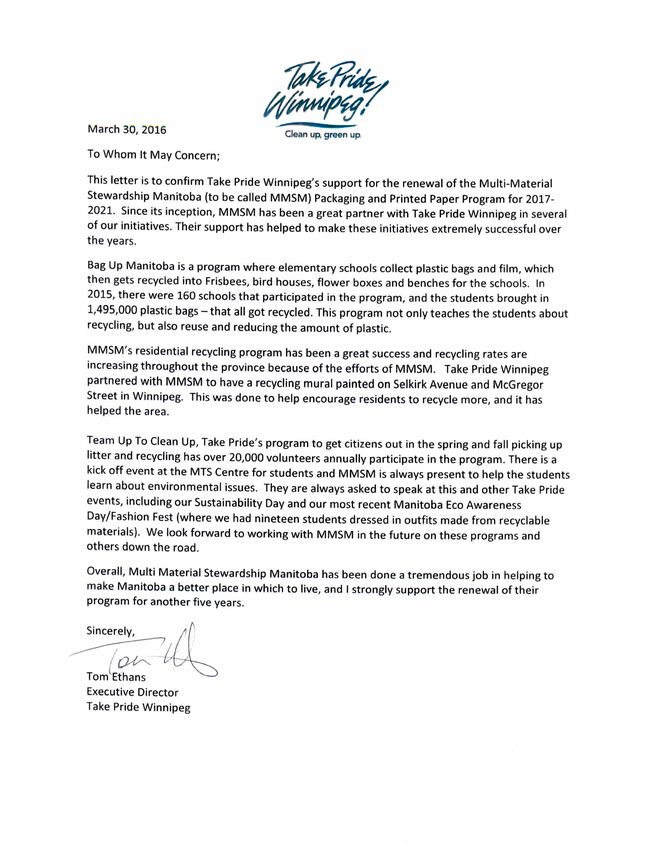
In an effort to promote harmonization with other provincial packaging and printed paper
 programs, MMSM has contracted with Canadian Steward Services Alliance (CSSA) to provide
 administrative and steward services, including the use of its Online Steward Data Entry System.

3.3.2       Data Reporting Requirements

 Under the PPP Program Plan, stewards are required to report annually to MMSM the total
 quantity (in kilograms and p l a s t i c b a g units) of designated packaging and printed paper
 supplied for use in households in the province.

 The reported kilograms of packaging and printed paper are used to determine a steward’s total
 fees payable to MMSM.

 In addition, stewards reporting to MMSM are required to:

        ·    Identify the brands, products, customers or suppliers for which the steward is
             responsible;
        ·    Provide a detailed explanation of the steps taken to calculate the total quantity
             of packaging and printed paper;
        ·    Provide details on the deducted quantities of designated material that are not
             supplied to consumers for use in households and available to be managed through
             Manitoba’s residential diversion system (by material type, number of units and
             weight) and explain the method by which this deduction was derived (e.g.,
             customer sales records, market research, waste audits etc.); and
        ·    Maintain records for a period of at least five years and make these records available
             to MMSM upon request.

3.3.3       Audit Provisions

 Stewards are required to maintain records for a period of at least five years in support of all
 data submitted to MMSM.

 MMSM may examine, audit and inspect a steward's records at any time up to five years after the
 date of receipt of the related steward report by MMSM. The number of steward reports to be
 audited in any given program year is determined by MMSM on an annual basis.

3.4     Enforcement Procedures

 Through the maintenance of a public registry of identified stewards and the development of
 a tracking system to monitor compliance, MMSM actively encourages compliance. The registry
 includes:

 1.          All persons for which these persons are the obligated stewards under the PPP
             Program Plan; and
 2.          All persons for which these persons are the voluntary stewards under the PPP Program
             Plan.

 Field research is performed by MMSM to identify non-compliant stewards, utilizing leads
 generated by complying stewards, or independently through store and product audits.
Page | 9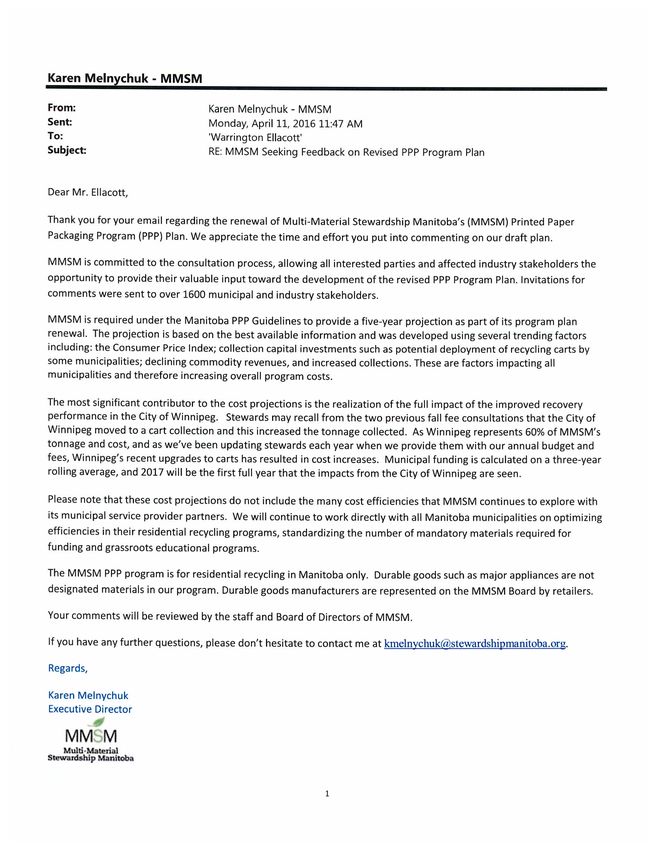
MMSM has implemented a non-compliance notification process, including written notification
    of when reports and fees are due. If stewards and products are identified that have not
    registered or reported under the Program or another approved packaging and printed material
    stewardship program, obligated stewards for these materials will be notified. If the Steward’s
    registration and data submission process is not complete MMSM will follow-up with 30-day, 60-
    day, 90-day and 120-day notifications. If the Steward’s registration and data submission process
    is not complete at the end of the 120 days, MMSM may request the Manitoba Government to
    take enforcement action as stipulated under the WRAP Act.

4      Program Delivery

4.1     Overview

MMSM works with municipalities and other partners to provide Manitoba residents with
reasonable access to collection services for PPP. While the type of collection service varies across
the province depending on the size, location and characteristics of each community, MMSM
works with municipalities to provide effective and efficient residential recycling services that are
reasonably consistent for similar types of communities across Manitoba and appropriate for the
community type.

Program delivery is governed by the Program Plan and informed by Steward Reporting and
feedback from municipalities via the Municipal Industry Programs Committee. Individual
participating municipalities manage their recycling systems in accordance with the terms of the
services agreement with MMSM. Municipalities provide program performance and financial data
to MMSM, which uses the data to calculate the payment amounts owing to each participating
municipality. This section describes that process.

4.2     Municipal Collaboration in Establishing Program Context

Given the number of municipalities in Manitoba, MMSM has established the Municipal Industry
Programs Committee (MIPC) as a forum to discuss operational issues with representatives from
the Association of Manitoba Municipalities (AMM). MIPC provides the forum for MMSM to
consult with municipal representatives on various aspects of program delivery, including changes
to the services agreement and a review of eligible costs. MIPC will also serve as a means through
which Manitoba municipalities are kept informed of changes to the program.

MIPC includes members from MMSM and AMM, and will consider the interests of all
municipalities. MIPC is co-chaired by representatives from MMSM and AMM and meets at
minimum twice a year.

Page | 10
4.3 Municipal Services Agreement
MMSM will pay 80% of eligible costs2 incurred by municipalities to manage designated materials
through efficient and effective municipal residential diversion programs. Municipalities wishing to
participate in MMSM’s program must meet minimum requirements and enter into a services
agreement with MMSM. Municipal participation in the MMSM program is voluntary.
The municipal services agreement sets out the minimum requirements that a municipality must
meet on a continuous basis in order to be eligible to receive payments under the program. The
requirements are intended to support the continued delivery of sustainable residential PPP
collection and recycling in Manitoba.
The municipal services agreement will be reviewed periodically by MIPC and will be updated as
appropriate to reflect changes to the program.
Municipalities that choose to sign a services agreement will provide certain services to MMSM,
including but not limited to the following:
· Resident promotion and education on the proper use of recycling services;
· Collection of the specified types of residential PPP in a manner that is appropriate for the
community and in a manner designed to protect the quality of the collected PPP and
maximize commodity revenue;
· Delivery of the collected PPP to a processor or broker registered with MMSM;
· Quarterly reporting of the PPP collected, with supporting documentation;
· Participation in the annual cost-monitoring survey; and
· Participation in any field study or audit (financial or performance related) reasonably
required by MMSM to meet its program obligations.
The services agreement also:
· Specifies the manner in which payments will be calculated and the frequency of payment;
· Provides the municipality with access to MMSM’s technical assistance, including
identification of contractual arrangements as well as assistance to promote collection and
processing services;
· Requires the municipality to provide MMSM with all necessary financial and non-financial
(e.g. performance) related assurances necessary for the program;
· Requires the municipality to provide MMSM with advance written notification of
proposed changes to program design and delivery;
· Requires the municipality to provide MMSM standing in the municipal process to
determine changes to program design and delivery and to take into consideration any
advice received from MMSM; and
· Provides MMSM with the ability to treat costs arising from municipal decisions that do not
reflect MMSM’s advice on the delivery of effective and efficient residential recycling
services as ineligible for the purposes of calculating payments to municipalities.
2
Eligible cost categories as of 2010 are listed in Appendix “B”
Page | 11Municipalities are required, as part of the services agreement, to notify MMSM and consider
MMSM’s advice prior to:
· Developing, approving or implementing any change in program design or operation that
may:
o Increase the quantity of PPP collected;
o Increase collection and/or processing costs; or
o reduce material revenue;
· Preparing or issuing a request for proposals or tender for PPP collection or processing
services in a manner that ensures a competitive procurement process;
· Awarding a contract to collect or process PPP from households; or
· Acquiring or modifying any capital assets.
Following notification by a municipality of possible changes to a program, MMSM will provide
technical assistance to the municipality during their decision making process. Should the
municipality disregard MMSM’s advice and implement changes that result in additional costs that
MMSM would not incur if the advice had been followed, these costs may be deemed to be
ineligible costs.
MMSM may from time to time enter into services agreements with collection agents other than
municipalities for the collection and recycling of residential PPP where such additional services are
deemed necessary by MMSM.3 Appendix 3 contains a list of municipalities, First Nations and parks
currently receiving funding from MMSM.
4.4 Recycling Program Data
4.4.1 Data Reporting Requirements and Verification
MMSM annually collects and analyzes the quantity of PPP collected and directed to a processor or
broker registered with MMSM, the costs of operating the recycling program and the commodity
revenue received in order to:
· Calculate program performance;
· Determine steward fees;
· Identify opportunities for continuous improvement to increase the material recovery rate
and reduce program costs;
· Identify eligible costs; and
· Calculate payments to municipalities to be made in the following year.
The data collected include:
· The quantity of material collected by each collector;
· The quantity of material directed to a processor or broker registered with MMSM;
3
MMSM currently provides direct services for plastic bag collection through events and partnerships with
not-for-profit organizations and schools.
Page | 12· Where services are delivered directly by a municipality:
o Capital costs for assets such as buildings, vehicles, balers;
o Staff costs;
o Operating costs, e.g. fuel, heating;
· Where services are subcontracted by a municipality:
o Contract costs for recycling collection and processing;
· Cost to transport material to a broker or market;
· Revenue sources and value; and
· Expenditures for promotion and education.
MMSM will verify the data through follow up with municipalities, which may include undertaking
an audit of the tonnage data submitted quarterly and the cost and revenue data submitted
annually by a municipality or other collector.
4.5 Calculation of Municipal Payments
4.5.1 Approach
MMSM provides payments to municipalities that collect residential PPP using the following
service delivery methods:
· Curbside collection in some municipalities;
· Depot collection in other municipalities; and
· Both curbside collection and depot collection operating in parallel in some municipalities.
The municipality receiving payments must meet the following requirements:
· Provide PPP collection services to residents and recycle, or cause to be recycled, the
collected PPP; and
· Be in compliance with the services agreement between the municipality and MMSM.
The manner in which payments are distributed is intended to:
· Support convenient, effective and efficient residential PPP collection and recycling
services to manage PPP supplied by MMSM stewards;
· Encourage diversion of residentially generated PPP supplied by MMSM Stewards from
municipal landfills; and
· Reimburse municipalities for 80% of the net costs to operate efficient and effective
programs to manage household PPP supplied by MMSM Stewards.
Payments from MMSM are for the collection and processing of recyclable residential PPP supplied
by MMSM stewards. MMSM will not pay municipalities to collect or recycle:
· Materials that are not PPP as defined in the Program Plan;
· PPP from industrial, commercial or institutional (ICI) sources;
Page | 13· PPP supplied by exempt and non-compliant stewards;
· PPP supplied by stewards that are part of an approved program plan for packaging and
paper other than MMSM’s Program Plan; or
· Packaging containers, such as oil, antifreeze and diesel exhaust fluid containers that are
intended to be managed by other product management programs.
Once MMSM is confident that the data accurately represents municipal operations, MMSM will
analyze the data to benchmark and compare program net costs among Manitoba programs. Data
will be sorted to group similar programs by municipal population using the most current census
data. In addition to using municipal groups to benchmark effective and efficient program costs,
MMSM will provide technical and advisory services to municipalities identified as having excessive
costs relative to their group.
Current Municipal Groups4:
Municipal Group Population Categories
0 – 5,000
5,001 – 20,000
City of Brandon
City of Winnipeg
Payments to municipalities are based on the sum of eligible administration, operating, promotion
and education and capital costs less revenue.
4.5.2 Eligible Administration Costs
Administration costs are costs incurred by municipalities in support of program operations.
Eligible administration costs are listed in Appendix B, and will be reviewed periodically by MIPC.
The Eligible Administration Costs for each municipality is based on a specified percentage of total
eligible operating costs and is currently calculated as follows:
· Municipalities that provide services directly are paid at the rate of 5% of total eligible
Operating Costs that are provided directly; and
· Municipalities that contract for services are paid at the rate of 3% of total eligible
Operating Costs that are under contract.
The result of the calculation described above is the Eligible Administration Cost.
4
The placement of a municipality in a group of municipalities with similar characteristics will be reviewed
based on changes in population or other factors that drive recycling costs.
Page | 14MMSM will review the percentages used to calculate the Eligible Administration Costs periodically through consultation with MIPC. Participating municipalities will be notified of any changes to the percentage by MMSM. 4.5.3 Eligible Net Costs Eligible Net Costs for each participating municipality are calculated as the sum of Eligible Administration Costs plus Operating Costs plus Promotion and Education Costs plus Capital Costs less Gross Revenue.5 Operating Costs include expenditures for the collection, processing, and marketing of residential PPP, whether the service is delivered by the municipality, contracted to the private sector, or a combination thereof. Promotion and Education Costs include the costs to promote the use of the municipal recycling program and educate residents on local recycling procedures. Capital Costs include the portion of the amortized capital cost of municipally owned collection vehicles, facilities, fixed and mobile equipment and collection containers used for residential PPP services where the capital costs do not form part of the contracted services provided by private sector contractors. Gross Revenue includes revenue from the sale of PPP and from the sale of collection containers as well as revenue from grants, waste management service fees or other funding sources that offset the delivery of recycling services. Eligible Net Costs are divided by the eligible tonnes managed by each municipality to calculate the eligible net cost per tonne for each municipality. 5 Eligible cost and revenue categories are listed in Appendix B, and will be reviewed periodically by MIPC. Page | 15
This data is then used to calculate the three year average median net cost per tonne within each
municipal group after removing programs with outlier net costs per tonne.

Within each municipal group, the three year average median net cost per tonne is multiplied by
80% to calculate the payment rate per tonne in accordance with MMSM’s payment obligation.

4.5.4 Payments to Municipalities
Participating municipalities that are in good standing with respect to their services agreements
will receive four quarterly payments, each equal to one-fourth of the municipality’s calculated
annual payment.

Payment to each municipality is based on the payment rate per tonne for its municipal group
multiplied by the number of eligible tonnes of residential PPP collected by the municipality in the
year during which costs reported in the most recently completed cost monitoring survey were
incurred.

Page | 16
5      First Nation and Northern Communities

MMSM continues to strengthen its relationships with First Nations and northern remote
communities in Manitoba by providing technical assistance on waste management issues
and helping communities increase the effectiveness and efficiency of their recycling
programs. Expanding and sustaining recycling in Manitoba’s northern communities
requires a comprehensive approach that recognizes the unique needs of the region while
also setting the direction for long-term efficiency and effectiveness. The readiness of the
community to take on these initiatives is also very important.

Some northern communities have, with support and technical assistance from MMSM,
developed and sustained a comprehensive recycling program that meets all of the
mandatory requirements of the program. These communities are often located near a
neighbouring municipality with an established recycling program in place that is willing to
collaborate with them. By coordinating their efforts, the communities are able to address
operational and logistical challenges like transportation.

MMSM will continue to work closely with other stewardship organizations as a member
of SWAT – Solid Waste Advisory Team, and will actively participate in meetings and
projects around Manitoba. The objective of the group is to meet and engage other
stakeholders, both private and public, that have environmental interests in the province.
The team discusses opportunities to improve waste management and recycling in
rural/remote communities in Manitoba.

MMSM partners with other stewardship organizations to collect and remove obligated
materials. MMSM and the Canadian Beverage Container Recycling Association (CBCRA)
have agreed to collaborate where beneficial in order to achieve an effective approach to
expanding and sustaining recycling programs in Manitoba’s First Nations and remote
northern communities. Together we have been working on several initiatives, including
collection events and clean-up days, in order to provide services to northern and remote
communities in Manitoba. Where possible, feasible and sustainable, we will continue to
identify opportunities to work with other organizations and stewardship programs to
collect and remove recyclable material from these communities.

Success in expanding recycling in Manitoba’s north will depend on strategic alliances
and partnerships with key groups, including support from key political and
government organizations. Partnering with government funding agencies (INAC,
ManitobaAboriginal and Northern Affairs) will allow MMSM to better understand their
existing funding mechanisms and to identify possible cost-sharing opportunities for
mutual benefit.

6      Plastic Bag Reduction Program

    MMSM along with staff and stewards from the food, beverage and consumer goods sectors,

Page | 17
have taken an effective combination of the 3Rs approach to the use of “single-use” plastic
bags. The goal was to reduce the number of empty “single-use” plastic bags disposed in
landfill by at least 50%. The primary emphasis was on the reduction of plastic bags supplied
into the market. This was followed by the responsible reuse of plastic bags, and thirdly,
through increased recycling opportunities for plastic bags. Some of the measures were
initiated and undertaken by MMSM; other measures were undertaken by retail stores but all
of these efforts have contributed to exceeding count toward the reduction goal.
6.1 Strategy
MMSM and the plastic bag stewards including retailers have taken a multi-pronged 3R
approach to achieving the target set forth in the Plastic Bag Guideline.
a) Plastic Bag Reduction
Reducing the number of plastic bags supplied into the market is the single most
effective measure that industry can take to reach the target. This has been achieved
through the following means:
· Enhancement of opportunities to acquire reusable bags in retail stores;
· Focused in-store messaging about the benefits of reusable bags;
· Continued and increased promotion of plastic bag best practices to further reduce
the number of bags provided at retail; and
· The use of a fee for plastic bags, where retailers choose to do so, as an incentive
for consumers to choose reusable bags.
b) Plastic Bag Reuse
Plastic bags are commonly purchased and used to dispose of kitchen, bath, or animal wastes.
Consumers are encouraged to reuse single use bags in their home or workplace rather than
purchasing new plastic bags to dispose of wastes. Additionally, consumers are encouraged to
reuse plastic bags for other domestic uses rather than disposing of them after a “single” use.
MMSM has partnered with Winnipeg Harvest on the Bag It Forward Program, which included
the deployment and setup of 300 bins in alternate locations within communities to collect plastic
bags for reuse as emergency food hampers. Any bags which are not in good condition are recycled.
Waste audit results over the past several years have shown that Manitobans are reusing single use
bags in greater quantities.
c) Plastic Bag Recycling
The plastic bag recycling program has two major complementary components.
1. Plastic Bag Collection
A Plastic Bag Recycling Program has been developed which includes the collection of empty
plastic bags at retail store locations. The intent of the Plastic Bag Recycling Program is to
increase the number of drop-off locations to ensure that Manitobans have reasonably
convenient access to plastic bag drop-off locations.
The following types of plastic bags are included in the Program:
Page | 18· Plastic grocery bags;
· Plastic retail bags with string ties and rigid plastic handles removed;
· Plastic newspaper bags; and
· Plastic dry-cleaning bags.
2. Plastic Bag Recycling Combined with School Education
MMSM has partnered with Take Pride Winnipeg! to offer a school-based program throughout
the province. The program links education with direct recycling efforts, thereby creating
impacts much greater than only the environmental benefits of recycling plastic bags. A
significant component of the Program involves the education of school children on the
benefits of reducing the use of, reusing, and recycling plastic bags.
MMSM continues to look for opportunities to work with communities and organizations to
promote and educate consumers on the proper disposal of plastic bags.
6.2 Measurement
MMSM collects data from stewards to determine the actual number of plastic bags distributed
in the province. Reviews of steward reports are conducted as part of MMSM’s effots to ensure
steward compliance, a level playing field and accuracy in reporting.
MMSM will investigate and evaluate additional opportunities to affect positive
environmental impacts associated with the use of plastic bags.
6.3 Education and Promotion
MMSM will create a Promotion and Education (P&E) campaign that will educate
consumers about the benefits of reducing their usage of plastic bags and of opportunities to
recycle their bags. This campaign will consult with key stakeholders, including the Province of
Manitoba and municipalities about the P&E program.
6.4 Reporting and Monitoring
The MMSM Annual Report will report on activities and progress made toward the Plastic Bag
reduction target. This report will include activities related to plastic bag reduction, and reuse,
plastic bag recycling, and industry efforts to increase the percentage of recycled content in
plastic bags.
7 Promotion and Education
This section describes the promotion and education (P&E) activities that will support the
objectives of the MMSM program.
The P&E program developed by MMSM will focus on two distinct communication
components. The first component is identified as “operational” communication support,
meaning the strategic and tactical activities required to support operational functions. The
second component is identified as “consumer” P&E, which will target consumers and
generators of PPP waste to participate in the Program.
The following sections describe the activities to support these two communications components.
Page | 197.1 Communication Strategy
MMSM’s communication strategy is dynamic and is updated annually to ensure it incorporates
continuous improvement and reflects the evolution of diversion opportunities over the life of
the Program Plan. It promotes a call to action – increased recycling and diversion —directly to
target audiences employing a wide assortment of tactics aimed at reaching people with
messages that capture their attention, prompt them to absorb information and motivate them
to adopt and maintain the desired behavior.
Activities include, for example, earned and paid media, educational programs, social media
marketing and information on the MMSM website.
7.2 Operational Communications
Stewards require regular communication to help them prepare to meet their reporting and
fee-payment obligations. Communication tactics include a website containing a broad range of
technical information tailored to steward needs, reporting and filing guidebooks, periodic
meetings/consultations, letters of notification and webinars or webcasts.
Similarly, municipalities require communication to help them meet their reporting
requirements. Communication tactics include a website containing technical information
tailored to municipal needs, a reporting guidebook and webinars or webcasts.
7.3 Consumer P&E
The primary goal of consumer P&E is to increase the recovery rates of PPP in community-based
collection services. MMSM uses a mix of communication tools to motivate residents to adopt the
desired behaviour. Key features and techniques include:
· A variety of tools to build awareness among residents about appropriate end-of-life
management of PPP;
· Targeted school programming for K-12 and post secondary institutions;
· Educating residents about the action required;
· Motivating action (providing a “call-to-action”); and
· Reinforcing and rewarding the newly adopted behaviour by providing information
about the result of their action.
P&E activities are set out in a communication strategy that is reviewed and updated annually.
7.4 P&E Activities
Depending on the annual communication strategy and P&E budget, the P&E tactics could
include (but not necessarily be limited to):
· Paid media– would require a moderately weighted media campaign designed to
reach identified target audiences and focusing on the recycling message;
· Earned Media – news releases and stories that would be disseminated throughout
the year; and
Page | 20· Website – the MMSM website will continue to have a consumer-friendly public
interface that will provide information on what can be recycled in each
community, as well as general information about the benefits of recycling.
7.5 Research Support
Research is a key building block of an effective communication strategy and will be used in
the development of the communication plan and to test creative concepts and messages. It
also is necessary to establish the creative elements needed to generate messages that
resonate with the various target audiences, triggering the desired response.
8 Program Costs and Cost Recovery
8.1 Annual Fee Setting
MMSM will establish steward’s fees annually after municipalities have reported their costs for
the previous calendar year and these costs have been verified by MMSM.
Fees for the following program year will be determined and approved by the MMSM
Board of Directors before the end of October each program year. The methodology used to
set fees is principle based and ensures that all obligated parties contribute to the maintenance
of the recycling system in a manner which reflects the material’s cost to manage and its
commodity value.
8.2 5-Year Cost Projections
The total program costs have been projected for the five years of the Program Plan based on
the best available information.
Scenario 2016 (act.) 2017 (est.) 2018 (est.) 2019 (est.) 2020 (est.) 2021 (est.)
Low Scenario $18,646,936 $19,858,285 $20,287,567 $20,892,485 $21,880,914
$16,544,063
High Scenario $18,861,419 $20,723,882 $21,687,770 $22,845,976 $24,072,080
Page | 21Year 8 Year 9 Year 10 Year 11 Year 12
Low Scenario 2017 2018 2019 2020 2021
Municipal funding $ 15,873,802 $ 17,001,957 $ 17,345,550 $ 17,862,207 $ 18,759,728
Program management/ P&E $ 2,678,134 $ 2,761,328 $ 2,847,018 $ 2,935,278 $ 3,026,187
Government fees $ 95,000 $ 95,000 $ 95,000 $ 95,000 $ 95,000
Program Cost $ 18,646,936 $ 19,858,285 $ 20,287,567 $ 20,892,485 $ 21,880,914
Year 8 Year 9 Year 10 Year 11 Year 12
High Scenario 2017 2018 2019 2020 2021
Municipal funding $ 16,034,438 $ 17,755,551 $ 18,571,023 $ 19,573,392 $ 20,635,867
Program management/ P&E $ 2,731,981 $ 2,873,330 $ 3,021,747 $ 3,177,584 $ 3,341,213
Government fees $ 95,000 $ 95,000 $ 95,000 $ 95,000 $ 95,000
Program Cost $ 18,861,419 $ 20,723,882 $ 21,687,770 $ 22,845,976 $ 24,072,080
The total program projected costs include the costs to cover government costs as it relates to
the PPP Program.
8.3 Interest and Penalties
MMSM charges interest and penalties to stewards that have not submitted fees or stewards
that have not registered. Delinquent and later joining stewards are obligated from the
date of obligation (April 1, 2010).
Interest and penalties received by MMSM are used to reduce the total steward fees payable in
the following year. Any fees paid after the year in which they were due will also be used to
reduce the total steward fees payable in the following year.
9 Program Performance Measurement and Reporting
MMSM will report annually on PPP Program performance. This information will be published
in the annual report.
Program performance indicators include:
Page | 22· Steward reported tonnes;
· Municipal eligible recycled tonnes;
· Recycling Rate;
· Population and households with access to PPP Program;
· Recovered kg per capita; and
· Percentage of residents aware of recycling services.
9.1 Recovery Rate Measurement
The recovery rate of the designated materials included in the PPP Program is measured by
dividing the total tonnage of designated PPP recovered as reported by municipalities by the
total tonnage of designated PPP supplied for use by consumers in households as reported
by stewards.
9.2 Environmental and Economic Sustainability
MMSM will consider environmental and economic sustainability as it determines the
method by which PPP is managed, such as a particular form of collection service, specific
collection locations or an approach to processing.
Local processing and manufacturing into new products will be promoted where both
economic and environmental objectives are met.
MMSM will monitor national and international laws and regulations to ensure that the
Program is in compliance.
By ensuring that the Program operates in the most sustainably efficient and effective
manner, potential negative environmental impacts will be reduced.
9.3 Annual Report
MMSM will report annually on PPP Program performance in its Annual Report. Once the
Annual Report is submitted to the Minister, MMSM will post the Annual Report on the MMSM
website, as well as provide a printed copy of the Annual Report free of charge, upon
request.
10 Stakeholder and Public Consultation
10.1 Program Plan Renewal
The Program Plan renewal submitted to the Minister for approval will include information on the
consultation process, participants in the consultation process and comments received by MMSM
from participants.
10.2 Ongoing
MMSM consults with stakeholders on a regular basis.
Stakeholders include:
Page | 23· Stewards of designated packaging and printed paper;
· Municipalities and other service delivery agents;
· The Manitoba Government, specifically the Department of Sustainable Development and
Green Manitoba;
· Relevant non-government organizations or agencies; and
· The general public.
Each stakeholder group receives information that is relevant to them, in a timely
manner. For example, a change in steward fees will be communicated to stewards but not
necessarily to the general public. In contrast, the addition of new materials will be
communicated to the general public and all other stakeholders.
The primary communications vehicle will be the MMSM website, accessible to all
stakeholders. The website will include information such as, but not limited to, Annual
Reports, municipal costs and volume, consultation documents and feedback received during
the consultation process, and plastic bag recycling information. All parties interested in
a particular aspect of the MMSM decisions or activities will have opportunity to provide
feedback via the website or by contacting the appropriate MMSM staff directly.
11 Governance Model
11.1 MMSM Board of Directors
MMSM is governed by a board of directors, consisting of eight industry and two unrelated
independent directors. The Board provides valuable input and governance to the organization,
and consists of representatives from the following sectors:
· Grocery sector
· Consumer products sector
· Alcohol beverages
· Beverages
· Restaurants
· Retailers
· Printed paper
· Newspapers
The following associations are represented on the MMSM Board:
· Canadian Beverage Association
· Retail Council of Canada
· Manitoba Liquor and Lotteries Corporation
· Food and Consumer Products of Canada
· Restaurants Canada
· Manitoba Newspaper Group
· Dairy Processors of Manitoba
· Canadian Federation of Independent Grocers
Page | 24Appendix A: Material list with examples
Material
Material Sub-Category Examples (not intended to be a comprehensive list)
Category
Newspaper publications, newsprint inserts and
Newsprint
flyers, product manuals printed on newsprint.
Weekly/monthly or annual magazines, retailer
Magazines and catalogues
seasonal catalogues, travel magazines.
Printed
Directories Phone books.
Paper
Free promotional calendars and posters; product
user guides, warranty cards, product safety
Other Printed Materials
information etc.; monthly, quarterly or annual
statements; cash register receipts.
Gable top containers – non-beverage Milk and cream cartons, sugar cartons.
Ready to serve beverages such as milk and juice
Gable top containers – beverage
cartons.
Aseptic containers – non-beverage Soup, sauce containers.
Aseptic containers – beverage Ready to serve beverages such as juice and milk.
Laminated kraft bags, paper hot/cold drink cups,
paper ice cream cartons, microwavable paper
Paper Paper laminates containers, paper wrap packaging provided with
Packaging food, such as sandwiches, burgers, or muffins, pet
food bags.
Television and computer boxes, pizza boxes, paper
Corrugated cardboard carry-out bags.
Cereal boxes, tissue boxes, clothing hang tags, shoe
boxes, egg cartons, formed coffee take-out trays, the
Boxboard and other paper packaging roll inside of toilet paper, paper towel, tin foil and
plastic wrap, boxboard shipping boxes used for
direct mail to residential customers.
Salad dressing bottles, edible oil bottles, peanut
PET bottles < 5 Litres - non-beverage butter jars.
PET bottles > = 5 Litres – non-beverage Salad dressing bottles, edible oil bottles.
PET bottles < 5 Litres – beverage Soft drink, juice, and water bottles.
PET bottles > = 5 Litres – beverage Water bottles.
Laundry detergent, shampoo, bleach, vinegar, body
HDPE bottles and jugs < 5 Litres - non-beverage wash, household cleaning products.
HDPE bottles and jugs >= 5 Litres – non-beverage Laundry detergent and bleach.
HDPE bottles and jugs =5 Litres – beverage Juices, milk.
Plastic Hot drink cups, clamshell containers, foam
Packaging Polystyrene packaging for electronics and appliances, foam
packing ‘peanuts’ and meat trays.
Margarine tubs, hand cream tubes, microwaveable
Other rigid plastic =5 Litres – non-beverage Pails.
Other rigid plastic = 5 Litres – beverage Juice bottles and jugs.
Fresh and frozen vegetable bags, milk bags, diaper
packaging, shrink wrap around products (e.g. tray of
LDPE/HDPE film 24 water bottles), dry cleaner bags, soil and fertilizer
bags, film used around newspapers.
LDPE/HDPE film carry-out bags Plastic shopping bags.
Page | 25Material
Material Sub-Category Examples (not intended to be a comprehensive list)
Category
Pouches for fresh pasta, dry pasta packaging, cheese
Plastic laminates – non-beverage wrap, candy wrappers, chip bags, cereal liner bags,
bubble wrap.
Plastic laminates – beverage Drink pouches containing juice or milk.
Biodegradable plastic film Vegetable bags, food film.
Biodegradable plastic film carry out bags Shopping bags
Biodegradable rigid plastic containers – non-beverage Trays, pails, lids.
Biodegradable rigid plastic containers – beverage Beverage containers.
Other steel and metal containers and packaging – non- Food cans such as soup, lids and closures.
beverage
Other steel and metal containers and packaging – Ready to serve beverages such as cans of juice,
beverage energy drinks.
Steel paint cans for paint and coatings not obligated
under the Waste Prevention and Protection Act,
Household Hazardous Material and Prescribed
Steel and Paint cans – non-HHW related containers Material Stewardship Regulation such as
Other Metal
automotive, marine, and arts and craft paint and
Packaging
coatings.
Steel aerosol containers used for products not
obligated under the Waste Prevention and Protection
Act, Household Hazardous Material and Prescribed
Aerosol containers – non-HHW related containers
Material Stewardship Regulation, such as air
freshener, deodorant and hairspray containers, food
spray cans, and polish spray cans.
Aluminum – food cans Pet food, sardines.
Ready to drink beverages including juice, iced tea,
Aluminum cans – beverage energy drinks, soft drinks
Aluminum aerosol containers used for products not
obligated under the Waste Prevention and Protection
Aluminum Act, Household Hazardous Material and Prescribed
Packaging Aluminum aerosols – non-HHW related containers
Material Stewardship Regulation such as such as air
freshener spray cans, hairspray cans, food spray
cans, deodorant spray cans, mousse spray cans.
Foil wrap supplied to the residential consumer as
Foil and other aluminum packaging service packaging, pie plates, yogurt/sour cream
seals, frozen food trays.
Food containers such as pickle, salsa, tomato sauce
Clear (flint) glass – non-beverage and jam jars, cosmetic containers for creams.
Ready to serve beverages such as juice, water, iced
Clear (flint) glass – beverage tea, lemonade, wine, spirits.
Glass
Packaging Olive oil bottles, balsamic vinegar bottles, cosmetic
Coloured glass – non-beverage containers for creams.
Ready to serve beverages such as juice, water, wine
Coloured glass – beverage & spirits.
Page | 26You can also read


