PARENT RESOURCE GUIDE - St. Johns County School District 2020 2021
←
→
Page content transcription
If your browser does not render page correctly, please read the page content below
St. Johns County
   School District
     2020 - 2021
PARENT RESOURCE
       GUIDE

Parent Resource Guide October 2020   Page 1 of 90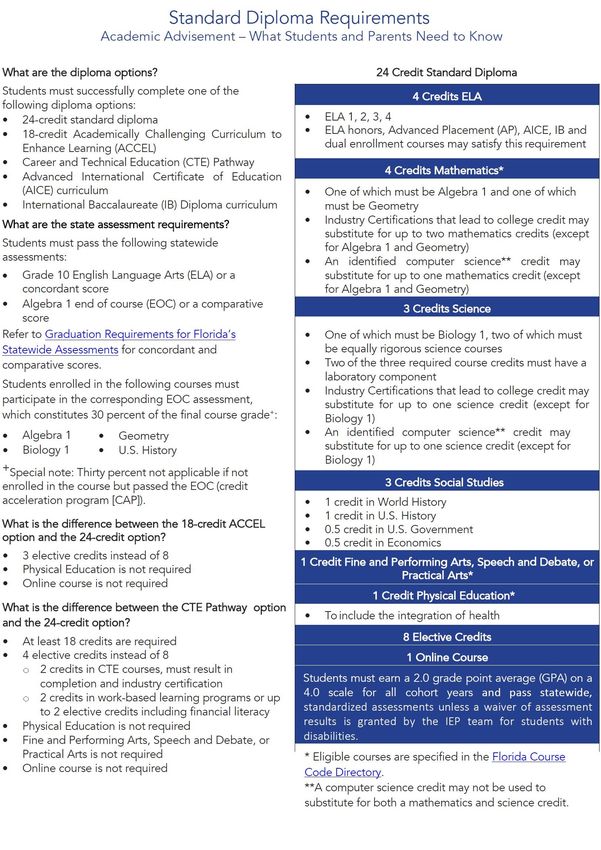
Table of Contents
Core Values ......................................................................................................................................................... 1
Letter from the Superintendent ............................................................................................................................ 2
Facts about St. Johns County School District ...................................................................................................... 3
School Board ....................................................................................................................................................... 4
District Department Phone Numbers ................................................................................................................... 5
The Strategic Plan ................................................................................................................................................ 6
School Directory .................................................................................................................................................. 8
Character Counts! Program.................................................................................................................................. 9
Social Emotional Learning ................................................................................................................................ 10
Fortify FL .......................................................................................................................................................... 11
Prevention Education ......................................................................................................................................... 11
Enrolling Your Child in School ......................................................................................................................... 12
Requesting a Change in Placement .................................................................................................................... 13
Testing ............................................................................................................................................................... 14
Reading – Our #1 Priority .................................................................................................................................. 15
What are the Florida Standards? ........................................................................................................................ 16
Kindergarten ...................................................................................................................................................... 17
First Grade ......................................................................................................................................................... 19
Second Grade..................................................................................................................................................... 20
Third Grade ....................................................................................................................................................... 21
Fourth Grade ...................................................................................................................................................... 23
Fifth Grade......................................................................................................................................................... 24
Advanced Academic Opportunities in Elementary School ................................................................................ 26
Middle School Years (Grades 6-8) .................................................................................................................... 27
Advanced Academic Opportunities in Middle Schools ..................................................................................... 30
Choice Program for Middle School Students ..................................................................................................... 31
High School (Grades 9-12) ................................................................................................................................ 32
Advanced Academic Opportunities in High Schools ......................................................................................... 34
Advanced International Programs...................................................................................................................... 36
Virtual Education ............................................................................................................................................... 37
Programs of Choice ........................................................................................................................................... 38
Career Academies .............................................................................................................................................. 39
Promotion Requirements ................................................................................................................................... 40
Grading and Reporting ...................................................................................................................................... 42
Summer Programs ............................................................................................................................................. 44
Available Services ............................................................................................................................................. 45

      Parent Resource Guide October 2020                                                                                                           Page 2 of 90
Food Service ...................................................................................................................................................... 47
Transportation .................................................................................................................................................... 50
Business and Community Partnerships .............................................................................................................. 52
Qualifications of Teachers ................................................................................................................................. 53
How You Can Participate .................................................................................................................................. 54
Homework ......................................................................................................................................................... 56
Special Services Available................................................................................................................................. 57
What Parents Can Do to Help Their Students .................................................................................................... 58
Communication.................................................................................................................................................. 60
Home Access Center.......................................................................................................................................... 61
Additional Resources ......................................................................................................................................... 62
What Happens If My Child Falls Behind? ......................................................................................................... 63
Master Calendar ........................................................................................................................................................ 64
Parent Glossary .................................................................................................................................................. 65
Florida Parent Checklist..................................................................................................................................... 66
Bibliography, Links and Cited Sources.............................................................................................................. 68
Appendix ........................................................................................................................................................... 69
            Middle School Course Sequence                                                                                                                              70
            High School Course Sequence                                                                                                                                73
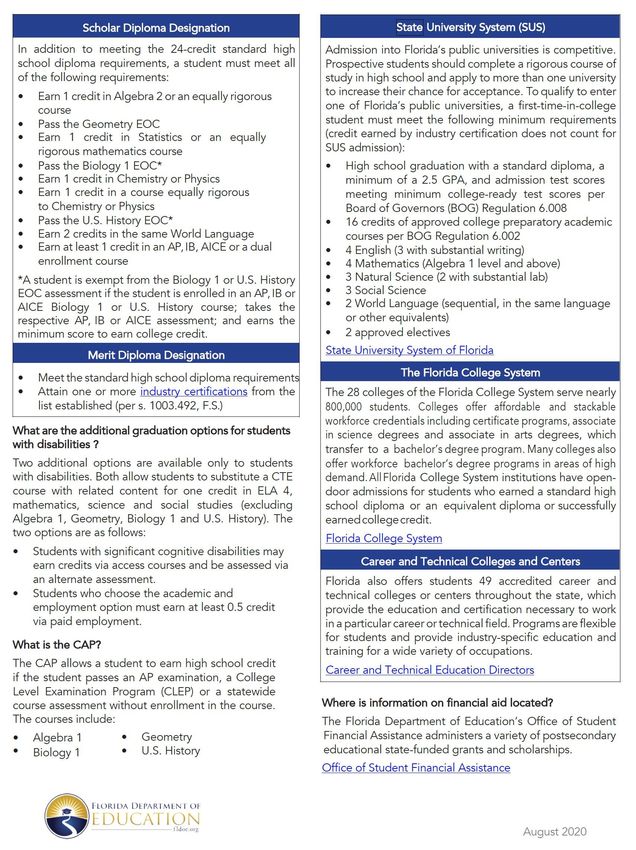
            Graduation Requirements-Standard & Scholar                                                                                                                 80
            Graduation Requirements for Florida Statewide Assessments                                                                                                  82
            Instructional Continuity Plan                                                                                                                              87

      Parent Resource Guide October 2020                                                                                                            Page 3 of 90
St. Johns County School District
                                            Core Values

                We believe that . . .
Trustworthiness, respect, responsibility, fairness, caring, and citizenship are essential to the
wellbeing of individuals and society.

All individuals have intrinsic value.

Every individual can contribute something of worth to society.

Individuals are responsible and accountable for their choices and decisions.

In order to grow and thrive, individuals need caring relationships and a nurturing environment.

Supportive family relationships are the foundation of the community.

High expectations lead to higher performance, which, in turn, empowers the individual and
strengthens society.

Continuous learning is a lifelong process that is essential to a productive and enriched life.

A safe and orderly environment is conducive to learning.

The St. Johns County School System is recognized throughout Florida for its innovative programming,
student accomplishments and professional staff. The District's success is due to its commitment to ex-
cellence in academics plus its commitment to character development.

The Six Pillars of Character (Trustworthiness, Respect, Responsibility, Fairness, Caring and Citizenship)
are found in the district’s Core Values. Individual worth and high expectations for all students are also
part of this value system.

St. Johns County schools and community partners have come together with a common approach in an
effort to say that children matter, values matter, character matters and academic excellence matters in
our community and in our country. These principles are embodied in the district’s visionary Mission
Statement:

The St. Johns County School District will inspire good character and a passion for
lifelong learning in all students, creating educated and caring contributors to the
world.

Return to Table of Contents                                                                           1

   Parent Resource Guide October 2020                                                        Page 4 of 90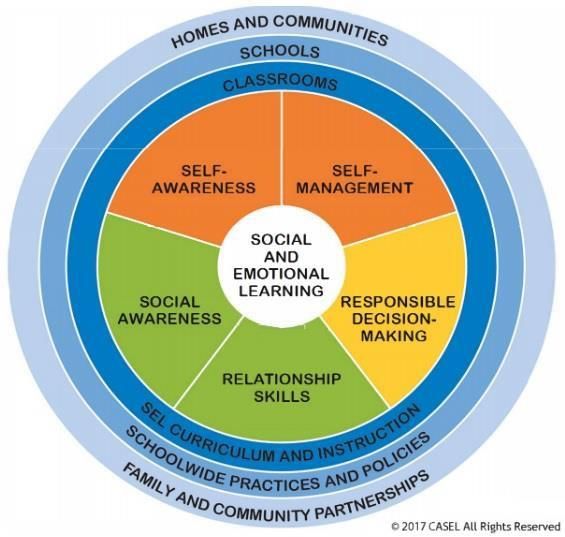
Letter from the Superintendent

                              “For children, parents are the vital link
                               between the classroom and society.”

Dear Parents and Community Partners:

Children thrive when their environment is safe, secure, and supportive of education. Whether at home or in
the classroom, adult involvement and encouragement have an enormously positive impact on a child’s learn-
ing process. For children, parents are the vital link between the classroom and society. As Superintendent of
St. Johns County School District, I encourage you to take an active role in your children’s school career. The
Parent Resource Guide was written to assist parents in participating in the lives of their children at school.

The Parent Resource Guide:
               • defines terms commonly used by educators.
               • gives examples of skills your children will be taught in each grade level.
               • explains what happens if your child falls behind and how s/he is assisted to catch up.
               • suggests what parents as partners in the learning process can do at home.

I encourage you to use the guide as a starting point for extended communication with teachers, school and dis-
trict administrators, and most importantly, with your children. Open your children’s book bags and talk with
them about what they are learning. Review their schoolwork and talk to their teachers by phone, email or
face-to-face. Always ask questions and stay involved.

Remember that as your children grow older you may have to take the initiative to maintain communication
with your children. We know that families have the greatest influence on their children’s academic achieve-
ment in school and throughout life. When parents talk to their children about school, expect them to do well,
help them plan for college and career, and make sure that out-of-school activities are constructive, their chil-
dren tend to do well in school and in life. Students with involved parents, irrespective of income or back-
ground, are more likely to enjoy school, perform better in school, and stay in school longer.

I applaud you for making your children’s education a family priority.

Sincerely,

Tim Forson
Superintendent of Schools

Return to Table of Contents                                                                                  2

    Parent Resource Guide October 2020                                                              Page 5 of 90
Facts about St. Johns County School District
St. Johns County Schools had 31 “A” schools, 7 “B” schools, 1
Superintendent of Schools “C” school and 1 “D” school.
St. Johns County School District has received a
grade of “A” each year since 2010 and is first in
the state out of 67 districts in total school ac-
SCHOOLS countability points for the past nine years. For
18 Elementary Schools (K-5) up-to-date information on school grades, see
6 K-8 Schools http://schoolgrades.fldoe.org/.
7 Middle Schools (6-8)
7 High Schools (9-12) DISTRICT ACADEMIC PERFORMANCE
2 Alternative Centers (6-12) Florida Standards Assessment State Rankings
3 Charter Schools
2 Juvenile Justice Facilities State Reading (2019)
1 Virtual School (1-12) 3rd Grade 1st 7th Grade 1st
1 Technical College 4th Grade 1st 8th Grade 1st
5th Grade 1st 9th Grade 1st
The St. Johns County School District is accredited as a 6th Grade 1st 10th Grade 1st
quality school system by AdvancED, the internationally
recognized accrediting agency for K-12 schools. State in Math (2019)
3rd Grade 3rd 6th Grade 1st
Class Size (Student-Teacher ratio) 4th Grade nd
2 - tie 7th Grade 1st
1:15.27 (PK-3) 5th Grade 2nd 8th Grade 1st
1:17.63 (4-8)
1:19.48 (9-12) State in Science (2019)
5th Grade 1st - tie
STUDENTS 8th Grade 1st
St. Johns County School District had 44,275 students
End-of-Course (EOC) Exams (2019)
as of June, 2020.
Civics 1st
Race: Algebra I (grades 3-12) 1st
White–82.85% Geometry (grades 3-12) 1st
African American or Black–7.07% Asian– Biology I 1st
4.85% U.S. History 1st
Multi-Racial−%
Hawaiian or Pacific Islander−0.25% ACT – Readiness for College (2019) – 42% of St.
Native American or Alaskan −0.26% Johns County graduates ready in all four areas
Ethnicity: tested (math, reading, science and writing) com-
Hispanic–10.43% pared to state average of 22%
SAT (2019) – 1166, above both the state average
Non-Hispanic–83.37%
of 999 and national average of 1059
Undeclared−6.21% ACT (2019) – 23.3, above both state average of
Student body−114 different countries, 79 languages 20.1 and national average of 20.7
Exceptional education students – 3,509 gifted students AP Exams (2019) –70% received college credit,
and 6,521 students with disabilities who have learning+ above state average of 55% and the national
or intellectual disabilities, emotional/behavioral or au- average of 59%
tism spectrum disorders, speech/language or sensory im- Graduation rate (2019) – 94.3% based on the
pairments and developmental delays. An additional Federal graduation rate compared to state average of
2,149 students with disabilities receive accommodations 86.9%
through 504 plans. Dropout rate (2019)− 1.8%, less than the state average
of 3.4%
SCHOOL GRADES National Merit Semifinalists (2020) – 32 seniors
For the 2018-2019 school year, St. Johns County placed in top 1% on the PSAT
Return to Table of Contents 3
Parent Resource Guide October 2020 Page 6 of 90
School Board
School Board meetings are held on the second Tuesday of each month at the School Board Administration
Center. Workshops are held on the first and fourth Tuesday of the month. (Please check the district website for
up-to-date meeting and workshop information.)
To contact a school board member, you may call the School Board Executive Secretary @ 904-547-7510, or
e-mail a member directly.
Bartram Trail High School
Creekside High School
Beverly Slough Cunningham Creek Elementary School
beverly.slough@stjohns.k12.fl.us Durbin Creek Elementary
Board Vice Chair Freedom Crossing Academy
Fruit Cove Middle School
District 1 Hickory Creek Elementary School
11/18-11/22 Julington Creek Elementary School
Liberty Pines Academy
Patriot Oaks Academy
Switzerland Point Middle School
Gaines Alternative Center
Hastings Juvenile Center
Juvenile Justice Center (DJJ)
Tommy Allen R. J. Murray Middle School
tommy.allen@stjohns.k12.fl.us Osceola Elementary School
Pacetti Bay Middle School
District 2 Picolata Crossing Elementary School
11/16-11/20 South Woods Elementary School
Timberlin Creek Elementary School
Wards Creek Elementary School
The Webster School
Bill Mignon
W. D. Hartley Elementary School
bill.mignon@stjohns.k12.fl.us
Otis A. Mason Elementary School
District 3 Pedro Menendez High School
11/18-11/22 Gamble Rogers Middle School
Alice B. Landrum Middle School
Kelly Barrera Allen D. Nease High School
kelly.barrera@stjohns.k12.fl.us Ocean Palms Elementary School
Board Chair PV/PV-Rawlings Elementary School
Palencia Elementary School
District 4 Palm Valley Academy
11/18-11/22 Ponte Vedra High School
Valley Ridge Academy
John A. Crookshank Elementary School
Patrick Canan R. B. Hunt Elementary School
patrick.canan@stjohns.k12.fl.us Ketterlinus Elementary School
Mill Creek Academy
District 5 Sebastian Middle School
11/16-11/20 St. Augustine High School
St. Johns Technical High School
Return to Table of Contents 4
Parent Resource Guide October 2020 Page 7 of 90
District Department Phone Numbers

Reception Desk                                           904-547-7500
Board Members’ Office                                    904-547-7510
Superintendent’s Office                                  904-547-7502
Deputy Superintendent for Academic Services              904-547-7520
Deputy Superintendent for School Operations              904-547-7670
Accountability and Intervention Services                 904-547-7672
Business and Fiscal Services                             904-547-7650
Career Education                                         904-547-4870
Community Relations                                      904-547-7517
Curriculum and Instruction                               904-547-7503
Early Childhood                                          904-547-8954
English for Speakers of Other Languages                  904-547-8924
Exceptional Student Education                            904-547-7672
Federal Programs                                         904-547-8928
Food Services                                            904-547-8931
Guidance and Choice                                      904-547-7554
Head Start                                               904-547-3868
Human Resources                                          904-547-7600
Information Technology                                   904-547-3920
Instructional Services-Elementary                        904-547-7541
Instructional Services-Secondary                         904-547-7558
Instructional Tech and Media Services                    904-547-3947
Leadership Development                                   904-547-3981
Maintenance                                              904-547-3707
Planning and Accountability                              904-547-8911
Pre-K Clinic                                             904-547-8958
Purchasing                                               904-547-8941
Risk Management                                          904-547-7554
RSVP/Volunteer Services                                  904-547-3945
Student Support Services                                 904-547-7724
Transportation                                           904-547-7810

Return to Table of Contents                                               5
Parent Resource Guide October 2020                              Page 8 of 90
The Strategic Plan

The 2016 – 2021 St. Johns County School District Strategic Plan was approved by the School Board on April
12, 2016. The Strategic Plan is the culmination of community input from district and school staff, students and
parents/legal guardian, community members and business partners. In addition to meetings generating
feedback across St. Johns County, over 3,800 individuals responded to the Strategic Plan Survey. The various
components of the Strategic Plan are as follows:
Mission Statement
The St. Johns County School District will inspire good character and a passion for lifelong learning in all stu-
dents, creating educated and caring contributors to the world.

Vision Statement
All students choose a learning path that leads to a well-rounded graduate who demonstrates good character
and leadership.

Core Values
   • Trustworthiness, respect, responsibility, fairness, caring, and citizenship are essential to the well-being
      of individuals and society.
   • All individuals have intrinsic value.
   • Every individual can contribute something of worth to society.
   • Individuals are responsible and accountable for their choices and decisions.
   • In order to grow and thrive, individuals need caring relationships and a nurturing environment.
   • Supportive family relationships are the foundation of the community.
   • High expectations lead to higher performance which, in turn, empowers the individual and strengthens
      society.
   • Continuous learning is a lifelong process that is essential to a productive and enriched life.
   • A safe and orderly environment is conducive to learning.

Strategic Delimiters
We will not initiate any new program or service unless it is:
    • consistent with and contributes to our mission.
    • accompanied by the training, staff development, and resources needed to assure its effectiveness.

Goals
   • Goal A: College and Career Readiness Student Success Goal 2021: All students will graduate with a
      skill set prepared for college or a career.
   • Goal B: Flexible Learning and Success Goal 2021: All students will have the choice and flexibility to
      customize their learning path.
   • Goal C: Well-rounded Student Success Goal 2021: All students will have the opportunity to demon-
      strate leadership and character, strengthen their life skills and participate in service to the community.
   • Goal D: Growth Management Success Goal 2021: St. Johns County School District will proactively
      manage systemic growth.

Tactical Planning Teams
Each of five focus area teams devised strategies to build upon for the five years of the Strategic Plan. They will
use success metrics to analyze each year and add tactics for every additional year through 2021. The focus teams
and strategies are as follows:

Return to Table of Contents                                                                                 6
Parent Resource Guide October 2020                                                            Page 9 of 90
•   Academic and Student Services
       Strategy 1: Create opportunities that empower students to build good character, life, social, and leader-
       ship skills.
       Strategy 2: Develop and implement a K-12 initiative to fully integrate STEM concepts.
       Strategy 3: Build literacy skills that empower students to communicate effectively.
       Strategy 4: Build capacity to fully support the academic, wellness and safety needs of all students.
   •   Operations
       Strategy 1: Develop a K-12 continuum of technology integration, including necessary network infra-
       structure, to ensure teachers are well equipped to implement technology in the classroom.
       Strategy 2: Continue to design and construct schools that accommodate growth while maintaining high
       quality programming with an intentional student-focused environment.
       Strategy 3: Continue to improve district-wide safety and security measures.
       Strategy 4: Continue to improve and upgrade operation systems and services to better meet the needs
       of students and staff.
   •   Community Relations
       Strategy 1: Continue to embrace technology to effectively communicate with families, students, em-
       ployees and community members by researching and seeking the best available communication meth-
       ods.
       Strategy 2: Continue to build a culture of character by further integrating CHARACTER COUNTS!
       initiatives and related programs throughout the St. Johns County School District while expanding into
       the community at large.
       Strategy 3: Continue to seek and expand business and community partnerships to provide more oppor-
       tunities for students.
   •   Human Resources
       Strategy 1: Using a comprehensive approach, HR will recruit high quality personnel in all employee
       groups (Administrative, Instructional, and Non-Instructional).
       Strategy 2: Align all professional development opportunities so all employees can grow professionally
       while performing at their highest potential.
       Strategy 3: Provide ongoing ethics and professional conduct training to all employee groups.
   •   Superintendent and School Board
       Strategy 1: Align all decision-making in the best interest of students.
       Strategy 2: Continue to influence state legislation and set policy at the local level to further the mis-
       sion, vision and goals of the school district.
       Strategy 3: Maintain a nurturing and supportive environment by continuing a culture that fosters team-
       work and collaboration that emphasizes shared values, integrity and loyalty.

Return to Table of Contents                                                                                7
Parent Resource Guide October 2020                                                          Page 10 of 90
School Directory
BARTRAM TRAIL HIGH SCHOOL (9-12) LIBERTY PINES ACADEMY (K-8) GAMBLE ROGERS MIDDLE SCHOOL (6-8)
Chris Phelps, Principal Traci Hemmingway, Principal Greg Bergamasco, Principal
7399 Longleaf Pine Parkway, St. Johns, FL 32259-9104 10901 Russell Sampson Road, St. Johns, FL 32259-8927 6250 U. S. 1 South, St. Augustine, FL 32086-7685
904-547-8340 (Phone) 904-547-8359 (FAX) 904-547-7900 (Phone) 904-547-7905 (FAX) 904-547-8700 (Phone) 904-547-8705 (FAX)
CREEKSIDE HIGH SCHOOL (9-12) OTIS A. MASON ELEMENTARY SCHOOL (K-5) ST. AUGUSTINE HIGH SCHOOL (9-12)
Steve McCormick, Principal Monique Keaton, Principal Dr. DeArmas Graham, Principal
100 Knights Lane, St. Johns, FL 32259-9104 207 Mason Manatee Way, St. Augustine, FL 32086-9373 3205 Varella Avenue, St. Augustine, FL 32084-
904-547-7300 (Phone) 904-547-7305 (FAX) 904-547-8440 (Phone) 904-547-8445 (FAX) 2096
904-547-8530 (Phone) 904-547-8535 (FAX)
CROOKSHANK ELEMENTARY SCHOOL (K-5) PEDRO MENENDEZ HIGH SCHOOL (9-12)
Marquez Jackson, Principal Dr. Clay Carmichael, Principal ST. AUGUSTINE PUBLIC MONTESSORI
1455 North Whitney Street, St. Augustine, FL 32084-2499 600 State Road 206 West, St. Augustine, FL 32086-7968 SCHOOL (1-4)
904-547-7840 (Phone) 904-547-7845 (FAX) 904-547-8660 (Phone) 904-547-8675 (FAX) deAnne DeLeon, Director
7 A Williams Street, St. Augustine, FL 32084
CUNNINGHAM CREEK ELEMENTARY SCHOOL MILL CREEK ELEMENTARY SCHOOL (K-5) 904-342-5350 (Phone) 904-342-5354 (FAX)
(K-5) Amanda Riedl, Principal
Edie Jarrell, Principal 3750 International Golf Parkway, St. Augustine, FL 32092 ST. JOHNS VIRTUAL SCHOOL
1205 Roberts Road, St. Johns, FL 32259-8927 904-547-3720 (Phone) 904-547-3730 (FAX) Dr. Nigel D. Pillay, Principal
904-547-7860 (Phone) 904-547-7857 (FAX) 2980 Collins Avenue, Bldg. 1
R. J. MURRAY MIDDLE SCHOOL (6-8) St. Augustine, FL 32084
DURBIN CREEK ELEMENTARY SCHOOL (K-5) Travis Brown, Principal 904-547-8080 (Phone) 904-547-8085 (FAX)
Angela Fuller, Principal 150 North Holmes Blvd., St. Augustine, FL 32084-0930
4100 Race Track Road, St. Johns, FL 32259-2083 904-547-8470 (Phone) 904-547-8475 (FAX) ST. JOHNS TECHNICAL HIGH SCHOOL
904-547-3880 (Phone) 904-547-3885 (FAX) (6-12)
ALLEN D. NEASE HIGH SCHOOL (9-12) Dr. Nigel D. Pillay, Principal
FIRST COAST TECHNICAL COLLEGE Lisa Kunze, Principal 2980 Collins Avenue, St. Augustine, FL 32084-
Chris Force, Principal 10550 Ray Road, Ponte Vedra, FL 32081-8800 2096
2980 Collins Avenue, St. Augustine, FL 32084-1919 904-547-8300 (Phone) 904-547-8305 (FAX) 904-547-8500 (Phone) 904-547-8505 (FAX)
904-824-4401 (Phone) 904-547-3506 (FAX)
OCEAN PALMS ELEMENTARY SCHOOL (K-5) SEBASTIAN MIDDLE SCHOOL (6-8)
FRUIT COVE MIDDLE SCHOOL (6-8) Tiffany Cantwell, Principal Kirstie Gabaldon, Principal
Kelly Jacobson, Principal 355 Landrum Lane, Ponte Vedra Beach, FL 32082-3828 2955 Lewis Speedway, St. Augustine, FL 32084-
3180 Race Track Road, St. Johns, FL 32259 904-547-3760 (Phone) 904-547-3775 (FAX) 8636
904-547-7880 (Phone) 904-547-7885 (FAX) 904-547-3840 (Phone) 904-547-3845 (FAX)
OSCEOLA ELEMENTARY SCHOOL (K-5)
FREEDOM CROSSING ACADEMY (K-8) Tina Waldrop, Principal SOUTH WOODS ELEMENTARY SCHOOL
Allen Anderson, Principal 1605 Osceola Elementary Road, St. Augustine, FL 32084- (K-5)
1365 Shetland Drive, St. Johns, FL 32259 0914 Randy Kelley, Principal
904-547-4231 (Phone) 904-547-4235 (FAX) 904-547-3780 (Phone) 904-547-3795 (FAX) 4750 SR 206 W, Elkton, FL 32033-3608
904-547-8611 (Phone) 904-547-8615 (FAX)
GAINES ALTERNATIVE SCHOOL (6-12) PACETTI BAY MIDDLE SCHOOL (6-8)
TRANSITION SCHOOL (K-12) Ted Banton, Principal SWITZERLAND POINT MIDDLE SCHOOL
Patricia McMahon, Principal 245 Meadowlark Lane, St. Augustine, FL 32092-3467 (6-8)
Evelyn Hamblen Center 904-547-8760 (Phone) 904-547-8735 (FAX) Sandra Brunet, Principal
1 Christopher Street, St. Augustine, FL 32084-4056 777 Greenbriar Road, St. Johns, FL 32259-8336
904-547-8560 (Phone) 904-547-7145 (FAX) PALENCIA ELEMENTARY SCHOOL (K-5) 904-547-8650 (Phone) 904-547-8645 (FAX)
Catherine Goodrich, Principal
W. D. HARTLEY ELEMENTARY SCHOOL (K-5) 355 Palencia Village Drive, St. Augustine, FL 32095 THE WEBSTER SCHOOL (PK-5)
Dr, Paul Goricki, Principal 904-547-4010 (Phone) 904-547-4015 (FAX) Bethany Groves, Principal
260 Cacique Drive, St. Augustine, FL 32086-8827 420 North Orange Street, St. Augustine, FL 32084-
904-547-8400 (Phone) 904-547-8385 (FAX) PALM VALLEY ACADEMY (K-8) 0665
Jessica Richardson, Principal 904-547-3860 (Phone) 904-547-3865 (FAX)
HICKORY CREEK ELEMENTARY SCHOOL (K-5) 2135 Palm Valley Road
Joy Reichenberg, Principal Ponte Vedra, FL 32081 THERAPEUTIC LEARNING CENTER
235 Hickory Creek Trail, St. Johns, FL 32259-8368 904-547-4201 (Phone) 904-547 -4205 (FAX) Paulette Hudson, Director
904-547-7450 (Phone) 904-547-7455 (FAX) 2109 Arc Drive, St, Augustine, FL 32084
PATRIOT OAKS ACADEMY (K-8) 904-824-8932 (Phone) 904-824-8063 (FAX)
R. B. HUNT ELEMENTARY SCHOOL (K-5) Allison Olson, Principal
Amanda Garman, Principal 475 Longleaf Pine Parkway TIMBERLIN CREEK ELEMENTARY
125 Magnolia Drive, St. Augustine, FL 32080-4684 St. Johns, FL 32259 SCHOOL (K-5)
904-547-7960 (Phone) 904-547-7955 (FAX) 904-547-4050 (Phone) 904-547-4055 (FAX) Linda Edel, Principal
555 Pine Tree Lane, St. Augustine, FL 32092-3207
JULINGTON CREEK ELEMENTARY SCHOOL (K-5) PICOLATA CROSSING ELEMENTARY 904-547-7400 (Phone) 904-547-7405 (FAX)
Jeannette Murphy, Principal Dr. Ken Goodwin, Principal
2316 Race Track Road, St. Johns, FL 32259-4299 2675 Pacetti Road, St. Augustine, FL 32092- VALLEY RIDGE ACADEMY (K-8)
904-547-7980 (Phone) 904-547-7985 (FAX) 904-547-4160 (Phone) 904-547-4165 (FAX) Sandra McMandon, Principal
105 Greenleaf Drive, Ponte Vedra, FL 32081
KETTERLINUS ELEMENTARY SCHOOL (K-5) PONTE VEDRA HIGH SCHOOL (9-12) 904-547-4090 (Phone) 904-547-4095 (FAX)
Kathy Tucker, Principal Dr. Fred Oberkehr, Principal
67 Orange Street, St. Augustine, FL 32084-3565 460 Davis Park Road, Ponte Vedra, FL 32081-7968 WARDS CREEK ELEMENTARY SCHOOL
904-547-8540 (Phone) 904-547-8554 (FAX) 904-547-7350 (Phone) 904-547-7355 (FAX) (K-5)
Bethany Nelson- Mitidieri, Principal
ALICE B. LANDRUM MIDDLE SCHOOL (6-8) PONTE VEDRA-PALM VALLEY (K-2) 6555 State Road 16, St. Augustine, FL 32092-2110
Ryan Player, Principal MARJORIE K. RAWLINGS ELEMENTARY SCH (3-5) 904-547-8730 (Phone) 904-547-8735 (FAX)
230 Landrum Lane, Ponte Vedra Beach, FL 32082-3831 Dr. Jesse Gates, Principal
904-547-8410 (Phone) 904-547-8415 (FAX) 630 A1A North, Ponte Vedra Beach, FL 32082-2746
PV-PV 904-547-3820 (Phone) 904-547-3825 (FAX)
RAWLINGS 904-547-8565 (Phone) 904-547-8575 (FAX)
Return to Table of Contents 8
Parent Resource Guide October 2020 Page 11 of 90Character Counts! Program
CHARCTER COUNTS! is an educational framework for teaching universal values and a national coalition of
organizations that support each other. The result is a culture change in your school, business or organization.
CHARCTER COUNTS! improves the lives of the adults who teach it, the communities that embrace it and the
students who make better choices as a result. St. Johns County Schools adopted the CHARACTER COUNTS!
Initiative in 1998 to help students learn about the Six Pillars of Character – trustworthiness, respect, responsibil-
ity, fairness, caring and citizenship – and develop strong character traits.
Each month one of the pillars is featured:
•August – All pillars
•September – Fairness
•October – Responsibility
•November – Citizenship
•December – All Pillars
•January – Respect
•February – Caring
•March – Trustworthiness
•April – All Pillars
•May – Citizenship (Emphasis on Patriotism)
Trustworthiness Be honest Don’t deceive, cheat or steal Be reliable – do what you say
you will do Have the courage to do the right thing Be loyal – stand by your family,
Build a good reputation
friends and country
Respect Treat others with respect; follow the Golden Rule Be tolerant and accepting of differences
Use good manners, not bad language Don’t threaten, hit or hurt
Be considerate of the feelings of others
anyone
Deal peacefully with anger, insults and disagreements
Responsibility Do what you are supposed to do Plan ahead Persevere: keep on trying!
Always do your best Use self-control Be self-disciplined Think before you act — consider the conse-
quences
Be accountable for your words, actions, and attitudes
Set a good example for others
Fairness Play by the rules Take turns and share Be open-minded; listen to others. Don’t take
Don’t blame others carelessly
advantage of others Treat all people fairly
Caring Be kind Be compassionate and show you care Express gratitude Forgive others Help
people in need
Be charitable and altruistic
Citizenship Do your share to make your school and community better Cooperate Get involved
in community affairs Stay informed; vote
Be a good neighbor
Obey laws and rules
Respect authority
Protect the environment Volunteer
Return to Table of Contents 9
Parent Resource Guide October 2020 Page 12 of 90Social Emotional Learning
Social and emotional learning (SEL) is the process through which children and adults understand and manage
emotions, set and achieve positive goals, feel and show empathy for others, establish and maintain positive re-
lationships, and make responsible decisions.
CASEL’s Framework – Five Core Competencies https://casel.org/
Self-awareness: The ability to accurately
recognize one’s emotions and thoughts and
their influence on behavior. This includes
accurately assessing one’s strengths and lim-
itations and possessing a well-grounded
sense of confidence and optimism.
Self-management: The ability to regulate
one’s emotions, thoughts, and behaviors ef-
fectively in different situations. This in-
cludes managing stress, controlling im-
pulses, motivating oneself, and setting and
working toward achieving personal and aca-
demic goals.
Social awareness: The ability to take the
perspective of and empathize with others
from diverse backgrounds and cultures, to
understand social and ethical norms for be-
havior, and to recognize family, school, and
community resources and supports.
Relationship skills: The ability to establish and maintain healthy and rewarding relationships with diverse in-
dividuals and groups. This includes communicating clearly, listening actively, cooperating, resisting inappro-
priate social pressure, negotiating conflict constructively, and seeking and offering help when needed. improve
Responsible decision-making: The ability to make constructive and respectful choices about personal behav-
ior and social interactions based on consideration of ethical standards, safety concerns, social norms, the realis-
tic evaluation of consequences of various actions, and the well-being of self and others.
Impact of Social Emotional Learning
Academic Increased pro- 11:1 return Improve Enhanced
Improvement social on investment economic lifetime
behaviors mobility outcomes
Return to Table of Contents 10
Parent Resource Guide October 2020 Page 13 of 90Fortify FL
FortifyFL is a suspicious activity reporting tool that allows students or parents/legal guardian to instantly
relay information to appropriate law enforcement agencies and school officials. By accessing FortifyFL at
https://getforti- fyfl.com/ or https://www.stjohns.k12.fl.us/blog/fortifyfl-app/, individuals can provide a
description of the threat, share pics and videos and optionally submit their contact information.
FortifyFL was created and funded by the 2018 Florida Legislature as part of the Marjory Stoneman Douglas
High School Public Safety Act. The Office of Attorney General, Department of Education and Florida Depart-
ment of Law Enforcement coordinated its development and rollout.
Prevention Education
St. Johns County School District is committed to providing developmentally appropriate education and preven-
tion programs that address the legal, social, and health consequences of alcohol, tobacco, and drug abuse per
School Board Rule 4.02(13). Strategies being used in our district for delivery of prevention education at the
elementary, middle, and high school levels include classroom instruction, prevention programs, character devel-
opment, guest speakers, community agency collaboration, staff training and parent awareness.
Elementary school students receive health and prevention education, which is integrated into the curriculum
throughout the year. In middle school students learn the effects and consequences of alcohol, tobacco, and other
drug use through the various strategies listed above. In addition, HIV education is delivered through science
classes. Parents/legal guardian may choose to opt-out their child from the HIV education by a written request
at the beginning of each school year. Prevention education in high school is included in the required class
Health Opportunities through Physical Education (HOPE), which is a comprehensive health and personal
fitness class.
Bullying prevention education is integrated into the curriculum at all grade levels and taught throughout the year
by teachers, the district prevention specialist, and community agencies. Instruction includes identifying, pre-
venting, and responding to bullying and harassment. Instruction on recognizing behaviors that lead to bullying
and harassment and taking appropriate action based on those observations is also included.
Cyberbullying and Internet Safety education are addressed through curriculum integration at all grade levels.
The state-mandated prevention education for teen dating violence abuse is taught to secondary students through
curriculum integration, presentations, and approved speakers. The characteristics of healthy and unhealthy re-
lationships and identifying and responding to danger signals of dating violence are included in this curriculum.
For more information on prevention resources and the district policy prohibiting bullying and harassment in-
cluding how to report bullying, please refer to the Safe and Drug Free Schools’ website at
http://www.stjohns.k12.fl.us/sdfs/.
Return to Table of Contents 11
Parent Resource Guide October 2020 Page 14 of 90Enrolling Your Child in School
How old does my child have to be to attend school?
Under Florida state law, a child must be 5 years old on or before September 1 to enter kindergarten. To enter
first grade, a child must be 6 years old on or before September 1 and must have successfully completed kinder-
garten.
How do I know which school my child will attend?
Our district website http://www.stjohns.k12.fl.us/zoning/ provides a link to an Attendance Zone Locator.
Our Student Services staff can also assist you. Parents/legal guardian with questions about zoning are
encouraged to call our office at 904-547-7598.
How do I enroll my child in school?
You may register your child online at http://www.stjohns.k12.fl.us/student/enrollment/. For additional infor-
mation contact your zoned school.
What paperwork will I need to enroll my child?
• Three proofs of residence – A current mortgage statement, lease or rent agreement, a current utility
bill and one other current bill or statement showing your address. For more information, visit
http://www.stjohns.k12.fl.us/student/residency.
• Health Records – Children entering a Florida public school for the first time must have an up-to-
date Florida Certificate of Immunization (HRS FORM 680) and a copy of a physical examination
done within one year of enrollment. For information about immunizations required at each grade
level, parents/legal guardian are encouraged to call the St. Johns County Health Department.
Current immuniza- tion requirements for SJCSD students can be found at http://
www.stjohns.k12.fl.us/health/immun- izations/.
• Birth Certificate – A certified copy of a birth certificate is required by Florida Statute 1003.21.
• Proof of Guardianship (if applicable)
• School Records – Standardized test scores, recent report cards, and school withdrawal forms are
documents that will help the school place your child appropriately. If you do not have access to these
verifications, please provide the school with the name and address of your child’s previous school
so that the necessary information can be obtained.
Return to Table of Contents 12
Parent Resource Guide October 2020 Page 15 of 90Requesting a Change in Placement The Parent’s Role with Placement Decisions Many factors are considered when making a placement decision for a student. The placement decision is based on the preponderance of evidence showing how well a student is meeting the levels of performance for student progression to the next grade level. Parents or legal guardian may discuss placement decisions with school officials, provide input for consideration, and ask for an explanation of the placement. They may also review the evidence the school used in making the placement; however, the final placement decision is made by the principal. There is no statutory provision which allows voluntary retention. How do I request a teacher change? Florida Statute 1003.3101 gives a parent the right to request his or her child be transferred to another classroom teacher based on (1) the teacher’s out-of-field certification status or (2) personal preference. This statute does not give the parent the right to choose a specific classroom teacher. Teachers with out-of-field certification are named on our district website 30 days before the beginning of the semester. Parents/legal guardian may complete a Teacher Change Request form, which is also available on the district website and at schools. When the form is returned to the school, the parent will be contacted to schedule a conference (required). After the conference, the principal will either approve or deny the request with the rationale for the denial in writing. Consistent with school board rules and in accordance with state statute (1012.28 (5) F.S.), the Superintendent has designated the principal of the school as the final authority in the placement of students in programs or classes. How do I obtain a school transfer? Information regarding types of transfers can found at http://www.stjohns.k12.fl.us/choice/. The hardship out–of-zone transfer request process is available on the School Services website, https://www. stjohns.k12.fl.us/schoolservices/transfers/. Return to Table of Contents 13 Parent Resource Guide October 2020 Page 16 of 90
Testing

Throughout the school year, your child will take several standardized tests, including the Florida Standards As-
sessment (3rd – 10th grade) for English Language Arts (ELA) and math (3rd – 8th grade). These assessments
measure student mastery of the Florida Standards. In 4th – 10th grade, the ELA assessment includes a writing
component. At the fifth and eighth grade levels, students also take the Statewide Science Assessment. This test
will measure how well students are meeting the Next Generation Sunshine State Standards in science. Students
enrolled in Civics (7th grade), Algebra I, Geometry, Biology, or U.S. History will take the corresponding state
end-of-course assessment and it will constitute 30% of the final grade in the course.,. Students with disabilities
following a modified curriculum will take the Florida Standards Alternate Assessment (FSAA) and Access
Points end-of-course assessments at the same grade levels as their peers without disabilities. For additional in-
formation about statewide assessments please visit http://www.fldoe.org/asp/.

2019–20 School Year
Pursuant to Florida Department of Education (FDOE) Emergency Order No. 2020-EO-01, the spring ad-
ministration of K–12 statewide assessments for the 2019–20 school year that were scheduled to take place
after March 16, 2020, were canceled and any outstanding assessment graduation requirements for seniors
scheduled to graduate in spring 2020 were waived. While the requirements themselves (detailed in this
document) did not change, this specific group of students are not required to meet them if they had not
already done so.

For non-seniors who were enrolled in grade 10 and/or Algebra 1 (or an equivalent course) during spring
2020 and who were scheduled to take the grade 10 English Language Arts (ELA) and/or Algebra 1 end-
of-course (EOC) assessments, Emergency Order No. 2020-EO-01 waived the requirement that these stu-
dents participate in the applicable assessment. However, these students are still required to meet these
graduation requirements by passing the applicable assessment during a future administration or by earn-
ing the appropriate concordant or comparative score, as detailed in tables 3 and 4. These students may
participate in any ELA Retake or applicable EOC administration to meet their graduation requirement,
but are not required to do so prior to using a concordant or comparative score.

Finally, participation and 30% final grade calculation requirements for students who were scheduled to
take a spring 2020 EOC assessment were waived. However, students who need to pass the Biology 1, Ge-
ometry, and/or U.S. History EOC assessment for Scholar diploma designation purposes must still do so
to earn the designation. These students may participate in any applicable EOC administration to meet the
Scholar diploma designation requirements.

See Appendix for more information.
The Florida Department of Education (FDOE) standardized assessments provide information about your child’s
mastery of Florida Standards and tracks his/her progress over time. Schools use test scores to develop plans for
individual student improvement. Test scores are helpful in identifying academic areas of challenge that may
require additional help or different methods of teaching. Tests results also help to identify a student’s strengths
and may suggest a need for extended learning experiences. Parents/legal guardian always have access to their
child’s test results.
Specific national, state and/or district assessments are shown for each grade level page in this document and on
the district assessment calendar at http://www.stjohns.k12.fl.us/testing/. Schools may opt for additional testing,
and each school creates a school specific assessment calendar.

Return to Table of Contents                                                                                14
Parent Resource Guide October 2020                                                           Page 17 of 90
Reading – Our #1 Priority
St Johns County Schools believe that reading is the most important skill taught in elementary school. Children
master six related components as they learn to read. The components of reading include:

      1. Oral Language provides the foundation for literacy development involving listening and speaking
         skills.

      2. Phonemic Awareness is the ability to hear and manipulate the sounds of spoken language. This
         includes noticing rhyme and the separate, small sounds in words (phonemes).

      3. Phonics is understanding the relationships between written letters and the sounds of spoken language.
         This knowledge allows the reader to “decode” words by translating the letters into speech sounds.

      4. Fluency is the ability to read quickly, correctly, and with proper expression. Fluent readers are able
         to better understand what they read because they are able to decode and recognize frequently used
         words. This allows them to read at a conversational pace.

      5. Vocabulary refers to all the words a reader can understand and use. The more words a child knows,
         the better he or she understands what is read. Knowing how words relate to each other is a building
         block that leads to comprehension.

      6. Comprehension is the ability to understand what one has read. This includes understanding the plot
         of a story or the information in an article. It also includes the ability to recognize the main idea of an
         article or being able to compare and contrast different characters in a story.

For more information about how parents/legal guardian can promote literacy skills, go to Florida Academics.

Return to Table of Contents                                                                                15
Parent Resource Guide October 2020                                                           Page 18 of 90
What are the Florida Standards? From the beginning of the American experience, citizens have discussed the importance of education and what learning should be taught in school. Educational standards are the learning goals describing what students should know and be able to do at each grade level. The Mathematics Florida Standards (MAFS) and Language Arts Florida Standards (LAFS) approved by the Florida State Board of Education are implemented across all grades. The Mathematics Florida Standards (MAFS) include the K-8 grade level standards, the content standards in high school courses, and the K-12 Standards for Mathematical Practice. The Language Arts Florida Standards (LAFS) include the K-12 English Language Arts standards as well as the content-area literacy standards for middle school and high school instruction in History/Social Studies, Science, and technical subjects. These rigorous and relevant standards will prepare Florida’s students with the knowledge and skills they need to succeed in college, careers and life. Each Florida Standard provides clear expectations for the knowledge and skills students need to master as they progress through each grade and subject. Parents/legal guardian are encouraged to find more information about the Florida Standards at http://www.fldoe.org/academics/standards. In addition to Florida’s standards for English Language Arts and Mathematics, Next Generation Sunshine State Standards are in place for the Arts, Health Education, Science, and Social Studies, and World Languages. Parents/legal guardian may view all of the standards at http://www.cpalms.org/Public/. Return to Table of Contents 16 Parent Resource Guide October 2020 Page 19 of 90
Kindergarten
In kindergarten, children learn to:
    • select material to read for pleasure
    • read common high frequency words
    • draw, dictate, and write simple stories
    • listen to and retell familiar stories
    • count to tell number of objects
    • understand addition as putting together and adding to, and understand subtraction as taking apart and
        taking from
    • identify and describe shapes and classify objects
    • know the body parts associated with and function of five senses
    • sort objects by observable properties such as size, shape, color, temperature (hot or cold)
    • observe that things make sound vibrate
    • observe plants and animals, describe how they are alike and different in the way they look and the things
        they do
    • describe and compare using measurable attributes
    • identify, describe, analyze, compare, create and compose shapes
    • understand that different things move at different speeds (motion)
    • use your five senses to observe things: big, small, far, near, push, pull
    • describe attributes of day and night
    • describe relative location of people, places, things using positional words and map skills
    • describe different kinds of jobs that people do and the tools or equipment used
    • know people and events honored in holidays

Parents/legal guardian may view all of the kindergarten standards at http://www.cpalms.org/Public/ (click on
“Standards, then enter the subject and grade level).

How do I help my child?
    •   Check recommended pacing and content standards using the SJCSD year-at-glance documents that are
        available at http://www.stjohns.k12.fl.us/year-at-a-glance/
    •   View the Parent Guide for Kindergarten English Language Arts and the Parent Guide for Kindergarten
        Mathematics
    •   Visit http://floridastudents.org/# for Florida Standards-based videos for English language arts, math, and
        science
    •   View math information http://www.fldoe.org/core/fileparse.php/12087/urlt/GK_Mathematics_Flor-
        ida_Standards.pdf
    •   View reading information at Just Read, Florida
    •   Communicate with the teacher – e-mail is usually best
    •   Look regularly at your child’s school work
    •   Attend parent-teacher conferences
    •   Attend the school’s Open House, PTA/PTO meetings, and special events
    •   Become a member of the School Advisory Council (SAC)
    •   Visit and volunteer at the school

What national, state or district tests will my child take in kindergarten?
Kindergarten students participate in the Florida Kindergarten Readiness Screener (FLKRS) within the first 30
days of school. The FLKRS screener is STAR Early Literacy, which assists teachers in understanding the abil-
ities of children entering school and targets instruction that helps children become successful learners. FLKRS
information assists teachers in planning curriculum and improving school readiness programs and services for

Return to Table of Contents                                                                                17
Parent Resource Guide October 2020                                                           Page 20 of 90
preschool-age children. Visit https://www.renaissance.com/lp/florida-k-readiness-practice/ for a better under- standing of what your child will experience during the STAR Early Literacy assessment. This site provides a child-friendly explanation of the assessment along with a few practice questions. Kindergarten students participate in the i-Ready English Language Arts and Math diagnostic assessments three times during the year for progress monitoring and guiding instruction. Schools have the option of using additional diagnostic assessments, as appropriate. A district assessment calen- dar is available at http://www.stjohns.k12.fl.us/testing/ and a school assessment calendar is available online for each school. Return to Table of Contents 18 Parent Resource Guide October 2020 Page 21 of 90
First Grade
In first grade, children learn to:
     • read independently for pleasure
     • write stories, journals and lists
     • use a variety of parts of speech (nouns, verbs, adjectives, etc.) when speaking and writing
     • read and discuss different types of literature and informational text
     • represent and solve problems involving addition and subtraction facts
     • understand place value and properties of operations to add and subtract
     • reason with shapes and their attributes
     • represent and interpret data
     • explore the Law of Gravity
     • demonstrate and describe various way objects can move
     • identify the major parts of plants, including stem, roots, leaves and flowers
     • identify the difference between living and nonliving things
     • use simple maps and globes
     • recognize symbols and individuals that represent American constitutional democracy
     • describe the characteristics of responsible citizenship in the school community
     • show respect and kindness to people and animals
     • distinguish people as buyers, sellers, and producers of goods and services

Parents/legal guardian may view all the first grade standards at http://www.cpalms.org/Public/ (click on
“Standards”, then enter the subject and grade level).

How do I help my child?
    •   Check recommended pacing and content standards using the SJCSD year-at-glance documents that are
        available at http://www.stjohns.k12.fl.us/year-at-a-glance/
    •   View the Parent Guide for Grade 1 English Language Arts and the Parent Guide for Grade 1 Mathe-
        matics
    •   Visit http://floridastudents.org/# for Florida Standards-based videos for English language arts, math, and
        science
    •   View math information http://www.fldoe.org/core/fileparse.php/12087/urlt/GK_Mathematics_Flor-
        ida_Standards.pdf
    •   View reading information at Just Read, Florida
    •   Communicate with the teacher – e-mail is usually best
    •   Look regularly at your child’s school work
    •   Attend parent-teacher conferences
    •   Attend the school’s Open House, PTA/PTO meetings, and special events
    •   Become a member of the School Advisory Council (SAC)
    •   Visit and volunteer at the school

What national, state or district tests will my child take in first grade?
First grade students participate in the i-Ready English Language Arts and Math diagnostic assessments three
times during the year for progress monitoring and guiding instruction.

Schools have the option to use additional diagnostic assessments, as appropriate. A district assessment calendar
is available at http://www.stjohns.k12.fl.us/testing/ and a school assessment calendar is available for each school.

Return to Table of Contents                                                                                  19
Parent Resource Guide October 2020                                                             Page 22 of 90
You can also read


