Persistent and Mobile Compounds in the Water Cycle: Challenges and Findings PROMOTE Project
←
→
Page content transcription
If your browser does not render page correctly, please read the page content below
Persistent and Mobile Compounds
                            in the Water Cycle:
                        Challenges and Findings
                                     ~
                            PROMOTE Project

Thorsten Reemtsma, Hans Peter Arp, Urs Berger, Stefanie Schulze,
Herve Gallard, Daniel Zahn, Thomas Knepper, Michael Neumann,
Rosa Montes, Rosario Rodil, José Benito Quintana, Pim de Voogt

Paris, 06.03.2019

Prioritizing of Emerging Contaminants

• For which purpose?
        • Define analytes for monitoring?
        • Select contaminants for regulating water quality?
        • For chemical‘s regulation?
• What to protect?
        • Surface water quality
                    • Ecological quality of rivers, habitat and biodiversity
        • Groundwater quality
        • Water resources for future use
                    • Depends on use
        • Drinking water quality / human health

                                                                               1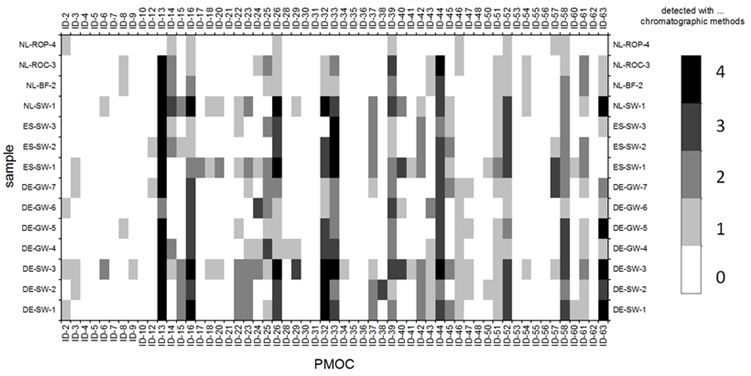
The Protection Gap

traffic, facades,        various            e.g.           consumer                                   direct discharge
          heating      chemicals     pesticides             products    drinking
                                                                         water                        sources

          cities          industry   agriculture            household              water works        barriers

                                                                                       raw
                                                   waste                              water
                                                   water

                                                           WWTP                       subsurface
                                     river                                     groundwater         surface water

    • Barriers in partially closed water cycles rely on microbial
      degradation and sorption processes
    • For persistent (P) and very polar (mobile, M) organic compounds
      (PM substances) these barriers are not effective
             •      water cycle may turn into a compound cycle
             •      only dilution reduces concentration

    Motivation

    • Single very polar compounds incidentally discovered in
      drinking water, among them
    • N,N-Dimethylsulfamide
             • Metabolite of pesticide Tolylfluanide
             • logD (pH 7.4) = -1.4
                    • Schmidt and Brauch (2008) Environ. Sci. Technol. 2008,
                      42, 6340
             • Precursor of NMDA during ozonation
    • Trifluoroacetic acid
             • Released from fluorochemical industry
                    • Scheurer et al. (2017) Water Res. 126, 460
             • logD (pH 7.4) = - 3.1
             • Ion exchange-MS

                                                                                                                         2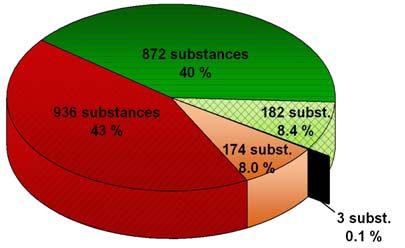
Incidental Findings in Drinking Waters
• Pyrazole
• Intermediate in acrylnitrile production
Concentration in
• Waterworks in the Netherlands using bank
filtrate closed down for > 4 months River Rhine
• discharge of >1 ton/d 16,0
concentration in µg/L
14,0
• logD (pH 7.4) = 0.4 12,0
Kleve‐Bimmen
Lobith
10,0
• Why present in drinking waters? 8,0
• Why detected so lately?
6,0
• 1,4-Dioxane 4,0
• logD (pH 7.4) = -0.3
2,0
0,0
18.8.15
28.8.15
17.9.15
27.9.15
7.10.15
17.10.15
27.10.15
6.11.15
16.11.15
26.11.15
6.12.15
16.12.15
26.12.15
15.1.16
25.1.16
14.2.16
24.2.16
15.3.16
25.3.16
14.4.16
24.4.16
14.5.16
24.5.16
13.6.16
23.6.16
13.7.16
23.7.16
12.8.16
22.8.16
11.9.16
21.9.16
1.10.16
11.10.16
21.10.16
31.10.16
10.11.16
20.11.16
30.11.16
10.12.16
20.12.16
30.12.16
19.1.17
29.1.17
18.2.17
28.2.17
10.3.17
20.3.17
30.3.17
19.4.17
29.4.17
19.5.17
29.5.17
18.6.17
28.6.17
18.7.17
28.7.17
17.8.17
27.8.17
7.9.15
5.1.16
4.2.16
5.3.16
4.4.16
4.5.16
3.6.16
3.7.16
2.8.16
1.9.16
9.1.17
8.2.17
9.4.17
9.5.17
8.6.17
8.7.17
7.8.17
• Groundwater Bavaria
2 years Courtesy of
C. Schmidt, Rheinenergie
European Project PROMOTE –
Protecting Water Resources from Mobile Trace Chemicals
cia ted partner
asso s
Seven Partners EDP partners SGS
• CNRS FR CH
Hervé Gallard KWR
NL
NGI UVA others
• HSF APS NO NL
NL
Thomas Knepper ES CNRS UFZ
FR DE
USC HW Six associated partners
• NGI ES
HSF
DE
Hans Peter Arp • ADG: Augas de Galicia, ES
UBA DE
DE
• UFZ ADG
• APS: APPLUS Norcontrol
Urs Berger ES SLU, ES
Thorsten Reemtsma HLUG
DE
• EDP: Eaux de Paris, FR
• UBA • HLUG: Hessisches
Michael Neumann
Landesamt für Umwelt und
Geologie, DE
• UVA
Pim de Voogt • HW: Hessenwasser, DE
• KWR: Watercycle Research
• USC
Jose Benito Quintana Institute, NL
01.01.15 - 30.06.18 • SGS: SGS Institute
Fresenius, CH
3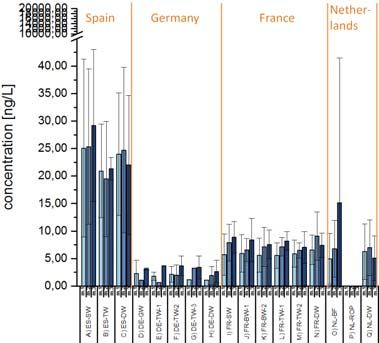
PROMOTE
Protecting water resources from mobile trace chemicals

  Novel analytical methods for        Persistence and Mobility Criteria
            PMOC                                for PMOC
   Screening in water cycle           Screening in REACH database
                                                (13.000 chemicals)

                        PMOC Suspects
                      Monitoring in European
                         Water Cycles +
                      Drinking Water Plants

        Treatment/Avoidance              Regulatory Needs
         Options for PMOC                 PMT in REACH

Water JPI Project PROMOTE

• Search for PM-substances in REACH Database
   • 14.000 registered substances (2015)
   • Data provided by the registrants
   • P (ersistence)
       • Half-life in marine water >60 days OR
       • half-life in fresh or estuarine water >40 days
   • M (obility)
       • Water solubility ≥150 μg/L AND
       • log Koc ≤ 4.5

   • Limited data quality for P and M
       • experimental data
       • modeling data

                                                                          4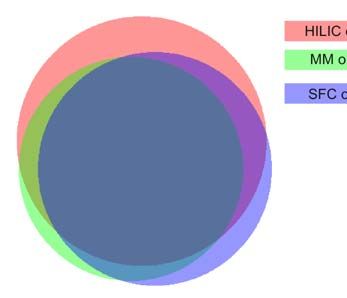
PM Scoring System
PM scores
•Combination of P and M
•Score 5 being the compounds
most likely to be PM chemical
•Non PM chemicals sorted as
• unstable but mobile
• persistent but immobile
• transient
Arp et al. (2017) Environ. Sci. Process Impacts, 19, 939-955
Prioritizing PM Chemicals by Risk of
Occurrence in the Water Cycle
hazard exposure
PM score Emission Score
• Emission score Emission Release Score for Score for
• Based on Category in REACH TRUE FALSE
• Tonnage High release to environment 7 3
• Use characteristicsWide dispersive use 4 1
• Emission Intermediate use 0 3
release Closed system use 1 3
category Professional use 1.5 0.5
Consumer use 2 0.5
Schulze et al. (2018) Sci. Total Environ. 625,
1122–1128
Substance in article 0.5 0
5
Prioritizing PM Chemicals (score 4 – 5)
by Risk of Occurrence

• High emission likelyhood
• Ranking according to E-score                                           low emission
                                                                         likelyhood
  1105 PM chemicals with a
   potential risk to emit into
       the environment                               Dapson                    TCPP
                                                                                           Cyanuric
                                                                                           acid low emission
                                                           Bisphenol S
                                                                         Melamine                 likelyhood
                   TOP                                                                          (precursors)
                   300

                                                                                    Saccharin
            „Silver List“                                        Acesulfame

                                                            high emission likelyhood
Schulze et al. (2018) Sci. Total Environ. 625, 1122–1128
                                                            substances/precursors

PROMOTE
Protecting water resources from mobile trace chemicals

   Novel analytical methods for                               Persistence and Mobility Criteria
             PMOC                                                       for PMOC
    Screening in water cycle                                  Screening in REACH database
                                                                           (13.000 chemicals)

                                      PMOC Suspects
                                    Monitoring in European
                                       Water Cycles +
                                    Drinking Water Plants

             Treatment/Avoidance                                  Regulatory Needs
              Options for PMOC                                     PMT in REACH

                                                                                                               6
The Analytical Gap
• Polarity (logDow) of analytes covered by GC- or
RPLC-MS analysis GC (n = 255)
no analytical method
no monitoring RPLC (n = 181)
no findings
gap compounds
7 2 9 10 4
5 11 6 1 3 8
-8 -7 -6 -5 -4 -3 -2 -1 0 1 2 3 4 5 6 7 8
logD (pH 7.4)
GC-MS: EPA methods 8270 D and 8290 A
LC-MS: Schymanski et al. (2014) Environ. Sci. Technol. 48, 1811-1818.
1: Aminomethylphosphonic acid (AMPA), 2: Paraquat, 3: Cyanuric acid, 4: DMS, 5: Diquat,
6: 5-Fluorouracil, 7: Glyphosate, 8: Melamine, 9: Metformin, 10: Perfluoroacetic acid, 11: EDTA
Reemtsma et al. (2016) Environ. Sci Technol. 50, 10308
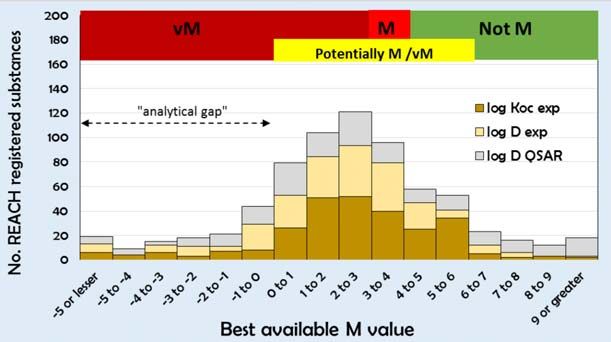
Mobility of REACH Substances
Arp and Hale (2018) NGI, DOC.NO. 20160426-TN-01 2018-03-06
7Chromatographic Approaches to Close
the Analytical Gap
• Liquid Chromatography-Mass Spectrometry with other stationary
phases
• Hydrophilic interaction liquid
chromatography (HILIC)
• comparable to NPLC
• Zahn et al. (2016) Wat. Res. 101, 292
• Mixed-mode chromatography 10
(MMC)
• polar interaction and ion
exchange
• Montes et al. (2017)
Environ. Sci. Technol. 51, 6250
• Supercritical fluid chromatography 3 5
(SFC) 42
• with normal phase columns
• Schulze et al., in prep.
• Approx. 67 analytes of the
“silver list” 2
4
Determination of M Compounds by SFC-MS
k’
RPLC (HSST3) Ethylsulfate
O
O S O
H3C O
0.43 1.98
• Stronger retention of
N-Methylmorpholin-
very polar analytes N-Oxid
SFC (BEH)
30
• Better peak shape
25
20
y = -1,3888x + 10,84
R² = 0,5138 • Sensitivity increase by a
1.09 4.24
15
factor of 4 - 5
Melamine
10
5
0
-8 -6 -4 -2 0 2 4 6
0.71 2.67
logD (pH 7)
8Narrowing The Analytical Gap
• Improvement by HILIC, MMC and SFC
GC (n = 255)
RPLC (n = 181)
HILIC, MMC, SFC (n = 63)
7 2
5 11
-8 -7 -6 -5 -4 -3 -2 -1 0 1 2 3 4 5 6 7 8
logDOW (pH 7.4)
• Enrichment remains challenging
Reemtsma et al., unpubl.
PROMOTE
Protecting water resources from mobile trace chemicals
Novel analytical methods for PM Persistence and Mobility Criteria
Compounds for PM Compounds
Screening in REACH database
Screening in water cycle (13.000 chemicals)
PM Suspects
Monitoring in European
Water Cycles +
Drinking Water Plants
Treatment/Avoidance
Regulatory Needs
Options for PM
Compounds PMT in REACH
9Screening Data for PMOC – 3 Methods
O O
S
Green: Cl
N O
Previously known PMOC H3C
O CH3
O
O CH3
H3C
O
P
O
Cl
Naphthalenesulfonic Melamine
100
Cl
Acid Acesulfame
HO TCPP O
90 OH
HN NH
e-Caprolactam
80 S
O
O O N O
frequency of detection
H
70 Bisphenol S
Cyanuric Acid
60
• 46 of 67 analytes found
• 25 PMOC50 detected in at
least 50%
40 of the samples
30
20
10
0
14 water samples (surface water, groundwater, bank filtrate) from 5 European countries
Results: Environmental monitoring
• Previously unknown PM compounds
Benzyltrimethyl Dimethylbenzene Trifluoro and Cl/Br 2-Acrylamido-2-
ammonium sulfonic acid methanesulfonic acids methylpropane
sulfonic acid
• Processing agents in
‐ polymerization
1,3-Di-o-tolylguanidine Cyanoguanidine 1,3-Diphenylguanidine ‐ vulcanization
‐ production of resins
• Tires and rubber
• Disinfectants
• Washing and cleaning
agents
• Textile industrie
• Water treatment
• Fertilizer
10Monitoring in European Waters
• Monitoring for 44 PM substances in 14 water samples
from ES, NL and DE
Schulze et al. (2918) Water Res., Water Res. 153, 80.
Monitoring of PM Compounds
• Concentrations in surface water, groundwater, bank
filtrate
Schulze et al. (2918) Water Res., Water Res. 153, 80.
1 µg/L
100 ng/L
10 ng/L
11Formation of PM Substances from REACH
Precursors
• Hydrolysis, photolysis, microbial transformation and
abiotic oxidation (MnO2)
• 12 PM precursors studied
Lab experiment on pH-dependent
hydrolysis of 2 Vinylpyrrolidone
time (d)
Search for 2-P in Hessian surface
waters by HILIC-HRMS
Zahn et al. (2019) Water Res. 150, 86
PROMOTE
Protecting water resources from mobile trace chemicals
Novel analytical methods for Persistence and Mobility Criteria
PMOC for PMOC
Screening in water cycle Screening in REACH database
(13.000 chemicals)
PMOC Suspects
Monitoring in European
Water Cycles +
Drinking Water Plants
Treatment/Avoidance Regulatory Needs
Options for PMOC PMT in REACH
12PM Chemicals in Drinking Water
Preparation
• Trifluoromethanesulfonic acid F
F F
O S O
O
Zahn et al., (2016) Water Res.
Schulze et al., (2019) Water Res.
153, 80.
PM Chemicals in Drinking Water
Preparation
• 2,3-dimethylbenzenesulfonic acid by SFC-MS
• Bank filtration with full scale reversed osmosis (NL)
Surface Bank Reversed Reversed
water filtrate osmosis osmosis
permeate concentrate
222 66 0 112
13Mitigation Measures
• Need depends on health risk associated with the PMOC
• PMT substances most urgent
• Measures depend on PMOC characteristics
• Source (municipal/industrial/else)
• PMOC as parent compound or transformation product
• Discharge characteristics (permanent/event driven)
• Possible
• Remove - Improve treatment
• source, wastewater, drinking water
• Reduce - Avoid discharge/release
• Change use (open/closed systems)
• Substitution
• Regulate - Regulation of PMT substances
A Regulatory Gap?
Stockholm POP (n = 106)
Chemicals
REACH candidates (n = 30)
• Yet no regulation
EU priority substances (n = 76)
• Is it necessary?
Water
EU watch list (n = 17)
-8 -7 -6 -5 -4 -3 -2
-1 0 1 2 3 4 5 6 7 8
logD (pH 7.4)
REACH candidates of SVHC, REACH, Article 57, d – f;
Priority substances according to Water Framework Directive (WFD);
Watch list of the WFD
Reemtsma et al. (2016) Environ. Sci. Technol. 50, 10308
14Conclusions
• PM compounds in the water cycle and in drinking water are
an issue in partially closed water cycles and in wastewater
reuse
• Data quality on P and M properties of chemicals still limited
• Analytical methdos for very polar contaminants need
ongoing improvement
• Occurrence of only 70 (of 1000?) PM compounds studied
yet
• Removal measures are limited
• No sorption, no biodegradation
• Oxidation?
• Avoiding the release of PM compounds important, if also
toxic (PMT)
Acknowledgements
Funding
• Water Challenges for a Changing World
• Joint Program Initiative (Water JPI) Pilot
Call 2013
• German Federal Ministry for Education and Research
(02WU1347A/B)
• Research Council of Norway (241358/E50)
• French Office National de l’Eau et des Milieux Aquatiques (project
PROMOTE)
• Spanish Ministry of Economy and Competitiveness (JPIW2013-117)
Thank you very much for your
attention!
15You can also read


