NEWS Practitioners Health Professions Council of South Africa Environmental Health - hpcsa
←
→
Page content transcription
If your browser does not render page correctly, please read the page content below

Issue 01/02/2018

Health Professions Council of South Africa

                                        Environmental Health
                                        Practitioners NEWS
                                             Newsletter for Environmental Health Practitioners Board
2                                                                                                        EHP NEWS 2018

                                          Contents
                                          Contents
Chairperson’s Note...................................... 3.         Workshops ................................................... 15.

Bogus Environmental Health Practitioners                            Designation of Environmental Health
Campaign - City of Joburg........................ 4.                Practitioners as Environmental Management
                                                                    Inspectors (EMIs)......................................... 16
Radical Tuck-shop Compliance joined
Operation..................................................... 6.   HPCSA Online Renewal and
                                                                    Payment Portal............................................ 17.
Climate Change and the Important Role
for Environmental Health Practitioners...... 9.                     HPCSA Moving Towards
                                                                    Maintenance of Licensure.......................... 18.
Food Safety: Environmental Health
Perspective.................................................. 11.   Benefits of Registering
                                                                    with HPCSA................................................... 20.
Role Played by Environmental Health
Practitioners (EHPS) in School Nutrition                            Renewal and Payment
Programme in Alfred Nzo District                                    of Fees Portal ............................................... 20.
Municipality................................................. 13.
                                                                    Professional Board for Environmental Health
Continuous Professional Development                                 Practitioners Stakeholder Meeting............ 23.
2018 EHP NEWS                                                                                                  3

CHAIRPERSON’S NOTE
Greetings colleagues

T  his is the second newsletter issued since
   the inauguration of the Board in 2015. This
newsletter is one of the means of communication
with our practitioners on the activities, challenges
and achievements of the Board. We also urge
practitioners to send through articles for
publication. This will ensure that we share best
practices among ourselves as a profession. We
planned to issue one newsletter each year.
A lot of work was covered in this past two years.
                                                          Health matters. To date the Board had visited
The Board has accredited an additional four
                                                          eThekwini Metropolitan Municipality and Buffalo
Universities of Technology to offer the Bachelor’s
                                                          City Metropolitan Municipality with plans to visit
degree in Environmental Health, since we reported
                                                          two more employers before the end of 2018 in
in the last newsletter. It is with great pleasure to
                                                          progress.
announce that all the seven universities are now
accredited. In 2019, the country will receive the first   The Council has taken a decision to improve the
cohorts of the Bachelor’s degree Environmental            way it renders service effectively and efficiently
Health Practitioners. This is indeed exciting times       to the public and practitioners by embarking
for the profession. We thank management of                on the applications of Business Processes Re-
these Universities for the support and cooperation        engineering. This process is aimed at improving
during assessments. Together we are prepared              systems within Council.        One of the areas
to continue ensuring that quality education and           improved is registration and renewal system.
training is offered at all these institutions.            The On-line registration and renewal service is in
                                                          operation and practitioners are encouraged to use
The Board will continue to strive towards protecting
                                                          it. This system among other benefits will enable
the community and guiding the profession in
                                                          practitioners to print their registration card
all Environmental Health related areas. We have
                                                          promptly. The introduction of this on-line system
finalised and approved the proposed amendments
                                                          will attend to challenges around the effectiveness
of all the regulations as well as Standard Operating
                                                          in registration and issuing of practice cards.
Procedure (SOP) in order to respond to some of
the challenges facing the profession, which fall          The strength of a Board is determined by the
under the Board’s mandate.                                number of registered professionals. To that
                                                          effect, practitioners are encouraged to ensure
In order for us to respond to calls from practitioners
                                                          that they remain registered at all times. Falling
on the Board’s visibility, we will continue to visit
                                                          off the register comes with serious penalties and
provinces whereby engagement with practitioners
                                                          or criminal charges laid as per section 39 of the
is encouraged and promoted. In 2016 and
                                                          Health Professions Act 56, 1974. This must be
2017, we engaged with practitioners from both
                                                          avoided at all costs.
Eastern Cape and Gauteng respectively. The next
engagement in 2018 is planned for Limpopo.                We urge practitioners to serve our community
We are continuing to engage with the employers            ethically and take pride in this profession, as
in the country whereby we sensitise them on               we are one of the respectable professions in the
issues around the scope of the profession for             country. The Board acknowledges all practitioners
Environmental Health Practitioners (EHPs) and             who continue serving our communities with
Environmental Health Assistant (EHAs), statutory          dedication and pride.
requirements for registration with HPCSA as
                                                          Remember we are always at your service.
EHPs and EHAs as well as employer support to
Practitioners to acquire CEUs for professional            Professional Board for Environmental
development.                                              Health Practitioners Chairperson
The Board also continues to meet with                     Ms. Duduzile Sebidi
employers in order to discuss Environmental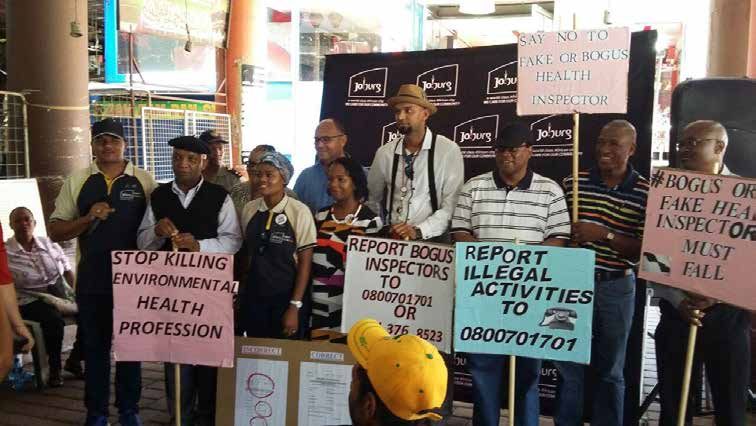
4                                                                                         EHP NEWS 2018

    Bogus Environmental Health Practitioners Campaign -
    City Of Joburg
    Ms Amanda Mbikwana

    The Environmental Health Department in the           during the march. On arrival the participants were
    City of Johannesburg embarked on an awareness        welcomed by the programme facilitator, Dewald
    campaign against bogus Health Inspectors in          Willemse, Environmental Health Operational
    conjunction with stakeholders in November 2016.      Manager.
    The campaign was held in Fordsburg Flea Market.
                                                         An opening speech was made by Amanda
    The aim of the campaign was to enhance the           Mbikwana, Environmental Health Practitioner
    knowledge of the community to be able to             highlighting the purpose of the day. Corrie
    distinguish the bogus Health Inspectors from         Bezuidenhout, Environmental Health Manager
    Environmental Health Practitioners in the City.      talked about the Environmental Health services
                                                         and challenges faced by the City of Johannesburg
    Participants were provided with information which
                                                         Municipality.
    relates to bogus Health Inspectors. This campaign
    also gave Environmental Health Department and        SAPS Social Crime Prevention officials highlighted
    other departments an opportunity to showcase         issues of crime related to bogus Health Inspectors
    their services that are offered to the communities   and warned Fordsburg community members from
    by the local and provincial government.              being ignorant regarding this issue. Police contact
                                                         numbers were given to the community in case they
    Stakeholders involved included the City Health
                                                         encounter such mentioned criminal activities.
    Department,     Environmental   Health,   Pest
    Control, Health Promoters, Social Development        Gauteng Department of Health educated the
    Department Migrant desk, HPCSA, SAPS- Social         community on the roles of Environmental
    Crime Prevention and the Department of Health        Health Practitioners from the provincial office
    Provincial Government.                               as compared to the Environmental Health
                                                         Practitioners in the local government. Emphasis
     As part of the event a march was organised
                                                         was made that Gauteng Health does not issue a
    and approved prior to the event, which started
                                                         Certificate of Acceptability or any other health
    at Mary Fitzgerald square in Newtown. The
                                                         permit to shop owners.
    participants during the march were escorted by
    Johannesburg Metro Police Department (JPMD)          Atwell Hola from the Department of Home Affairs
    along Bree Street towards Fordsburg Flea Market.     advised the Fordsburg community to correct
    Participants hoisted their messaged placards         their identification documents issued by his
                                                         department when planning to conduct a business,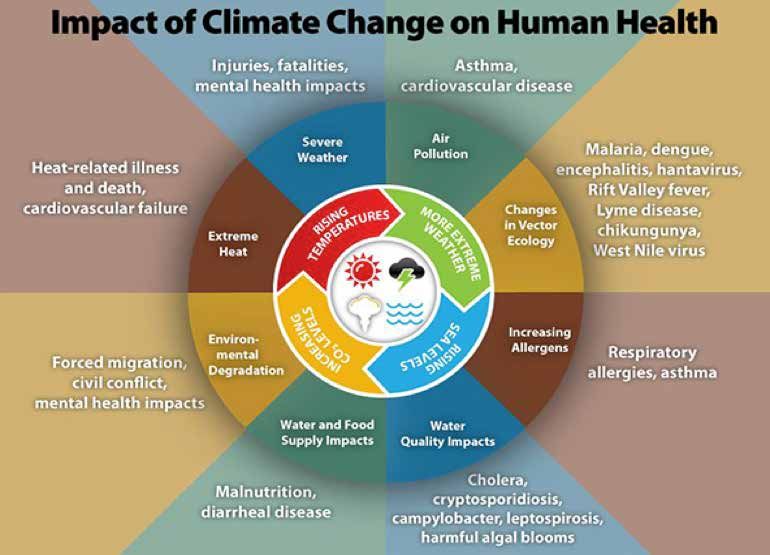
2018 EHP NEWS                                                                                                5

                                     Some of the march participants hoisting their messaged placards

and emphasising that they must ensure that their
refugee or asylum papers are in order. Sanele          OBSERVED CHALLENGES
Mayisela from Social Development Migrant
desk in the City of Johannesburg indicated to
the community that the department is there to
                                                       •       There were allegations that employees
assist migrants with various issues including
                                                       are also involved in the practice of bogus health
documentation and access to the City services.
                                                       inspectors. This matter needs to be followed up.
He also highlighted that the nature of their service
is currently information and referral.                 •       It is alleged that bogus health inspectors
                                                       are being arrested, appear at court and released
The newly appointed ward 58 councillor Alex
                                                       on bail. They then continue in another area
Christians in closing thanked all the departments
involved in the campaign against bogus health          •      Most of the shop owners are foreigners
inspectors and he encouraged the community of          and don’t have proper documentations to operate
Fordsburg to work together with Environmental          businesses, thereby becoming vulnerable to bogus
Health Department to ensure that bogus health          inspectors
inspectors are caught and eradicated permanently.      •      The procedures of closing down shops,
Exhibitions from Environmental Health and all          court system, issuing of fines and notices due to
mentioned departments were displayed in the            non-compliance need to be improved.
venue. Pamphlets were distributed to the Fordsburg     The event was well attended and successful
community and to shop owners. Education on the         particularly due to the intersectoral collaboration
environmental health services was provided and         approach of addressing the problem. The
health screening for blood pressure and sugar          campaign will be implemented in other wards
level testing form health promotion department         within the City of Johannesburg on an ongoing
was rolled out to the community.                       basis for it to be effective and sustainable.
6                                                                                            EHP NEWS 2018

    Radical Tuck-shop Compliance Joined Operation
    Alex Makateng- Environmental Health Practitioner

                                                                 Tuck-shop in Zamdela-Sasolburg, Free State

    “We are not only here to make business                  Presently tuck shops operate mainly in areas
    in South Africa but to ensure that the                  (residential) that are not zoned for business and
    food we are selling to the community is                 this creates a challenge as far as compliance is
    safe and of good quality, and we believe                concerned from the Municipal Health Services
    that we can achieve that with the help                  point of view.
    of Environmental Health Practitioners”.                 Factors affecting non-compliance of tuck shops:
    These are words of a tuck-shop owner in Zamdela,
                                                            •   Operating tuck shop in residential area without
    Sasolburg.
                                                                consent usage from Town Planning Scheme.
    Over the past decades, operation of tuck shops
                                                            •   Sleeping in business premises.
    has been existing- predominately in townships of
    South Africa selling affordable foodstuffs. Prior       •   Non-availability of business licenses for tuck
    1994, majority of tuck shops were owned by black            shops
    South Africans in townships. And after 1994,            •   Tuck shop owners having expired or fogged
    South Africa being a democratic country, opened             asylum papers.
    up its borders to accommodate foreign nationals
    seeking asylum. With the slow growing economy           •   Unavailability of     By-Laws from       Local
    and increasing levels of unemployment, foreign              Municipalities to regulate tuck shops.
    nationals slowly crept in tuck shop business            It is interesting to note that the mentioned
    selling food at low prices and giving credit to their   factors are not only affecting the Municipal
    customers. Their business model outgrew that            Health Service but other departments such as
    of black South Africans tuck shop owners, giving        Local Municipalities, South African Police, SARS,
    them an upper hand in the tuck shop business            departments of Home Affairs and Labour. Hence,
    and ultimately gaining a popular name “My-              Fezile Dabi District Municipality: Municipal
    friend” from their customers. In the early 2000s        Health Service, embarked on a multi-disciplinary
    majority of tuck shops in townships were owned          approach to address issues of non-compliance in
    by foreign nationals.                                   tuck shops. In April 2017, Radical Tuck shops
                                                            Compliance Joint Operation was launched in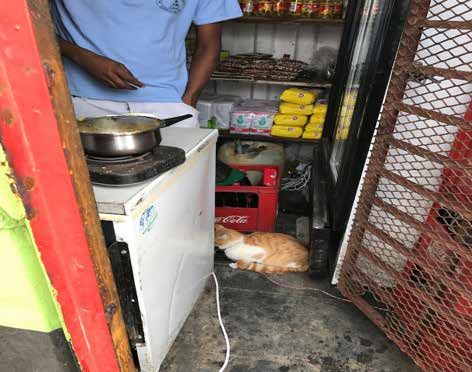
2018 EHP NEWS                                                                                                 7

Zamdela, Sasolburg. The operation targeted            before the operation versus level of compliance
over 50 tuck shops in five different areas within     after the operation. And also see Annexure A and
Zamdela in the first three months of the operation.   B reflecting improvement in compliance levels and
                                                      major non-compliance factors (Sleeping in food
See figure 1 below reflecting level of compliance
                                                      premises and keeping of animals) in tuck-shops.

Figure 1: Compliance levels of tuck-shops in five different areas in Zamdela before and after the operation
within the first three months.
Annexure A: Comparison photos showing the tuck-shop conditions before and after the operation.

Before the operation                                  After the operation

Annexure B: Photos showing keeping of animals and sleeping in food premises

Keeping of animals on food premises                   Sleeping in food premises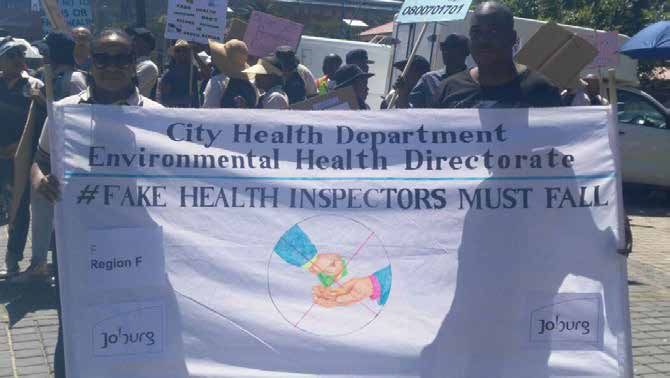
8                                                          EHP NEWS 2018

    Both Figure 1 and Annexure A indicates that
    compliance levels were drastically improved
    due to multi-disciplinary approach of various
    stakeholders. Photo in Annexure B reflects non-
    compliance factors that needs an intervention
    of Local Municipality Town Planning to address,
    and enforce the issue of sleeping inside a
    business premises. In the process of issuing
    consent usage, the LM Town Planning needs to
    clearly outline conditions of occupancy. While
    Environmental Health Practitioners were focusing
    on environmental health aspects; each stakeholder
    was focusing on their respective functions. Some
    of the challenges that were encountered during the
    operation included the language barrier between
    tuck-shop owners and officials,unavailability of
    tuck shop owners, possession of copies of asylum
    instead of originals and resistance to arrest by
    tuck shop owners not having valid asylum papers.

    Radical Compliance Tuck-shop Joint Operation
    has brought lots of achievements in Municipal
    Health Service,such as cohesion amongst FDDM
    Environmental Health Practitioners, forging of
    inter-governmental relations,visibility of EHPs in
    communities,community awareness regarding
    EHPs responsibilities, encouraged management
    and political support and improvement in
    compliance levels.
    Achieving 100% compliance in tuck shops is a
    journey that cannot be achieved overnight by
    Environmental Health Practitioners alone. Through
    multi-disciplinary engagements, especially if
    Local Municipality can be on board in development
    of By-Laws that governs tuck-shops business,
    greater strides can be made in as far as tuck shop
    compliance is concerned. Factors that affect non-
    compliance cut across different departments,
    therefore when local municipalities embark on a
    process of developing By-Laws; factors affecting
    non-compliance in tuck shops such as; sleeping in
    food premises, non-availability of business license,
    non-availability of By-Laws regulating tuck shops,
    etc. should be taken into consideration. Protecting
    the health of communities as embodied in section
    24(a) of the Constitution of the Republic of South
    Africa is and should be the number one priority of
    every Environmental Health Practitioners in South
    Africa.
2018 EHP NEWS                                                                                                        9

Climate Change and the Important Role for Environmental
Health Practitioners
Ms Shalin Bidassey-Manilal and Professor Caradee Wright
City of Joburg
South African Medical Research Council and University of Pretoria

F  loods, heatwaves and other extreme weather
   events are only one part of the changing climate
presently facing the world and its inhabitants. A
                                                               changing (Lundgren et al., 2013). Most of the
                                                               Earth’s surface may be uninhabitable by the year
                                                               2 300 and because human tolerance of heat is
more insidious impact is the slow but consistent               limited, mass dependence on air-conditioning
rise in ambient temperature – predicted to be                  facilities, to cope with increasing temperatures
about a 2 degrees Celsius increase in average                  (even if it were to be readily available and
temperature for the world by 2100, but a 4 degrees             affordable) will immensely overload the current
Celsius increase for southern Africa. An increase              energy supply system. Using air-conditioning
in temperature of this magnitude will likely have              will also lead to increases in greenhouse gas
significant impacts on ecosystems, agriculture                 emissions which are the main drivers of climate
and public health, among others.                               change (Sherwood & Huber, 2010).
Climate change refers to Earth’s natural                       In developing countries, climate change
greenhouse effect which has been around since                  undermines access to safe water, adequate food,
the planet formed and has sustained life for many              and clean air, exacerbating the 12.6 million
millions of years. Without greenhouse gases the                deaths each year that are caused by avoidable
Earth would be too cold for us, or any other living            environmental risk factors (WHO, 2017).
thing, to survive change (Pacorz slideshare, 2010).            Climate change affects social and environmental
The largest contributing source of greenhouse gas              determinants of health – clean air, safe drinking
is the burning of fossil fuels leading to the emission         water, sufficient food and secure shelter (WHO,
of carbon dioxide (United States Environmental                 2017). Environmental health can be affected by
Protection Agency, 2015). Greenhouse gases let                 disruptions of physical, biological, and ecological
the sun’s light shine onto the Earth’s surface, but            systems. The health effects of these disruptions
they trap the heat that reflects back up into the              include increased respiratory and cardiovascular
atmosphere. In this way, they act like the glass               disease, injuries and premature deaths related to
walls of a greenhouse and contribute to climate                extreme weather events, changes in the prevalence
change (Pacorz slideshare, 2010).                              and geographical distribution of food- and water-
                                                               borne illnesses and other infectious diseases,
Climate change is a reality and there is a strong
                                                               and threats to mental health (Center for Disease
scientific consensus that the global climate is
                                                               Control & Prevention, 2016) (Figure 1).
10                                                                                            EHP NEWS 2018

     Figure 1. Potential impacts of a changing climate on public health (CDC, 2016).

     Environmental Health Practitioners (EHPs) have          References
     for decades played a critical role in monitoring and
     controlling the quality and health of the human         CDC, 2016. Climate effects on health. Available at
     environment. (Wright, Mathee & Garland, 2014).          https://www.cdc.gov/climateandhealth/effects/
     EHPs also play an important role in prevention,         default.htm (accessed 15 August 2017).
     detection and abatement of pollution of land, air       Costello, A. (2009). ‘Managing the health effects
     and water sources that have created new threats         of climate change’, The Lancet, Volume: 373, pp.
     to the health of both animals and humans. EHPs          1693-1733.
     carry out house-to-house inspections of water,
     sanitation and hygiene and are involved in abating      Lundgren, K, Kuklane, K, Gao, C & Holmer, I. (2013)
     threats at households that could impact public          ‘Effects of heat stress on working populations
     health. EHPs now have an equally important role to      when facing climate change. Industrial Health,
     play to develop coping and adaptation strategies        (51), pp. 3-15.
     and measures to protect communities against             Pacorz slideshare, 2010. Climate change and you.
     the challenges of climate change at community           Available at https://www.slideshare.net/pacorz/
     level (Wright, Mathee & Garland, 2014). If we are       climate-change-powerpoint (Accessed 15 August
     to take effective action to keep the impacts of         2017)
     climate change to a minimum, we need to better
                                                             Sherwood, S.C. & Huber, M. 2010. An Adaptability
     understand the consequences of climate change
                                                             Limit to climate change due to heat stress. PNAS,
     on public health and the possibilities for change
                                                             107(21):9552-9555.
     or adaptation (Costello, 2009).
     Submitted by Joe Shikwambane
2018 EHP NEWS 11
United Nations Framework Convention on Climate Wright CY, Mathee A and Garland RM (2014)
Change. 2015. The Cancun Agreement. An Climate change, human health and the role of
assessment by the Executive Secretary of the Environmental Health Practitioners. S Afr Med J
United Nations Framework Convention on Climate 104(8): 262-265.
Change. Available from: http://cancun.unfccc.
WHO, 2017. Climate change and health. Available
int/cancun-agreements/main-objectives-of-the-
at http://www.who.int/mediacentre/factsheets/
agreements/#c33 [Accessed: 19/07/2015].
fs266/en/ [Accessed: 15/08/2017]
Food Safety: Environmental Health Perspective
Joe Shikwambane
F ood safety is a scientific discipline describing handling, preparation, and storage of food in ways
that prevent food borne illness. It is the assurance that food will not cause harm to the consumer
when prepared and/or eaten in accordance with its intended use.
The whole purpose is to ensure that FOOD IS SAFE TO EAT in order
to protect the consumer
Contaminated food and water are the biggest sources of foodborne illnesses that affect people,
particularly in South Africa. This phenomenon is also true throughout the world. The problem does not
discriminate between rich and poor countries. In both cases they impose substantial health burdens,
ranging in severity from mild indisposition to fatal illnesses.
Food safety is an increasingly important public that food will not cause harm to the consumer
health issue and according to the World Health when prepared and/or eaten in accordance with
Organisation (WHO), governments all over the world its intended use. Furthermore ‘Food Hygiene’ is
are intensifying their efforts to improve food safety. defined, as all the measures necessary to ensure
This is largely due to rapid globalisation and the the safety, soundness and wholesomeness of food
emphasis placed on and the interest shown in the at all stages from its production or manufacture
importance of the safety of food crossing national until its final consumption.
boundaries in international trade. Together with
this, there has been a dramatic increase in the Food safety in South Africa
number of people travelling internationally for,
The services rendered by health authorities in
amongst others, tourism and business purposes,
South Africa aimed at ensuring that the food
including the attendance of special events such as
consumers are exposed to do not cause them
sport, cultural and others.
any harm, is generally referred to as “food safety
The WHO defines ‘Food Safety’ as the assurance control”. This can be defined as a mandatory12 EHP NEWS 2018
regulatory activity of enforcement by the relevant The role of the Environmental Health Practitioner
health authority to provide consumer protection includes, but is not limited to the following:
and to ensure that all foods during production,
• Inspection of food premises and - vehicles
handling, storage, processing, and distribution
are safe and fit for human consumption and • Compliance monitoring in terms of legislative
conform to safety requirements as prescribed by requirements and provisions and instituting
law (WHO). remedial and preventative measures
Although South Africa is considered a developing • Issuing of certificates of acceptability
country, the food industry of the country can be • Examination, sampling and analysis of
considered as a well-developed and sophisticated foodstuffs
sector, geared towards providing the needs of
• Examination of food labels
consumers through both the formal and informal
sectors of the country’s economy. From food • Monitoring compliance with HACCP
production on the farm, to further processing at requirements
factory level, through to retail level, both as food
• Hygiene control and meat inspection at
stuffs offered for sale to consumers at outlets such
municipal abattoirs
as supermarkets or shops (Spaza shops- within
disadvantaged communities), or further prepared • Reaction to complaints
as ready to eat meals by catering facilities such as • Law enforcement by serving compliance
restaurants, fast food outlets, street food vendors, notices or if deemed necessary by issuing
etc. legislation exists aimed at ensuring that all “summonses to appear in Court” notices
foodstuffs and food handling facilities comply to (Sect 56 of Criminal Procedures Act. 1977)
health standards aimed at protecting consumers
from unsafe food and food prepared under • Export control when requested
unhygienic conditions. • Provision of information
• Health promotion and training
Environmental Health For more information, consult the following
Practitioners conduct daily examples of legislation around food control and
safety
inspections to ensure Food
Safety in their respective The Constitution of South Africa 1996, (Act 107
of 1996)
government authorities
International Health Regulations, (IHR2005)
According to the basket of Municipal health
services, the EHP has a Food Control role. International Health Regulations Act, 1974 (Act
No 28 of 1974) as amended.
Food Control relates to a mandatory regulatory
activity of enforcement to provide consumer National Health Act 2003, (Act no 61 of 2003) as
protection and ensure that food: amended.
»» is handled in a hygienic manner during Guidelines for an Environmental Health Officer
production, storage, processing, (EHO) Engaged in the evaluation of food premises
distribution and sale; within the HACCP principles, Department of
Health, Directorate: Food Control
»» is safe, wholesome and fit for human
consumption and conforms to safety,
nutrition and quality requirements; and
»» is honestly and accurately labelled as
prescribed by law.2018 EHP NEWS 13
ROLE PLAYED BY ENVIRONMENTAL HEALTH PRACTITIONERS (EHPs)
IN SCHOOL NUTRITION PROGRAMME
T he role played by Environmental Health Practitioners (EHPs) in schools is more on Food Safety and
Control. The programme is one of the most critical key performance areas for Municipal Health
Services mandated by the National Health Act No.63 of 2003 as amended; Foodstuffs Cosmetics
Disinfectants Act No. 54 of and its Regulations, of which Alfred Nzo DM has been authorised by
the Minister of Health to enforce; Scope of Practice of (No R698 of 2009);Norms and Standards for
Environmental Health;National Environmental Health Policy and all other Environmental Health related
legislations.
Achievements Outstanding Contributions
• Inter-government Relations (IGR) - Good To The Advancement Of
working relations with other Departments Environmental Health
(Department of Education, Department of
• Ongoing involvement of political fraternity in
Social Development)
Food Safety and Control Programme;
• Comprehensive monitoring of food safety and
• Involvement of Dieticians from the Department
control programme in schools
of Health in the programme.
• Monitoring of food outlets where food is
Authors: Miss Sibongile Ntshengulana (Chief EHP
procured
Alfred Nzo District Municipality),
• Communication of recommendations
Mrs Bulelwa Nokwe (Chief EHP Alfred Nzo District
with School Principals, and as such the
Municipality),
recommendations are actioned immediately
• Training of meal-servers by Environmental
Health Services
• The Food Safety does appear in Alfred Nzo
District Municipality IDP and is budgeted for;
• The Food Safety and Control Programme
is accounted for, on a monthly basis in the
District Health Information System and in
municipal reports.14 EHP NEWS 2018
Exposure of children to high levels of lead in Toys
A lfred Nzo District Municipality (ANDM)
is engaged in doing an in-house capacity
building programme for EHPs by EHPs, where
findings were communicated to the school
principal. Parents’ meeting was conducted to
create awareness amongst the parents and also
a topic that addressed Lead in Paint was encourage them to take their children for blood
presented by Mr Ngejane (Environmental Health analysis and check for lead residues in their
Practitioner). bodies. An arrangement of proper disposal of
toys with high levels of lead was done. A service
It is after this presentation and engagement that
provider was appointed to dispose of toys with
ANDM Municipal Health Services Unit saw the
high levels of lead.
need to conduct research on the presence of lead
in children’s toys, and health effects thereafter. The project will be rolled out to other pre-
St Monica’s Preschool in Matatiele ward 19 has schools, two in each town over three years, and
been piloted to do this research partly because this amounts to 10 pre-schools.
it is having large number of children aged 3-6
After a meeting was held with the parents, they
years and it is urban-based, and also it has a lot
saw the need to test the levels of lead in their
of old toys that were identified during the health
children, and it is at this stage that Department
inspection.
of Health was engaged, as they also have a
The school was engaged to seek permission National Health Laboratory Services contract.
to do the research. Different toys were taken Health and hygiene was done to educators on
to Nelson Mandela Metropolitan University procurement of properly labelled toys. Municipal
Laboratory for lead analysis. Results came Health Services input on awareness and
back with seven toys having extremely high prevention of lead laden toys from being used
levels (between 277 and 1062 ppm), and the does have a very huge impact on implementation
of NHI in this district.2018 EHP NEWS 15
CONTINUOUS PROFESSIONAL DEVELOPMENT WORKSHOPS
Mr Anil Baruth
T he Health Professions Council of South Africa
(HPCSA) Continuing Professional Development
(CPD) guidelines for the healthcare practitioners
Health, Kwa-Zulu Natal branch, held a successful
CPD workshop in May 2017 at Albert Luthuli
Hospital Nurses Hall. The workshop focused
state that the ethical practice of the health on Oil Spillage Response and was presented in
professions requires consistent and ongoing partnership with the Department of Environmental
commitment to lifelong learning by all healthcare Affairs and South African Maritime Safety
practitioners, through a process of Continuous Authority.
Professional Development (CPD). CPD assists
The programme was presented by Phindile
health professionals to update and develop
Sabela-Rikhotso, Ulric Van Bloemestein, Capt.
their knowledge, skills and ethical attitudes that
Saroor Ali and James Collocot. Day one of the
underpin competent practise.
workshop related to introduction of oil spills
The Health Professions Act No. 56 of 1974 as covering aspects such as a sources and causes of
amended endorses CPD as a means for maintaining Oil spills; behaviour and outcome of oil spilled at
and updating professional competence, to ensure sea and related impacts of oil spill. Other topics
that the public interest is always promoted and for the day were: National Arrangements in Oil
protected, as well as ensuring the best possible Spill Response; Incident Management System;
health care service to the community. Communication Protocol; Contingency Planning;
Principals of Oil Spill Response Mechanism and
In ensuring compliance with the provisions of the
Oil Spill Videos.
Act, the South African Institute of Environmental
The programme on day two featured the The workshop was well attended, with more
presentations on Principles of Oil Spill Response than 200 Environmental Health Practitioners
Mechanisms viz: Dispersant Use, Containment registered, widening their understanding and
and Recovery; Shoreline Oil Spill Response and scope of their profession.
assessment; Protection of Vulnerable Resources;
The workshop was accredited with 7 General CEU
Shoreline clean-up; waste management and site
points, 1 Ethics CEU point for day 1 and 6 General
restoration.
CEU points, 2 Ethics points for day 2.
Regular workshops are being planned the next
workshop will be held in September 2017 and
EHP’s and EHA’s are encouraged to attend.
Registration and application forms are available
from the SAIEH Secretary of each Region in the
Province.16 EHP NEWS 2018
Designation of Environmental Health Practitioners as Environmental
Management Inspectors (EMIs)
Professor Koos Engelbrecht
T he Department of Environmental Affairs (DEA), the Gauteng Department of Agriculture and
Rural Development (GDARD), the Health Professions Council of South Africa (HPCSA), the South
African Institute of Environmental Health (SAIEH), the Department of Health (DoH) and the Tshwane
University of Technology (TUT) - Department of Environmental Health (TUT) signed a memorandum
of understanding mandating TUT to proceed with the offering of a short learning programme to
capacitate practising Environmental Health Practitioners (EHPs) to be appointed as Environmental
Management Inspectors (EMIs). In terms of section 31g of the National Environmental Management
Act (NEMA), the function of an EMI is to monitor and enforce compliance with a law for which he or
she has been designated. The undertaking of compliance and enforcement activities forms a critical
component of implementing the NEMA and the specific environmental management Acts (SEMAs),
and is an executive function allocated to national, provincial and local organs of state according to the
Constitution.
The first short learning programme was presented during July 2017 and attended by various
municipalities from Gauteng and Mpumalanga. Feedback were very positive and it foreseen that the
Environmental Health Practitioners that successfully completed the programme will be appointed as
EMIs. TUT aims to present the programme at least twice a year. The following entry requirements were
agreed upon by the above parties that signed the memorandum of understanding:
• Registration as an environmental health practitioner (independent practice) at the HPCSA
• Employed by a Municipality as an environmental health practitioner
• Successful completion of a peace officers course
The successful completion of this course provides an opportunity for the EHP to be appointed as EMIs
and thus broadening their scope of practise.
Officials from GDARD and TUT attended the opening of the first course. Management attended
included the Deputy Director General of GDARD Priscilla Peterson and the Executive Dean: Science
TUT Prof Prince Ngobeni.2018 EHP NEWS 17
The facilitators and learners on the last day of the training
HPCSA ONLINE RENEWAL AND PAYMENT PORTAL
H PCSA’s Online Renewal of Registration is an interactive system, applying intelligence to the Renewal and
payment process for the Health Professions of South Africa. The system guides the user to create an
account, login, update their profile, renew the registration and complete the process by making the payment for
their yearly renewal of annual fees.
The system is intuitive and usable. To assist you as the user, an easy to follow guide has been created with real
graphics and an easy to use interactive index.
The process starts with creating an account and is finalised when a payment is made. The user can also generate
a practicing card, view the HPCSA documents as well as invoices and statements. Please see the website.
https://practitionerssso.hpcsa.co.za/identity/login?signin=48caed057a366059ccf477320da7691a18 EHP NEWS 2018
HPCSA Moving Towards Maintenance of Licensure
I n 2007 Continuing Professional Development (CPD)
became compulsory for all professions registered
with the Health Professionals Council of South Africa
provide a model that guides genuine learning and
enables improvement of professional competence
and performance, rather than a system of CPD which
(HPCSA). From the outset, the goal was to encourage has equated the number of hours/CEUs accumulated
practitioners to update their knowledge and skills to with competence. Currently, many practitioners meet
enable ethical and competent practise. The focus of mandatory CPD CEUs opportunistically, erratically or
the HPCSA’s current system of CPD has been largely casually. In contrast, the Maintenance of Licensure
on continuing education and to update knowledge. model places greater responsibility on practitioners
Literature, however suggests a need for a comprehensive to set out their CPD requirements and demonstrate
system of CPD – beyond knowledge gain – as a how their CPD activities improve their professional
method of addressing performance inadequacies of performance and patient health. Such a model more
the professional as well as at the overall healthcare explicitly recognises that different professionals
systems level. This comprehensive system of CPD is will have different development needs and require
referred to as Maintenance of Licensure in this article individual practitioners to take greater ownership of
to avoid confusion with CPD as it has always been their professional development.
referred to at HPCSA. While on one hand continuing
education is acknowledged to be a core component The model is depicted in the figure below:
of continuous professional development, Maintenance
HPCSA MODEL FOR MAINTENANCE OF LICENCE TO
of Licensure as envisaged is more comprehensive and
PRACTISE
addresses a wider range of skills, including education,
training, audit, management, team building and
communication.
HPCSA CPD proposed MODEL (for MOL)
In 2013 the HPCSA decided that all practitioners
will be required to have a license to practise their
professions. The primary purpose of such a decision
was to ensure that all practitioners, under the
jurisdiction of the HPCSA, maintain and improve their
professional knowledge, skills and performance for
improved patient outcomes and health systems.
In keeping with the HPCSA’s mandate of protecting
the public and guiding the professions, the CPD
Committee of the HPCSA has critically reflected
on the current programme in light of research
and international trends in CPD. The rationale is to2018 EHP NEWS 19
Reflection on own practice entails critically looking at mortality and morbidity meetings.
oneself across four domains; viz
4. Ethics- related learning or practice - 5 hours per
DOMAIN 1: PROFESSIONALISM – encompassing good year.
practice, integrity, intercultural competence.
Implementation of Learning Programme: CPD, which
DOMAIN 2: SAFETY AND QUALITY – relates to systems is already an HPCSA requirement, is a key component
one has in place to protect patients/clients, how one of the maintenance of licensure programme and
responds to risks to safety, and how they protect is a major in the implementation process. There
patients/clients from risks posed by colleagues. are additional requirements to demonstrate
competence and performance, including peer review
DOMAIN 3: COMMUNICATION is about communicating and engagement, audit, multisource feedback, and
effectively, working constructively with colleagues and evaluation of competence and performance.
where necessary delegating effectively.
Application of learning to practice - Practitioners are
DOMAIN 4: KNOWLEDGE, SKILLS AND PERFORMANCE required to determine their own learning needs, then
entails developing and maintaining professional devise an individualised CPD programme that meets
performance, applying knowledge and experience these learning needs, with the ultimate aim being to
to own practice and maintaining clear, accurate and improve their own practice.
legible records.
Evaluating competence and performance is
Determining Learning Needs can be achieved by using comprehensively done every five years; It is
the following methods: proposed that this should constitute a Competence
Assessment(summative) which may be done online
Self assessment of competence & performance;
or through a training institution and performance
assessments which include 3600 /multisource
Audit of practice or work ethic;
feedback and assessment of practice.
Peer feedback, in same profession.
In Conclusion
3600 feedback from patients or clients, from families
The CPD Committee has and will continue to consult
one interacts with, from other colleagues one works
iteratively with a wide range of stakeholders in refining
with who are not necessarily in the profession
and implementing the guidelines and standards for the
Developing Individualised Learning: Plan is achievable comprehensive CPD programme which will be linked
through: to maintenance of licensure. The CPD Committee
welcomes and values all perspectives and commits
1. Setting own CPD programme as follows: itself to thoroughly reviewing and considering all
submissions arising out of the consultation process.
Embarking on Continuing Education - 20 hours per The feedback received will influence the final proposal.
year - Learning related to performance improvement.
(This article is adapted from the concept document
Involvement in Accredited activities e.g. attending put together by the CPD Committee starting in 2014,
conferences, workshops, courses, producing as well as the presentation from Prof Sanjila Singh to
publications, engaging in research programmes. the Interboard Forum that was held on 31st July 2017.
Prof Singh is a member of the task team of the CPD
Involvement in Non-accredited activities e.g. Self- Committee that is spearheading the Maintenance of
directed learning programmes and Journals reading. Licensure programme)
2. Ensuring own practice is audited at least once a
year – systematic critical analysis of own practice,
or having a senior managing own performance.
3. Participation in peer review for at least 10 hours
per year – Examples include joint review of cases,
review of charts, inter-professional review of cases,20 EHP NEWS 2018
BENEFITS OF REGISTERING WITH HPCSA
Practitioners practising any of the health professions falling within the ambit of the HPCSA are obliged to
register with Council as a Statutory body.
The role of the HPCSA, apart from guiding the • Acting against unethical practitioners
professions, is to:
Ensure your Continuing Professional Development
Confer professional status through:
• The right to practice your profession • Setting and promoting the principles of good
practice to be followed throughout the career
• Ensuring no unqualified person practises your
Practitioners who are not practising their profession
profession
may in terms of section 19(1)(c) of the Health
• Recognising you as a competent practitioner who Professions Act 1974 (Act 56 of 1974) request that
may command a reward for service rendered their name be removed from the relevant Register
on a voluntary basis. A written request should reach
Set standards of professional behaviour Council before 31 March of the year in which the
practitioner wishes his or her name to be removed
• Guiding professionals on best practices in from the Register.
healthcare delivery
http://www.hpcsa.co.za/Registrations/
• Contributing to quality standards that promote the VoluntaryRemoval
health of all South Africans http://www.hpcsa.co.za/PBDieteticsNutrition/
Restoration2018 EHP NEWS 21
RENEWAL AND PAYMENT OF FEES PORTAL
A heartfelt thank you to more than 60 000
practitioners who interacted with the HPCSA’s new
Renewal and Fee Payment Portal which went live on 1
practitioners had multiple registrations. In such cases
where the ID was linked to more than one account, the
practitioner could not create a uniquely identifiable
March 2017. account on the portal. The practitioners who contacted
the HPCSA after getting the multiple accounts error
Bringing the portal into operation presented us with
message had the multiple accounts merged and could
the opportunity to update our database, but we must
then create an account and renew their registration.
acknowledge that the exercise was not without its
frustrations and challenges, some of which included d) THE AMOUNT THE PRACTITIONER IS
the following: PROMPTED TO PAY DIFFERED FROM THE
PUBLISHED OR INVOICED AMOUNT.
a) LOGGING IN BEFORE CREATING AN ACCOUNT
The portal allows for the offsetting of funds received
In a few instances, practitioners attempted to LOG
from, and funds owed by the practitioner. If there is
IN instead of CREATING AN ACCOUNT. This resulted
an outstanding amount on the account, this will be
in an error message stating that the Username and
added to the renewal fee, resulting in 2017/18 amount
Password were invalid. The portal could not identify
payable being higher than expected. By the same
the practitioner as an account had not been created.
token, if the account is in credit, due to overpayment
b) ID NOT RECOGNISED BY THE PORTAL in the past, the amount payable will be less than the
current renewal fee.
This was a source of frustration for many practitioners
who have been interacting with the HPCSA for many PRACTISING STATUS NOT DISPLAYED BECAUSE
years, for which we sincerely apologise. We still had RENEWAL IS “PENDING”
the old ID numbers for a sizeable proportion of our
1. The following conditions need to be satisfied prior
practitioners, and the problem was easily overcome
to a practitioner accessing their practising card
by HPCSA officials promptly updating the ID numbers
online. The practitioner must be ACTIVE, in other
and alerting practitioners that this had been done.
words, not ‘suspended’ or ‘erased’. Practitioners
We would like to encourage those practitioners who who are not ACTIVE and wish to register, should
have not yet created their accounts on the portal to please contact the HPCSA and request to be
do so. If the same problem is encountered, please ‘restored’.
email a copy of your ID to records@hpcsa.co.za or
2. The practitioner’s account balance must be zero,
registrationgroup@hpcsa.co.za so that we can update
or in credit, and
your ID details.
3. All fields on the RENEWAL tab need to be
c) EXISTENCE OF MULTIPLE ACCOUNTS
completed.
The portal uses the ID number to access a practitioner’s
We have compiled a list of challenges that practitioners
account on the main HPCSA database. Each ID may
frequently encounter, and added these to the portal
be linked to only one account, albeit, in some cases,
under the DOCUMENTS TAB.
FEW FACTS AND FIGURES ON THE PORTAL
The graph below illustrates the number of practitioners per Professional Board who interacted with the online
portal up to 27 August 2017:22 EHP NEWS 2018
A total of 9584 MTB practitioners were invoiced for • Click on the ‘Create an Account’ button – you
2017/18, and 92% of these (8797 practitioners) will need to create an account or register before
have paid annual, with a third or 33% having done so attempting to log in
through the online renewal and payment portal.
• Select South Africa or Outside SA Country of
We are pleased to report that a significant proportion Practice
of the practitioners used either the integrated EFT
embedded on the portal or a credit/debit card to make • Enter the ID/Passport number and click on the
payments, compared to the proportion that made Continue button as shown in the Figure below. Your
payments in a bank and emailed or faxed a proof of name and surname as they appear in our database
payment to us. will appear on the screen
FUTURE RENEWALS
In the 2017/18 financial year, we operated two renewal
processes – the online portal and the traditional face-
to-face renewal – we intend to discontinue the face-to-
face model where practitioners come to our offices or
we go out to specific sites for practitioners to renew or
make payment. For this renewal period, practitioners
could choose to have the “purple” paper practicing
card or the electronic version of the card on a phone
or desktop, or have both the paper and the electronic
formats.
We encourage every practitioner to go online and • Follow the prompts and complete the CREATE AN
create an account, as interaction with the HPCSA ACCOUNT PROCESS.
will increasingly, be through electronic means. This
offers practitioners the opportunity to log on to the For further enquires regarding the Renewal and Payment
portal at any time, and not only for renewal purposes, of Fees portal, please contact the Registrations team
enabling them to update personal details as required on registrationgroup@hpcsa.co.za, or contact the Call
by the Health Professional Council Act 56 of 1974, Centre on 012 338 9300.
as amended.
We hope that this communication has cleared up any
How to Create an Account: problems you may have been experiencing, and we
encourage you to register on the portal.
This can be done in three easy steps:
• From the home page on the HPCSA website www.
hpcsa.co.za click on the Online Renewals tab. This
will take you to the landing page on the portal2018 EHP NEWS 23
PROFESSIONAL BOARD FOR ENVIRONMENTAL HEALTH PRACTITIONERS STAKEHOLDER MEETING
O n 24 October 2017, the Professional Board for Environmental Health Practitioners (PBEHP)
hosted practitioners from around Gauteng at Emperors Palace Kempton Park, as part of its annual
Stakeholder engagement. The purpose of the meeting was to encourage interaction and open lines of
communication between the practitioners and the Board. The Board communicated its objectives for
the term of office and practitioners were afforded an opportunity to state their aspirations and express
themselves regarding the way the Board, in their opinion, could better ensure it is carrying out its
mandate for the benefit of all stakeholders.
Practitioners were issued 2 general Continuing Education Units (CEUs) and 2 Ethics CEUs, where the
Chairperson of the Board Ms Duduzile Sebidi, the General Manager for CPD, Registration and Document
Management at HPCSA Ms D Musemwa and Ethics presenter Prof S Mukhola gave presentations.
MS DUDUZILE SEBIDI – THE PRESENTATION
FOCUSED ON:
• The role of the Board
• Strategic direction of the Board
Practitioners listening to different speakers giving presentations
• Developments in education and training
• Continuing professional development (CPD)
• Registration/restoration – procedures and
requirements
• Other issues pertaining to the profession
Ms Doreen Musemwa MS D MUSEMWA – THE PRESENTATION
FOCUSED ON:
• Registration process
• Online renewals
• Maintenance of Licensure
PROF S MUKHOLA – THE PRESENTATION
Prof Stanley Mukhola
FOCUSED ON:
• Highlights of the current status/situation in
relation to realities of ethics.
• EHP’s to understand what work place ethics
encompasses
Ms Funeka Bongweni, Ms Tembisa Manciya, Mrs Aneliswa Cele, Ms Refiloe • Employer actions
Ntoi & Ms Duduzile Sebidi
• Overview of the profession in relation to
ethics and ethical behavior
• General ethics
Mr Patrick Maisela ka Mdluli, Mr Andre van Zyl, Mr Daniel Hlanyane,
Mr Charles Qoto, Mr David Nemakonde, Mr Bright Khumalo &
Dr Andile Zimba
The EHPs were given their CPD certificates at the end of the event. The next Stakeholder meeting will
be held in the Limpopo Province, which will be in the second half of 2018. Further details of the next
stakeholder meeting will be provided at a later stage.10
08--2016
August - 2016
2016
GENERAL INFORMATION
24 EHP NEWS 2018
For any information or assistance from the Council Service Delivery
direct your enquiries to the Call Centre
Email: servicedelivery@hpcsa.co.za
Tel: 012 338 9300/01
For any information or assistance from the Council Ethics
Tel: 012and professional practice, undesirable
3389301
Fax: 012
direct 328
your 5120 to the Call Centre
enquiries Complaints againstand
business practice human rights
practitioners ofServices
Legal Council:
Tel: 012info@hpcsa.co.za
Email: 338 9300/01 Sadicka Butt
Fax: 012 328 4895
Fax:
Where to328
012 5120
find us: Tel: 012 338 3946
Email: legalmed@hpcsa.co.za
Email: info@hpcsa.co.za Email: SadickaB@hpcsa.co.za
553 Madiba Street 09
11
Statistical Information and Registers:
Corner to
Where Hamilton
find us:and Madiba Streets Service Delivery
Yvette Daffue
Arcadia,
553 MadibaPretoria
Street Email:
Tel: 012servicedelivery@hpcsa.co.za
338 9354
Corner
P.O BoxHamilton
205 and Madiba Streets Tel: 012 3389301
Email: yvetted@hpcsa.co.za
Arcadia, Pretoria
Pretoria 0001
Complaints against practitioners
Working Hours :
P.O Box 205 Professional Board for Environmental Health
Legal Services
Monday 0001
Pretoria – Friday : 08:00 – 16:30 Practitioners
Fax: 012 328 4895
Weekends and public holidays – Closed Email: legalmed@hpcsa.co.za
Working Hours
Certificate :
of Good Standing/ Status, certified Board Manager:
Monday
extracts–verification
Friday : 08:00 – 16:30
of licensure Statistical Information and Registers:
Ms Tebogo Vundule
Weekends and public holidays – Closed
Email: hpcsacgs@hpcsa.co.za Yvette Daffue
Tel: 012 338 9448
Tel: 012 338 9354
Continuing Professional Development (CPD)
Certificate of Good Standing/ Status, certified Email:
Email:TebogoV@hpcsa.co.za
yvetted@hpcsa.co.za
Helena da
extracts Silva
verification of licensure Committee Coordinator
Tel: 012
Email: 338 9413
hpcsacgs@hpcsa.co.za Professional Board for Occupational Therapy, Medical
Mr Tlou Maboya
Email: cpd@hpcsa.co.za Orthotics and Prosthetics and Arts Therapy
Tel: 012 338 3985
Continuing Professional Development (CPD)
Raylene Symons
Helena da Silva Email:
ActingTlouM@hpcsa.co.za
Board Manager
Tel: 012 338 9443
Tel: 012 338 9413 Administrator
Sibusiso Nhlapo
Email:cpd@hpcsa.co.za
Email: raylenes@hpcsa.co.za Tel:Kagiso
012 338 3993
Mr Maupye
Change of contact details Email: sibusion@hpcsa.co.za
Tel:012 338 9474
Raylene Symons
Email: records@hpcsa.co.za
Email: kagisom@hpcsa.co.za
Tel: 012 338 9443 Acting Committee Coordinator
Ethics and professional practice, undesirable
Email: raylenes@hpcsa.co.za Secretary:
Mamokete Maimane
business practice and human rights of Council:
Tel:Modern
Ms 012 338Ramare
9497
Ntsikelelo Sipeka
Change of contact details Email:
Tel: 012MamoketeM@hpcsa.co.za
338 9421
Tel: 012
Email: 338 9304
records@hpcsa.co.za
Email: ModernR@hpcsa.co.za
Email: NtsikeleloS@hpcsa.co.za Secretary
Bongi Nzuza
Tel: 012 338 9460
Email: Bongin@hpcsa.co.za
Copyright Disclaimer
Copyright and Disclaimer
The EH news is a newsletter for practitioners registered with the PBEHP.. It’s produced by the Public Relations and Service Delivery Department, HPCSA building, 2nd floor, Madiba
The OCP
Street, NewsPretoria.
Arcadia, is a newsletter practitioners
EH practitioners registered
are encouraged with the
to forward OCP.
their Its is produced
contributions by the Public Relations
at TlouM@hpcsa.co.za. The copyright andinService Delivery
the compilation of department,
this newsletter,HPCSA
its namebuilding,
and logo
2nd floor,byMadiba
is owned Street,
the HPCSA. YouArcadia, Pretoria. OCP
may not reproduce are encouraged
this newsletter, to forward
or its name or the logotheir
of thecontributions to Fezile
HPCSA that appears in thisSifunda at in
newsletter, feziles@hpcsa.co.za The copyright
any form, or for commercial purposes orin for
the
compilation
purposes of of this newsletter,
advertising, publicity,its name and
promotion, orlogo is other
in any owned by the
manner Healththeir
implying Professions Council
endorsement, of Southof,Africa.
sponsorship Youwith
affiliation mayany
not reproduce
product this newsletter,
or service, or its name
without the HPCSA’s prioror
the logo of the Health Professions Council of South Africa that appears in this newsletter, in any form, or for commercial purposes or for purposes of advertising,
express written permission. All information in this newsletter, is provided in good faith but is relied upon entirely at your own risk. By making use of this newsletter and its information
publicity, promotion, or in any other manner implying their endorsement, sponsorship of, or affiliation with any product or service, without the Health Professions
you agree to indemnity the HPCSA, Employees and Service Providers from all liability arising from its use.
Council of South Africa’s prior express written permission. All information in this newsletter, is provided in good faith but is relied upon entirely at your own risk. By
making use of this newsletter and its information you agree to indemnify the Health Professions Council of South Africa, Employees and Service Providers from
all liability arising from its use.You can also read


